
Seeing Life From Different Angles
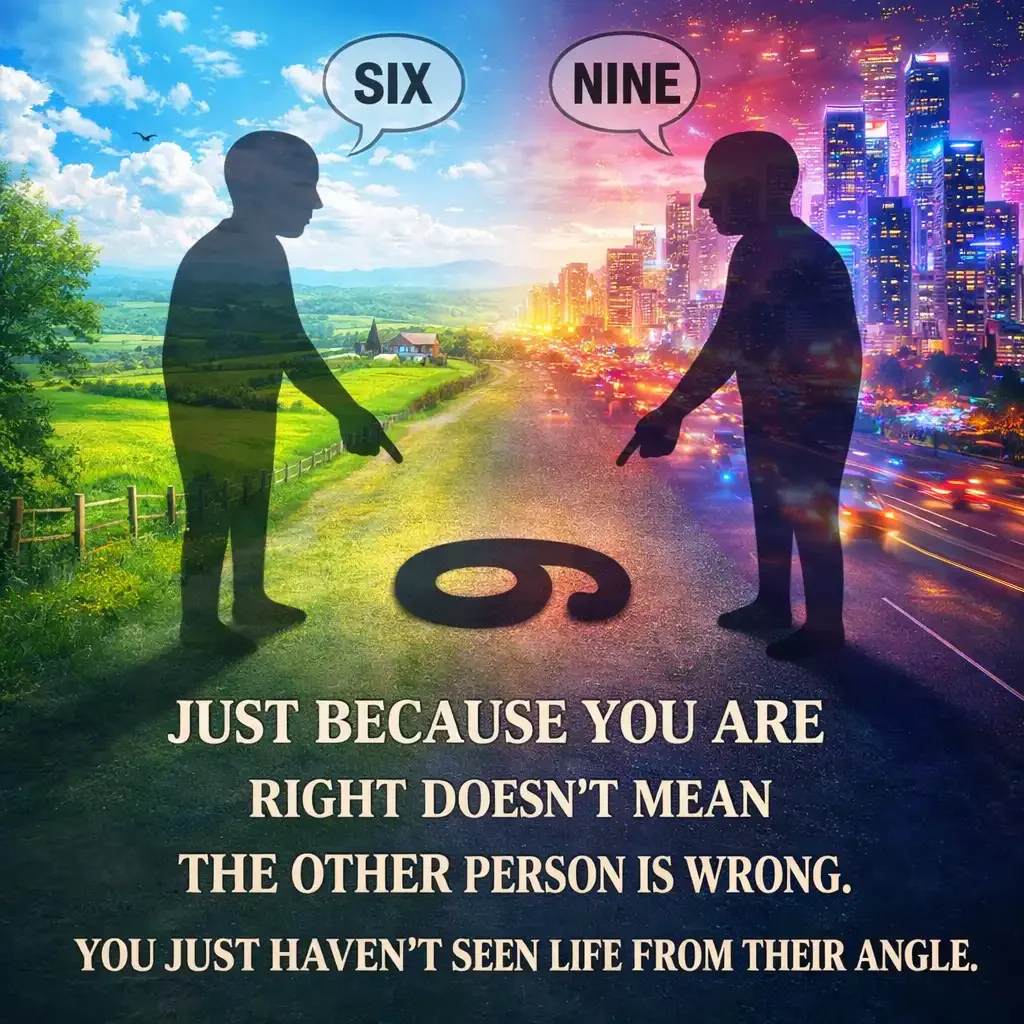
There is a simple image that keeps resurfacing in different forms. Two people stand across from each other. Between them is a number on the ground. One sees a six. The other sees a nine. Neither is lying. Neither is confused. Neither is acting in bad faith. They are simply standing in different places.
That image unsettles people because it removes the comfort of certainty. It refuses to give us a clear winner. It does not let us point to ignorance or malice and walk away feeling superior. Instead, it quietly suggests something far more uncomfortable: perspective shapes truth.
Most conflicts in life are not caused by evil intentions. They are caused by environment, experience, pressure, timing, and history. Where you stand determines what you see. What surrounds you trains your instincts. What you’ve lived through changes how you interpret the same exact facts.
This realization has grown sharper for me as my life shifts toward the homestead mindset.
The Quiet Lesson Inside the Image
At first glance, the image feels like a lesson about empathy. Look again and it becomes a lesson about responsibility.
If you are standing on one side of the number, you are not wrong for seeing what you see. But you are responsible for remembering that your position is not universal. The danger is not being right. The danger is assuming that being right from your angle invalidates every other angle.
We rarely argue about numbers. We argue about meaning. About priorities. About what matters most in a given moment. The number on the ground becomes a symbol for values, fears, and survival strategies.
The countryside and the city represent more than locations. They represent different ways of moving through the world.
Country Eyes Learn Patience
Life in the countryside teaches lessons slowly, sometimes painfully. Nature does not care about your schedule. You cannot negotiate with the weather. You cannot rush soil. You cannot force roots to grow faster because you are impatient.
When you live closer to the land, patience stops being a virtue you admire and becomes a requirement you submit to. Seeds take the time they take. Animals grow at their own pace. Seasons arrive when they arrive.
Mistakes linger longer. If you plant too close, the plants compete all season. If you ignore drainage, you pay for it year after year. The land remembers what you do to it.
From this angle, the world rewards foresight and restraint. Planning matters. Observation matters. Quiet effort matters. Solutions are rarely instant, but they are durable.
Standing here, the six feels obvious. Why would anyone see anything else?
City Eyes Are Shaped by Motion
Now move to the other side.
The city never fully sleeps. It hums. It flashes. It demands attention. Time compresses. Decisions stack on top of each other. Hesitation costs money, opportunity, and sometimes safety.
Urban life trains people to optimize. To move quickly. To make decisions with incomplete information and adjust later. Efficiency becomes survival. Speed becomes competence.
In that environment, patience can feel like weakness. Waiting feels like falling behind. Silence feels like wasted space.
From that angle, the same number looks like a nine. Not because the person is careless or blind, but because their world has taught them to read the situation differently.
Standing there, the countryside logic can feel slow, unrealistic, or detached from reality.
The Argument Is Rarely About the Thing
Most arguments are proxies.
They are not really about politics, money, parenting, health, land use, or lifestyle choices. They are about worldview. About what risks feel acceptable. About what losses feel survivable.
Two people can look at the same facts and draw different conclusions because they are protecting different things.
One may be protecting stability. Another may be protecting momentum. One may be protecting long-term resilience. Another may be protecting short-term survival.
When we ignore that, conversations turn into battles.
Homesteading Forces Context
Homesteading strips away illusions quickly.
You learn that single-factor explanations rarely hold. If a crop fails, you don’t blame one thing and move on. You look at soil quality, rainfall, spacing, pests, sunlight, timing, and human error.
Context becomes unavoidable.
You stop asking who is at fault and start asking what conditions produced this result.
That habit slowly rewires how you interpret people as well.
Instead of asking, “Why would they think that?” you begin asking, “What environment trained them to think that way?”
This shift does not excuse harmful behavior. It explains it. And explanation is the first step toward solutions that actually work.
The Cost of Ignoring Perspective
When perspective is ignored, everything escalates.
Families fracture over misunderstandings that were never clarified. Communities divide over assumptions that were never questioned. Online spaces devolve into outrage because no one is rewarded for slowing down.
We live in a time where certainty is currency. Algorithms amplify confidence, not accuracy. The loudest voice often wins, even when it is wrong.
The homestead path pushes against that pressure. It rewards observation over reaction. It values results over rhetoric.
Grace Without Surrender
There is a misconception that understanding another perspective means abandoning your own.
It does not.
You can stand firmly where you are while still recognizing that someone across from you is responding honestly to their reality. Grace is not weakness. It is strength with awareness.
Just because you are right does not mean the other person is wrong.
It may simply mean they are standing somewhere else.
Why This Matters Beyond the Image
This lesson extends far beyond philosophy.
It applies to how we design systems, raise children, manage land, run businesses, and build communities. Solutions created from a single angle fail the moment conditions change.
Resilient systems account for multiple perspectives.
Nature does this instinctively. Diversity strengthens ecosystems. Monocultures collapse under stress.
Human systems are no different.
The Homestead as a Teacher
Living closer to the land teaches humility.
You realize how little control you truly have and how much cooperation matters. You stop expecting perfection and start preparing for variability.
That mindset spills into relationships.
You listen longer. You react slower. You judge less quickly.
Not because you became softer, but because you became wiser.
Final Reflection
The goal is not to convince everyone that the number is six or nine.
The goal is to step back far enough to see the shape of the number itself.
Perspective does not erase truth. It reveals it.
And sometimes the most meaningful growth does not happen in the garden, the field, or the pasture.
It happens in the space between where you stand and where someone else does.
That space is where understanding lives.
That space is where SimitianNest was born.
And that space is where real, lasting change begins.