
Bumblebees
The Complete Homesteader's Guide
Overview
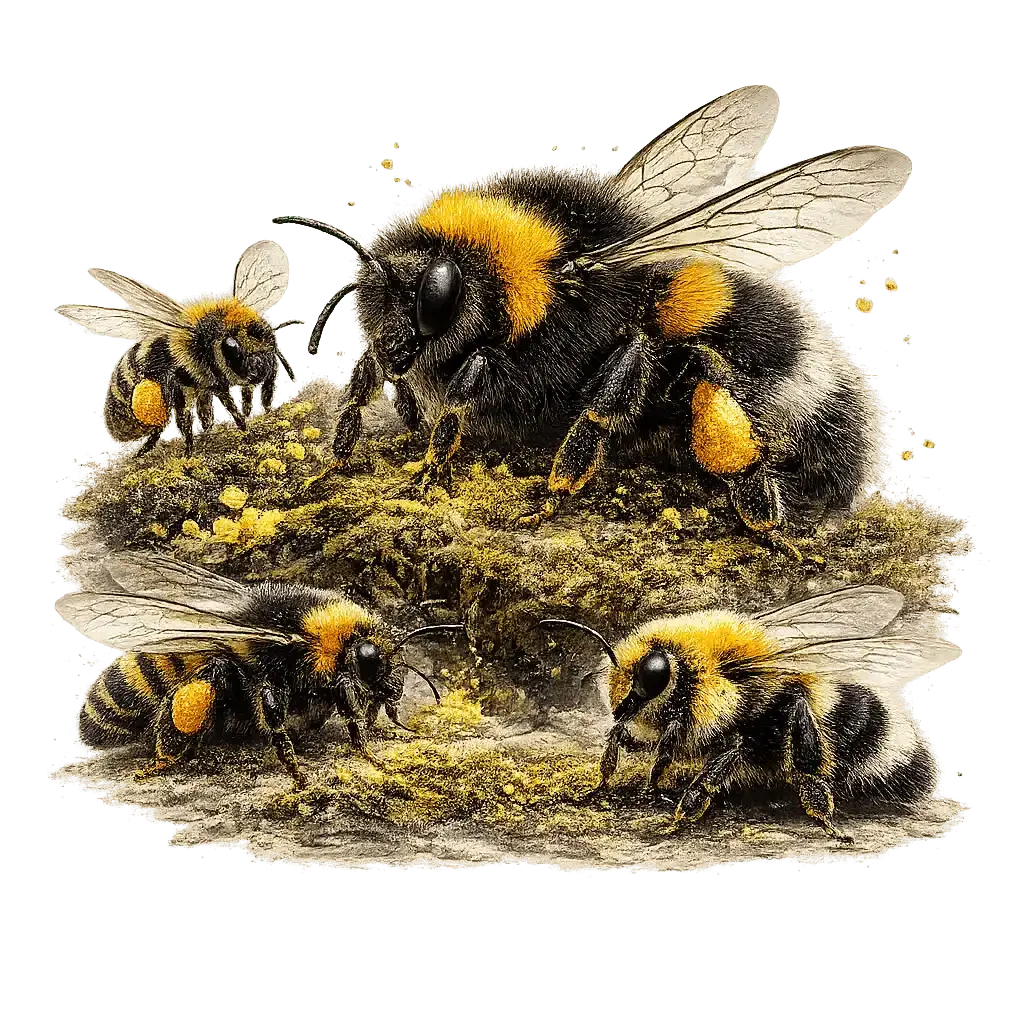
Bumblebees are among nature's most remarkable pollinators and valuable allies for any homestead, farm, or self-sufficient property. These fuzzy, industrious insects are social bees that live in annual colonies, making them distinctly different from their honeybee cousins. Unlike honeybees that can survive harsh winters as a full colony, bumblebees follow an annual lifecycle where only newly mated queens survive winter to start fresh colonies each spring. With over 250 species worldwide and 49 species in the United States, bumblebees are exceptionally adapted to a wide range of climates and are particularly valuable for their ability to forage in cold weather and perform specialized "buzz pollination" that honeybees cannot. For homesteaders interested in supporting pollinators and improving crop yields, understanding bumblebees is essential for creating a thriving, sustainable ecosystem.
Flight Range & Foraging Distance
Understanding how far bumblebees travel from their nests is crucial for homesteaders planning pollinator gardens and crop placement.
Typical Foraging Range: Most bumblebee workers stay within 250 meters to 1.5 kilometers (820 feet to nearly 1 mile) from their nest
Maximum Distance: Some species can forage up to 5 kilometers (3.1 miles) from the nest, though this is uncommon
Species Variation: Smaller species like Bombus pascuorum are "doorstep foragers" staying within a few hundred meters, while larger species like Bombus terrestris regularly fly 1-1.5 km
Flight Speed: Bumblebees fly at 3.0-4.5 meters per second (6.7-10 mph)
Daily Pattern: They work from sunup to sundown, making multiple foraging trips throughout the day
Home Range: Individual bumblebees can use areas ranging from 0.25 to 43.5 hectares (0.6 to 107 acres) for foraging over just a few days
Distance Factors: Flight distance depends on flower availability, species size (larger bees fly farther), weather conditions, and colony needs
Homestead Implications: Plant diverse flowering plants within 500 meters of where you want pollination. Closer is better, but bumblebees will travel up to 1-2 kilometers if needed. This means your vegetable garden doesn't need to be right next to bee habitat, but keeping nectar sources nearby will maximize pollination efficiency.
What Bumblebees Eat & Drink
Primary Diet: Nectar and pollen from flowers
Nectar Purpose: Provides carbohydrates (sugars) for energy; collected in their "honey stomach" (crop)
Pollen Purpose: Rich in protein and fats; essential for feeding larvae and colony growth
Pollen Preference: Bumblebees prefer pollen with a protein-to-lipid (fat) ratio of about 5:1; they can detect and select nutritionally optimal pollen
Favorite Plants Include: American senna, spiderwort, Culver's root, lupines, tomatoes, peppers, blueberries, cranberries
Water Consumption: Bumblebees drink water from puddles, ponds, and dew on flowers for temperature regulation and diluting honey
Honey Consumption: While they don't rely on honey like honeybees, bumblebees will consume their small honey stores during bad weather or nectar dearth
Foraging Behavior: Use their long proboscis (tongue) to access nectar; collect pollen in specialized "pollen baskets" (corbiculae) on their hind legs
Daily Needs: A foraging bee may visit 100+ flowers to fill her honey stomach, which can hold 0.06-0.20 ml of nectar
Dietary Diversity: Research shows bumblebee queens that eat diverse pollen types produce healthier, faster-developing colonies than those eating limited varieties
Homestead Planning: Plant a succession of flowers blooming from early spring through fall. Include native plants and those with diverse pollen nutritional profiles. Provide shallow water sources with landing platforms (stones, floating corks) for bees to safely drink.
Temperature Tolerance & Weather Conditions
Bumblebees are remarkable for their ability to function in conditions that ground other pollinators.
Cold Weather Performance
Minimum Foraging Temperature: Bumblebees can forage at temperatures as low as 6°C (43°F), compared to 11°C (52°F) for honeybees
Flight Muscle Requirement: Must warm thorax muscles to at least 30°C (86°F) before flight is possible
Operating Range: Maintain thorax temperature between 30-40°C (86-104°F) during flight regardless of outside temperature
Warm-Up Mechanism: "Shiver" by uncoupling wing muscles and vibrating without moving wings to generate heat
Cold Tolerance: Queen bumblebees can survive temperatures down to -7.4°C (18.7°F); workers freeze at about -7.1°C (19.2°F)
Chronic Cold Exposure: Queens can survive 0°C (32°F) for over 25 days; workers for 7.2 days
Winter Foraging: Some species (Bombus terrestris) in mild climates forage during winter when temperatures reach 0°C (32°F) or above
Early/Late Season: Queens forage in early spring and late fall at lower temperatures than workers can tolerate
Heat Tolerance
Maximum Operating Temperature: Can forage at temperatures exceeding 36°C (97°F)
Heat Stress Point: Bumblebee larvae are more heat-sensitive than adults, with lower critical thermal maximums
Cooling Mechanisms: Workers fan the nest to cool brood when temperatures rise; foraging may decrease during extreme heat as workers focus on nest cooling
Optimal Temperature: Peak foraging activity and efficiency occurs around 27°C (81°F)
Insulation & Adaptation
Fuzzy Coat: Dense body hairs provide insulation, helping retain body heat in cold weather and reflecting heat in warm weather
Size Advantage: Larger bumblebees have better heat retention in cold weather and may be better adapted to cooler temperatures
Weather Avoidance: Bumblebees generally don't fly during heavy rain or high winds; will shelter during storms
Homestead Advantage: Bumblebees extend your pollination season significantly beyond when honeybees are active. Early spring crops, late fall plantings, and cool-season vegetables benefit enormously from bumblebee pollination. In cold climates, bumblebees may be your only pollinators for several weeks in spring and fall.
Honey & Wax Production
Unlike honeybees, bumblebees produce honey and wax on a very limited scale.
Honey Production
Quantity: Bumblebees produce only a few tablespoons of honey per colony-just enough to sustain the colony for 2-3 days during bad weather
Quality: Bumblebee honey is more watery than honeybee honey and has a greenish-golden tint
Storage: Stored in small, round wax "honey pots" (upright containers) near the brood area, not in horizontal honeycombs
Purpose: Short-term energy reserve only; colonies don't overwinter so large honey stores aren't needed
Not Harvested: Due to small quantities, bumblebee honey is not commercially harvested or typically collected by beekeepers
Colony Size: With only 50-400 bees per colony (vs. 20,000-60,000 for honeybees), production is minimal
Seasonal Pattern: Production increases during nectar flows; consumed during periods of poor foraging weather
Wax Production
Production Level: Bumblebees produce small amounts of wax from glands on the underside of their abdomen
Uses: Building nectar pots, covering eggs, creating brood cells-not elaborate honeycombs
Structure: Wax cells are irregular and clustered, not the precise hexagonal honeycomb of honeybees
Quantity: Far less wax produced than honeybees; not harvested for commercial use
Production Trigger: Queens and workers produce wax as needed for colony construction
Homestead Reality: Don't keep bumblebees for honey or wax production-these are not viable products. The value of bumblebees lies entirely in their exceptional pollination services and their role in ecosystem health.
Pollination Services: The Real Value
Bumblebees are worth their weight in gold for pollination, offering unique advantages over honeybees.
Pollination Advantages
Buzz Pollination: Bumblebees perform "sonication"-grabbing flower parts and vibrating wing muscles at specific frequencies to shake loose tightly-held pollen that honeybees cannot access
Cold Weather Pollination: Forage 5°C cooler than honeybees, extending pollination season and working on cold spring/fall days
Early Morning/Late Evening: Work longer hours than honeybees, starting earlier and finishing later in the day
Low Light Tolerance: Forage effectively in cloudy, overcast conditions when honeybees stay home
Efficiency: Collect more pollen per visit due to larger, fuzzier bodies; some plants require fewer bumblebee visits than honeybee visits for pollination
Flower Preference: Access deep, tubular flowers honeybees cannot reach with their longer tongues
Aggressive Foraging: Work faster and visit more flowers per minute than honeybees in many crops
Critical Crops for Bumblebees
These crops benefit significantly or require bumblebee pollination:
Tomatoes (require buzz pollination)
Peppers (greatly improved by buzz pollination)
Eggplants (require buzz pollination)
Blueberries (significantly benefit from buzz pollination)
Cranberries (major beneficiary of buzz pollination)
Squash & Pumpkins (early morning pollinators)
Strawberries (improved fruit quality)
Apples (complement honeybee pollination)
Raspberries & Blackberries
Many wildflowers (including native plants honeybees don't pollinate effectively)
Pollination Statistics
Wild Plant Pollination: Native bees including bumblebees pollinate an estimated 80% of flowering plants
Crop Impact: Fruit crops pollinated by bumblebees can see 70-90% improved yield and quality
Diversity Benefit: Having both honeybees and bumblebees provides more complete, reliable pollination than either alone
Homestead Value: For vegetable gardeners and small fruit growers, bumblebees may be more valuable than honeybees. If you grow tomatoes, peppers, berries, or squash, supporting bumblebee populations should be a top priority.
Social Structure: Not Solitary, But Annual
Bumblebees are social insects, but their colonies function very differently from honeybees.
Colony Structure
Social Organization: Bumblebees are truly social (eusocial) with three castes: queen, workers (sterile females), and drones (males)
Colony Size: 50-400 individuals depending on species (much smaller than honeybee colonies of 20,000-60,000)
Annual Cycle: Colonies last only one season (spring through fall); only new queens survive winter
Not Solitary: Unlike mason bees or carpenter bees, bumblebees work cooperatively in colonies
Division of Labor: Queen lays eggs; workers forage, feed larvae, defend nest, and regulate temperature; drones mate with new queens
Annual Lifecycle
Early Spring:
Mated queens emerge from underground hibernation (diapause) when soil temperatures warm and days lengthen
Queens search for 1-2 weeks for suitable nest sites (old rodent burrows, abandoned bird nests, cavities)
Queen forages alone to build fat reserves and activate ovaries
Begins colony by laying first eggs on a pollen ball in her chosen nest
Broods eggs by sitting on them and generating body heat to keep them at 30-32°C
First brood (4-5 weeks) produces only workers
Summer:
Workers take over foraging, nest maintenance, brood care, and temperature regulation
Queen focuses solely on egg-laying
Colony grows steadily, producing more workers
Colony size peaks in mid to late summer
Late Summer/Fall:
Queen switches from producing workers to producing new queens (gynes) and drones
New queens and drones emerge, leave the nest, and mate
Mated queens feed heavily to build fat reserves
New queens find underground hibernation sites (burrows 2-5 inches deep)
Old queen, workers, and drones all die with first hard frost
Winter:
Only mated queens survive, hibernating underground in diapause
Queens don't need honey stores since they hibernate alone
Colony Development Timeline
First eggs to adult: 21-28 days (egg 3-5 days, larva 10-14 days, pupa 10-14 days)
First worker emergence: 4-5 weeks after colony founding
Colony growth phase: May through August
Reproductive phase: Late July through October
Colony lifespan: 3-5 months total
Homestead Consideration: Because colonies are annual and small, you don't "keep" bumblebees like honeybees. Instead, you create habitat that attracts wild queens each spring and supports colony growth through the season. Each year brings new colonies from new queens.
Distance from Cabin/Home: Safety Considerations
Bumblebees are generally docile, but understanding safe distances helps avoid conflicts.
Nest Location Recommendations
Minimum Distance: No specific minimum required-bumblebee nests can safely exist 10-15 feet from high-traffic areas if left undisturbed
Ideal Distance: 30-50 feet (10-15 meters) from porches, patios, play areas, and main entry doors for comfort
Flight Patterns: Bumblebees fly directly from nest to flowers; they don't circle around homes like yellowjackets
Traffic Paths: Avoid placing nest boxes directly in walking paths or mowing areas
Child/Pet Areas: Keep 20+ feet from play areas to minimize accidental encounters
Tolerance Zone: Most homesteaders successfully coexist with bumblebee nests within 15-20 feet of living spaces
Temperament & Sting Risk
Docility: Bumblebees are among the most docile bees; rarely sting unless directly threatened
Defensive Distance: Bumblebees don't aggressively defend territory beyond 3-6 feet from the nest
Sting Capability: Both queens and workers can sting repeatedly (no barbed stinger like honeybees)
Sting Pain: Moderate pain, similar to or slightly less than honeybee stings; less than yellowjacket stings
Aggression Triggers: Vibration near nest, blocking nest entrance, handling bees, crushing bees
Foraging Behavior: Bumblebees on flowers are extremely docile and rarely sting; can be observed closely
Nest Defense: Most defensive when nest is directly disturbed; can release alarm pheromone alerting colony
Safety Guidelines
Respect Nests: Once discovered, leave bumblebee nests alone; avoid mowing, digging, or working within 6 feet
Barrier Option: If nest is in high-traffic area, create temporary barrier (fencing, stakes, pots) allowing bee access while keeping people/pets at distance
Night Work: If absolutely must work near nest, do so after dark when bees are inactive
Children Education: Teach kids to observe bees from distance and never swat at them
Allergies: If family member has bee sting allergies, maintain greater distance (100+ feet) or relocate nest
Accidental Encounters
Lawn Mowing: Most bumblebee stings occur when mowers run over underground nests-learn to recognize nest entrances and avoid them
Ground Work: Be observant when gardening; ground-nesting species may be in grass clumps or under plants
Defensive Response: If you accidentally disturb a nest, calmly walk away; bumblebees don't pursue far from nest
Multiple Stings Rare: Unlike honeybees or wasps, mass stinging events are extremely rare with bumblebees
Homestead Reality: Bumblebees are far less aggressive than honeybees and dramatically safer than wasps or hornets. Most homesteaders live peacefully with nests 15-30 feet from homes. The benefits of close-proximity pollination far outweigh minimal sting risks for most situations.
Advantages of Supporting Bumblebees on Your Homestead
Superior Pollination: Buzz pollination capability; work in cold weather; longer daily hours than honeybees
Extended Season: Pollinate early spring through late fall; active when honeybees aren't
Crop Quality: Improved fruit size, shape, seed set, and yield in tomatoes, peppers, berries, squash
Low Maintenance: No hive management, no feeding, no disease treatment, no equipment needed
Native Species: Support native biodiversity and ecosystem health
No Winter Feeding: Queens hibernate; no colony to maintain through winter
Gentle Nature: Exceptionally docile; safe around children and pets with basic precautions
No Harvesting: Don't need to worry about robbing hives or honey extraction
Small Space Friendly: Can support bumblebees in small gardens; don't need large property
Self-Sustaining: Wild populations repopulate naturally if habitat provided
Educational Value: Excellent for teaching children about pollinators and nature
Complementary to Honeybees: Work together with honeybees for comprehensive pollination
Climate Resilient: Adapted to local conditions; more resilient than imported honeybees in some climates
Free Service: Provides thousands of dollars worth of pollination services at zero cost
Disadvantages & Challenges
No Honey Production: Cannot harvest honey; only produces tablespoons per colony
No Wax Production: Wax production is minimal and not harvestable
Annual Colonies: Must attract new queens each year; can't build up multi-year colonies
Cannot Be "Kept" Like Honeybees: No traditional beekeeping; you support wild populations only
Nest Box Low Success: Only 30% success rate for artificial nest boxes; most queens prefer natural sites
Unpredictable Nesting: Can't control where wild queens nest; may be inconvenient locations
Small Colonies: Only 50-400 bees per colony vs. thousands of honeybees
Population Decline: Many bumblebee species declining; habitat loss and pesticides major threats
Disease Risk: Commercial bumblebees can spread diseases to wild populations (avoid buying commercial colonies)
Sting Capability: While docile, can still sting if provoked; concern for allergic individuals
Short Season: Colonies only last 3-5 months; queen must successfully hibernate to start next year
Weather Dependent: Poor spring weather can prevent queen establishment
Habitat Requirements: Need continuous flowering plants, nesting sites, and hibernation spots-requires planning
Limited Control: Can't move colonies for pollination services like commercial honeybee operations
How to Support & Protect Bumblebees on Your Homestead
Providing Food Sources
Early Spring Flowers (Critical for Emerging Queens):
Pussy willow, crocus, hellebore, winter aconite
Early-blooming fruit trees (apricot, cherry, plum)
Native wildflowers (trillium, bloodroot, spring beauty)
Spring Flowers:
Lupines, salvia, catmint, lavender, borage
Fruit tree blossoms (apple, pear, peach)
Clover, vetch, wild geranium
Summer Flowers:
Bee balm, echinacea, black-eyed Susan, sunflowers
Agastache, penstemon, foxglove, hollyhock
Garden crops (squash, cucumber, tomato, pepper)
Fall Flowers (Critical for New Queen Fat Reserves):
Asters, goldenrod, sedum, Russian sage
Late-blooming herbs (oregano, basil, thyme)
Sunflowers, zinnias, cosmos
Key Principles:
Plant in clusters/drifts, not scattered individuals
Succession bloom from March through October
Include native plants preferred by local bumblebee species
Choose single flowers over doubles (more pollen/nectar accessible)
Avoid hybrid cultivars that don't produce nectar
Mix flower shapes: tubular, flat, bell-shaped
Providing Nesting Sites
Natural Habitat:
Leave areas of yard "wild" and unmowed under hedges, shrubs
Maintain brush piles, fallen logs, dead trees (with cavities)
Don't disturb abandoned rodent burrows-prime nesting sites
Leave grass clumps, especially bunch grasses
Create compost heaps (attractive to some species)
Leave leaf litter in garden beds
Artificial Nest Boxes:
Note: Success rate only 30% with artificial boxes, but worth trying
Underground Nesters (most common):
Wooden box 15x15x15 cm to 25x25x25 cm
Buried or half-buried with entrance tube at surface
Garden hose or PVC pipe as entrance tunnel (20+ cm long)
Fill with nesting material: kapok, upholster's stuffing, dry moss, old rodent nest material
Ventilation holes covered with nylon mesh (prevents ants)
Place in partial shade, well-drained location
South-facing entrance preferred
Above-Ground Nesters (Tree bumblebees):
Old bird boxes mounted 1.5+ meters off ground
Reduce entrance hole to 2-2.5 cm diameter
Fill with nesting material
Place on shed, tree, or wall out of direct sun
Nest Box Tips:
Place nest boxes in position by early spring (March)
Add old rodent bedding/droppings if available ("eau de rodent" attracts queens)
Don't check boxes frequently-disturbance causes nest abandonment
If no activity by end of July, store until next year
Leave successful boxes in place; may be reused by different queen next year
Providing Hibernation Sites
Maintain north-facing banks and slopes (preferred overwintering sites)
Don't till or disturb soil under hedgerows and wooded edges in fall/winter
Leave areas of loose, well-drained soil
Piles of leaves, logs, rocks provide hibernation spots
Avoid fall tilling in potential hibernation areas
Queens burrow 2-5 inches deep; shallow cultivation can kill hibernating queens
Protection from Threats
Pesticide Protection:
Eliminate pesticide use-especially neonicotinoids, which are deadly to bumblebees
If you must spray, do so at night when bees aren't active
Never spray open flowers or when bees are foraging
Use organic/biological pest controls instead
Read labels; avoid products labeled toxic to bees
Habitat Protection:
Avoid intensive mowing; mow in sections, leaving unmowed refuges
Learn to recognize nest entrances (1-2 cm holes, often with landing platform)
Mark nests with stakes/flags to avoid disturbing during yard work
Don't use landscape fabric or heavy mulch in areas bees may nest
Protect established nests from pets, children, lawn equipment
Disease Prevention:
Never purchase commercial bumblebee colonies marketed to gardeners
Commercial bees spread diseases and parasites to wild populations
Support wild populations through habitat, not commercial introductions
Predator Management:
Skunks, raccoons dig up underground nests-protect nests with wire mesh if needed
Avoid attracting predators with pet food, garbage near bee areas
Some birds eat bumblebees; this is natural and usually not problematic
Water Sources:
Provide shallow dishes with pebbles/corks for landing platforms
Change water every 2-3 days to prevent mosquitoes
Position near flowering plants
Seasonal Management Calendar
Early Spring (March-April):
Position nest boxes before queens emerge
Ensure early-blooming flowers available
Avoid disturbing potential nesting sites
Watch for queen nest-searching behavior (low, zigzag flight)
Late Spring (May):
Minimize disturbance around nest boxes and natural sites
Don't check nest boxes-let queens settle undisturbed
Ensure continuous flower bloom
Summer (June-August):
Maintain flowering plants; deadhead to promote blooming
Provide water sources
Protect established nests from mowing, digging
Avoid pesticides completely
Fall (September-October):
Ensure late-blooming flowers available for new queen feeding
Don't disturb potential hibernation sites
Leave leaf litter, avoid tilling
Let perennials stand for winter shelter
Winter (November-February):
Protect hibernation sites-no digging or disturbing in these areas
Leave dead wood, brush piles
Plan next year's flower succession
Getting Started: First-Year Plan
Year One Goal: Create habitat that attracts at least 2-3 bumblebee colonies
Step 1 - Assess Property (Winter):
Identify sunny spots for flowers
Locate potential nesting sites (hedgerows, unmowed areas, south-facing banks)
Note hibernation areas (north-facing slopes, wooded edges)
Map pesticide-free zones
Step 2 - Plant Flowers (Early Spring):
Plant at least 3 species each for spring, summer, fall bloom
Include native plants
Create drifts/clusters, not scattered plants
Ensure some flowers bloom by early April for emerging queens
Step 3 - Create Nesting Habitat (Late Winter):
Leave 2-3 areas of yard unmowed/wild
Install 2-3 nest boxes in different locations by March
Don't disturb potential natural nesting sites
Add compost pile if space allows
Step 4 - Eliminate Threats (Before Spring):
Stop all pesticide use in bee areas
Mark areas to avoid mowing
Educate family about bumblebee safety
Step 5 - Observe & Learn (Spring-Fall):
Watch for nest-searching queens (March-May)
Note which flowers bumblebees prefer
Don't disturb nest boxes for first 6-8 weeks
Document bee activity
Step 6 - Protect Hibernation (Fall):
Leave leaf litter
Avoid tilling hibernation areas
Ensure late flowers available
Year Two & Beyond:
Expand flower plantings based on observations
Add nest boxes if first boxes succeed
Continue eliminating pesticides
Protect successful nesting areas
Adjust based on what works
Measuring Success
You'll know your bumblebee habitat is working when you observe:
Queen bees searching for nests in March-May (low, zigzag flight pattern)
Worker bees foraging on flowers throughout summer
Multiple bumblebee species visiting flowers
Bees returning to nest with full pollen baskets
Increased crop yields and fruit quality
Nest entrances with bee traffic (though nests may be hard to spot)
New queens feeding heavily in September-October
Year-over-year increase in bumblebee sightings
Conservation Note
Over one-quarter of North American bumblebee species are at risk of extinction. By supporting bumblebees on your homestead, you're participating in critical conservation work. Every wild habitat patch, every pesticide-free flower garden, and every protected nest site helps reverse population declines. Bumblebees aren't just pollinators-they're indicators of ecosystem health and biodiversity. Supporting them supports countless other species, creating a more resilient, productive landscape for your homestead.
Conclusion
Bumblebees offer exceptional value to homesteaders through their superior pollination services, cold-weather work ethic, and ability to pollinate crops honeybees cannot. While you won't harvest honey or wax from bumblebees, their contribution to vegetable yields, fruit quality, and biodiversity far exceeds what you could gain from honey production. Supporting bumblebees requires a shift from traditional beekeeping to habitat creation-providing continuous flowers, protecting nesting sites, eliminating pesticides, and preserving hibernation areas.
The beauty of bumblebee stewardship is its simplicity: plant flowers, leave wild spaces, stop spraying pesticides, and let nature do the rest. There are no hive inspections, no winter feeding, no disease treatments, and no equipment purchases. In exchange for these simple steps, you receive year-round pollination services worth thousands of dollars, healthier crops, and the satisfaction of supporting native wildlife.
For homesteaders committed to self-sufficiency and sustainable living, bumblebees are essential partners. They extend your growing season, increase yields, and pollinate crops that determine whether your tomatoes, peppers, and berries thrive or fail. Every dollar invested in bumblebee habitat-whether in native plant seeds, nest boxes, or preserved wild spaces-returns many times over in improved harvests and a more resilient homestead ecosystem.
Start small, observe what works, and expand over time. Your homestead's relationship with bumblebees will deepen each year, creating a sustainable cycle where healthy bee populations support abundant harvests, and abundant flowers support healthy bee populations. This is the essence of regenerative homesteading-working with nature to create systems that benefit both humans and wildlife for generations to come.
Explore more Types of Bees & Pollinators