
Carpenter Bees
The Complete Homesteader's Guide
Overview
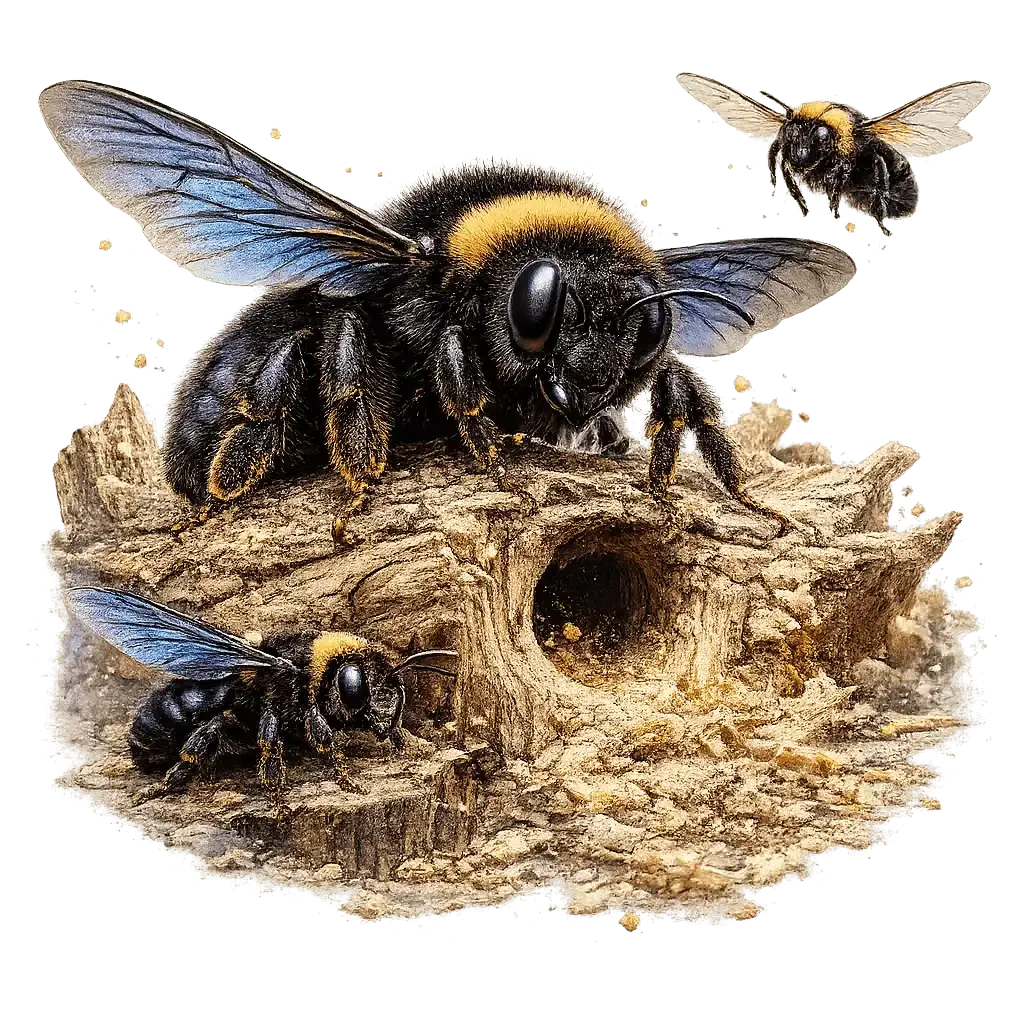
Carpenter bees are large, powerful, solitary bees that play a vital but often underappreciated role in pollination. Unlike their social cousins the honeybees and bumblebees, carpenter bees live independently, excavating nests in wood to raise their young. With over 500 species worldwide and several common species in North America, carpenter bees are among the largest native bees, rivaling bumblebees in size but sporting a distinctive glossy, mostly hairless black abdomen. The Eastern carpenter bee (Xylocopa virginica) is the most common species in the eastern United States, while the Valley carpenter bee (Xylocopa sonorina) and California carpenter bee (Xylocopa californica) dominate western regions. Though often viewed as pests due to their wood-nesting behavior, carpenter bees are exceptional pollinators with unique capabilities including buzz pollination, extreme temperature tolerance, and the ability to pollinate crops that many other bees cannot handle effectively. For homesteaders seeking to understand the full spectrum of pollinators on their property, carpenter bees represent an important - if sometimes challenging - partner in creating a productive, biodiverse landscape.
Flight Range & Foraging Distance
Carpenter bees are long-distance flyers with impressive foraging capabilities that rival and often exceed those of other bee species.
Typical Foraging Range: 1-3 miles (1.6-4.8 kilometers) from nest sites under normal conditions
Maximum Distance: Up to 6 kilometers (3.7 miles) documented in research studies; potential flight range extends to 10 kilometers (6.2 miles)
Flight Pattern: Very fast, powerful, direct flight; faster than bumblebees or honeybees
Median Distance: Most foraging occurs around 720 meters (0.45 miles) from nest
Preferred Range: 64% of foraging flights fall between 200-1,000 meters (650-3,280 feet)
Distance Variation: Flight distance increases when floral resources are abundant and weather conditions are favorable
Weather Impact: Foraging distances shorten during adverse weather or when flower rewards are low
Flower Availability: Can travel significantly farther (up to 6 km) when large numbers of flowers are available
Foraging Efficiency: Use "traplining" - visiting the same flowers in the same order on repeated trips, demonstrating excellent spatial learning and route memory
Homestead Implications: Carpenter bees can effectively pollinate crops and gardens over a much larger area than bumblebees. A single nest can service flowers and crops across multiple acres. However, this also means they may forage far beyond your property, making them less "contained" than some other pollinators.
What Carpenter Bees Eat & Drink
Primary Diet: Nectar and pollen from flowering plants
NOT Wood-Eaters: Despite their name and nesting behavior, carpenter bees do NOT eat wood; they only excavate it for nesting
Nectar Purpose: Provides carbohydrates for energy; collected and consumed by adults and mixed into "bee bread" for larvae
Pollen Purpose: Rich protein source essential for larval development; formed into balls mixed with nectar
Generalist Foragers: Feed on a wide variety of flower types; highly adaptable to available blooms
Powerful Mandibles: Strong jaws allow them to access nectar from flowers other bees cannot reach
Nectar Robbing: Often pierce the sides of long-tubed flowers to "steal" nectar without pollinating (though they legitimately pollinate many other flowers)
Buzz Pollination Capable: Can vibrate flowers to release pollen from closed anthers (like tomatoes, blueberries, eggplants)
Bee Bread: Females create pollen balls mixed with nectar; each egg is laid on a single pollen ball that provides all food for that larva
Favorite Plants & Flowers
Eastern Carpenter Bee Preferences: Clover, roses, sunflowers, passion fruit vines, wisteria
General Favorites: Open-faced flowers, tubular flowers (even when nectar-robbing), wildflowers, flowering trees and shrubs
Crop Pollination: Tomatoes, peppers, eggplants, passion fruit, melons, blueberries, greenhouse crops
Flowering Trees: Fruit trees (apple, peach, cherry), locust, redbud, crape myrtle
Garden Flowers: Salvia, penstemon, foxglove, hollyhocks, bee balm, lantana
Herbs: Lavender, rosemary, oregano, basil (when flowering)
Water Needs
Water Consumption: Drink water from shallow sources, puddles, dew
Water Sources: Provide shallow dishes with landing stones; carpenter bees will visit regularly
Thermoregulation: May use water or nectar evaporation for cooling during extreme heat
Homestead Value: Carpenter bees are extreme generalists, foraging on almost any available flowers. This makes them reliable pollinators across diverse plantings but also means they don't "specialize" in any particular crop. Their nectar-robbing behavior can reduce pollination of some long-tubed flowers, though their overall pollination value far exceeds any negative impacts.
Temperature Tolerance & Weather Conditions
Carpenter bees possess extraordinary thermoregulatory abilities, allowing them to forage in extreme conditions that would ground other bee species.
Heat Tolerance: Desert Champions
Exceptional Heat Tolerance: Can maintain flight with body temperatures reaching 46.5-48°C (116-118°F) - among the highest of any bee species
Foraging in Extreme Heat: Can forage when air temperatures exceed 40°C (104°F), though they avoid the hottest part of the day
Body Temperature While Foraging: Typically 35-47°C (95-117°F) when returning from foraging flights
Heat Stress Threshold: Not heat-stressed until air temperature exceeds 35-38°C (95-100°F); serious impacts don't occur until 41-42°C (106-108°F)
Heat Dumping: Unique ability to transfer excess heat from thorax to abdomen and head through active physiological heat transfer
Flight Speed Cooling: Can increase flight speed to enhance convective cooling when overheating
Flat Head Design: Large, flat heads enable efficient heat dissipation during high-speed flight
Behavioral Adaptations: Forage during coolest hours (early morning, late evening) when temperatures are extreme; avoid midday heat
Evaporative Cooling: Use nectar dehydration (evaporating water from nectar) to lose body heat
Developmental Limits: Larvae cannot survive sustained temperatures of 40°C (104°F); no bees survive to adulthood at this temperature
Cold Tolerance
Minimum Foraging Temperature: Can forage at temperatures as low as 12°C (54°F) - warmer minimum than bumblebees but colder than honeybees
Pre-Flight Warm-Up: Must raise thorax temperature to approximately 30°C (86°F) before flight
Endothermic Capability: Generate heat through muscle contractions ("shivering") like bumblebees
Operating Range: Maintain thorax temperatures of 33-46.5°C (91-116°F) during flight regardless of ambient temperature
Early/Late Season: Active earlier in spring and later in fall than honeybees
Overwintering: Adults hibernate inside nest galleries during winter; can survive months of cold
Weather Adaptations
Rain Tolerance: Generally avoid foraging in heavy rain; may forage in light drizzle
Wind Tolerance: Strong fliers can handle moderate winds better than smaller bees
Low Light Capability: Some species forage during twilight hours (crepuscular foraging) and even in dim nighttime conditions
Extended Foraging Hours: Can forage from very early morning through late evening, especially during hot weather
All-Season Activity: In mild climates, some species remain active nearly year-round with only brief winter dormancy
Seasonal Activity Pattern
Spring Emergence: Late March through May depending on region and temperature
Peak Activity: April through October in most regions
Fall Foraging: Continue foraging into late fall to build fat reserves for winter
Winter: Hibernate as adults inside nest galleries; emerge again in spring
Homestead Advantage: Carpenter bees can pollinate when other bees are grounded by heat or cold. In hot climates, they're among the few pollinators active during summer heat waves. Their extended daily foraging hours provide pollination services from dawn to dusk. This makes them particularly valuable in areas with temperature extremes or for crops that require early morning or late evening pollination.
Honey & Wax Production
Critical Clarification: Carpenter bees produce NO harvestable honey or wax.
Honey Production
Quantity: NONE for harvest; carpenter bees do not produce or store honey
No Honey Storage: Unlike honeybees, carpenter bees don't create honey stores
Nectar Use: Collect nectar only for immediate consumption and for mixing with pollen to create bee bread for larvae
Colony Structure: Solitary bees with no colony to feed through winter; no need for honey stores
Wax Production
Quantity: Minimal amounts used only for sealing brood cells
Purpose: Mix wood pulp with wax/saliva to create partitions between brood chambers
Not Harvestable: Produce only microscopic amounts; not collected or usable for any purpose
Different from Honeybees: Do not build wax combs; use excavated wood galleries instead
What They DO Produce
Bee Bread: Mixture of pollen and nectar formed into balls for larval food
Sawdust (Frass): Wood shavings expelled during nest excavation - not edible, not useful
Fecal Staining: Yellowish-brown stains near nest entrances from bee waste
Homestead Reality: Do NOT keep carpenter bees for honey or wax - they produce neither in any usable quantity. Their entire value lies in pollination services. Anyone suggesting you can "harvest carpenter bee honey" is misinformed.
Pollination Services: Why They Matter
Despite producing no honey, carpenter bees are pollination powerhouses worth protecting and encouraging.
Pollination Advantages
Buzz Pollination (Sonication): Can vibrate flowers at precise frequencies to shake loose pollen from closed anthers - critical for crops like tomatoes, peppers, eggplants, blueberries
Larger Fruits: Studies show fruits pollinated by carpenter bees are larger and higher quality than those pollinated by other bees
Long Tongues: Some species can access nectar in deep flowers honeybees cannot reach
Strong, Fast Flight: Cover large territories quickly, visiting many flowers in short time
High Flower Visitation Rate: Visit 16+ flowers per minute on some plants
Generalist Pollinators: Forage on wide variety of plants, providing comprehensive pollination
Weather Resilience: Forage in heat, cold, and marginal conditions when other pollinators are inactive
Extended Hours: Work from early morning through late evening; some species forage in dim light or at night
Greenhouse Pollination: Function better than other bees in high-temperature greenhouse environments
No Swarming: Won't abandon crops mid-season like honeybees sometimes do
Critical Crops for Carpenter Bees
These crops significantly benefit from or require carpenter bee pollination:
Tomatoes (require buzz pollination - carpenter bees excel)
Peppers (greatly improved by buzz pollination)
Eggplants (require buzz pollination)
Passion Fruit (carpenter bees more efficient than honeybees)
Blueberries (buzz pollination increases fruit size)
Melons (benefit from carpenter bee efficiency)
Greenhouse Crops (carpenter bees tolerate greenhouse heat better than other bees)
Rabbit-eye Blueberries (carpenter bee "flower-cutting" behavior actually increases honeybee pollination!)
Many Wildflowers (particularly those with deep corollas)
Pollination Efficiency
Native Pollinator: 15% of U.S. agricultural crops pollinated by native bees including carpenter bees
Larger Pollen Loads: Carry significant amounts of pollen due to large, hairy bodies
Effective Transfer: Touch anthers and stigma effectively on many flowers
Complement Honeybees: Work different flowers and different times than honeybees
Year-Round Potential: In mild climates, provide pollination nearly year-round
Homestead Value: If you grow tomatoes, peppers, eggplants, or greenhouse crops, carpenter bees are essential. Their buzz pollination is irreplaceable - no other common pollinator does it as effectively. They're also valuable for extending pollination hours and working in weather conditions that ground honeybees.
Social Structure: Solitary with Variations
Carpenter bees are fundamentally solitary, but with fascinating social complexity.
Basic Structure
Primarily Solitary: Each female typically builds and provisions her own nest independently
No True Colony: Unlike honeybees or bumblebees, no cooperative worker caste
No Queen: All females are reproductive; term "queen" doesn't apply
Individual Nests: Each female excavates her own nest gallery (though galleries may be clustered)
Males Don't Build: Males don't excavate nests; they only defend territories and mate
Semi-Social Behavior (Communal Nesting)
When resources are limited, carpenter bees may display surprising social organization:
Communal Nests: Multiple females may share the same nest entrance and tunnel system
Hierarchical Structure: Loosely organized hierarchy emerges with three female roles:
Primary Female: Dominant bee; does most egg-laying, foraging, and nest construction; heavily worn mandibles and wings; usually overwintered twice
Secondary Females: Assist with some egg-laying, brood care, foraging; waiting to become primary female; usually overwintered once
Tertiary Females: Mainly guard the nest; minimal activity; waiting to mate next season; usually newly emerged
Division of Labor: Different females specialize in different tasks
Parasocial Behavior: Young adults may remain with mother for days or weeks after emergence, receiving food via trophallaxis (mouth-to-mouth feeding)
Nest Reuse: Same nest may be used for multiple years, growing larger and more elaborate with each generation
Nest Inheritance: Daughters often enlarge and reuse mother's nest
Males: The Defenders
Territorial Behavior: Males establish and aggressively defend territories near nest entrances
No Sting: Males CANNOT sting (no stinger), despite aggressive displays
Hovering Patrol: Spend hours hovering near nests, chasing intruders
Speed Detection: Only pursue fast-moving bees; ignore slow or hovering bees
Territory Size: Linear territories several meters long near nests; square territories farther away
Territory Duration: Hold same territory for up to two weeks
Mating Strategy: Patrol near nests to intercept females; only mate in flight
Larger Males Advantage: Bigger males claim best territories near female nests
White/Yellow Faces: Males have distinctive light facial markings unlike black-faced females
Lifecycle & Generation Overlap
Spring (March-May):
Overwintered adults emerge from nest galleries
Males emerge slightly before females
Mating occurs in flight
Females begin nest excavation or enlargement
Summer (June-August):
Females excavate galleries and provision brood cells
Each cell receives one pollen ball and one egg
Cells sealed with wood pulp/wax mixture
6-10 chambers per new nest
Egg to adult: approximately 7 weeks (egg 2-3 days, larva 2 weeks, pupa 3-4 weeks)
Late Summer (August-September):
New adults emerge from brood cells
New adults feed and build fat reserves but don't mate
Old adults (parents) die by early August
Minimal generation overlap
Fall (September-October):
New adults continue foraging and storing pollen
Prepare for winter by moving into nest galleries
Huddle together in groups inside same gallery
Winter (November-March):
Adults hibernate inside nest galleries
Survive on stored fat reserves
Emerge following spring to mate and start cycle again
Generations Per Year
Northern States: One generation per year
Southern States: Sometimes two generations per year
Continuous Activity: In very mild climates, some activity nearly year-round
Homestead Consideration: Because carpenter bees are solitary, you can't "keep" or "manage" them like honeybees. You can only create habitat that encourages wild carpenter bees to nest on your property. Each female works independently, so losing one nest doesn't affect others. The semi-social behavior means you might have small clusters of related females sharing nest sites.
Distance from Cabin/Home: Managing Coexistence
Carpenter bees can damage wooden structures, making distance and management crucial.
Nest Location Patterns
Preferred Sites: Untreated, bare, unpainted, weathered softwood (pine, cedar, redwood, cypress, fir)
Common Locations: Decks, siding, fascia boards, eaves, soffits, fence posts, sheds, barns, pergolas, picnic tables, outdoor furniture
Entry Points: Attracted to nail holes, cracks, splinters - any imperfection offering a "head start"
Entrance Hole Size: Nearly perfect 1/2-inch (12mm) diameter round holes
Gallery Depth: Initial excavation 6-10 inches; expanded yearly to several feet
Multiple Tunnels: Several females may excavate adjacent galleries in same piece of wood
Reuse: Same wood attacked year after year, with galleries expanding
Recommended Distances
Minimum Safe Distance: 50-100 feet (15-30 meters) from main living structures if using untreated wood
Ideal Arrangement: Provide alternative nesting sites 100+ feet from buildings
Treated Wood: Well-maintained, painted/stained wood can be safely adjacent to living areas
Composite Materials: Vinyl, aluminum siding, composite decking eliminates nesting entirely
Buffer Zone: Keep unpainted/untreated wood at least 30 feet from high-traffic areas
Structural Damage Risk
Cosmetic vs. Structural: Most damage is cosmetic; serious structural issues rare
Timeframe: Takes many years of repeated use before structural integrity compromised
Warning Signs: Extensive galleries, multiple nests in same board, old nests in load-bearing members
Secondary Damage: Woodpeckers drilling for bee larvae cause more damage than bees
Moisture Entry: Holes allow water infiltration, potentially leading to rot
Staining: Yellowish-brown fecal stains near holes (unsightly but not damaging)
Sawdust (Frass): Piles of wood shavings below holes
Male Aggression: Looks Scary, Actually Harmless
Intimidating Behavior: Males dive-bomb, hover aggressively near faces, buzz loudly
Cannot Sting: Males have NO stinger; displays are pure bluff
Territory Defense: Patrolling behavior near nests and flowers
Not Dangerous: Despite alarming behavior, males are 100% harmless
Peak Season: April-June when mating/nesting activity highest
Duration: Individual males patrol for a few minutes to over an hour
Female Sting Risk
Females CAN Sting: Possess functional stingers and can sting repeatedly
Extremely Docile: Rarely sting; very tolerant of handling
Sting Triggers: Only sting when directly handled, crushed, or severely threatened
Pain Level: Moderate pain, similar to honeybee; less than wasp
Foraging Bees: Females on flowers are extremely gentle and unlikely to sting
Near Nests: More defensive when disturbed at nest entrance but still quite docile
Safety Guidelines
Identify Wood Risk: Inspect all untreated/unpainted wood on property for existing holes
Preventive Painting: Paint/stain all exposed wood before spring emergence (March)
Fill Holes: Seal nail holes, cracks, splinters in wood surfaces
Avoid Disturbance: Don't block nest entrances during active season (April-September)
Educate Family: Teach kids that buzzing males are harmless; avoid swatting
Observe Males: Watch male behavior from 10+ feet; fascinating but keep distance
Respect Nests: Don't touch females at nest entrances
Woodpecker Protection: Screen or cover infested wood to prevent woodpecker damage
Safe Nest Monitoring
Best Time to Inspect: Early morning or evening when activity lower
Observation Distance: 6+ feet for comfortable watching
Photography: Can photograph from 2-3 feet; females won't react to camera
Children: Supervise kids near nests; explain gentle observation only
Homestead Reality: Unlike bumblebees that can nest 15 feet from homes safely, carpenter bees require more careful management. Their wood-excavating behavior means you must actively protect structures. However, with proper wood treatment and alternative nesting sites, peaceful coexistence is entirely possible. The key is controlling WHERE they nest, not whether they're present.
Advantages of Supporting Carpenter Bees on Your Homestead
Superior Buzz Pollination: Irreplaceable for tomatoes, peppers, eggplants, blueberries - crops many homesteaders depend on
Extreme Weather Resilience: Pollinate in heat, cold, and marginal conditions other bees avoid
Extended Daily Hours: Work from dawn to dusk, providing all-day pollination services
Long-Distance Foraging: Service crops and gardens across large properties (several acres)
Greenhouse Excellence: Best pollinators for greenhouse crops due to exceptional heat tolerance
Early/Late Season: Active earlier in spring and later in fall than many other bees
Larger Fruit Production: Produce bigger, higher-quality fruits in crops they pollinate
Native Species: Support native biodiversity and local ecosystems
Self-Sustaining: Require no feeding, no disease treatment, no equipment
Long-Lived Adults: Individual females live 2-3 years (vs. 6 weeks for honeybee workers)
Generalist Pollinators: Visit wide variety of flowers, providing comprehensive coverage
Complement Honeybees: Work different flowers, different times, different conditions
No Swarming: Don't abandon property mid-season
No Colony Collapse: Solitary nature means one nest failure doesn't affect others
Educational Value: Fascinating to observe; teach children about native pollinators
Minimal Sting Risk: Females extremely docile; males cannot sting
Free Pollination: Provide thousands of dollars of pollination services at zero cost
Disadvantages & Challenges
Wood Damage: Primary concern; will excavate galleries in untreated wood structures
Cosmetic Issues: Holes, sawdust piles, fecal staining on buildings
Woodpecker Attraction: Nests attract woodpeckers that cause additional structural damage
Moisture Entry: Holes allow water infiltration potentially leading to rot
Difficult to Exclude: Can't easily prevent nesting without treating all wood
Male Aggression: Intimidating defensive displays (though harmless) alarm people
Cannot "Keep" Them: Solitary nature means no traditional beekeeping or colony management
No Honey/Wax: Produce no harvestable products
Unpredictable Nesting: May choose inconvenient locations on your structures
Nectar Robbing: Can reduce pollination effectiveness on some long-tubed flowers
Limited Commercial Use: Unlike honeybees, can't rent them for pollination services
Nest Removal Challenges: Active nests difficult to relocate or eliminate humanely
Long-Term Wood Degradation: Repeated yearly use eventually weakens wood
Variable Pollination: Don't provide consistent, predictable pollination like managed honeybees
Sting Potential: Though rare, females can sting if handled
Population Unpredictability: Wild populations fluctuate; can't control numbers
Limited Research: Less studied than honeybees; fewer management resources available
How to Support & Protect Carpenter Bees on Your Homestead
Supporting carpenter bees requires a dual strategy: protect your structures while providing alternative nesting sites.
Protecting Structures from Damage
Paint and Seal (Primary Defense):
Paint or stain ALL exposed softwood on buildings, decks, fences before spring
Use oil-based paint or solid stains for best protection
Re-paint every 2-3 years to maintain protection
Fill nail holes, cracks, splinters with wood putty/caulk before painting
Seal cut edges of lumber completely
Alternative Materials:
Use composite decking instead of wood
Install vinyl or aluminum siding
Choose pressure-treated lumber for outdoor projects
Use hardwoods (oak, maple, ash) which carpenter bees avoid
Metal or vinyl fencing instead of wood
Timing Matters:
Paint/treat in late summer (August-September) after new adults emerge but before hibernation
Or early spring (February-March) before nesting activity begins
Avoid mid-season painting when larvae are developing
Existing Hole Management:
Wait until fall when bees have departed (late August-October)
Stuff holes with steel wool, caulk, or wood putty
Replace heavily damaged boards entirely
Repair in fall to prevent reuse next spring
Providing Alternative Nesting Sites
Natural Wood Alternatives:
Create "bee wood pile" with untreated softwood logs/posts 100+ feet from buildings
Use 4x4 or 6x6 posts of cedar, pine, or fir
Position vertical posts 4-6 feet tall partially buried in ground
Bundle of untreated lumber scraps
Dead standing trees (snags) - leave if safe distance from structures
Old fence posts from property cleanup
Firewood stacks (untreated softwood)
Artificial Nest Blocks:
Create nest blocks from untreated softwood (pine, cedar, fir)
Dimensions: 4x4" to 6x6" posts, 8-12 inches long
Drill holes 1/2 inch (12mm) diameter, 6-8 inches deep
Space holes 3/4 inch apart (center to center)
Drill holes slightly upward (5-10 degree angle) for drainage
Don't drill completely through - create dead-end galleries
Position blocks 4-6 feet off ground on posts, trees, or sheds
Face holes away from prevailing winds/rain
Provide roof overhang or small cover for weather protection
Place in partial shade to avoid overheating
Optimum Locations for Alternative Nests:
South or east-facing exposure (morning sun)
100+ feet from buildings you want to protect
Near flower gardens or crop areas
Partial shade to prevent overheating
Protected from strongest winds
Near edge of woods or hedgerows
Visible location for observation
Maintenance:
Leave nest blocks in place year-round (bees overwinter inside)
Don't disturb active nests during season
Replace heavily weathered blocks every 3-4 years
Add new blocks if existing ones fill up
Providing Food Sources
Plant Diversity for Full-Season Bloom:
Early Spring (March-May):
Fruit trees (apple, cherry, peach, plum)
Redbud, locust, wisteria
Crocus, dandelions, wild violets
Fruit tree blossoms critical for emerging adults
Late Spring-Summer (May-August):
Tomatoes, peppers, eggplants (garden crops)
Sunflowers, zinnias, cosmos
Bee balm, salvia, penstemon
Lavender, rosemary, oregano
Passion flower vines
Roses, hollyhocks
Late Summer-Fall (August-October):
Asters, goldenrod, sedum
Late-blooming sunflowers
Crape myrtle
Basil, oregano (if left to flower)
Continued vegetable garden flowers
Key Principles:
Plant in large clusters (not scattered individuals)
Include both wild and cultivated flowers
Provide continuous bloom from March-October
Mix flower shapes: open-faced, tubular, complex
Native plants preferred but not essential
Avoid double flowers (less accessible nectar/pollen)
Protection from Threats
Pesticide Protection:
NEVER use pesticides on flowering plants
Avoid neonicotinoids entirely (deadly to all bees)
Don't spray during blooming period even at night
Use organic/mechanical pest controls instead
If you must spray, do so at night when bees are inactive and flowers are closed
Never spray open blooms or foraging bees
Natural Predator Management:
Woodpecker damage: Wrap infested wood in hardware cloth or screen
Large predatory wasps: Part of nature; usually don't significantly impact populations
Tiger bee flies: Parasitize carpenter bee larvae; control is difficult and not recommended
Birds: Some birds eat carpenter bees; this is natural predation and not usually problematic
Habitat Protection:
Maintain diverse flowering plants throughout property
Leave some wild/unmowed areas for foraging
Protect existing dead wood (snags) at safe distances from structures
Don't remove all old fence posts or dead trees
Create habitat corridors connecting flower patches
Water Sources
Provide shallow dishes or birdbaths with rocks/corks for landing
Change water every 2-3 days to prevent mosquitoes
Position near flower gardens
Multiple small sources better than one large source
Seasonal Management Calendar
Late Winter (February-March):
Paint/seal any unpainted wood on structures BEFORE bees emerge
Position new nest blocks in alternative locations
Repair winter damage to existing structures
Plan flower succession planting
Spring (March-May):
Watch for emerging adults
Do NOT disturb active nests once established
Monitor structure damage on buildings
Ensure early-blooming flowers available
Identify new nest entrances for tracking
Summer (June-August):
Maintain flowering plants; deadhead to promote blooming
Provide water sources
Avoid disturbing nests
Mark nest locations to protect during yard work
Complete ban on pesticides
Late Summer (August-September):
New adults emerge and begin foraging
Safe time to treat/repair damaged wood after bees depart nests
Plug old holes with steel wool and wood putty
Replace severely damaged boards
Ensure late-blooming flowers available for new adults
Fall (September-October):
Adults store fat for winter
Ensure late flowers available
Complete wood repairs before hibernation
Leave nest blocks undisturbed (bees hibernating inside)
Winter (November-February):
Bees hibernating inside nest galleries
Plan next year's plantings
Order supplies for alternative nest blocks
Do NOT remove or disturb wood with nest holes - bees are inside
Managing Carpenter Bees: Practical Strategies
Goal: Redirect nesting away from structures while maintaining pollination services
If You Want Carpenter Bees (for pollination):
Protect all valuable wood structures through painting, sealing, composite materials
Create alternative nesting sites 100+ feet from buildings
Plant diverse flowers for continuous bloom
Accept minor cosmetic damage on less critical wood
Monitor alternative sites to see if bees use them
Educate family about value and minimal risk
Photograph and observe from safe distance
If You Want to Minimize Carpenter Bees:
Paint all exposed softwood with oil-based paint
Use composite/vinyl materials for new construction
Repair holes immediately each fall
Remove untreated wood from property
Don't provide alternative nesting sites nearby
Accept reduced pollination of some crops
Still avoid pesticides (harms all pollinators, not just carpenter bees)
Middle Ground (Most Homesteaders):
Protect primary structures (house, garage) completely
Accept some damage on secondary structures (sheds, old fences)
Provide alternatives in designated areas
Maintain flower diversity for pollination
Monitor and repair damage seasonally
Balance costs/benefits based on crop needs
Common Myths & Misconceptions
Myth: Carpenter bees eat wood Reality: They excavate wood for nesting only; eat pollen and nectar
Myth: Male carpenter bees are dangerous Reality: Males cannot sting; aggressive displays are harmless bluff
Myth: Carpenter bees produce honey Reality: Produce no honey whatsoever; purely pollination value
Myth: One nest will destroy your house Reality: Takes many years and multiple nests to cause structural damage
Myth: Carpenter bees and bumblebees are the same Reality: Different genera; bumblebees social with hairy abdomens, carpenter bees solitary with shiny black abdomens
Myth: Killing carpenter bees solves the problem Reality: New bees will arrive each spring; prevention (painting) is only solution
Myth: Carpenter bees are aggressive Reality: Females extremely docile; rarely sting even when handled
Myth: All bees make honey Reality: Only honeybees make substantial honey; most native bees produce none
First-Year Action Plan
Goal: Establish controlled carpenter bee habitat while protecting structures
Step 1 - Property Assessment (Late Winter):
Identify all untreated wood on property
Prioritize which structures need protection
Locate suitable alternative nesting sites (100+ feet from buildings)
Check for existing carpenter bee holes from previous years
Step 2 - Structure Protection (February-March):
Paint/seal all critical structures before bee emergence
Repair existing holes in protected structures
Install composite materials where feasible
Fill nail holes and cracks
Step 3 - Alternative Habitat Creation (March):
Build or purchase 2-3 nest blocks
Position blocks in designated "bee areas" away from buildings
Create or identify natural wood pile for nesting
Ensure placement near flower sources
Step 4 - Flower Planting (March-April):
Plant early-blooming flowers (fruit trees, crocus)
Ensure mid-summer blooms (sunflowers, salvia, bee balm)
Add late-season flowers (asters, goldenrod)
Focus on diversity over quantity
Step 5 - Observation (April-October):
Watch for nest-building activity
Note which flowers carpenter bees prefer
Document any structure damage
Observe pollination of crops (tomatoes, peppers)
Photograph behavior for education
Step 6 - Fall Maintenance (August-October):
Repair any new damage after adults depart
Assess success of alternative nesting sites
Plan adjustments for next year
Leave alternative nest blocks undisturbed (hibernating bees inside)
Year Two & Beyond:
Expand alternative nesting if successful
Adjust flower plantings based on observations
Maintain protective painting schedule
Monitor long-term structure integrity
Share knowledge with neighbors
Measuring Success
You'll know your carpenter bee strategy is working when:
Carpenter bees using alternative nest blocks instead of structures
Minimal new holes in protected/painted wood
Abundant bee activity on tomatoes, peppers, eggplants
Larger fruit size and better yields in buzz-pollinated crops
Active foraging throughout day on diverse flowers
Multiple generations using alternative sites year after year
Reduced woodpecker damage (fewer nests in buildings attract fewer woodpeckers)
Family comfortable with bee presence and understands value
Balanced coexistence with acceptable minor cosmetic damage only
Conclusion
Carpenter bees present a unique challenge and opportunity for homesteaders. Unlike honeybees or bumblebees, you cannot truly "keep" carpenter bees - you can only create conditions that attract them to appropriate nesting sites while protecting your structures from damage. This requires a more nuanced approach than simply "supporting pollinators."
The key is recognizing carpenter bees' irreplaceable value while acknowledging their challenges. If you grow tomatoes, peppers, eggplants, or greenhouse crops, carpenter bees may be your most important pollinators - their buzz pollination simply cannot be replicated by honeybees. Their ability to forage in extreme heat and cold extends your pollination season beyond what other bees can provide. A homestead with abundant carpenter bees will see larger harvests, better fruit quality, and more reliable crop set in key vegetables.
However, this value comes with responsibility. You must actively protect wooden structures through painting, sealing, and proper maintenance. You must provide alternative nesting sites far from buildings. And you must educate family members about carpenter bee biology, behavior, and the critical difference between harmless male displays and genuine threats.
The strategy is not "eliminate carpenter bees" (you'll lose valuable pollination) nor "ignore the problem" (you'll suffer structural damage). The strategy is "redirect and coexist" - channel their nesting behavior away from valuable structures while supporting their populations for pollination services.
For homesteaders committed to self-sufficiency, carpenter bees are essential partners despite their complications. Every alternative nest block you install, every structure you protect with paint, and every flower you plant represents an investment in sustainable, productive pollination that will return dividends for years. When your tomatoes are loaded with fruit, your peppers are setting heavily, and your eggplants are producing abundantly - thank the carpenter bees buzzing methodically from flower to flower, vibrating pollen loose with their remarkable sonication abilities.
Start with protection (paint your house), add alternatives (nest blocks away from buildings), plant flowers (continuous bloom), and observe. Within one season, you'll see the results: protected structures, productive crops, and a deeper understanding of one of North America's most important - if sometimes troublesome - native pollinators.
Explore more Types of Bees & Pollinators