
Loganberry
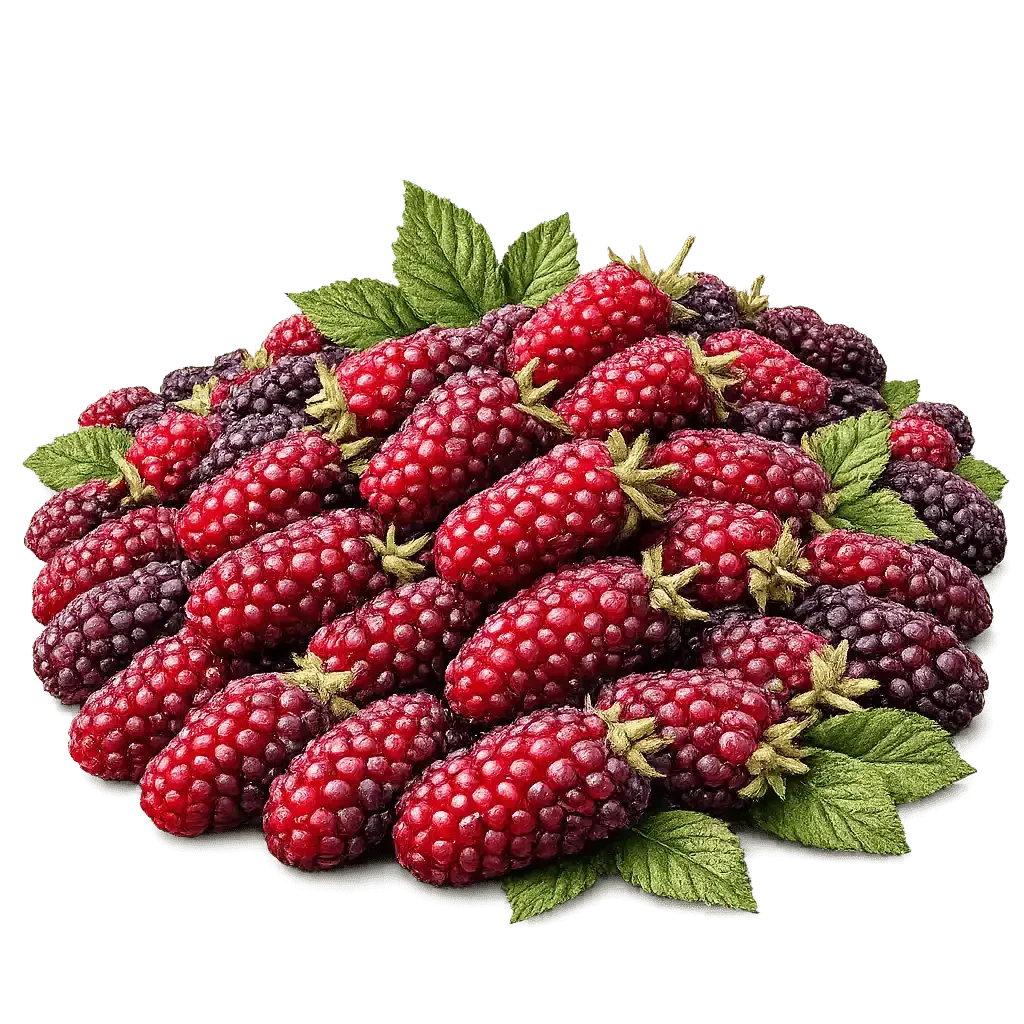
Complete Homestead Growing Guide
Botanical Name: Rubus x loganobaccus
Origin: The loganberry was first developed in 1881 by Judge James Harvey Logan in Santa Cruz, California. It is a cross between a raspberry (Rubus idaeus) and a blackberry (Rubus ursinus), and it was one of the first deliberately bred berry hybrids in the United States.
Description: The loganberry is a vigorous, trailing bramble that produces long, conical berries with a flavor that sits squarely between a raspberry and a blackberry. The fruit is tart when underripe but develops a rich, complex sweetness at full maturity. Canes can reach 6 to 8 feet in length and require trellising for best results. Plants are thorny by default, though thornless cultivars such as the American Thornless Loganberry now exist.
Size: Mature plants produce canes that spread 6 to 10 feet if left unmanaged. On a trellis, plants are typically maintained at 5 to 6 feet tall with a 3 to 4 foot lateral spread. Individual berries measure 1 to 1.5 inches long.
USDA Hardiness Zones: 5 through 10. Loganberries perform best in zones 7 through 9 where mild winters allow adequate chill hours (200 to 400 hours below 45 degrees Fahrenheit) without exposing canes to prolonged temperatures below 0 degrees Fahrenheit.
Why It Matters for Homesteaders: The loganberry fills a niche that few other berries can match. It produces heavy yields in a relatively small footprint, makes outstanding preserves and wine, and thrives with minimal inputs once established. For homesteaders looking to diversify beyond standard blackberries and raspberries, the loganberry offers a unique flavor profile that commands premium prices at farmers markets and provides years of reliable harvests from a single planting.
How Long Does It Take to Grow?
Loganberries are perennial plants with biennial canes. Here is what to expect year by year after planting bare root stock or tissue culture transplants.
Year 1: Primocanes (first year canes) grow vigorously from the crown, reaching 4 to 6 feet by the end of the season. No fruit is produced. Focus on training canes to the trellis and building root mass. Water consistently, providing 1 to 1.5 inches per week.
Year 2: The previous year's primocanes become floricanes and produce your first harvest. Expect a light crop of 1 to 2 pounds per plant. New primocanes will grow simultaneously, which should be trained to the opposite side of the trellis.
Year 3: Plants hit their stride with 4 to 8 pounds per plant depending on soil quality, watering, and climate. The root system is now well established and annual maintenance becomes straightforward.
Years 4 through 15: Full production. A well maintained loganberry plant will produce 8 to 12 pounds of fruit per season. With proper care, plants remain productive for 12 to 15 years before crowns begin to decline and should be replaced.
Berry Shelf Life
Fresh: Loganberries are fragile. Expect 2 to 3 days of refrigerator shelf life at 32 to 35 degrees Fahrenheit when stored in a single layer on a paper towel lined tray. Do not wash until ready to eat.
Frozen: Flash freeze berries on a sheet pan for 2 hours, then transfer to freezer bags. Properly frozen loganberries keep for 10 to 12 months at 0 degrees Fahrenheit.
Dried: Dehydrate at 135 degrees Fahrenheit for 12 to 18 hours until leathery but pliable. Store in airtight containers in a cool, dark location. Dried loganberries last 6 to 12 months.
Jams and Preserves: Properly canned loganberry jam (processed in a boiling water bath for 10 minutes) keeps for 12 to 18 months on the pantry shelf. Once opened, refrigerate and use within 3 weeks.
Homestead Storage Tip: Loganberries have a high pectin content compared to most bramble fruits, which makes them ideal for jam making without commercial pectin. Harvest in the cool morning hours and process or freeze within 4 to 6 hours for the best flavor and texture retention.
Berry Color and Appearance
Flowers: Loganberry blossoms are white to pale pink with five petals, appearing in late spring. Each flower cluster can produce 5 to 12 individual berries.
Unripe Fruit: Berries start green, then transition through pale yellow and light red as they develop. At the light red stage, berries are firm and extremely tart.
Ripe Fruit: Fully ripe loganberries are a deep, dark reddish purple. They are soft to the touch and detach easily from the receptacle. Unlike blackberries, the core remains with the fruit when picked.
Size and Shape: Each berry is elongated and conical, measuring 1 to 1.5 inches long and about 0.75 inches in diameter. They are noticeably longer than raspberries and more slender than blackberries.
Cluster Pattern: Fruit forms in loose clusters along the floricane laterals. Each lateral may hold 6 to 15 berries that ripen unevenly over a 2 to 3 week window, requiring multiple harvests.
Seeds: Loganberries contain small seeds similar to raspberry seeds. They are noticeable but not unpleasant when eating fresh. Seeds are less prominent in cooked and strained preparations.
Ripening Time: Most cultivars ripen from mid June through late July, with peak harvest in early to mid July depending on climate. Expect a 3 to 4 week harvest window in most areas.
Visual Appeal: Loganberries have a striking jewel toned appearance that makes them excellent for farm stand displays and value added products. Their deep color creates vivid jams, syrups, and baked goods that stand out from standard berry offerings.
How Much Berry Can You Collect?
Young Plants (Years 1 to 2): No fruit in year one. Year two yields 1 to 2 pounds per plant as the floricanes begin producing.
Mature Plants (Years 3 and Beyond): Expect 8 to 12 pounds per plant annually under good growing conditions. Exceptional plants on fertile ground with ideal climate may push 14 pounds.
Per Row: With plants spaced 6 to 8 feet apart in rows, a 100 foot row holds 12 to 16 plants, yielding 96 to 192 pounds per season at maturity.
Per Acre: Commercial plantings average 600 to 800 plants per acre with yields of 5,000 to 8,000 pounds per acre annually. Homestead plantings with wider spacing and less intensive management can realistically expect 3,000 to 5,000 pounds per acre.
Harvest Season: Mid June through late July in most regions. Cooler climates may see harvest extend into early August. Pick every 2 to 3 days during peak production.
Ease of Harvest: Moderate. Thorny varieties demand gloves and long sleeves. Berries are soft and must be handled gently. The trailing growth habit means berries hang at varying heights on the trellis. Thornless varieties significantly reduce harvest time and labor.
Homestead Reality: Five to ten well maintained plants will supply a family of four with enough fresh berries for eating plus 20 to 40 pounds of surplus for preserving. That translates to roughly 20 to 30 jars of jam, several gallons of syrup, or a substantial batch of homemade wine each season.
Why Loganberries Are Good for You
Key Vitamins and Minerals: Loganberries are an excellent source of vitamin C, providing approximately 15 milligrams per 100 gram serving (about 17 percent of the daily value). They also supply meaningful amounts of manganese, vitamin K, folate, potassium, and iron. A one cup serving contains roughly 80 calories, 2 grams of protein, and 8 grams of dietary fiber.
Antioxidants: The deep reddish purple color signals a high concentration of anthocyanins, ellagic acid, and quercetin. These compounds are potent free radical scavengers. Loganberries score well on ORAC (Oxygen Radical Absorbance Capacity) testing compared to many common fruits.
Research Backed Health Benefits: Studies on anthocyanin rich berries have shown associations with reduced inflammation, improved cardiovascular health, and better blood sugar regulation. The high fiber content supports digestive health and promotes satiety. Ellagic acid, found abundantly in loganberries, has been studied for its potential role in supporting cellular health and reducing oxidative stress.
Traditional Medicinal Uses: Historically, bramble fruits including loganberry relatives were used in folk medicine as astringents and digestive aids. Leaf teas made from bramble plants were used to soothe sore throats and mild stomach complaints. While these uses are traditional and not clinically validated, the nutritional profile of loganberries supports their reputation as a health promoting food.
What You Can Make with Loganberries
Jam and Preserves: Loganberry jam is arguably the finest use of this fruit. The natural tartness and high pectin content produce a jam with brilliant color and complex flavor. Use a ratio of 4 cups crushed berries to 3 cups sugar for a less sweet, more fruit forward preserve.
Pies and Cobblers: Loganberries make exceptional pies, either on their own or combined with apples or blueberries. Their tartness balances beautifully with a buttery crust and a modest amount of sugar.
Syrup: Loganberry syrup is a regional specialty in parts of the Pacific Northwest and western New York. Simmer equal parts berries and sugar with a splash of lemon juice, strain, and bottle. Use on pancakes, in cocktails, or as a soda base.
Wine: Loganberry wine has a long tradition, particularly in England and the Pacific Northwest. The fruit's natural acidity and tannin structure produce a wine that can rival grape wines for complexity. Five to six pounds of berries make one gallon of wine.
Baked Goods: Muffins, scones, galettes, and crumbles all benefit from loganberries. Fold frozen berries directly into batter without thawing to prevent bleeding.
Sauces: A loganberry coulis pairs well with roasted meats, especially duck, lamb, and pork. Simmer berries with a touch of balsamic vinegar and honey, then strain for a smooth, elegant sauce.
Homestead Tip: Process your largest berries fresh or frozen for eating and baking. Use smaller, imperfect, and slightly overripe berries for jam, syrup, and wine where appearance does not matter. This zero waste approach maximizes the value of every harvest.
Best Ways to Store, Can, or Make Jam
Freezing: Spread rinsed and dried berries in a single layer on a parchment lined sheet pan. Freeze for 2 hours until solid, then transfer to freezer bags, pressing out excess air. Label with the date. Use within 10 to 12 months for best quality.
Canning: Loganberry Jam Recipe
Ingredients: 5 cups crushed loganberries (about 2.5 pounds fresh), 4 cups granulated sugar, 2 tablespoons lemon juice, 1 packet (1.75 ounces) powdered pectin (optional, for a firmer set).
Method: Combine crushed berries and lemon juice in a large, heavy bottomed pot. Stir in pectin if using. Bring to a full rolling boil over high heat, stirring constantly. Add sugar all at once and return to a rolling boil. Boil hard for 1 minute, stirring constantly. Remove from heat and skim any foam. Ladle into hot, sterilized half pint jars, leaving 1/4 inch headspace. Wipe rims, apply lids and bands to fingertip tight. Process in a boiling water bath for 10 minutes (adjust for altitude: add 5 minutes above 1,000 feet, 10 minutes above 6,000 feet). Yield: approximately 6 to 7 half pint jars.
Syrup: Combine 4 cups loganberries, 2 cups sugar, 1 cup water, and 1 tablespoon lemon juice in a saucepan. Bring to a boil, reduce heat, and simmer for 15 minutes. Strain through a fine mesh sieve or cheesecloth, pressing gently. Pour into sterilized bottles. Refrigerate for up to 3 months or process in a water bath for 10 minutes for shelf stable storage.
Drying: Halve larger berries and spread on dehydrator trays. Dry at 135 degrees Fahrenheit for 12 to 18 hours, rotating trays every 4 hours. Berries are done when leathery and no moisture appears when squeezed. Condition in a sealed jar for 7 days, shaking daily, before long term storage.
Other Preservation Methods: Loganberries also make excellent fruit leather (puree and dry at 135 degrees for 8 to 10 hours on parchment lined trays), shrub vinegar (combine equal parts berries and sugar, refrigerate 2 days, strain, and add equal parts apple cider vinegar), and frozen puree (blend and strain seeds, freeze in ice cube trays for year round use in smoothies and sauces).
Pros of Growing Loganberry
• Exceptional Flavor: The sweet tart complexity of loganberries is unique among bramble fruits and is highly valued for both fresh eating and cooking.
• High Yield per Plant: Mature plants produce 8 to 12 pounds annually, giving homesteaders a significant return on a small planting.
• Excellent for Preserving: High natural pectin and acidity make loganberries one of the easiest berries to process into jam, syrup, and wine without additives.
• Long Productive Life: A well maintained planting produces for 12 to 15 years, providing over a decade of harvests from a single investment.
• Low Input Requirements: Once established, loganberries need modest fertilization, moderate watering, and basic pruning. They are not heavy feeders.
• Pest and Disease Resistance: Loganberries are generally hardy and less susceptible to many common bramble diseases than pure blackberries or raspberries, particularly when given good air circulation.
• Unique Market Value: Loganberries are uncommon at retail, giving homesteaders who sell at farmers markets a distinctive product that commands premium prices.
• Dual Purpose Planting: The vigorous trailing canes can serve as a living fence or screen when trained along a boundary trellis, providing both food and privacy.
Cons of Growing Loganberry
• Thorns: Traditional loganberry varieties have aggressive thorns that make pruning and harvesting painful without heavy gloves and long sleeves. Thornless cultivars solve this but may offer slightly lower yields.
• Short Shelf Life: Fresh berries last only 2 to 3 days refrigerated. You must be prepared to process fruit quickly at harvest time or it will spoil.
• Trellising Required: The long trailing canes cannot support themselves. You will need to install and maintain a sturdy trellis system, which adds upfront labor and cost.
• Uneven Ripening: Berries within the same cluster ripen over a 2 to 3 week window, requiring multiple passes through the planting to harvest at peak quality.
• Cold Sensitivity: While hardy to USDA zone 5, loganberry canes can suffer winter dieback in areas with prolonged temperatures below 0 degrees Fahrenheit or harsh freeze thaw cycles without protection.
• Limited Cultivar Selection: Compared to blackberries and raspberries, there are relatively few loganberry cultivars available. Sourcing plants may require ordering from specialty nurseries.
• Aggressive Spreading: Like other trailing brambles, loganberry canes can root at the tips if they contact the ground. Without management, plantings can spread beyond their intended area.
Growing Tips for Homesteaders
Site Selection: Choose a spot with full sun (6 to 8 hours minimum) and well drained soil with a pH of 5.5 to 6.5. Avoid low lying areas where cold air pools and frost lingers. Good air circulation is essential for preventing fungal diseases. A south facing slope is ideal in cooler climates.
Planting: Plant bare root stock in late winter or early spring while plants are still dormant. Space plants 6 to 8 feet apart within rows and 8 to 10 feet between rows. Dig a hole wide enough to spread roots without bending, and set the crown just below the soil surface. Water deeply at planting and apply 3 to 4 inches of organic mulch (straw, wood chips, or leaf mold) to retain moisture and suppress weeds.
Trellising: Install a two wire trellis with wires at 3 feet and 5 feet. Use sturdy end posts set at least 2 feet deep. Train first year primocanes to one side of the trellis and second year floricanes to the other. This separation makes pruning and harvesting far easier and improves air circulation.
Watering: Provide 1 to 1.5 inches of water per week during the growing season. Drip irrigation is preferred to reduce leaf wetness and fungal pressure. Increase watering during fruit development and reduce after harvest. Avoid overhead watering during bloom and fruiting.
Fertilization: Apply a balanced fertilizer (10 10 10) at a rate of 5 pounds per 100 feet of row in early spring as buds begin to swell. Side dress with compost in late fall. Avoid heavy nitrogen applications, which promote excessive cane growth at the expense of fruit production.
Pruning: After harvest, cut spent floricanes to the ground immediately. They will not fruit again. In late winter, thin primocanes to the strongest 8 to 12 per plant and tip them at 5 to 6 feet to encourage lateral branching.
Variety Selection: The standard thorned loganberry remains the most productive and widely available. The American Thornless Loganberry is the best option for homesteaders who want easier handling, though yields may be 10 to 15 percent lower. The LY 654 selection from New Zealand is noted for improved disease resistance.
Companion Planting: Loganberries pair well with comfrey (as a mulch chop and nutrient accumulator), white clover (as a living mulch and nitrogen fixer), and tansy or marigolds (to repel common pests). Avoid planting near wild brambles, which can harbor diseases. Keep loganberries at least 300 feet from wild blackberries or raspberries if possible.
Conclusion
The loganberry is one of the most rewarding and underutilized berry crops available to homesteaders. It combines the best qualities of its raspberry and blackberry parents into a fruit with superior flavor, excellent preserving characteristics, and reliable production over many years. For the homesteader willing to install a trellis and manage a few thorny canes, the payoff is substantial. A small planting of five to ten plants can supply a family with fresh berries, dozens of jars of jam, gallons of syrup, and enough surplus for wine making or market sales.
What makes the loganberry particularly valuable on a homestead is its versatility and its longevity. Few fruit crops offer 12 to 15 years of production with such modest maintenance requirements. The high pectin content eliminates the need for commercial additives in jam making. The natural acidity produces wines and shrubs that rival more expensive and labor intensive grape operations. And the deep, distinctive color and flavor of loganberry products will set your homestead offerings apart from the standard berry fare at any market or community exchange.
If you have the space for a trellis row and a climate within USDA zones 5 through 10, the loganberry deserves a place in your homestead plan. Start with three to five plants, learn the rhythm of primocane and floricane management, and within three years you will be harvesting one of the finest berries most people have never tasted.
Explore more guides on different types of berries