
Tayberry
Complete Homestead Growing Guide
Overview
Tayberry (Rubus fruticosus x R. idaeus) is a hybrid bramble created by crossing blackberry and red raspberry. Developed in Scotland in 1962 by botanist Derek Jennings at the Scottish Crop Research Institute near the River Tay, tayberry was designed to improve upon the loganberry (another blackberry-raspberry hybrid). The tayberry combines the best traits of both parents: large, aromatic berries sweeter than loganberries with rich, complex flavor. These distinctive cone-shaped berries grow up to 4 cm (1.5 inches) long, making them larger than both raspberries and blackberries. For homesteaders, tayberry represents an ideal garden berry: prolific production, disease resistance, exceptional flavor, and straightforward care. The primary challenge is extreme berry softness when ripe, making tayberries virtually impossible to find commercially and perfect for home gardens where you can pick and eat immediately.
How Long Does It Take to Grow?
Tayberry follows the standard biennial cane pattern of all brambles.
Year 1 (Primocane Year): Plant bare-root tayberry canes in late winter to early spring (late October through mid-March if soil is not frozen or waterlogged). New canes (primocanes) emerge from the crown in spring and grow vigorously throughout the growing season. First-year canes reach 6 to 8 feet long (up to 2 to 3 meters in some cases) and develop large compound leaves with three leaflets. Primocanes do not flower or produce fruit in their first year. They focus entirely on vegetative growth, building strength for next year's crop.
Year 2 (Floricane Year): The same canes (now called floricanes) produce lateral branches in spring. These side shoots bear pinkish-white flowers from late May through June. Berries form and ripen progressively over 4 to 6 weeks from late June through August (early July in most climates, late July to late August in cooler regions). After fruiting, second-year canes die back naturally and should be cut to ground level. Meanwhile, new primocanes are already growing for next year.
First Harvest: Expect first meaningful berry crop in year 2 from canes grown in year 1. Some sources report fruit production in the first season from two-year-old nursery stock, but yields will be light.
Full Production: Within 2 years, tayberry plants reach good productivity. By year 3, established plants with strong root systems produce substantial harvests.
Homestead Timeline: Plant in year 1, harvest begins year 2, full production by year 3. This is typical timing for brambles and faster than most tree fruits.
Berry Shelf Life
Tayberries are exceptionally delicate when fully ripe, which is both their charm and their challenge.
Fresh Berries: Refrigerate immediately after picking. Store in single layer in breathable container (not plastic bag). Maximum shelf life 2 to 3 days refrigerated. Tayberries are so soft when fully ripe that they cannot be machine harvested and barely tolerate hand harvesting. Use or process within 1 to 2 days for best quality.
Frozen Berries: Spread unwashed berries on baking sheet in single layer. Freeze solid (2 to 3 hours). Transfer to freezer bags, remove air, seal. Frozen tayberries store exceptionally well for up to 1 year. This is the best preservation method for most homesteaders. Freezing on open trays keeps berries separate, allowing use just like fresh fruit.
Jam and Preserves: Properly canned tayberry jam stores 12 to 18 months. Natural pectin content makes jam-making easy without added pectin.
Wine: Tayberry wine can be fermented and aged for years. The aromatic, sweet-tart flavor creates excellent fruit wine.
Homestead Reality: Plan to pick every 2 to 3 days during the 4 to 6 week harvest season. Process or freeze berries immediately. The extreme softness that makes tayberries unmarketable makes them perfect for immediate eating or freezing.
Berry Color & Appearance
Flowers: Pinkish-white to white, five petals, appear in late spring (late May to June). Flowers form in terminal clusters on lateral branches. Self-fertile (no pollinator required), though bee activity enhances yield and berry size.
Unripe Berries: Begin bright red, similar to raspberry color.
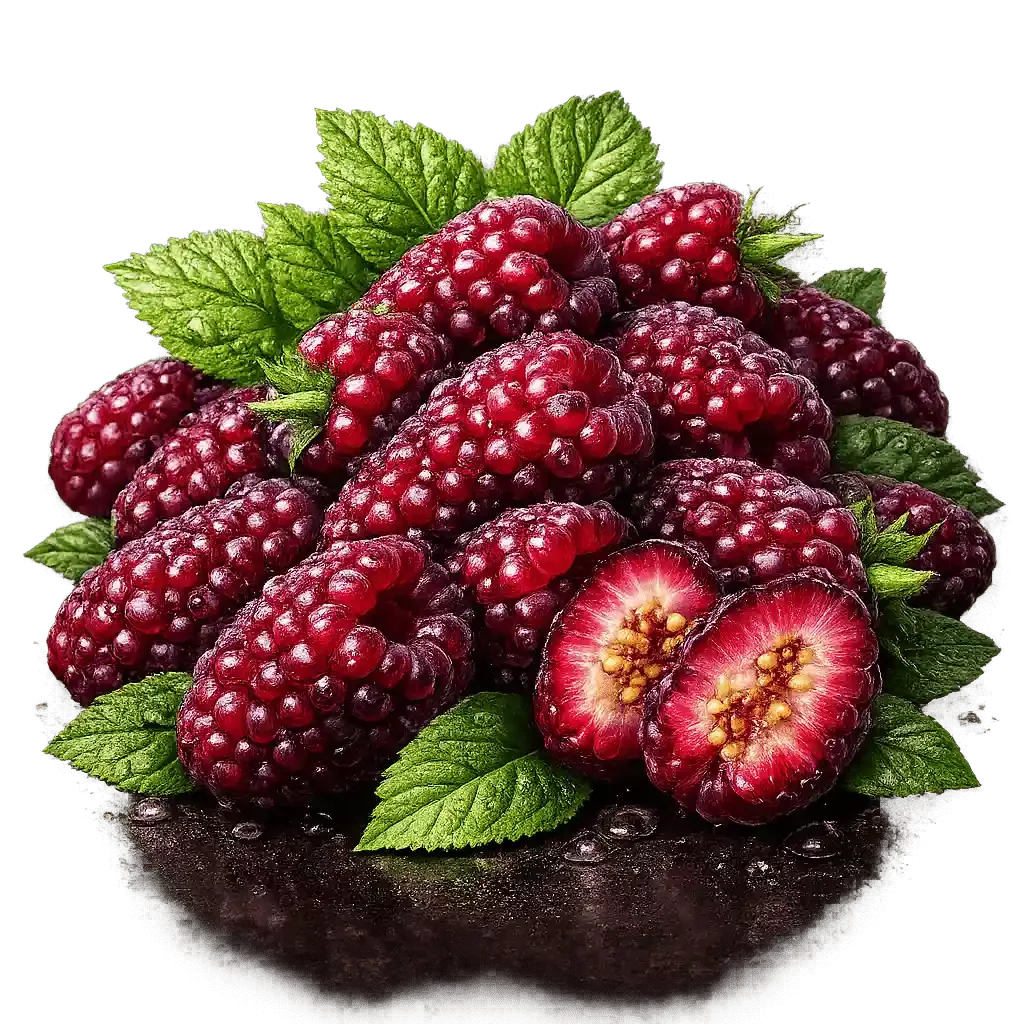
Ripe Berries: Transition from bright red to deep vibrant red-purple to rich maroon when fully ripe. The darkest purple-red berries are sweetest; red ones are tangier. Glossy sheen creates attractive appearance. Berries have elongated, cone-shaped form with finer individual drupelets than blackberries.
Size: Extra-large for a berry. Up to 4 cm (1.5 inches) long. Twice the weight of large raspberries in many cases. Significantly larger than both parent species.
Structure: Aggregate fruit composed of numerous small drupelets clustered together. Each drupelet contains a seed. The receptacle (core or plug) remains in berry when picked, similar to blackberries. This is different from raspberries, which leave the core on the plant.
Texture: Slightly bumpy and textured surface due to clustering of drupelets. Delicately bound by very fine, almost imperceptible hairs. Exceptionally soft and fragile when fully ripe, susceptible to bruising with rough handling.
Aroma: Richly aromatic fragrance that is sweet and floral with deep, earthy undertones. Aroma intensifies at peak ripeness.
Canes: Vigorous, arching, thorny canes that grow 6 to 7 feet long (some varieties reach 8 feet). Covered in sharp thorns similar to blackberry. Thornless varieties like Buckingham available, making handling and harvesting much easier.
Leaves: Compound leaves with 3 serrated leaflets (rarely 5). Leaves are green above, paler beneath.
How Much Berry Can You Collect?
Tayberries are exceptionally productive, consistently out-yielding both raspberries and loganberries.
Per Plant Yield: Under optimal management, well-established tayberry plants average 4 to 6 kg (approximately 9 to 13 pounds) per plant annually. This is substantially higher than typical raspberry yields. Some sources report commercial yields up to 27 tonnes per hectare (12 short tons per acre), though these figures represent ideal conditions.
Per Row Yield: When planted at recommended spacing (plants 1.5 to 2.5 meters apart), expect high production along entire row.
Harvest Timing: Long cropping period from early midsummer to late summer (typically early July through August). Berries ripen progressively along canes over 4 to 6 weeks. Pick every 2 to 3 days to prevent overripening.
Individual Berry Weight: Large berries, often twice the weight of standard raspberries. Each berry can weigh several grams.
Ease of Harvest: Berries pull off easily when fully ripe. The challenge is their extreme softness. Harvest with stem intact when possible to preserve structural integrity. Thorny canes require gloves and long sleeves (unless growing thornless Buckingham variety). Handle berries gently to avoid bruising.
Homestead Reality: Three established tayberry plants can easily produce 25 to 40 pounds of berries annually. This is enough for fresh eating plus substantial amounts for freezing and jam-making. The key is consistent picking every few days during peak season.
Why Tayberry Berries Are Good for You
Tayberries offer exceptional nutritional benefits comparable to or exceeding their parent berries.
Exceptional Vitamin C Content
Tayberries provide approximately 30% of daily value (DV) per 100g serving. Vitamin C supports immune function, promotes collagen synthesis for healthy skin and connective tissue, enhances iron absorption, provides powerful antioxidant protection, aids wound healing, and fights free radical damage that contributes to aging.
Outstanding Vitamin K
Approximately 25% DV per 100g. Essential for blood clotting regulation, bone health and calcium metabolism, and cardiovascular health.
Rich Mineral Content
Manganese: Approximately 30% DV per 100g. Critical for metabolism, bone development, and antioxidant enzyme function.
Iron: High quantities support red blood cell production and prevent anemia. Particularly beneficial during pregnancy and for those with iron deficiency.
Copper: About 10% DV. Supports energy production and connective tissue health.
Magnesium and Potassium: Help regulate blood pressure and support cardiovascular function.
Powerful Antioxidants
Anthocyanins: The pigments creating deep purple-red color are exceptionally potent antioxidants. Higher concentration than many other berries. Combat oxidative stress, protect cells from free radical damage, reduce inflammation, support cardiovascular health, and may provide anti-cancer properties.
Ellagic Acid: Rare polyphenol with exceptional antioxidant properties. Linked to cellular health protection and potential anti-cancer effects, particularly against colon cancer, skin cancer, and breast cancer.
Quercetin: Flavonoid antioxidant that neutralizes toxins and poisons, supports cardiovascular health, reduces inflammation, and may have anti-proliferative effects on cancer cells.
Vitamin E: About 8% DV. Fat-soluble antioxidant protecting cell membranes.
Excellent Fiber Content
Approximately 7% DV per 100g (roughly 6.5 grams fiber per serving). Dietary fiber supports digestive health and regular bowel movements, helps regulate blood sugar levels (low glycemic index of 35), promotes satiety and weight management, supports healthy gut microbiome, and helps maintain healthy cholesterol levels.
Bioflavonoids and Folate
Bioflavonoids: Work synergistically with vitamin C to enhance immune function, support skin health, improve cardiovascular well-being, enhance circulation, and decrease inflammation.
Folate: Water-soluble B vitamin essential for DNA and RNA synthesis and cell growth, preventing neural tube defects in pregnancy, supporting red blood cell formation, and maintaining overall cellular health.
Additional Health Benefits
Anti-Inflammatory: Strong anti-inflammatory effects throughout the body reduce inflammatory processes and chronic inflammation-related conditions.
Weight Management: Low calorie density (63 calories per 100g) with exceptional nutrient concentration supports healthy weight loss by reducing unwanted body fats.
Skin and Hair Health: High vitamin and antioxidant content nourishes skin and hair follicles, promotes youthful, smooth skin, supports healthy, thick hair growth.
Cardiovascular Support: Polyphenols improve endothelial function (blood vessel health), may lower blood pressure and cholesterol, enhance arterial flexibility, and reduce oxidative stress on cardiovascular system.
Blood Sugar Regulation: Low glycemic index (35) and glycemic load (5) support stable blood sugar and sustained energy, beneficial for diabetes management.
What You Can Make with Tayberry Berries
Tayberries substitute directly for raspberries in any recipe.
Fresh Eating
Eat straight off the vine when deep purple-red. Sweet-tart flavor with richly aromatic, succulent character. Serve with cream, sweetened yogurt, or panna cotta for dessert. Layer over cereal, oatmeal, or pancakes for breakfast. Add to charcuterie boards paired with cheeses.
Tayberry Jam or Jelly
Classic preservation. Natural pectin content means no added pectin required in many cases. Combine crushed tayberries with sugar (3:4 ratio works well), boil to gel stage, can in sterilized jars. Creates tart-sweet jam perfect for toast, biscuits, or peanut butter sandwiches.
Baked Goods
Excellent in pies, tarts, berry crumbles, muffins, scones, and cakes. Can substitute directly for raspberries in any recipe. The berries add moisture and burst of complex flavor to baking.
Sauces and Syrups
Cook berries with sugar to create syrup for pancakes or desserts. Make tayberry coulis (sweet-tart sauce) to drizzle over vanilla ice cream, grilled meats, or poultry. The nuanced flavor enhances both sweet and savory dishes.
Beverages
Smoothies: Blend frozen tayberries with yogurt, milk, or juice for nutritious drinks.
Cocktails: Macerate tayberries to enhance cocktails with unique flavor.
Fruit-Based Liqueurs: Create specialty liqueurs from berries.
Tayberry Wine: Traditional use. Ferment berries with sugar and yeast to create aromatic fruit wine with complex flavor profile.
Frozen Desserts
Make tayberry ice cream, sorbet, or frozen yogurt. The sweet-tart flavor creates exceptional frozen treats.
Freezer Jam
Simple preservation without canning. Crush berries, add sugar and pectin if desired, freeze in containers. Use within 6 to 12 months.
Best Ways to Store, Can, or Make Jam
Freezing (Highly Recommended)
Whole Berries (Best Method): Spread unwashed berries in single layer on baking sheet. Freeze solid (2 to 3 hours). Transfer to freezer bags, remove excess air, label with date. Stores up to 1 year. Frozen berries stay separate and can be used just like fresh.
Crushed Berries: Lightly crush, add sugar if desired (1/4 cup per quart), freeze in containers. Good for smoothies, baking, or sauce.
Tayberry Puree: Blend smooth, strain seeds if preferred, freeze in ice cube trays or containers for easy portioning.
Canning Tayberry Jam
Ingredients:
4 cups crushed tayberries
3 cups granulated sugar (adjust to taste)
1 to 2 tablespoons lemon juice
Optional: 1 package powdered pectin (tayberries have natural pectin)
Method:
Combine berries in large pot, crush slightly
Add lemon juice, bring to boil
If using pectin, add according to package directions
Add sugar all at once, return to full rolling boil
Boil hard 1 to 2 minutes stirring constantly
Test for gel stage (spoon test or temperature 220°F)
Remove from heat, skim foam
Ladle into hot sterilized jars leaving 1/4 inch headspace
Wipe rims, apply lids and bands
Process in boiling water bath 10 minutes
Cool, check seals, store up to 18 months
Tayberry Wine
Crush 5 pounds berries, add to primary fermenter with 3 pounds sugar dissolved in water to make 1 gallon total volume. Add wine yeast and yeast nutrient. Ferment 7 to 10 days, stirring daily. Strain into secondary fermenter (carboy). Attach airlock. Age 6 to 12 months. Bottle and enjoy aromatic fruit wine.
Pros of Growing Tayberry
Exceptionally High Yields: Consistently out-produces raspberries and loganberries. Can yield 9 to 13 pounds per plant annually with good care. Commercial yields up to 27 tonnes per hectare under ideal conditions.
Superior Flavor: Sweet-tart, richly aromatic flavor described as combining best of raspberries and blackberries. Less acidic than loganberries. Complex flavor profile with hints of boysenberry.
Large Berry Size: Berries up to 1.5 inches long, twice the weight of standard raspberries. Impressive, elongated cone shape.
Outstanding Nutrition: Exceptional vitamin C (30% DV), vitamin K (25% DV), manganese (30% DV), plus powerful antioxidants including anthocyanins, ellagic acid, and quercetin. Low glycemic index, high fiber.
Disease Resistance: Excellent resistance to diseases. More resistant to late yellow rust than raspberries. Generally pest and disease free.
Cold Hardy: Tolerates temperatures to negative 26°C (negative 15°F). Hardy to USDA zones 5 to 10 (some sources say zones 3 to 9 for certain varieties).
Self-Fertile: Does not require cross-pollination or multiple plants for fruit set. One plant will produce berries, though bee activity enhances yield.
Long Harvest Season: 4 to 6 week harvest period from early July through August provides continuous supply of fresh berries.
Royal Horticultural Society Award: Received RHS Award of Garden Merit, recognizing excellence as garden crop.
Adaptable: Grows in wide range of soil types (sandy, loamy, clay) as long as well-drained. Tolerates pH 5.5 to 7.0 (optimal 6.0 to 6.5). Can grow in full sun or partial shade (though best yields in full sun).
Thornless Varieties Available: Buckingham tayberry is thornless, making training, pruning, and harvesting much easier and safer.
Cons of Growing Tayberry
Extreme Berry Softness: Berries are exceptionally delicate when fully ripe. Cannot be machine harvested. Barely tolerate hand harvesting. This is why tayberries are virtually never found commercially. Must be handled with extreme gentleness. Susceptible to bruising.
Very Short Shelf Life: Fresh berries store only 2 to 3 days refrigerated. Must be used or processed immediately. Not practical for market gardening or farmers markets due to rapid deterioration.
Thorny Canes (Standard Variety): Sharp thorns similar to blackberries make pruning, training, and harvesting difficult without proper protective clothing. Wear thick gloves and long sleeves. Solved by growing thornless Buckingham variety.
Requires Support Structure: Vigorous canes reaching 6 to 8 feet long must be trellised or supported on wires or against walls. Plants become very heavy when fruiting. Support structure must be sturdy to prevent collapse. This adds initial setup cost and labor.
Space Requirements: Each plant needs approximately 4 square meters (roughly 43 square feet) of space. Plants should be spaced 1.5 to 2.5 meters (5 to 8 feet) apart. Not suitable for very small gardens.
Annual Pruning Required: Must remove spent floricanes after fruiting each year. Requires regular maintenance to keep plants productive and healthy.
Potential Pest Issues: While generally disease-resistant, tayberries can occasionally be affected by raspberry beetles (grubs cause dried patches at stalk end), aphids, and spider mites. Birds love ripe berries and may peck fruit.
Not Available Everywhere: As a specialty berry, tayberry plants may be harder to find at local nurseries compared to standard raspberries or blackberries. Often must order from specialty fruit nurseries.
Growing Tips for Homesteaders
Site Selection
Sunlight: Full sun produces most berries and sweetest fruit. Can tolerate partial shade, though yields will be reduced. Minimum 6 hours direct sun daily.
Soil: Well-drained soil is essential. Tayberries will not tolerate waterlogged conditions. Adapts to sandy, loamy, or clay soils. Amend heavy clay with organic matter to improve drainage. Add compost to sandy soils for moisture retention.
Soil pH: Optimal range 6.0 to 6.5. Tolerates 5.5 to 7.0. Test soil before planting and amend as needed.
Location: Choose site with good air circulation to reduce fungal disease risk. Avoid low spots where cold air settles. Locate near sturdy support structure (fence, wall, or trellis).
Planting
Timing: Late winter to early spring while plants are dormant. Optimal time is mid-October through mid-March if soil is not frozen or waterlogged.
Spacing: Plant 1.5 to 2.5 meters (5 to 8 feet) apart within rows. Space rows 2 meters (6 to 7 feet) apart. Each plant needs approximately 4 square meters of space.
Method: Dig holes large enough to spread roots without crowding. Plant 1 to 2 inches deeper than nursery soil line (look for dark line on cane). Backfill with amended soil, pack firmly for good root-to-soil contact. Water deeply after planting.
Support Installation: Install trellis, wire support, or plan to train against wall before planting. Two parallel wires strung between posts works well. Wires at 3 feet and 5 feet height ideal.
Fertilizing
First Year: Apply 3 pounds Territorial Complete Fertilizer or 1 pound 10-10-10 fertilizer per 100 feet of row at 10 to 40 days after planting. Alternatively, apply general fertilizer like Blood, Fish, and Bone at planting and water in well.
Established Plants: Apply 5 pounds complete fertilizer or 2 to 3 pounds 10-10-10 per 100 feet of row in early spring before growth starts. Apply second application in May after flowering. Alternatively, mulch annually with compost or well-rotted manure and apply balanced fertilizer (10-10-10) in early spring followed by light side dressing after flowering.
Avoid Excess Nitrogen: Too much nitrogen encourages leafy growth at expense of fruiting.
Watering
First Year: Keep well watered to establish roots. Provide 1 to 2 inches water per week during growing season.
Established Plants: Moderately drought-tolerant once established, but perform best with consistent moisture during fruit set and ripening. Provide 1 to 2 inches per week during growing season, especially during dry spells. Drip or trickle irrigation at soil level is ideal.
Training and Support
Methods: Train canes along wires in fan shape or double-row system. Tie individual canes to parallel wires. Can also train against sunny wall or fence.
Purpose: Support prevents canes from lying on ground (reduces disease), prevents wind damage, makes harvesting easier, improves air circulation, maximizes sunlight exposure to all canes.
Pruning
First Year: Do NOT prune except to remove dead, damaged, or diseased wood. Let primocanes grow.
Second Year and Beyond:
Spring Pruning: Select 5 to 6 most vigorous new canes, cut back to approximately 30 inches tall. Remove all other canes at ground level. Tip-prune lateral branches to 20 to 30 cm to encourage larger fruit clusters.
After Harvest: Immediately remove and destroy all spent floricanes (canes that just fruited) by cutting at ground level. These will not bear again. Tie in new primocanes to support structure for next year's crop.
Thinning: Thin remaining primocanes to 6 to 8 strongest shoots per plant. Tie horizontally or in fan shape to support.
Pest and Disease Management
Prevention: Plant in well-ventilated area to reduce fungal infections. Maintain good air circulation through proper spacing and pruning. Remove and destroy all pruned canes to eliminate disease harbor.
Raspberry Beetles: Apply control containing deltamethrin when 80% of petals have fallen.
Aphids and Spider Mites: Use neem oil or insecticidal soap. Encourage natural predators like ladybugs.
Birds: Cover plants with BirdBlock protective netting or grow canes vertically (prevents easy access).
Crown Gall: Examine canes before planting for wart-like growths. Remove infected plants. Avoid plant injury.
Harvesting
Timing: Pick when berries turn deep purple-red and detach easily from receptacle. Fully ripe berries are soft and aromatic. Harvest every 2 to 3 days during 4 to 6 week season.
Method: Pick gently to avoid bruising. Harvest with stem intact when possible to preserve structure. Use shallow containers. Process or freeze immediately.
Mulching and Weed Control
Apply 2 to 3 inch layer of compost, well-rotted leaves, or pine needles around base to conserve moisture, suppress weeds, regulate soil temperature. Renew mulch annually. Control weeds by shallow cultivation (roots are shallow) or mulching. Do not cultivate deeply.
Conclusion
Tayberry is an exceptional homestead berry that deserves wider recognition. This Scottish hybrid combines the best characteristics of blackberries and raspberries into a superior fruit: larger size, sweeter flavor, higher yields, better disease resistance, and outstanding nutrition. The berries provide 30% daily value of vitamin C, exceptional antioxidants including anthocyanins and ellagic acid, and comprehensive vitamins and minerals, all in a delicious package with richly aromatic, sweet-tart flavor.
For homesteaders, tayberry offers several distinct advantages. Plants are highly productive, yielding 9 to 13 pounds per plant annually once established. They are hardy to zone 5 (some varieties to zone 3), self-fertile, disease-resistant, and adaptable to various soil types. The long 4 to 6 week harvest season provides continuous fresh berries from July through August. Best of all, the extreme softness that makes tayberries impossible to find commercially means home gardeners have exclusive access to this exceptional fruit.
Practical Considerations: Tayberries do require some commitment. You need space (each plant needs about 4 square meters), sturdy support structures (trellis or wires), and willingness to do annual pruning. The berries must be picked every few days and processed immediately due to their 2 to 3 day shelf life. Thorny canes require protective clothing during pruning and harvest, though the thornless Buckingham variety solves this issue completely.
Recommended Approach: Start with 2 to 3 plants (preferably thornless Buckingham variety). Install sturdy trellis before planting. Plant in late winter/early spring in well-drained, sunny location. Feed with balanced fertilizer, water consistently during fruit development, and prune religiously after harvest. Plan to freeze most of your harvest for year-round use.
The reward for this moderate investment is access to one of the finest berries in existence. Tayberries won the Royal Horticultural Society Award of Garden Merit for good reason. They produce exceptional yields of large, aromatic berries that simply cannot be purchased. Whether eaten fresh, made into jam, baked into pies, or fermented into wine, tayberries deliver complex, satisfying flavor that elevates any dish.
If you have the space and are willing to provide basic care, tayberry is an outstanding addition to any homestead berry patch. The combination of superior yields, exceptional flavor, outstanding nutrition, and commercial unavailability makes tayberry one of the most rewarding berries to grow at home.
Explore more guides on different types of berries