
Osage Orange
Written By Arthur Simitian
Before barbed wire, before chain link, before any manufactured fencing product existed on the American frontier, farmers and homesteaders turned to Osage orange. Planted in dense rows across the prairies of the central United States, it became the living fence that defined land boundaries, contained livestock, and shaped the agricultural landscape of a continent. The phrase horse high, bull strong, and hog tight described exactly what a properly established Osage orange hedge delivered, and more than a century later that description still holds. For homesteaders willing to invest the years required for establishment, nothing built from wire and steel matches it.
This guide covers Osage orange in full: its history and ecology, why it remains one of the most effective living fence plants available, how to establish and manage a hedge, its remarkable secondary uses as a timber and woodworking material, its wildlife value, and an honest assessment of its considerable strengths and the patience it demands.
What Is Osage Orange
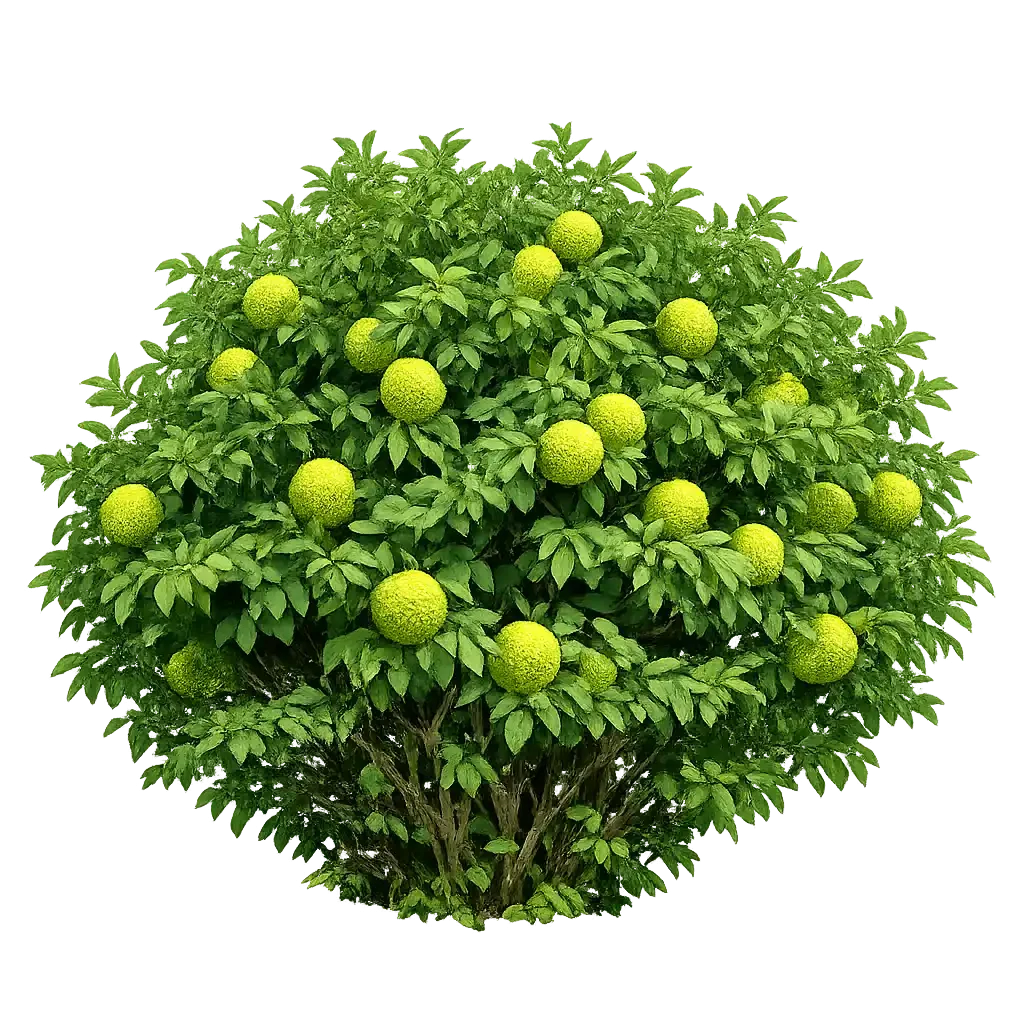
Osage orange, Maclura pomifera, is a deciduous tree native to a small natural range in the south-central United States, centered on the Red River valley of Texas, Oklahoma, and Arkansas. Its common name references the Osage Nation, whose territory encompassed part of its native range, and the large, knobby, lime-green fruit that resembles an orange in size and surface texture despite bearing no botanical relationship to citrus.
It is the sole species in the genus Maclura and belongs to the mulberry family, Moraceae, making it a relative of mulberry, fig, and breadfruit rather than of true oranges or any other fruit tree of the rose family. The large, bumpy green fruit, typically three to five inches in diameter, is botanically a multiple fruit composed of many small drupes fused together, and it contains a milky, sticky latex that oozes from any cut surface.
The tree grows naturally to thirty to sixty feet in height with a broad, irregular crown, but when managed as a hedge it is kept to six to ten feet through annual or biennial pruning and develops an entirely different character: a dense, low, multi-stemmed thicket of stiff, armed branches that is the functional equivalent of a wall. The thorns are stout, sharp, and positioned at the nodes along the stems, and in a well-established hedge they are present in sufficient density and rigidity to make the barrier genuinely impenetrable.
The wood of Osage orange is exceptionally hard, dense, and resistant to decay and insect damage, qualities that made it historically valuable for tool handles, wagon wheels, fence posts, and bows. Native peoples of the central plains prized it above all other woods for bow-making, and the tree was known to early French traders as bois d'arc, wood of the bow, a name that persists in some parts of its range today as bodark or bois d'arc.
The History of Osage Orange as a Living Fence
The story of Osage orange as a living fence plant is inseparable from the settlement of the American prairie. The treeless central plains offered essentially no timber for conventional fencing, and the cost of importing wood or stone to fence millions of acres of farmland was prohibitive. When agricultural journals in the 1840s and 1850s began promoting Osage orange as a living fence solution, the response was enormous.
By the 1860s, nurseries across the Midwest were growing millions of Osage orange seedlings annually, and the hedge became the standard boundary marker across Kansas, Iowa, Missouri, and the surrounding states. Estimates suggest that tens of thousands of miles of Osage orange hedge were planted across the prairie states before barbed wire arrived in the mid-1870s and made wire fencing economically practical for the first time.
The introduction of barbed wire dramatically reduced new Osage orange plantings, but the existing hedges remained and many persist to this day, more than a century and a half after planting. Their survival is itself a testament to the plant's extraordinary durability and longevity. For contemporary homesteaders revisiting the living fence tradition, that historical track record is a compelling endorsement.
Why Use Osage Orange for Living Fences and Security
Osage orange occupies a unique position among living fence plants because it is the most proven and historically validated option available in North America. The combination of qualities it brings to a boundary planting is difficult to match with any single alternative.
The thorns are long, rigid, and positioned at every node along the stems. In a hedge that has been properly established through annual heading-back in the early years, the stem density is such that the thorns interlock into a nearly continuous barrier at every height from ground level to the top of the hedge. Unlike barberry, which can be squeezed through by determined livestock at weak points, a mature Osage orange hedge managed to adequate width genuinely stops cattle, horses, and hogs without gaps.
It is also exceptionally cold-hardy, surviving the full range of prairie winters from zone 4 through zone 9 without protection or loss. It tolerates drought, heat, poor soils, and wind exposure with a resilience that few other woody plants match. Once established, it requires essentially no inputs to remain productive as a barrier.
The fence posts cut from Osage orange wood last in the ground for decades without treatment, outlasting treated pine posts by a significant margin. A homestead that establishes an Osage orange hedge has, in time, both a living fence and a self-renewing source of the most durable fence post material available in North America.
Climate and Growing Zones
Osage orange is broadly adapted and reliably hardy across USDA zones 4 through 9. Its native range in the south-central US represents only a fraction of the climatic conditions it tolerates, and it has naturalized widely across the eastern half of North America following its extensive planting during the living fence era.
It thrives in the continental climate of the central plains, tolerating extreme summer heat, severe winter cold, and prolonged drought with equal equanimity. In humid eastern climates it grows vigorously and fruits prolifically. In the drier western plains it establishes more slowly but remains productive once its roots reach reliable moisture.
It is not suited to the Pacific Coast climates of California, Oregon, and Washington, where it grows poorly compared to its performance in continental climates. For Pacific Coast homesteaders, alternatives such as hawthorn, firethorn, or rugosa rose are more appropriate living fence options.
Zone 4 performance: Osage orange is one of the very few large-growing thorned hedge plants that is reliably hardy to zone 4. For homesteaders in the upper Midwest and northern plains states who need genuine livestock containment from a living fence, it is effectively the only option that delivers the combination of cold hardiness, thorn density, and proven barrier effectiveness at this scale.
Sunlight Requirements
Osage orange requires full sun and performs best with six or more hours of direct sunlight daily. It is a plant of open, exposed sites in its natural range and reflects this in its growth habit: in full sun it develops the dense, well-armed, compact branching structure required for an effective hedge, while in shade it becomes tall, open, and poorly armed with reduced thorn density.
For hedge applications, full sun is not negotiable. Shaded plantings will not form effective barriers regardless of how well they are managed. Siting the hedge along a boundary that receives full sun throughout the growing season is the first requirement of a successful Osage orange planting.
Soil Requirements
Osage orange is one of the most soil-tolerant woody plants available. It grows in heavy clay, sandy loam, poor rocky soil, and compacted disturbed ground with comparable success, and it tolerates a very wide pH range from slightly acidic to moderately alkaline.
Its deep, wide-spreading root system allows it to access moisture and nutrients from a large soil volume, which contributes to its drought resilience and its ability to thrive where other plants struggle. This root system is also the reason Osage orange should be sited with care relative to underground utilities, drainage systems, and building foundations: the roots are vigorous, extensive, and capable of causing problems in poorly planned locations.
Good drainage is beneficial but not essential. Osage orange tolerates moderately wet soils and occasional flooding better than most of its companions in the hedge planting tradition, though it will not thrive in persistently waterlogged conditions.
Sex, Fruit, and Seedling Management
Osage orange is dioecious, meaning individual plants are either male or female, and only female plants produce the large green fruit. The fruit is not edible for humans, though squirrels and some other wildlife will extract and eat the seeds. The fruit falls in autumn and creates a significant litter issue under female trees, and the milky latex inside the fruit stains and is difficult to remove from clothing and skin.
For hedge plantings where fruit production and the associated mess and seedling spread are undesirable, two approaches are available. Planting male-only trees eliminates fruit production entirely. Male trees are not always reliably available from nurseries, but they can be selected by purchasing grafted plants propagated from confirmed male specimens.
Alternatively, maintaining the hedge through annual heading-back prevents the plants from reaching the size and maturity required for significant fruit production. Hedges that are kept hard-pruned produce little or no fruit and the litter and seedling problem is largely eliminated through management rather than plant selection.
Designing an Effective Osage Orange Hedge
The design of an Osage orange hedge for livestock containment follows principles developed and refined over generations of practical use on the American frontier, and the traditional approach remains the most effective one available.
The classic hedge design involves planting in a single row and then, through the first three to five years of annual heading-back, forcing the plants to branch densely from the base upward rather than growing into open-crowned trees. This heading-back is the critical management step that determines whether the eventual hedge is a genuine livestock barrier or merely a row of trees.
12 to 18 inches apart within the row for a dense, gap-free livestock barrier hedge
18 to 24 inches apart for a security hedge where livestock containment is not the primary goal
2 to 3 feet apart for a wider, more naturalistic hedgerow where maximum density is less critical
At least 6 to 8 feet from fences, structures, and underground utilities to allow for root spread and management access
The target for a finished livestock containment hedge is a barrier that is at least five feet tall, two to three feet wide at the base, and dense enough at ground level that a hog cannot push through at the base. Achieving this requires consistent management in the establishment years and cannot be shortcut by wider spacing or less frequent pruning.
When to Plant Osage Orange
Osage orange is best planted in early spring while still dormant, from bare-root stock which is widely available and economical for establishing long hedge runs. Bare-root whips planted in early spring establish rapidly and grow vigorously through the first season, often outpacing container-grown plants set out later in the year.
Container-grown plants are also available and can be planted throughout the growing season with attentive watering, but the cost per plant is higher and the establishment advantage of early spring bare-root planting is meaningful for large-scale hedge projects.
Fall planting of dormant bare-root stock is also effective in zones 5 and warmer, where the mild autumn conditions allow root establishment before winter. In zones 4 and colder, spring planting is preferred.
Planting Process
Mark the planting line clearly and precisely before beginning. For a livestock containment hedge, absolute consistency in spacing is important for uniform barrier development. String lines and measured stakes ensure accuracy over long runs.
Prepare the soil along the planting line by loosening it to at least twelve inches depth. Osage orange establishes in poor soil but loosening the planting zone reduces transplant stress and accelerates early growth.
For bare-root whips, dig a hole or slot deep enough to accommodate the full root length without bending or cramping the roots. Spread the roots evenly and set the crown at soil level.
Backfill firmly, eliminating air pockets around the roots. Water in thoroughly even in moist soil conditions.
Cut each newly planted whip back to six to twelve inches immediately after planting. This severe heading-back at planting is the first and most important step in establishing the dense basal branching required for an effective hedge. It feels drastic but is essential.
Apply mulch along the planting run to conserve moisture and suppress competing vegetation, which is the primary threat to newly planted whips in the establishment year.
The Critical Heading-Back Program
The management of Osage orange in the establishment years is what separates a genuine living fence from a row of trees, and it requires a commitment to annual pruning that some growers find counterintuitive. The instinct when growing a hedge is to let the plants grow as quickly as possible to their target height. With Osage orange, the opposite approach produces the better result.
In the first year after planting, the headed-back whips will produce multiple shoots from the cut stump. At the end of the first growing season or in early spring of the second year, head these shoots back again to within a few inches of the previous cut. This forces branching from extremely low on the plant, building a dense framework of stems from ground level upward.
Repeat this heading-back annually for three to five years. Each year the plant builds more stems from progressively more branching points, and the overall structure becomes increasingly dense and interlocked. After three to five years of consistent heading-back, allow the hedge to grow to its target height, shearing the sides to maintain the desired width and the top to maintain the desired height.
The traditional prairie hedge management also included weaving and interlacing the stems of adjacent plants together as they grew, a practice called laying the hedge, which further increased interlocking density at the base. While labor-intensive, this traditional technique produces the most impenetrable barriers and is worth considering for sections of hedge where maximum livestock containment is critical.
Patience is the requirement: A properly established Osage orange hedge takes five to eight years to reach full barrier effectiveness. This timeline cannot be accelerated meaningfully by any management shortcut. Growers who understand and accept this from the outset, and who maintain interim fencing during the establishment period, are rewarded with a barrier of extraordinary durability. Those who expect faster results will be disappointed.
Watering Needs
Osage orange is exceptionally drought tolerant once established and is one of the most self-sufficient woody plants available for dry-climate homesteads. Its deep root system accesses moisture from well below the surface zone, allowing it to survive extended drought conditions that would stress or kill most other hedging plants.
During the establishment year, consistent moisture is important for rapid root development and strong first-season growth. Water deeply once or twice per week in dry conditions through the first growing season. From the second year onward, supplemental irrigation is rarely necessary except during severe, prolonged drought.
Fertilization Strategy
Osage orange requires essentially no fertilization on average soils. Its vigorous root system accesses nutrients effectively from a wide soil volume, and in most planting situations it grows well without any supplemental feeding.
On exceptionally poor, sandy, or nutrient-depleted soils where first-season growth is very slow, a modest application of balanced organic fertilizer in early spring of the second year can support establishment. Beyond this, the standard approach for Osage orange is to plant it, manage it through the heading-back program, and otherwise leave it alone. It does not need or benefit from the ongoing fertilization program that more demanding hedging plants require.
Pruning the Established Hedge
Once the Osage orange hedge has completed its establishment heading-back program and reached its target height, annual maintenance pruning is straightforward but physically demanding. Heavy leather gloves, long sleeves, eye protection, and ideally leather chaps or heavy trousers are essential. The thorns are long, stout, and positioned to snag clothing and skin from every direction, and working in a mature Osage orange hedge without adequate protection results in significant injury.
Prune once annually in late winter before new growth begins. Using loppers and a pruning saw rather than power hedge trimmers is the practical approach for most homestead-scale hedges: the stems are thick and woody, the thorns interfere with power tool operation, and the precision of hand tools allows better control of the hedge profile.
Shear the sides to maintain the desired width and cut the top to the target height. Remove any dead wood and cut back any excessively long shoots that have broken out of the hedge profile. The goal is a hedge that is maintained at a consistent size year to year, with a slightly wider base than top to ensure light reaches the lower stems.
Osage orange tolerates hard renovation pruning extremely well. Sections of hedge that have become overgrown, gapped, or misshapen can be cut back hard to eighteen inches or lower in late winter and will typically regrow vigorously from the base, allowing the hedge to be rebuilt over two to three seasons.
Wood: The Secondary Harvest
The prunings and thinnings from an Osage orange hedge are not waste material. They are some of the most valuable wood produced by any managed plant in North America, and treating them as a secondary crop rather than a disposal problem changes the economics of the hedge considerably.
Osage orange wood has a Janka hardness rating of approximately 2,620 pounds-force, making it harder than hickory, oak, and most other North American hardwoods. It is extraordinarily resistant to rot and insect damage, with fence posts cut from Osage orange lasting fifty years or more in the ground without treatment. This durability is the result of the high concentrations of natural compounds including 2,3,4,5-tetrahydroxystilbene that permeate the heartwood and resist fungal and insect attack.
The wood burns with exceptional heat output and is one of the most BTU-dense firewoods available, producing roughly 32 million BTUs per cord, which compares favorably with anthracite coal and significantly outperforms oak, hickory, and most other commonly available firewood species. For homesteads that heat with wood, the annual prunings from a long Osage orange hedge represent a meaningful fuel resource.
The wood is also valued by craftspeople for tool handles, mallet heads, and turned objects where hardness and durability are required. Historically it was the premier bow wood of the North American plains, and it continues to be sought by traditional bowyers for this purpose.
Wildlife Value
A mature Osage orange hedge is a significant wildlife habitat feature. The dense, thorned interior provides nesting cover and predator protection for songbirds at a level that few other hedgerow plants approach. The complexity and depth of the habitat created by an established Osage orange hedge, with its multiple layers of interlocking stems and thorns, supports a range of bird species that use it for both nesting and winter shelter.
The large fruit, while not palatable to most wildlife in its intact form, is consumed by squirrels and other rodents that extract and eat the seeds. In regions where this occurs, the hedge provides a reliable autumn and winter food source. The seeds are also dispersed by water along stream corridors, which is one of the mechanisms by which Osage orange has naturalized well beyond its original range.
The spring flowers, though inconspicuous, provide pollen for bees and other early pollinators. The overall ecological contribution of an established Osage orange hedgerow to a homestead landscape is substantial and long-lasting.
Pests and Diseases
Osage orange is remarkably free of serious pest and disease problems, which is one of its most practical advantages as a long-term hedge plant. The same natural compounds that make its wood so rot-resistant also appear to confer significant resistance to most fungal pathogens and wood-boring insects.
No significant diseases are known to threaten established Osage orange hedges under normal conditions. Occasional scale insect infestations can appear on young plants in the establishment period but rarely persist on vigorous established plants. The plant is not a host for the serious diseases that affect related fruit trees, and it requires none of the preventive disease management that firethorn, serviceberry, or other rose family members may need.
The most significant practical concern is not pest or disease related: it is the spread of the plant beyond the intended hedge boundary through root sprouting and seed dispersal. Osage orange spreads by root sprouts that can emerge several feet from the hedge line, and in areas where the fruit is produced and dispersed by water or wildlife, seedlings can establish at a distance from the parent planting. Managing root sprouts along the hedge edges and preventing the spread of fruiting material beyond the homestead boundary are ongoing but modest management tasks.
Pros and Cons of Planting Osage Orange
Advantages
The most historically proven living fence plant in North America
Exceptional cold hardiness, reliable from zone 4 to zone 9
Thorning density unmatched by any other common hedge plant
Extremely drought tolerant once established
Tolerates poor, compacted, and difficult soils
Requires essentially no fertilization or disease management
Produces the most rot-resistant natural fence post material available
Among the highest BTU-density firewoods in North America
Exceptional nesting habitat and predator cover for birds
Extraordinarily long-lived, with hedges persisting for well over a century
Limitations
Requires five to eight years of managed establishment before full effectiveness
Deciduous, losing barrier density somewhat in winter
Large, messy fruit from female plants creates litter and staining
Root sprouts require ongoing management along hedge edges
Pruning and maintenance demand heavy protective gear throughout
Not suitable for Pacific Coast climates
Requires interim fencing during the long establishment period
Milky latex from cut surfaces stains clothing and skin
Long-Term Planning Considerations
Osage orange is the ultimate long-term living fence investment. No other single plant decision a homesteader makes will still be delivering value one hundred years from now, but an Osage orange hedge planted with proper technique and managed through its establishment years will. The existing nineteenth-century hedges still standing across the American Midwest are the evidence.
The most important planning decisions are siting the hedge with adequate clearance from structures, utilities, and property boundaries to allow for mature root spread and ongoing management access, committing to and following through on the heading-back program in the establishment years, and maintaining interim fencing throughout the period before the hedge reaches full effectiveness.
For homesteads with livestock to contain, predators to exclude, or boundaries to define in a permanent and self-sustaining way, Osage orange is in a category by itself. The patience it demands is real. So is what it delivers.
Final Thoughts
Osage orange is not a plant for the impatient or the uncertain. It is a plant for homesteaders who think in decades, who want a boundary that improves with age rather than deteriorating, and who are willing to do the management work in the early years to earn something that will outlast them and the next generation after them.
In return for that patience and commitment, it delivers the most effective living fence available in North America, some of the most valuable wood that can be grown on a homestead, exceptional wildlife habitat, and a connection to a long tradition of land stewardship that no manufactured product can replicate. For the right homestead and the right grower, there is nothing quite like it.