
Rugosa Rose
Written By Arthur Simitian
Rugosa rose is the living fence that also feeds you. Among the thorned hedging plants in this series it stands alone in offering genuine food value alongside its security function, producing large, nutritious rose hips that are among the richest natural sources of vitamin C available from any plant. Add to this an exceptional fragrance, some of the most beautiful flowers of any hardy shrub, extraordinary cold hardiness to zone 2, and a thorning density that stops deer, dogs, and determined humans, and it becomes clear why rugosa rose belongs on virtually every homestead that has space for a productive boundary planting.
This guide covers rugosa rose in full: what it is, how it functions as a living fence and security hedge, planting, care, pruning, the edible and medicinal value of its hips and petals, variety selection, invasiveness considerations, and an honest assessment of its strengths and the management it requires.
What Is Rugosa Rose
Rugosa rose, Rosa rugosa, is a species rose native to the coastal and inland regions of northeastern China, Korea, Japan, and the Russian Far East, where it grows naturally in sandy soils along shorelines, forest margins, and disturbed ground. It has been cultivated in East Asian gardens for centuries and was introduced to Western horticulture in the late eighteenth century, where it quickly proved itself one of the hardiest and most adaptable roses available.
The common name rugosa refers to the distinctive wrinkled, deeply veined texture of the leaves, which gives the plant a coarser, more substantial appearance than most cultivated roses and contributes to its resistance to the fungal diseases that plague hybrid tea and floribunda roses. The leaves turn attractive shades of yellow and orange in fall before dropping, extending the plant's ornamental value into the colder months.
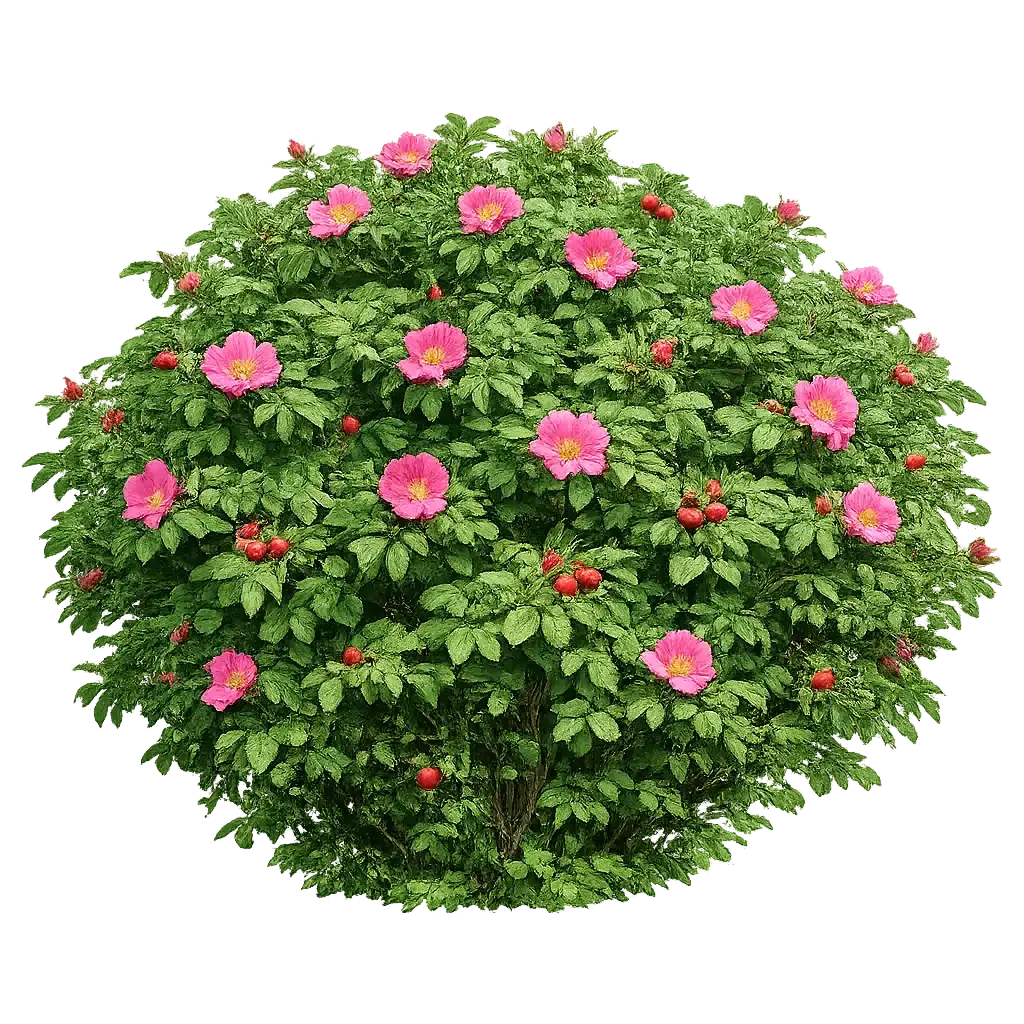
The flowers are large, typically three to four inches across, with five petals in the species form, intensely fragrant, and produced in repeated flushes from late spring through fall rather than in a single annual bloom. Color in the species is a deep, rich magenta-pink, and cultivars extend this range to pure white, pale pink, deep red, and various shades between. The fragrance of rugosa rose is widely regarded as among the finest of any hardy rose, and it is used in the perfume industry as a source of rose absolute.
The thorns are numerous, varied in size, and distributed densely along every stem. Unlike some roses that are thorned primarily on the larger canes, rugosa rose produces thorns at every scale from large curved prickles to fine bristles that cover the stems almost continuously. This multi-scale thorning makes it particularly effective as a barrier plant because there is no comfortable way to grip or push through the stems at any point.
The hips are large, typically one inch or more in diameter, bright red to orange-red, and appear from late summer onward, often persisting on the plant alongside the late flowers into autumn and early winter. They are among the largest rose hips produced by any species and among the most nutritionally rich, containing exceptionally high concentrations of vitamin C along with vitamin A, antioxidants, and flavonoids.
Why Use Rugosa Rose for Living Fences and Security
The case for rugosa rose as a security hedge begins with its thorning. The combination of large curved prickles and fine bristle-like thorns covering every stem from base to tip creates a plant that is genuinely painful and deterring to push through. Unlike barberry, which is thorned at discrete points along relatively smooth stems, rugosa rose offers no comfortable grip anywhere on its stems. Animals and people who test a mature rugosa hedge typically do not do so twice.
Beyond thorning, rugosa rose spreads by root suckers to form a dense, multi-stemmed thicket over time. A planting that begins as a single row fills in laterally over years, creating a barrier of increasing width and depth that becomes more, not less, effective with age. This self-thickening habit is one of the characteristics that makes rugosa rose particularly well suited to boundary plantings where the goal is a permanent, self-sustaining barrier rather than a precisely maintained formal hedge.
The combination of security function, edible hips, outstanding fragrance, repeated flowering across a long season, excellent cold hardiness, and tolerance of difficult coastal and exposed sites makes rugosa rose one of the most complete boundary plants available to the homestead. No other plant in this series offers the same breadth of function from a single planting.
Climate and Growing Zones
Rugosa rose is one of the most cold-hardy roses available, reliably hardy in USDA zones 2 through 7 and performing well in zone 8 in cooler, moister parts of that zone. Its native habitat in the coastal and inland regions of northeastern Asia includes climates with extreme winter cold, and this origin gives it a cold hardiness that few other ornamental shrubs can match.
It is particularly well suited to coastal climates, tolerating salt spray, sandy soils, and strong winds that would damage or kill most other hedging plants. In maritime climates it is one of the standard choices for coastal boundary plantings precisely because its performance under these conditions is outstanding.
In zone 8 and warmer, rugosa rose can struggle with the heat and humidity of long southern summers. It is prone to fungal disease pressure in hot, humid conditions and may perform poorly compared to its cold-climate counterparts. For warm-climate homesteads, other species better suited to heat and humidity are more appropriate choices.
Coastal and exposed sites: Rugosa rose is one of very few thorned security hedge plants that thrives in salt spray, sandy soils, and full coastal exposure. For homesteads near salt water or on exposed, wind-swept sites where other hedging plants fail, it is often the only practical thorned option available.
Sunlight Requirements
Rugosa rose performs best in full sun and produces its most prolific flowering, largest hip crops, and densest growth with six or more hours of direct sunlight daily. In full sun it is also most resistant to fungal disease, as good light and air movement around the foliage reduces the humidity at the leaf surface that fungal pathogens exploit.
It tolerates partial shade and will grow and flower in sites receiving four to five hours of sun, but flowering is reduced, hips are fewer and smaller, and the open, looser growth habit produced in shade is less effective as a physical barrier. For both food production and security function, full sun is always the appropriate target.
Soil Requirements
Rugosa rose is notably tolerant of poor, sandy, and infertile soils, which sets it apart from most other roses and makes it practical for the difficult boundary sites where many hedging plants struggle. Its native coastal habitat is primarily sandy, well-drained ground, and it reflects this in its preference for lean, open soil over the rich, heavily amended beds that hybrid roses typically require.
It grows well across a soil pH range of roughly 5.5 to 7.0 and tolerates mildly alkaline conditions in coastal settings where salt accumulation raises soil pH. Good drainage is important, as rugosa rose does not perform well in persistently waterlogged soil, though it handles seasonal moisture variation better than many other roses.
Importantly, rugosa rose does poorly in heavily clay soils that have been over-amended with organic matter. Rich, moisture-retentive soils produce lush, soft growth that is more susceptible to fungal disease and produces fewer flowers and hips than the lean, slightly stressed growth of plants in well-drained, moderately infertile soil. Restraint in soil enrichment is the appropriate approach.
Designing an Effective Rugosa Rose Hedge
Rugosa rose can be managed as a formal clipped hedge, though this requires ongoing shearing and significantly reduces hip production. For most homestead applications, a more naturalistic approach that allows the plant to develop its characteristic arching, suckering habit produces the most effective barrier with the least management effort and the greatest secondary yield of hips and flowers.
The suckering habit means that plants spread laterally over time regardless of initial spacing, so the initial spacing primarily affects how quickly a continuous barrier develops rather than the ultimate width of the planting.
2 to 3 feet apart for a dense, quickly closing security hedge
3 to 4 feet apart for a productive hedgerow where hip yield and flower display are priorities alongside security
4 to 5 feet apart for a naturalistic boundary planting where lateral suckering will fill gaps over time
At least 3 to 4 feet from paths and areas of regular foot traffic to prevent incidental contact with thorns and bristles
Because rugosa rose spreads by suckering, growers should plan for the hedge to widen by one to two feet per side over time in good conditions. Installing a root barrier along the inner edge of the planting is worth considering if lateral spread into garden beds or lawn areas is undesirable.
When to Plant Rugosa Rose
Rugosa rose is best planted in early spring while still dormant or in fall after the summer heat has passed. Bare-root plants, available in early spring from specialist rose nurseries, are economical for establishing long hedge runs and establish rapidly when planted before bud break. Container-grown plants are available throughout the growing season and can be planted at any time with attentive watering, though spring and fall establishment is preferable.
In zones 2 through 5, spring planting is strongly preferred, giving the roots a full growing season to establish before the first winter in the ground. In zones 6 and 7, fall planting works well and often produces vigorous plants the following spring.
Planting Process
Wear thick leather gloves and long sleeves before handling rugosa rose. The bristle-like thorns covering the stems are fine enough to work through standard gardening gloves and cause persistent irritation. Rose gauntlets are the appropriate protection.
Mark the planting line and dig holes two to three times the width of the root ball and no deeper than the root ball itself. For bare-root plants, dig a hole wide enough to spread the roots without cramping.
Set the plant so the bud union, the swollen point where the canes join the rootstock, sits just at or slightly below soil level. For own-root rugosa plants, which are common, set the crown at soil level.
Backfill with native soil. Avoid heavy amendment, as rugosa rose performs better in lean soil than in enriched beds. A modest addition of compost is acceptable but heavy enrichment is counterproductive.
Water thoroughly to settle the soil around the roots and eliminate air pockets.
Apply two to three inches of mulch around the base, keeping it pulled back from the main canes to prevent crown rot and reduce vole habitat at the stem base.
Watering Needs
Rugosa rose is moderately drought tolerant once established and significantly more resilient to dry conditions than hybrid roses. Its native coastal habitat experiences periods of drought, and its deep root system allows it to access moisture from well below the surface zone.
During establishment, consistent moisture supports rapid root development and strong first-season growth. Deep watering once or twice per week during dry spells in the first growing season is appropriate. From the second year onward, established rugosa roses in average soils typically require supplemental watering only during extended drought. Overwatering in heavy soils increases fungal disease pressure and should be avoided.
Fertilization Strategy
Rugosa rose is a light feeder and performs best with modest annual nutrition rather than the heavy feeding programs associated with hybrid roses. An application of compost worked lightly into the soil around the drip line in early spring is the standard and most effective approach.
Avoid high-nitrogen fertilizers, which produce lush, soft growth that is significantly more susceptible to fungal disease and produces fewer flowers and hips than the firmer, more disease-resistant growth from lean feeding. If the plants show strong healthy growth and flower reliably, no additional fertilization beyond annual compost is necessary. The goal is to feed the soil moderately and let the plant regulate its own growth rather than to push vigorous production through heavy inputs.
Pruning Rugosa Rose
Heavy leather gloves, long sleeves, and eye protection are essential for all pruning work on rugosa rose. The fine bristle-like thorns are particularly effective at working their way into skin and under fingernails, and working without adequate protection is genuinely uncomfortable and potentially problematic if thorns break off under the skin.
Rugosa rose does not require the detailed annual pruning program that hybrid roses need, and heavy pruning actually reduces hip production by removing the flowering wood that carries the current season's fruit. The appropriate approach depends on whether the hedge is being maintained formally or naturalistically.
For naturalistic hedgerow management, prune lightly in late winter or early spring by removing dead, damaged, or crossing canes and cutting the oldest, most exhausted canes at the base to encourage fresh growth from the crown. Avoid cutting back the main canes heavily, as this removes the flowering and fruiting wood. Light annual renewal pruning maintains vigor without sacrificing the hip crop.
For a more formal, controlled hedge, shear after the main spring flowering flush and again in late summer. This produces a tidier appearance but significantly reduces hip production and the secondary bloom flushes that make rugosa rose so productive across the season. Growers who want both the formal hedge appearance and the full hip crop need to choose one priority or the other, as the pruning requirements conflict.
Rugosa rose tolerates hard renovation pruning and will regrow vigorously from old wood. Overgrown or neglected plants can be cut back to twelve to eighteen inches in late winter and will typically produce strong new growth within a single season.
When to Expect Effective Barrier Coverage
Rugosa rose establishes more quickly into an effective barrier than most other security hedge plants because of its suckering habit. Plants set out at two to three foot spacing typically begin to form a continuous, thorned barrier within two to three years as the canopies close and the lateral suckering fills in gaps between plants. By year four or five a well-established planting is a dense, multi-stemmed thicket that most animals will not attempt to penetrate.
The self-widening habit means the barrier actually improves and deepens over time without any additional planting or management, which is one of the characteristics that distinguishes rugosa rose from more static hedging plants.
Rose Hips: Edible and Medicinal Value
The rose hips of rugosa rose are one of the most nutritionally significant edible products available from any hedging plant, and for food-focused homesteads they transform the boundary planting from a pure security feature into a productive element of the food system.
Rugosa hips are large, fleshy, and flavorful compared to the hips of most other rose species. They contain exceptionally high concentrations of vitamin C, with some analyses showing levels twenty times higher than oranges by weight, making them one of the richest natural sources of vitamin C available from any temperate plant. They also contain significant quantities of vitamin A, vitamin E, vitamin K, and a range of antioxidant flavonoids and carotenoids.
The hips are best harvested after the first frost, which converts some of their starches to sugars and softens the flesh. The interior of the hip contains seeds surrounded by irritating fibrous material that should be removed before consumption. The processed hip flesh and juice are the parts used in cooking and medicine.
Rose hip jam and jelly, where the natural pectin content and sweet-tart flavor produce outstanding results
Rose hip syrup, a traditional Scandinavian and British preparation used as a vitamin C supplement and flavoring
Rose hip tea, made from dried hips, one of the most pleasant and nutritious herbal teas available
Rose hip soup, a traditional Scandinavian dish still widely made in Sweden and Norway
Rose hip powder, dried and ground for use as a nutritional supplement and flavoring ingredient
Infused vinegars and shrubs for culinary use
Rose hip oil, cold-pressed from the seeds, used in skin care for its high essential fatty acid content
A mature, well-established rugosa hedge produces hips in substantial quantities each autumn. Even a modest planting of ten to twenty feet can yield enough hips for meaningful household use of jam, syrup, and tea through the winter months.
Rose Petals: Culinary and Aromatic Uses
The petals of rugosa rose are intensely fragrant and entirely edible, and they offer a secondary culinary yield alongside the hips that makes the plant even more productive from a food garden perspective.
Fresh petals can be used to infuse sugar, vinegar, honey, and butter with their distinctive fragrance and flavor. Rose petal jam is a traditional preparation across many cultures. Dried petals are used in potpourri, herbal sachets, and bath preparations. The essential oil content of rugosa petals is high enough that they are commercially harvested for rose absolute production, and homemade rose water and rose-infused preparations from rugosa petals have a quality that those from less fragrant rose species cannot match.
For harvest, collect petals in the morning after any dew has dried and before the heat of the day reduces volatile oil content. The most intensely fragrant petals come from flowers that are just opening rather than fully open.
Ornamental Value
Rugosa rose earns its place in any landscape on ornamental grounds alone, entirely apart from its security and food functions. The flowers are large, intensely fragrant, and produced in repeated flushes from late spring through fall, providing a level of bloom continuity that most flowering shrubs cannot match. The fragrance carries on the air from a considerable distance and is one of the defining sensory experiences of the summer garden on a warm, still morning.
The large, bright red to orange-red hips that develop alongside the late flowers create a striking combination of bloom and fruit in autumn that is unique among hedging plants. The wrinkled, dark green foliage turns yellow and orange before dropping in fall. In winter the stout, bristled canes provide structure and the persistent hips, if not yet taken by birds, maintain color in the dormant landscape.
Wildlife Value
Rugosa rose is one of the most ecologically generous hedging plants available. Its dense, deeply thorned interior provides nesting habitat and predator cover for songbirds that few other shrubs match in effectiveness. The repeated flowering across the entire growing season provides a continuous nectar and pollen resource for bees, including native bumblebees that are particularly attracted to the open, accessible flower form of the species and single-flowered cultivars.
The large hips persist well into winter and provide an important food source for birds including waxwings, thrushes, and robins during the period when other food is scarce. A mature rugosa hedge is a genuine wildlife asset that contributes meaningfully to pollinator populations and winter bird food supplies simultaneously.
Invasiveness Considerations
Rugosa rose has naturalized in parts of North America and northern Europe, where birds disperse the seeds from hips and the plant can establish in coastal dunes, roadsides, and disturbed areas. In some coastal regions of the northeastern United States, Atlantic Canada, and parts of northern Europe it is considered invasive and displaces native coastal vegetation.
The invasiveness risk is highest in coastal environments with sandy soils and mild maritime climates that closely resemble the plant's native habitat. In inland continental climates, naturalization is much less common and invasiveness is generally not a significant concern.
Growers in coastal regions of the northeastern US and maritime Canada should research current local guidance before planting. Sterile or low-fruiting cultivars, or careful removal of hips before they are consumed by birds, can reduce dispersal risk while retaining the plant's other values. In regions where it is listed as invasive, native thorned alternatives such as wild plum, hawthorn, or native rose species are the responsible choice.
Pests and Diseases
Rugosa rose is significantly more resistant to the fungal diseases that devastate hybrid roses than virtually any other commonly cultivated rose species. Its thick, wrinkled foliage and natural disease resistance make it largely immune to the black spot, powdery mildew, and rust that require constant management on hybrid varieties. This disease resistance is one of its most practical advantages for low-input homestead plantings.
Japanese beetle is the most consistent pest concern in regions where that insect is present. Beetles feed on the flowers and foliage and can cause significant cosmetic damage, though healthy established plants typically recover without lasting harm. Hand removal in the early morning when beetles are sluggish, combined with avoiding the use of beetle traps near the hedge, is the most effective management approach.
Rose sawfly can occasionally cause defoliation of new growth in spring but is rarely serious on established plants. Aphids may colonize new growth but are typically managed by beneficial insects without intervention on healthy, well-sited plants.
Variety Selection
The straight species, Rosa rugosa, is available in both the deep magenta-pink form and a white-flowered form, Rosa rugosa alba, both of which produce large hips in abundance and represent the most vigorous, disease-resistant, and cold-hardy options available. For pure function as a security hedge and food plant, the straight species is difficult to improve upon.
Hansa is one of the most widely planted rugosa cultivars, producing intensely fragrant double flowers in deep violet-crimson and large hips, with excellent cold hardiness to zone 2 and vigorous, suckering growth well suited to hedge applications. It is a standard recommendation for cold-climate security hedges where hip production is also a goal.
Blanc Double de Coubert is a white-flowered double cultivar of exceptional fragrance and elegance, hardy to zone 3 and producing good hips in a planting with cross-pollination from another variety nearby. It is somewhat less vigorous than Hansa but produces one of the finest fragrances of any rugosa cultivar.
Frau Dagmar Hartopp, also sold as Fru Dagmar Hastrup, is a compact single-flowered cultivar with pale pink flowers, large hips, and an excellent balance of modest size with good barrier effectiveness, suitable for smaller spaces where the full vigor of Hansa would be excessive.
For maximum hip production, single-flowered varieties consistently outperform doubles, as the double flower form reduces the plant's ability to set fruit. Growers prioritizing the hip harvest should choose single or semi-double flowered varieties.
Pros and Cons of Planting Rugosa Rose
Advantages
Exceptional cold hardiness, reliable from zone 2 to zone 7
Multi-scale thorning creates a genuinely deterring barrier
Produces edible hips among the richest in vitamin C of any plant
Intensely fragrant flowers across a long season from spring to fall
Outstanding ornamental value across all seasons
Tolerates coastal exposure, salt spray, and sandy soils
Self-thickening suckering habit improves barrier with age
Highly disease resistant compared to other roses
Exceptional wildlife value for bees and winter-foraging birds
Petals and hips both have culinary and medicinal uses
Limitations
Invasive in some coastal regions of northeastern North America and Europe
Suckering spread requires management if lateral growth is undesirable
Pruning and maintenance require heavy protective gear throughout
Heavy pruning for formal appearance eliminates the hip harvest
Japanese beetle pressure can be significant in affected regions
Not well suited to hot, humid climates in zone 8 and warmer
Deciduous, losing some barrier density in winter
Hip processing requires removal of seeds and fibrous interior material
Long-Term Planning Considerations
Rugosa rose planted thoughtfully and managed with a light hand becomes one of the most self-sustaining and rewarding elements of a homestead boundary. Its suckering habit means it builds a wider, denser barrier over time without additional planting. Its annual hip and petal production means it contributes to the household food supply every year. Its exceptional cold hardiness and disease resistance mean it requires less ongoing intervention than almost any other comparably productive hedging plant.
The most important long-term planning decisions are ensuring adequate clearance for lateral spread, selecting varieties appropriate to the climate and the intended balance between security function and food production, and understanding the invasiveness context for the specific region before planting. In regions where rugosa rose presents invasiveness concerns, the responsible approach is either to choose a different plant or to manage hip dispersal carefully through timely harvest before birds take the fruit.
For cold-climate homesteads in zones 2 through 6 where the invasiveness concern does not apply, rugosa rose is one of the most complete and satisfying boundary plants available. It earns its space through beauty, fragrance, security, food, and ecological function simultaneously, season after season, for decades.
Final Thoughts
Rugosa rose is the living fence that asks the grower to think beyond the single function of deterrence. Yes, it stops animals and deters intruders. But it also fills the air with one of the finest fragrances in the plant world from late spring through fall, feeds bees and birds generously across every season, and produces nutritious hips that belong in the kitchen pantry as much as any fruit from a dedicated food planting.
In the right climate and on the right site, there is no single plant that delivers more value per square foot of boundary than a well-established rugosa rose hedge. It is a plant that rewards patience, rewards light management, and rewards the grower who is willing to see a boundary not merely as a line of defense but as a productive, living part of the homestead.