
Siberian Peashrub
Written By Arthur Simitian
Siberian peashrub is the cold-climate homesteader's nitrogen-fixer. Where autumn olive cannot survive the winter, where goumi struggles and most leguminous shrubs give up, Siberian peashrub thrives. It has been tested against the most brutal winters of the northern plains, the Siberian steppe, and the Canadian prairies, and it does not merely survive these conditions: it grows productively in them, fixing nitrogen, providing livestock fodder, producing edible seeds, establishing windbreaks on exposed sites, and supporting pollinators with its bright yellow flowers. For homesteads in zones 2 through 6 searching for a multi-functional, low-input soil-building shrub, the search ends here.
This guide covers Siberian peashrub completely: what it is, how it fixes nitrogen, its livestock and human food applications, how to establish and manage it, its windbreak and agroforestry value, its ecological contributions, and the honest limitations that every grower should understand before planting.
What Is Siberian Peashrub
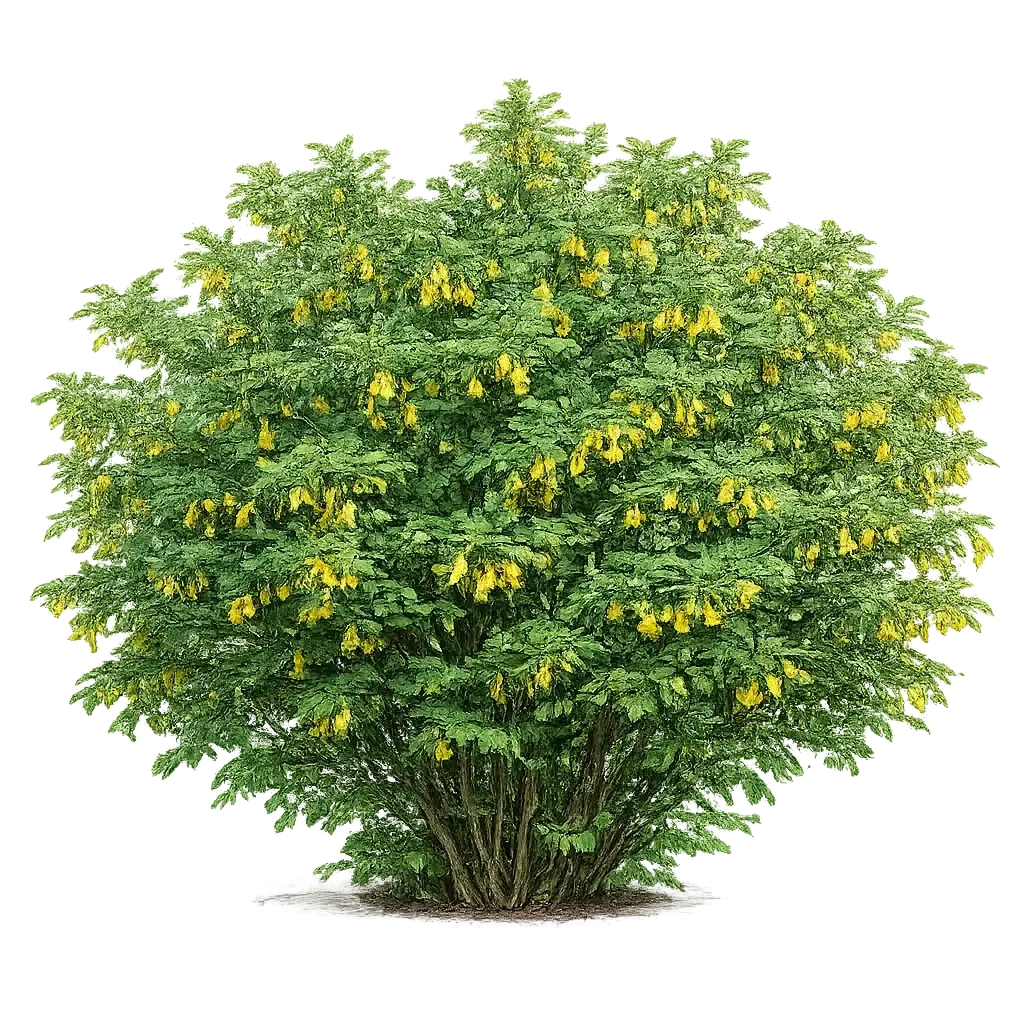
Siberian peashrub, Caragana arborescens, is a large, fast-growing deciduous shrub or small tree in the legume family, Fabaceae, native to Siberia, Mongolia, and the adjacent regions of central Asia, where it grows across a vast range of climates including some of the coldest, driest, and most nutrient-depleted soils on the continent. Its survival across this range reflects adaptations that make it one of the most resilient woody plants available for difficult growing conditions.
The plant grows vigorously into a large, upright to arching shrub reaching eight to eighteen feet in height and six to twelve feet in spread, depending on the cultivar and growing conditions. The growth rate is fast for a woody plant, commonly adding one to three feet of height per year in favorable conditions, which makes it one of the quickest-establishing large shrubs available for windbreak and hedgerow plantings.
The foliage is pinnately compound, with eight to twelve small, oval leaflets arranged in pairs along each leaf stem, giving it a fine, feathery texture that is light and airy in appearance despite the plant's substantial overall size. The leaves emerge early in spring, bright green and fresh, and remain clean and healthy through the growing season before dropping in fall without significant fall color.
The flowers are the plant's most immediately attractive feature: bright, clear yellow, pea-shaped, and produced in clusters of two to five along the previous year's wood in late spring. They appear before the foliage has fully expanded, making the display more visible than it would be on a fully leafed-out plant, and the flowering period is a notable landscape event for two to three weeks. The flowers are attractive to bumblebees and native bees, which are the primary pollinators.
The seed pods that follow the flowers are small, narrow, linear pods two to four inches long, green ripening to tan and then splitting open with an audible pop when fully ripe in mid to late summer. Each pod contains four to six small seeds that are nutritious, edible, and of genuine interest as a food source for both humans and livestock. The pods scatter their seeds by the twisting, splitting mechanism rather than relying on animal dispersal, which limits their spread beyond the immediate planting area.
The stems are armed with small paired spines at the base of each leaf, which provide a modest deterrent to casual browsing by livestock and deer but are not substantial enough to create an effective barrier hedge in the way that hawthorn, barberry, or Osage orange can. Siberian peashrub is not a security hedge plant. It is a nitrogen-fixing fodder and windbreak shrub, and that is where its value lies.
Nitrogen Fixation and Soil Health
Siberian peashrub fixes atmospheric nitrogen through the standard legume mechanism of Rhizobium bacterial symbiosis in root nodules, with fixation rates estimated at fifty to one hundred pounds of nitrogen per acre per year in favorable conditions. This is comparable to or better than other commonly recommended nitrogen-fixing shrubs, and it is delivered year after year from a plant that requires essentially no inputs to maintain its productivity.
The nitrogen fixed by established Siberian peashrub becomes available to neighboring plants through root nodule decomposition, root exudates, and the annual incorporation of leaf litter. In a windbreak or hedgerow system, the soil in the immediate vicinity of Siberian peashrub plants shows measurable improvement in nitrogen status over time, reducing or eliminating external nitrogen inputs needed by adjacent crops and fodder plants.
On severely degraded sites, including eroded hillsides, compacted former cropland, and alkaline or saline prairie soils where most plants will not establish, Siberian peashrub is one of the few woody nitrogen-fixers that will grow reliably. The combination of extreme cold hardiness, drought tolerance, and soil adaptability gives it a range of deployment options that more demanding nitrogen-fixers simply cannot match.
The deep taproot that Siberian peashrub develops over several years penetrates compacted soil layers, improving drainage and aeration while accessing subsoil moisture that surface-rooted plants cannot reach. This root architecture is one of the mechanisms by which the plant survives extended drought and contributes to the long-term physical improvement of degraded soils alongside its chemical nitrogen contribution.
Coppicing, the practice of cutting the shrub to near ground level on a rotation, produces large quantities of nitrogen-rich green material that can be used directly as chop-and-drop mulch around neighboring plants or incorporated into compost to produce a high-quality fertility amendment. Coppiced Siberian peashrub regrows vigorously from the stump and root system, making this a sustainable management practice that harvests the above-ground nitrogen while preserving the soil-building root network.
Livestock Fodder Value
Siberian peashrub has been used as a livestock fodder plant across its native range in central Asia for centuries, and the research conducted on its fodder value confirms what traditional practice established empirically: it is a nutritious and well-accepted browse for a range of livestock species.
The foliage contains protein levels comparable to conventional legume forages, with dry matter protein content typically ranging from sixteen to twenty-five percent depending on the growth stage at harvest. This protein level is genuinely competitive with alfalfa and other high-quality legume forages, and it is delivered from a perennial woody plant that requires no annual replanting, no cultivation, and minimal inputs to maintain productivity year after year.
Goats and sheep browse the foliage readily and can be used as a management tool to maintain the size of established plants, converting the growth into productive livestock nutrition. The small paired spines on the stems do not prevent browsing but do discourage the most aggressive grazing pressure, which is functionally useful for protecting the plants from complete defoliation.
Chickens and other poultry consume the seeds with enthusiasm, and the seed pods can be harvested at various stages of ripeness and fed directly without processing. For poultry operations where reducing grain inputs is a priority, Siberian peashrub planted in or adjacent to the ranging area provides a supplemental protein source during the summer seed production period.
The seeds have also been evaluated as a protein supplement for cattle and pigs, and their protein and energy content compares favorably with conventional feed grains. On homesteads where growing some portion of livestock feed on-site is a goal, the seed harvest from an established Siberian peashrub windbreak or hedgerow represents a meaningful contribution to the annual feed budget.
Caragana as poultry fodder: Among cold-climate homesteaders raising pastured poultry, Siberian peashrub planted along poultry ranging boundaries is one of the most productive fodder investments available. The combination of protein-rich foliage within reach of foraging birds and a summer seed crop that falls within the ranging area reduces grain dependence significantly on homesteads where the birds have adequate access to established plantings.
Edible Seeds for Humans
The seeds of Siberian peashrub are edible for humans and nutritious enough to be considered a genuine food crop rather than merely a survival food, though they remain little known in mainstream cooking and are almost exclusively used on homesteads where the plant is already grown for its other functions.
The seeds have a flavor and texture comparable to lentils or small dried peas, which is unsurprising given that they are in the same legume family as both. They can be cooked and eaten as a vegetable in the green pod stage, similar to fresh peas or edamame. At the dry seed stage they can be cooked as a lentil substitute in soups, stews, and dals, ground into a protein-rich flour, or sprouted for fresh greens.
The protein content of the dry seeds is approximately thirty-six percent, which is comparable to soy and significantly higher than most conventional grain crops. For homesteads in cold climates where soy does not perform reliably, Siberian peashrub seeds represent one of the few locally producible high-protein plant foods available from a perennial plant without annual cultivation.
The seeds contain some antinutritional factors common to raw legumes, including trypsin inhibitors and lectins, that are substantially reduced or eliminated by thorough cooking. Eating the seeds raw or undercooked is not recommended. Fully cooked, they are safe and nutritious. Fermentation, as in traditional legume preparations, further improves digestibility and nutrition.
Harvest the seeds when the pods have turned tan and just before they split open, which is the window of two to three days between full seed maturity and the explosive dehiscence that scatters them. Laying a tarp beneath the plants and shaking the branches dislodges ripe pods efficiently. Pods can also be collected by hand over several days as they approach full maturity. After collection, spread the pods in a single layer to dry completely before threshing and winnowing to separate the seeds from the pod material.
Climate and Growing Zones
Siberian peashrub is reliably hardy from USDA zone 2 through zone 7 and is one of the coldest-hardy large shrubs available from any source. In zone 2, where temperatures can drop to negative fifty degrees Fahrenheit in exceptional cold events, Siberian peashrub survives and continues growing productively. This cold hardiness is unmatched by any other commonly grown nitrogen-fixing shrub and is the primary reason it is the standard recommendation for cold-climate homesteaders across the northern United States, Canada, and similarly cold regions worldwide.
It performs best in the cool to cold continental climates of zones 2 through 5 and is the dominant woody legume in traditional land management systems across Siberia, Mongolia, and the northern plains of China for good reason: it was selected by centuries of practical use in exactly these conditions. In zones 6 and 7 it grows and performs adequately but is less vigorous and productive than in cooler climates, and in zones 8 and warmer it declines and is not an appropriate choice.
The combination of extreme cold hardiness and drought tolerance makes Siberian peashrub particularly well suited to the northern Great Plains of North America, where harsh winters, low rainfall, high winds, and alkaline soils create growing conditions that challenge most plants. In these conditions it is not merely adequate but genuinely excellent, performing better than in the milder and moister conditions of more temperate regions.
Sunlight Requirements
Siberian peashrub performs best in full sun and produces its most vigorous growth, most prolific flowering, and most active nitrogen fixation with six or more hours of direct sunlight daily. It is a plant of open, exposed sites in its native range and reflects this in its preference for full sun over shaded conditions.
It tolerates partial shade but grows more slowly, flowers less abundantly, and fixes nitrogen less actively in shaded conditions. For windbreak, hedgerow, and agroforestry applications where maximum productivity is the goal, full sun siting is always preferred. Unlike American hazelnut or false indigo, which have meaningful shade tolerance, Siberian peashrub's value is most fully realized on open, sunny sites.
Soil Requirements
Siberian peashrub's tolerance of difficult soils is one of its most practically useful characteristics and the quality that makes it deployable on sites where other nitrogen-fixing shrubs will not establish. It grows in poor, sandy soils, alkaline and mildly saline soils, rocky and gravelly ground, compacted former cropland, and the eroded, nutrient-stripped soils of overgrazed or disturbed sites.
It handles soil pH from approximately 6.0 to 8.5, which includes the highly alkaline conditions of many prairie and high plains soils where most leguminous plants perform poorly. This alkaline tolerance is a significant distinguishing characteristic: most nitrogen-fixing plants decline in alkaline conditions as key nutrients become unavailable, but Siberian peashrub maintains productive growth across a pH range that excludes most competitors.
Good drainage is important. Siberian peashrub does not tolerate persistently wet or waterlogged soils, and on poorly drained sites it will decline and eventually fail. On sites with drainage concerns, raised bed establishment or planting on berms and mounds keeps the root zone above the waterlogged layer and allows the plant to establish successfully.
On highly fertile, heavily amended soils Siberian peashrub grows rapidly and vigorously but may produce more vegetative growth and less seed than on leaner soils. As with all nitrogen-fixing plants, moderate rather than rich soil conditions maintain the most active nodule symbiosis and the best balance of vegetative growth and reproductive output.
Windbreak and Shelterbelt Value
Siberian peashrub has been one of the primary windbreak and shelterbelt plants across the northern Great Plains and prairie provinces since the large-scale shelterbelt planting programs of the 1930s, when millions of plants were established across the Dust Bowl-affected regions to reduce wind erosion and protect farmsteads. The shelterbelts planted during that era are still standing and still performing across the northern plains, which is a powerful endorsement of the plant's durability and long-term effectiveness.
The fast growth rate, dense branching habit, cold hardiness, and drought tolerance that make it effective as a windbreak plant are the same qualities that make it valuable in other roles. A Siberian peashrub windbreak becomes functionally effective within three to five years of planting, providing meaningful wind reduction that protects garden crops, orchards, livestock housing, and the farmstead generally from the desiccating winds that make cold-climate agricultural production more difficult.
In a multi-row shelterbelt design, Siberian peashrub is typically planted in the middle rows between taller trees on the windward exterior and lower shrubs on the leeward interior. Its intermediate height and dense branching fills the middle zone of the windbreak cross-section most effectively, creating a graduated barrier that reduces wind velocity without the turbulence that a solid barrier can create.
The nitrogen fixed by the Siberian peashrub rows in a multi-species shelterbelt improves the soil fertility of the entire planting over time, supporting the growth and health of the tree species planted alongside it. This soil-building contribution to the windbreak system as a whole is a secondary benefit that multiplies the value of the nitrogen-fixing function beyond the immediate root zone of the Siberian peashrub plants themselves.
How Far Apart to Plant
3 to 4 feet apart for a dense fodder hedge or screen planting where rapid canopy closure is the primary goal
4 to 6 feet apart for a multi-functional hedgerow combining fodder, nitrogen fixation, and wildlife cover
6 to 8 feet apart in the middle row of a multi-row windbreak or shelterbelt planting
8 to 10 feet apart for food forest or agroforestry support species plantings where individual plant development is prioritized
At least 4 feet from fences, structures, and property boundaries to allow for mature spread and management access
When to Plant Siberian Peashrub
Siberian peashrub is best planted in early spring while dormant, from bare-root stock which is economical, widely available, and the standard form used for large-scale windbreak and reclamation plantings. Bare-root whips planted before bud break establish rapidly and can add two feet or more of growth in their first season under favorable conditions.
Container-grown plants are available from some specialty nurseries and can be planted throughout the growing season, though spring planting in the ground when soil temperature and moisture conditions are favorable gives the best establishment results. In zones 2 through 4, spring planting is strongly preferred. In zones 5 through 7, fall planting of dormant plants also works well.
Siberian peashrub can also be grown from seed, which is inexpensive and sometimes the most practical option for large-scale plantings. Scarify the hard seed coat by rubbing briefly on sandpaper or soaking in warm water for twenty-four hours before sowing, which significantly improves germination rates. Sow outdoors in early spring or start indoors six to eight weeks before the last frost date.
Planting Process
Choose a site in full sun with good drainage. Avoid low areas where water collects and stands. On sites with alkaline soils, no amendment is needed: Siberian peashrub tolerates these conditions naturally and does not require pH adjustment.
For bare-root whips, dig a hole or planting slot deep enough to accommodate the full root length without bending or cramping. The taproot of Siberian peashrub can be surprisingly long relative to the above-ground size of the plant, and accommodating it fully at planting supports rapid establishment.
On sites with no prior legume planting history, dust the roots with a Rhizobium inoculant formulated for Caragana or for legumes generally before planting. This step is particularly important on severely depleted or sterilized soils where the appropriate Rhizobium strains may be absent.
Set the plant so the crown is at soil level and backfill firmly with native soil without amendment. Water in thoroughly even in moist conditions to settle the soil around the roots.
Apply mulch along the planting run to conserve moisture and suppress competing vegetation, which is the primary threat to bare-root whips in the establishment year. Weed competition in the first season is the most common cause of establishment failure for Siberian peashrub, particularly on disturbed sites where annual weeds grow aggressively.
If deer pressure is significant in the area, protect individual plants with tree tubes or wire cages through the first two to three seasons. Deer browse Siberian peashrub readily and can set back or kill newly planted whips before they develop enough size to tolerate browsing.
Watering Needs
Siberian peashrub develops exceptional drought tolerance once established and is one of the most self-sufficient large shrubs available for dry-climate homesteads. On the dry northern plains where annual rainfall may be fifteen inches or less, established Siberian peashrub survives and produces without supplemental irrigation in most years.
During the establishment year, consistent moisture supports rapid taproot development and strong first-season growth. Deep watering once or twice per week during dry spells in the first growing season is appropriate. From the second year onward, supplemental watering is rarely necessary except during severe drought on the most free-draining soils.
Fertilization Strategy
Siberian peashrub must not receive nitrogen fertilization. The reasoning is identical to that for all nitrogen-fixing legumes: external nitrogen suppresses nodule activity and eliminates the plant's most valuable contribution to the surrounding soil system. On phosphorus-depleted soils, a modest application of rock phosphate at planting supports nodule establishment. Beyond this, the appropriate fertilization program is none.
On excessively fertile soils or in heavily amended garden beds, Siberian peashrub may grow so vigorously that its size and spread become difficult to manage. Planting it in its intended context of hedgerows, windbreaks, and agroforestry systems on average to lean soils produces the most appropriate growth rate alongside the most active nitrogen fixation.
Pruning and Coppicing
Siberian peashrub responds exceptionally well to pruning and coppicing and is one of the easiest large shrubs to manage through these techniques. It regrows vigorously from the base after hard cutting, tolerates annual shearing for formal hedge applications, and maintains productivity across a wide range of management intensities.
For windbreak and hedgerow applications where size management and dense canopy are the primary goals, annual shearing in late winter maintains the plants at a consistent height and encourages dense lateral branching. For fodder applications where the focus is on producing fresh, protein-rich growth accessible to livestock, coppicing on a two to three year rotation harvests the above-ground biomass while the root system and nodule network remain intact and continue fixing nitrogen.
Coppicing is best done in late winter before new growth begins. Cut the plants to six to twelve inches above the ground, leaving a short stump from which vigorous new shoots will emerge in spring. The resulting regrowth in the first season after coppicing is rapid and produces abundant, palatable, high-protein young foliage that is among the most nutritious growth the plant produces across its full cycle. This fresh coppice regrowth is particularly valuable as a high-quality fodder harvest in systems where the plants are also managed for windbreak and nitrogen fixation functions.
For seed production, avoid hard pruning in the year when a significant seed harvest is planned, as the seeds are produced on mature wood. Light maintenance pruning that removes dead wood and maintains shape without removing substantial quantities of productive branches allows seed production to continue alongside general management.
Ornamental Value and Landscape Use
Siberian peashrub is more ornamentally attractive than its purely utilitarian reputation suggests. The bright yellow pea flowers produced in abundance in late spring are genuinely cheerful and visible from a distance, creating a notable seasonal display for two to three weeks. Several cultivars have been selected specifically for ornamental use, with weeping, compact, and fine-leaved forms available from nurseries specializing in ornamental woody plants.
Pendula is a widely available weeping form grafted onto standard rootstock, producing a distinctive small weeping tree that is attractive as a specimen plant in formal and informal landscape settings. Lorbergii is a fine-leaved selection with a more delicate, ferny texture than the standard species, valued for ornamental plantings where the coarser texture of the species is considered too heavy.
For homestead applications where ornamental value is a consideration alongside functional performance, the standard species form is attractive enough to hold its own in most landscape contexts, and its spring flowering is a genuine asset in the shoulder season between late winter dormancy and the full flush of summer growth.
Wildlife Value
Siberian peashrub makes meaningful wildlife contributions across its range, particularly in the cold-climate regions where its cold hardiness makes it one of the dominant woody plants in managed landscapes and shelterbelts.
The spring flowers are attractive to bumblebees and native bees that are among the first to emerge from dormancy in cold climates, providing pollen and nectar at a time when food sources are limited. The dense branching habit of established plants provides nesting cover and winter shelter for a range of songbirds and small mammals. Pheasants and other ground-nesting birds use the dense shelterbelt plantings that incorporate Siberian peashrub for nesting and escape cover.
The seeds are consumed by songbirds including finches and sparrows, and the foliage is browsed by deer, which in managed contexts is a pressure to protect against during establishment but in naturalistic contexts contributes to the broader browse ecology of the landscape. On the northern Great Plains, the shelterbelt plantings of Siberian peashrub have created significant wildlife habitat value in an otherwise highly simplified agricultural landscape, and this ecological contribution is among the plant's most important legacies in North American land management.
Invasiveness Considerations
Siberian peashrub has been planted across enormous areas of North America in shelterbelt and windbreak programs since the 1930s and has not demonstrated the invasive tendency that would be expected from a plant with such extensive introduction if invasiveness were a significant concern. It does not spread by bird-dispersed seed, as its pod-splitting dispersal mechanism is self-limiting, and it does not sucker aggressively beyond its planting site in the manner of autumn olive or false indigo.
It is listed as potentially invasive in some localized contexts, particularly in certain prairie and grassland ecosystems of the northern Great Plains where it can establish along drainage areas and disturbed ground beyond shelterbelt edges. Growers near intact native grassland or prairie remnants should be aware of this potential and monitor for spread onto adjacent natural areas. In most agricultural and homestead contexts, however, Siberian peashrub is not a significant invasiveness concern.
Pests and Diseases
Siberian peashrub is generally free of serious pest and disease problems in North American growing conditions, which is consistent with the clean bill of health of most plants in their non-native range where the suite of co-evolved pathogens and herbivores is absent.
Caragana leaf beetle can cause significant defoliation in some regions, feeding on the foliage and reducing photosynthetic capacity and plant vigor. In outbreak years the defoliation can be severe but is rarely fatal to established plants, which recover and refoliate within the same season. Insecticide applications are rarely justified for this pest on homestead plantings where some foliar damage is acceptable and the systemic effects of insecticides on the plant's pollinator relationships and soil biology are a concern.
In very humid growing conditions, fungal leaf spot diseases can appear but are generally not serious on well-sited, adequately spaced plants with good airflow through the canopy. Siberian peashrub performs best in the drier, more continental climates to which it is adapted, and disease pressure is typically lowest in these conditions.
Pros and Cons of Planting Siberian Peashrub
Advantages
Hardy to zone 2, the most cold-tolerant nitrogen-fixing shrub available
Fixes significant nitrogen on even the most difficult soils
Tolerates alkaline, sandy, dry, and compacted soils with equal reliability
Fast-growing windbreak and shelterbelt component for exposed sites
Foliage is high-protein livestock browse readily accepted by goats and poultry
Seeds are edible and nutritious for both humans and livestock
Responds exceptionally well to coppicing for fodder biomass harvest
Bright yellow flowers support early-season native bees and pollinators
Proven performance in North American shelterbelt programs since the 1930s
No significant invasiveness concern in most homestead contexts
Limitations
Not well suited to zones 7 and warmer, declines in heat and humidity
Does not tolerate wet or waterlogged soils
Not an effective security or barrier hedge due to modest spine density
Seeds must be fully cooked before human consumption, not suitable raw
Deciduous, providing no winter wind protection or screening
Deer browsing pressure can be significant during establishment
Caragana leaf beetle can cause significant but temporary defoliation in some regions
No significant edible fruit yield for humans beyond the seed crop
Long-Term Planning Considerations
Siberian peashrub planted in the right context and climate is one of the most reliable long-term investments in soil health and fodder productivity available for cold-climate homesteads. The shelterbelt plantings established on the northern Great Plains nearly a century ago are the most compelling evidence: these plants have been fixing nitrogen, producing fodder, sheltering farmsteads from wind, and supporting wildlife continuously for eighty to ninety years without replanting, without fertilization, and with minimal maintenance.
The most important planning decisions are climate suitability, site drainage, deer protection during establishment, and the integration of coppice management into the broader fodder and soil health system. Siberian peashrub planted with these factors addressed and managed appropriately will still be performing every one of its functions decades from now, long after the grower has stopped thinking of it as a new planting and started thinking of it as a permanent feature of the landscape.
For cold-climate homesteads in zones 2 through 5, particularly those on the northern plains and in the upper Midwest and prairie provinces of Canada, Siberian peashrub is not a marginal or optional choice. It is one of the few plants that does everything the homestead needs from a nitrogen-fixing shrub in conditions where most alternatives simply will not survive, and that combination of extreme hardiness and multi-functional productivity makes it genuinely indispensable for the right homestead and the right climate.
Final Thoughts
Siberian peashrub does not have the immediate visual appeal of a flowering berry shrub or the novelty of a recently rediscovered food plant. What it has is a long track record of genuine performance in some of the most difficult growing conditions that temperate agriculture encounters, a set of functional contributions that address real needs on cold-climate homesteads, and a resilience that allows it to deliver these contributions year after year with minimal attention.
For the cold-climate homesteader who takes the long view, plants for the system rather than the season, and values reliable productivity over novelty, Siberian peashrub is one of the most rewarding shrubs in the entire toolkit. It is not flashy. It is not trendy. It works.