
Goumi
Written By Arthur Simitian
Goumi may be the most underappreciated shrub in the serious homesteader's toolkit. A nitrogen-fixing member of the Elaeagnus family, it produces abundant, nutritious, genuinely delicious berries weeks before most other fruit plants hit their stride, improves the soil around it every season it grows, provides fodder that livestock eat readily and safely, and does all of this on poor soils with minimal management. It offers most of the functional benefits of autumn olive without the invasiveness liabilities that make that plant so problematic across much of North America. The wonder is not that people grow goumi. The wonder is that so few of them do.
This guide covers goumi completely: what it is, how it fixes nitrogen and builds soil, its berry harvest and culinary value, its role as a livestock fodder plant, planting and care, variety selection, and an honest comparison with its more famous and more controversial relative, autumn olive.
What Is Goumi
Goumi, Elaeagnus multiflora, is a deciduous shrub in the family Elaeagnaceae, native to China, Korea, and Japan, where it has been cultivated for its edible berries for centuries and grows naturally in forest margins, hillsides, and disturbed ground across a range of elevations. The name goumi is the Japanese common name for the plant and is the term most widely used in English-language horticulture and permaculture literature.
It is closely related to autumn olive, Elaeagnus umbellata, and silverberry, Elaeagnus commutata, sharing the family's characteristic silver-scaled foliage, actinorrhizal nitrogen-fixing root associations, and small, fragrant spring flowers. Where goumi differs most significantly from autumn olive is in its berry timing, berry quality, growth habit, and invasive potential, all of which favor goumi for most homestead applications.
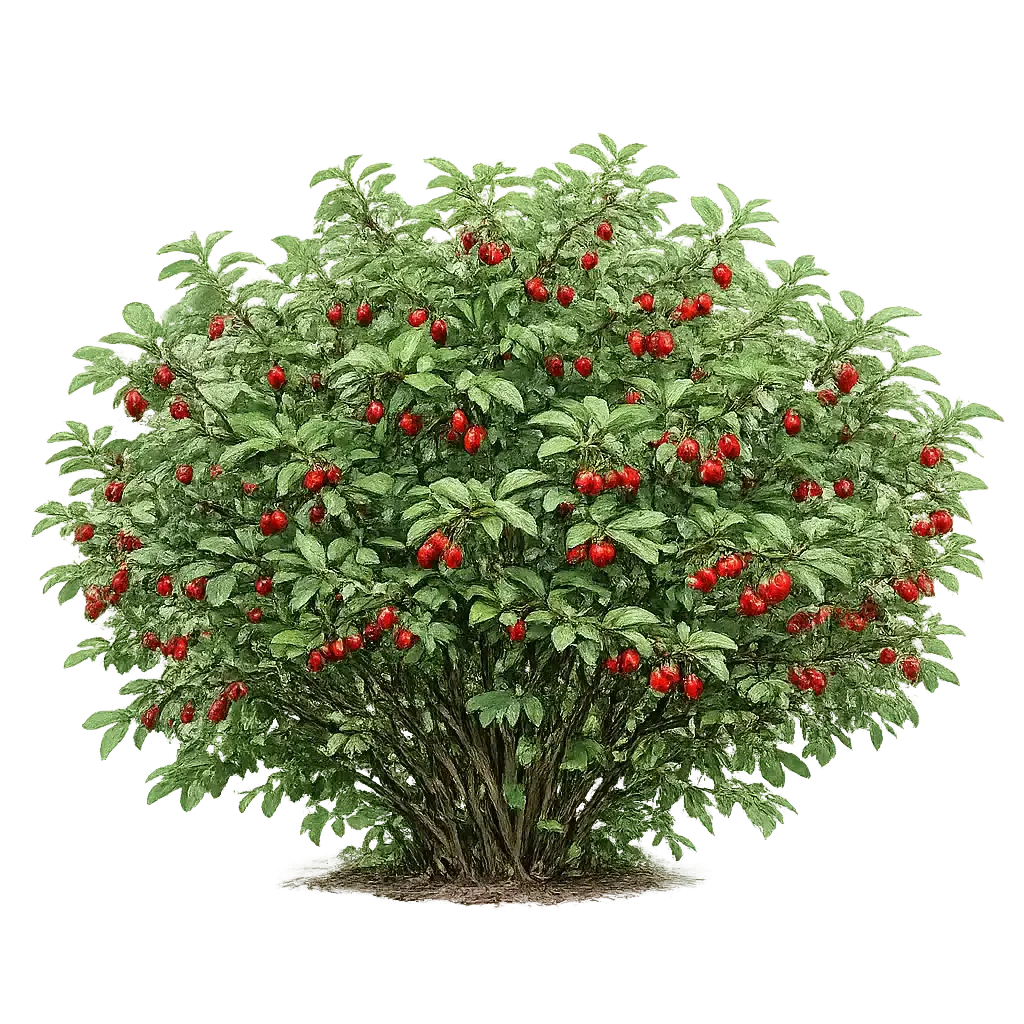
The plant grows as a medium to large spreading shrub, typically reaching six to ten feet in height and comparable spread at maturity. The foliage is oval, silver-green with the characteristic Elaeagnus scale covering, and attractive throughout the growing season. Some stems on mature plants carry small spines, though goumi is generally much less thorned than its relatives and does not form the impenetrable thickets that autumn olive can produce.
The flowers appear in spring, creamy yellow, tubular, intensely fragrant, and produced in clusters along the stems before the leaves have fully expanded. The fragrance is distinctive and carries well on warm spring air, making even a small planting noticeable at a distance during bloom. The flowers are followed by the berries that are goumi's most distinctive feature: small, oval to round, bright red with silver speckles, hanging in clusters from long slender stalks and ripening in late spring to early summer, well ahead of most other fruiting shrubs.
The roots host symbiotic actinobacteria of the genus Frankia, forming root nodules that fix atmospheric nitrogen in the same manner as autumn olive and all other members of the Elaeagnaceae family. This nitrogen-fixing capacity is continuous throughout the growing season and represents a significant ongoing contribution to soil fertility in any system where goumi is planted.
Goumi vs. Autumn Olive: The Key Comparison
Because goumi and autumn olive are so frequently discussed together, and because the choice between them is one that many homesteaders face directly, a direct comparison is worth addressing before moving into the detailed growing guide.
Autumn olive produces berries in autumn, after most other fruits have been harvested. Goumi produces berries in late spring to early summer, before most other fruits are available. This early bearing window is a significant practical advantage: goumi fills a genuine gap in the harvest calendar that autumn olive does not.
Autumn olive berries are astringent until after frost and require processing or freezing before they are palatable for most fresh eating. Goumi berries are sweet-tart and pleasant for fresh eating directly from the plant at harvest, with a flavor that most people find immediately appealing rather than requiring an acquired taste or processing to enjoy.
Autumn olive is listed as invasive across numerous eastern US states and is prohibited in several of them. Bird dispersal of its abundant fruit has spread it across millions of acres of natural areas in the eastern United States. Goumi has not demonstrated the same aggressive naturalization tendency in North America, and while caution and observation remain appropriate for any introduced plant, it is generally considered a lower-risk option.
Both fix nitrogen at comparable rates and provide similar soil-building contributions. Both are good livestock fodder plants, though goumi's track record of safe use is better documented. For most homestead applications in North America, goumi is the more appropriate choice and the one this guide recommends.
Nitrogen Fixation and Soil Health
Goumi fixes atmospheric nitrogen through its symbiotic association with Frankia actinobacteria in root nodules, with estimated fixation rates comparable to autumn olive at roughly forty to one hundred pounds of nitrogen per acre per year in favorable conditions. This nitrogen becomes available to the surrounding soil and neighboring plants through root nodule turnover, root exudates, and the decomposition of leaf litter.
In a food forest or agroforestry system, goumi planted as a support species beneath or alongside fruit trees provides a continuous nitrogen subsidy that reduces or eliminates the need for external nitrogen inputs to the system as a whole. The improvement in soil fertility accumulates over time as the root network expands and the annual leaf fall adds organic matter to the surface soil.
On degraded or depleted sites, goumi establishes readily and initiates a soil-building sequence that supports more diverse plant communities over time. Its tolerance of poor, infertile soils is genuine: it does not require enriched planting conditions to establish successfully and in fact performs better on lean soils where the nitrogen-fixing symbiosis is most actively maintained.
The deep, spreading root system also contributes to soil structure through physical penetration of compacted layers and through the creation of channels that improve water infiltration and aeration. On compacted former agricultural soils, the combination of biological nitrogen fixation and physical root action makes goumi one of the most effective single-species soil restoration tools available.
Livestock Fodder Value
Goumi is a genuinely useful and safe livestock fodder plant, which distinguishes it from false indigo and from autumn olive, whose fodder credentials carry more qualification. The foliage, young shoots, and berries are all consumed by livestock without the toxicity concerns associated with some other nitrogen-fixing shrubs, and the nutritional profile of the foliage compares favorably to conventional fodder crops.
The foliage contains reasonable protein levels and is browsed readily by goats and deer. Goats in particular will graze goumi enthusiastically and can be used as a management tool to control the size and spread of established plants, converting the growth into productive livestock nutrition. The foliage is also consumed by rabbits and chickens given access to the plants.
The berries are excellent fodder for poultry and pigs, providing a concentrated energy and nutrition source during the early summer ripening window. For pastured poultry operations where birds have access to the planting during fruiting season, goumi berries represent a meaningful supplemental food source that reduces grain inputs. The berries are small enough that chickens consume them whole, and both the flesh and the small seeds are digestible.
The leaves harvested as chop-and-drop mulch or incorporated into compost carry their nitrogen content into the composting process, producing a nitrogen-rich compost amendment that can be returned to the garden or food forest system to close the fertility loop.
Berry Harvest: Culinary and Nutritional Value
The goumi berry is the plant's most distinctive and immediately appreciated product, and it deserves detailed treatment for homesteads where the edible harvest is a priority alongside the soil-building and fodder functions.
The berries ripen in late May through June across most of zones 6 and 7, making them one of the earliest fruiting shrubs available in temperate homestead plantings. This early harvest window is genuinely valuable in a food calendar where June is otherwise a gap between the last of the spring crops and the beginning of summer fruits. A productive goumi planting fills that gap with a fresh berry crop that requires no processing to enjoy.
The flavor is sweet-tart with a mild astringency that most people find pleasant rather than off-putting. Unlike autumn olive berries, which require frost or freezing to become palatable for most fresh eaters, ripe goumi berries can be eaten directly from the plant throughout the harvest period. Flavor varies between plants and improves as berries reach full ripeness, transitioning from firm and tart to softer and sweeter over the course of the two to three week harvest window.
Nutritionally, goumi berries contain high levels of lycopene, the antioxidant carotenoid also found in high concentrations in autumn olive and tomatoes, along with vitamin C, vitamin A, essential fatty acids, and various flavonoids. The nutritional profile is comparable to autumn olive berries and significantly richer than most commonly grown soft fruits.
Fresh eating directly from the plant, particularly in the second half of the ripening window when flavor is fullest
Jam and jelly, where the natural pectin content and sweet-tart flavor produce excellent results
Fruit leather, dried by dehydrator or low oven for long-term storage
Juice and fruit wine, where the lycopene-rich flesh produces a deeply colored, nutritious product
Smoothies blended with other early summer fruits such as strawberries
Sauces and coulis alongside game meats, duck, and pork
Infused vinegars and shrubs for culinary use
Frozen whole for later use in cooked preparations through the year
A mature goumi plant of four to five years or older can yield five to fifteen pounds of berries per season, and a small planting of three to five productive plants provides a meaningful household supply. Cross-pollination between multiple plants, or between goumi and autumn olive if both are present, improves fruit set and yield.
Climate and Growing Zones
Goumi is reliably hardy across USDA zones 5 through 9, with some sources reporting success in protected zone 4 locations. Its native range in China, Korea, and Japan encompasses a range of temperate climates including regions with cold winters and hot, humid summers, which reflects the adaptability it shows in cultivation across similar North American climates.
It performs well across the eastern United States in zones 5 through 8, in the Pacific Northwest in zones 7 through 9, and in comparable climates in other parts of its hardiness range. In the hot, dry climates of the interior West it grows more slowly and requires supplemental irrigation to perform well, though it will establish and survive with adequate water.
Unlike autumn olive, which is broadly cold-hardy to zone 3, goumi is not suitable for the coldest northern and prairie climates. For zone 3 and 4 homesteads seeking a nitrogen-fixing Elaeagnus, silverberry, Elaeagnus commutata, is the native North American option, and Siberian pea shrub, Caragana arborescens, provides comparable nitrogen fixation with superior cold hardiness.
Sunlight Requirements
Goumi produces its best berry crops and most active nitrogen fixation in full sun, with six or more hours of direct sunlight daily. In full sun it also develops its most compact, well-branched habit and is least susceptible to fungal disease in humid climates.
It tolerates partial shade and will grow and produce reasonable crops in sites receiving four to five hours of direct sun, which makes it useful in the partially shaded understory layer of food forest systems. In shade its growth is more open and fruit production is reduced, but its nitrogen-fixing contribution continues at a reduced rate and it remains a functional support species in less-than-ideal light conditions.
Soil Requirements
Goumi is tolerant of poor, infertile soils and performs reliably on sandy, rocky, or compacted ground where most fruit-bearing shrubs would struggle. Like all members of the Elaeagnaceae, it manufactures its own primary fertility requirement through nitrogen fixation and does not need the rich, well-amended soil conditions that conventional fruit shrubs typically demand.
It grows well across a soil pH range of approximately 5.5 to 7.5, tolerating mild acidity and mild alkalinity with comparable success. Good drainage is beneficial, as goumi does not perform well in persistently waterlogged soils, though it handles seasonal moisture variation better than many other fruit shrubs. On very heavy clay soils, incorporating coarse material to improve drainage at the planting site supports better establishment and long-term performance.
Importantly, as with all nitrogen-fixing plants, goumi should not be planted in heavily fertilized soil or given nitrogen-rich amendments. Rich, heavily amended planting conditions suppress the nodule formation and nitrogen-fixing activity that are the foundation of the plant's soil-building value, and they produce lush, soft growth that is more susceptible to disease and less productive than the firmer growth of plants in leaner conditions.
Cross-pollination and yield: Goumi is largely self-fertile but produces significantly better fruit set and higher yields with cross-pollination from a second plant of a different variety, or from an autumn olive if one is present on the property. For maximum berry production, planting at least two named varieties within reasonable proximity of each other is the standard recommendation.
Spacing Goumi in Different Systems
6 to 8 feet apart for a productive hedgerow or nitrogen-fixing support planting alongside fruit trees
8 to 10 feet apart as an understory support species in a food forest where canopy trees will eventually shade the spacing
10 to 12 feet apart for freestanding specimen plants managed for maximum berry production
At least 5 feet from fences, structures, and paths to allow for mature spread and harvest access
When to Plant Goumi
Goumi is best planted in early spring while dormant or in fall after the summer heat has passed. Container-grown plants from specialist fruit nurseries and permaculture suppliers are the standard form available, as goumi is less commonly offered as bare-root stock than autumn olive. Spring planting gives the roots a full growing season to establish before winter, and is preferred in zones 5 and colder.
Fall planting works well in zones 6 and warmer, where mild autumns allow good root development before the first hard freeze. Goumi planted in fall in appropriate zones often establishes as well as spring plantings and may show slightly earlier growth in the following spring.
Planting Process
Select the planting site for full sun to partial shade with good drainage. Avoid low-lying frost pockets, which can damage the early spring flowers and reduce fruit set in years with late frosts.
Dig a planting hole two to three times the width of the container root ball and no deeper than the container depth. Goumi does not benefit from deep planting.
Remove the plant from its container and loosen any circling roots gently before setting it in the hole. Set the crown at the same level it was growing in the container.
On sites with no prior leguminous planting history, dusting the roots with a Frankia inoculant before backfilling supports the establishment of effective nitrogen-fixing nodules. This step is most valuable on sterilized or severely depleted soils.
Backfill with native soil without amendment. Goumi does not benefit from enriched planting holes and performs better in lean conditions.
Water thoroughly to settle the soil and eliminate air pockets around the roots. Apply two to three inches of mulch around the base, keeping it clear of the main stem to prevent crown rot.
Watering Needs
Goumi develops good drought tolerance once established but benefits from consistent moisture during the establishment year and during the fruit development period in spring. Dry conditions during fruit development can cause premature drop and reduce berry size and yield.
Deep watering once or twice per week during dry conditions in the first growing season supports rapid root development. From the second year onward, established plants on average soils typically require supplemental watering only during extended summer drought or in the weeks surrounding fruit development. On sandy, free-draining soils in dry climates, more regular supplemental irrigation maintains better productivity.
Fertilization Strategy
Goumi should not receive nitrogen fertilization at any point. The reasoning is identical to that for all nitrogen-fixing plants: external nitrogen suppresses the Frankianodule activity that represents the plant's most valuable soil contribution and produces excessive vegetative growth at the expense of fruit production.
An annual topdressing of compost around the drip line in early spring is the appropriate and sufficient maintenance feeding. On phosphorus-depleted soils, a modest application of rock phosphate or bone meal at planting supports nodule establishment. Beyond these light inputs, goumi requires no fertilization and is better served by restraint than by generosity in this area.
Pruning Goumi
Goumi flowers and fruits on wood from the previous year, which means timing and approach to pruning directly affects the berry harvest. Heavy pruning in late winter removes the flowering wood and eliminates or severely reduces the current season's fruit crop. Understanding this relationship is the foundation of productive goumi pruning.
The appropriate pruning approach for a berry-productive goumi is light annual renewal pruning in late winter: remove dead, damaged, or crossing canes, cut the oldest and most exhausted canes at the base to encourage vigorous new growth from the crown, and thin any inward-facing growth that reduces airflow through the canopy. Avoid cutting back the healthy one-year-old wood that will carry the current season's flowers and fruit.
After the harvest is complete in early summer, any shaping or size reduction pruning can be done on the current season's growth without affecting the following year's fruit, as the new growth produced after pruning will become the fruiting wood for the year after that. Summer pruning for size control is therefore the more productive approach for growers who want both good fruit yields and a manageable plant size.
Goumi tolerates hard renovation pruning and will regrow vigorously from old wood. Overgrown plants that have become too large or structurally disordered can be cut back hard in late winter with confidence that strong regrowth will follow, accepting the loss of one to two seasons of fruit production during the recovery period.
When to Expect the First Harvest
Goumi typically begins producing berries in the second or third year after planting from container-grown stock, with the first meaningful harvest usually arriving in year three to four. Yields build steadily as the root system develops and the plant reaches its productive maturity at around year five, after which consistent annual harvests can be expected from healthy, well-sited plants.
The harvest window is relatively short, typically two to three weeks in late May through June depending on the variety and the season. Checking the planting daily during this period and harvesting berries as they reach full ripeness prevents waste from overripe fruit dropping. The berries hold on the plant reasonably well once ripe but begin to soften and drop after a week or two at peak maturity.
Ornamental Value
Goumi is an attractive shrub throughout the growing season and earns its place in the landscape on ornamental grounds alongside its functional contributions. The silver-green foliage has a distinctive shimmering quality in the breeze, the intensely fragrant spring flowers are notable for both their scent and their appearance before the leaves have fully expanded, and the bright red berries hanging in clusters against the silver-green foliage in early summer create a striking display that few other shrubs match at that time of year.
In fall, the foliage turns yellow before dropping, providing a modest but pleasant seasonal transition. In winter the branching structure is clean and unobjectionable. For a plant that also fixes nitrogen, feeds livestock, and produces a human food crop, the ornamental quality is a genuine bonus rather than a compensation for other shortcomings.
Wildlife Value
The fragrant spring flowers of goumi are attractive to bees and other early-season pollinators, providing pollen and nectar at a time when many native pollinators are actively foraging but sources are relatively limited. The early fruiting in late May and June provides a food source for birds and small mammals during the late spring period before summer fruits are available, and the dense branching habit provides nesting cover for songbirds.
Unlike autumn olive, whose abundant fruit is consumed and dispersed by birds on a large scale, goumi's earlier-ripening and somewhat less prolific fruit is harvested more completely by the homesteader before birds can disperse it widely. This difference in fruit timing and quantity is part of why goumi presents a lower naturalization risk: the fruit is taken by the grower before it can become a dispersal event.
Invasiveness Considerations
Goumi is not currently listed as invasive in any US state and has not demonstrated the aggressive naturalization tendency that has made autumn olive so problematic across the eastern United States. This distinction is meaningful and is one of the primary reasons goumi is generally recommended as the preferred Elaeagnus for North American homestead plantings where the soil-building and food functions of the genus are desired.
That said, responsible practice requires continued observation rather than complete complacency. Goumi does produce viable seed dispersed by birds, and on some sites with favorable conditions it can naturalize to a limited extent. Harvesting the berries promptly and completely reduces the seed dispersal risk. Monitoring for any naturalized seedlings beyond the managed planting area and removing them promptly is good practice for any introduced fruiting plant.
In parts of Europe where goumi has been planted, some naturalization has been observed, and growers outside North America should research the current status of the plant in their specific region before planting. The general principle applies: any introduced fruiting plant with bird-dispersed seed carries some naturalization potential that warrants ongoing observation and responsible management.
Variety Selection
The number of named goumi varieties available in North American nurseries is growing as interest in the plant increases within permaculture and homestead growing communities, though selection remains more limited than for many conventional fruit crops.
Sweet Scarlet is one of the most widely available and recommended varieties, producing large, sweet berries with good flavor for fresh eating and reliable yields on a vigorous, productive plant. It is a standard recommendation for growers prioritizing fresh eating quality.
Red Gem is another commonly available variety, valued for its productivity and its somewhat more compact growth habit compared to some other selections, which makes it useful in smaller spaces or where size management is a priority.
Tillamook is a selection developed in the Pacific Northwest with particular performance in the cool, moist climates of that region. For Pacific Northwest homesteaders, it is worth seeking out locally developed varieties that have been selected for performance in regional conditions rather than defaulting to varieties selected for eastern US climates.
For growers who can source it, planting two or more named varieties ensures cross-pollination and the associated improvement in fruit set and yield that cross-pollination delivers. Any two goumi varieties will cross-pollinate effectively, and autumn olive if present will also serve as a cross-pollinator for goumi despite being a different species within the genus.
Pests and Diseases
Goumi is generally free of serious pest and disease problems and requires essentially no preventive management in this area. Its resistance to the fungal diseases that affect most fruit shrubs is a significant practical advantage, eliminating the spray programs that conventional fruit production typically requires.
Birds are the most significant competition for the berry harvest, and in some locations they can take a substantial portion of the crop before it is fully ripe. Netting the plants during the harvest window is the most effective protection, though on larger plantings this becomes logistically challenging. Growing more plants than strictly needed for household use ensures that a reasonable harvest remains after birds have taken their share.
Japanese beetle may occasionally feed on the foliage in regions where that pest is present. Healthy, established plants tolerate moderate defoliation without lasting harm, and hand removal in the early morning when beetles are sluggish is the most effective management approach without resorting to insecticides.
Pros and Cons of Planting Goumi
Advantages
Fixes nitrogen at rates comparable to autumn olive without the invasiveness risk
Produces early-season berries in late May to June, filling a genuine harvest gap
Berries are sweet-tart and pleasant for fresh eating directly from the plant
Safe and readily accepted livestock fodder for goats, poultry, and pigs
Establishes on poor, infertile, and degraded soils
Fragrant spring flowers support bees and early pollinators
Significantly lower invasiveness risk than autumn olive in North America
Attractive silver-green foliage with ornamental value across all seasons
Requires no fertilization and minimal pest and disease management
Effective support species in food forest and agroforestry systems
Limitations
Less cold-hardy than autumn olive, not reliable below zone 5
Named varieties can be harder to source than conventional fruit shrubs
Berry harvest window is short, typically two to three weeks only
Requires cross-pollination for maximum fruit set and yield
Some naturalization potential with bird-dispersed seed warrants monitoring
Heavy pruning in late winter removes fruiting wood and reduces crop
Does not provide winter screening or structure as a deciduous plant
Berry yield per plant is lower than autumn olive in comparable conditions
Long-Term Planning Considerations
Goumi rewards long-term thinking and integrative planning. Its greatest contributions accumulate over time: nitrogen fixation builds soil fertility progressively, the root system develops slowly into a wide network that influences the soil chemistry of a surprisingly large surrounding area, and the berry yield increases year over year as the plant reaches its full productive maturity.
In a food forest system, goumi planted in the shrub layer beneath or alongside fruit trees contributes to the productivity of the entire system by improving soil fertility for the trees it grows near. In a hedgerow, it provides nitrogen to neighboring productive plants while contributing its own fruit harvest and pollinator support. On a degraded or depleted site, it initiates the soil-building process that makes the land progressively more productive for everything that follows.
Planning for at least two plants of different varieties from the beginning maximizes fruit production through cross-pollination. Planning for the short harvest window and having processing capacity ready, whether for fresh eating, jam-making, or freezing, prevents waste during the concentrated two to three week period when the berries are ready. And planning for the long view, accepting that the first few seasons are an investment in the plant and soil infrastructure that will pay dividends for decades, is the mindset that goumi rewards most generously.
Final Thoughts
Goumi is a plant whose time in the broader homesteading conversation is overdue. It does not have autumn olive's name recognition or the controversy that comes with it. It does not have the thousand-year cultivation history of the apple or the pear. What it has is a genuinely impressive combination of soil-building function, early-season food production, safe and productive livestock integration, low maintenance requirements, and responsible ecological behavior that most gardeners and homesteaders discover only once they have planted one and watched it perform across several seasons.
The homesteader who plants goumi today is planting something that will still be improving the soil, feeding the livestock, filling the early summer harvest basket, and supporting the pollinators decades from now. That is a combination worth far more attention than it currently receives.