
White Orpington
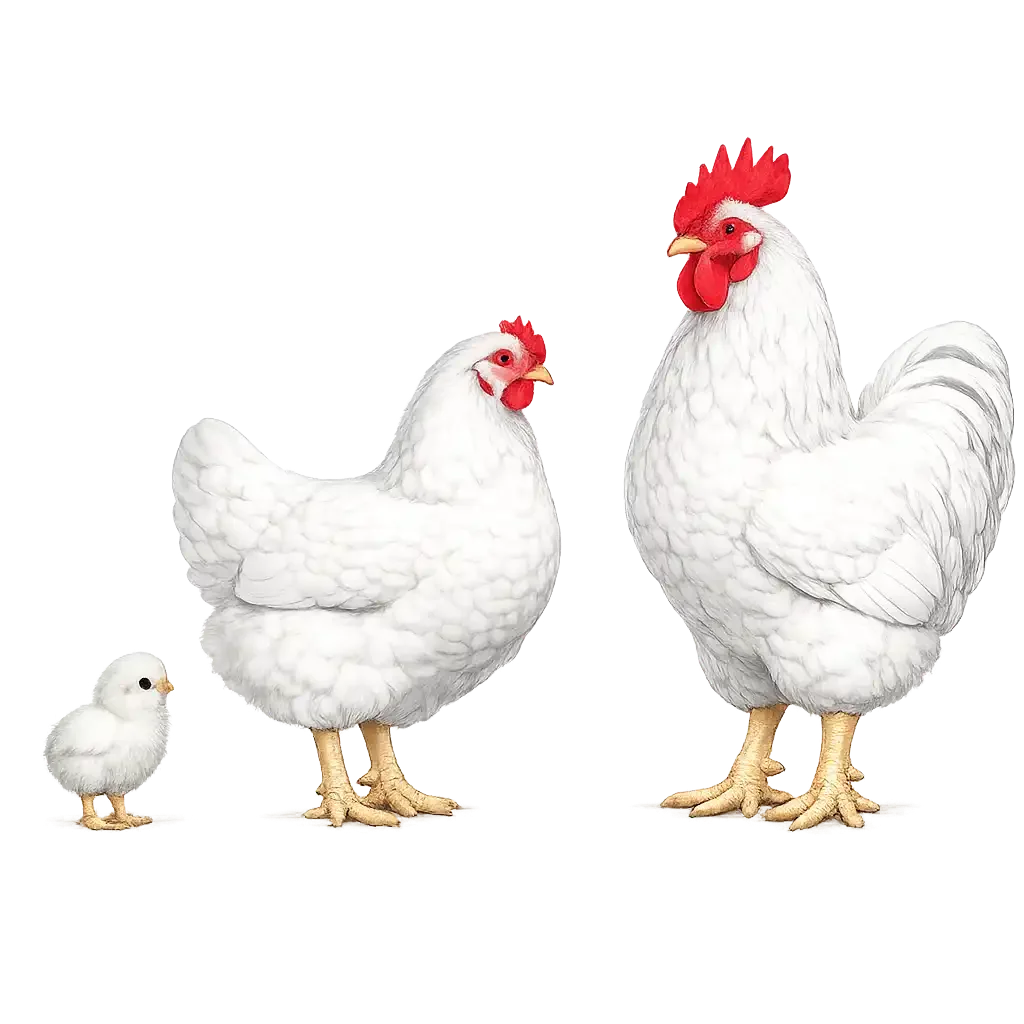
The White Orpington is one of four APA-recognized varieties of the Orpington breed, sharing the breed's foundational character across all practical dimensions while carrying specific plumage and origin details that distinguish it from the more widely kept Buff. It was recognized by the APA in 1905 alongside the Black variety, three years after the Buff's 1902 recognition, and it carries all the traits that made the Orpington one of the most celebrated dual-purpose breeds in British and American poultry history: a large, heavily built body with extraordinarily dense and fluffy feathering, exceptional docility that makes it among the calmest breeds in any flock, genuine dual-purpose utility across both egg production and table bird quality, and a tendency toward broodiness that supports natural flock propagation.
The White Orpington's origin sits in a genuine historical dispute. William Cook, who created the Black Orpington in 1886 from Minorca, Black Plymouth Rock, and Langshan crosses, also claimed to have developed a White variety using White Dorkings and Silver Spangled Hamburgs. Independently, a breeder named Godfrey Shaw created a white-plumaged large fowl he initially called the Albion, which many breed historians identify as the more direct ancestor of the White Orpington recognized today. Shaw's Albions were eventually absorbed into the Orpington name and standardized by the APA in 1905. Whether Cook's or Shaw's birds contributed more significantly to the modern White Orpington is a settled controversy in one direction: the APA recognized the White Orpington as a distinct variety, the Albion name was dropped, and the breed has carried the Orpington name ever since.
The White Orpington's practical profile is identical to the Buff's in all essential dimensions. The same 200 to 280 large brown eggs per year from utility strains, the same 10-pound roosters and 8-pound hens at standard weight, the same exceptional cold hardiness from extraordinary feather density, the same beginner-friendly docility that makes Orpingtons among the most recommended breeds for new keepers, and the same broodiness that produces attentive, capable mothers. What distinguishes the White Orpington from its Buff sibling is plumage: pure white throughout, with pale pink rather than yellow feet and beaks, producing a visual effect that has historically made it the preferred Orpington variety for exhibition alongside the practical advantage of a clean-dressing carcass that white feathering provides.
Quick Facts
Class: English (APA)
Weight: Roosters approximately 10 lbs; hens approximately 8 lbs; bantam roosters approximately 40 oz; bantam hens approximately 36 oz
Egg Production: Approximately 200 to 280 large light brown eggs per year from utility strains; 150 to 200 from exhibition-selected strains; historically documented at up to 340 eggs per year before show selection degraded production
Egg Color: Light brown; consistent across all Orpington varieties
Egg Size: Large; consistent with the breed's substantial body size
Primary Purpose: Dual purpose; eggs and meat; historically an excellent broiler at 8 to 10 weeks and roasting bird at 5 months; white skin preferred by the British market was a specific design goal of the original Orpington breeding program
Temperament: The most docile and people-seeking of any dual-purpose heritage breed in this directory; seeks human contact, tolerates handling readily, actively enjoys interaction; suited to families with children; docility creates predator vulnerability that requires careful housing management
Brooding: Reliably and frequently broody; one of the most dependable natural incubators among standard heritage breeds; attentive and protective mother; broodiness temporarily interrupts laying production
Flight Capability: Essentially none; the lowest flight capability of any standard heritage breed; extremely low clearance fencing contains the breed adequately
APA Recognition: 1905; English Class; one of four recognized Orpington varieties alongside Buff (1902), Black (1905), and Blue (1923)
Country of Origin: England; developed in late 19th century
Comb Type: Single comb; five points; frostbite management required in hard winters despite breed's exceptional cold hardiness from feathering
Distinctive Trait: Pure white plumage throughout; pale pink feet and beaks rather than yellow; extraordinary feather density creating the characteristic rounded, almost spherical silhouette; white skin preferred by the British poultry market was the specific design goal that drove the entire Orpington breed's development; exhibition and utility strain distinction significantly affects production and body weight outcomes; clean-dressing white-feathered carcass without dark pin feather residue
Conservation Status: Recovering (Livestock Conservancy); removed from the priority list in 2016 following population recovery driven by backyard flock enthusiasm
Lifespan: 5 to 8 years
Breed Overview
The Orpington breed's origin is one of the most specifically documented in American and British poultry history because William Cook, who created the breed, was as skilled at marketing his birds as he was at breeding them. Cook was a coachman living in the Kentish town of Orpington in southeast England in the 1880s, working at the moment when a wave of enthusiasm for exotic Asian breeds, Cochins and Brahmas imported from China, was fading and practical-minded poultry keepers were returning their attention to productive farm birds. American dual-purpose breeds had begun arriving in England and were respected for their practical qualities, but British poultry buyers specifically preferred white-skinned birds rather than the yellow-skinned American class breeds. Cook recognized the market gap and set about filling it.
He crossed Minorca roosters with Black Plymouth Rock hens, then crossed the offspring with clean-legged Langshan chickens, selecting throughout for a fast-growing, productive laying bird with white skin and dark plumage that would not show the soot of the London environment. He exhibited the result, the Black Orpington, at the Dairy Show in Islington in 1886, and the breed was an immediate success. Within a decade Orpingtons were established throughout England and beginning to be exported internationally. Cook then developed additional color varieties, including a White variety produced from White Dorkings and Silver Spangled Hamburgs according to his own account, before the simultaneously developed Albion birds of Godfrey Shaw contributed to or merged with the White Orpington line that the APA eventually standardized.
The Livestock Conservancy documents the original Orpington's exceptional dual-purpose performance: excellent broilers at 2 to 2.5 pounds at 8 to 10 weeks, excellent roasting birds at 5 months, and production figures from the breed's early years that Wikipedia records as having reached up to 340 eggs per year. The subsequent decline from those figures is documented explicitly by Wikipedia as the consequence of exhibition breeders selecting for the extraordinary feather density and rounded silhouette that characterizes the modern Orpington show bird at the expense of the utility traits Cook originally emphasized. This exhibition-versus-utility strain distinction remains the most practically important sourcing consideration for homestead keepers today, because exhibition-strain Orpingtons may produce substantially fewer eggs and reach smaller mature weights than utility-strain birds.
The Orpington breed graduated from the Livestock Conservancy's priority list in 2016, driven by the backyard flock movement that embraced the breed's docile character and brown egg production. The White variety does not have the Buff's dominance in the popularity rankings, but it is available from mainstream hatcheries and from specialty breeders and carries the same full breed character in clean white plumage.
Plumage and Appearance
The White Orpington's plumage is pure, unbroken white throughout the entire bird, from comb to tail, with no color markings, lacing, or pattern variation of any kind. The visual effect is one of immaculate whiteness carried in the Orpington's characteristic extraordinarily dense, fluffy feathering that creates the breed's signature almost-spherical silhouette. The feathering is so full and dense that it substantially obscures the bird's actual body size, making Orpingtons appear even larger and rounder than their already substantial 8 to 10 pound actual weight suggests.
The feet and beaks of the White Orpington are pale pink rather than the yellow that characterizes the American class heavy breeds covered elsewhere in this directory. This pale pink foot color is specific to the White variety and reflects the white skin that Cook specifically designed the Orpington to carry for the British market. White skin and white plumage together produce the clean-dressing carcass that the British poultry market preferred and that homestead direct-sale keepers find practically useful today: white pin feather stubs disappear against pale skin during processing rather than creating the visible dark residue that black or barred feathering leaves.
The single comb is upright and medium-sized relative to the bird's overall scale, red and well-formed, with five points. The wattles and earlobes are red. The body shape when properly typed is described as heart-shaped when viewed from the side, with a broad, full breast and a distinctive downward curve to the back that creates the characteristic silhouette.
The feathering's extraordinary density is the single most important physical characteristic for management planning. It is the source of the breed's exceptional cold hardiness and the source of its heat vulnerability. Managing both characteristics requires understanding the feathering's role before acquiring birds.
The Exhibition Versus Utility Strain Distinction
The most important practical consideration for homestead keepers acquiring White Orpingtons is the well-documented and explicitly named exhibition versus utility strain distinction that applies to the Orpington breed across all color varieties. This distinction is more pronounced in the Orpington than in most other dual-purpose heritage breeds because the exhibition community's selection pressure toward maximum feather density, the fullest and most rounded silhouette, and specific feather texture has diverged significantly from utility selection pressure toward maximum egg production, efficient feed conversion, and genuine dual-purpose body development.
Exhibition-strain Orpingtons are selected for feather abundance first, with production traits secondary. The result, documented across breed sources and buyer accounts, is that exhibition-strain birds may lay 150 to 180 eggs per year or fewer rather than the 200 to 280 that utility-strain Orpingtons produce, and may not reach the full 10-pound rooster and 8-pound hen mature weights that the breed standard specifies when birds have been selected primarily for feather quality rather than body development.
Utility-strain Orpingtons maintain the selection pressure toward genuine productive performance alongside the breed's characteristic temperament and cold hardiness. Wikipedia's note that Orpingtons were once documented producing up to 340 eggs per year before exhibition selection degraded production is the most striking illustration of how consequential the divergence between exhibition and utility selection can be over generations of breeding emphasis.
For homestead keepers whose primary goals are consistent egg production and genuine dual-purpose meat utility, sourcing from hatcheries or breeders who specifically maintain utility-oriented Orpington strains is more likely to produce birds that perform at the 200 to 280 egg range and reach genuine standard weight than sourcing from exhibition-focused breeders or from hatcheries whose Orpington stock has drifted toward show quality. Asking specific questions about the strain's selection history and production documentation before purchasing is appropriate due diligence for Orpington buyers in a way that is less necessary for breeds whose exhibition and utility populations remain more closely aligned.
Egg Production
The White Orpington's egg production from utility-strain birds is a genuine and consistent 200 to 280 large light brown eggs per year, placing it solidly in the productive heritage layer category alongside Barred Rocks and Wyandottes despite the breed's heavy English class body type. This production figure comes from utility-selected strains; exhibition-selected strains may fall significantly short of this range.
The eggs are light brown, consistent across all Orpington varieties, and large in size, consistent with the breed's substantial body. Egg size is one of the Orpington's more consistent characteristics across strain types, as the breed's body scale supports large egg production even when laying frequency is reduced by exhibition selection pressure.
Laying onset at approximately 5 to 6 months is moderate for a large heritage breed. The breed begins laying at a reasonable age without the delayed onset of very large breeds like the Jersey Giant, and production builds to its full rate over the first several months of laying.
Broodiness is the most significant production interruption that Orpington keepers manage. The breed is reliably and frequently broody, more so than Plymouth Rocks or Wyandottes, and a broody Orpington hen stops laying entirely for the duration of the brooding period, which may extend 3 to 4 weeks or longer. Keepers who want to maintain consistent production without interruption need to manage broodiness actively by breaking broody hens using standard methods, while keepers who want natural flock propagation will find the Orpington's reliable broodiness and attentive mothering one of the breed's most valuable characteristics.
Winter production continues at meaningful rates given the breed's exceptional cold hardiness from dense feathering, though all heritage breeds reduce production in the shortest daylight months and Orpingtons are no exception.
Meat Quality
The White Orpington's meat quality is historically among the highest of any dual-purpose heritage breed, with the Livestock Conservancy specifically documenting that original Orpingtons made excellent broilers at 2 to 2.5 pounds at 8 to 10 weeks and excellent roasting birds at 5 months. The breed was specifically designed to produce the white-skinned, full-breasted carcass that the British market preferred, and this design intent produces a genuinely useful table bird from both surplus cockerels and from hens that have passed their peak laying years.
The white plumage and white skin combination produces the same clean-dressing carcass advantage documented for the White Plymouth Rock and White Jersey Giant: white pin feather stubs disappear against pale skin during processing, producing a clean-looking dressed bird without the visible dark residue that dark-feathered breeds leave. For direct-sale whole bird marketing where carcass presentation is a significant factor in buyer willingness to pay premium prices, the White Orpington's carcass is among the most attractive available from any heritage breed.
The meat itself from heritage-strain Orpingtons is rich and flavorful, reflecting the breed's slower growth pace and genuine dual-purpose muscle development rather than commercial broiler optimization. Cockerels processed at 16 to 22 weeks produce the best balance of yield and tenderness, while full-maturity roasters at 5 to 6 months produce larger, more developed carcasses with deeper flavor that heritage poultry buyers specifically seek.
Temperament and Behavior
The White Orpington's temperament is the characteristic that generates the most consistent enthusiasm from keepers across all experience levels. The breed sits at the furthest docile extreme of any standard heritage breed in this directory: not merely calm and approachable like a Barred Rock or a Wyandotte, but actively seeking human contact, learning individual keepers' routines and appearances, tolerating handling with genuine patience, and in many keeper accounts sitting contentedly in a lap or on a shoulder without attempting to escape.
This extraordinary docility has practical management consequences in both directions. It makes the White Orpington the most accessible large heritage breed for families with children who will regularly handle the birds, for new keepers who have limited experience managing chicken behavior, and for small homestead operations where frequent close interaction is part of the management routine. It also makes the Orpington the most vulnerable standard heritage breed to predator attack, because birds that do not react to threat with the alarm and flight response that more alert breeds display are more susceptible to predators that approach closely before the birds respond. Adequate predator protection infrastructure, including hardware cloth rather than standard chicken wire, secure latching mechanisms, and covered runs for free-ranging periods when supervision is not available, is specifically important for Orpington keeping.
The breed's inability to fly is an additional predator vulnerability factor. Where alert Mediterranean breeds escape ground predator approach by flying to fence tops or tree limbs, Orpingtons cannot escape upward from a ground threat. This combination of non-alertness and non-flight capability makes predator protection planning the single most important management consideration specific to the White Orpington relative to more active and flight-capable breeds.
In mixed flocks, the Orpington's docility creates the vulnerability to bullying from more assertive breeds that the Oklahoma State University breed profile specifically notes. Pairing Orpingtons with breeds of comparable calm temperament, other Orpington varieties, Cochins, Brahmas, or Silkies, produces a harmonious flock. Mixing Orpingtons with Rhode Island Reds, production Leghorns, or other assertive breeds creates a hierarchy in which the Orpingtons consistently occupy the bottom position and may be denied feed access by more dominant flock members.
Climate Adaptability
The White Orpington's climate adaptability is exceptional for cold weather and requires specific management attention in heat. The dense, fluffy feathering that defines the breed's visual character provides genuine insulation that keeps birds comfortable in temperatures that challenge less well-feathered breeds, and multiple sources specifically document the Orpington's cold hardiness as exceptional even among cold-hardy heritage breeds.
The heat vulnerability from the same dense feathering is the more practically significant consideration for keepers in warm climates or warm-summer regions. Orpingtons with their extraordinary feather mass retain metabolic heat more than light-feathered breeds, and in sustained temperatures above 85 to 90 degrees Fahrenheit they require proactive shade access, cool water refresh multiple times daily, and good coop ventilation to prevent heat stress. Farmhouse Guide notes specifically that Orpingtons are not as well adapted to warm temperatures and can suffer heat stress and even death if exposed to very warm temperatures without proper ventilation and shade. Keepers in hot-climate regions should plan heat management infrastructure before acquiring the breed rather than improvising when heat stress symptoms appear.
The single comb requires standard frostbite management in hard winters despite the breed's exceptional overall cold tolerance. The comb is exposed regardless of how well-insulated the body feathering is, and petroleum jelly application during sustained hard freezes and dry, draft-free roost housing remain appropriate management practices.
Housing and Management
Standard large heritage breed housing dimensions apply to the White Orpington throughout, with specific attention to several Orpington-specific management considerations that differ from other large breeds.
The feathering's extreme density creates specific hygiene challenges that lighter-feathered breeds do not present. The fluffy, full feathering around the vent area can accumulate fecal matter and become matted, creating a surface that attracts external parasites more readily than clean-feathered breeds. Regular vent area inspection and occasional trimming of the feathering around the vent is appropriate preventive management for Orpingtons, and higher litter quality and more frequent replacement is appropriate given the feathering's tendency to contact and collect debris from the coop floor.
The weight and body size of mature Orpingtons makes roost height management important. Jumping from roosts higher than 18 to 24 inches can strain or injure legs and feet in birds weighing 8 to 10 pounds, and nesting boxes positioned at ground or near-ground level accommodate the breed's limited mobility more comfortably than elevated nesting infrastructure appropriate for lighter breeds.
Obesity is a documented health risk for Orpingtons specifically because the breed's exceptional docility reduces its activity level relative to more energetic breeds, and because the dense feathering can obscure the body condition changes that indicate weight gain in less feathered breeds. Managing feed access and providing genuine range opportunity rather than total confinement helps maintain appropriate body condition. Obesity exacerbates egg-laying disorders including egg binding, prolapse, and egg yolk peritonitis that are more common in heavy brown egg layers.
Sourcing Considerations
White Orpingtons are available from mainstream hatcheries including McMurray, which lists both Buff and White Orpingtons as standard offerings, and from specialty breeders focused on exhibition quality or utility performance. The exhibition versus utility strain distinction applies to all hatchery and breeder sources to varying degrees, and the most reliable indicator of which selection emphasis a specific source reflects is asking directly about documented production figures and mature weights from their breeding stock rather than accepting generalized breed-level production claims.
The White variety is less commonly ordered than the Buff from mainstream hatcheries, which means hatchery White Orpington strains may have smaller breeding populations and potentially less consistent selection pressure than the Buff receives. Specialty breeders specifically focused on White Orpington quality, whether exhibition or utility, typically maintain more focused selection within the variety.
Bantam White Orpingtons are also APA-recognized and available from specialty breeders for keepers who want the full Orpington breed character in a smaller package suited to restricted space.
Pros and Cons
Pros
The most docile and people-seeking temperament of any large dual-purpose heritage breed; the ideal choice for families with children, first-time keepers, and anyone who wants chickens that actively enjoy human interaction
Exceptional cold hardiness from extraordinary feather density; one of the most cold-tolerant large heritage breeds available
Genuine dual-purpose performance at 200 to 280 large brown eggs per year from utility strains alongside meaningful table bird utility from 10-pound heritage carcasses
White plumage and white skin produce clean-dressing carcass without dark pin feather residue; practical advantage for direct-sale whole bird marketing
Reliably broody and attentive mother; the most useful natural incubator among the commonly kept dual-purpose heritage breeds
APA recognized since 1905; active exhibition community; bantam variety also recognized
Conservation status fully recovered from threatened listing; no longer requires conservation-specific sourcing attention
Available from mainstream hatcheries without specialty sourcing requirements
Essentially no flight capability; the lowest clearance fencing contains the breed
Quiet and calm; suitable for suburban settings where noise is a concern
Cons
Exhibition versus utility strain distinction significantly affects production and weight outcomes; specific strain research required before purchasing for homestead purposes
Extreme docility creates predator vulnerability; predator protection infrastructure must be more robust than for alert, flight-capable breeds
Substantial heat stress risk from dense feathering; requires proactive shade and ventilation management in warm climates and warm-summer regions
Reliably broody; broodiness must be managed actively to maintain consistent production if natural incubation is not the goal
Dense vent-area feathering requires regular inspection and occasional trimming for hygiene management
Obesity risk from low activity level; body condition monitoring requires attention because dense feathering obscures weight change
Single comb requires frostbite management in hard winters despite exceptional overall cold tolerance
Bullying vulnerability in mixed flocks with assertive breeds; companion breed selection must prioritize comparable docility
Roost and nesting box height must be limited to 18 to 24 inches to prevent leg and foot injury from heavy birds landing from height
Profitability
The White Orpington's profitability is built on the same complete dual-purpose model as the Buff variety, with the specific addition of the clean-dressing carcass advantage of white plumage and white skin that makes the dressed bird particularly well-presented for direct-sale marketing.
Brown egg revenue from utility-strain hens at 200 to 280 large eggs per year provides consistent production income. The heritage breed provenance story, the exceptional docility that photographs and films compellingly for farm social media, and the breed's visual elegance in clean white plumage all support the narrative marketing that commands above-commodity direct-sale pricing. White Orpingtons in a free-range setting photographed in morning light are among the most striking images in heritage breed farm photography, and farm social media content featuring them consistently generates strong engagement.
Heritage table bird revenue from surplus cockerels processed at 16 to 22 weeks for fryers or at 5 months for roasting birds benefits from the white skin and white feathering carcass presentation advantage. The historical documentation of the breed's exceptional early broiler weight of 2 to 2.5 pounds at 8 to 10 weeks and roasting weight at 5 months gives utility-strain White Orpingtons genuine commercial heritage meat potential.
Natural flock propagation from the breed's reliable broodiness eliminates ongoing hatchery acquisition costs for keepers who maintain breeding stock and allow hens to hatch and raise their own chicks, creating the most economical long-term flock management model available from any heritage breed that combines reliable laying, reliable broodiness, and reliable mothering.
Comparison With Related Breeds
Buff Orpington: The most directly comparable variety, sharing identical breed character across all practical dimensions. The Buff is the most widely kept and most commercially available Orpington variety, available from more hatcheries in larger quantities with more documented strain histories. The White offers the clean-dressing carcass advantage of white plumage and white skin that the Buff, with its warm golden feathering, does not provide. For keepers who want maximum Orpington availability and the widest hatchery selection, the Buff is the practical choice; for keepers who specifically want white plumage for carcass presentation or visual distinction, the White serves that purpose within the identical breed character.
Black Australorp: The Australian utility breed derived directly from the Black Orpington, covered in a dedicated post in this directory. The Australorp was developed in Australia by crossing Black Orpington imports with other breeds and selecting intensively for laying performance, producing a bird that holds the world egg-laying record for heritage breeds at 364 eggs in 365 days from one individual bird in 1920s Australian laying trials. The Australorp is black-feathered with white ear lobes and greenish-black plumage sheen, considerably less docile-seeking than the Orpington, and produces more eggs per year at the cost of the Orpington's extraordinary docility and full feathering character. Keepers who want maximum production from Orpington heritage genetics choose the Australorp; keepers who want the full Orpington feathering, temperament, and broodiness character choose the Orpington.
White Plymouth Rock: The comparison for large white-plumaged dual-purpose breeds in the American class, covered in a dedicated post in this directory. The White Rock is American class and produces 200 to 280 brown eggs per year from heritage strains in a somewhat more active and less docile bird with yellow rather than white skin. The White Orpington produces comparable egg numbers from utility strains in an English class bird with exceptional docility, white skin, and the clean-dressing carcass advantage that white feathering and white skin together provide.
White Wyandotte: The comparison for calm, cold-hardy white-plumaged American class heritage birds. The White Wyandotte carries a rose comb eliminating frostbite risk entirely and produces 200 to 240 eggs per year in a somewhat smaller, more active body without the Orpington's extraordinary feather density or docility level. For keepers who want a white-plumaged dual-purpose heritage bird with the best single-comb-free cold management in the most challenging climates, the White Wyandotte is the choice; for keepers who want maximum docility and the fullest feathering in a white-plumaged bird, the White Orpington is the answer.
Final Verdict
The White Orpington is the most docile large heritage breed in this directory and one of the most visually elegant, its clean white plumage and extraordinary feather density producing the characteristic rounded, immaculate silhouette that makes it one of the most photographable birds on any homestead. The exhibition versus utility strain distinction is the most important practical consideration before purchasing and requires honest research rather than assumption that any White Orpington from any source performs at the full utility production range. The heat vulnerability from dense feathering requires genuine infrastructure planning for warm-climate keepers, and the predator vulnerability from low alertness and no flight capability requires more robust housing than more alert breeds demand. For the keeper who brings those practical planning requirements together with genuine appreciation for the Orpington's extraordinary docility, reliable broodiness, genuine dual-purpose performance from utility strains, and the clean-dressing white-plumaged carcass that white skin and white feathers together produce, the White Orpington delivers a complete and deeply satisfying homestead heritage breed experience that no other large breed in this directory exactly replicates.
Frequently Asked Questions
What is the difference between the White and Buff Orpington in practical terms? In practical terms, almost nothing except plumage color and its consequences. Both varieties share identical breed character: the same exceptional docility, the same body weight at 10-pound roosters and 8-pound hens, the same egg production from utility strains at 200 to 280 large brown eggs per year, the same cold hardiness, the same broodiness, and the same heat vulnerability. The White Orpington has white skin alongside white feathers, producing a cleaner-dressing carcass than the Buff's golden feathering over yellow skin. The Buff is far more widely available from mainstream hatcheries and has more documented utility strain history. The choice between them is primarily aesthetic and driven by whether the keeper values the visual distinction of white plumage or the wider availability and larger community of the Buff.
How do I know whether a hatchery is selling utility or exhibition strain White Orpingtons? Ask directly about documented production figures from their breeding stock, specifically the average egg production per hen per year and the typical mature weight of their roosters and hens. A hatchery or breeder maintaining utility-oriented Orpingtons should be able to document production in the 200 to 280 range and mature weights approaching the breed standard's 10-pound rooster and 8-pound hen targets. Exhibition-focused breeders may be more interested in discussing feather quality, comb shape, and show record than production figures. Either orientation is legitimate for its stated purpose; the keeper's job is to match the source's selection emphasis to their own goals before purchasing.
Are White Orpingtons suitable for free range? Yes with supervision and appropriate predator awareness. The breed's exceptional foraging character in range conditions, combined with its calm disposition, makes it an enjoyable free-range flock bird. The practical limitation is predator vulnerability from the breed's low alertness and inability to escape upward from ground predator approach. Free-ranging White Orpingtons benefit from supervisory presence, good perimeter predator deterrence, and the option to move quickly into secure covered space when needed. Unsupervised free-ranging in high predator pressure environments carries meaningful risk for a breed that cannot fly and does not react to threat with the urgency that more alert breeds display.
How do I manage Orpington broodiness without losing too much production? Breaking a broody Orpington requires removing her from the nest promptly and repeatedly, placing her in a wire-bottomed isolation cage elevated off the ground that prevents the nest contact and body-temperature elevation that maintain the hormonal broodiness state, and providing food and water but no nesting material during a 3 to 5 day breaking period. Most Orpington hens respond to this intervention and resume laying within 1 to 2 weeks of returning to the flock. Keepers who want natural hatching to occur can allow one or two reliable broodies per season to complete incubation while managing the rest of the flock's broodiness to maintain overall production.
Do White Orpingtons need special care because of their feathering? Two specific care requirements apply that lighter-feathered breeds do not need as consistently. First, regular inspection and occasional trimming of the vent-area feathering prevents fecal accumulation that attracts external parasites. Second, proactive heat management including shade access, cool water refreshed multiple times daily, and good coop ventilation is required in warm climates and warm-summer periods because the dense feathering retains metabolic heat more than light-feathered breeds. Both requirements are manageable with appropriate routine attention.
Related Breeds
Black Australorp
White Plymouth Rock
White Wyandotte
White Jersey Giant
Buff Orpington
Bielefelder