
White Naked Neck (Turken)
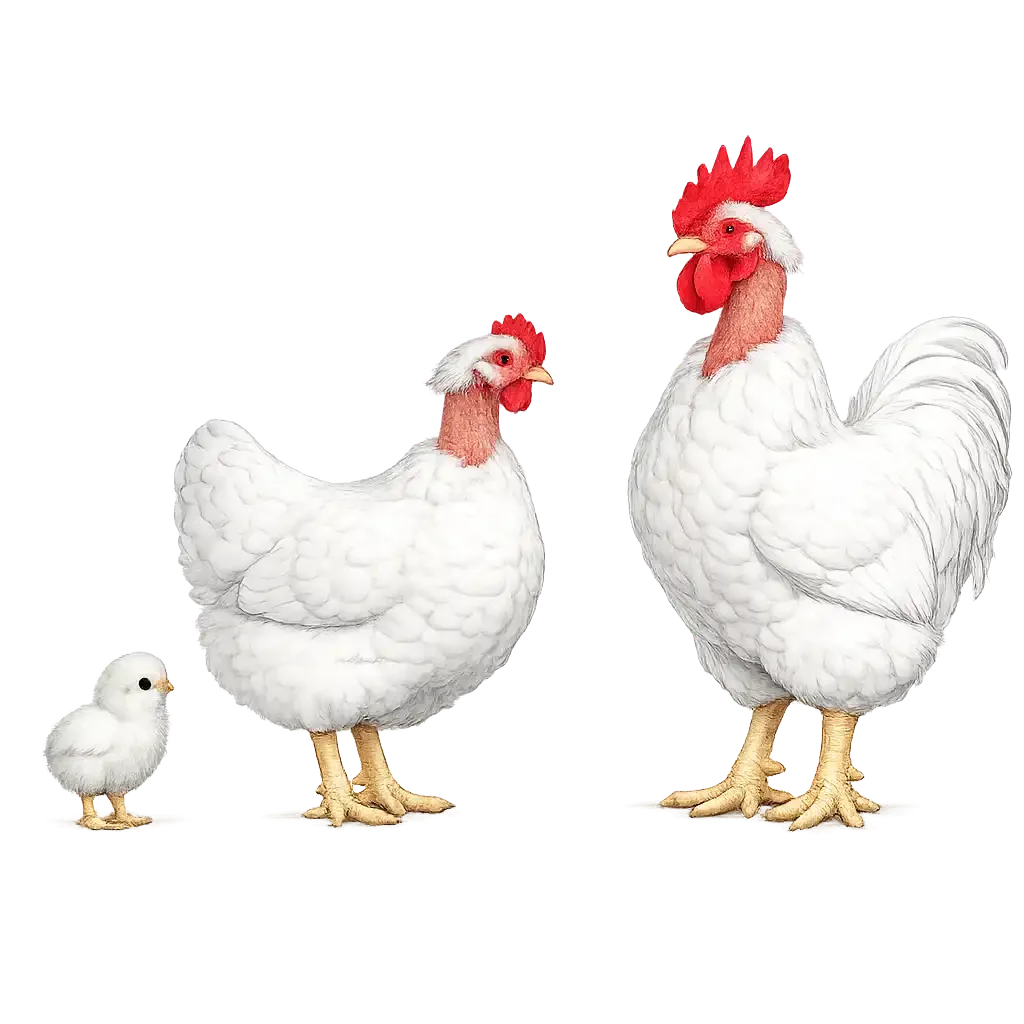
The White Naked Neck is the most immediately recognizable chicken in this directory and arguably in any American backyard flock, not because of brilliant plumage or unusual crest or dramatic size, but because of a single genetic trait that no other APA-recognized standard breed carries: the complete absence of feathers on the neck and upper chest, leaving bare skin exposed from below the head to the front of the breast. The rest of the body is fully feathered in clean white, but the neck is bare, and the effect is arresting and unmistakable. The breed is not a turkey cross, not a genetic anomaly, and not the product of feather pulling or disease. It is a legitimate APA-recognized dual-purpose heritage breed, one of six breeds from Murray McMurray Hatchery that holds APA certification, and it has been valued across Transylvania, Hungary, Germany, France, and much of Europe for centuries as one of the hardiest, most heat-tolerant, most disease-resistant, and easiest-to-process dual-purpose farm birds available.
The name Turken is a portmanteau of turkey and chicken, coined from the early mistaken belief that the bare-necked bird must be a turkey hybrid. It is not. Turkens are entirely chicken, genetically and practically, and the bare neck is produced by a single incompletely dominant gene called Na located near the middle of Chromosome 3, which causes the overproduction of a molecule called BMP12 that suppresses feather growth in the neck and chest region. A 2011 research study confirmed this mechanism by demonstrating that treating embryos of other breeds with BMP12 produced the same bare-neck phenotype. The Na gene is dominant, meaning a single copy produces the characteristic bare neck, and one copy of the gene is all any Naked Neck carries: a bird homozygous for the gene has fewer feathers still and is not the same as the standard Naked Neck.
The practical consequence of approximately 40 to 50 percent fewer feathers than fully feathered breeds is a bird uniquely suited to heat management, uniquely easy to process without extensive plucking, and genuinely surprising in its cold-weather performance for a bird so visibly under-feathered. The White Naked Neck is the variety with the longest presence in American hatchery catalogs, carried by McMurray as an APA-certified breed and available from several major hatcheries, and it is the variety most homestead keepers in North America encounter when they first discover the breed.
Quick Facts
Class: Any Other Standard Breed (APA)
Weight: Roosters approximately 8.5 lbs; hens approximately 6.5 lbs; cockerels approximately 7.5 lbs; pullets approximately 5.5 lbs; bantam variety also recognized
Egg Production: Approximately 150 to 200 large light brown eggs per year from Transylvanian-heritage strains; improved strains documented at 180 to 240 per year; some sources document up to 280 per year from production-oriented lines
Egg Color: Light brown; consistent across all Naked Neck color varieties
Egg Size: Large; consistent with the breed's substantial body weight
Primary Purpose: Dual purpose; eggs and meat; notably easy to process due to reduced feathering; heat-tolerant range bird valued in warm climates globally
Temperament: Docile and friendly; easy to tame; good with children; active forager; roosters occasionally assertive but generally manageable; hens calm and people-tolerant
Brooding: Moderate; some hens go broody and prove attentive, capable mothers; not reliably broody across the breed
Flight Capability: Low to moderate; active and reasonably alert; better predator evasion than very heavy breeds but not as flight-capable as Mediterranean light breeds
APA Recognition: 1965; Any Other Standard Breed class; recognized in Black, Buff, Red, and White; the White Naked Neck from McMurray Hatchery is one of six APA-certified breeds in their catalog
Country of Origin: Transylvania (historical Hungary, now Romania); refined and standardized in Germany; distributed across Europe from the 19th century onward
Comb Type: Single comb; medium-sized; rooster combs and wattles particularly large and prominent; frostbite risk applies despite breed's cold-weather performance
Distinctive Trait: Bare neck and bare crop from the Na gene overproducing BMP12; approximately 40 to 50 percent fewer total feathers than standard breeds; rooster neck skin turns bright red with sun exposure; hen neck skin is pale pink to pale red; small bow-tie tuft of feathers at the front base of the neck in purebreds; bare crop confirms purebred status; chicks hatch with bare necks and are immediately identifiable
Feather Genetics: Na gene is incompletely dominant on Chromosome 3; single copy produces standard Naked Neck phenotype; Na gene dominant over fully feathered; does not affect feathers on rest of body
Lifespan: 7 to 10 years
Breed Overview
The Naked Neck's origin stretches back through the complex layered history of the Carpathian Basin, where the movement of peoples, trade routes, and empires produced extraordinary livestock diversity across centuries. The breed type likely traces to Asian origins, with bare-necked chickens documented in old Japanese paintings and theorized to have spread from Malaysia or other parts of Asia into the Eurasian steppe. The most historically documented pathway into Europe connects to the Ottoman Empire's rule over Transylvania from 1541 to 1699, during which larger, red-eared Asian chickens were introduced to the region and may have contributed the Na gene that spread through Transylvania, Serbia, and Bosnia. Magyar settlers had brought their own fowl from the steppe east of the Carpathians, and later Habsburg-era western European breeds arrived, producing the multilayered genetic foundation from which the Transylvanian Naked Neck developed over centuries of free-range adaptation to the damp, temperate valley climate.
By the 19th century the breed was well known in Transylvania in several color varieties, most commonly White, Black, and Cuckoo, valued by farmers for its foraging ability in all weathers, disease resistance, economical maintenance, consistent winter laying, fast growth rate, and the ease of processing that reduced feathering provides. The breed reached Germany in the 19th century, where German and Austrian breeders refined the body type, standardized the color varieties, and distributed the breed across Europe. It was first exhibited at the International Agricultural Show in Vienna in 1875.
The 20th century brought the same conservation challenges to the Transylvanian Naked Neck that industrial poultry development brought to most heritage breeds. In the 1930s, Hungarian researchers collected surviving native birds at the research institute in Gödöllő, Hungary, with the goal of standardizing colors and body type while improving egg production and body size. World War II destroyed most of those stocks, but breed scientists restored significant populations by the 1950s. Conservation work has continued through university programs, private breeders, and breed associations in both Hungary and Romania, and the breed's global commercial use through the incorporation of the Na gene into heat-climate commercial hybrid programs in France, Venezuela, and other countries has kept the genetics more widely distributed than pure heritage breed populations alone would sustain.
In the United States, the APA recognized the Naked Neck in 1965 in Black, Buff, Red, and White varieties in the Any Other Standard Breed class. McMurray Hatchery carries the White variety specifically as one of their six APA-certified breeds, a distinction that reflects the White Naked Neck's breed standard compliance and exhibition quality.
Plumage, Appearance, and the Naked Neck Gene
The White Naked Neck's appearance is the most visually specific and immediately memorable of any breed in this directory. The body is fully feathered in clean white from the head's feathered cap to the tail, with a well-muscled, broad-chested, slightly rearward-sloping body carried at a moderate oblique angle. The neck, from just below the head to the base where it meets the breast, is completely bare, exposing the skin directly. The crop, the food-storing pouch at the front of the chest, is also bare in purebred birds, and the underside of the body carries fewer feathers than fully feathered breeds without being completely bare. A small bow-tie tuft of feathers at the front base of the neck is characteristic of purebred Naked Necks and distinguishes them from crossbred birds with partial neck coverage.
The color of the exposed neck skin changes significantly with sun exposure. In roosters, the neck becomes bright red with sunlight, creating the turkey-like visual that generated the breed's popular Turken name. In hens, the neck is paler, typically pink to pale red, deepening with sun exposure but not reaching the rooster's vivid coloration. Eyes are reddish bay. In the White variety, the legs, feet, and beak are yellow to pale, consistent with the Hungarian breed preference for white skin in light-colored varieties.
The Na gene's mechanism is among the most specifically documented single-gene effects in domestic poultry genetics. The gene causes overproduction of BMP12 in the neck and head region, which suppresses the expression of the genetic sequences responsible for feather follicle development, preventing feather growth in those areas while leaving feather development elsewhere in the body unaffected. The 2011 research confirmation that applying BMP12 to embryos of other breeds produces the same bare-neck phenotype established the molecular mechanism clearly. Because the Na gene is incompletely dominant, birds carrying one copy show the standard Naked Neck phenotype while birds carrying two copies have even fewer feathers and a different, more extreme appearance. Standard Naked Neck breeding aims to produce single-copy Na birds.
The bare crop is the most reliable indicator of purebred status that experienced Naked Neck keepers cite. Crossbred birds with the Na gene often have a feathered crop and additional feather patches on the neck that distinguish them from birds conforming to the breed standard.
Egg Production
The White Naked Neck's egg production is consistent and respectable, falling in a range that reflects genuine strain variation between the original Transylvanian-heritage landraces and the improved production-oriented strains developed from the Hungarian gene bank restoration program. The Backyard Poultry breed profile documents 140 to 180 eggs per year for the Transylvanian landrace, reflecting the original utility performance of the landrace population. The APA-standard American strains from hatcheries including McMurray document performance in the 180 to 240 range. Some improved and production-selected strains are documented at up to 280 eggs per year.
The consistency of the breed's laying through heat that reduces production in fully feathered breeds is one of its most practically distinctive characteristics. Because the Na gene reduces feather mass by 40 to 50 percent, Naked Necks carry less metabolic heat than fully feathered birds in the same ambient temperature, which allows them to maintain normal physiological function and continue productive laying in conditions that push fully feathered breeds into heat stress and laying cessation. This heat-climate laying consistency is the primary reason the Na gene has been incorporated into Label Rouge hybrids in France and other heat-climate commercial layer programs globally: the gene demonstrably maintains egg production through hot conditions that standard broiler and layer genetics cannot sustain at equivalent performance.
Winter laying from the original Transylvanian landrace was specifically noted as exceptional, with historical accounts describing the breed as prolific even in winter conditions. The combination of heat-season production resilience and cold-season continuation makes the Naked Neck one of the more year-round consistent dual-purpose heritage layers available.
The eggs are large and light brown, consistent across all Naked Neck color varieties and well-sized for the breed's 6.5-pound hen body weight.
Meat Quality
The White Naked Neck's meat utility is the strongest of any dual-purpose heritage breed in this directory from a processing efficiency standpoint, and genuinely competitive from a flavor and yield standpoint as well. The processing efficiency advantage is specific and documented: with approximately 40 to 50 percent fewer feathers than fully feathered breeds, the Naked Neck requires dramatically less plucking time and effort than any standard heritage breed. Heritage breed processing, which involves the wet scalding and hand-plucking that commercial operations perform mechanically, is the most time-intensive step in homestead heritage bird processing, and the Naked Neck's reduced feathering cuts that time investment proportionally. Keepers who process their own birds consistently report the Naked Neck as one of the fastest and easiest heritage breeds to clean.
The carcass quality beyond processing efficiency is also well-documented. The breed is described across multiple sources as producing a muscular, meaty carcass with a higher percentage of dark meat relative to the commercial broiler's breast-heavy profile, reflecting the breed's active foraging lifestyle and heritage genetics. The skin quality from range-raised Naked Necks is specifically praised in keeper accounts, with one homesteader describing the fat distribution as producing skin that crisps beautifully in cooking.
At APA standard weight of 8.5 pounds for roosters and 6.5 pounds for hens, the Naked Neck produces a substantial heritage carcass. Cockerels harvested at 20 to 22 weeks at lighter processing weights are also described as excellent fryer-weight table birds.
Temperament and Behavior
The White Naked Neck's temperament is consistently docile and people-friendly across the broad range of keeper accounts in the McMurray blog and breed literature, with hens specifically described as calm, easy to tame from young, and tolerant of handling by children. Multiple keepers describe individual Naked Neck hens that actively seek lap time and shoulder perching, which represents the more affectionate end of the breed's temperament range but is not unusual for the variety.
Roosters are generally manageable but occasionally assertive, and the McMurray blog specifically notes that occasional Naked Neck roosters can be aggressive. This is the standard management variance that applies to most heritage breed roosters rather than a specific Naked Neck behavioral trait, and socialization from young produces the well-mannered rooster that most Naked Neck keepers describe. Rooster protectiveness of the flock, expressed through active vocalization and defensive behavior toward perceived threats, is a genuine and practically useful trait in a breed kept for range production.
The breed's foraging drive is active and well-documented. Naked Necks forage purposefully and efficiently, and the reduced feathering around the neck and head specifically facilitates foraging without feathers obscuring vision or catching on vegetation the way crested breeds' head feathering does. Range conditions where foraging can supplement the commercial ration meaningfully are well-matched to the Naked Neck's active character.
Disease resistance is cited consistently across breed sources as genuinely exceptional, with Wikipedia specifically documenting that the breed is immune to most diseases and Heritage Acres Market describing it as far less susceptible than other breeds to common chicken ailments. This disease resistance, evolved over centuries of hardy free-range maintenance with minimal veterinary intervention in the Transylvanian landscape, is a practical advantage for homestead keepers who do not want intensive health management demands from their flock.
Climate Adaptability
The White Naked Neck's climate adaptability is the most specific and most practically important characteristic in this post for keeper planning purposes, because it is counterintuitive in both directions: the breed handles heat far better than its appearance in summer would suggest requires management, and it handles cold far better than its bare neck would suggest it could.
Heat tolerance is exceptional and mechanistically explained. With 40 to 50 percent fewer feathers, the Naked Neck sheds metabolic heat more efficiently than fully feathered breeds, maintains lower body temperature in hot ambient conditions, and continues normal physiological function including laying in heat that pushes heavily feathered breeds into stress. The breed handles hot and humid conditions specifically as well as hot and dry, which is a meaningful distinction from many heat-tolerant Mediterranean breeds that perform better in dry heat than in humid heat.
The documented incorporation of the Na gene into commercial heat-climate hybrids including the French Label Rouge program reflects scientific validation of the breed's heat performance rather than anecdotal observation. Research specifically confirms that the Na gene in broiler strains at high temperatures produces lower body temperature, increased body weight gain, better feed conversion ratios, and improved carcass traits compared to normally feathered broilers under equivalent heat conditions.
Cold hardiness is genuinely surprising for a visually bare-necked bird. Multiple keeper accounts describe Naked Necks as among the first out of the coop on cold mornings, thriving in hard winters including both Colorado and Maine climates, and withstanding below-zero temperatures without the management complications that more fully feathered breeds with more conventional cold vulnerability assumptions require. The original Transylvanian landrace specifically evolved through centuries of cold-damp winters with minimal protection, producing cold tolerance that persists in the modern breed beyond what the bare neck visually implies.
The single comb requires standard frostbite management in hard winters. The bare neck skin itself does not frostbite in the way that soft tissue extremities do, but it is vulnerable to sunburn in high sun exposure settings, which is the climate management consideration specific to the breed that standard heritage breeds do not share.
Sunburn Management
Sunburn on the bare neck is a documented and real management consideration for White Naked Necks in high sun exposure environments, specifically at higher altitudes where UV intensity increases, and during extended periods of direct overhead sun without shade access. The McMurray blog documents keeper accounts of sunburn on exposed neck and wattle skin, and multiple keepers specifically describe applying waterproof children's sunscreen to their Naked Necks' necks during peak sun periods.
The practical management approach is shade provision rather than sunscreen application in most homestead settings: shade structures in the outdoor run, natural canopy from trees or shrubs, and access to covered areas during the highest UV hours of midday provide adequate sun protection for most Naked Necks in most climates without requiring individual bird treatment. Keeper accounts from Arizona at 5,100 feet specifically note that a single hen with direct sun access had no sunburn problems, suggesting that shade access is the meaningful management variable rather than sunscreen being a routine requirement.
The Naked Neck's rooster neck skin turns bright red with sun exposure regardless of sunburn status, which is a normal pigmentation response rather than a sign of sun damage. Keeper familiarity with the breed's normal sun-exposed neck color prevents unnecessary concern about what is simply the visual character of the bare skin in sunlight.
Processing Advantage
The processing efficiency advantage of the White Naked Neck deserves its own section because it is the most consistently underemphasized practical attribute of the breed in casual breed discussions and the one that produces the most tangible time savings for homestead keepers who process their own birds.
Standard heritage breed wet-scalding and hand-plucking is the most labor-intensive step in homestead poultry processing. A fully feathered 8-pound heritage breed rooster requires thorough scalding and careful plucking to remove the full feather complement from every part of the carcass. A Naked Neck of equivalent weight enters processing with 40 to 50 percent fewer feathers, meaning the plucking work is reduced proportionally. The neck and upper chest, which on a standard breed require careful feather removal around the skin folds and junctures where feathers are most likely to tear the skin if removed carelessly, require no plucking at all on a Naked Neck. The bare crop and bare neck areas simply do not need attention, and the reduced body feathering plucks faster than a fully feathered bird even from the areas that do carry feathers.
Carol Ekarius in Storey's Illustrated Guide to Poultry Breeds specifically addresses this attribute, describing the Naked Neck carcass as easily and quickly plucked with fewer feather follicles under the skin. For homestead operations processing multiple birds per session, the time savings compound meaningfully across a full processing day.
The white feathering on the body areas that do carry feathers produces white pin feather stubs against pale skin, the same clean-dressing carcass advantage documented for the White Plymouth Rock, White Jersey Giant, and White Orpington. The combination of greatly reduced feather count and white-stub-against-pale-skin presentation produces one of the cleanest-dressing heritage breed carcasses available.
Comparing the White Naked Neck to Other Naked Neck Color Varieties
The APA recognizes Black, Buff, Red, and White Naked Necks in the United States. The British standard adds Cuckoo and Blue. In terms of practical production, temperament, and management requirements, all color varieties share the same breed character: the same Na gene expression, the same approximate 40 to 50 percent feather reduction, the same dual-purpose utility, and the same heat and cold adaptability.
The White variety's specific distinction from the other APA varieties is the same clean-dressing carcass advantage that white plumage provides across all white-feathered breeds, and the greater visibility of the bare neck skin color against the white body feathering, which makes the White Naked Neck's distinctive appearance the most visually pronounced of the four APA varieties. The red or pale-pink bare neck against pure white body feathering is a more dramatic visual contrast than the bare neck against black or buff body feathering, which is part of why the White variety became the most widely distributed in American hatchery catalogs.
McMurray Hatchery also carries a mixed-color Turken assortment under the general Naked Neck listing, described as including White, Black, Buff, Red, and Silver colors mixed for variety. The White Naked Neck from McMurray is the APA-certified standard-bred variety available as a separate listing from the mixed assortment.
Pros and Cons
Pros
Genuinely exceptional heat tolerance; one of the most heat-tolerant standard heritage breeds available; maintains laying production through conditions that push fully feathered breeds into heat stress
Dramatically easier to process than fully feathered breeds; 40 to 50 percent fewer feathers reduces plucking time proportionally; bare neck and crop require no plucking
White plumage and pale skin produce clean-dressing carcass without dark pin feather residue
Surprisingly good cold hardiness despite visual bare-neck appearance; documented performing well in hard winters across multiple cold-climate keeper accounts
Exceptional disease resistance cited consistently across breed sources
APA recognized since 1965; McMurray White Naked Neck is one of only six APA-certified breeds in their catalog
Genuinely docile and beginner-friendly temperament; easy to tame from young; good with children
Active, efficient forager; self-sufficient on range
Large egg size from 6.5-pound hens; substantial heritage carcass at 8.5-pound rooster standard weight
Long lifespan of 7 to 10 years from heritage-oriented management
Moderate broodiness with attentive mothering when hens do go broody
Cons
Bare neck and crop create sunburn risk in high sun exposure environments; shade access planning required before acquiring
Comb requires standard frostbite management in hard winters despite overall cold hardiness
Occasional rooster assertiveness; monitoring during flock integration appropriate
Rare in North America; considered unusual by neighbors and visitors unfamiliar with the breed; may generate confusion or concern from people who mistake the bare neck for illness or injury
Not all hens reliably broody; incubator or surrogate broody hen needed for planned hatching programs
Exhibition community smaller than for more common heritage breeds due to limited North American popularity
Reduced but not absent foraging risk; active breed needs secure outdoor management despite low-medium flight tendency
Profitability
The White Naked Neck's profitability for homestead operations is strongest in operations that specifically value the three characteristics that distinguish it from conventional dual-purpose heritage breeds: heat-season egg production consistency, processing time efficiency, and range feed economy.
Heat-season production value is the most specific and most documentable financial advantage. In climates where fully feathered heritage breeds reduce or stop laying during the hottest weeks of summer, Naked Necks maintaining production through that period fill the supply gap with no management intervention required. Direct-sale egg operations that commit to year-round supply benefit specifically from a breed whose production curve does not dip sharply in the season when other heritage breeds are least productive.
Processing time efficiency translates directly to labor cost for homestead operations that process birds by hand. Processing six Naked Neck birds in the time that would be required for four fully feathered birds of comparable weight is a meaningful efficiency gain across a full heritage meat bird processing season.
Range feed economy from the breed's active foraging character and reduced total feed requirement reflects both the foraging efficiency of a breed developed for centuries of self-sufficient range maintenance and the energy-saving effect of reduced feather production. Feather growth requires protein and energy, and birds with 40 to 50 percent less feathering invest proportionally less feed energy in feather maintenance and more in egg production and body development.
The breed's visual distinctiveness, unusual enough to generate genuine visitor interest and social media engagement, supports the narrative marketing that direct-sale heritage poultry operations rely on. A flock of White Naked Necks is not a background element; it is a conversation starter that connects buyers to the breed's Transylvanian history, Ottoman Empire genetics, French Label Rouge incorporation, and 19th-century German standardization in a way that no conventional white-plumaged heritage breed can approach.
Final Verdict
The White Naked Neck is the most underrated dual-purpose heritage breed in this directory and possibly in North American homestead poultry keeping broadly, occupying an unusual position as a breed that is simultaneously visually arresting enough to stop any visitor in their tracks and practically exceptional enough to justify its place in a production-oriented homestead flock on merit alone. The heat tolerance, processing efficiency, disease resistance, and range self-sufficiency are genuine and well-documented advantages that are difficult to find in any other single APA-recognized breed. The sunburn management consideration is real but manageable with shade infrastructure. The bare neck's visual character is unusual enough to generate consistent comment from visitors unfamiliar with the breed, which is either an asset or a liability depending on whether the keeper values the educational and social media conversation that unusual breeds generate. For the homestead or small farm keeper in a warm climate, a heat-challenged summer region, or any operation where processing efficiency is a meaningful labor consideration, the White Naked Neck is worth serious evaluation alongside the more conventionally attractive dual-purpose heritage breeds that get more attention from homestead chicken media.
Frequently Asked Questions
Is a Turken really a cross between a turkey and a chicken? No. The Turken name is a portmanteau of turkey and chicken, coined from the early popular belief that the bird's bare neck indicated turkey ancestry. It is entirely chicken, genetically and biologically. The bare neck results from a single dominant gene called Na that causes overproduction of BMP12, a molecule that suppresses feather growth in the neck and chest region. A 2011 research study confirmed this mechanism specifically. Turkeys and chickens cannot produce fertile hybrid offspring under natural conditions; the Naked Neck's bare neck has no connection to turkey genetics whatsoever.
How do I manage the sunburn risk on my Naked Neck's bare neck? Shade provision is the most practical management approach for most homestead settings. Shade structures in the outdoor run, natural canopy from trees or shrubs, and covered access areas during peak midday UV hours provide adequate protection for most Naked Necks in most climates. Keeper accounts from high-altitude and high-UV environments document successful use of waterproof children's sunscreen applied to the bare neck and wattles for birds with heavy sun exposure during the most intense summer periods. The rooster's neck turning bright red with sun exposure is a normal pigmentation response rather than sunburn and does not require treatment.
Why does the bare crop indicate purebred status? Purebred Naked Necks carry the bare neck and bare crop as part of the breed standard, reflecting the full expression of the Na gene's feather suppression in the neck and upper chest region. Crossbred birds with the Na gene from a Naked Neck parent crossed with a standard breed often have a feathered crop and additional feather patches on the neck, because the Na gene's expression in a single-copy heterozygous crossbred bird may not produce the complete feather suppression seen in the standardized purebred. When purchasing chicks, a fully bare crop alongside the bare neck indicates breed standard compliance; a feathered crop with a bare neck indicates probable crossbred origin.
Are White Naked Necks suitable for cold climates? Yes, with standard single-comb cold management. Multiple keeper accounts from Maine, Colorado, and other cold-climate regions document Naked Necks thriving through hard winters with minimal special management. The breed evolved in Transylvania through centuries of cold-damp winters with minimal protection and developed genuine cold hardiness that persists in the modern breed. The bare neck skin does not frostbite in the way that soft tissue extremities do. The comb requires petroleum jelly application during sustained hard freezes and dry, draft-free housing at roost level, which is the standard management for any single-combed heritage breed.
Why is the Na gene used in commercial hybrid programs in France and other countries? Research has demonstrated that incorporating the Na gene into broiler and layer strains in hot climates produces lower body temperature, better feed conversion, higher body weight gain, and improved carcass traits compared to normally feathered birds under equivalent heat conditions, because the reduced feather mass allows more efficient heat dissipation and redirects energy from feather production toward growth and egg formation. The French Label Rouge program has incorporated the Na gene into its pasture-based hybrid lines, and similar programs exist in Venezuela and other hot-climate poultry producing regions. This commercial validation of the Na gene's practical advantages is scientific confirmation of what Transylvanian farmers observed empirically for centuries.
Related Breeds
Black Australorp
White Plymouth Rock
White Orpington
Heavy Assorted
Barred Plymouth Rock