
White Polish
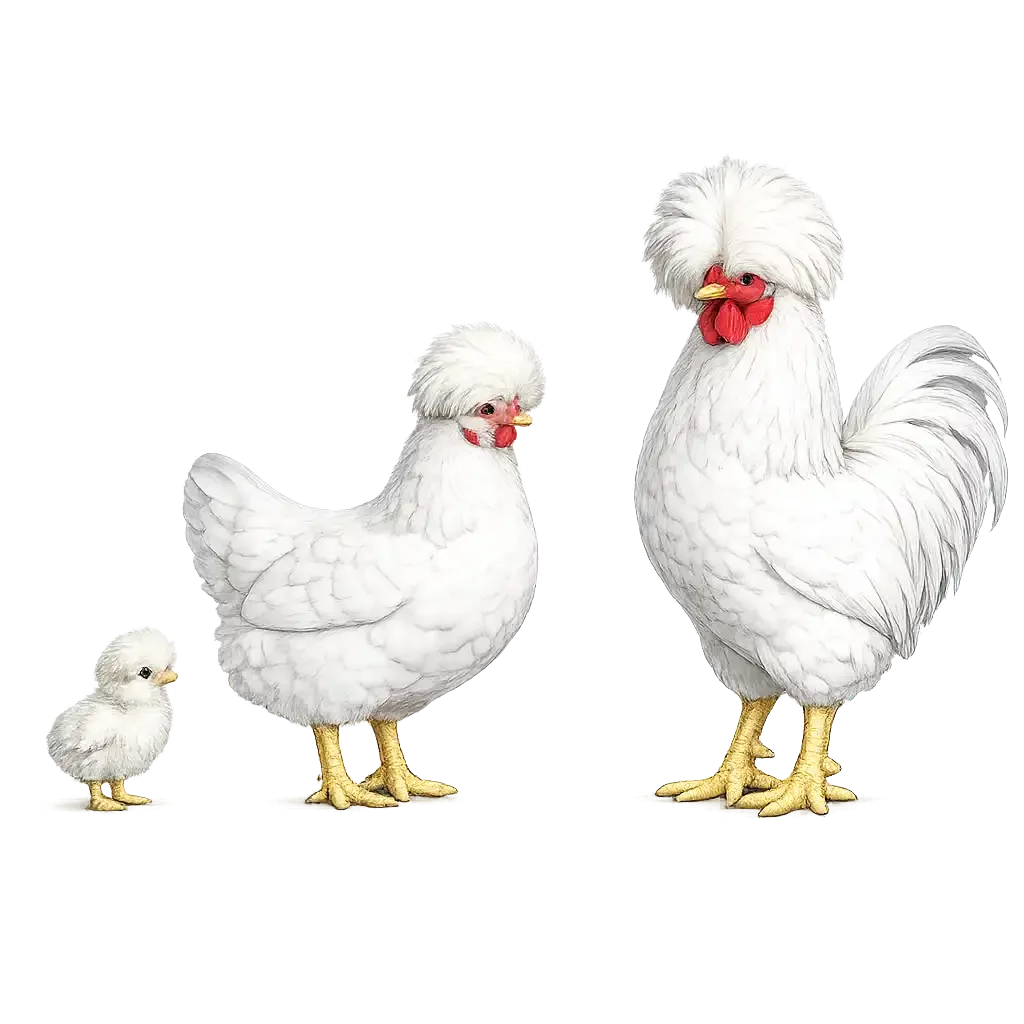
The White Polish is the most visually clean and exhibition-precise variety of one of the oldest and most immediately recognizable ornamental breeds in the world. The Polish chicken has appeared in Dutch and Italian paintings dating to the 15th century, carries an origin story that remains genuinely disputed by poultry historians, and has been described at various points as the showgirl of the poultry world, the top hat chicken, and the breed Charles Darwin used to define what a crested chicken is. The White variety presents the full Polish breed experience in a pure white plumage that makes the dramatic spherical crest its undisputed visual focus: a rounded, full, white pom-pom on the hen, a larger and more ruffled white mop on the rooster, growing from a bony protuberance on the skull that is unique to the breed and that gives the Polish its unmistakable profile from any distance. The White Polish is an APA-recognized variety admitted to the Standard of Perfection in 1874, lays approximately 150 to 200 medium white eggs per year depending on strain, weighs approximately 4.5 pounds for hens and 6 pounds for roosters, and carries the gentle, quiet, and occasionally startled temperament that the crest's vision obstruction creates in all Polish varieties. It is primarily an ornamental and exhibition breed rather than a production bird or a genuine dual-purpose homestead choice, and it is kept most successfully by keepers who understand and plan for its specific management requirements, particularly the crest care, the wet-weather vulnerability, the predator exposure that limited vision creates, and the mixed-flock compatibility considerations that arise from the breed's consistently low pecking order position.
Quick Facts
Class: Continental (APA)
Weight: Roosters approximately 6 lbs; hens approximately 4.5 lbs
Egg Production: Approximately 150 to 200 medium white eggs per year; 2 to 4 eggs per week; highly variable between exhibition-selected and production-selected strains
Egg Color: White
Egg Size: Medium
Primary Purpose: Ornamental; exhibition; pet; light egg production
Temperament: Gentle, quiet, and friendly when approached calmly; easily startled due to crest-obstructed vision; benefits from being spoken to before approached; can become tame with regular gentle handling; not aggressive
Brooding: Essentially never; considered a non-sitter breed; incubator or surrogate broody hen required for hatching
Flight Capability: Good for a small breed; lightweight and capable of perching in trees; higher fencing or covered runs beneficial
APA Recognition: 1874; Continental Class; White is one of the original recognized non-bearded varieties
Country of Origin: Disputed; likely developed in the Netherlands from possible Eastern European or Spanish origins; named for resemblance to Polish soldier helmets or derived from Dutch word Pol meaning large head; not from Poland despite the name
Varieties (APA): White; Black; Blue; Buff Laced; Golden; Silver; White Crested Black; White Crested Blue; bearded and non-bearded forms of most colors; bantam versions recognized
Comb Type: V-shaped horn comb; small; usually hidden beneath the crest
Distinctive Trait: Dramatic spherical white crest growing from a bony protuberance on the skull; pure white plumage across body and crest in the White variety; V-shaped comb; white earlobes; slate gray clean legs; vision severely restricted by crest; showgirl of the poultry world
Conservation Status: Watch (Livestock Conservancy)
Lifespan: 5 to 8 years
Breed Overview
The Polish chicken's origin is one of the more genuinely contested questions in poultry history, and the honest answer is that no one knows with certainty where the breed began. The name Polish does not indicate Polish origin; the breed is not from Poland and likely never was. The two most commonly cited name origin theories are: first, that the name derives from the resemblance of the breed's dramatic head crest to the feathered caps worn by Polish soldiers, which Charles Darwin specifically cited when he classified any crested chicken as Polish or Crested in his writings; and second, that the name derives from the Dutch word Pol meaning large head, which would connect the name to the breed's most defining physical characteristic rather than to any geographic association.
What is reasonably documented is the breed's presence in Dutch and Italian paintings from the 15th century onward, its establishment in the Netherlands where Dutch breeders are credited with refining color patterns and developing the large crest into its current form through the 18th century, and its recognition and popularity in France, England, and subsequently America as both an egg layer and an exhibition bird. The breed was known in England in the 1700s and popular in France for egg production before arriving in America between 1830 and 1840. By 1850 it was widespread in American farm flocks as one of the better white egg layers available before the Leghorn's rise to production dominance displaced it from commercial consideration through the 1850s to 1890s.
The Polish's transition from respected egg layer to exhibition bird, driven by the Leghorn's superior production efficiency rather than any fault of the Polish's character, established the breed identity that persists today: the most visually dramatic crested breed in the ornamental chicken world, kept primarily for exhibition and as a pet, with egg production that is adequate for a backyard layer but not sufficient for a keeper whose primary motivation is eggs.
The APA recognized the Polish in 1874, among the first breeds admitted to the inaugural Standard of Perfection, with White, Golden, Silver, and other non-bearded varieties accepted that year. Additional bearded varieties and the White Crested colors were added in subsequent years, and today the APA recognizes both bearded and non-bearded forms in multiple colors, with the White variety remaining one of the cleaner exhibition colors in the breed.
The Livestock Conservancy's Watch listing for the Polish reflects the breed's population status as below the recovered threshold despite its widespread recognition and availability. The breed's exhibition focus and specific management requirements have limited its appeal to casual homestead keepers who might otherwise maintain heritage breed populations, and the conservation community recognizes that maintaining genuinely breed-correct Polish outside exhibition circles requires active support.
Plumage and Appearance
The White Polish's appearance is defined entirely by its crest, and everything else about the bird is secondary to that defining feature in both visual impact and management implication. The crest is a spherical, full explosion of pure white feathers growing upward and outward from a bony protuberance on the top of the skull, creating the distinctive top hat or pom-pom silhouette that makes the Polish instantly recognizable at any distance. In the White variety, the crest and the body plumage are the same pure white, creating a visually unified all-white bird whose dramatic head gear is the only contrast element in the entire profile.
The hen's crest is tidier and more spherical, the classic pom-pom shape that reads as deliberate and round from the front. The rooster's crest is larger, more ruffled, and more irregularly shaped, falling forward and to the sides in what some describe as a mop or floppy top hat appearance rather than the neat sphere of the hen. This crest shape difference is reliable enough to be used for early sex identification before combs and wattles develop.
The bony protuberance on the skull that supports the crest is not merely a curiosity but a structural feature with management implications. This protuberance creates a slight depression in the skull beneath it that makes the bird slightly more vulnerable to head impacts and that contributes to the occasional neurological presentation in some Polish birds where they appear confused or disoriented. This condition, sometimes called water on the brain or hydrocephalus, occurs in a small proportion of Polish chickens and is associated with the same skull structure that supports the crest.
The V-shaped horn comb is small and sits at the base of the crest, usually completely hidden beneath the feathers. White earlobes are present. The wattles are red and relatively small. The legs are slate gray and clean, without feathering. The body is relatively light and compact, similar in size and type to the White Leghorn, with white skin beneath the feathers.
Egg Production
The White Polish's egg production is genuinely variable in a way that few other heritage breeds show as clearly, and this variability is directly connected to the breeding selection history of the specific birds a keeper acquires. Polish chickens kept primarily for exhibition and selected over generations for the most dramatic crest, the cleanest plumage, and the most correct exhibition conformation produce noticeably fewer eggs than Polish chickens from strains maintained for laying performance alongside visual character. The range of 150 to 200 eggs per year represents the span between these extremes, and keepers who want the higher end of that range should specifically seek laying-performance strains rather than exhibition-focused bloodlines.
My Pet Chicken specifically notes that egg laying in Polish is varied, with some birds laying well and some very poorly, and that the breed is not reliable as an egg layer. This honest assessment reflects the exhibition breeding pressure that has reduced laying performance in many Polish lines below what the breed's historical reputation as a French and Dutch egg layer would suggest.
The eggs are white and medium-sized, consistent across all Polish varieties regardless of plumage color. Hens begin laying at approximately 20 weeks or later, somewhat delayed compared to earlier-maturing production breeds. The breed is essentially non-broody, which is a production advantage for consistent laying but means that incubators or surrogate broody hens are required for flock propagation.
Temperament and Behavior
The White Polish's temperament is gentle, quiet, and friendly in its baseline character, and also easily startled and occasionally erratic in its immediate responses, two qualities that are simultaneously true and that arise from the same source: the crest's obstruction of the bird's peripheral and upward vision. A Polish chicken that cannot see what is approaching it from the side or from above responds to unexpected contact with alarm rather than calm assessment, and this alarm response can read as nervousness or flightiness in a bird that is actually gentle and friendly when approached correctly.
The standard advice for working with Polish chickens is to speak to them before approaching, giving the bird auditory warning of human presence that compensates for the visual information the crest blocks. Keepers who consistently announce their approach find that Polish chickens become genuinely tame and personable, approaching their keeper, tolerating handling, and interacting with the calm curiosity of a bird that is not fundamentally nervous but that needs its vision limitations accommodated in management practice.
The breed is quiet by chicken standards, producing less vocalization than active Mediterranean layers and maintaining the subdued, conversational flock sounds that many keepers find pleasant. Roosters crow normally; hens sing their egg song after laying but are not characteristically noisy outside these functional vocalizations.
In mixed flocks the Polish is consistently at the lower end of the pecking order, a position that arises not from passivity or weakness but from the vision limitation that makes the bird less able to read and respond to social signals from flockmates. More assertive breeds including Rhode Island Reds, Leghorns, and other active, alert heritage breeds will peck at Polish crest feathers with enough persistence and force to cause significant feather loss and stress. The White Polish kept in a mixed flock is best paired with similarly gentle and less assertive breeds such as Silkies, Cochins, Orpingtons, and other calm varieties that do not exploit the Polish's visual vulnerability.
Climate Adaptability
The White Polish's climate adaptability is limited in both directions relative to most heritage breeds, and the crest is the reason in both cases. The crest feathers collect moisture in wet weather, becoming waterlogged and heavy in rain or high humidity and then creating a chilling effect on the bird's head as wet feathers conduct heat away. In cold weather, waterlogged crest feathers can freeze, causing genuine cold injury and potential crest damage. The combination of these wet-weather and cold-weather risks makes the White Polish poorly suited to consistently wet or cold climates without specific management interventions.
Dry, warm climates are the White Polish's natural comfort zone, and the breed handles heat adequately with shade access. The small V-shaped comb and wattles present minimal frostbite risk compared to large single-combed breeds, but the crest itself is the vulnerability in cold conditions rather than the facial features.
Practical cold-climate management for White Polish includes keeping the coop dry and well-ventilated, ensuring bedding absorbs moisture effectively, providing covered outdoor access that prevents crest exposure to rain, and bringing birds indoors promptly when ice storms or sustained wet cold weather arrives. Many keepers in cold climates trim or band the crest feathers to prevent them from hanging into the bird's face and collecting ice in winter conditions.
Housing and Management
The White Polish's housing and management requirements diverge from standard backyard breed guidelines in several crest-specific ways that prospective keepers should understand before acquiring the breed.
Covered housing access during wet weather is essential rather than optional. A covered run or covered area adjacent to the coop that allows birds to be outside without direct rain exposure prevents the wet crest conditions that create chilling and ice formation risks. Birds kept without covered access in wet climates spend significant time with wet crests that never fully dry, creating chronic cold stress and crest health problems.
Crest maintenance is a specific and ongoing management task for the White Polish that no other breed in this directory requires. The crest feathers must be periodically checked for parasites, which find the dense feathering an ideal habitat for lice and mites. The feathers around the eyes must be trimmed when they grow long enough to hang into the bird's field of vision, which even the crest's normal spherical shape often does and which trimming corrects to allow the bird to see clearly enough to find food, water, and navigate its environment safely. Untrimmed crest feathers hanging directly into the eyes can cause eye infections from the debris they carry and can prevent the bird from locating its waterer and feeder.
Exhibition preparation for the White Polish involves bathing, drying, and grooming the crest and body feathers to present the breed at its cleanest and most correct. This preparation is specific, time-consuming, and a significant component of what makes the Polish an exhibition breed rather than a low-maintenance backyard bird.
Perching options at multiple heights accommodate the White Polish's good flight capability and preference for elevated roosting, which contrasts with the heavy dual-purpose breeds in this directory that require low roost bars. Standard roost heights that would injure a Bielefelder or Malines are comfortable for the lightweight Polish. Multiple perching options at different levels give the birds roosting choices that reflect their natural tree-roosting tendencies.
Free-ranging is not recommended for the White Polish. The crest's vision obstruction makes the bird significantly more vulnerable to aerial predators, which can approach from above without the bird detecting them until contact. Supervised ranging in secure environments is possible for keepers who want to provide outdoor access; unsupervised free-ranging in areas with aerial predator exposure is a genuine welfare concern for the breed.
Sourcing Considerations
The White Polish is available from mainstream hatcheries including Murray McMurray, Cackle Hatchery, and most regional hatcheries that carry ornamental breeds alongside production breeds. This wide availability makes sourcing uncomplicated for keepers who want White Polish for pet and backyard purposes.
The laying performance versus exhibition conformation distinction discussed in the egg production section applies directly to sourcing decisions. Keepers who want the best egg production from their White Polish should seek hatcheries and breeders who specifically document laying performance in their Polish lines rather than selecting purely for exhibition conformation. Exhibition-focused breeders active in Polish chicken specialty clubs maintain the most breed-correct birds for show purposes; production-oriented hatcheries maintain the most laying-capable birds for backyard egg supply.
Pros and Cons
Pros
The most visually dramatic and immediately recognizable ornamental breed in the backyard poultry world; the White variety presents the full crest impact in a clean, pure white package
Gentle, quiet, and friendly when approached with appropriate crest-aware technique
APA recognized since 1874; active exhibition community with established show standards
Reasonable white egg production of 150 to 200 per year from laying-selected strains
Non-broody; consistent laying without brooding interruptions once production begins
Lightweight; economical to feed relative to larger heritage breeds
Quiet flock presence; not characteristically noisy
Good companion for calm breeds in appropriately managed mixed flocks
Available from mainstream hatcheries without specialty sourcing
Cons
Crest severely limits vision; bird easily startled and more vulnerable to predators than clear-sighted breeds
Cannot free range safely in areas with aerial predator exposure
Requires covered housing access in wet weather; wet crest creates chilling and ice formation risk in cold conditions
Regular crest maintenance required: parasite checking, trimming around eyes, grooming for exhibition
Poorly suited to cold and wet climates without significant additional management infrastructure
Consistently low in pecking order; bullied by assertive breeds; requires careful mixed-flock companion selection
Egg production highly variable between strains; exhibition-selected birds may lay significantly fewer than 150 eggs per year
Occasional hydrocephalus and neurological presentations from skull protuberance structure
Not a meat breed; not suitable as a dual-purpose bird
Livestock Conservancy Watch listing; breed-correct genetics require exhibition community engagement to maintain
Profitability
The White Polish's profitability as a backyard and homestead bird is built around the ornamental and exhibition markets rather than egg volume or meat production. The breed's extraordinary visual impact generates consistent interest from buyers who want something genuinely unusual in their backyard flock, and the White variety's clean all-white presentation with the dramatic spherical crest photographs exceptionally well for farm social media and direct marketing.
Exhibition-quality White Polish from breeders maintaining correct breed type with full, spherical crests and clean white plumage command premium prices from the show community. The Polish breed has an active national and regional exhibition following, and breeders who produce show-winning birds sell both exhibition stock and hatching eggs at premium prices to the show community.
Pet chicken sales to families, particularly to households with children who are drawn to the Polish's comical and immediately engaging appearance, provide consistent revenue from buyers who specifically seek the ornamental character that the breed offers and that no production breed matches.
Comparison With Related Breeds
White Sultan: The most directly comparable comparison within this directory, covered in a dedicated post. Both the White Polish and the White Sultan are white-plumaged, crested, non-production ornamental breeds. The Sultan is more extensively feathered with foot feathering, vulture hocks, and a fuller overall feather coverage, carries a different crest character, and is rarer and harder to source than the Polish. The Polish is more widely available, more egg-productive by a small margin, and more commonly kept in exhibition. Both require similar crest management and wet-weather protection. Keepers who want white crested ornamental chickens should read both posts before choosing between them.
White Silkie Bantam: The temperament comparison for very gentle, non-production backyard and pet breeds. The Silkie is calmer and more people-seeking than the Polish, is an exceptionally reliable broody hen while the Polish essentially never goes broody, produces fewer eggs per year than a Polish laying-strain hen, and requires different feather management given the hookless feather structure. Both are frequently recommended for families with children; the Silkie's calmer temperament and better handling character make it more beginner-accessible, while the Polish's visual drama and egg production make it more practically useful.
Houdan: A crested breed from France that is sometimes confused with the Polish due to the shared crest characteristic. The Houdan is heavier, has a V-shaped comb like the Polish, carries a crest, and has five toes, distinguishing it from the Polish's four toes. The Mottled Houdan appears in the Related Breeds of the White Sultan post in this directory. The Houdan and Polish share exhibition community overlap but are distinct breeds.
Exchequer Leghorn: The comparison for white egg production in a dramatically different bird. The Exchequer Leghorn produces 250 to 300 white eggs per year from an active, alert, flight-capable production bird with no ornamental character whatsoever. The White Polish produces 150 to 200 white eggs per year from a gentle, vision-limited ornamental bird with dramatic visual impact. Both lay white eggs; everything else about them is different. The comparison clarifies that choosing the White Polish for egg production over the Leghorn requires valuing the ornamental character enough to accept significantly lower production volume.
Final Verdict
The White Polish is the right breed for exactly the keeper it has always appealed to: someone who wants a genuinely dramatic and immediately engaging ornamental presence in their backyard flock, who values visual impact alongside light egg production, who is willing to invest in the crest maintenance, wet-weather management, and companion breed selection that the crest's vision limitations require, and who understands that the Polish's gentle, occasionally startled temperament is a management situation to accommodate rather than a problem to fix. It is not the right breed for keepers who want maximum egg production, free-range reliability, cold-climate hardiness without significant infrastructure investment, or compatibility with assertive heritage breeds in a mixed flock. Both the honest case for the White Polish and the honest case against it rest on the same foundation: this breed is entirely and specifically itself, and it rewards keepers who accept and plan for that specificity completely. The backyard chickens category is better for including it.
Frequently Asked Questions
Why is it called a Polish chicken if it did not come from Poland? The name's exact origin is debated. The most widely cited theory is that Charles Darwin and other historical observers named any crested chicken Polish because the breed's dramatic head crest resembled the feathered caps worn by Polish soldiers of the era. A second theory connects the name to the Dutch word Pol meaning large head, which describes the breed's most defining characteristic. The breed was most likely developed in the Netherlands rather than Poland, and the Livestock Conservancy notes that Dutch breeders are credited with refining today's feather patterns and large crests through the 18th century.
Why does the White Polish startle so easily? The crest physically obstructs the bird's peripheral and upward vision, preventing it from seeing movement approaching from the sides and above. A bird that cannot see what is near it cannot read the approach of another bird, animal, or person and responds to unexpected contact with alarm. Speaking to Polish chickens before approaching gives them auditory warning that compensates for the visual information the crest blocks, and birds handled with this approach consistently become noticeably calmer and more tractable than birds approached without warning.
Can I trim my White Polish chicken's crest? Yes, and for birds whose crest feathers are hanging directly into their eyes, trimming is necessary for the bird's welfare rather than merely cosmetic. Crest feathers covering the eyes prevent the bird from finding food and water, increase the risk of eye infection from debris in the feathers, and amplify the predator vulnerability that the crest creates. Trimming around the eye area to restore forward and downward vision is a straightforward grooming task with scissors. Exhibition breeders use different techniques to manage crest presentation for show; backyard keepers who prioritize welfare over exhibition appearance can trim as needed for the bird's daily function.
Do White Polish chickens get along with other breeds? With appropriate companion selection, yes. White Polish chickens are consistently low in the pecking order and are bullied by assertive breeds that peck at their crest feathers. Pairing Polish with similarly calm and gentle breeds such as Silkies, Cochins, Orpingtons, and other docile varieties creates a mixed flock where the Polish's vision limitation does not make it a consistently exploited target. Pairing Polish with Rhode Island Reds, Leghorns, or other assertive heritage breeds typically results in crest feather loss and ongoing stress for the Polish birds.
Is the White Polish a good breed for cold climates? Not without specific management. The crest feathers collect moisture in wet weather and can freeze in cold conditions, creating genuine cold injury risk. The breed handles cold temperatures better when kept dry, and covered outdoor access that prevents crest exposure to rain and snow is essential management infrastructure for White Polish in cold climates. Keepers in consistently cold and wet regions who want crested birds should evaluate whether their management situation can provide the crest protection the Polish requires before committing to the breed.
Where can I buy White Polish chickens? From most mainstream hatcheries including Murray McMurray, Cackle Hatchery, and regional hatcheries that carry ornamental breeds. Exhibition-quality White Polish from breeders maintaining correct breed type with full, spherical crests and clean exhibition conformation require sourcing from the Polish chicken exhibition community rather than from general hatcheries.
Related Breeds
White Sultan
White Silkie Bantam
Houdan
Mottled Houdan
Exchequer Leghorn
Crevecoeur