
Yokohama
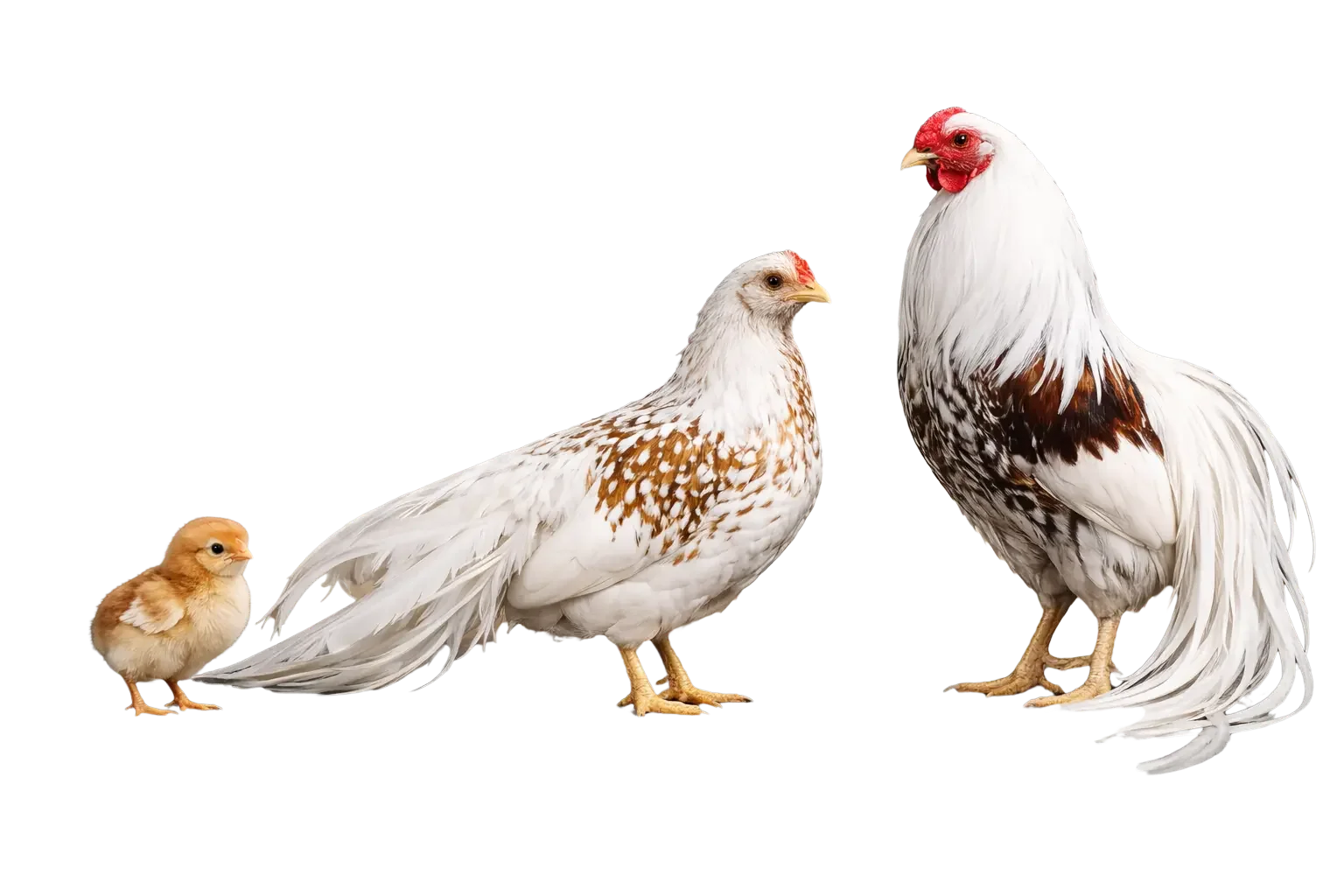
The Yokohama is one of those breeds that stops a visitor mid-step. The rooster's tail, three to four feet long under good management and growing at roughly one meter per year, sweeps the ground behind him as he moves, and the overall effect is less barnyard chicken than living ornament, something closer to a bird from a Japanese woodblock print than anything you would expect to find foraging in a backyard run. It is a genuinely beautiful animal, and that beauty is the entire point. The Yokohama was not developed to lay abundantly, grow quickly, or fill a roasting pan. It was developed to be looked at, admired, and shown, and on those terms it delivers completely. The breed traces its roots to the long-tailed ornamental chickens of Japan, exported from the port of Yokohama to Europe in the 1860s and refined into their modern form by German breeders in the decades that followed. It arrived in the United States sometime in the early 20th century and was admitted to the American Poultry Association Standard of Perfection in 1981. It is listed as Critical by the Livestock Conservancy, meaning it is one of the rarest standardized breeds in North America. For backyard keepers who have adequate space, understand the tail management requirements, and want a bird that generates genuine wonder from everyone who sees it, the Yokohama is an extraordinary and underappreciated choice.
Quick Facts
Class: All Other Standard Breeds (APA)
Weight: Roosters approximately 4.5 to 5.25 lbs; hens approximately 3 to 3.5 lbs
Egg Production: Approximately 80 to 100 small cream to tinted eggs per year; broody after 12 to 14 eggs
Egg Color: Cream to tinted white
Egg Size: Small; approximately 40 grams
Primary Purpose: Ornamental; exhibition; conservation
Temperament: Docile, calm, and friendly; unusually quiet for a chicken; roosters can be assertive toward other roosters
Brooding: Yes; hens go broody readily after 12 to 14 eggs and are good natural mothers
Flight Capability: Moderate; covered runs or five-foot fencing recommended
APA Recognition: 1981; two varieties recognized: White and Red Shouldered
Country of Origin: Developed in Germany from Japanese long-tailed stock; named after the Japanese port of Yokohama
Varieties (APA): White; Red Shouldered
Also Known As: Race de Yokohama (France); Jokohama (Germany, walnut comb varieties)
Comb Type: Walnut comb; low frostbite risk compared to single-comb breeds
Distinctive Trait: Exceptionally long flowing tail and saddle feathers; roosters grow approximately one meter of tail per year under good management
Conservation Status: Critical (Livestock Conservancy)
Lifespan: 7 to 10 years
Breed Overview
The Yokohama's story begins not in Japan but at sea, in the trade routes that opened between Japan and Europe after the Convention of Kanagawa ended Japan's long period of near-total isolation in 1854. Among the first goods to flow out of the newly opened port of Yokohama when it began operation in 1859 were ornamental long-tailed chickens, known in Japan as Minohiki, or Saddle Dragger, a breed developed from two older game breeds, the Shokoku and the Shamo. The first documented export reached France in 1864, shipped by a French missionary named Girad, and the birds were named after their port of departure rather than their Japanese breed name. They arrived in Germany via Paris, and in 1869 a Mr. Prosche of Dresden obtained a small group and began working with them.
The early breeding program was difficult. Multiple attempts to import additional stock from Japan resulted in only male survivors, the females proving unable to withstand the long sea voyage. German breeders, working with limited genetic material, were forced to outcross to Malay, Phoenix, common game fowl, and eventually Sumatra chickens to maintain and expand the flock. Hugo du Roi, the first president of the German national poultry association, took a particular interest in the breed and is credited with developing the distinctive red-saddled color variety. It was du Roi's work that shaped the modern Yokohama into the recognizable form it holds today, and the breed is considered a German creation built on Japanese foundations rather than a direct continuation of any single Japanese breed line.
The United Kingdom formed a Yokohama breeders club in 1904, and the breed spread gradually across Europe. One important historical note for North American keepers: what Germany and the United States call the Yokohama and the Phoenix are two distinct breeds, while the United Kingdom historically used the Yokohama name for both. The practical distinction is the comb type: the Yokohama has a walnut or pea comb and red earlobes with yellow legs, while the Phoenix has a single comb with cream or white earlobes and slate legs. Color patterns also differ, with the Yokohama standardized in White and Red Shouldered and the Phoenix in Silver and Golden. This naming confusion has created occasional misidentification in historical records and in some modern sourcing contexts, and buyers in North America should verify comb type when sourcing birds sold as Yokohama.
The breed was added to the APA Standard of Perfection in 1981. Today the Livestock Conservancy lists it as Critical, with fewer than 500 breeding birds documented in the United States. A red-saddled variety of the ancestral Minohiki that once existed in Japan became extinct by 1922, making the Yokohama the sole living representative of that historic Japanese color line.
Plumage and Appearance
The Yokohama's most immediately striking characteristic is its tail, and understanding what that tail requires is the most important practical step before deciding to keep the breed. Under good management with appropriate housing, clean litter, adequate protein, and high wide roost bars that keep the tail off the ground during roosting, a Yokohama rooster's tail grows at approximately one meter per year. Three to four foot tails in well-managed adult roosters are realistic and documented. The tail is composed of long sweeping sickle feathers and extended saddle feathers that flow from the lower back and create the breed's characteristic silhouette. Unlike the Onagadori, the most extreme Japanese long-tailed breed whose tail can grow to several meters and requires highly specialized housing and constant management, the Yokohama's tail length is remarkable but achievable under conditions that most dedicated backyard keepers can provide.
The body type is slim, upright, and game-like in carriage, reflecting the Shamo and Shokoku ancestry in the breed's foundation. The Yokohama is a small to medium-sized bird, noticeably lighter in body than dual-purpose breeds, with a trim silhouette and an alert, held-high posture. The breast is moderately broad. The legs are yellow and clean of feathers, medium in length, with four toes.
The walnut comb is low and compact, sitting tightly on the skull with a slightly bumpy texture. It is distinctly different from the single comb of the Phoenix and is one of the reliable distinguishing features between the two breeds. Earlobes are red. The beak is yellow and slightly curved. The face skin is red.
In the White variety the plumage is pure white throughout, with the long tail and saddle feathers carrying the same clean white. In the Red Shouldered variety, also called Red Saddled in some references, the rooster carries rich red-brown feathering across the shoulder, saddle, and hackle contrasting against white body feathering and a white tail. The hen in the Red Shouldered variety is more subdued in coloring, with brownish wheat tones across the body and a shorter, less dramatic tail than the rooster. Both varieties carry the iridescent sheen in direct light that reflects the breed's game heritage ancestry.
Chicks are hardy at hatch but require extra dietary protein during the early tail-growing phase of development, as the feather structures demand significant nutritional resources to develop properly. Breeders who skip protein supplementation during this window frequently see stunted tail development that does not recover fully in the first year.
Egg Production
The Yokohama is an indifferent layer by any production standard, and this should be understood clearly before adding it to a flock where egg supply matters. Annual production of approximately 80 to 100 small cream to tinted eggs represents the upper range for the breed under good management. Many flocks produce somewhat less. Eggs are small, approximately 40 grams, lighter than the large eggs of production breeds and comparable to other ornamental breeds of similar body weight.
The brooding pattern is distinctive and practically significant: Yokohama hens typically go broody after laying only 12 to 14 eggs, ceasing to lay and committing to incubation with an intensity that interrupts the annual production cycle repeatedly. This strong broodiness is both a limitation and an advantage depending on the keeper's goals. For egg supply purposes it is a genuine constraint, as the repeated broody cycles substantially reduce annual production below what the hen's physical capacity would otherwise allow. For natural flock propagation it is a genuine asset, as Yokohama hens are good mothers who hatch and raise chicks reliably. Keepers using incubators for propagation can remove eggs before the hen commits to brooding and maintain a more consistent laying schedule, though this requires consistent egg collection and monitoring.
Hens begin laying at approximately 18 to 26 weeks, somewhat later than production breeds, consistent with the breed's slower maturity timeline. The delayed onset of lay is normal and should not be treated as a health concern.
Temperament and Behavior
The Yokohama's temperament is one of its genuine practical strengths for backyard keeping. Hens are calm, docile, and easy to handle, becoming notably tame with regular gentle contact from young. The breed is described consistently by keepers as unusually quiet for a chicken, with roosters that are less vocal than most breeds, a practical advantage in suburban or semi-urban settings where noise is a consideration. This quietness combined with the docile hen temperament makes the Yokohama a more manageable backyard bird than its exotic appearance might suggest.
Roosters are assertive toward other roosters, consistent with the Shamo game heritage in the breed's background, and multi-rooster management in confined spaces is not recommended. Single-rooster flocks or carefully separated paddock arrangements with sight barriers are the appropriate approach for keepers maintaining more than one male. Toward humans, roosters are generally indifferent or mildly curious rather than aggressive, though individual variation exists and consistent handling from young produces the most tractable adults.
The breed does well in confinement, which is a practical necessity given the tail management requirements for exhibition birds. A Yokohama rooster ranging freely through a standard backyard will rapidly accumulate dirt, debris, and feather damage in its tail that takes a full molt cycle to recover from. Covered runs with clean litter, typically wood chips, are the standard management approach for maintaining tail condition in exhibition birds. Hens, whose shorter tails require less intensive management, adapt more readily to open ranging without the same consequences.
The Yokohama is described as well suited to back garden or estate settings where it can move freely across clean grass with light foot traffic. Keepers who find a balance between giving birds outdoor access and protecting the rooster's tail from the worst damage report that partial free-ranging during dry weather with covered run access during wet or muddy conditions produces birds in good overall condition without the full confinement that some exhibition breeders maintain year-round.
Climate Adaptability
The Yokohama's walnut comb is a meaningful practical advantage over single-comb ornamental breeds in cold winter climates. Where the Phoenix, the Yokohama's closest relative, requires management attention for its single comb during hard freezes, the Yokohama's compact walnut comb presents minimal frostbite risk under standard winter housing conditions. This makes the breed more practical for cold-climate keepers than the comb type of the Phoenix while maintaining a similar overall appearance and tail character.
Cold hardiness overall is moderate rather than strong. The breed tolerates cold winters with appropriate dry, wind-protected housing but is not as cold-robust as heavy dual-purpose breeds with dense body mass and heavy feathering. Keepers in regions with hard winters report success with well-insulated coops providing protection from drafts and wet conditions, which is the same standard that serves most ornamental breeds adequately.
Heat tolerance is good, consistent with the breed's game heritage and light body type. The Yokohama manages summer heat better than heavy feathered or large-bodied breeds, and shade with cool water access is the standard summer management practice that serves the breed well without special intervention.
One climate-related management note specific to the Yokohama: wet and muddy conditions are the tail's primary enemy regardless of temperature. Keepers in high-rainfall regions need to pay particular attention to covered run access and clean litter management to prevent the constant tail soiling and feather breakdown that wet conditions produce in birds with floor-length sickle feathers.
Housing and Management
The Yokohama's housing requirements diverge from standard backyard breed guidelines in one specific and important way: roost bar placement for tail protection. Standard low roost bars that work well for production breeds will allow the rooster's tail to rest on the floor or drag against the coop wall during roosting, causing feather breakage and soiling that accumulates across the season. Roost bars for Yokohama roosters should be placed high and wide, ideally four feet or more from the floor, giving the tail clearance to hang freely without ground contact. This single housing adjustment makes more difference to tail condition than almost any other management decision.
Litter management is the second critical housing factor. Clean, dry litter, wood chips are the most commonly recommended substrate, keeps the tail out of wet or soiled material during the hours birds spend on the ground. Deep litter systems that maintain a dry surface layer work well. Wet, compacted, or heavily soiled litter damages tail feathers quickly and the damage is not recoverable until the next molt.
Indoor floor space follows standard guidelines at four square feet per bird. Outdoor run space should be generous for a breed with the Yokohama's active, ranging character. Exhibition breeders maintaining birds in covered runs for tail protection typically provide larger covered run areas rather than smaller ones, allowing birds adequate movement without the tail exposure that open ranging during wet weather produces.
Feed management during the chick and juvenile phase requires attention to protein levels. Growing chicks developing their tails benefit from higher-protein starter and grower feeds during the active tail-growing period. Adult birds maintain well on standard layer ration supplemented with range foraging where conditions allow.
Sourcing Considerations
The Yokohama's Critical conservation status means that sourcing verified birds requires deliberate effort. The breed is not available from mainstream hatcheries and is not commonly found at farm supply stores. Sourcing routes in North America include the American Poultry Association breeder referral network, the Livestock Conservancy breeders directory, and specialty poultry exhibitions where Yokohama breeders show and sell birds directly.
The naming confusion between Yokohama and Phoenix in historical and some current sources means that buyers should verify comb type before purchasing: walnut or pea comb confirms Yokohama; single comb indicates Phoenix. This distinction matters for APA showing purposes and for bloodline verification. Red earlobes with yellow legs also confirm Yokohama; cream earlobes with slate legs indicate Phoenix.
Quality breeding stock is expensive relative to production breeds, reflecting the genuine difficulty of maintaining a small population with correct tail development, color type, and comb characteristics across generations. Keepers committed to the breed for exhibition should prioritize verified bloodlines from breeders active in the Yokohama community over birds of uncertain origin regardless of price.
Pros and Cons
Pros
Extraordinary visual presence: the long flowing tail and game-like carriage are unmatched among backyard ornamental breeds
Walnut comb means minimal frostbite risk, a practical advantage over the single-combed Phoenix in cold climates
Docile, calm, and unusually quiet temperament; hens are easy to handle and manageable for most keepers
Bears confinement well, making covered run management practical without significant stress to the birds
Strong broodiness and good maternal instincts; hens hatch and raise chicks reliably for natural flock propagation
Heat tolerant; manages warm climates well without special intervention
Well suited to back garden settings; less noise than most breeds makes it more neighbor-friendly
Conservation breeding: keeping Yokohamas actively supports a Critical breed
Cons
Critical conservation status; quality stock is genuinely difficult to source in North America
Tail management is a real commitment: high roost bars, clean litter, covered runs during wet weather, and extra protein for chicks are all necessary for good tail condition
Egg production of 80 to 100 small eggs per year is among the lower figures for any recognized breed
Strong brooding tendency after only 12 to 14 eggs repeatedly interrupts the laying cycle
Not cold hardy enough for extreme winter climates without careful housing management
Roosters assertive toward other roosters; single-rooster management recommended
Small body size makes the breed unsuitable for meat purposes
Naming confusion with the Phoenix breed requires careful verification at the point of purchase
Profitability
The Yokohama's profitability is built around exhibition, conservation breeding, and the novelty market rather than any production utility. Exhibition-quality birds with verified bloodlines and documented tail development command premium prices through specialty poultry networks and show connections. Hatching eggs and chicks from verified breeding pairs have a consistent market among the small but committed community of North American Yokohama breeders and among keepers drawn to the breed's visual impact.
The breed's Critical status means that supply from verified sources is reliably limited relative to the interest the breed generates, which supports price stability for quality stock. Keepers who invest in correct housing infrastructure and proper breeding selection produce birds that are in steady demand from a niche but serious buyer community.
The breed's aesthetic appeal extends beyond the traditional exhibition poultry audience. Social media and video content featuring Yokohama roosters in good condition, with full flowing tails and their characteristic elegant movement, consistently generates significant engagement and drives inquiry from people outside the traditional poultry community. This broader audience represents a secondary market for keepers willing to document and share their flocks online alongside the core exhibition breeding market.
Comparison With Related Breeds
Phoenix Chicken: The closest relative and most frequent comparison. Both descend from Japanese long-tailed stock and were refined by European breeders in the 19th century. The key practical differences are the comb type, walnut for the Yokohama versus single for the Phoenix, and the earlobe and leg coloring. The Phoenix's single comb requires more winter management attention in cold climates. The Phoenix is somewhat more available in North America than the Yokohama, though both are rare by any standard. Color variety recognition also differs between the two.
Black Sumatra: Shares the game-heritage body type, slim horizontal carriage, and long flowing tail character with the Yokohama, and was used as an outcross in early Yokohama breeding programs. The Sumatra's pea comb, beetle-green iridescent plumage, and multiple-spur trait distinguish it clearly from the Yokohama's white or red-saddled appearance. Both are Critical conservation breeds with similar tail management requirements. The Sumatra's temperament is more independent and flighty than the Yokohama's docile character.
Onagadori: The ancestral Japanese long-tailed breed from which the Yokohama's founding stock ultimately derives. The Onagadori's tail grows continuously without molting and can reach several meters in length, requiring highly specialized housing, individual tail management, and dedicated expertise that goes well beyond what the Yokohama demands. The Yokohama represents a practical compromise: significant tail length achievable under normal backyard management rather than the extreme length that requires full-time specialist care.
Modern Game: Shares the upright, slim, game-like body type and exhibition focus with the Yokohama but differs entirely in tail character, purpose, and temperament history. The Modern Game was developed for show ring competition based on body conformation and color, while the Yokohama's exhibition value is centered entirely on its tail. Both are ornamental breeds with modest egg production and similar body weights.
Final Verdict
The Yokohama asks something of its keeper that most backyard chickens do not: genuine attention to housing detail and a willingness to organize the flock's management around the rooster's tail. High roost bars, clean covered runs, adequate protein for growing birds, and protection from wet conditions are not complicated requirements, but they are specific ones, and keepers who treat the Yokohama like a standard backyard bird will end up with a damaged, ragged-tailed rooster that no longer delivers the visual experience the breed promises. The keeper who takes those requirements seriously gets something genuinely remarkable in return: a bird that draws a reaction from every person who sees it, that is quiet and manageable and friendly in daily interaction, and that connects its flock to a line of ornamental poultry stretching back through 19th century Germany to the long-tailed ceremonial birds of feudal Japan.
For keepers who want eggs, the Yokohama is not the answer. For keepers who want a backyard bird that is beautiful enough to stop conversation, calm enough to handle easily, quiet enough for a suburban setting, and rare enough to matter to the conservation of a historic breed, the Yokohama is one of the most rewarding choices available. The chicken directory is better for including it.
Frequently Asked Questions
How long do Yokohama tails actually get? Under good management with appropriate housing, high roost bars, clean litter, covered runs during wet weather, and adequate dietary protein, a Yokohama rooster's tail grows at approximately one meter per year. Three to four foot tails in well-managed adults are realistic and commonly documented by serious keepers. This is substantially shorter than the Onagadori, the most extreme Japanese long-tailed breed, but impressive by any domestic chicken standard and achievable without highly specialized husbandry.
How many eggs do Yokohama hens lay? Approximately 80 to 100 small cream to tinted eggs per year under good management, though many flocks produce somewhat less. The breed's strong tendency to go broody after laying only 12 to 14 eggs repeatedly interrupts the laying cycle and reduces annual production below what the hen's physical capacity would otherwise allow. The Yokohama is not a laying breed and should not be evaluated on egg production terms.
Is the Yokohama the same as the Phoenix? No, though they are closely related and share Japanese long-tailed ancestry. The Yokohama has a walnut or pea comb, red earlobes, and yellow legs, while the Phoenix has a single comb, cream or white earlobes, and slate legs. Color variety recognition also differs between the two breeds. The naming confusion arises partly because the United Kingdom historically used the Yokohama name for both breeds, while Germany and the United States have maintained them as distinct breeds. Buyers in North America should verify comb type when sourcing birds sold as Yokohama.
Are Yokohamas good for beginners? More approachable for beginners than many rare or exhibition breeds, given the genuinely docile and quiet temperament. The primary challenge for beginners is not the bird's behavior but the tail management requirements, which demand specific housing adjustments and attention to litter and run conditions. Beginners willing to research and implement the housing requirements correctly before acquiring birds can keep Yokohamas successfully.
Do Yokohamas do well in cold climates? Moderately well. The walnut comb presents minimal frostbite risk compared to single-comb breeds, which is a genuine cold-climate advantage. The breed manages winter conditions adequately with dry, well-insulated, draft-protected housing. It is not as cold-robust as heavy dual-purpose breeds and requires more housing attention than cold-hardy breeds in regions with extreme winter temperatures. Wet conditions are more damaging to tail condition than cold temperatures, making litter management and covered run access the priority in all seasons.
Where can I find Yokohama chickens in North America? The Livestock Conservancy breeders directory and the American Poultry Association breeder referral network are the most reliable starting points. Specialty poultry exhibitions are good venues for meeting Yokohama breeders directly and evaluating birds before purchasing. The breed is not available from mainstream hatcheries. Expect waiting lists from reputable breeders and verify comb type and color variety before committing to a purchase.
Why do Yokohama chicks need extra protein? The rapid development of the long tail feather structures during the juvenile growth phase demands significant nutritional resources. Chicks and young birds growing their tails for the first time benefit from higher-protein starter and grower feeds during this active development window. Keepers who feed standard protein levels during this phase often see stunted tail development in the first year that does not fully recover. A protein-enriched diet during the tail-growing phase is one of the most impactful management decisions for the breed's long-term exhibition quality.
Related Breeds
Phoenix Chicken
Black Sumatra
Onagadori
Modern Game
Old English Game
Malay Chicken