
Kniphofia
Quick Overview
Common Name: Kniphofia, Red Hot Poker, Torch Lily, Tritoma
Scientific Name: Kniphofia spp.
Plant Type: Perennial
USDA Zones: 5 to 9 depending on species and variety
Sun Requirement: Full Sun
Soil Type: Well-drained, average to moderately fertile
Bloom Season: Summer through Fall, varies by variety
Height: 24 to 60 inches depending on species and variety
Pollinator Friendly: Yes
Edible: No
Why Grow Kniphofia on a Homestead
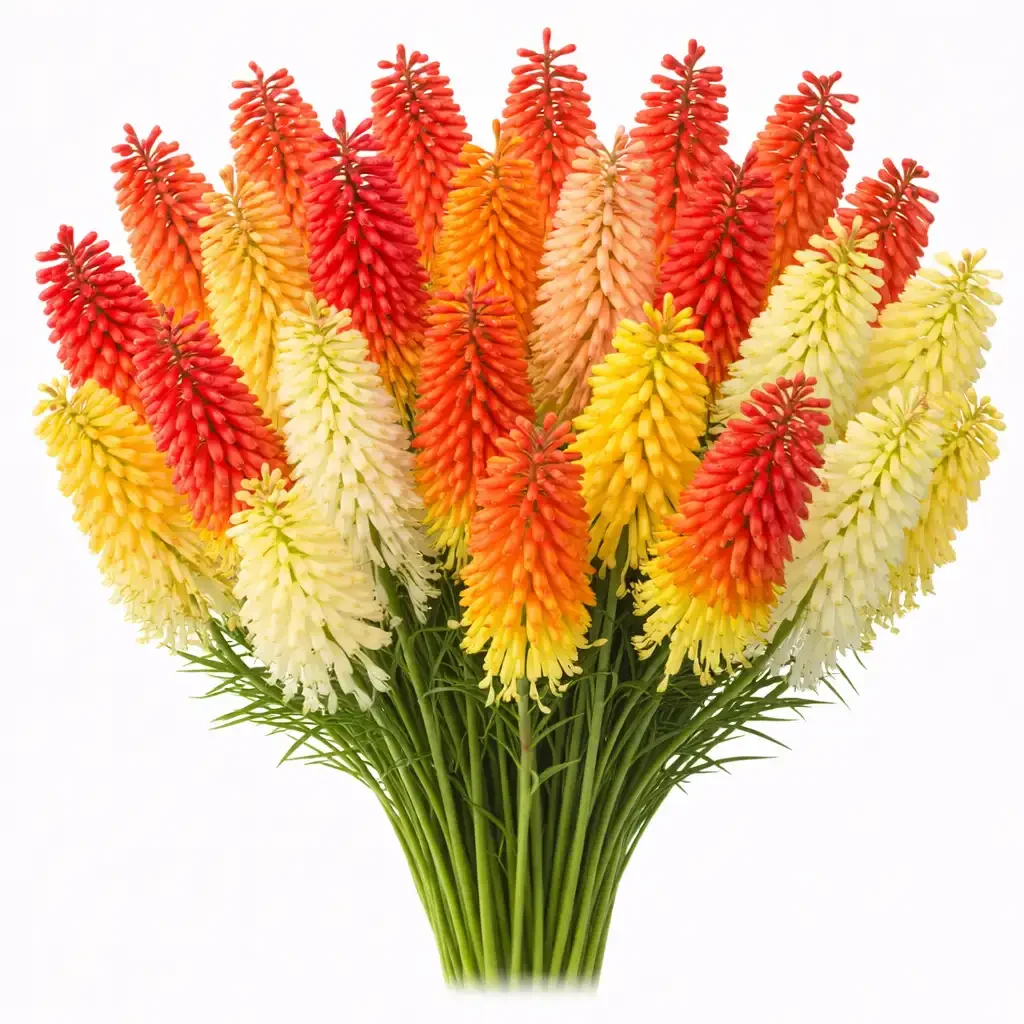
Kniphofia is one of the most architecturally striking and visually dramatic cut flowers available to homestead growers. Its tall, torch-like spikes of densely packed tubular florets in blazing combinations of red and yellow, deep orange, soft coral, creamy white, and bicolor gradients that shift from one color at the top to another at the base create an immediate, powerful visual impact in arrangements that customers and florists find impossible to ignore. At the farmers market, a bucket of Kniphofia in full bloom is one of the most eye-catching and conversation-generating displays a homestead flower grower can have, drawing attention and customers from across the market with the kind of bold, exotic beauty that most summer flowers simply cannot match.
For homestead growers, Kniphofia represents a genuinely underutilized specialty cut flower opportunity. Despite its extraordinary visual impact, exceptional ecological value, and strong market differentiation potential, it remains surprisingly rare at most farmers markets and in most local florist supply chains. Growers who develop a productive Kniphofia planting occupy an essentially uncontested local market position for a flower that florists and customers actively seek out and that is difficult to source locally in most regions. And as a permanent, long-lived perennial that returns year after year with increasing vigor and expanding clump size, it delivers an improving return on investment every season with minimal ongoing input after establishment.
Here is why Kniphofia deserves a prominent spot on your homestead:
It provides a genuinely rare and architecturally dramatic cut flower that most market stands do not offer. Kniphofia's bold, torch-like spikes and striking color combinations create immediate market differentiation that attracts attention and drives sales throughout its long blooming season.
It is one of the most important hummingbird plants available. Kniphofia is among the most powerfully attractive hummingbird plants a homestead grower can cultivate. Hummingbirds visit the nectar-rich tubular flowers constantly throughout the blooming period and the spectacle of hummingbirds working a mass Kniphofia planting is one of the most compelling agritourism experiences available to any homestead.
It covers an extended summer through fall harvest window. With careful variety selection combining early, mid-season, and late-blooming types, Kniphofia can provide a continuous supply of harvestable spikes from early summer through late fall, one of the longest harvest windows of any summer perennial cut flower crop.
It is a permanent, low-maintenance perennial that improves with age. Once established, Kniphofia returns year after year with minimal care, forming expanding clumps that produce more harvestable spikes each season from a fixed initial investment.
It thrives in conditions that challenge many other cut flower crops. Kniphofia is extremely drought tolerant once established, performs well in full sun and heat, and tolerates poor, well-drained soils where many other perennials struggle.
Growing Conditions
Sunlight
Kniphofia requires full sun to perform its best. It needs at least 6 to 8 hours of direct sunlight per day for strong stem production, abundant flowering, and the bold, vibrant colors that make it so commercially valuable. In partial shade plants produce fewer, weaker spikes with less intense coloration. Full sun is the single most important growing requirement for productive Kniphofia cut flower production.
Soil
Kniphofia prefers well-drained, average to moderately fertile soil. Good drainage is the most critical soil requirement. Waterlogged soil, particularly in winter when plants are dormant, is the most common cause of Kniphofia failure. A loose, well-drained soil with a pH between 6.0 and 7.0 is ideal. In heavy clay soils, incorporate coarse sand and compost to improve drainage and aeration before planting. Sandy or gravelly well-drained soil suits Kniphofia well and supports the drought tolerance that is one of its most commercially important characteristics.
Water
Kniphofia is moderately drought tolerant once established and performs better in drier conditions than in consistently moist soil. It needs regular watering during its first growing season to establish a strong root system but after that requires significantly less supplemental irrigation than most other perennial cut flowers. Water deeply during extended dry periods in summer to maintain stem length and bloom quality but allow the soil to dry out between waterings. In wet winter climates ensure excellent drainage to prevent the crown rot that is the most common cause of winter losses.
Temperature
Kniphofia is a summer-blooming perennial that is cold hardy in USDA zones 5 to 9 depending on the species and variety. Most commonly grown varieties perform reliably in USDA zones 6 to 9. In the coldest end of its hardiness range within USDA zones 5 to 6, provide winter protection by leaving the foliage in place until spring and tying the leaves together over the crown to protect it from freeze-thaw damage. In hot climates at the warmer end of its range within USDA zones 8 to 9 Kniphofia thrives in the summer heat and performs exceptionally well with adequate moisture during the hottest periods. In mild winter climates within USDA zones 8 to 9, many Kniphofia varieties remain semi-evergreen through the winter months.
Planting Guide
Kniphofia is best planted from nursery transplants or divisions. Growing from seed is possible but slow and results in variable performance in the first few years. Nursery transplants give the most reliable path to productive plants within the first or second season.
Step 1: Choose a location with full sun and excellent drainage. This is the most critical planting decision for Kniphofia. A location that receives standing water in winter or that has heavy clay soil without drainage improvement is not suitable without significant bed modification.
Step 2: Prepare the planting bed by incorporating compost and coarse sand into heavy soils to improve drainage and aeration. In well-drained, average soils minimal amendment is needed as Kniphofia performs well in moderately lean conditions.
Step 3: Plant nursery transplants in spring after the last frost date in cold winter climates. In mild winter climates within USDA zones 8 to 9, fall planting allows roots to establish through the cool season before the first blooming summer arrives.
Step 4: Plant at the same depth the transplant was growing in its container. Do not plant too deeply as burying the crown increases the risk of crown rot.
Step 5: Space plants 18 to 24 inches apart for cut flower production. Proper spacing allows each plant to develop its full clump size and provides adequate air circulation around the foliage.
Step 6: Water thoroughly after planting and keep soil consistently moist until plants are well established. After establishment, transition to the deep, infrequent watering schedule appropriate for this drought-tolerant perennial.
Seed vs Transplant: Nursery transplants are strongly recommended for cut flower production. Growing from seed takes two to three years to produce blooming plants of useful size and performance is variable.
Spacing: 18 to 24 inches apart for cut flower production.
Planting Season: Spring after last frost in cold winter climates. Fall or spring in mild winter climates within USDA zones 8 to 9.
Maintenance
Deadheading and Harvesting
Regular harvesting is both the commercial goal and the most important maintenance practice for keeping Kniphofia productive. Removing spent spikes promptly encourages the development of new spikes from the crown and basal shoots throughout the long blooming season. Unlike many perennials that produce a single main flush of bloom, well-maintained Kniphofia clumps can produce a succession of spikes from midsummer through fall with consistent harvesting and deadheading.
Dividing
Divide Kniphofia clumps every four to five years in spring when new growth is just emerging. Division maintains clump vigor, prevents overcrowding that reduces spike production, and provides free new plants to expand your planting. Each divided section should have several healthy growth points with good root systems. Replant immediately at the correct spacing and depth and water thoroughly to support establishment.
Leaf Management
In cold winter climates within USDA zones 5 to 6, leave the foliage in place through winter rather than cutting it back. Tying the leaves together in a bundle over the crown provides critical protection for the growing point during freeze-thaw cycles. Remove the tied leaves and any dead foliage in early spring as new growth emerges. In warmer climates where frost is not a significant factor, cut back dead or damaged foliage in early spring to tidy the planting before new growth begins.
Fertilizing
Kniphofia is a moderate feeder. Apply a balanced fertilizer or compost top dressing in early spring as new growth emerges. A light midseason application supports continued spike production throughout the long blooming period. Avoid excessive nitrogen which promotes lush, floppy foliage at the expense of the strong, upright spikes most valuable for cut flower use.
Pest Control
Kniphofia is largely pest resistant. Thrips can occasionally damage developing flower spikes, causing browning and distortion of florets. Monitor developing spikes and treat with neem oil if thrip pressure is significant. Slugs and snails can damage young plants and emerging spikes in wet conditions. Iron phosphate slug bait provides effective control.
Harvesting
When to Harvest
Harvest Kniphofia spikes when the bottom one quarter to one third of the individual tubular florets on the spike are open and showing their characteristic color, with the remaining florets still tightly closed or just beginning to show color at the top of the spike. Spikes harvested at this stage continue to open progressively after cutting from the bottom upward, giving the stem a long and evolving display in the vase. Spikes harvested when already fully open have a significantly shorter remaining vase life. Harvest in the early morning when stems are fully hydrated and temperatures are cool.
How to Cut
Use clean, sharp pruners or a sharp knife. Cut stems as long as possible, ideally 18 to 36 inches depending on the natural stem length of the variety, cutting at the base of the stem close to the crown. Remove any foliage attached to the stem. Place stems immediately into a bucket of cool water with a floral preservative. Kniphofia stems can be quite thick at the base and may benefit from a fresh angled cut before conditioning.
Conditioning
After cutting, place stems in deep cool water in a cool, dark location for several hours or overnight before sale or arrangement. This conditioning period allows stems to fully hydrate and significantly improves vase life. Kniphofia conditions readily and holds up well in arrangements and market displays when properly conditioned.
How Often to Harvest
During the blooming season, harvest every three to four days as new spikes reach the correct stage. A well-established Kniphofia clump with multiple crowns produces spikes in a continuous succession throughout its long summer to fall blooming period. Regular harvesting and removal of spent spikes encourages continued production.
Vase Life
Kniphofia typically lasts 7 to 14 days as a fresh cut flower with proper conditioning and care. Strip any foliage below the waterline, recut stems at an angle, and place in fresh water with a floral preservative. Change water every few days to maximize longevity.
Uses on a Homestead
Cut Flower Use
Kniphofia is primarily grown as a dramatic focal and accent flower in mixed summer and fall bouquets and arrangements. Its tall, torch-like spikes add bold architectural structure and a striking, exotic quality to arrangements that few other summer flowers can provide. It pairs beautifully with dahlias, rudbeckia, helenium, ornamental grasses, and other bold summer and fall flowers in arrangements that capture the late season garden at its most dramatic and vibrant. Even a single Kniphofia spike transforms the character and visual impact of a mixed bouquet.
Wedding and Event Flowers
Kniphofia is a sought-after specialty flower for bold, contemporary, tropical, and garden-style wedding and event designs. Its architectural form and vivid color combinations create immediate visual impact in large event installations and in statement bridal bouquets where something genuinely different from standard wedding flowers is desired. Wedding florists working with bold and contemporary aesthetics actively seek out local sources of quality Kniphofia stems.
Hummingbird and Pollinator Garden
Kniphofia is one of the most powerfully attractive hummingbird plants available to homestead growers. Ruby-throated hummingbirds, broad-tailed hummingbirds, and other hummingbird species are strongly attracted to the nectar-rich tubular flowers and will visit a mass Kniphofia planting constantly throughout the blooming period. Bumblebees and other long-tongued bees also visit Kniphofia flowers regularly. A mass planting in full bloom covered with visiting hummingbirds creates a spectacular and highly photogenic display that generates powerful social media content and agritourism interest.
Farmers Market
Kniphofia is one of the most visually striking and attention-generating summer and fall flowers at any farmers market. Its bold, torch-like spikes and vivid colors create an immediate presence in a market display that draws customers from a distance. Its rarity at most market stands generates immediate customer curiosity and purchasing interest that more common summer flowers cannot replicate.
Can You Make Money With Kniphofia
Yes, Kniphofia is a profitable specialty cut flower crop for homestead operations, particularly for growers who leverage its visual uniqueness, hummingbird attraction story, and near-zero ongoing input costs after establishment.
Genuine market rarity creates premium positioning. Kniphofia is genuinely rare at most farmers markets and in most local florist supply chains. Being a reliable local source of quality stems creates an essentially uncontested market position that supports premium pricing.
Architectural drama commands attention and premium prices. Kniphofia's bold, torch-like spikes are impossible to overlook at a market stand or in a florist display. The immediate visual impact it creates drives strong impulse purchasing and justifies premium per-stem pricing.
Permanent perennial with improving returns. Once established, Kniphofia returns year after year with minimal care, forming expanding clumps that produce more harvestable spikes each season. The return on investment improves every year as established clumps develop and multiply.
Hummingbird and agritourism story adds market value. The extraordinary hummingbird attraction of Kniphofia is a compelling market narrative that resonates with customers and generates powerful social media content and farm visitor interest.
Farmers Market: Fresh Kniphofia bundles sell for 10 to 18 dollars per bunch depending on spike length, color, and variety. Individual statement stems can sell for 3 to 6 dollars each at retail given their dramatic size and visual impact.
Florists and Wedding Designers: Kniphofia is a sought-after specialty flower for florists and wedding designers working with bold, contemporary, and garden-style aesthetics. Local supply is rare and valued.
CSA Flower Subscriptions: Kniphofia adds a bold, exotic, and genuinely distinctive element to summer and fall flower subscription boxes that subscribers find immediately dramatic and different from standard summer flowers.
Companion Plants
Kniphofia grows beautifully alongside many other summer and fall perennials with similar growing requirements and complementary bloom times.
Agapanthus: Both are architectural summer perennials with similar growing requirements and complementary forms that pair beautifully in bold mixed arrangements and in the landscape.
Echinacea: Both are summer-blooming perennials that grow well in full sun with well-drained soil and complement each other beautifully in naturalistic mixed arrangements.
Rudbeckia: Both are summer and fall perennials that complement each other beautifully in warm-toned arrangements where Kniphofia provides dramatic vertical spikes and Rudbeckia provides warm golden masses.
Ornamental Grasses: Pair beautifully with Kniphofia in naturalistic arrangements and in the landscape, providing movement and a prairie quality that contrasts with the bold, upright form of Kniphofia spikes.
Helenium: Both are bold, warm-toned late summer and fall perennials that complement each other magnificently in arrangements that capture the essence of the late season garden.
Crocosmia: Both are summer-blooming perennials with arching spikes of tubular flowers in warm orange and red tones that pair naturally in mixed arrangements and share similar growing requirements.
Common Problems
Crown Rot in Wet Winters
The most common cause of Kniphofia failure, particularly in cold and wet winter climates. Caused by waterlogged soil around the crown during the dormant period. Prevention through excellent drainage is the only effective management strategy. Plant in the most well-drained location available, build raised beds if necessary, and avoid any tendency to overwater in fall and winter. In climates with wet winters, choose planting sites on slopes or raised areas where water drains away quickly.
Winter Cold Damage
In the coldest end of the hardiness range within USDA zones 5 to 6, Kniphofia can be damaged or killed by severe freeze-thaw cycles without adequate protection. Leave foliage in place through winter and tie leaves together over the crown to protect the growing point. Apply a light layer of straw mulch around the base of plants after the ground freezes for additional insulation.
Failure to Bloom
Usually caused by insufficient sun, plants that have not yet reached maturity in their first season, overcrowded clumps that need dividing, or plants grown in overly rich soil that promotes vegetative growth at the expense of flowering. Ensure full sun, allow newly planted transplants a full season to establish before expecting peak production, divide overcrowded clumps every four to five years, and grow in average to moderately fertile rather than heavily amended soil.
Thrips
Can damage developing flower spikes, causing browning and distortion of the individual tubular florets. Monitor developing spikes regularly and treat with preventive neem oil applications if thrip pressure is significant. Choosing planting locations with good air circulation reduces thrip pressure.
Floppy Stems
Can occur in overly rich soil, insufficient sun, or in tall varieties in exposed locations subject to wind and rain. Grow in average to moderately fertile soil with full sun and space plants properly. In exposed locations horizontal support netting can help maintain stem uprightness during storms.
Varieties to Consider
Kniphofia uvaria (Common Red Hot Poker): The classic species with the iconic bicolor spikes graduating from deep red at the top to yellow at the base. Tall, vigorous plants reaching 36 to 48 inches. Reliable performance across a wide range of climates within USDA zones 5 to 9. The standard variety and an excellent starting point for homestead cut flower production.
Flamenco Mix: A seed-grown mix that produces a range of colors including red, orange, yellow, and cream on strong stems. Useful for establishing a diverse mixed planting from seed at low cost. Blooms in the first year from seed if started early indoors.
Mango Popsicle: A compact variety with soft orange to peach-toned spikes on strong stems reaching 24 to 30 inches. Very popular at farmers markets for its unusual warm peachy tone that is significantly different from the classic red and yellow varieties. Excellent for smaller spaces.
Popsicle Series: A compact series specifically bred for smaller garden spaces and cut flower production. Available in a range of colors including orange, yellow, and red. Very productive and reliable performance in USDA zones 6 to 9.
Tawny King: Creamy white to soft apricot spikes on strong stems. Very popular with florists and wedding designers for its soft, sophisticated color that is considerably more versatile in mixed arrangements than the classic bold red and yellow forms.
Percy's Pride: Soft greenish-yellow to cream spikes on tall, strong stems. Very popular with florists working with soft, naturalistic color palettes. The unusual soft yellow-green color is genuinely rare among Kniphofia varieties and commands premium prices for its distinctiveness.
Redhot Popsicle: A compact variety with vivid red spikes on strong stems of 24 to 30 inches. Very popular at farmers markets for its bold, saturated color and manageable size. Excellent productivity and reliable performance.
Kniphofia rooperi (Rooper's Red Hot Poker): A late-blooming species that flowers in fall rather than summer. Large, rounded spikes in orange-red on strong stems reaching 36 to 48 inches. Very useful for extending the Kniphofia harvest window into fall when most other summer perennials have finished. Reliable performance in USDA zones 6 to 9.
Final Thoughts
Kniphofia is one of the most genuinely underutilized specialty cut flower crops available to homestead growers. Its extraordinary visual impact, dramatic architectural form, rare and striking color combinations, and unmatched hummingbird attraction create a combination of commercial and ecological value that is difficult to find in any other single perennial cut flower crop. In a local cut flower market where most homestead operations offer the same reliable summer annuals, a productive Kniphofia planting places your operation in an essentially uncontested specialty market position that customers and florists find immediately compelling and consistently valuable throughout its long summer and fall blooming period. Plant in full sun with excellent drainage, provide winter crown protection in cold climates, divide every four to five years to maintain vigor, and Kniphofia will reward your homestead with decades of spectacular blooms, extraordinary hummingbird activity, and a genuinely distinctive market product that sets your flower operation apart from every other summer grower in your area.
FAQ
Is Kniphofia the same as Red Hot Poker? Yes, Red Hot Poker is the most widely used common name for Kniphofia. The name refers to the characteristic torch-like spike of tubular flowers that resembles a glowing red poker in the classic bicolor varieties where the upper florets are deep red and the lower florets are yellow. Other common names include Torch Lily and Tritoma. All of these names refer to plants in the genus Kniphofia. In the cut flower trade the plant is most commonly marketed under either Kniphofia or Red Hot Poker depending on the market and the audience.
Can Kniphofia be grown in hot, humid climates? Kniphofia performs reasonably well in hot climates within its hardiness range of USDA zones 5 to 9. In hot, humid climates good drainage and excellent air circulation are the most critical success factors. Kniphofia is significantly more tolerant of heat than of wet conditions and the combination of heat and wet soil is the most challenging environment for this plant. Choose the most well-drained location available, consider raised beds if drainage is marginal, avoid overwatering, and space plants generously for good air circulation. In very humid climates thrip pressure may be higher and preventive monitoring and management are important.
How do I extend the Kniphofia harvest season? The most effective strategy is combining varieties with different natural bloom times within the same planting. Early-blooming varieties produce spikes in early summer. Mid-season varieties bloom in midsummer. Late-blooming species such as Kniphofia rooperi extend the harvest window into fall. By planting all three groups together a homestead grower can extend the total Kniphofia harvest window from early summer through late fall, providing a continuous supply of dramatic stems throughout the entire peak summer and fall selling season.
Do Kniphofia clumps need to be divided? Yes, dividing Kniphofia clumps every four to five years is important for maintaining vigor and maximum spike production. As clumps mature and expand they can become overcrowded, resulting in declining spike size and quantity as multiple crowns compete for resources. Division in early spring when new growth is just emerging is the standard approach. Each divided section should have several healthy growth points with good root systems. The outer sections of divided clumps are always the most vigorous and productive and should be replanted while the congested central portion can be discarded.
Is Kniphofia deer resistant? Yes, Kniphofia is generally considered deer resistant. Deer tend to avoid plants with tough, strap-like foliage and strongly architectural forms like Kniphofia. While no plant is completely deer-proof in conditions of extreme hunger, Kniphofia is significantly less attractive to deer than many other garden perennials and is rarely browsed heavily in areas with moderate deer pressure. This natural deer resistance is a practical advantage for homestead growers in areas where deer damage is a significant management concern.