
Angelica
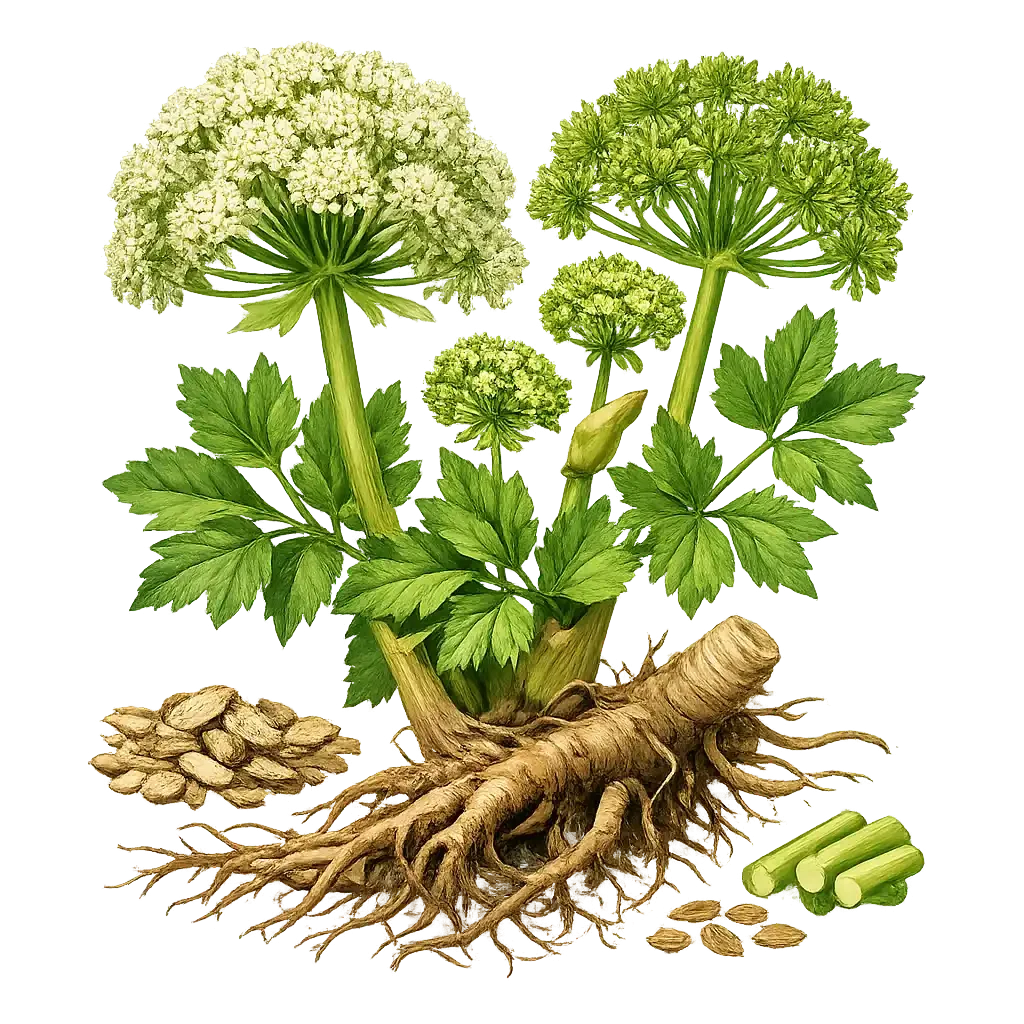
QUICK FACTS
Common Name
Angelica, Garden Angelica, Wild Celery
Scientific Name
Angelica archangelica
Plant Type
Biennial or short-lived perennial
Hardiness Zones
4 to 9
Sun Requirements
Full sun to partial shade
Soil Type
Moist, rich, well-drained to slightly wet
Plant Height
4 to 8 feet at full flower
Spacing
24 to 36 inches
Uses
Culinary, medicinal, confectionery, pollinator plant, liqueur flavoring
Angelica is one of the most architecturally dramatic herbs a homestead can grow, reaching six to eight feet in its flowering year with broad, deeply divided bright green leaves and spectacular compound flower heads that draw beneficial insects from a considerable distance. It is a plant of old European herbal tradition, deeply embedded in the medicinal and culinary history of northern and central Europe, and one of the more underused herbs in the contemporary homestead garden despite its genuine practical value.
Introduction
Angelica archangelica is native to the cool, moist regions of northern Europe and central Asia, growing naturally along stream banks, in moist woodland clearings, and in the rich, damp soils of river valleys from Scandinavia through Russia and into the Himalayas. Its common name reflects its longstanding reputation as a protective and healing plant: medieval European herbalists believed angelica bloomed on the feast day of the Archangel Michael and attributed the plant with the power to ward off plague and evil. Whatever one makes of that history, the plant's actual chemical constituents give it genuine medicinal and culinary value that stands without any assistance from medieval legend.
On the homestead, angelica earns its space in several ways simultaneously. The hollow stems and petioles are the traditional source of candied angelica, the bright green confectionery used in European baking and cake decoration that remains virtually impossible to find in quality without growing your own. The seeds and roots flavor a remarkable list of alcoholic beverages including gin, Chartreuse, Benedictine, and vermouth. The large flowers provide an early summer nectar and pollen source of exceptional value for beneficial insects, particularly the predatory wasps and parasitoid flies that manage pest populations in adjacent vegetable gardens. And the plant's medicinal history, while requiring careful attention to safe use guidelines, reflects a genuine pharmacological activity that has attracted modern research interest.
Angelica is biennial in most climates, spending its first year as a rosette of large, aromatic leaves and its second year sending up its towering flower stalk before setting seed and dying. Understanding and working with this cycle, including the seed freshness requirement that catches many first-time growers off guard, is the most important practical knowledge for successful long-term cultivation.
How to Grow
Sun Requirements
Angelica performs best in partial shade in warm climates and tolerates full sun well in cool, moist climates where summer temperatures stay below 80 degrees Fahrenheit for most of the season. In zones 7 and warmer, afternoon shade is genuinely beneficial, keeping the soil cool and moist around the roots and extending the productive life of the plant into the summer heat. In zones 4 through 6, full sun produces the most robust plants and most prolific flowering without stress.
A north-facing border, a position on the east side of a building or tall hedge, or a spot beneath the filtered light of a high tree canopy all suit angelica well in warmer zones. The key is avoiding the combination of full summer sun and dry, hot soil, which causes premature bolting and shortens the plant's productive season considerably.
Soil Requirements
Angelica demands rich, moist, deep soil and is one of the more specific herbs in its site requirements. Its native riverside habitat translates in cultivation to a preference for loamy, humus-rich soil that retains moisture consistently without becoming waterlogged. Adding generous amounts of compost to the planting area before sowing or transplanting, and maintaining a deep organic mulch around established plants, are the two most productive soil preparation practices.
Soil pH in the range of 6.0 to 7.0 is appropriate. Dry, sandy, or compacted soils produce stunted, short-lived plants that bolt quickly without developing the large, productive size that makes angelica worthwhile. If the only available site is drier than ideal, consistent irrigation compensates but is less satisfying than choosing a naturally moist position.
Water Needs
Angelica is a moisture-loving plant and should never be allowed to dry out significantly between waterings. Consistent, moderate to generous moisture through the growing season supports the large leaf growth of the first year and the towering flower stalk development of the second. In dry periods, deep watering two to three times per week maintains the soil moisture that the plant's extensive root system requires.
Mulching heavily around the base of the plant is the most effective water conservation practice for angelica, reducing evaporation from the soil surface and keeping root temperatures cool through summer heat. A three to four inch layer of compost, wood chip, or straw mulch maintained throughout the growing season dramatically reduces the irrigation demand on drier sites.
Planting
The most important fact about angelica seed is that it loses viability very quickly. Fresh seed sown immediately after harvest, typically in late summer or early autumn, achieves germination rates of 60 to 80 percent. Seed stored through winter and sown the following spring often fails almost entirely, with germination rates below 10 percent even under ideal conditions. This is the single most common cause of angelica establishment failure for new growers, and the solution is straightforward: sow fresh seed as soon as it is available in late summer, or source seed from a reputable supplier that can confirm the harvest date and guarantees fresh stock.
Alternatively, cold stratification of stored seed for four to six weeks in a moist medium in the refrigerator before spring sowing significantly improves germination rates on older seed, replicating the natural winter cold period that breaks dormancy in the wild.
Direct sowing onto a prepared seedbed in late summer is the most reliable approach. Press seeds lightly into the soil surface without covering deeply, as angelica requires light for germination. Thin to the final spacing of 24 to 36 inches when seedlings are large enough to handle. Transplanting is possible but not preferred, as angelica develops a deep taproot early that resents disturbance.
Plant Spacing
Plants should be spaced 24 to 36 inches apart to allow the large basal leaves of the first year full development without crowding and to give the second-year flowering stem adequate air circulation. Angelica is a large plant by herb garden standards, and attempting to crowd it produces weak, disease-susceptible specimens that never reach the architectural scale that makes it so visually effective and productive.
In kitchen garden settings where space is limited, a single well-sited plant delivers the full ornamental, culinary, and ecological value the species offers. Multiple plants are most practical in larger borders or in dedicated medicinal herb areas where the spreading habit and self-seeding can be allowed to develop naturally.
Companion Planting
Angelica is an excellent companion for a range of vegetable and fruit garden plants, primarily because its large compound flower heads are exceptional attractors of predatory and parasitoid insects that manage common garden pests. Hoverflies, parasitoid wasps, lacewings, and ground beetles are all drawn to the angelica bloom in numbers that measurably reduce aphid, caterpillar, and whitefly pressure on nearby crops.
Good companion plants include:
Tomatoes, where the attracted predatory insects help manage aphid and whitefly populations
Cabbage family crops, where parasitoid wasps attracted to angelica prey on cabbage white caterpillars
Fruit trees and berry bushes, where the extended bloom season bridges the insect food gap between spring blossom and summer fruiting
Carrots and parsnips, which share the Apiaceae family and the same beneficial insect community
Peas and beans, where the shade tolerance of angelica allows it to be planted at the north end of a legume bed without reducing their sun exposure
Avoid planting angelica immediately adjacent to other large umbellifers such as fennel, which can produce allelopathic effects on neighboring plants including angelica itself.
Harvesting
Harvest Time
The harvest timing varies by plant part and intended use. Young stems and leaf petioles for candying are harvested in the first year or very early in the second year before the flower stalk emerges, when they are still tender and brightly flavored. Leaves for culinary and tea use are best harvested young, in the first year, before the flavors concentrate and intensify to the point of bitterness in older foliage.
Root harvest for medicinal preparations is done in the autumn of the first year or very early spring of the second, before the plant directs its energy into flowering. Roots harvested after flowering are significantly reduced in the active compound content that makes them medicinally useful.
Seeds are harvested in late summer of the second year when the seed heads have turned from green to light brown and the individual seeds begin to separate easily from the head. Harvest before the seeds disperse naturally if seed collection for replanting or culinary use is the goal.
Harvest Method
Stems and petioles for candying are cut at the base with a sharp knife when they are four to eight inches long and still succulent. Wear gloves when harvesting in bright sunlight, as the furanocoumarins in angelica sap cause photodermatitis on sensitive skin when combined with UV exposure. Washing hands and covering exposed skin before harvesting is a sensible precaution even for growers without known sensitivity.
Roots are dug carefully with a fork or spade to avoid breaking the taproot, washed thoroughly, and sliced before drying. Seeds are cut from the plant in small bunches when nearly ripe and hung upside down in paper bags in a dry, well-ventilated space to finish ripening and catch any that separate during drying.
Important identification note: Angelica archangelica can be confused with several toxic plants in the carrot family Apiaceae, including poison hemlock (Conium maculatum) and water hemlock (Cicuta species). Positive identification before harvesting any wild or unfamiliar plant is essential. Garden-grown plants from a known source eliminate this risk entirely. If in doubt, grow from seed rather than harvesting from the wild.
How to Use
Kitchen Uses
The young hollow stems of angelica are the traditional ingredient in candied angelica, one of the oldest European confectionery traditions still in practice. The stems are blanched, then simmered in a heavy sugar syrup over several days, producing the bright green, intensely aromatic, chewy sweet that decorates traditional cakes and pastries across France, Scandinavia, and central Europe. The process requires patience but is not technically difficult, and home-produced candied angelica from fresh stems far surpasses anything commercially available in quality and flavor intensity.
Beyond candying, fresh young leaves add a sweet, musky, slightly anise-like flavor to salads, soups, and fish dishes. The flavor is distinctive and not to every taste, but in small quantities it provides a complexity that few other herbs offer. Chopped fresh leaves added to rhubarb jam or compote reduce the acidity of the rhubarb and extend the flavor in a way that is subtle and very effective. The seeds are used whole or ground to flavor breads, biscuits, and pastries with a warm, aromatic quality similar to caraway but sweeter.
Tea Uses
Angelica tea is prepared from the dried leaves or dried root, steeped in hot water for five to ten minutes. The flavor is warm, mildly sweet, and pleasantly aromatic with a slightly bitter finish from the coumarin compounds in the plant. It is traditionally drunk as a digestive herb tea after meals and as a warming drink in cold weather, and the flavor is more accessible than many medicinal herbs of comparable potency.
Root tea is stronger and more medicinally active than leaf tea and should be used in smaller quantities and for shorter periods. Leaf tea for occasional culinary enjoyment is safe for most healthy adults without particular caution, while root tea is more appropriately treated as a medicinal preparation with the considerations that implies.
Medicinal Uses
Angelica has a long documented history as a digestive herb, carminative, and warming circulatory tonic across European, Nordic, and Chinese traditional medicine. The active compounds include a range of furanocoumarins, volatile oils including alpha and beta-phellandrene, and phthalides that collectively produce the aromatic, slightly bitter, warming character of the plant's medicinal preparations.
Traditional applications include treatment of digestive complaints including bloating, gas, and cramping, where the carminative and antispasmodic properties of the volatile oils provide genuine relief. The warming, circulatory-stimulating effect of angelica preparations has been used for cold extremities, respiratory catarrh, and as a general tonic for debility and fatigue in European herbal practice. Chinese medicine uses the closely related Angelica sinensis, known as dong quai, primarily as a women's tonic herb, while European angelica archangelica has a somewhat different traditional application profile focused more on digestion and respiratory health.
Angelica preparations are contraindicated in pregnancy due to uterine-stimulating effects. The furanocoumarins in the plant cause photosensitivity and should not be used alongside pharmaceutical anticoagulants without medical advice, as coumarins affect blood clotting. These are genuine contraindications rather than theoretical cautions, and they apply particularly to root preparations, which are significantly more concentrated than leaf preparations.
Liqueur and Beverage Uses
Angelica is one of the foundational botanical ingredients in European herbal liqueur and spirit production. The seeds and roots contribute to the flavor profile of gin alongside juniper, and angelica root is a named ingredient in Chartreuse, Benedictine, Campari, and several styles of vermouth. The plant's warm, musky, slightly bitter aromatic character provides a depth and complexity to botanical spirits that is difficult to replicate with other ingredients.
Homestead-scale infusions of dried angelica root in neutral spirit, combined with other botanicals, produce an excellent homemade bitter or digestif. The seeds steeped in grain alcohol with citrus peel and a sweetener produce a simple but very pleasant aromatic liqueur that makes excellent use of the second-year seed harvest.
Storage
Fresh angelica leaves are best used immediately after harvest, as they wilt quickly and the volatile oils that carry the flavor begin to dissipate within hours of cutting. For short-term storage, stems standing in a glass of water in the refrigerator extend usability by two to three days.
Dried leaves retain useful flavor and medicinal potency for up to one year when dried quickly in a warm, well-ventilated space out of direct sunlight and stored in airtight glass containers away from heat and light. Drying at temperatures above 100 degrees Fahrenheit drives off the volatile oils that are the most important quality component, so gentle drying at room temperature or in a dehydrator set below 95 degrees is preferable.
Dried root, sliced before drying for faster and more complete moisture removal, stores for two to three years and retains its medicinal compound content well. Seeds dried thoroughly and stored in airtight glass keep their culinary value for two years and their germination viability for one season at most, which reinforces the importance of sowing fresh seed annually rather than relying on stored stock.
Candied stems, properly made with sufficient sugar penetration, store at room temperature in an airtight tin for several months and keep indefinitely when refrigerated.
Lifespan of the Plant
Angelica is typically biennial, completing its life cycle across two growing seasons. In the first year it produces a large, attractive rosette of deeply divided, bright green leaves and an extensive root system. In the second year it sends up the tall flowering stem, blooms in early to midsummer, sets seed, and then dies.
In cool, moist climates and particularly on very rich soils, angelica sometimes behaves as a short-lived perennial, surviving for a third or occasionally a fourth season if the flower stalk is cut before the plant sets seed. Removing the flower stalk as it begins to develop in the second year redirects the plant's energy back into vegetative growth and can extend its productive life by one to two seasons, though at the cost of the spectacular flower display and any seed harvest.
The most reliable approach for continuous angelica in the garden is to allow a few plants each year to complete their full cycle and set seed, which self-sow readily onto bare soil around the parent plant. A self-sustaining colony of angelica at different stages of development, with first-year rosettes and second-year flowering plants present simultaneously, provides a continuous harvest and an ongoing ornamental and ecological contribution without requiring annual replanting.
Pros and Cons
Advantages
Extraordinary architectural presence, reaching six to eight feet with dramatic compound flower heads
Exceptional beneficial insect attractor, drawing predatory and parasitoid insects that manage vegetable garden pests
Multiple harvest uses: stems, leaves, roots, and seeds all have distinct culinary or medicinal value
Source of candied angelica that is essentially unavailable in quality form without home production
Self-seeds reliably, creating a self-sustaining colony without annual replanting once established
Tolerates partial shade, filling sites where most culinary herbs perform poorly
Genuine medicinal herb with documented historical and modern research interest
Cold-hardy to zone 4, suitable for northern homestead herb gardens
Limitations
Seed viability is very short, requiring fresh seed and careful sourcing
Biennial growth cycle means no harvest in the first year for many plant parts
Furanocoumarins cause photodermatitis on skin exposed to sap in sunlight
Contraindicated in pregnancy and with anticoagulant medications
Can be confused with toxic Apiaceae family plants, requiring careful identification
Requires consistently moist, rich soil and performs poorly in dry or compacted conditions
Dies after flowering unless flower stalk is removed, requiring management for longevity
Large size makes it impractical for small herb gardens without dedicated siting
Common Problems
Aphids, particularly the angelica aphid, cluster on the new growth and flowering stems of second-year plants and can be significant in numbers on plants grown in sheltered, still-air positions. The beneficial insect community that a healthy angelica planting attracts tends to manage aphid populations naturally on well-sited plants, but a severe early-season infestation before natural predators have established can be knocked back with a strong water spray or insecticidal soap.
Powdery mildew appears on the foliage in warm, dry, still-air conditions, particularly on plants that are under moisture stress. Adequate soil moisture and good air circulation around the plant are the most effective preventive measures. By the time mildew appears in late summer on a second-year plant approaching the end of its cycle, it is typically not worth treating.
Root rot from poorly drained or persistently waterlogged soils is the most common cultural problem and is entirely preventable by appropriate site selection. Slugs and snails feed on young seedlings and on the expanding leaf rosette of first-year plants, and protection through the seedling stage in moist garden conditions is often necessary.
Premature bolting in the first year is usually caused by drought stress, excessive heat, or root disturbance from transplanting, and produces a small, unproductive plant that completes its cycle without reaching its potential size. Starting from seed in situ and maintaining consistent moisture through the first season prevents this.
Varieties
Angelica archangelica is the primary species for culinary and medicinal use and the one this guide focuses on. It is the garden angelica of European tradition and the source of virtually all culinary and commercial medicinal angelica products.
Angelica gigas, Korean angelica, is a closely related species grown primarily as an ornamental, producing deep burgundy-purple stems and flower heads rather than the green of the common species. It is equally attractive to beneficial insects and provides the same ecological functions as the common species, though its culinary and medicinal uses are less thoroughly documented in European tradition. It is worth growing as a companion to archangelica for its extraordinary color contrast in a mixed herb planting.
Angelica sylvestris, wild angelica, is a smaller, more compact species native to European woodlands and meadows, similarly useful medicinally and as a beneficial insect plant, and better suited to smaller garden spaces where the full eight-foot stature of archangelica would be overwhelming.
Final Thoughts
Angelica rewards the homestead grower who takes the time to understand its biennial cycle and fresh-seed requirement with one of the most architecturally dramatic, ecologically productive, and multi-use herbs in the temperate garden palette. It is not the herb for the grower who wants instant results from a plug plant purchased at a garden center. It is the herb for the grower who thinks in seasons and years, who values a plant that contributes at the insect level and the kitchen level and the medicine cabinet level simultaneously, and who wants something in the garden that genuinely earns the space it occupies.
Allow a few plants each year to self-seed and the colony manages itself. Cut the stems in early summer for candying. Let the flowers open for the hoverflies and the wasps. Harvest the roots in autumn for the medicine cabinet. And stand back in early July when the six-foot flower heads open above the vegetable beds and acknowledge that some plants simply justify every square foot they occupy.