
Anise
Written By Arthur Simitian
QUICK FACTS
Common Name
Anise, Aniseed; not to be confused with star anise (Illicium verum), which is an entirely different plant from the Schisandraceae family native to southern China and Vietnam, or with fennel (Foeniculum vulgare), which shares the anethole flavor profile but is a distinct plant in the same Apiaceae family; the shared licorice-anise flavor among anise, fennel, star anise, tarragon, and sweet cicely reflects convergent evolution of the anethole compound rather than botanical relationship, and the interchangeability of these flavors in cooking does not make the plants equivalent medicinally
Scientific Name
Pimpinella anisum; Apiaceae family (carrot or parsley family); native to the eastern Mediterranean, particularly Egypt, Greece, and the Levant, with cultivation extending through the ancient Near East, Greece, and Rome for at least four thousand years; one of the most ancient cultivated spice and medicinal plants in the Western tradition, appearing in ancient Egyptian medical papyri, in Greek and Roman texts, and in medieval European monastery gardens as a foundational carminative herb
Plant Type
Annual; completes its full life cycle from germination to seed maturity in a single growing season of approximately one hundred twenty to one hundred forty days; must be resown each year; does not tolerate transplanting well and is best direct-sown in its permanent location; the shallow, sensitive taproot that develops early in the seedling stage is easily damaged by transplanting, leading to bolting and poor seed development in transplanted seedlings
Hardiness
Annual, no cold hardiness relevant; sown after last frost in spring; in warm climates with long growing seasons it can be sown in late summer for an autumn seed harvest; requires a frost-free growing period of at least one hundred twenty days from germination to seed maturity for a reliable harvest; the cool, dry Mediterranean climate of its native range defines its preferences: it thrives in the conditions that suit Mediterranean culinary herbs generally and dislikes the humid heat of the southeastern United States summer
Height
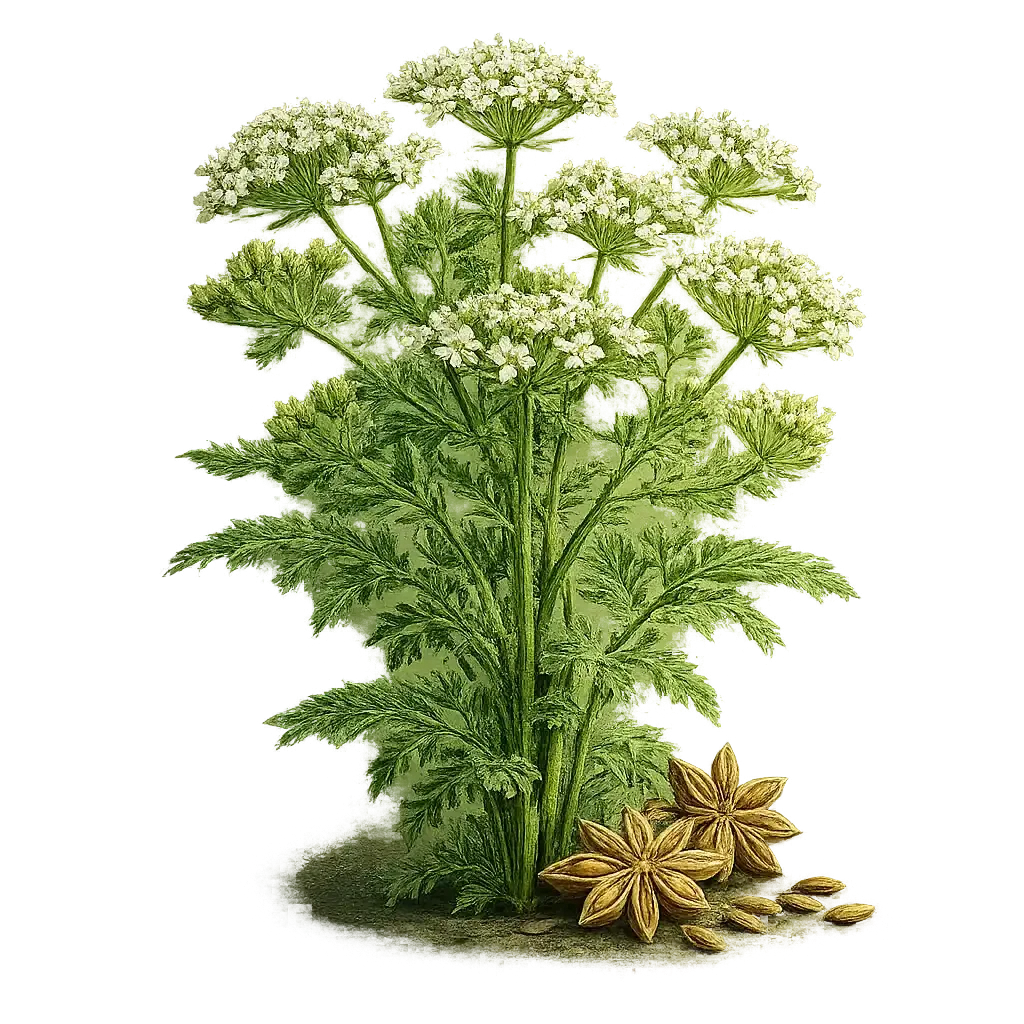
Eighteen to twenty-four inches; slender, upright, and branching; the above-ground plant is airy and open in character rather than dense, with the compound umbels of white flowers at the branch tips giving the upper part of the plant a lacy quality that is one of the most recognizable signatures of the Apiaceae family; a small planting of five to ten plants makes a modest but graceful mid-border annual in the herb garden
Harvest
Both the leaves and the seeds are harvested; the young leaves from the basal rosette and lower stem are harvested through the growing season for fresh culinary use; the seed harvest is the primary purpose for most growers and occurs in late summer when the seed heads have dried to a gray-brown on the plant; harvest the entire seed head by cutting the stalk and inverting into a paper bag; thresh to separate the seeds; the seeds are the aniseed of commerce and the primary form used medicinally
Primary Active Compounds
Trans-anethole (the dominant essential oil component at eighty to ninety percent of the essential oil fraction; the compound responsible for the characteristic sweet licorice flavor and the primary pharmacologically active constituent; estrogenic, carminative, expectorant, antimicrobial, and spasmolytic activity); foeniculin and estragole (minor essential oil constituents); flavonoids including rutin and apigenin (anti-inflammatory, antispasmodic); coumarins including bergapten and umbelliferone (photosensitizing at high topical concentrations; present at low levels in the seeds); caffeic acid derivatives; fixed oils in the seeds; the essential oil content of the dried seeds is typically two to three percent by weight, which is sufficient for perceptible pharmacological effects at culinary and tea-dose levels
Culinary Uses
The dried seeds are used whole or ground in baked goods including breads, biscotti, and cakes; in sausage and charcuterie seasoning; in pickling blends; in liqueur production including ouzo, pastis, arak, sambuca, and absinthe; the seeds are chewed as an after-dinner digestive aid throughout the Mediterranean and Middle East; the fresh leaves are used similarly to flat-leaf parsley or chervil in salads, egg dishes, and as a garnish; the entire plant is aromatic, but the seeds carry the most concentrated flavor
Anise is the herb that closes this series as it opened it: an ancient Mediterranean annual with a flavor that civilization recognized as worth growing four thousand years ago and has not stopped growing since. The anethole chemistry in the seed is the same compound in fennel, in star anise, in pastis and ouzo and sambuca, in the after-dinner digestive tradition of a dozen cultures across the Mediterranean and Middle East. It is not a coincidence that so many distinct cultures independently arrived at the same uses: the carminative action on intestinal gas, the expectorant action on respiratory mucus, the mild antispasmodic effect on gut cramping are all real, all attributable to the same essential oil chemistry, and all accessible from a cup of anise seed tea steeped for ten minutes. This is a plant whose entire value is available from a single season's direct sow into good garden soil, and whose flavor and medicine have been understood for as long as any herb in this collection.
Introduction
Pimpinella anisum appears in the Ebers Papyrus, an ancient Egyptian medical text dating to approximately 1550 BCE, as a remedy for digestive complaints. It appears in the writings of Theophrastus, Dioscorides, and Pliny the Elder, who described both the culinary and medicinal applications that are still current today. It was grown in the monastery gardens of medieval Europe as a foundational carminative and in the spice trade as a valuable commodity; Roman wedding cakes flavored with anise, mustus cakes called mustaceum, were eaten after feasts specifically for their digestive properties. This is a plant with a continuous, well-documented use record spanning four thousand years and three continents, in which the specific application described in the earliest texts is essentially unchanged in the twenty-first century herbal tradition.
The Apiaceae family membership places anise in one of the most important culinary herb families in the garden: the family that includes dill, fennel, coriander, caraway, chervil, parsley, lovage, and sweet cicely, all of which have been covered in this series. The compound umbel flower structure, the hollow ribbed stems, the aromatic seeds, and the sensitivity to transplanting that characterizes most Apiaceae members are all present in anise. The family also includes some of the most toxic plants in temperate regions, including poison hemlock and water hemlock, whose compound umbels of small white flowers create a visual similarity to the edible Apiaceae that requires careful species identification in any wild-harvested context; for garden cultivation of verified purchased seed, this is not a practical concern.
The distinction between anise, fennel, and star anise is worth establishing clearly because the three are frequently conflated in cooking contexts where the shared anethole flavor makes them interchangeable, but they are not interchangeable plants. Anise is Pimpinella anisum, an annual herb in the Apiaceae family, native to the Mediterranean, producing small oval seed-like fruits. Fennel is Foeniculum vulgare, a perennial or biennial herb also in the Apiaceae family, native to the Mediterranean, producing larger seeds and an edible bulb. Star anise is Illicium verum, a small evergreen tree in the Schisandraceae family, native to southern China, producing the characteristic star-shaped fruit pods of Chinese five-spice and Vietnamese pho. All three contain trans-anethole as a primary flavor compound; none is a substitute for the others in medicinal applications where the full phytochemical profile matters.
How to Grow
Direct Sowing
Direct sow anise seeds in their permanent location after the last frost date, once soil temperatures have reached at least 60 degrees Fahrenheit. The transplant sensitivity of anise is genuine and consistent: seedlings started indoors and then moved to the garden suffer root disturbance that triggers premature bolting, producing plants that flower and set seed before developing a useful leaf harvest or a full root system capable of supporting a large seed head. The time saved by indoor starting is lost to the poor performance of transplanted plants. Direct sow where the plants will grow.
Sow seeds shallowly, about one quarter inch deep, in rows or clusters spaced twelve inches apart. Anise seeds are slow to germinate, typically fourteen to twenty-one days at optimal soil temperatures; the seed coat is thick and the germination rate of commercial anise seed is moderate, so sow two to three seeds per position and thin to the strongest seedling. Water consistently through germination and early establishment; once established the plants are fairly drought tolerant. Thin to twelve inches between plants to allow adequate air circulation, which is important for reducing fungal disease on the stems and foliage in humid conditions.
Anise grows best in full sun and well-drained, moderately fertile soil with a neutral to slightly alkaline pH. It does not perform well in heavy clay, waterlogged positions, or highly acidic soil. A sheltered position protects the slender stems from wind damage as the plant approaches full height; stake individual plants or grow in a block planting where neighboring plants provide mutual support if the garden site is exposed.
Leaf Harvest
The young leaves of the basal rosette and lower stem are the most flavorful and can be harvested from about four weeks after germination through the growing season. The flavor of the fresh leaves is a lighter, greener version of the seed flavor: sweet anise with a fresh herbal quality suited to salads, egg dishes, fresh cheese, and as a garnish. Harvest individual leaves as needed; do not strip the plant heavily, particularly early in the season, as the leaves support the root and stem development that ultimately produces the seed harvest. Once the plant begins flowering the leaf flavor becomes stronger and more assertive.
Seed Harvest
The seed harvest is the primary purpose for most homestead growers. The seeds mature approximately one hundred to one hundred twenty days after germination, in late summer. Watch for the color change from green to gray-brown in the seed heads; harvest when the majority of seeds on a head have turned gray-brown but before they have begun to shatter and fall naturally. Cut the seed stalks and invert them into paper bags, tying the bag around the stalk; as the heads continue to dry the seeds will fall into the bag. Alternatively, harvest entire seed heads and spread on screens in a warm, shaded, well-ventilated space for one to two weeks, then thresh by rubbing between the palms or striking against the inside of a bucket.
Clean the harvested seeds by winnowing: pour the threshed seeds and chaff from one container to another in a gentle breeze or in front of a fan, allowing the lighter chaff to blow away while the heavier seeds fall cleanly. Dry the cleaned seeds for an additional week on screens before storing. Store in sealed glass jars away from light and heat; properly dried anise seed retains its essential oil potency and flavor for one to two years.
Medicinal Uses and Preparations
Carminative and Digestive Applications
The carminative action of anise seed, meaning its capacity to reduce intestinal gas and the cramping that accompanies it, is its most ancient and most thoroughly validated medicinal application. The anethole and other volatile oil constituents relax the smooth muscle of the gastrointestinal tract, reducing the spasms that trap intestinal gas and cause discomfort, while the antimicrobial properties of the essential oil fraction reduce the fermentation-producing bacterial overgrowth that generates excessive gas in the first place. This dual mechanism, spasmolytic and antimicrobial, produces a more comprehensive carminative effect than herbs that act through only one pathway.
The traditional practice of chewing anise seeds after meals, or serving aniseed candies or anise-flavored spirits as digestifs, is a direct application of this carminative mechanism. The seeds are chewed whole, releasing the volatile oils directly in the mouth and upper gastrointestinal tract where they begin their spasmolytic action before the material reaches the lower gut. A small pinch of seeds, half a teaspoon or less, chewed slowly after a meal is among the simplest and most effective digestive aids in the homestead herb repertoire.
Expectorant and Respiratory Uses
Anise seed has a well-established traditional application as an expectorant for productive coughs and bronchial congestion, and this use is supported by Commission E approval in Germany for catarrh of the respiratory tract and mild spasmodic discomfort. The anethole fraction acts on the mucociliary transport system of the respiratory epithelium, loosening and thinning mucus secretions and stimulating the ciliary action that moves mucus out of the bronchial passages. The result is a more productive cough that clears congestion more effectively than the dry, unproductive cough of unthinned mucus. Anise seed tea taken warm during a respiratory infection supports this mechanism throughout the day.
Estrogenic Activity and Reproductive Applications
Trans-anethole has demonstrated estrogenic activity in laboratory studies, binding weakly to estrogen receptors. The traditional uses of anise as a galactagogue to increase milk production in nursing mothers, and as an herb to support menstrual regularity, reflect this estrogenic activity in traditional practice. The evidence base for these applications is largely traditional and animal-model rather than robust human clinical trial data, but the underlying mechanism is consistent with the traditional use. At normal culinary and tea doses the estrogenic activity is mild; concentrated essential oil preparations deliver far higher anethole concentrations and carry a different risk profile than seed tea or culinary use.
Anise seed tea: the foundational preparation
The simplest and most broadly applicable medicinal preparation for anise is a seed infusion taken warm after meals or at the onset of digestive discomfort or respiratory congestion. The process is straightforward but the specific technique of lightly crushing the seeds before steeping matters: the essential oil is stored within oil ducts in the seed tissue and crushing breaks those ducts to release the volatile compounds into the water more efficiently than steeping whole seeds.
Measure one to two teaspoons of dried anise seeds per cup of water. Place the seeds on a cutting board and press once with the flat side of a knife or the bottom of a glass to lightly crush them; the seeds should crack open but not be ground to powder. Place the crushed seeds in a cup or teapot and pour water that has just come off the boil over them; do not use a full rolling boil as excessive heat volatilizes and drives off some of the essential oil compounds. Cover the cup or pot to trap the volatile oils within the steam rather than allowing them to escape into the room. Steep for ten minutes covered, then strain. A small addition of raw honey improves palatability and adds mild additional antimicrobial activity; a squeeze of fresh lemon brightens the flavor and adds vitamin C.
For digestive use, drink one cup warm after meals or at the first sign of bloating, gas, or cramping; the effect on intestinal spasm is typically noticeable within fifteen to twenty minutes. For respiratory use, drink two to three cups through the day during a productive cough or bronchial congestion; the combination of warmth, steam inhalation while drinking, and systemic anethole absorption gives a combined benefit beyond what the tea alone provides. The tea can be combined effectively with fennel seed, caraway seed, and ginger for a broader digestive blend that addresses different facets of gastrointestinal discomfort simultaneously.
Aniseed honey: for a shelf-stable preparation ready to use as needed, infuse whole anise seeds in raw honey by filling a small jar halfway with lightly crushed seeds, covering with raw honey, sealing, and leaving at room temperature for four to six weeks, shaking gently every few days. The resulting aniseed honey can be stirred into hot water for a quick digestive or respiratory tea, used as a spread, or taken by the teaspoon directly. It keeps indefinitely and the flavor improves with age as the essential oils fully infuse into the honey.
Cautions: Anise at normal culinary and tea-dose quantities has a very long and safe traditional use record. The following points require attention. Apiaceae allergy: as a member of the carrot family, anise may cause reactions in people with documented Apiaceae allergy or sensitivity; the family includes several known allergens including celery and coriander; people with known Apiaceae allergy should approach anise with caution. Estrogen-sensitive conditions: the estrogenic activity of trans-anethole raises a theoretical concern for people with estrogen-sensitive conditions including certain breast, uterine, and ovarian cancers, or endometriosis; culinary-level seed use and moderate tea consumption are unlikely to deliver pharmacologically significant estrogenic doses, but concentrated essential oil preparations should be avoided; people with estrogen-sensitive conditions should discuss anise use with their medical provider. Essential oil toxicity: the concentrated essential oil of anise, which is not the same as the dried seed or seed tea, contains anethole at concentrations that are toxic and irritating to skin and mucous membranes; do not use concentrated anise essential oil internally; the culinary seed and seed tea preparations described in this entry do not carry this risk. Pregnancy: anise essential oil is traditionally contraindicated in pregnancy due to the concentrated estrogenic anethole content; culinary seed use in food amounts is generally considered safe during pregnancy; avoid concentrated preparations including essential oil and high-dose supplements during pregnancy. Photosensitivity: the coumarin constituents of anise seed, including bergapten, are photosensitizing at high topical concentrations; this is not a concern from internal seed tea use but is relevant for anyone applying anise-containing preparations directly to skin that will be sun-exposed. Anethole sensitivity: a small number of people develop an allergic contact reaction to anethole; if skin redness, itching, or hives develop after using anise-containing products, discontinue use.
Anise and the Flavor of Antiquity
There is a short list of culinary herbs whose flavor is so closely associated with specific cultural traditions that tasting them is a kind of historical experience: the anise note in Greek ouzo, in French pastis, in Italian sambuca, in Lebanese arak, in Egyptian keshk and anise bread, in Indian mukhwas after-meal seed mixtures, in Mexican pan dulce. The anethole compound in Pimpinella anisum is the source of all of these, and the compound is the same one that has been in continuous use since the Ebers Papyrus was written thirty-five hundred years ago. Growing anise in the garden is the most direct possible connection to that continuity.
The homestead case for anise is practical: it is a dual-purpose annual providing fresh leaves through summer and a storable seed harvest in autumn, both useful in the kitchen and medicinally. The carminative and expectorant applications are among the most immediately verifiable of any herb in this series because the effect of anise seed tea on intestinal gas or a productive cough is noticeable within an hour. And the growing requirements, a warm sunny bed with decent drainage and a direct sow after last frost, are no more demanding than any other Mediterranean annual in the garden.
It is a fitting final entry for a series that began with Astragalus and Arnica and traced the full range from multi-year root crops to protected alpine perennials to the simplest possible annual from seed to table in one season. Anise seeds sown in May, harvested in August, steeped in October: the entire arc of the herb garden in a single plant.
Pros and Cons
Advantages
Dual-purpose harvest from a single planting: the fresh leaves are a culinary asset from early summer through flowering, and the dried seeds provide both a kitchen spice and a medicinal carminative and expectorant that stores for one to two years; few other annuals in this series deliver both an in-season leaf harvest and a storable seed medicine from the same planting
The carminative and expectorant applications are supported by Commission E approval in Germany and by a continuous traditional use record across multiple cultures spanning four thousand years; the underlying anethole chemistry provides a credible pharmacological mechanism for both applications; this is a well-understood, well-validated herb whose medicinal claims are not speculative
The entire growing cycle from sowing to seed harvest completes in one hundred twenty to one hundred forty days, requiring no multi-year commitment, no overwintering management, and no permanent bed allocation; anise fits naturally into the annual rotation of any kitchen garden and makes no demands on the garden beyond a sunny well-drained position through the growing season
The flavor connection to Mediterranean, Middle Eastern, and South Asian culinary traditions gives anise broader kitchen utility than most medicinal herbs, which tend toward purely remedial applications; a homesteader who grows anise for the medicine also acquires a spice with applications in baking, charcuterie, pickling, liqueur-making, and after-dinner seed service that would otherwise require purchase
The compound umbel flowers are genuinely useful as insectary plants, attracting small parasitic wasps, hoverflies, and other beneficial predatory insects that help manage pest populations in the kitchen garden; interplanting anise with brassicas, tomatoes, or other pest-susceptible crops supports the broader beneficial insect habitat of the garden
Limitations
The transplant sensitivity is a genuine constraint that eliminates the indoor starting option available to most other annuals in this series; in climates with short growing seasons of fewer than one hundred twenty frost-free days, the inability to get a head start indoors means the seed harvest is marginal or unreliable; growers in zones 3 and 4 may need to accept that anise is a foliage crop only in their climate rather than a reliable seed producer
The slow and uneven germination of anise seed, at fourteen to twenty-one days with moderate germination rates, creates a gap in the garden where bed space is occupied but not yet productive; in a tightly managed kitchen garden where succession planting maximizes use of every square foot, this slow start can be awkward to schedule around other crops
Hot, humid summers outside the Mediterranean climate range significantly reduce plant performance; in the southeastern United States and other humid subtropical summer climates, anise is prone to fungal stem and foliage diseases, premature bolting, and reduced essential oil content in the seeds; the carrot family characteristic of preferring cool, dry growing conditions is most limiting for anise among the Apiaceae herbs in this series
The medicinal applications of anise overlap substantially with fennel, which is already covered in this series and which offers the additional advantage of an edible bulb and perennial or biennial habit in mild climates; growers who are already growing fennel for its seeds and foliage are partially duplicating the anise carminative application; the distinction is worth maintaining for their different flavor nuances and different chemical profiles but the functional overlap is real
The seed yield per plant is modest compared to the Apiaceae family members with larger umbels and more prolific seed set; a planting of five to ten plants produces enough seed for household culinary and medicinal use but not enough for large-scale preservation, infused spirits, or significant dried herb commerce; growers wanting anise as a serious production crop rather than a household supply crop need to plan for substantially larger plantings
Final Thoughts
Anise asks for a warm sunny position, soil that drains, and the patience to direct sow rather than transplant. It gives back fresh leaves through summer, a seed harvest that stores through winter, a carminative that works, an expectorant that the German Commission E approved, and a flavor that connects a homestead kitchen to four thousand years of continuous human cultivation.
Sow it in May. Crush a teaspoon of seeds in October and steep them for ten minutes in covered hot water. Drink it after dinner. The ancient Egyptians, the Greeks, the Romans, and every culture in between that arrived independently at the same use were right about what this small gray-brown seed does. The herb series that began at the letter A ends here, at the same letter, with the oldest herb in the collection and the simplest medicine in the garden.