
Fenugreek
Written By Arthur Simitian
QUICK FACTS
Common Name
Fenugreek, Greek Hay, Methi
Scientific Name
Trigonella foenum-graecum
Plant Type
Annual legume; cool-season crop
Hardiness Zones
Annual grown in all zones; prefers cool weather for leaf production, tolerates light frost as a seedling
Sun Requirements
Full sun
Soil Type
Well-drained, moderately fertile; tolerates poor, dry soils; pH 6.0 to 7.0; nitrogen-fixing legume that improves soil for following crops
Plant Height
12 to 24 inches
Spacing
4 to 6 inches for leaf production; 6 to 8 inches for seed production
Time to Harvest
Leaves: 20 to 30 days from sowing; Seeds: 90 to 120 days from sowing
Harvest Part
Seeds (primary spice use); fresh and dried leaves (kasuri methi); sprouts; occasionally the young pods
Primary Active Compounds
Diosgenin (steroidal saponin; insulin-sensitizing, cholesterol-modulating); trigonelline (alkaloid; blood sugar, neuroprotective); 4-hydroxyisoleucine (unusual amino acid; insulin secretagogue); galactomannan fiber (viscous; slows glucose absorption); fenugreekine; flavonoids including vitexin and isovitexin
Uses
Culinary spice fundamental to Indian, Middle Eastern, North African, and Ethiopian cooking; blood sugar support with multiple clinical trials; lactation enhancement (galactagogue); digestive bitter and carminative; cholesterol modulation; testosterone and athletic performance (contested evidence); topical hair and skin uses
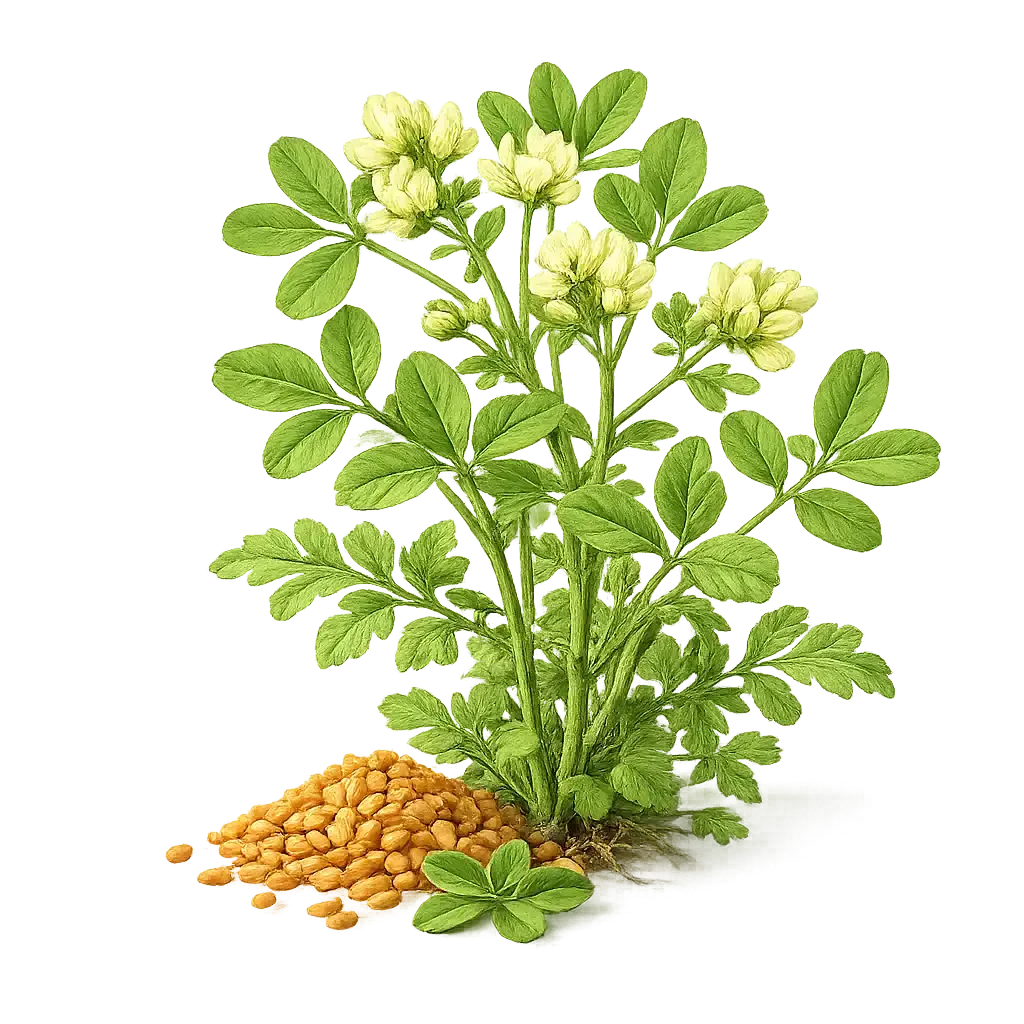
Fenugreek is the spice that anchors Indian cooking to its deepest flavor register, the warm bitter-maple-curry note that defines the base of countless dals, curries, and spice blends. It is also among the most practically multifaceted herbs in this series: a legume that fixes nitrogen and improves the soil it grows in, a cool-season annual that can be sown twice a year in most temperate climates, a plant whose leaves are harvested as a fresh vegetable in South Asian cooking weeks before the seeds ripen, and a medicinal herb with one of the stronger clinical evidence bases for blood sugar modulation of any plant in the homestead herb garden. The maple syrup smell that cooked fenugreek seeds produce is the same compound, sotolon, responsible for the characteristic body odor that appears after eating significant quantities of the seeds, a harmless but notable side effect that serves as informal confirmation that the active compounds have been absorbed. Growing fenugreek requires almost nothing from the grower beyond sowing seed in cool weather and waiting; what it returns for that minimal investment covers more practical uses than most herbs in this series combined.
Introduction
Trigonella foenum-graecum is native to the eastern Mediterranean and western Asia, with the oldest archaeological evidence of cultivation coming from Neolithic sites in the Near East dating to approximately 4000 BCE. The plant belongs to the Fabaceae pea family and, like all legumes, forms root nodules with nitrogen-fixing Rhizobium bacteria that convert atmospheric nitrogen into plant-available ammonium, enriching the soil in which it grows. This nitrogen-fixing capacity makes fenugreek a soil-improving cover crop as well as a food and medicine plant, and incorporating the above-ground biomass back into the soil after harvest adds significant organic matter and fixed nitrogen to benefit following crops.
The Latin name foenum-graecum means Greek hay, reflecting the ancient practice of using the dried plant as fodder and the plant's association with Greek agricultural tradition. The Sanskrit word methi, still the most common name for fenugreek in South Asia, where the plant is most deeply integrated into daily cooking and medicine, reflects a separate naming tradition that predates the Greek-hay etymology and indicates independent cultivation history across the Indian subcontinent going back thousands of years.
Fenugreek seed is among the twelve most commonly used spices in Indian cooking and appears in curry powder blends, panch phoron, and sambar powder. It is central to Ethiopian berbere and Egyptian dukkah. It flavors the imitation maple syrup industry globally; the sotolon compound that gives fenugreek its characteristic warm-maple aroma is the same compound used in artificial maple flavoring. This aromatic signature means that fenugreek-flavored dishes, and people who have eaten significant quantities of fenugreek, tend to smell perceptibly of maple or curry, a quality that is both a reliable indicator of consumption and entirely harmless.
How to Grow
Cool-Season Timing
Fenugreek is a cool-season annual that performs best in the same spring and autumn windows that suit peas, cilantro, and spinach. It tolerates light frost as a seedling, germinates well in soil temperatures between 50 and 70 degrees Fahrenheit, and bolts to flower and seed relatively quickly in summer heat. In most temperate climates this means two sowing windows: early spring, four to six weeks before the last frost, for a leaf harvest through spring and a seed harvest by midsummer; and late summer or early autumn, six to eight weeks before the first frost, for a leaf harvest through the cool autumn weeks before hard frost ends the season.
In hot climates with mild winters, zones 8 through 10, fenugreek is most productively grown as a winter annual sown in autumn and harvested through the cool months, completing its cycle before the heat of spring accelerates bolting. In cool maritime climates, a single spring sowing often provides both a sustained leaf harvest and a full seed crop from the same planting.
Sowing
Direct sow seed into prepared soil; fenugreek does not transplant well due to a long taproot that is easily damaged. Sow seed one half to one inch deep, spacing two to three inches apart in a grid or broadcast pattern and thinning to four to six inches after germination. Germination is fast and reliable in cool moist soil, typically five to seven days. The seed bought from any Indian grocery store as a culinary spice is viable planting material and is often substantially cheaper than seed sourced from herb suppliers; buying in bulk from an Indian grocery is both the most economical and the most reliably fresh source of fenugreek seed.
Successive sowings every two to three weeks through the cool growing window extend the fresh leaf harvest season. Once a planting bolts to flower in warm weather, the leaf harvest is essentially over; having a succession of plantings at different stages ensures continuous leaf supply through the spring season.
Soil and Fertilizing
Fenugreek is a nitrogen-fixing legume and does not require nitrogen fertilizer. In fact, applying nitrogen-rich fertilizer suppresses the root nodule formation that makes fenugreek valuable as a soil-improving crop; lean-to-moderate soil fertility produces better nitrogen fixation than rich, heavily amended soil. Phosphorus availability supports nodule development; a moderate application of compost at sowing time provides adequate phosphorus without excess nitrogen.
After harvest, cutting the plant at soil level and leaving the roots in the ground to decompose deposits the fixed nitrogen where following crops can access it. Incorporating the cut above-ground biomass adds organic matter and releases the amino acid and alkaloid-rich leaf tissue back into the soil food web.
Harvesting
Leaf Harvest
Fresh fenugreek leaves, known as methi in South Asian cooking, can be harvested beginning twenty to thirty days after sowing, when the plants have reached four to six inches. Cut the top third of the stem, leaving enough growth for the plant to continue producing. Regular harvesting of the growing tips delays bolting, extending the leaf harvest window by several weeks compared to plants left uncut. Fresh leaves have a pleasantly bitter, slightly grassy, herbal flavor that intensifies considerably on drying.
Dried fenugreek leaves, called kasuri methi, are the dried form used extensively in North Indian cooking to finish dishes, particularly butter chicken, paneer dishes, and flatbreads. To make kasuri methi from the home harvest, spread freshly harvested leaves in a thin layer on a tray and dry at room temperature in a warm, airy space for four to five days, or in an oven at the lowest possible setting with the door cracked for two to three hours. The flavor of home-dried kasuri methi is substantially more complex and fresher-tasting than commercial dried fenugreek leaf, which loses volatile compounds during extended storage.
Seed Harvest
For seed production, allow the plant to flower and set pods without continued leaf harvesting. The long, narrow, curved pods ripen over several weeks, turning from green to tan-yellow as they mature. Harvest timing is important: the pods shatter and release seed when fully ripe, so monitor carefully and harvest pods when they have yellowed but before they begin to split. Cut whole plant tops or individual pods and spread on a tray in a dry location to finish drying for a week before threshing. Thresh by rubbing the dried pods between the palms or by bundling and beating over a clean surface; the hard angular golden-yellow seeds separate readily from the dry pod material.
Seed stores for two to three years in airtight glass containers. Whole seeds hold their aromatic volatile compounds better than pre-ground; grind small quantities as needed in a spice grinder. Toasting whole seeds in a dry pan before grinding or before adding to a dish drives off some of the raw bitterness and develops the warm, nutty, maple-inflected character that is the culinary expression of fully developed fenugreek flavor.
Sprouting fenugreek: Fenugreek is among the easiest and most nutritionally rewarding sprouts to grow and provides a continuous supply of fresh leaf material year-round regardless of season. Soak two tablespoons of seeds in cool water for twelve hours, drain, and place in a sprouting jar or tray. Rinse with cool water twice daily and keep at room temperature away from direct sun. Sprouts are ready in three to five days when the shoots are one to two inches long. The flavor of fenugreek sprouts is milder than dried seed but carries the characteristic bitter-maple quality; they work well in salads, sandwiches, and as a garnish on dal or curry. Sprouting approximately doubles or triples the bioavailability of the galactomannan fiber and the 4-hydroxyisoleucine amino acid compared to raw seeds, making sprouts a practical way to access fenugreek's blood sugar modulating compounds without the strong flavor impact of large quantities of ground seed in cooking.
How to Use
Blood Sugar Support
Fenugreek has one of the more robust and consistently positive clinical evidence bases for blood sugar modulation of any culinary herb in this series. The mechanisms are multiple and work through different pathways simultaneously: the viscous galactomannan fiber in the seed endosperm slows the rate of gastric emptying and glucose absorption from the small intestine, directly reducing the postprandial blood glucose spike; 4-hydroxyisoleucine, an unusual amino acid found almost exclusively in fenugreek, directly stimulates insulin secretion from pancreatic beta cells in a glucose-dependent manner; and diosgenin, the steroidal saponin, improves peripheral insulin sensitivity through PPAR-gamma activation similar to the mechanism of some pharmaceutical diabetes medications.
A 2009 meta-analysis published in Nutrition Research reviewed ten randomized controlled trials of fenugreek preparations for blood glucose in diabetic and pre-diabetic patients, finding significant reductions in fasting blood glucose, postprandial glucose, and HbA1c across the majority of included trials. Effect sizes were clinically meaningful in several studies, with fasting blood glucose reductions of fifteen to twenty percent in some trials using doses of five to fifty grams of powdered seed daily. For the homestead grower managing blood sugar through dietary intervention, incorporating one to two teaspoons of ground fenugreek seed into daily cooking, in dal, in bread dough, in smoothies, or stirred into yogurt, is a practical and food-based approach that delivers therapeutic-range doses within normal culinary quantities.
Lactation Support
Fenugreek has the most extensive traditional and anecdotal record of any galactagogue herb globally, used to support and increase breast milk production across South Asian, Middle Eastern, North African, and Mediterranean nursing traditions for documented centuries. The proposed mechanism involves fenugreek's phytoestrogen content, including diosgenin, stimulating prolactin secretion and mammary gland development, though the specific mechanism has not been definitively established in clinical research.
The clinical evidence for fenugreek as a galactagogue is positive in several trials but inconsistent across the larger body of research, with some well-designed randomized trials finding significant increases in milk production and others finding no effect compared to placebo or domperidone. A 2018 systematic review concluded that available evidence supports a modest but real galactagogue effect from fenugreek in the first weeks postpartum, while noting that methodological limitations and small sample sizes in most trials prevent strong conclusions. Given the safety profile, the traditional use depth, and the positive balance of available evidence, fenugreek tea or seed supplementation during early lactation is a reasonable first-line approach for nursing mothers with supply concerns, used alongside lactation counseling rather than as a substitute for it. The standard traditional dose is one to two teaspoons of whole or lightly crushed seeds simmered in water or added to food three times daily.
Digestive Uses
The bitter compounds in fenugreek seed, including trigonelline and the sesquiterpene lactones, stimulate bile production and gastric acid secretion in the manner of other digestive bitters in this series, making fenugreek a traditional digestive tonic before or after heavy meals. The galactomannan fiber content adds a prebiotic function that supports beneficial gut bacteria and moderates intestinal transit. The combination of bitter stimulation of digestive secretion with prebiotic fiber support makes fenugreek useful for digestive sluggishness, poor fat digestion, and the flatulence that sometimes follows bean-heavy meals.
Cholesterol Modulation
Multiple clinical trials have found reductions in total cholesterol and LDL cholesterol in patients consuming fenugreek seed preparations regularly, attributed primarily to the galactomannan fiber's binding of bile acids in the intestine, which forces the liver to convert additional cholesterol into bile acids as replacement, and to diosgenin's direct effect on cholesterol synthesis. The magnitude of effect is modest in most trials but consistent in direction across the evidence base. The same dietary dose range that supports blood sugar management, five to twenty-five grams of powdered seed daily, is the range associated with cholesterol effects in clinical research.
Topical Uses
Ground fenugreek seed paste made with water or coconut oil has a long traditional use in South Asian hair and scalp care, applied as a conditioning treatment that proponents credit with reducing hair loss, improving scalp condition, and adding shine. The mucilaginous character of the soaked and ground seeds, combined with the saponin and lecithin content, does produce a conditioning effect on hair and skin that is consistent with the traditional use. The anti-inflammatory activity of diosgenin and the emollient properties of the seed's fat content support the topical application; clinical research on topical fenugreek is limited but not negative.
Culinary Notes
The two fundamentally different culinary uses of fenugreek, seed as a spice and leaf as a vegetable, are so different in flavor and application that they deserve separate consideration. The whole or ground seed carries the characteristic warm, bitter, maple-curry flavor at full intensity, used in tempering oil for dal, in spice blend bases, in Ethiopian injera batters, and in Egyptian bread. The bitterness of raw seed is substantial and intentional; it moderates on toasting and is balanced by the other flavors in a dish rather than used in quantity alone.
Fresh leaves are milder, herbal, and slightly bitter, used as a vegetable in methi saag, in methi paratha flatbread, in Gujarati thepla, and scattered over many North Indian preparations. The dried leaf, kasuri methi, has a concentrated, nutty, maple quality from the Maillard reactions during drying that is distinct from both fresh leaf and seed; it is added at the end of cooking as a finishing herb rather than cooked from the start. Growing fenugreek provides access to all three forms: fresh leaf in the weeks before bolting, dried kasuri methi from preserved harvest, and whole seed from the ripened pods, each with its own application and flavor profile from a single plant.
Cautions and interactions: Fenugreek at culinary doses is very safe with a globally extensive history of use including in pregnancy and lactation at culinary levels. Medicinal doses of five grams or more daily warrant the following cautions. The hypoglycemic activity is meaningful and additive to pharmaceutical diabetes medications; people on metformin, insulin, or other diabetes drugs who add high-dose fenugreek supplementation should monitor blood glucose closely and discuss with a prescriber, as dose adjustment may be needed. The body odor and urine odor effect from sotolon is harmless but persistent and worth noting to anyone beginning regular fenugreek consumption; it is not a symptom of any adverse reaction. Fenugreek may interact with anticoagulant medications through its coumarin content; INR monitoring is appropriate for people on warfarin who begin regular supplementation. Allergy to fenugreek, though uncommon, can involve cross-reactivity with peanuts and chickpeas in people with legume sensitization; anyone with a history of legume allergy should introduce fenugreek cautiously. Fenugreek has uterine-stimulating activity at very high doses in animal studies; while culinary use in pregnancy is widely practiced across South Asia without documented harm, very high medicinal doses are generally avoided in the first trimester as a precaution. The maple syrup smell in infant urine from breastfed babies of mothers consuming fenugreek should not be confused with maple syrup urine disease, a genetic metabolic disorder; the smell from fenugreek consumption is benign and resolves when fenugreek use stops.
Pros and Cons
Advantages
Provides three distinct harvests from a single planting: fresh leaves for cooking, dried kasuri methi for finishing, and whole seed for spice use, covering more culinary applications per plant than almost anything else in this series
Blood sugar evidence base is among the stronger for a culinary herb, with multiple clinical trials demonstrating meaningful reductions across three separate mechanisms working simultaneously
Nitrogen-fixing legume that improves rather than depletes the soil it grows in; genuinely regenerative in the garden rotation
Grocery store seed from any Indian market is viable, cheap, and often fresher than herb supplier seed; barrier to entry is essentially zero
Fast-growing annual with leaves ready in three to four weeks from sowing and seed in ninety to one hundred twenty days; one of the quickest returns in this series
Sprouts easily year-round on a kitchen counter with no growing space required, providing continuous access to fresh leaf material and enhanced bioavailability of active compounds through any season
Limitations
Cool-season annual only; bolts quickly in summer heat and requires two separate sowing windows in most climates rather than a single season-long planting
Body odor and urine odor from sotolon is harmless but persistent and noticeable at medicinal doses; requires acceptance as a trade-off for regular high-dose use
Blood sugar effect is additive to pharmaceutical diabetes medications and requires monitoring and potential dose adjustment; not a herb to add without awareness for people on diabetes medication
Allergy risk in people with legume sensitization; cross-reactivity with peanuts and chickpeas possible
Strong bitter flavor limits the culinary dose that is palatable to most people unfamiliar with South Asian cooking; requires integration into appropriate dishes rather than use in isolation
Pods shatter at full maturity; seed harvest requires close monitoring and prompt action to avoid significant loss
Common Problems
Powdery mildew is the most common disease problem with fenugreek, appearing as white powdery coating on the leaves and stems in warm, humid conditions or when air circulation is poor. It progresses quickly once established and significantly reduces leaf quality for culinary and medicinal use. Adequate spacing between plants to ensure airflow, avoiding overhead irrigation that keeps foliage wet, and removing affected plant material promptly limits its spread. In most cases, by the time significant powdery mildew develops, the plant has been producing leaves for several weeks and the focus shifts to allowing the remaining growth to set seed.
Aphids colonize fenugreek readily in spring, attracted by the tender young growth. The same management approach as across the herb series applies: strong water spray, predatory insect support, and removal of heavily infested growing tips. Severe aphid pressure in the early weeks after germination, before the plants have established, is the most damaging scenario; row cover through the vulnerable seedling stage provides protection where aphid pressure is consistently high.
Root rot from overwatering or waterlogged soil collapses fenugreek seedlings rapidly. The plant's taproot is sensitive to waterlogging, and the characteristic symptoms are sudden wilting and collapse of the stem at soil level. Ensuring good drainage before sowing and avoiding overwatering in cool, cloudy weather when evaporation is low prevents the vast majority of root rot failures.
Final Thoughts
Fenugreek is the herb in this series that most rewards the grower who cooks South Asian food. Every part of the plant contributes to a kitchen, from the fresh spring leaves in a methi saag to the dried kasuri methi that finishes a butter chicken to the toasted whole seeds that go into a dal tadka. Beyond the kitchen, the blood sugar evidence is real and practically applicable, the nitrogen fixation improves whatever follows it in the rotation, and the sprouts grow on a counter without soil, light, or significant effort.
Sow it in cool weather. Harvest the leaves early. Let some plants run to seed. Grow the rest as sprouts through winter. There is nothing complicated here, and the return for the lack of complication is genuine across every dimension the plant touches.