
Mullein
Written By Arthur Simitian
QUICK FACTS
Common Name
Common Mullein, Great Mullein, Velvet Plant, Cowboy Toilet Paper, Torch Plant
Scientific Name
Verbascum thapsus
Plant Type
Hardy biennial
Hardiness Zones
3 to 9
Sun Requirements
Full sun
Soil Type
Well-drained, poor to moderately fertile; tolerates rocky, sandy, and gravelly soils
Plant Height
First year rosette to 2 feet; second year flower spike to 6 feet or more
Spacing
18 to 24 inches
Harvest Parts
Leaves (year one and two), flowers (year two)
Uses
Respiratory demulcent and expectorant, mullein flower ear oil, topical anti-inflammatory poultice, wildlife habitat, ornamental
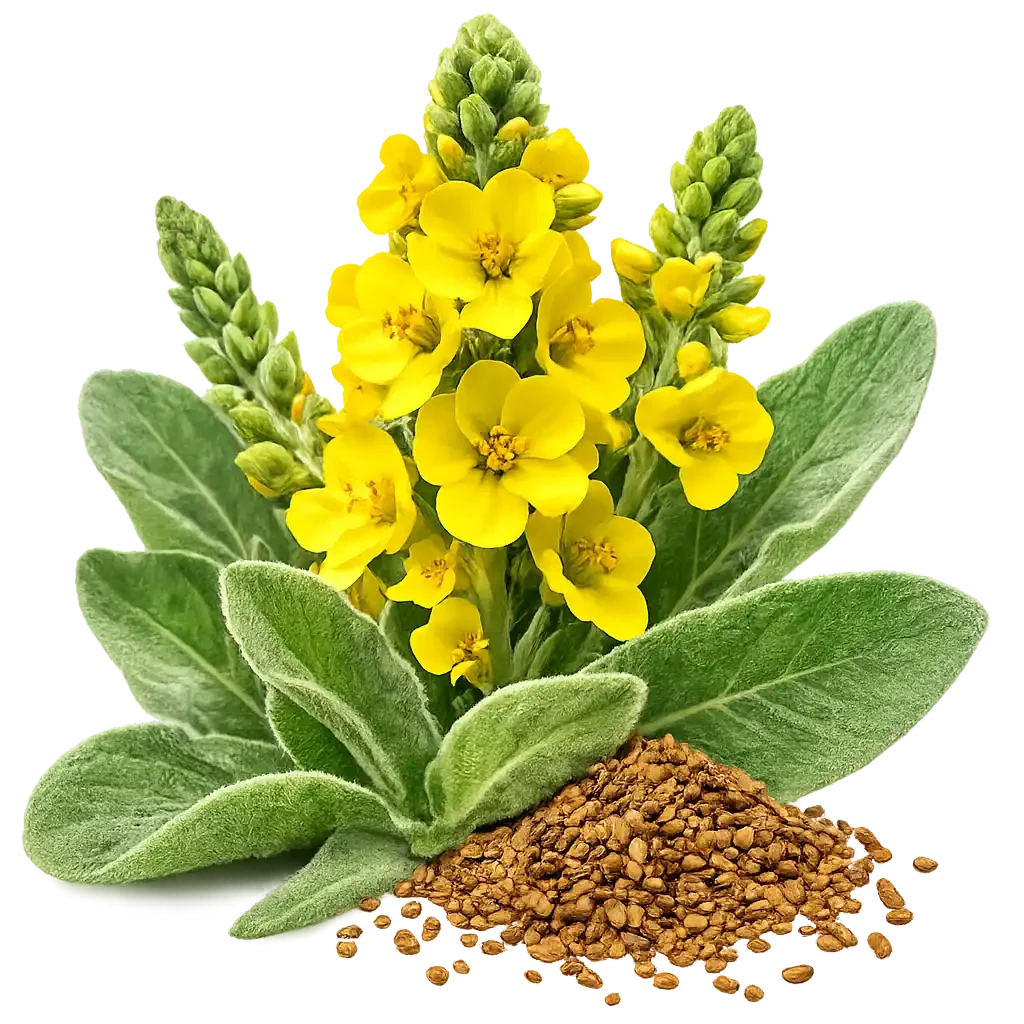
Mullein is the plant that announces itself. The first-year rosette of broad, silver-grey, densely felted leaves pressed flat to the ground is distinctive enough to stop a walker in their tracks; the second-year flower spike, rising to six feet or more above the rosette with its dense column of small yellow flowers, is one of the most dramatic natural structures available to the herb garden. It grows on roadsides, in gravel, on dry rocky banks, and in disturbed ground with the serene indifference of a plant that does not require the gardener's attention. And it is, in the leaves and flowers of that striking form, one of the most effective and most consistently used respiratory herbs in the North American and European herbal tradition.
Introduction
Verbascum thapsus is native to Europe, western Asia, and North Africa, introduced to North America with European settlement and naturalized across the continent with such thoroughness that it is now a characteristic feature of roadsides, pasture margins, dry fields, and disturbed ground from coast to coast. It is a biennial, spending its first year as the flat, ground-hugging rosette that protects its growing point through winter, and its second year producing the towering flowering spike before setting seed and dying.
The common names are illuminating. Torch plant refers to the historical practice of dipping the dried second-year flower spike in tallow and using it as a torch, a use documented from ancient Rome through the medieval period. Cowboy toilet paper is a more recent and frankly accurate description of the large, extremely soft, densely woolly leaves that make the plant immediately useful to anyone who finds themselves in the field without better options. Velvet plant requires no explanation beyond a single touch of the leaf.
The active compounds responsible for mullein's medicinal activity include saponins, which provide expectorant action by reducing the surface tension of bronchial mucus and making it easier to clear; mucilage polysaccharides, which coat and soothe irritated respiratory membranes; iridoid glycosides including aucubin (shared with plantain) with anti-inflammatory activity; and flavonoids including luteolin and apigenin with additional anti-inflammatory and antispasmodic effects. This combination of expectorant, demulcent, anti-inflammatory, and antispasmodic activity in a single herb explains why mullein leaf tea has been the primary household respiratory remedy in North American folk medicine for over three centuries.
How to Grow
Sun Requirements
Mullein requires full sun and is uncompromising about it. In partial shade it grows taller and more weakly, produces fewer flowers, and has a significantly reduced essential compound content in the leaves. Its native habitat is exposed disturbed ground, roadsides, and rocky slopes in full sun, and replicating those light conditions produces the compact, densely woolly, strongly medicinal plants that represent the herb at its best.
Soil Requirements
Mullein is one of the most demanding plants in the series in terms of what it does not want rather than what it does. It thrives in poor, dry, well-drained, even rocky and gravelly soils where other herbs and vegetables would struggle, and performs poorly in the rich, moist, heavily amended beds that most kitchen garden plants prefer. In fertile soil with consistent moisture, mullein produces unusually large and soft leaves but tends to become more prone to the fungal leaf diseases that affect stressed plants in humid conditions, and the essential oil and medicinal compound concentration is often lower in plants grown in optimal fertility compared to those grown lean.
Drainage is the single non-negotiable requirement. Mullein does not tolerate waterlogged or consistently wet soil at any time of year, and crown rot from standing water in winter is the most common cause of failure in established plantings. A sunny, dry bank, a gravel bed, a rocky slope, or the dry strip along a south-facing fence line are all more appropriate than a well-irrigated garden bed.
Water Needs
Established mullein is highly drought-tolerant, drawing on deep reserves with its taproot and producing fully medicinal leaf growth in conditions that would stress most other herbs. Young seedlings need moderate moisture during their establishment period, but once the first-year rosette has developed its full size, supplemental irrigation is rarely necessary in most temperate climates and overwatering is a more significant risk than underwatering. The plants in the driest, most exposed positions on a homestead are often the most productive and most aromatic.
Planting
Mullein is best established from seed, which is tiny and requires light for germination. Surface-sow on a prepared bed in early spring or in autumn for spring germination, pressing seed lightly into the soil surface without covering. Germination occurs within two to three weeks at 60 to 70 degrees Fahrenheit and is often erratic, with some seeds germinating promptly and others taking several weeks longer. Thinning seedlings to eighteen to twenty-four inches as they develop allows each plant to form the full, impressive rosette that is the first year's characteristic form.
Mullein transplants with moderate success if moved when small, but the taproot that develops even in young seedlings resents disturbance. Where transplanting is necessary, moving very young seedlings with as much soil intact as possible, into their final position, gives the best outcome. Direct sowing in the intended permanent location is always preferable.
Because mullein is a biennial, a continuous planting requires sowing each year so that there are always both first-year rosettes and second-year flowering plants present simultaneously. Once the colony is established and allowed to self-seed, this management is largely self-sustaining: second-year plants shed enormous quantities of seed from the tall spikes before dying, and the seedlings that germinate from this shed seed maintain the population without deliberate replanting.
Plant Spacing
Space plants eighteen to twenty-four inches apart to accommodate the large basal rosette that a well-grown first-year plant develops by autumn. The rosette of a healthy mullein in a dry, sunny position can reach two feet across by the end of its first growing season, and crowded plants produce smaller rosettes and less medicinal leaf material than those given adequate space to develop fully.
Harvesting
Harvesting Leaves
Mullein leaves are harvested from first-year rosettes from late summer through autumn, when the plant has produced its full complement of large basal leaves and the medicinal compound content has reached its seasonal peak. Second-year plants also provide leaves from the lower stem before the flower spike elongates, and this second-year leaf material is equivalent in medicinal quality to the first-year rosette harvest.
Select the largest, most intact, most densely woolly leaves from the outer portion of the rosette, leaving the central growing point and the youngest inner leaves to continue the plant's development. The leaves should be uniformly grey-green and densely covered with the soft woolly trichomes that give the plant its velvet character; yellowing, spotted, or damaged leaves are discarded at harvest in favor of clean material.
Drying mullein leaves is the primary challenge of working with this herb. The dense woolly surface that traps moisture and makes the leaves so visually distinctive also makes them difficult to dry completely without mold developing at the leaf center before the surface dries. Spread leaves in a single layer on mesh drying racks with good air circulation on all sides, in a warm, dry location, and turn daily for the first week. A food dehydrator at 95 to 105 degrees Fahrenheit dries mullein leaves reliably in eight to twelve hours. Leaves that are completely dry have a crisp, papery texture and a faintly sweet, slightly musty herbal scent. Any leaf that feels even slightly soft or damp in the center should be returned to drying before storage.
Harvesting Flowers
Mullein flowers are harvested individually from the second-year spike as they open, typically from June through August. Because the flowers open progressively from the base of the spike upward over a period of six to eight weeks, daily or every-other-day collection of freshly opened flowers provides a continuous harvest of fresh material throughout the flowering season. This individual flower collection is laborious for large quantities but provides the freshest possible material for the flower infused oil preparation that is mullein's most specific and widely used medicinal application.
The flowers are small, bright yellow, with five petals and a slight stickiness from the resinous compounds relevant to their medicinal activity. They should be harvested when fully open and dry, not after rain or morning dew, to minimize the moisture that accelerates spoilage in the infused oil preparation. Collect into a small container and use or begin infusing within hours of harvest.
Mullein flower ear oil: Pack a small, completely dry glass jar loosely with freshly harvested mullein flowers. Cover completely with warm olive oil, ensuring all flowers are submerged. Seal loosely and set in a warm, sunny window for four to six weeks, shaking gently every few days. The oil will turn a deep golden color as it absorbs the flower compounds. Strain through cheesecloth, pressing the spent flowers to extract the remaining oil, and decant into a small dropper bottle. Store at room temperature away from light for up to one year. For ear discomfort associated with congestion and mild ear irritation, warm the oil bottle briefly in warm water, test a drop on the wrist, and apply two to three warmed drops into the affected ear, plugging loosely with a small cotton ball. This is the application that has made mullein flower oil one of the most consistently recommended preparations in North American herbalism for generations, and the home-infused version from fresh flowers is considerably more aromatic and more active than any commercial preparation.
How to Use
Respiratory Uses
Mullein leaf is one of the most broadly and consistently used respiratory herbs in both European and North American herbal medicine, employed across independent folk traditions on both continents for essentially the same applications: cough, bronchitis, asthma, and the management of chronic respiratory congestion. This cross-cultural convergence on the same plant for the same conditions, without any historical communication between the traditions, is one of the stronger empirical arguments for the genuine effectiveness of the herb.
The primary mechanism is the saponin-driven expectorant activity that thins and loosens bronchial mucus, combined with the mucilage that soothes the inflamed membranes that the loosened mucus irritates as it clears. Together these actions make mullein a particularly effective herb for the dry, spasmodic, unproductive cough that follows upper respiratory infections, where the mucus is thick and adherent and the cough reflex is irritated without producing a useful result. Mullein loosens the mucus and soothes the irritation simultaneously, addressing both components of this common and uncomfortable presentation.
Mullein leaf tea, prepared by steeping one to two teaspoons of dried leaf in hot water covered for fifteen minutes and then strained carefully through a fine cloth to remove the woolly leaf hairs that can irritate the throat if present in the finished tea, produces a mildly sweet, slightly mucilaginous preparation that is pleasant to drink and effective as a respiratory support. The straining step is not optional: the same leaf trichomes that make the leaf so visually distinctive are physical irritants in the throat if swallowed in quantity, and a tea made without fine straining defeats part of the purpose of the preparation. Three to four cups daily through the acute phase of a respiratory illness is the traditional dosing pattern.
Mullein smoking, the practice of smoking dried mullein leaf in a pipe as a direct respiratory treatment, is a traditional application across several North American Indigenous traditions and appears in European folk medicine as well. The logic is counterintuitive but has a plausible mechanism: the saponins and aromatic compounds in the smoke, delivered directly to the bronchial mucosa, produce an immediate local expectorant and antispasmodic effect that relieves acute bronchial spasm faster than any oral preparation can act. This application is documented but not recommended for routine use given the general risk of smoke inhalation on respiratory tissue.
Ear Oil Uses
Mullein flower oil is the most specific and most widely used preparation from this herb, applied directly into the ear canal as a treatment for the pain and discomfort associated with ear congestion, mild otitis media, and the earache that accompanies upper respiratory infections. The anti-inflammatory and demulcent properties of the flower compounds, delivered directly to the inflamed tissues of the outer and middle ear via the oil carrier, provide relief that is both prompt and gentle.
Several small clinical studies have examined mullein flower ear oil preparations, including a randomized trial that compared naturopathic ear drops containing mullein flowers alongside other botanical extracts against anesthetic ear drops for the management of acute otitis media pain in children, finding equivalent pain relief in both groups. While the evidence base is limited, it is consistent with the traditional clinical experience of generations of practitioners who have used this preparation, and the safety profile is excellent when used as directed.
The application is appropriate for earache associated with congestion and the kind of ear pain that accompanies a cold, where the mechanism is inflammatory rather than infectious. It is not a treatment for bacterial ear infection and should not be used in the presence of a perforated eardrum. For ear pain that persists beyond a few days, worsens significantly, or is accompanied by fever, medical evaluation is appropriate.
Topical Uses
Mullein leaf poultice, prepared by briefly warming a large fresh or rehydrated dried leaf and applying it directly to inflamed skin, bruised muscle, or arthritic joints, provides soothing anti-inflammatory relief through the same mucilage and iridoid glycoside activity that makes the herb effective internally. The large, soft, felted leaf is physically comfortable against inflamed skin in a way that most poultice materials are not, and the gentle warmth retained by the thick leaf amplifies the local anti-inflammatory effect.
Mullein-infused oil from leaves, prepared in the same way as the flower oil but using dried leaf material, provides a topical preparation useful for massage of inflamed or arthritic joints, for application to irritated or inflamed skin, and as a base for salves combining mullein with other anti-inflammatory herbs. The leaf oil is less specifically active than the flower oil for ear applications but is more broadly useful for topical anti-inflammatory purposes.
Storage
Properly dried mullein leaf stores for one to two years in airtight dark glass containers, with the mucilage and saponin content remaining reasonably stable through this period. The critical storage requirement is complete dryness before sealing: any residual moisture in the leaf leads to mold in the container. Checking dried leaf by crushing a small amount between the fingers is the reliable test; fully dried mullein leaf crumbles cleanly without any pliability or resistance that would indicate retained moisture.
Mullein flower oil, once strained and bottled, stores at room temperature in a dark glass dropper bottle for one year. Beyond this period the olive oil base begins to oxidize and the preparation should be discarded and replaced with fresh material from the following summer's flower harvest. Refrigeration extends the oil's shelf life slightly but the oil should always be warmed to body temperature before ear application regardless of storage method.
Lifespan of the Plant
Mullein is a strict biennial that dies after setting seed at the end of its second year. There is no perennial component: each individual plant lives for exactly two growing seasons, produces its massive seed set from the tall spike, and is gone. The practical management implication is that a desired mullein presence in the garden requires either annual sowing of new seed or the encouragement of self-seeding from existing plants.
Self-seeding is prolific. A single mullein spike produces up to 180,000 tiny seeds, and many of these land within a few feet of the parent plant. The seedlings that appear the following spring can be thinned to the desired spacing and allowed to develop into the next generation of medicinal plants, making the colony effectively self-sustaining once established in a location that the plant finds suitable. Mullein seed is also long-lived in the soil, with documented viability of over one hundred years under favorable conditions, meaning that a mullein population established in a suitable location is essentially permanent in the seed bank even if the above-ground plants are removed for several years.
Straining is essential: Always strain mullein leaf tea through a fine cloth, fine-mesh strainer, or coffee filter before drinking. The dense woolly trichomes on the leaf surface are physical irritants that cause throat tickling and discomfort if present in the prepared tea. This is not a toxicity concern but a straightforward mechanical irritation that the straining step completely prevents. Mullein is otherwise a very safe herb with no documented significant drug interactions or contraindications at reasonable use levels.
Pros and Cons
Advantages
One of the most effective and most consistent respiratory herbs available, with a three-century North American folk medicine record and a plausible mechanism across multiple active compound classes
Mullein flower ear oil is among the most specifically useful preparations available from any herb in this series, with genuine clinical trial support for ear pain relief
Dramatically ornamental, with the first-year silver-grey felted rosette and the towering second-year flower spike providing genuine garden presence that no other herb in this series matches
Thrives in poor, dry, rocky conditions where most herbs fail, making it productive in the difficult spots that would otherwise be unused
Highly drought-tolerant once established; minimal maintenance and irrigation required
Self-seeding population is essentially self-managing once established in an appropriate location
Hardy to zone 3; grows in virtually all temperate climates
Excellent wildlife value: the tall dried flower spikes provide winter songbird foraging and the flowers support bees and hoverflies through the summer
Limitations
Strict biennial: no medicinal harvest in the first year, and each plant must be replaced by the next generation after its second-year flowering
Leaves require careful, thorough drying due to the moisture-retaining woolly surface; improperly dried material molds readily in storage
Tea requires fine straining to remove leaf trichomes; an unstrained preparation is mechanically irritating to the throat
Flower harvest is labor-intensive, requiring daily collection of individually opening flowers over a six to eight week period for adequate oil production
Self-seeding can be prolific to the point of becoming weedy in disturbed soil; some management of seed dispersal is required if spread into adjacent areas is not desired
Not a culinary herb; contributes nothing to the kitchen beyond the medicinal cabinet
Common Problems
Mullein is generally a problem-free plant in appropriate dry, sunny growing conditions, with its natural adaptations to stress and poor soil making it more resistant to most garden pests and diseases than the more pampered kitchen garden herbs.
Mullein moth caterpillars feed on mullein foliage in Europe and increasingly in North American gardens where the moth has naturalized, producing characteristic holes and eaten patches on the large leaves. The caterpillars are striking, creamy-white with yellow and black spots, and while they can defoliate a plant rapidly in large numbers, they are the larval form of an attractive moth and represent a manageable trade-off rather than a crisis. Hand-picking caterpillars in the early morning and relocating them away from the medicinal planting is the appropriate response for a small infestation; larger populations can be managed with Bacillus thuringiensis applied to the foliage.
Powdery mildew affects mullein in humid conditions with poor air circulation, producing the white powdery coating on the leaf surface that reduces harvest quality. Appropriate spacing, which allows air to move freely around the large leaves, and siting in an exposed, well-ventilated position manage the problem in most cases. Plants growing in too much shade or too much moisture are more susceptible than those in the dry, sunny conditions that suit the plant naturally.
Crown rot from waterlogged winter soil is the primary cause of plant loss in established plantings, killing the growing point at the center of the rosette and preventing the second-year flowering that provides the flower harvest. Adequate drainage before planting is the only effective prevention; there is no recovery from established crown rot.
Varieties
Verbascum thapsus, common mullein, is the medicinal species described throughout this guide and is the species to source for any planting where the respiratory and ear oil applications are the primary purpose. It is also the species most widely naturalized across North America and the one most likely to be found growing wild near the homestead.
The Verbascum genus contains over three hundred species, many of which are grown as ornamental garden perennials rather than medicinal herbs, with flower colors ranging from white through yellow, pink, and purple on plants that are shorter and more refined in appearance than the towering common mullein. These ornamental species, including Verbascum chaixii, Verbascum phoeniceum, and the numerous named hybrid cultivars, are not equivalents to Verbascum thapsus for medicinal purposes; their active compound profiles differ and they should not be substituted for the common mullein in any medicinal preparation.
Verbascum olympicum, the Olympic or branched mullein, produces multiple branching flower spikes from a single rosette in its second year, reaching similar heights to common mullein with a more candelabra-like form. It has equivalent medicinal properties and provides a more architecturally striking second-year display.
Final Thoughts
Mullein rewards attention in a way that most herbs do not, because the plant itself is extraordinary before it is useful. The first-year rosette of silver-felted leaves is one of the most beautiful structures in the winter garden. The second-year spike is one of the most dramatic statements any plant makes in the landscape. And both are also, in the leaves and flowers that produce those forms, some of the most effective and most accessible respiratory medicine available from a homestead garden.
The management asks very little: a dry, sunny, poor-soil spot, patient establishment from seed, and the discipline of fine straining for the tea and individual flower collection for the oil. The plant does the rest, self-seeding into perpetuity in any location that suits it, providing a continuing supply of medicinal material from the kind of difficult, dry, sun-baked position that tends to be exactly where the homestead has space to spare.
Grow it at the back of the driest bed in the fullest sun available. Stand back. Watch it become one of the tallest, most distinctive things on the property. Then harvest the leaves in autumn and the flowers through summer, and put something genuinely useful in the medicine cabinet from a plant that would have been perfectly happy growing on the roadside without you.