
Mugwort
Written By Arthur Simitian
QUICK FACTS
Common Name
Mugwort, Common Mugwort, Cronewort, Wild Wormwood
Scientific Name
Artemisia vulgaris
Plant Type
Hardy perennial
Hardiness Zones
3 to 9
Sun Requirements
Full sun to partial shade
Soil Type
Tolerates almost any well-drained soil; thrives in average to poor fertility
Plant Height
2 to 6 feet
Spacing
18 to 24 inches; spreads aggressively by rhizome
Harvest Parts
Young leaf tips and leaves (spring through summer), dried aerial parts
Uses
Digestive bitter, emmenagogue, nervine, moxibustion material, dream herb, traditional culinary flavoring for fatty meats and rice cakes, insect repellent
Mugwort occupies a distinct position among the herbs in this series because it sits at the intersection of the practical and the genuinely unusual. It is a bitter digestive herb with a long and consistent European culinary record, used to season fatty meats and poultry before hops displaced it as the primary bittering agent in ale. It is an emmenagogue with a documented and well-understood mechanism, used in women's herbal medicine for at least two thousand years. It is the plant from which moxa is made, the dried herb burned above acupuncture points in the Chinese medical tradition that has been in continuous practice for over two thousand years and is the subject of a substantial clinical research literature. And it is the herb that carries, across cultures as distant from each other as they could possibly be, a reputation for influencing the content and vividness of dreams that is either the most persistent coincidence in ethnobotany or something worth paying attention to.
Introduction
Artemisia vulgaris is native to Europe, Asia, and North Africa, introduced to North America with European settlement and now naturalized across the continent as a common roadside, field edge, and disturbed-ground plant. It is a member of the Artemisia genus, which contains over five hundred species including wormwood (Artemisia absinthium, covered elsewhere in this series), tarragon (Artemisia dracunculus), and sagebrush (Artemisia tridentata, covered in the bushes section). The genus is named for the Greek goddess Artemis, associated with the moon, women, and the night, a naming that reflects the historical use of Artemisia species as herbs for women's health across the Mediterranean world.
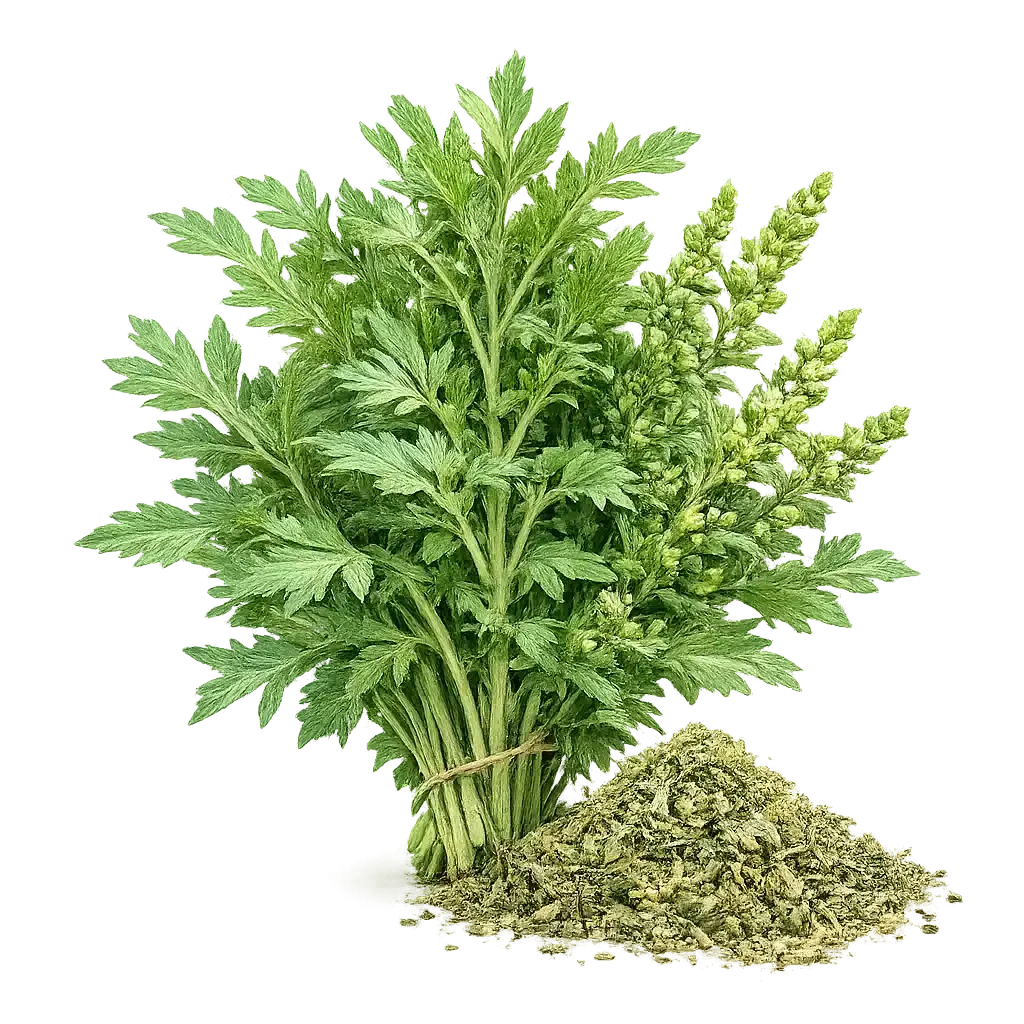
The plant grows as a tall, upright, branching perennial from a spreading rhizome network, reaching two to six feet in height with deeply pinnately lobed leaves that have a distinctive two-tone appearance: the upper surface is dark green and relatively smooth, while the underside is covered in dense white woolly hairs that give it a silver-white appearance. This contrast between the dark upper surface and silver underside is one of mugwort's most reliable identification features when encountered in the wild. The small, reddish-brown, nodding flower heads appear in dense racemes on the upper stems in late summer and provide limited ornamental interest compared to the bold foliage.
The aroma of mugwort is distinctive and unlike any other Artemisia in the series: warm, slightly sweet, faintly camphoraceous, with an earthy depth that separates it clearly from the bitter medicinal harshness of wormwood and the culinary brightness of tarragon. The aroma is released most strongly when the leaves are crushed between the fingers and is present at lower intensity as a background note in the garden when the plant is in full growth.
How to Grow
Sun Requirements
Mugwort grows in full sun to partial shade, adapting to a wider light range than most of the Mediterranean herbs in this series. In full sun it produces the most compact, most aromatic growth with the highest essential oil content. In partial shade it grows taller, produces larger and more numerous leaves, and has a slightly less concentrated aroma. For medicinal use where the thujone and other volatile compounds are the active constituents, full sun is preferable. For a general garden planting, partial shade is a reasonable compromise that produces abundant leaf material.
Soil Requirements
Mugwort tolerates an exceptionally wide range of soil conditions, from compacted clay to sandy loam, from nutrient-poor disturbed ground to moderately fertile garden soil, from dry to moderately moist. This tolerance reflects its ruderal character as a colonizer of disturbed ground and is consistent with its widespread naturalization in habitats that most garden plants would find inhospitable. It performs best in well-drained soil of average to low fertility, where the growth is more compact and the aromatic compound concentration is higher than in rich, moist soil that produces lush but less concentrated foliage.
Water Needs
Established mugwort is moderately drought-tolerant, managing well on natural rainfall in most temperate climates without supplemental irrigation once the root system is established. Young plants during their first growing season benefit from regular watering during dry periods until the rhizome network develops the capacity to access moisture from a broader soil volume. In consistently dry conditions, the plant reduces its above-ground growth but persists from the rhizome and recovers rapidly when moisture returns.
Planting
Mugwort is established from seed, from divisions of existing clumps, or from rhizome sections transplanted in early spring or autumn. Seed germinates readily on the surface of moist growing medium without covering, as the small seeds require light for germination. Division of an established clump in early spring is the most practical approach for most growers, producing plants that establish rapidly and begin productive growth the same season.
The critical cultivation decision with mugwort is containment. The rhizome network spreads vigorously in all directions from the parent clump, colonizing adjacent garden space with persistent underground runners that are difficult to remove once established in the rootzone of other perennial plants. Physical rhizome barriers sunk to a depth of twelve to eighteen inches around the designated planting area, or a contained raised bed with solid sides, are the appropriate approaches for a deliberate medicinal planting. Alternatively, regular perimeter management by spading around the bed boundary each spring removes advancing rhizomes before they establish beyond the designated area.
Plant Spacing
Space plants eighteen to twenty-four inches apart in a designated bed, with the understanding that even at this spacing the plants will fill the available space within two growing seasons as the rhizome network expands to connect individual plants into a continuous colony. The spacing is relevant primarily to the establishment period; once the bed is established, management focuses on containing the perimeter rather than managing spacing between individual plants.
Harvesting
Harvest Time
The primary harvest for both culinary and medicinal purposes is the young shoot tips and upper leaves in late spring and early summer, when the foliage is freshest and the volatile oil content is at its seasonal peak. For moxibustion material, the harvest is taken just before or at the beginning of flowering in midsummer, when the leaves have their maximum compound concentration and the fibrous quality appropriate for processing into moxa. A second harvest of fresh growth in early autumn, from plants cut back after flowering, provides additional material of good spring-like quality from the regrowth.
Harvest Method
Cut the upper six to eight inches of stems, taking the actively growing tips and young leaves and leaving the lower stem and older foliage intact for continued plant development. From an established stand, this cut-and-come-again approach allows multiple harvests per season and encourages the bushy, productive growth that maximizes leaf yield. For drying, bundle cut stems loosely and hang in a warm, well-ventilated location, or strip leaves onto mesh drying racks. Mugwort dries within one to two weeks at room temperature and retains its distinctive aroma well in the dried form.
An autumn hard cutback of the entire stand to a few inches above ground removes the season's growth, prevents self-seeding that adds to the spread management challenge, and stimulates vigorous fresh growth from the rhizome the following spring. The cut stems and leaves from the autumn cutback are the most abundant single harvest of the year and can be dried in bulk for moxibustion preparation or medicinal use.
On the aroma: The best way to understand mugwort before growing it is to find a roadside stand and crush a leaf. The smell is immediately distinctive and unlike any other Artemisia: warm, complex, faintly sweet in a way that wormwood is not, with the characteristic camphorous depth of the genus but softened by something that sits between dried sage and damp forest floor. Once recognized it is unforgettable and instantly identifiable in the field. This is also the aroma that makes mugwort distinctive in cooking, in tea, and in the smoke of moxibustion, and understanding it before beginning to work with the herb is genuinely useful preparation for every application that follows.
How to Use
Digestive Uses
Mugwort is a bitter digestive herb whose sesquiterpene lactone content stimulates gastric acid and bile secretion, improving digestion of fatty foods and reducing the bloating, nausea, and sluggishness that accompany inadequate digestive secretion. This bitter tonic activity is the basis of mugwort's traditional culinary use across European cooking: it was used to stuff geese and pork before roasting, to season fatty sausages, and as a component of the herb mixtures used to prepare game birds, specifically because the bitter stimulation of digestive secretions was understood to make the fatty and heavy meats more digestible.
In Japanese and Korean cooking, mugwort, known as yomogi in Japanese and ssuk in Korean, is used as a culinary herb in rice cakes, soups, and seasonal spring preparations, with the slightly bitter, aromatic flavor valued for exactly the digestive properties that European cooks recognized independently. Yomogi mochi, the green rice cake flavored with mugwort that appears at Japanese spring festivals, is one of the most culturally specific and most immediately pleasant culinary applications of the herb available, and growing your own mugwort makes an authentic preparation possible from home-grown dried leaf powder.
As a digestive tea, mugwort leaf steeped in hot water for ten minutes produces a pleasantly bitter, aromatic cup that is appropriate as a digestive aid after heavy meals. The flavor is genuinely pleasant in a way that wormwood, the most bitter of the Artemisia herbs, is not, and regular use as a post-meal digestive bitter provides the ongoing biliary stimulation that supports fat digestion and liver function over time.
Women's Health Uses
Mugwort is one of the oldest and most consistently used emmenagogue herbs in the Western and Eastern herbal traditions, with a documented record of use for menstrual irregularity, delayed menstruation, and the cramping associated with difficult periods stretching back at least two thousand years in European herbal texts and with an equivalent record in Chinese, Japanese, and Korean traditional medicine.
The emmenagogue activity is mediated primarily by the essential oil compound thujone, which stimulates uterine contractions through a direct smooth muscle effect. This is the same mechanism that makes mugwort absolutely contraindicated in pregnancy: the uterine-stimulating activity that makes it useful for encouraging delayed menstruation is precisely the activity that poses a risk of miscarriage in early pregnancy. This is not a theoretical concern based on botanical caution; it is a documented pharmacological effect of the plant's active compounds, and the pregnancy contraindication is absolute and unambiguous.
For non-pregnant women using mugwort for menstrual support, a standard tea or tincture preparation in the days before an expected period provides the warming, uterine-toning stimulation that traditional herbalism associates with the herb's primary women's health application. Contemporary herbal practice uses it carefully and for specific indications rather than as a general tonic, respecting the potency of the emmenagogue activity.
Moxibustion
Moxa, the dried and processed mugwort used in moxibustion, is prepared from the aged and finely processed woolly hairs of the mugwort leaf. The fresh leaf is dried, aged for several years to reduce harshness, and then processed by grinding and sifting to produce the soft, fibrous, golden-colored material that burns slowly and evenly when formed into a cone or rolled into a moxa stick. The heat produced by burning moxa above or on specific acupuncture points is the therapeutic mechanism of moxibustion, used in Traditional Chinese Medicine to tonify the qi, warm and move blood, and address conditions of cold and deficiency.
Moxibustion has been studied in clinical trials for several conditions, including a Cochrane review of its use for correcting breech presentation in late pregnancy, which found that moxibustion applied to the acupoint BL67 at thirty-three to thirty-five weeks of pregnancy was associated with increased rates of cephalic version compared to no treatment, with a reasonable evidence base across multiple trials. This is one of the more robust clinical applications of moxibustion and has influenced clinical guidelines in several countries.
Home preparation of moxa from garden-grown mugwort requires the aged, finely processed woolly leaf material rather than simply dried leaf, and the preparation process is time-consuming. Commercially prepared moxa sticks are widely available and represent the more practical option for most homestead practitioners; growing mugwort for its medicinal leaf and tea applications while sourcing commercial moxa for moxibustion practice is a reasonable division of labor.
Dream Herb
The use of mugwort as a dream herb, placed in a sachet under the pillow or drunk as a strong tea before bed to promote vivid, lucid, or memorable dreaming, appears across European folk traditions, North American Indigenous practices, and East Asian traditional medicine with a consistency that makes it one of the most cross-culturally documented of any plant's non-medical traditional uses. The mechanism is attributed to thujone and other volatile compounds that may influence GABA-A receptor activity in ways that alter the character of REM sleep and dream content.
This application sits at the edge of what herbal writing typically covers, being neither a culinary use nor a clinical medicinal application but something older and less easily categorized. It is included here because it is genuine, consistent, and part of an honest account of what this plant has meant to the people who have grown and used it across history. Whether it works in any individual experience is something only direct experimentation with a bag of dried mugwort under the pillow can settle, and the safety profile of this topical, non-ingestion application is entirely benign.
Insect Repellent Uses
Dried mugwort sachets placed in wardrobes, drawers, and storage areas repel moths and other textile insects through the same aromatic volatile compounds that give the plant its distinctive smell. Fresh mugwort branches placed around doorways and windows have been used traditionally to deter mosquitoes and other flying insects, and the essential oil has documented insect-repellent activity in laboratory studies against several mosquito species. This is a mild, pleasant-smelling, non-toxic alternative to synthetic moth repellents for natural fiber textile storage.
Storage
Dried mugwort stores for one to two years in airtight dark glass containers with reasonable retention of the volatile oil content that provides both the aroma and the medicinal activity. Proper airtight storage is more important for mugwort than for many herbs because the thujone and other volatile sesquiterpenes in the essential oil dissipate more rapidly from improperly sealed containers than from airtight ones, and the dried herb left in an open bag or loosely covered container loses its characteristic aroma and medicinal potency within a few months.
For moxibustion material, traditionally aged mugwort is considered more effective than freshly dried material, with the three-year aging period associated in traditional Chinese medicine texts with the optimal quality of processed moxa. Home-dried mugwort aged in sealed containers for one to three years before processing into moxa approximates this traditional preparation standard.
Lifespan of the Plant
Mugwort is a long-lived perennial that persists indefinitely through the expansion of its rhizome network, with individual crowns potentially surviving for decades in appropriate conditions. The above-ground growth dies back to the ground each winter in cold climates and re-emerges from the rhizome each spring with vigorous new growth. In mild climates the stems persist as woody bases through winter before new growth emerges in spring.
The practical lifespan question for the homestead gardener is not the plant's longevity but its containment. A mugwort planting that is not physically contained or regularly managed at its perimeter will expand continuously over successive seasons, colonizing adjacent beds and becoming increasingly difficult to remove as the rhizome network establishes itself in the rootzone of neighboring plants. Planning the physical containment before planting is far easier than managing uncontrolled spread after the fact.
Pregnancy contraindication: Mugwort is absolutely contraindicated in pregnancy. The uterine-stimulating activity of its thujone and other volatile compounds poses a documented risk of miscarriage, and this contraindication applies to all forms of internal use including tea, tincture, and culinary use in more than token quantities. The topical dream sachet application and external insect repellent use are not subject to this concern. People with ragweed or other Asteraceae family allergies should also approach mugwort with caution, as cross-reactivity is documented. Anyone with epilepsy should avoid medicinal doses, as thujone is a known convulsant at high concentrations.
Pros and Cons
Advantages
Effective bitter digestive herb with well-understood mechanism and a long culinary and medicinal record across multiple independent traditions
The plant from which moxa is made, connecting the homestead herb garden to one of the oldest continuously practiced medical traditions in the world
Consistent emmenagogue activity with genuine traditional clinical relevance for menstrual irregularity in non-pregnant women
Distinctive cross-cultural identity as a dream herb that stands apart from any other plant in this series
Highly resilient and essentially indestructible once established; long-lived perennial that requires no replanting
Tolerates a very wide range of soil and light conditions
Pleasant, distinctive aroma that functions as an effective natural insect repellent for textile storage
Japanese and Korean culinary tradition provides genuinely delicious applications unavailable from any other herb in this series
Limitations
Absolute pregnancy contraindication with documented risk of miscarriage; this is a hard limit, not a theoretical caution
Spreads aggressively by rhizome and requires physical containment or persistent perimeter management to prevent garden colonization
Thujone content means prolonged high-dose internal use is not appropriate; this is a herb for specific, purposeful use rather than daily large-quantity consumption
Cross-reactivity with ragweed and other Asteraceae in allergic individuals
Self-seeds prolifically if flowering stems are not cut before seed set, adding to the spread management challenge
Not a primary culinary herb in Western cooking; the culinary applications require familiarity with East Asian food traditions to access the most rewarding uses
Common Problems
Mugwort has essentially no significant pest or disease problems under appropriate growing conditions, consistent with its ruderal character and its chemical defenses from the same aromatic compounds that make it medicinally active. The management challenges are behavioral rather than horticultural.
Uncontrolled spread is the primary concern. Mugwort rhizomes advance two to three feet per season in appropriate soil conditions, and a planting established without physical containment will have colonized a significant area of the garden within three to four years. The rhizomes break easily when disturbed, and each broken section is capable of regenerating a new plant, making removal by digging an exercise that frequently stimulates more growth than it removes. Physical containment installed before planting is the only fully effective management strategy.
Unwanted self-seeding from the small flower heads adds a secondary spread mechanism to the rhizome expansion, with seedlings appearing in cracks and disturbed soil beyond the rhizome boundary of the existing planting. Cutting the stems back before the flower heads ripen and shed seed prevents this secondary spread and is straightforward to integrate into the annual management of the stand.
Ragweed allergy cross-reactivity produces seasonal allergic symptoms in sensitive individuals who are exposed to mugwort pollen during the late-summer flowering period. Planting mugwort at sufficient distance from living and working areas, and cutting the plants back before flowering if pollen exposure is a concern, manages this issue adequately for most sensitive individuals.
Related Species
Artemisia vulgaris, common mugwort, is the species described throughout this guide and is the appropriate species for the culinary, medicinal, and moxibustion applications discussed here. It is the most widely distributed Artemisia in temperate North America and Europe and the one most likely to be encountered in the wild or available from herb seed and plant suppliers.
Artemisia absinthium, wormwood, is a close relative covered in its own guide in this series, sharing the bitter digestive properties and emmenagogue activity of mugwort but with a significantly higher thujone content, a more intensely bitter flavor, and a medicinal profile that differs in emphasis. Wormwood is not a substitute for mugwort in moxibustion or culinary applications; they are complementary herbs with distinct characters.
Artemisia argyi, Chinese mugwort or ai ye, is the species primarily used in Traditional Chinese Medicine for moxibustion, considered in TCM texts to have a slightly different energetic quality from common mugwort and traditionally preferred for high-quality moxa preparation. It is increasingly available from specialist herb seed suppliers for those who want to explore the moxibustion application with the traditional Chinese species.
Final Thoughts
Mugwort is a more complex herb than its appearance suggests. The tall, silver-backed, aromatic stems growing at the fence line or the garden edge carry within them a culinary tradition from medieval European goose stuffing to Japanese spring festivals, a medical history that spans two thousand years and two continents independently, a clinical evidence base in moxibustion research, and a folk tradition around dreams that no other plant in this entire series can claim with equivalent consistency across cultures.
It is not a herb to plant without understanding the contraindications and the spread management requirements. But it is also not a herb to overlook because it grows vigorously and demands boundaries. The herbs that ask for the most respect are often the ones that return it most generously, and mugwort is among the clearest examples of that principle in this series.
Contain it physically. Respect the pregnancy contraindication completely. Harvest it in spring when the silver-backed leaves are freshest. Make the tea. Stuff a sachet for the pillow. Consider what it means that the same plant has been doing these things for people on opposite ends of the world, independently, for longer than most written records reach.