
Nasturtium
Written By Arthur Simitian
QUICK FACTS
Common Name
Nasturtium, Garden Nasturtium, Indian Cress
Scientific Name
Tropaeolum majus
Plant Type
Tender annual
Hardiness Zones
Annual in all zones; perennial in zones 9 to 11
Sun Requirements
Full sun to partial shade
Soil Type
Poor to moderately fertile, well-drained; thrives on neglect
Plant Height
Dwarf mounding types 12 inches; trailing and climbing types to 8 feet
Spacing
10 to 12 inches for bush types; 18 to 24 inches for trailing types
Harvest Parts
Flowers, leaves, unripe seed pods (all edible); ripe seeds for replanting
Uses
Edible flowers and leaves for salads and garnishing, pickled capers substitute, medicinal antimicrobial and respiratory herb, companion plant, pollinator plant
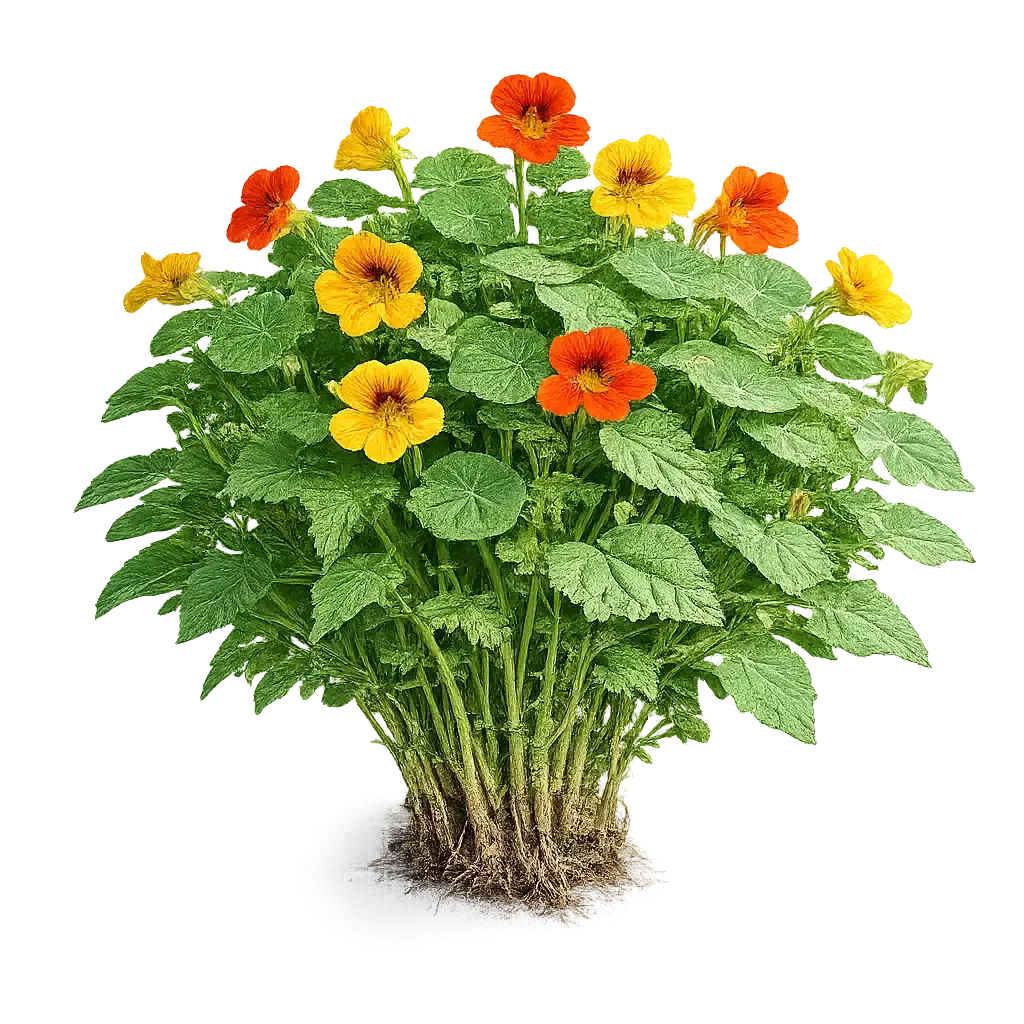
Nasturtium is the most immediately rewarding herb in the kitchen garden for a grower who has never grown it before. You direct-sow large seeds into indifferent soil in a sunny spot, more or less ignore the plants through the summer, and they return the favor by covering themselves in vivid flame-orange, deep red, and bright yellow flowers from midsummer through frost while providing a continuous harvest of peppery edible leaves and flowers that make every salad more interesting. The flowers taste of watercress with a sweetness at the base from the nectar spur. The leaves have the same peppery bite in a larger package. The unripe seed pods are the closest thing the kitchen garden produces to genuine capers. There is almost no herb in this series that asks less of the grower and gives more in return.
Introduction
Tropaeolum majus is native to the Andes of Peru and Colombia, where it grows in the disturbed ground and rocky margins of mountain habitats at elevations from two thousand to nearly ten thousand feet. It was introduced to Spain from Peru in the sixteenth century and spread rapidly through European gardens, arriving in England by the late 1600s and establishing itself as a kitchen garden fixture within a generation of its introduction. The genus name Tropaeolum derives from the Greek for trophy, a reference to the shield-like peltate leaves and helmet-shaped flowers that early botanists found reminiscent of the shields and helmets displayed on ancient battlefield trophies.
The common name nasturtium means, in Latin, nose-twister, a reference to the peppery, nose-stinging volatile compounds in the leaves and flowers, the same glucosinolates that give watercress its characteristic bite. Nasturtium is in fact not botanically related to watercress, Nasturtium officinale, which is a member of the Brassicaceae family, but the shared peppery flavor produced by glucosinolate chemistry is close enough that early botanists applied the same name to both plants, and the culinary name stuck to Tropaeolum despite the botanical confusion.
The entire above-ground plant is edible, from the round peltate leaves to the flowers to the unripe seed pods, and the flavor profile throughout is the distinctive peppery-sweet nasturtium character produced by the glucosinolate benzyl isothiocyanate in combination with the natural sugars in the flower nectar. This whole-plant edibility and the continuous production of flowers and leaves through a long season make nasturtium one of the most kitchen-productive of all ornamental herbs.
How to Grow
Sun Requirements
Nasturtium grows in full sun to partial shade, producing its most abundant flower display in full sun but tolerating three to four hours of direct daily light reasonably well. The important interaction to understand is between light, soil fertility, and the flower-to-leaf balance: in rich soil and partial shade, nasturtium produces abundant lush foliage with reduced flowering; in poor soil and full sun, it produces its most spectacular flower display with proportionally less foliage. For a planting managed primarily for flower production and the visual spectacle nasturtium provides, full sun and lean soil is the prescription. For a planting where the leaf harvest is the primary consideration, richer soil and moderate shade produces larger, more numerous leaves.
Soil Requirements
Nasturtium is the rare garden plant that actively performs better in poor, infertile, well-drained soil than in the rich, amended beds that most kitchen garden plants prefer. In fertile soil with high nitrogen, the plant channels its energy into vigorous vegetative growth, producing enormous leaves and sprawling vines with comparatively few flowers. In lean, gravelly, or sandy soil with minimal fertility, it flowers prolifically from midsummer through frost in the most spectacular display available from any annual herb.
This lean-soil preference makes nasturtium one of the most useful plants for the difficult spots in the kitchen garden: the gravelly path edge, the dry bank where other herbs fail, the corner that receives runoff from a hard surface but no deliberate cultivation attention. It fills these spaces with color and edible production that no other plant in this series would volunteer for.
Drainage is important. Nasturtium is susceptible to root rot in waterlogged or consistently wet soil, and the same drainage requirement that makes lean gravelly soil preferable for flowering also applies as a plant health consideration in any soil type.
Water Needs
Nasturtium is drought-tolerant once established, reflecting its Andean mountain origin in habitats with distinct dry seasons. Established plants in lean soil require minimal supplemental irrigation in most temperate climates, accessing sufficient moisture from natural rainfall and tolerating periods of drought that would stress less adapted plants.
Young seedlings in the establishment period of the first three to four weeks benefit from regular watering until the root system develops. Once established, the less water nasturtium receives within the range of reasonable tolerance, the more prolifically it flowers. Consistent overwatering in rich soil produces the vigorous, floriferous-foliage-heavy result described above; letting the soil dry between waterings in a lean bed produces the compact, heavily flowered plant the herb is capable of.
Planting
Direct sowing is strongly preferred over transplanting. Nasturtium has a sensitive taproot that resents disturbance, and transplanted seedlings establish more slowly and with more stress than direct-sown plants that develop their root systems undisturbed from germination. The large seeds are easy to handle, germinate reliably within seven to fourteen days at soil temperatures above 60 degrees Fahrenheit, and grow so rapidly after germination that the head start of indoor starting provides minimal practical advantage.
Sow seeds one inch deep directly in the garden after all frost risk has passed and the soil has warmed, spacing seeds ten to twelve inches apart for bush types and eighteen to twenty-four inches for trailing and climbing varieties. Pre-soaking seeds in warm water for twelve hours before sowing softens the seed coat and improves germination speed, particularly in cooler soil at the beginning of the planting window.
In zones 9 and warmer where nasturtium can be grown as a short-lived perennial, a second sowing in late summer or early autumn establishes plants for winter and spring flowering in the cool season, with the heat of summer typically being the period when nasturtium performs least well in warm climates.
Plant Spacing
Bush and mounding varieties including Alaska and Whirlybird reach twelve to eighteen inches across and can be spaced at ten to twelve inches for a dense planting that covers the ground rapidly. Trailing and semi-climbing varieties including Tall Single Mixed and the climbing types can spread to six or eight feet and should be spaced at eighteen to twenty-four inches, with a trellis, fence, or other support if the climbing habit is desired, or allowed to cascade freely over walls, raised bed edges, and slopes where the trailing growth is ornamentally effective.
Companion Planting
Nasturtium is one of the most valued companion plants in the kitchen garden, with practical applications across several different companion planting strategies that are backed by consistent observation and reasonable mechanistic explanations.
Brassicas, particularly cabbage, kale, broccoli, and cauliflower, benefit from nasturtium planted at the bed perimeter as a trap crop for aphids: nasturtium is highly attractive to black aphids and draws them away from the brassica crop, concentrating the infestation in a sacrificial plant that can be monitored, managed, or removed rather than treating the food crop
Cucumbers and squash, alongside which nasturtium's peppery volatile compounds deter cucumber beetles, squash bugs, and whitefly; the large nasturtium leaves also provide ground-level moisture retention as a living mulch around the base of the climbing cucurbit crops
Tomatoes, near which nasturtium deters aphids and whitefly through its aromatic compounds and serves as a beneficial insect habitat that supports the predatory population managing pest pressure across the entire bed
Beans, which benefit from nasturtium's black aphid trap cropping function and whose nitrogen-fixing activity is compatible with nasturtium's lean-soil preference in a shared bed
Fruit trees, around whose base nasturtium planted as a ground cover deters woolly aphids while providing a continuous flower display that supports the pollinator populations the fruit tree depends on
Harvesting
Harvest Time
Nasturtium provides a continuous harvest from the moment the first leaves are large enough to be useful, typically six to eight weeks after germination, through to the first hard frost that kills the plant. The flower harvest runs from midsummer through frost and is continuous throughout that period, with individual flowers lasting one to two days before fading and being replaced by new buds from the same plant.
For the unripe seed pod harvest, pods should be collected when they are plump, bright green, and still tender, before the seed inside has hardened and the pod begins to yellow and dry. This window is typically two to three weeks after the flower petals fall, and the pods should be harvested as they reach size rather than allowed to accumulate on the plant past their tender peak.
Harvest Method
Flowers are snapped or cut from the stem at the base of the flower, collected in a shallow basket or on a plate to avoid crushing the petals, and used the same day for best quality. The nectar spur at the base of the flower holds a small drop of sweetness that is part of the flavor experience of eating the whole flower; pinching off the spur base before eating removes the sweetness but also removes any insects that may have been collecting nectar inside it, which is a practical step for flowers going directly into a salad.
Leaves are picked individually from any point on the trailing stems, taking young to mid-age leaves that are fully expanded but not yet damaged or yellowing. The youngest, smallest leaves are the most tender for raw use in salads; slightly larger leaves are appropriate for cooking applications or for stuffing with soft cheese or other fillings as an appetizer preparation.
Unripe seed pods are snapped from the stem when plump and green, rinsed, and used immediately or pickled for storage. Allow a proportion of the pods to mature and dry on the plant for seed saving; nasturtium seed saved from open-pollinated varieties comes reliably true and provides the entire following year's planting from the previous season's harvest.
Pickled nasturtium capers: Collect unripe nasturtium seed pods when plump and bright green, before any yellowing. Spread on a tray and leave uncovered overnight to dry the surface slightly. Pack loosely into a clean jar. Make a simple brine of one part white wine vinegar, one part water, a teaspoon of sea salt, and a few whole black peppercorns, brought briefly to the boil and allowed to cool slightly. Pour over the pods to cover completely, seal the jar, and refrigerate. The pods are ready to use after two weeks and keep for three months refrigerated. Used anywhere genuine capers would be used, the flavor is not identical but it is genuinely good: peppery, sharp, slightly floral, and entirely produced from a plant that has been growing in the garden largely without assistance since May.
How to Use
Culinary Uses
The nasturtium flower is the most visually striking edible from the kitchen herb garden, producing the vivid orange, red, and yellow trumpet shapes that have made it the default choice for edible flower garnishing since the seventeenth century. Used in salads, as a plate garnish, scattered over cold soups, floated on summer drinks, or pressed into cream cheese for a canapé topping, the flower is both genuinely beautiful and genuinely flavored rather than merely decorative. The flavor is peppery, slightly sweet from the nectar, and distinctly itself in a way that makes it a contributing ingredient rather than a garnish.
Nasturtium leaf is the more versatile culinary ingredient of the two. The peppery glucosinolate flavor makes it a direct substitute for watercress in any application: mixed into green salads as a component with bite, used as a bed for smoked salmon or cold meats, blended into a peppery green sauce with capers and olive oil for grilled fish, or stuffed with soft goat cheese and rolled for a simple appetizer that takes five minutes to assemble. Young leaves are tender enough for direct salad use; larger leaves become progressively more peppery and are best used cooked or in preparations where their assertive flavor is balanced by fat or acid.
Nasturtium pesto, prepared by blending fresh leaves with olive oil, garlic, Parmesan, and pine nuts in standard pesto proportions, produces a vivid green, intensely peppery paste with a character entirely distinct from basil pesto and genuinely useful as a pasta sauce, sandwich spread, or pizza base in preparations where the peppery heat is an asset.
Nasturtium butter, made by blending finely chopped flowers and leaves into softened butter with a little lemon zest and sea salt, provides a compound butter with vivid orange flecks and a peppery, floral flavor that is outstanding on grilled fish, corn, or new potatoes and that keeps refrigerated for two weeks or frozen for three months.
The pickled unripe seed pods described above are the most genuinely kitchen-useful preserved preparation from nasturtium, providing a caper substitute that earns its place in the pantry for any cook who uses capers regularly in Mediterranean-style cooking. They are not a perfect caper replica but are sufficiently similar in function and flavor to substitute in most applications at a fraction of the cost.
Medicinal Uses
Nasturtium's medicinal value is real but more modest than several of the primary medicinal herbs in this series, concentrated in two areas where the plant has a well-documented traditional record and some laboratory support: antimicrobial activity and respiratory support.
The benzyl isothiocyanate released from nasturtium's glucosinolates when the plant tissue is chewed or crushed has documented broad-spectrum antimicrobial activity against a range of bacterial and fungal pathogens in laboratory studies, including Staphylococcus aureus, E. coli, and several Candida species. This antimicrobial activity is the basis for the traditional European use of nasturtium as a treatment for urinary tract infections and respiratory infections, and for its historical use as a wound dressing herb.
A clinical study conducted in Germany examined a standardized preparation of nasturtium herb combined with horseradish root for the treatment of acute sinusitis and bronchitis, finding results comparable to conventional antibiotic treatment for uncomplicated cases with a good safety profile. This combination preparation is available as a licensed herbal medicine in Germany and several other European countries, representing one of the stronger clinical outcomes for nasturtium as a medicinal herb.
As a vitamin C source, nasturtium leaves and flowers provide a meaningful contribution to daily intake, with the vitamin C content of fresh nasturtium comparable to citrus fruit. The regular inclusion of nasturtium in the diet during the growing season, as a continuous fresh green from midsummer through frost, provides a consistent vitamin C contribution at the end of summer when fresh produce consumption may be declining.
For urinary tract support, nasturtium tea prepared by steeping a small handful of fresh leaves and flowers in hot water for ten minutes provides the antiseptic glucosinolate compounds in a form appropriate for mild urinary tract irritation support. This is a traditional application rather than a clinically established one, and established urinary tract infection requires medical evaluation rather than herbal management alone.
Storage
Fresh nasturtium flowers and leaves are at their best used the day of harvest and store for no more than two days refrigerated in a sealed container lined with a damp paper towel. They are not appropriate for drying or freezing in any form that preserves culinary quality; the volatile flavor compounds and the structure of the flowers and leaves are entirely dependent on freshness. The management of nasturtium for kitchen use is therefore a continuous harvest-and-use cycle through the growing season rather than a preservation exercise.
Pickled seed pods as described above are the only appropriate long-term preservation form, storing for three months refrigerated. Nasturtium pesto freezes well in small portions for three months, retaining the peppery flavor for use as a pasta sauce or spread through the winter.
Ripe seed for replanting stores for two to three years in a cool, dry, dark location, and collecting a generous quantity of ripe seed at the end of the season before the first frost kills the plant provides the entire following year's sowing from the previous season's plants. Nasturtium seed is large, easy to collect, and reliable in germination, making seed saving one of the most straightforward operations in the kitchen garden.
Lifespan of the Plant
Nasturtium is an annual in all temperate climates, completing its lifecycle from germination to seed set in a single growing season and dying with the first frost. In zones 9 and warmer it persists as a short-lived perennial, but even in frost-free climates the plant typically declines and is best treated as an annual, replaced each year with fresh seed for the most vigorous growth and flowering.
Self-seeding is prolific in many garden conditions, with seed shed in autumn germinating the following spring without any deliberate intervention. In beds where nasturtium is wanted in the same location each year, allowing the plant to set and shed ripe seed before removing the spent plants at the end of the season establishes the self-seeding cycle that effectively makes nasturtium a perennial presence in the garden without any annual replanting effort. The seedlings that appear in spring can be thinned to the desired spacing and left to grow; the surplus can be transplanted with care if moved at a very young age, though direct-sown plants always establish more reliably than transplants.
Pros and Cons
Advantages
The most visually spectacular of all edible herbs in the kitchen garden, producing vivid flame, red, and yellow flowers continuously from midsummer through frost
Entire plant is edible: flowers, leaves, and unripe seed pods all provide distinct culinary uses from a single planting
Unripe seed pods pickled as a caper substitute represent one of the most practically useful preserved preparations available from any annual herb
Thrives on neglect in poor, dry soil where other herbs fail; one of the most low-maintenance plants in this entire series
Exceptional companion plant providing documented trap cropping, pest deterrence, and beneficial insect support
Direct-sows easily and germination is reliable; no indoor starting required
Self-seeds freely once established, effectively becoming a permanent garden presence with no replanting effort
Documented antimicrobial activity with some clinical support for respiratory applications
Limitations
Rich soil produces foliage at the expense of flowers; must be grown lean to achieve the full ornamental and harvest potential
Annual requiring direct sowing each year in temperate climates, or management of self-seeding in beds where it is wanted to return
Fresh leaves and flowers do not dry or freeze well; all culinary use requires fresh-harvested material from the growing plant
Highly attractive to black aphids as a trap crop, which is a companion planting asset but also means the nasturtium itself may carry dense aphid populations that require monitoring
Trailing varieties spread vigorously and can overwhelm smaller companion plants if not managed
Cold-sensitive; killed by any frost and cannot be established until the soil has warmed reliably
Common Problems
Black aphids are the most consistent pest of nasturtium and are in some respects a feature rather than a problem: nasturtium is deliberately chosen as a companion plant specifically because it draws aphids away from more valuable crops. The dense aphid colonies that develop on nasturtium stems in midsummer are simultaneously a pest management success story for the companion planting strategy and a genuine infestation that reduces the harvest quality of affected plants.
Managing aphid pressure on nasturtium itself involves accepting a level of infestation on the trap crop while maintaining the surrounding food crops free of aphid damage, periodically removing the most heavily infested stems from the nasturtium to prevent the aphid population from building beyond the capacity of natural predators to manage, and relying on the ladybirds, lacewing larvae, and parasitic wasps that the aphid population attracts to progressively reduce the infestation through the season.
Caterpillars of the Large and Small White butterflies feed on nasturtium foliage, as the plant belongs to the same glucosinolate-containing chemical family as the brassicas that these butterflies use as primary host plants. As with the butterfly caterpillars on nettle, the ecological calculus here involves the distinction between a food crop being damaged and a designated companion and sacrificial plant fulfilling its intended role. For flowers and leaves that are still being harvested from the plant, hand-picking caterpillars is the appropriate response; for a nasturtium planting that has served its companion planting purpose through the season, accepting the caterpillar feeding as part of the plant's ecological contribution is reasonable.
Powdery mildew appears on nasturtium foliage in humid conditions with poor air circulation from midsummer onward, producing the characteristic white powdery coating on leaf surfaces. At this stage of the season the harvest quality of affected leaves is reduced and the plant is approaching the end of its most productive period; removing heavily affected stems and harvesting remaining clean leaves and flowers for immediate use is the practical response rather than attempting to treat the mildew on a plant that will be killed by frost within weeks.
Varieties
Tropaeolum majus includes both trailing and compact bush forms, with a wide range of flower colors from pale cream through lemon yellow, orange, deep red, and mahogany, in single and double flower forms, with plain green leaves or the distinctive cream-variegated foliage of the Alaska series.
Alaska Mixed is perhaps the most widely planted nasturtium variety for culinary use, producing compact mounding plants with attractively variegated cream and green leaves and a full range of flower colors. The variegated foliage adds ornamental interest to the leaf harvest and makes the plant distinctive in salad presentations where the leaves appear alongside the flowers.
Empress of India is a heritage variety with deep blue-green leaves and rich dark red-orange flowers, considered one of the most striking single-variety plantings available among nasturtiums and producing one of the most intensely flavored leaves in the species, with the peppery character at the higher end of the nasturtium range.
Jewel Mixed is the standard trailing and climbing variety mix, producing vigorous plants to four or five feet with the full range of warm flower colors on compact growth more suitable for trellising or cascading over raised bed edges than for ground-level mounding. Appropriate for the trap-cropping companion planting role where coverage of a larger area is the goal.
Whirlybird Mixed is a compact, spurless variety with upward-facing flowers that are particularly visible from above in a bed planting and whose spurless design means that the nectar that normally fills the spur is absent. The flavor is comparable to spurred varieties; the visual presentation of the flowers facing upward rather than outward is the primary distinction.
Final Thoughts
Nasturtium makes a compelling argument for a particular kind of garden generosity: the plant that gives more than it asks, that fills the difficult corner with vivid color, that puts a continuous harvest of genuinely flavored food in the kitchen from the same bed where it is simultaneously managing aphid pressure on the brassicas, supporting the pollinator population, and setting seed for the following year without any instruction from the gardener.
It asks for poor soil and a sunny spot. It asks to be left largely alone. It asks for direct sowing rather than the fuss of indoor starting. In return it provides one of the most visually spectacular performances in the annual herb garden, a continuous harvest of peppery flowers and leaves from midsummer through frost, the best caper substitute available outside a Mediterranean climate, and a companion plant that is working on behalf of everything around it for the entire season.
The seeds cost almost nothing. Sow them in the worst soil in the sunniest part of the garden and stand back.