
The Real Cost of Starting a Small Farm
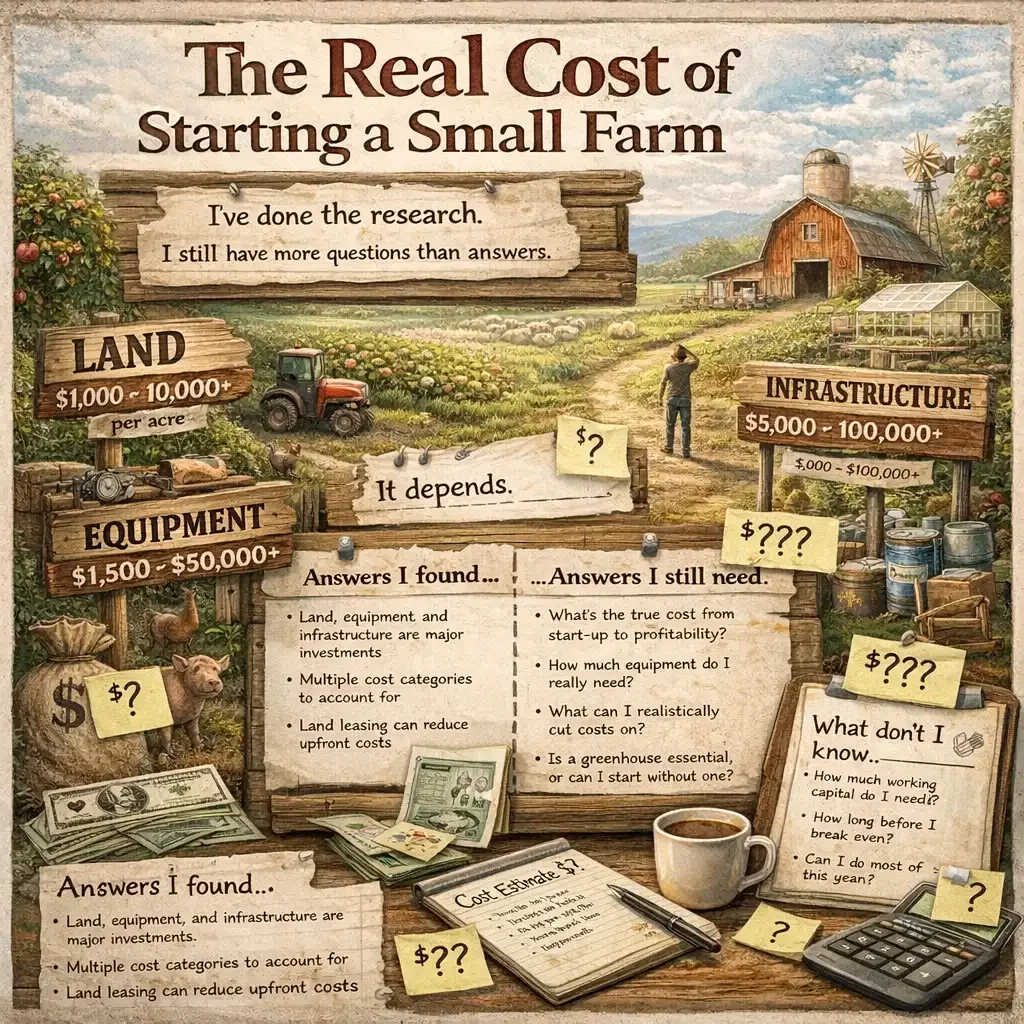
I've done the research. I still have more questions than answers.
I've spent the last few years trying to answer one straightforward question: How much does it actually cost to start a small farm?
You'd think there would be a simple answer.
There isn't.
What I found instead was a massive range of numbers, conflicting advice, and a whole lot of "it depends." So instead of pretending I have all the answers, I'm going to share what I've learned so far, what still confuses me, and the questions I'm still trying to figure out.
This is the research phase done in public.
What The Numbers Say (Sort Of)
If you search "cost to start a small farm," you'll find estimates that range from $600 to over $500,000.
That's not helpful.
But when you dig deeper, the range starts to make sense. A "small farm" means different things to different people:
· Micro farm (under 1 acre): $5,000 to $50,000
· Small vegetable farm (1 to 5 acres): $30,000 to $150,000
· Small diversified farm (5 to 10 acres): $50,000 to $500,000+
· Medium farm (10 to 50 acres): $500,000 to $1 million+
And that's just startup costs. That doesn't include ongoing operating expenses, which is a whole other beast.
The Big Four Costs (That Everyone Agrees On)
After reading through dozens of farm budgets, business plans, and USDA reports, four major cost categories show up every single time:
1. Land (The Biggest Variable)
Land is almost always the largest expense. And the cost per acre varies wildly:
· National average (cropland): $4,170 per acre
· Midwest farmland: $8,164 per acre
· Rural areas (less desirable land): $1,000 to $3,000 per acre
· Near cities or prime locations: $10,000+ per acre
Leasing option: If you lease instead of buy, typical rates are 2 to 4% of land value annually. So for land valued at $5,000/acre, you might pay $100 to $200/acre per year to lease.
What I still don't know: How much does marginal land (cheaper, less fertile) actually cost you in the long run? Do you end up spending more on soil amendments, irrigation, and failed crops? Is it smarter to pay more for better land upfront?
2. Equipment and Tools
Equipment costs depend entirely on your scale and what you're growing:
Hand tools only: $500 to $1,500 (shovels, rakes, broadforks, wheelbarrows)
Walk-behind tractor/rototiller: $2,000 to $8,000
Small tractor: $30,000 to $50,000 (new) or $10,000 to $25,000 (used)
Harvester/specialized equipment: $50,000 to $200,000+
Annual maintenance: Budget 5 to 8% of equipment value per year
What I still don't know: How do you know what equipment is actually essential versus just nice to have? Everyone says "start small and scale up," but what does that mean in practice? What breaks first when you buy used?
3. Infrastructure and Buildings
This is where costs can spiral quickly:
· Fencing: $8 to $12 per linear foot (basic perimeter for 10 acres: $8,000 to $12,000)
· Deer fencing (if needed): Variable, often not grant-funded
· Barn/storage: $34 to $63 per square foot
· Greenhouse/high tunnel: $5,000 to $15,000 each (small); $25,000 to $120,000 (larger)
· Irrigation system (drip): $500 to $1,500 per acre (basic setup)
· Walk-in cooler: $3,000 to $7,000 (DIY build) or $7,000 to $13,000 (commercial)
· Wash/pack station: $1,000 to $3,000
What I still don't know: Can you actually start without a greenhouse in most climates? How much does skipping the cooler limit your market options? What infrastructure is "build it now" versus "wait and see if you need it"?
4. Ongoing Operating Costs (The Monthly Burn Rate)
This is the part that keeps me up at night. Even before you make a single sale, you have monthly costs:
· Mortgage/land lease: Varies (could be $0 if owned outright, or $2,000 to $5,000+/month)
· Insurance: $300 to $500/month (personal); $500 to $1,500/month (farm liability)
· Utilities (electricity, water, propane): $1,000 to $3,000/month
· Fuel: $200 to $1,000/month (depending on equipment use)
· Total fixed overhead (before revenue): $11,000 to $15,000/month is common
One source I found estimated that small farms need $10,000 to $50,000 in working capital just to cover initial operating expenses before the first sale.
What I still don't know: How many months of runway do you realistically need? If you're growing food trees that take 3 to 5 years to produce, how do you cover costs in the meantime? What do people actually do during the gap years?
The Hidden Costs Nobody Tells You About
These are the costs that don't show up in the big startup estimate lists but can add up quickly:
· Permits and licenses: $500 to $3,000 depending on what you're selling and where
· Organic certification (if pursuing): $750 to $2,500 annually, plus application fees
· Soil testing: A few hundred dollars, but essential before you buy or plant
· Water rights/permits: Varies by state; can be expensive or free
· Legal fees (contracts, land transactions): $3,000 to $30,000
· Agricultural consultant: $100 to $300/hour
· Loan interest/financing costs: If borrowing, factor in 5 to 7% interest on loans
· Property taxes: Ongoing annual cost
What I still don't know: Which permits do you need before you buy land versus after? Can you realistically navigate all the legal/regulatory stuff yourself or do you actually need professionals?
What This Actually Means For SimitianNest
Here's my current, rough estimate based on what I'm planning:
Target: 5 to 10 acre diversified farm with food trees, maybe small livestock, maybe aquaculture
Realistic startup cost range: $150,000 to $300,000 (if buying land) OR $50,000 to $100,000 (if leasing land initially)
Monthly operating costs before revenue: $5,000 to $10,000 (if leasing); $8,000 to $15,000 (if owning with mortgage)
Working capital needed: At least $30,000 to $50,000 to cover 6 months of expenses
And that assumes:
· Starting small and scaling up gradually
· Buying used equipment where possible
· Building infrastructure incrementally (not all at once)
· Leasing land initially instead of buying
· Having another income source during the startup phase
What I'm Still Figuring Out
This research has given me a ballpark. But I still have a lot of open questions:
1. How much can I actually reduce costs by doing things myself? (Building my own greenhouse, installing my own irrigation, etc.)
2. What's the real timeline from "buy land" to "first meaningful revenue"? Everyone says it takes years, but how many years for different crops?
3. How do you phase the investment? What do you build year 1 versus year 3 versus year 5?
4. How much does climate and location actually affect these numbers? Is farming in Zone 7 significantly cheaper or more expensive than Zone 9?
5. What grants and loans are actually accessible to new farmers? The USDA has programs for beginning farmers, but how hard are they to get?
6. What's the smart way to finance this? All cash? Some loans? Land contract?
The Bottom Line (For Now)
Starting a small farm is expensive. Way more expensive than I thought when I started this research.
But the costs aren't impossible if you:
7. Start small and grow incrementally
8. Lease land before buying (reduces upfront capital)
9. Buy used equipment
10. Have working capital to cover 6 to 12 months of expenses
11. Plan for 3 to 5 years before meaningful revenue if planting trees
12. Keep another income source during the startup phase
The research continues. I'm not buying land yet. I'm still in the planning phase, still asking questions, still trying to figure out what the right path is for SimitianNest.
But at least now I have a clearer picture of what I'm working toward. And a much more realistic understanding of what it will actually take to make this work.
What's Next
Next up, I want to break down:
· Financing options for new farmers (USDA loans, grants, private financing)
· The real timeline for different farm types (vegetables vs. fruit trees vs. livestock)
· How to build a realistic 5-year financial plan
If you're going through this process too, or if you have answers to any of my open questions, I'd love to hear from you. This is the messy middle part of building something real.
I'm figuring it out in public.
---
Part of the SimitianNest Journey: Grow • Build • Live
Building a homestead from scratch. One decision at a time.