
Leafcutter Bees
The Complete Homesteader's Guide
Overview
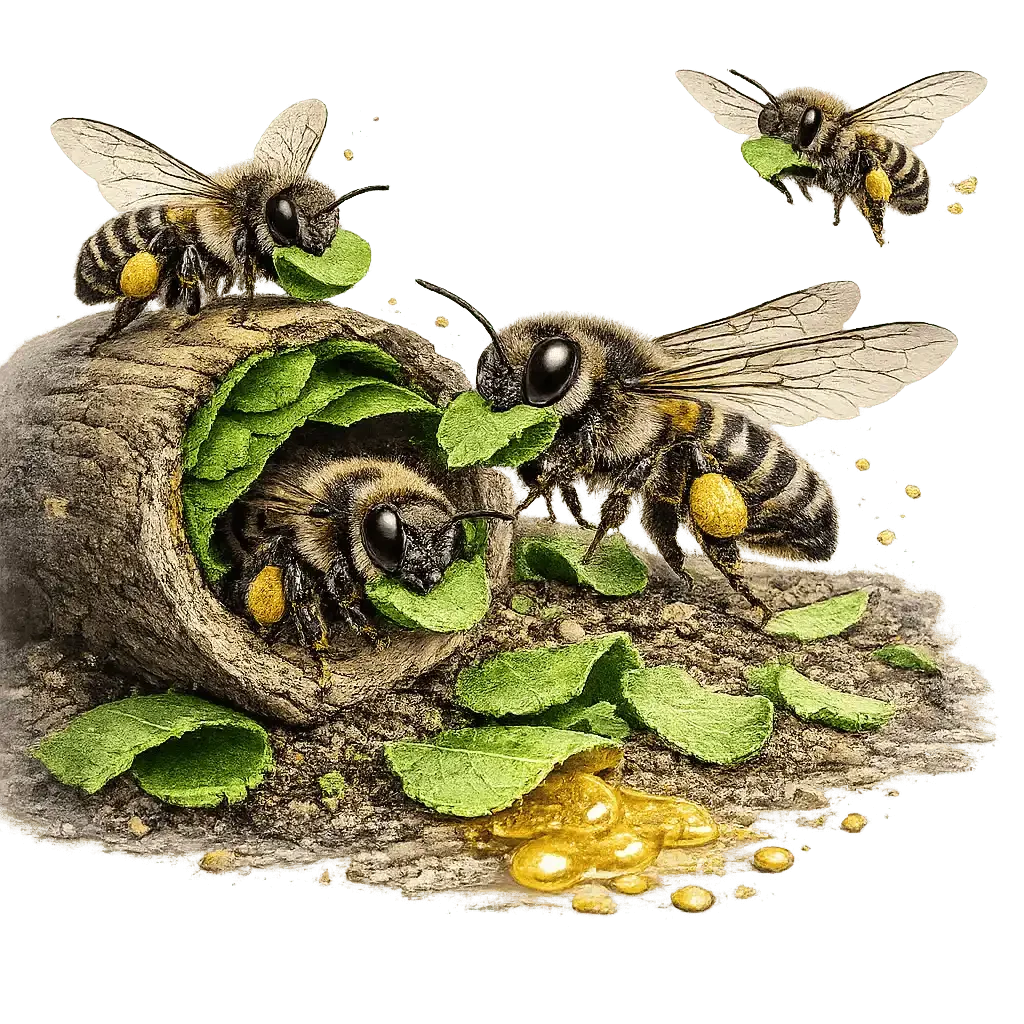
Leafcutter bees (family Megachilidae, genus Megachile) are among the most recognizable and valuable native pollinators, famous for the perfectly circular holes they cut in leaves. Unlike social honeybees, these solitary bees live independently, with each female building and provisioning her own nest in pre-existing cavities. With over 1,500 species worldwide and approximately 130 native species in North America, leafcutter bees are exceptional pollinators of summer crops, particularly alfalfa, blueberries, and vegetables. The commercial alfalfa leafcutter bee (Megachile rotundata) pollinates most North American alfalfa crops and is actively managed by farmers. For homesteaders, leafcutter bees offer unique advantages: they're easy to attract with simple bee houses, require no management beyond providing habitat, pollinate during peak summer when many crops bloom, and their distinctive leaf cutting behavior creates fascinating educational opportunities. Understanding these industrious native pollinators is essential for homesteaders seeking to maximize crop yields without the complexity of honeybee management.
Flight Range & Foraging Distance
Leafcutter bees are short range foragers, staying very close to their nests compared to honeybees or even bumblebees.
Typical Foraging Range: 100 to 300 feet (30 to 100 meters) from nest
Maximum Distance: Some species may travel up to 600 meters but this is uncommon
Optimal Placement: Flower sources should be within 300 feet of bee houses for best results
Distance Impacts: Studies show females produce more male offspring when forced to fly longer distances (conserving energy)
Compared to Other Bees: Much shorter range than honeybees (1 to 2 miles) or bumblebees (500+ meters)
Nesting Fidelity: Females often return to where they emerged to find nesting sites nearby
Short Trips: Typically make 15 to 20 foraging trips to provision a single nest cell
Energy Efficient: Short foraging distances allow more trips per day and faster nest completion
Homestead Implications: Leafcutter bees require flowers immediately adjacent to their nesting sites. Unlike honeybees that cover entire properties, leafcutter bees only service the garden or orchard within 300 feet of their bee houses. This makes placement critical but also means you can create targeted pollination zones around specific crops.
What Leafcutter Bees Eat & Drink
Primary Diet: Nectar and pollen from flowering plants
NOT Leaf Eaters: Do not eat leaves; only cut them for nest lining material
Nectar Purpose: Adult energy source; mixed with pollen to create provisions for larvae
Pollen Collection: Carried on underside of abdomen (scopa) rather than on legs
Provision Ratio: Each nest cell contains approximately 2:1 nectar to pollen ratio
Larval Food: Larvae feed exclusively on pollen and nectar ball left in their cell
Adult Feeding: Adults feed on nectar for energy throughout active season
Water Needs: Drink water from shallow sources; need it for temperature regulation and nest humidity
Favorite Plants & Flowers
Legumes (Pea Family):
Alfalfa (commercial leafcutter bee's primary crop)
Clovers, vetches
Sweet peas, garden peas
Aster Family:
Sunflowers, zinnias, cosmos
Asters, coneflowers (Echinacea)
Black-eyed Susans
Rose Family:
Roses, brambles (blackberries, raspberries)
Strawberries
Apple blossoms
Mint Family:
Lavender, salvia, catmint
Oregano, thyme, basil (when flowering)
Bee balm
Other Favorites:
Squash, cucumbers, melons
Blueberries, cranberries
Native wildflowers
Leaf Sources for Nest Building
Leafcutters prefer certain plants for cutting leaves:
Roses (very popular)
Lilacs, ash trees
Virginia creeper
Beans, peas
Bougainvillea
Redbud trees
Note: The circular notches rarely harm plants and are actually signs of healthy pollinator activity!
Homestead Value: Leafcutter bees are generalists but show strong preference for legumes (alfalfa, clover, peas), making them exceptional for homesteads growing these crops. Their activity peaks in summer (June through August), perfectly timed for warm season vegetable pollination.
Temperature Tolerance & Weather Conditions
Leafcutter bees are warm season specialists active during summer months.
Temperature Requirements
Emergence Temperature: Begin emerging when temperatures consistently reach 70 to 80°F (21 to 27°C)
Active Season: Peak activity June through August in most regions
Foraging Minimum: Will forage when temperatures above approximately 60°F (15°C)
Optimal Activity: Most active 70 to 85°F (21 to 29°C)
Heat Tolerance: Can forage in temperatures up to 95°F (35°C) but activity may slow
No Cold Tolerance: Unlike bumblebees, will not forage in cool spring temperatures
Summer Specialists: Fill the pollination gap when early spring bees are declining
Weather Sensitivity
Rain: Generally will not forage in rain; retreat to nest cavities
Wind: Moderate wind tolerance; strong winds reduce activity
Sunny Days: Prefer bright sunny conditions for peak activity
Overcast: Will forage in cloudy conditions if warm enough
Morning Activity: Cold blooded; need morning sun to warm up before foraging
Overwintering
Lifecycle: Single annual generation in most species
Winter Form: Overwinter as prepupae in cocoons inside nests
Diapause: Enter dormancy (diapause) in late summer/fall
Spring Development: Complete development in spring; emerge as adults in early summer
Cold Survival: Can survive freezing winter temperatures in protected nest sites
Emergence Timing: Emerge in summer (unlike mason bees which emerge in early spring)
Homestead Consideration: Leafcutter bees complement early season pollinators (mason bees, bumblebees) by working summer crops when temperatures are warmest. They're ideal for homesteaders in hot climates where other bees struggle with heat.
Honey & Wax Production
Leafcutter bees produce NO harvestable honey or wax.
No Honey: Solitary bees do not produce or store honey
Provisions Only: Collect nectar and pollen only for immediate larvae feeding
No Wax: Do not produce beeswax
Leaf Nests: Line nest cells with cut leaves instead of wax
No Products: Entire value is pollination services only
Homestead Reality: Keep leafcutter bees solely for pollination. Anyone suggesting you can harvest products from them is mistaken.
Pollination Services: Summer Crop Specialists
Leafcutter bees are among the most efficient pollinators for summer crops.
Pollination Advantages
High Efficiency: 80% flower tripping rate on alfalfa (vs 22% for honeybees)
Summer Timing: Active June through August when many crops bloom
Warm Weather: Work effectively in heat that slows other pollinators
Fast Provisioning: Make 15 to 20 trips per nest cell; very active foragers
Belly Pollen: Pollen on underside of abdomen contacts flowers differently than leg pollen
Native Species: Support native biodiversity and ecosystem health
No Swarming: Solitary nature means stable populations
Easy to Manage: Can increase populations simply by providing more nest cavities
Critical Crops
Commercial Crops:
Alfalfa: Primary pollinator; commercial alfalfa industry depends on managed leafcutters
Blueberries: Excellent pollinators with high fruit set
Carrots: Essential for seed production
Onions: Important for seed crops
Homestead Crops:
Squash, cucumbers, melons
Tomatoes (some pollination benefit)
Peppers, eggplants
Strawberries, raspberries, blackberries
Garden peas, beans
Sunflowers
Pollination Statistics
Native Pollinator: 15% of U.S. crops pollinated by native bees including leafcutters
Alfalfa Dependence: 90%+ of commercial alfalfa pollinated by managed leafcutters
Fruit Quality: Studies show larger fruit size when pollinated by native bees
Pollen Transfer: Excellent at moving pollen between flowers
Homestead Value: For vegetable gardeners, leafcutter bees provide targeted summer pollination without the commitment of honeybee management. A single bee house with 50 to 100 active females can significantly improve yields in nearby crops.
Social Structure: Solitary with Nesting Aggregations
Leafcutter bees are truly solitary; each female works independently.
Basic Structure
Solitary: No colony, no queen, no workers
Independent Females: Each female builds her own nest, provisions her own offspring
No Cooperation: Females do not help each other or share resources
Aggregations: Many females may nest in same bee house but work independently
Males: Mate and die; provide no parental care
No Hierarchy: All females are reproductive equals
Female Lifecycle
Emergence (June/July):
Mature females emerge from cocoons in early summer
Feed on nectar to build energy reserves
Mate soon after emergence
Nesting (July/August):
Search for suitable cavities (hollow stems, bee houses, beetle holes)
Often return to nest near where they emerged
Begin cutting leaves to line nest cells
Provisioning (July/August):
Make 15 to 20 foraging trips per cell
Collect nectar first, regurgitate into cell
Add pollen on top of nectar
Lay single egg on provision ball
Seal cell with circular leaf pieces
Multiple Cells:
Create 6 to 12 cells per nest tunnel (species dependent)
Work on one cell at a time
Female eggs (larger) laid in back of tunnel
Male eggs (smaller) laid near front
Complete nest in 2 to 4 weeks
Death (Late August/September):
Females die after completing nests
Adults do not overwinter
Larval Development
Egg Stage: 2 to 3 days
Larval Stage: Feeds on provision ball for 2 weeks
Prepupal Diapause: Enters dormancy with full-grown larva
Cocoon Spinning: Spins silk cocoon inside leaf-lined cell
Overwintering: Remains in prepupal stage all winter
Spring Pupation: Pupates for 3 to 4 weeks in late spring
Summer Emergence: Cuts way out of cocoon and nest in early summer
Males
Emergence First: Males emerge several days before females
Patrolling: Hover near nest sites waiting for females
Mating: Mate with females immediately after emergence
No Nesting: Do not build nests or provision offspring
Short Lifespan: Live only 1 to 2 weeks after emergence
No Sting: Males cannot sting
Homestead Consideration: The solitary nature means you're not managing colonies but rather providing habitat for independent wild bees. Success means attracting females to nest in your bee houses year after year.
Distance from Cabin/Home: Placement for Success
Leafcutter bees are docile and can be placed very close to living areas.
Recommended Placement
Minimum Distance: Can safely place bee houses 10 to 15 feet from patios, doors, play areas
Ideal Distance: 20 to 50 feet provides comfort buffer while keeping within foraging range
Flight Paths: Bees fly directly from nest to flowers; won't circle around homes
Morning Sun: East or southeast facing for morning warmth (bees are cold blooded)
Partial Shade: Some afternoon shade prevents overheating
Protection: Mount on solid surface (post, wall, fence); not swinging in wind
Safety & Temperament
Extremely Docile: Among the gentlest bees; rarely sting even when handled
Female Sting: Females can sting but only if squeezed or stepped on
Mild Sting: Sting described as half as painful as honeybee
Males Harmless: Males cannot sting
No Aggression: Will not defend nests aggressively
Child Friendly: Safe to observe closely; excellent for teaching children
Bee House Specifications
Location:
Eye level (5 feet / 1.5 meters off ground)
Solid mounting (wall, fence, post)
Morning sun exposure
2 to 3 inch roof overhang for rain protection
Within 300 feet of flower sources
Orientation:
Face east or southeast (morning sun)
Avoid west facing (too much afternoon heat)
Slight downward tilt to drain moisture
Protection:
Bird netting if woodpeckers present (3/4 inch openings, 2 inches from house)
Mouse guard at ground level if applicable
Roof overhang for weather protection
Homestead Reality: Leafcutter bee houses can be placed much closer to living areas than honeybee hives. Their gentle nature and small foraging range make them ideal for small urban homesteads or yards with children.
Advantages of Supporting Leafcutter Bees
Exceptional Summer Pollination: Peak activity June through August for warm season crops
Easy Habitat: Simple bee houses attract them; no complex management
No Products Needed: Support them for pollination alone; no honey expectations
Extremely Docile: Safest bees for households with children
Native Species: Support local biodiversity
No Feeding: Require no supplemental feeding or sugar water
No Disease Management: Minimal disease issues in wild populations
Alfalfa Specialists: If growing alfalfa or legumes, they're essential
Close Observation: Can watch nesting behavior up close safely
Educational Value: Leaf cutting creates visible, teachable moments
Heat Tolerant: Work in temperatures that slow other pollinators
Self Sustaining: Populations grow naturally if habitat provided
Commercial Availability: Can purchase cocoons to jumpstart populations
Multiple Species: Different Megachile species provide season-long coverage
Complementary: Work alongside other pollinators without competition
Disadvantages & Challenges
No Harvestable Products: Produce no honey or wax
Short Foraging Range: Must plant flowers within 300 feet of bee houses
Limited Season: Only active summer; no spring or fall pollination
Leaf Damage: Cut circular notches in roses and other plants (usually harmless but visible)
Nest Parasites: Susceptible to parasitic wasps and flies
Chalk Brood: Can develop fungal disease (Ascosphaera aggregata)
Nest Management: Require annual nest cleaning to prevent disease buildup
Cocoon Harvesting: If managing commercially, must harvest and clean cocoons
Dispersal: Some bees will nest elsewhere despite provided houses
Predation: Woodpeckers, mice, and other predators attack nests
Weather Dependent: Extended rain periods reduce activity
Cannot Move: Unlike honeybees, can't relocate nests to different crops
Lower Numbers: Individual females vs thousands in honeybee colony
Species Identification: Difficult to identify to species level without expertise
How to Attract & Support Leafcutter Bees
Providing Nesting Habitat
Commercial Bee Houses:
Purchase houses with 5/16 inch (8mm) diameter holes
Depth: 6 inches minimum
Paper tubes, cardboard tubes, or drilled wood blocks
Replace tubes annually to prevent disease
DIY Bee Houses:
Drill 5/16 inch holes in untreated wood blocks
Holes 6 inches deep, not drilled completely through
Space holes 3/4 inch apart (center to center)
Sand holes smooth; bees avoid rough surfaces
Bundle hollow plant stems (bamboo, reeds)
Natural Nesting:
Leave dead wood with beetle holes
Bundle hollow stems vertically
Maintain pithy-stemmed plants (elderberry, raspberry canes)
Providing Food Sources
Continuous Bloom (June through August):
Early Summer:
Roses, raspberries, blackberries
Early squash blossoms
Lavender, salvia
Mid Summer:
Zinnias, sunflowers, cosmos
Tomatoes, peppers, eggplants
Squash, cucumbers, melons
Bee balm, catmint
Late Summer:
Asters, goldenrod
Late squash varieties
Oregano, basil (if flowering)
Planting Strategy:
Large patches better than scattered plants
Multiple bloom times for season-long activity
Include native plants when possible
Avoid hybrid flowers with no pollen
Providing Leaf Sources
Plant Leafcutter-Friendly Plants:
Roses (most popular)
Lilacs
Virginia creeper
Bean and pea plants
Redbud trees
Accept Leaf Damage:
Circular notches rarely harm plant health
Sign of active nesting nearby
Educational opportunity to observe behavior
Protection from Threats
Disease Prevention:
Replace nesting tubes annually
Clean reusable nest blocks with 10% bleach solution
Allow cocoons to dry completely before storage
Store overwintering cocoons in cool location (35 to 40°F)
Predator Management:
Install bird netting if woodpeckers present
Elevate houses above ground for mouse protection
Secure mounting prevents raccoon damage
Pesticide Elimination:
Never spray flowering plants
Avoid neonicotinoids completely
Use organic pest controls
Water Sources:
Shallow dishes with landing stones
Change water every 2 to 3 days
Position near flowers and bee houses
Managing Populations
Purchasing Cocoons:
Buy from reputable suppliers
Order 100 to 200 cocoons to start
Time delivery for local emergence (late June/early July)
Place cocoons in bee house for emergence
Cocoon Harvesting (Optional):
Wait until late fall/early winter
Open nests carefully
Separate cocoons from debris
Store at 35 to 40°F in ventilated container
Release in summer for next generation
Natural Population Growth:
Provide abundant nesting cavities (50+ holes)
Maintain flowers within 300 feet
Protect overwintering cocoons from predators
Populations double or triple annually with good habitat
Year-Round Management Calendar
January through May: Stored cocoons remain in refrigeration; clean bee houses; repair/replace damaged tubes; plan flower succession
June: Release cocoons in bee houses; watch for emergence; ensure early summer flowers blooming
July through August: Peak nesting activity; observe leaf cutting; avoid disturbing active nests; maintain flower bloom; provide water
September: Adults die; nests contain overwintering prepupae; leave nests undisturbed
October through December: Optional: harvest cocoons for cleaning; store cocoons in cool location; clean and sanitize reusable nest blocks; order new tubes for next season
Common Mistakes to Avoid
Placing houses too far from flowers (remember 300 foot maximum)
West facing houses (afternoon sun overheats nests)
Never cleaning nests (disease and parasites accumulate)
Using wrong size holes (5/16 inch is critical; too small or large reduces nesting)
Expecting honey (they produce none)
Treating leaf cutting as pest damage (it's natural nesting behavior)
Pesticide use (kills bees immediately)
No roof overhang (rain enters nests)
Swinging houses (bees avoid unstable structures)
Starting with too few holes (provide 50+ cavities for growing populations)
Measuring Success
First Year:
At least 10 to 20% of tubes occupied
Visible leaf cutting on nearby plants
Bees entering and exiting houses regularly
Completed sealed tubes by late August
Second Year:
30 to 50% tube occupation
Multiple bee species using house
Noticeable increase in crop pollination
Visible fruit set improvement
Third Year:
50%+ tube occupation
Self-sustaining population without purchasing cocoons
Consistent crop yields
Potential to harvest cocoons for expansion or sharing
Conclusion
Leafcutter bees represent an ideal entry point into supporting native pollinators for homesteaders. Unlike honeybees that require substantial equipment and knowledge, leafcutter bees need only simple nest boxes, nearby flowers, and basic annual maintenance. Their summer activity perfectly complements spring mason bees and extends pollination services through peak vegetable season.
For homesteaders growing legumes, summer vegetables, or berries, leafcutter bees provide targeted, efficient pollination without the complexity of managed honeybees. Their extremely docile nature makes them safe around children and pets, while their visible leaf cutting behavior creates educational opportunities.
The key to success is simple: mount a bee house with east facing exposure within 300 feet of diverse summer flowers, provide some plants for leaf cutting (roses work great), eliminate pesticides, and leave the nests undisturbed through winter. Within 2 to 3 years, you'll have a thriving population providing free pollination services to your garden.
Start small with a single bee house containing 50 holes. Purchase 100 to 200 cocoons from reputable suppliers or wait for wild bees to discover your habitat. Observe their fascinating nesting behavior, tolerate the harmless leaf notches, and enjoy improved summer crop yields. Leafcutter bees are proof that supporting native pollinators can be simple, safe, and remarkably effective for productive homesteads.
Explore more Types of Bees & Pollinators