
Blackberry
Complete Homestead Growing Guide
The blackberry (Rubus spp.) is the workhorse of the homestead berry patch, a plant so tough, so productive, and so deeply rooted in rural American life that it barely needs an introduction. Wild blackberries grow across nearly the entire continent, from the hedgerows of the Pacific Northwest to the fencerows of Appalachia to the thickets of the Deep South. Dozens of species exist within the Rubus genus, but the cultivated blackberries grown on homesteads today descend primarily from Rubus fruticosus (European blackberry), Rubus ursinus (Pacific trailing blackberry), and various crosses between them. Humans have been eating wild blackberries for thousands of years, and deliberate breeding efforts over the past 150 years have produced modern cultivars with fruit that is larger, sweeter, more productive, and far more manageable than their wild ancestors.
Blackberry growth habits fall into three categories. Erect varieties produce stiff, upright canes 4 to 6 feet tall that are largely self-supporting, though a simple trellis improves management. Semi-erect varieties produce arching canes 5 to 8 feet long that benefit from trellising. Trailing varieties produce long, flexible canes 10 to 20 feet in length that require a trellis system. All types are available in both thorned and thornless forms. Depending on variety and type, blackberries are hardy in USDA Zones 4 through 9, with erect types generally offering the best cold hardiness (some to Zone 4) and trailing types performing best in milder climates (Zones 6 through 9). Primocane-fruiting varieties that produce fruit on first-year canes have further expanded the range and simplified management.
For homesteaders, blackberry is a no-excuses fruit crop. It produces enormous yields from a modest space, fruits quickly after planting, thrives in a wide range of soils and climates, preserves beautifully, and delivers berries with a rich, complex flavor that improves on wild fruit while retaining its essential character. Whether you want fresh eating, jam by the case, pies that win ribbons, wine by the gallon, or simply a reliable fruit source that asks very little and gives back abundantly, blackberry delivers.
How Long Does It Take to Grow?
Blackberry is one of the fastest fruit crops to reach production on the homestead, which is one of many reasons it remains the backbone of home berry growing. Here is the timeline from planting to peak harvest.
Year 1: Plant bare-root or container-grown blackberry in early spring. During the first season, the plant produces vigorous primocanes (first-year vegetative canes) from the crown. Erect types will grow 3 to 5 feet tall. Semi-erect and trailing types can push 6 to 15 feet of cane growth. These canes are vegetative only and will not fruit this year. Train canes onto a trellis as they grow and focus on establishing a strong root system with consistent watering and mulching. No fruit in year one on floricane-fruiting types. Primocane-fruiting varieties (like 'Prime-Ark Freedom') may produce a small late-season crop on the tips of first-year canes.
Year 2: This is your first major harvest year for floricane-fruiting varieties. The primocanes from year one are now floricanes and will flower and fruit from late spring through mid-summer. Simultaneously, the plant produces a new flush of primocanes for next year's crop. Expect 3 to 8 pounds per plant depending on variety and how well canes established in year one.
Year 3: The root system is now fully established and cane production is at full strength. Expect 8 to 15 pounds per plant from most varieties. Erect thornless types like 'Triple Crown' and 'Ouachita' are hitting their stride. Trailing types in mild climates may exceed 15 pounds.
Years 4 to 5: Peak production. A mature, well-managed blackberry plant routinely produces 10 to 20 pounds of fruit per season. Vigorous trailing varieties in the Pacific Northwest can yield 20 to 30 pounds per plant under optimal conditions. Production at this level continues as long as the planting is properly maintained.
Years 5 to 15: Blackberry plantings remain productive for 10 to 15 years with good management. Annual removal of spent floricanes and training of new primocanes keeps the cycle going. After 12 to 15 years, vigor typically declines and new plantings should be established. Some homesteaders stagger new plantings every 8 to 10 years for continuous production.
Berry Shelf Life
Blackberries are more perishable than blueberries but considerably sturdier than raspberries, landing in a middle ground that gives homesteaders a reasonable window for fresh enjoyment and processing.
Fresh: Unwashed blackberries stored in a single layer in a shallow container in the refrigerator at 34 to 38 degrees Fahrenheit will keep for 3 to 5 days. Do not wash until ready to eat, as moisture accelerates mold. Sort out any soft, leaking, or moldy berries before storing, as deterioration spreads quickly.
Frozen: Blackberries freeze well. Spread unwashed berries on a parchment-lined sheet pan in a single layer, freeze for 2 to 3 hours until solid, then transfer to freezer bags with air removed. At 0 degrees Fahrenheit, frozen blackberries maintain good quality for 10 to 12 months. Thawed berries will be softer than fresh but are perfectly suited for jam, pies, smoothies, and sauces.
Dried: Dehydrate at 135 degrees Fahrenheit for 18 to 24 hours until berries are leathery and no moisture appears when squeezed. Blackberries are slow to dry due to their high moisture content. Dried blackberries store in airtight containers for 6 to 12 months and make a chewy, flavorful addition to trail mix and baking.
Jams and Preserves: Water-bath canned blackberry jam keeps 12 to 18 months and is one of the most beloved of all fruit preserves. Blackberry's natural pectin content is moderate, and most recipes call for added pectin to achieve a reliable set.
Homestead Storage Tip: Pick blackberries into shallow containers no more than two or three berries deep to prevent the weight of upper berries from crushing those below. Wide, flat harvest containers or trays lined with paper towels are ideal. Get berries into the refrigerator or freezer within 2 hours of picking for maximum shelf life. On hot days, bring a cooler with ice packs to the patch.
Berry Color and Appearance
Blackberry is an iconic fruit with a visual progression from flower to ripe berry that most people recognize instinctively.
Flowers appear on second-year floricanes (or on first-year primocanes in primocane-fruiting varieties) in late spring to early summer, typically May through June. The blossoms are white to pale pink, 3/4 to 1 1/4 inches across, with five petals and a prominent cluster of stamens. They appear in clusters at the cane tips and along lateral branches. The flowers are attractive to honeybees, bumblebees, and other pollinators, and good pollination is essential for full-sized, well-formed berries.
Unripe berries emerge as hard, green clusters of tightly packed drupelets. They transition through red and then dark red as they approach maturity. This progression from green to red to black takes approximately 4 to 6 weeks from fruit set.
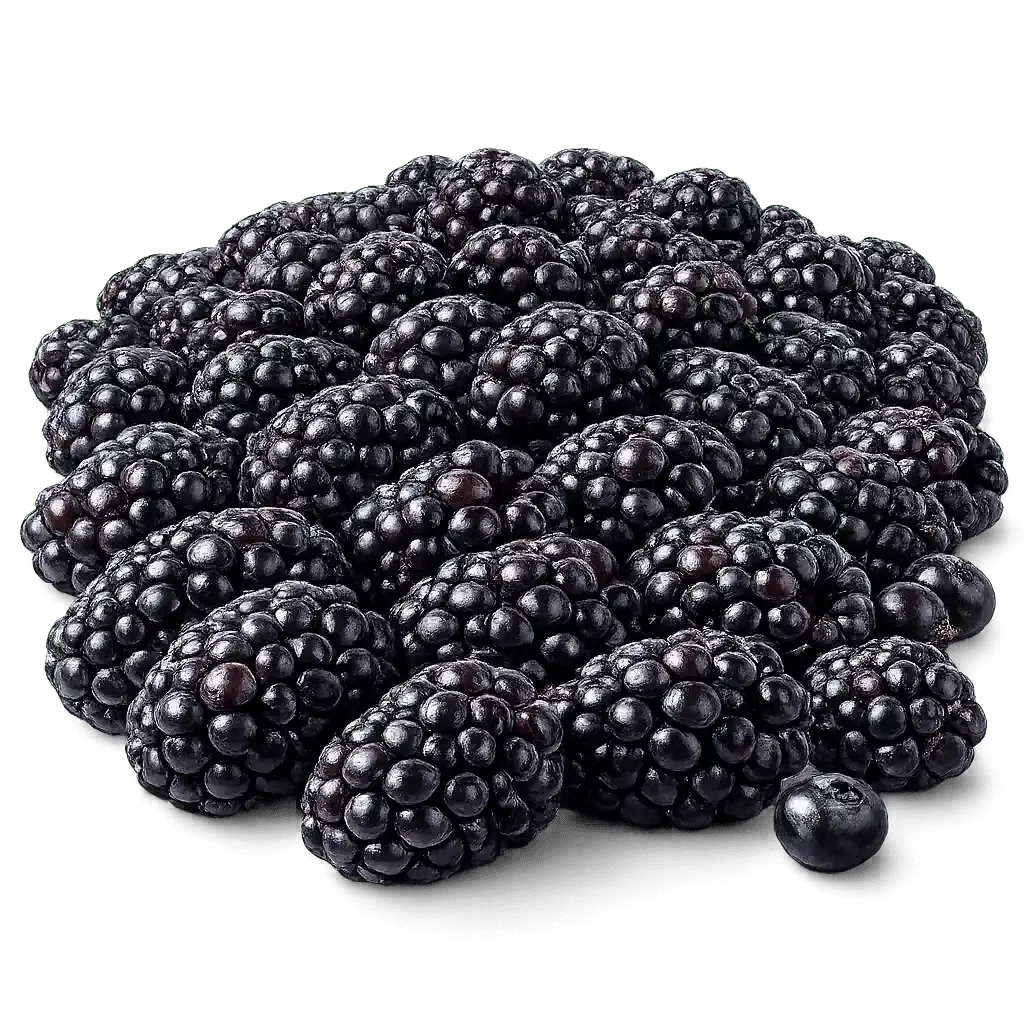
Ripe berries are composed of numerous individual drupelets clustered around a central core (receptacle). Unlike raspberries, the receptacle stays with the berry when picked, giving blackberries their characteristic solid center. Ripe berries are glossy, deep black, and range from 3/4 inch to over 1 1/2 inches in length depending on variety. Modern cultivars like 'Osage,' 'Ouachita,' and 'Triple Crown' consistently produce berries over 1 inch. The drupelets are plump, rounded, and glistening when fully ripe. Each drupelet contains a small seed that is noticeable but not objectionable in most eating and cooking applications.
Ripening time varies by type, variety, and zone but generally spans from June through September. Early varieties in warm zones (7 through 9) may begin ripening in early June. Mid-season types in Zones 5 through 7 ripen in July. Late-season and primocane-fruiting varieties extend the harvest into August and September. Individual plants produce ripe berries over a 3 to 5 week window, with fruit at the tips of clusters ripening first.
Visual appeal is strong. The contrast between jet-black ripe berries, ruby-red transitioning fruit, and the green foliage creates an attractive display. The white flowers against dark green canes are also showy in late spring. A well-trellised blackberry planting is a genuinely handsome feature in the homestead landscape.
How Much Berry Can You Collect?
Blackberry is among the highest-yielding fruit crops available to homesteaders, and the numbers are well-established from both commercial and home growing experience.
Young plants (year 2): Expect 3 to 8 pounds per plant from the first fruiting year. Vigorous varieties with good first-year cane establishment will be at the higher end.
Mature plants (years 3 to 5 and beyond): Erect thornless varieties produce 10 to 15 pounds per plant. Erect thorned varieties produce 10 to 20 pounds per plant. Semi-erect varieties like 'Triple Crown' and 'Chester' produce 15 to 25 pounds per plant. Trailing varieties in ideal climates produce 15 to 30 pounds per plant. Primocane-fruiting varieties yield somewhat less, typically 5 to 12 pounds per plant, but offer the advantage of simplified management.
Per-row and acre estimates: Erect blackberries planted at 3 to 4 foot spacing within rows and 8 to 10 feet between rows yield approximately 100 to 250 pounds per 100 linear feet of established row. Semi-erect and trailing types at 5 to 8 foot spacing yield 100 to 200 pounds per 100 linear feet. Commercial erect blackberry plantings average 8,000 to 12,000 pounds per acre, with top operations exceeding 15,000 pounds. Trailing types in the Pacific Northwest have been documented at over 20,000 pounds per acre in commercial production.
Harvest season is one of blackberry's great strengths. By planting a combination of early, mid, and late floricane varieties along with primocane-fruiting types, a homesteader can harvest fresh blackberries from June through October in many zones. That is up to 4 to 5 months of continuous production.
Ease of harvest is variety-dependent. Thornless varieties are a joy to pick, with easy access to berries and no skin-shredding thorns to navigate. Thorned varieties produce outstanding fruit but make picking slower and more painful. Ripe blackberries detach with a gentle tug when truly ready; berries that require pulling are not yet fully ripe. An experienced picker can harvest 4 to 8 pounds per hour from thornless varieties, somewhat less from thorned types.
Homestead reality: Six to ten mature blackberry plants will produce 60 to 200 pounds of fruit per season, depending on variety. That is an extraordinary yield from a planting that might occupy a 30 to 50 foot row. Even a modest planting of four thornless erect plants will supply a family with more blackberries than they can eat fresh, with plenty left for freezing, jam, pies, and wine. Blackberry is simply one of the most productive food plants a homesteader can grow.
Why Blackberry Berries Are Good for You
Blackberries pack a nutritional profile that puts them in the top tier of healthy fruits, with an impressive combination of vitamins, minerals, fiber, and antioxidant compounds.
Key vitamins and minerals: A one-cup serving of fresh blackberries (approximately 144 grams) provides approximately 30 milligrams of vitamin C (50 percent of the daily value), 29 micrograms of vitamin K (36 percent of the daily value), and meaningful amounts of manganese (47 percent of the daily value), vitamin A, vitamin E, folate, potassium, and magnesium. The dietary fiber content is exceptional at approximately 7.6 grams per cup, one of the highest fiber counts of any fresh fruit. All of this comes at only about 62 calories per cup.
Antioxidants: Blackberries are loaded with anthocyanins (the deep purple/black pigment compounds), ellagic acid, gallic acid, and ellagitannins. Ellagic acid in particular has received significant research attention for its potential anticancer properties. Blackberries also contain notable levels of quercetin, catechins, and salicylic acid (the natural compound related to aspirin).
Research-backed health benefits: Studies published in the Journal of Agricultural and Food Chemistry, the Journal of Nutritional Biochemistry, and other peer-reviewed journals have documented that blackberry consumption supports cardiovascular health through improved blood vessel function and reduced LDL oxidation, demonstrates anti-inflammatory activity, may support cognitive function and memory, promotes oral health (blackberry extracts have shown antibacterial activity against oral pathogens), and supports digestive health through its outstanding fiber content. Research on ellagic acid from blackberries has shown inhibition of cancer cell proliferation in laboratory studies, though human clinical trials are still ongoing.
Traditional and folk uses: Blackberry has one of the longest and most widespread histories of medicinal use of any fruit. Root and leaf tea was used by Indigenous peoples across North America as a treatment for diarrhea, dysentery, and mouth sores. European herbalists used blackberry preparations for sore throats, gum inflammation, and digestive complaints. Blackberry vinegar was a common frontier remedy for fever. The leaves are mildly astringent and have been used as a tea for centuries to treat stomach upset and as a gargle for throat infections.
What You Can Make with Blackberry Berries
Blackberry's bold, rich flavor and deep color make it one of the most satisfying fruits to cook and preserve. Its culinary range is enormous.
Blackberry Jam and Preserves: A homestead classic. Blackberry jam is dark, glossy, and richly flavored. Seedless jam (pressed through a fine-mesh sieve or food mill to remove seeds) is preferred by many, though whole-berry preserves have their own rustic appeal. Either version is outstanding on biscuits, toast, and scones.
Blackberry Cobbler: Perhaps the most iconic blackberry dessert in the American South. Sweetened berries baked beneath a biscuit or cake batter topping until bubbling and golden. Simple, fast, and deeply satisfying. Use 4 to 5 cups of berries for a 9-by-13-inch pan.
Blackberry Pie: A rich, juicy filling with complex flavor. Use 5 to 6 cups of berries, 3/4 cup sugar, 4 tablespoons cornstarch, and 1 tablespoon lemon juice for a standard double-crust pie. Lattice tops are traditional, allowing steam to escape and the dark filling to show through.
Blackberry Wine: One of the finest fruit wines, with deep garnet color, full body, and tannic complexity that ages beautifully. A 5-gallon batch requires approximately 12 to 16 pounds of fruit. Blackberry wine was a staple of rural American households for generations.
Blackberry Syrup: Simmer strained juice with sugar for a versatile pantry staple. Outstanding on pancakes, waffles, ice cream, and in cocktails. The deep purple-black color is stunning.
Blackberry Vinegar: Steep crushed berries in apple cider vinegar or white wine vinegar for 2 to 4 weeks, then strain. Use in salad dressings, marinades, and shrub-style drinking vinegars.
Blackberry Sauce: Reduce strained juice with sugar, a splash of balsamic vinegar, and cracked black pepper. A refined sauce for duck, lamb, pork tenderloin, venison, and aged cheeses.
Blackberry Leather: Puree cooked, strained berries with honey or sugar and dehydrate at 135 degrees Fahrenheit for 6 to 10 hours. A portable, kid-friendly snack with concentrated flavor.
Blackberry Cordial and Shrubs: Steep berries in spirits for cordial or combine berry syrup with vinegar for a traditional drinking shrub. Both are old-time homestead beverages making a well-deserved comeback.
Homestead tip: To make seedless blackberry products, cook berries with a small amount of water until soft, then press through a food mill or fine-mesh sieve. You will lose about 20 to 25 percent of the volume to seeds and pulp, but the resulting juice and puree are silky smooth and work beautifully in jam, syrup, sauce, and baked goods. The seed waste goes straight to the compost pile.
Best Ways to Store, Can, or Make Jam
Blackberry responds well to every major preservation method, and a well-stocked homestead pantry should include several forms.
Freezing: The simplest and most versatile method. Spread unwashed berries on parchment-lined sheet pans in a single layer. Freeze for 2 to 3 hours until solid. Transfer to freezer bags, remove air, and seal. Store at 0 degrees Fahrenheit for 10 to 12 months. Do not wash before freezing. Rinse briefly after thawing if needed.
Canning Blackberry Jam (Recipe):
Ingredients: 5 cups crushed blackberries (approximately 2 to 2.5 quarts fresh) 1 package (1.75 ounces) powdered pectin 7 cups granulated sugar 2 tablespoons lemon juice
Method:
Wash and crush berries in a large pot using a potato masher. For seedless jam, press the crushed berries through a fine-mesh sieve or food mill and measure 5 cups of pulp.
Stir in pectin and lemon juice. Bring to a full rolling boil over high heat, stirring constantly.
Add sugar all at once. Return to a full rolling boil and boil hard for exactly 1 minute, stirring constantly.
Remove from heat and skim foam. Ladle into hot, sterilized half-pint jars, leaving 1/4 inch headspace.
Wipe rims clean, apply lids and bands fingertip-tight, and process in a boiling water bath for 10 minutes (adjust for altitude: add 5 minutes above 6,000 feet).
Yield: approximately 8 to 9 half-pint jars.
Blackberry Syrup: Combine 4 cups strained blackberry juice with 2 cups sugar in a heavy saucepan. Bring to a boil, stir until dissolved, and simmer for 10 minutes. Ladle into hot jars with 1/4 inch headspace and process in a boiling water bath for 10 minutes. Makes approximately 4 to 5 half-pint jars.
Drying: Spread berries on lined dehydrator trays. Dry at 135 degrees Fahrenheit for 18 to 24 hours until fully leathery. High moisture content makes blackberries slow to dehydrate. Store in airtight containers for 6 to 12 months.
Canning whole blackberries: Pack clean berries into hot pint jars. Cover with boiling light syrup (1 cup sugar to 3 cups water), leaving 1/2 inch headspace. Process in a boiling water bath for 15 minutes (pints). Canned whole blackberries are ready to use in cobblers, crisps, and sauces year-round.
Freezer jam: Crush berries, combine with freezer-jam pectin and sugar per package directions, and ladle into freezer-safe containers. Freeze for up to 12 months. Thaw in the refrigerator and use within 3 weeks. Freezer jam preserves a brighter, more fresh-tasting flavor than cooked jam.
Pros of Growing Blackberry
Exceptional productivity. Blackberry is one of the highest-yielding fruit crops per linear foot of row. Mature plants routinely produce 10 to 20 or more pounds per plant, and even a short row generates an enormous amount of food.
Fast to production. First harvest comes in year two, with full production by year three or four. Among fruit crops, this is an impressively fast return on investment.
Wide climate adaptability. Between erect, semi-erect, trailing, and primocane-fruiting types, there are blackberry varieties suited to USDA Zones 4 through 9. Very few fruit crops cover this range with such consistent performance.
Thornless varieties available. Modern thornless cultivars like 'Triple Crown,' 'Chester,' 'Ouachita,' 'Osage,' and 'Natchez' produce excellent fruit on canes that are painless to manage and harvest. This has transformed blackberry from a thorny ordeal into a pleasure to grow.
Primocane-fruiting options. Varieties like 'Prime-Ark Freedom' and 'Prime-Ark Traveler' produce fruit on first-year canes, eliminating the need for winter cane protection in cold zones and simplifying pruning to a single annual mowing of all canes in late winter.
Universal culinary appeal. Blackberries are loved by virtually everyone. Fresh eating, jam, pie, cobbler, wine, syrup, sauce, and baked goods are all straightforward and delicious. There is no "acquired taste" barrier as with some homestead fruits.
Low input requirements. Once established, blackberry needs minimal fertilization, no spraying in most regions, and only basic annual pruning to remain productive. It is a genuinely low-maintenance fruit crop.
Extended harvest season. By planting multiple varieties, homesteaders can harvest fresh blackberries from June through October, providing months of continuous production.
Cons of Growing Blackberry
Aggressive spreading. Blackberry spreads by root suckers and, in some species, by tip-rooting (where arching cane tips touch the ground and take root). Without vigilant management, a blackberry planting can colonize an area rapidly. Mow, dig, or otherwise remove suckers regularly. Erect types are somewhat less aggressive than trailing types in this regard.
Trellising required for most types. Semi-erect and trailing varieties absolutely require a wire trellis for management and harvest. Even erect types benefit from a simple single-wire support. Building and maintaining trellis systems adds cost and labor.
Annual cane management. Floricane-fruiting blackberries require annual removal of spent fruiting canes after harvest and training of new primocanes. Neglecting this creates an impenetrable, unproductive thicket within 2 to 3 years. Primocane-fruiting types simplify this to an annual mowing, but they sacrifice some yield potential.
Thorns on many varieties. Traditional and many wild-type blackberries have fierce thorns that make pruning and picking arduous and occasionally bloody. While thornless cultivars solve this problem, some growers report that thorned types have slightly better flavor or cold hardiness in certain situations.
Double-blossom and rosette disease. This fungal disease (Cercosporella rubi) causes deformed, sterile flowers and is a significant problem in the Southeast. Infected canes must be removed and destroyed. Choosing resistant varieties and maintaining good sanitation are essential.
Spotted wing drosophila (SWD). This invasive fruit fly has become a serious pest of blackberries across much of North America. SWD lays eggs in ripening fruit, causing larval infestation. Monitoring with traps, short harvest intervals, and immediate refrigeration or processing of picked fruit are the primary defenses for organic homestead growers.
Seeds. Blackberry seeds are larger and more noticeable than raspberry seeds, which bothers some people. Straining for seedless products adds processing time and reduces yield by 20 to 25 percent.
Staining. Blackberry juice stains hands, clothing, and surfaces a deep, persistent purple. Process in old clothes and use stainless steel or glass equipment.
Growing Tips for Homesteaders
Site selection: Full sun (6 to 8 hours minimum) is essential for maximum production and disease prevention. Good air circulation reduces fungal problems, so avoid enclosed, stagnant areas. Choose well-drained soil; blackberries tolerate a range of soil types but will not survive waterlogged roots. Ideal soil pH is 5.5 to 6.5, though blackberry is more forgiving of soil conditions than many fruit crops. Avoid sites where tomatoes, peppers, potatoes, eggplant, or other brambles have grown in the past 3 to 4 years to reduce verticillium wilt and soil-borne disease risk.
Planting: Plant bare-root stock in early spring while dormant, or container-grown plants from spring through early fall. For erect varieties, space plants 3 to 4 feet apart within rows and 8 to 10 feet between rows. For semi-erect and trailing types, space 5 to 8 feet within rows and 8 to 12 feet between rows. Install a trellis before or at planting. A simple two-wire system with wires at 3 and 5 feet supported by sturdy posts every 15 to 20 feet works well for most types. Plant crowns 1 to 2 inches below the soil surface. Mulch with 3 to 4 inches of straw, wood chips, or shredded bark. Water deeply after planting.
Maintenance: Water consistently during fruit development, providing 1 to 1.5 inches per week. Drip irrigation is preferred over overhead watering to minimize foliar disease. After harvest on floricane types, cut all spent floricanes to ground level and remove them from the area. Train new primocanes onto the trellis for the following year's crop. For primocane-fruiting types, mow all canes to the ground in late winter for a simplified single-crop system. Fertilize in early spring with a balanced organic fertilizer or compost. Apply 2 to 4 ounces of actual nitrogen per plant per year (roughly equivalent to a 1 to 2 inch top-dressing of composted manure). Remove suckers that emerge outside the desired row width by mowing or hoeing.
Variety selection: This is critical and should match your zone, climate, and management style. For Zones 4 to 5 (cold climates), erect thorned varieties like 'Illini Hardy' (one of the hardiest, surviving minus 20 degrees Fahrenheit) or primocane types like 'Prime-Ark Freedom' (which can be mowed annually, avoiding winter cane damage) are best. For Zones 5 to 7, the widest range is available: 'Ouachita' and 'Natchez' (erect, thornless, excellent flavor), 'Triple Crown' (semi-erect, thornless, outstanding yields and flavor), and 'Chester' (semi-erect, thornless, late season, very productive). For Zones 7 to 9, trailing types like 'Marion' (the benchmark for blackberry flavor in the Pacific Northwest), 'Boysen' (technically a hybrid but managed identically), and 'Olallie' perform excellently. 'Kiowa' is a thorned erect variety with the largest berries of any cultivar (up to 2 inches) for growers who want maximum fruit size. Always plant at least two varieties for season extension, even though blackberries are self-fertile.
Companion planting and integration: Blackberry pairs well with fruit trees when planted at the orchard edge where it receives full sun without competing for root space. Avoid planting near wild brambles that may harbor diseases and pests. Pollinator-attracting companions like borage, phacelia, and white clover planted between rows support honeybees and native pollinators that improve fruit set and berry size. In a homestead layout, a blackberry row along a south-facing fence line or property boundary serves as both a food producer and a living fence. The thorned varieties in particular create an effective barrier planting that discourages both two-legged and four-legged intruders.
Conclusion
Blackberry is the fruit that built rural America's preserving tradition. Generations of homesteaders, farmwives, and country families built their pantries around blackberry jam, cobbler, and wine long before anyone used the word "superfood" or worried about antioxidant levels. The plant earned its place through sheer reliability: it grows almost everywhere, it produces abundantly, it tastes magnificent, and it preserves like it was designed for the canning jar.
Modern cultivars have made blackberry even better. Thornless varieties have eliminated the blood-and-thorn ordeal that defined picking day for centuries. Primocane-fruiting types have opened cold-climate growing to homesteaders who could never before keep floricanes alive through harsh winters. Breeding programs have delivered berries that are larger, sweeter, and more disease-resistant than anything previous generations had access to. The blackberry you plant today is a dramatically improved version of the wild fruit your great-grandmother picked from the fencerow, but the jam you make from it will taste just as good.
Start with four to six plants of a thornless variety suited to your zone. Build a simple trellis, mulch well, and water through the first summer. By year two you will be picking. By year three you will be preserving. By year four you will have more blackberries than you know what to do with, and you will understand why this fruit has been at the center of American homestead life for as long as there have been homesteads. Some crops are trendy. Blackberry is forever.
Explore more guides on different types of berries