
Blackcurrant
Complete Homestead Growing Guide
The blackcurrant (Ribes nigrum) is one of the most nutritionally powerful and historically significant small fruits in the world, yet it remains strangely underappreciated on American homesteads. Native to northern Europe and northern Asia, blackcurrant has been cultivated since at least the 1500s and became a dietary staple across Britain, Scandinavia, and Eastern Europe, where it is still consumed in enormous quantities as juice, jam, cordial, and liqueur. In the United States, blackcurrant was effectively banned for most of the 20th century because the plants can serve as alternate hosts for white pine blister rust (Cronartium ribicola), a disease that threatened the timber industry. Federal restrictions were lifted in 1966, and today most states allow blackcurrant cultivation, though some northeastern states still regulate or restrict planting. That decades-long ban is the primary reason most Americans have never tasted a blackcurrant, and it is exactly why homesteaders should be growing them now.
Blackcurrant grows as a compact, multi-stemmed deciduous shrub, typically reaching 4 to 6 feet in height with a similar spread. The leaves are distinctively aromatic when crushed, with a musky, resinous fragrance that carries into the fruit's complex flavor profile. The plant is remarkably cold-hardy, thriving in USDA Zones 3 through 7, with some cultivars performing well into Zone 2 with snow cover. Blackcurrant prefers cool summers and cold winters, making it an ideal crop for northern homesteads where heat-loving fruits struggle.
For homesteaders, blackcurrant fills a critical gap. It produces prodigious amounts of vitamin C (far more than citrus), thrives in cold climates, requires minimal space, tolerates partial shade better than almost any other fruit crop, and yields berries that process into some of the finest jams, juices, and syrups you will ever taste. The plants are productive, compact, and long-lived. If you homestead anywhere from Zone 3 through 7 and you are not growing blackcurrants, you are missing one of the most valuable fruit crops available to you.
How Long Does It Take to Grow?
Blackcurrant is one of the faster fruit shrubs to reach production, rewarding homesteaders with meaningful harvests within just a few years of planting. Here is what to expect.
Year 1: Newly planted blackcurrants, whether bare-root or container-grown, will establish their root systems and produce moderate top growth of 12 to 18 inches. Some nursery plants may carry a few flower clusters, but most growers recommend removing these to prioritize root and branch development. No significant harvest this year.
Year 2: Plants begin to show vigorous growth with multiple new basal shoots emerging from the crown. You will see your first real crop, typically 1 to 3 pounds per bush. The berries will be full-sized and fully flavored. This is enough for a small batch of jam or a taste test of fresh juice.
Year 3: Production increases markedly. Expect 3 to 6 pounds per bush from healthy, well-sited plants. The shrub is now 3 to 4 feet tall and developing a strong multi-cane structure. This is the year blackcurrant starts earning its place on the homestead in earnest.
Years 4 to 5: Plants are approaching mature size and production. Expect 6 to 12 pounds per bush, depending on variety and growing conditions. The shrub has a full, rounded form and is producing plenty of new basal canes each year to sustain future crops.
Years 6 to 8: Full production. A well-maintained blackcurrant bush will yield 10 to 15 pounds of fruit per season consistently. Superior cultivars under ideal conditions can produce up to 20 pounds.
Years 8 and beyond: Blackcurrant bushes remain productive for 15 to 20 years with proper pruning. The key to longevity is regular renewal pruning, removing the oldest one-third of canes every year or two, because blackcurrant produces its best fruit on one-year-old and two-year-old wood. Plants that are never pruned decline in both vigor and yield after about 8 to 10 years. Well-managed bushes keep producing strongly for two decades.
Berry Shelf Life
Blackcurrants are firmer than many people expect for such a juicy berry, and they store better fresh than most soft fruits. Their high acidity and thick skin work in their favor.
Fresh: Unwashed blackcurrants stored in shallow containers in the refrigerator at 34 to 38 degrees Fahrenheit will keep for 7 to 10 days. This is considerably longer than raspberries or strawberries. The berries hold their shape well and resist mold better than many other soft fruits thanks to their relatively tough skin and low pH.
Frozen: Blackcurrants freeze exceptionally well. Remove berries from their strigs (stems) by running a fork down the cluster, spread on parchment-lined sheet pans, freeze for 2 to 3 hours, then transfer to freezer bags with air removed. At 0 degrees Fahrenheit, frozen blackcurrants maintain excellent quality for 12 to 18 months. Freezing is the preferred bulk storage method for most homesteaders.
Dried: Dehydrate at 135 degrees Fahrenheit for 12 to 18 hours until berries are shriveled and leathery. Dried blackcurrants (sometimes called "cassis raisins") are chewy, intensely flavored, and store in airtight containers for 12 to 18 months. They are outstanding in baking, granola, and trail mix.
Jams and Preserves: Water-bath canned blackcurrant jam keeps 12 to 18 months and is one of the most prized fruit preserves in the European tradition. The berries' high natural pectin and acidity make them among the easiest of all fruits to set into a perfect jam.
Homestead Storage Tip: Blackcurrants can be processed into concentrated juice or cordial that stores beautifully. Simmer berries with a small amount of water, strain, sweeten, and bottle. Refrigerated cordial keeps for 3 to 4 weeks, or freeze in measured portions for year-round use. A small glass of diluted blackcurrant cordial during cold and flu season provides a massive dose of vitamin C in the most delicious form imaginable.
Berry Color and Appearance
Blackcurrant is a handsome shrub with distinctive fruit that is instantly recognizable once you know what to look for.
Flowers appear in mid-spring, typically April to May depending on zone. They are small, bell-shaped, and hang in pendulous clusters (racemes) called strigs, with 8 to 15 flowers per strig. The flowers are greenish to reddish-purple and are not particularly showy, but they are attractive to bees and other pollinators. Some varieties have a faint fragrance.
Unripe berries appear as tiny, hard, pale green clusters in late spring to early summer. They swell gradually over several weeks, transitioning through shades of green to reddish-purple before reaching their final color.
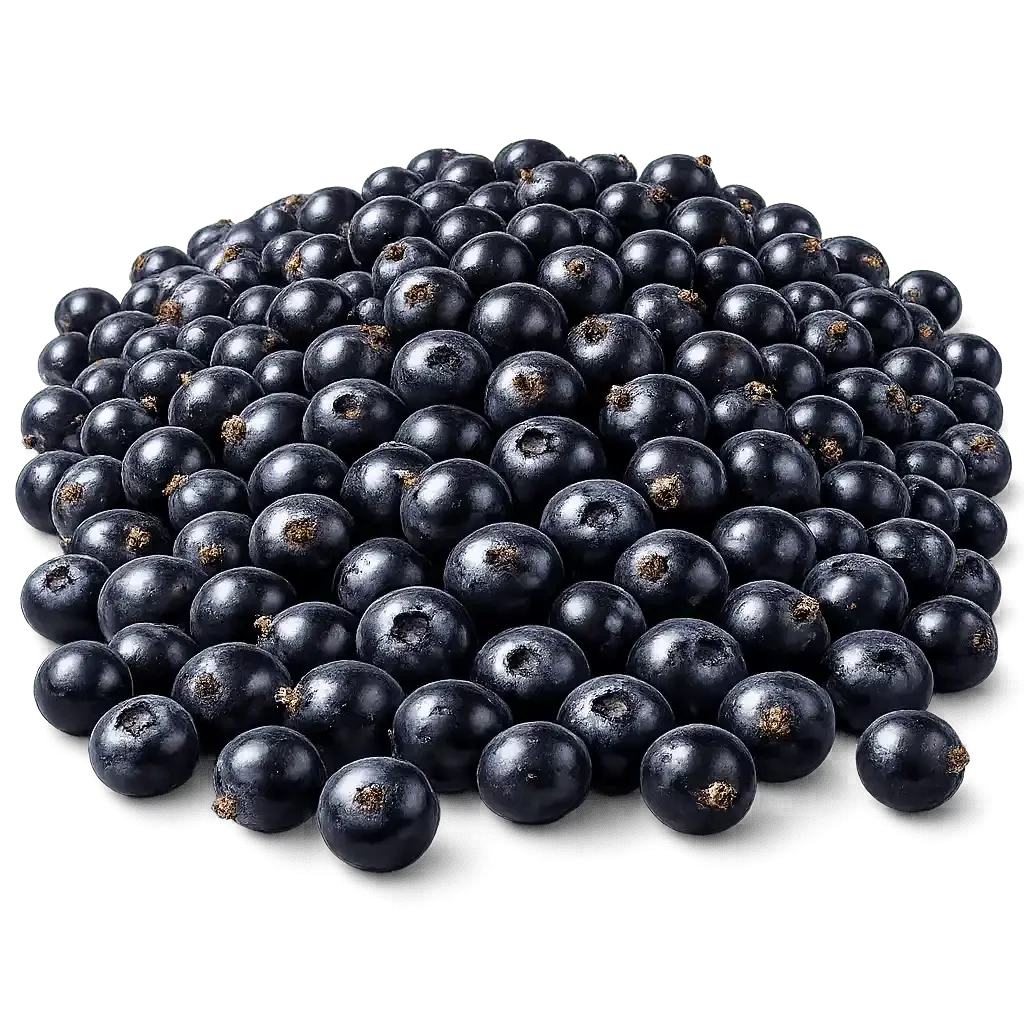
Ripe berries are round, glossy, and deep purplish-black, approximately 3/8 to 1/2 inch in diameter on most cultivars. Newer varieties like 'Titania' and 'Ben Connan' produce berries up to 5/8 inch in diameter. The berries hang in loose, drooping strigs of 6 to 12 berries each. The skin is smooth and slightly waxy. Each berry contains several small seeds that are noticeable but not unpleasant when eating. The flesh is deep purple-red and extremely juicy, releasing an intensely aromatic juice that stains everything it contacts.
Ripening time is generally mid-June through late July, depending on variety and zone. Early cultivars like 'Ben Lomond' may ripen in mid-June in warmer areas, while late varieties extend into August. Most blackcurrant varieties ripen their entire strig relatively uniformly, which is convenient for harvest. Unlike some berries, blackcurrants hold well on the bush for 1 to 2 weeks after reaching full ripeness without significant quality loss, giving you flexibility in scheduling your pick.
Visual appeal is moderate. Blackcurrant is not as ornamentally striking as blueberry or chokeberry, but the glossy dark fruit clusters against the aromatic green foliage are attractive in a quiet, understated way. The leaves turn yellow in fall. The real beauty of blackcurrant is in the kitchen, where the deep purple juice and jewel-toned jam are genuinely stunning.
How Much Berry Can You Collect?
Blackcurrant is one of the most productive small fruit shrubs per square foot of garden space, and yields are well-documented from both commercial and homestead plantings.
Young plants (years 2 to 3): Expect 1 to 6 pounds per bush, increasing as the plant adds canes and fills out. Even these early yields provide enough fruit for meaningful batches of jam or juice.
Mature plants (years 5 and beyond): A healthy, properly pruned blackcurrant bush produces 10 to 15 pounds of fruit per year consistently. Vigorous cultivars like 'Titania,' 'Ben Hope,' and 'Consort' can push toward 15 to 20 pounds under optimal conditions. Commercial orchards in Europe report average per-bush yields of 10 to 12 pounds.
Per-row and acre estimates: Blackcurrants planted at 4 to 5 foot spacing within rows and 8 to 10 feet between rows yield approximately 100 to 200 pounds per 100 linear feet of established hedgerow. At commercial density (roughly 1,000 to 1,500 plants per acre), yields range from 6,000 to 12,000 pounds per acre at maturity. These are impressive numbers for a low-input crop.
Harvest season is concentrated, typically spanning 2 to 3 weeks per variety. By planting early, mid, and late cultivars, you can extend the total harvest window to 4 to 6 weeks. Most blackcurrant harvest occurs in July in Zones 4 through 6.
Ease of harvest is good. Blackcurrants can be picked as individual berries or (more efficiently) as entire strigs, which are then stripped of berries indoors using a fork or by hand. Strig-picking is roughly twice as fast as individual berry picking. An experienced picker harvesting by the strig can collect 5 to 8 pounds per hour. The berries are firm enough to handle without crushing and do not leak during harvest.
Homestead reality: Six to eight mature blackcurrant bushes will produce 60 to 120 pounds of fruit per year. This is a substantial amount that will keep a family supplied with jam, juice, cordial, dried currants, and frozen stores year-round, with excess for sharing, selling, or bartering. The entire planting fits in a space roughly 25 by 10 feet.
Why Blackcurrant Berries Are Good for You
Blackcurrant is a nutritional powerhouse. Its vitamin C content alone makes it one of the most important fruit crops a self-sufficient homesteader can grow, but the benefits extend far beyond that single nutrient.
Key vitamins and minerals: Blackcurrants are extraordinarily rich in vitamin C, providing approximately 180 to 200 milligrams per 100 grams of fresh fruit. That is roughly three to four times the vitamin C content of oranges and among the highest of any commonly cultivated fruit. They are also an excellent source of vitamin A, vitamin E, vitamin K, and B vitamins (particularly B5 and B6). Mineral content includes significant levels of potassium, manganese, iron, calcium, and phosphorus. The dietary fiber content is approximately 4 to 5 grams per 100 grams.
Antioxidants: Blackcurrant's deep pigmentation signals extremely high levels of anthocyanins, particularly delphinidin and cyanidin glycosides. The total anthocyanin content is among the highest of any commonly consumed fruit. Blackcurrants also contain high concentrations of proanthocyanidins, flavonols, and phenolic acids. The gamma-linolenic acid (GLA) found in blackcurrant seed oil is a rare and valuable omega-6 fatty acid with documented anti-inflammatory properties.
Research-backed health benefits: The scientific literature on blackcurrant is extensive, particularly from European and New Zealand research institutions. Studies have demonstrated that blackcurrant consumption strengthens immune function (largely through vitamin C and anthocyanin synergy), reduces inflammation and muscle soreness after exercise, supports eye health and may improve night vision (research on this dates to WWII-era studies on RAF pilots), improves blood flow and cardiovascular function, and supports urinary tract health. Research published in the European Journal of Applied Physiology has documented blackcurrant extract's ability to enhance blood circulation during exercise. Studies from the New Zealand Institute for Plant and Food Research have shown positive effects on cognitive function and mood.
Traditional medicinal uses: Blackcurrant has a long history in European folk medicine. The leaves were brewed into tea for treating inflammatory conditions, urinary complaints, and sore throats. The berry juice was used as a gargle for throat infections and as a general tonic during winter illness. In France, blackcurrant leaf tea ("tisane de cassis") remains a popular herbal remedy. During World War II, the British government actively promoted blackcurrant cultivation and distributed free blackcurrant syrup (Ribena) to children because citrus imports were cut off and the vitamin C in blackcurrant was essential for preventing scurvy.
What You Can Make with Blackcurrant Berries
Blackcurrant has one of the most complex, intense flavor profiles of any berry. It is tart, musky, deeply fruity, and aromatic, with a character so distinctive that it is used as a reference flavor in wine tasting ("cassis notes"). This intensity makes it extraordinarily versatile in the kitchen.
Blackcurrant Jam: The gold standard of fruit preserves in Britain and across Europe. The berries' naturally high pectin and acidity produce a jam that sets perfectly with minimal fuss. The flavor is rich, tart, and deeply complex. A jar of homemade blackcurrant jam is a homestead luxury.
Blackcurrant Juice and Cordial: Perhaps the most traditional use. Simmer berries with water, strain, and sweeten to create a concentrate that dilutes into a refreshing drink. Blackcurrant cordial is a staple in British households and delivers an enormous dose of vitamin C per serving.
Cassis (Blackcurrant Liqueur): Creme de cassis is one of the great European liqueurs. Steep macerated blackcurrants in vodka or brandy for 2 to 3 months, strain, and sweeten. The result is a deep purple, intensely flavored liqueur used in the classic Kir and Kir Royale cocktails.
Blackcurrant Syrup: Simmer strained juice with sugar until slightly thickened. Use on pancakes, ice cream, yogurt, and in cocktails. The deep purple color and complex flavor make an impressive presentation.
Pies, Crumbles, and Baked Goods: Blackcurrant filling is intensely flavored and holds up well in baked desserts. The tartness balances beautifully with a sweet pastry crust or crumble topping. Combine with apples for a classic British combination.
Blackcurrant Wine: A full-bodied, deeply colored fruit wine with tannic structure and aging potential. Blackcurrant wine rivals grape wine for complexity. A standard 5-gallon batch requires approximately 10 to 14 pounds of fruit.
Blackcurrant Sauce: Reduce juice with sugar, a splash of red wine vinegar, and black pepper for a savory sauce that pairs magnificently with duck, venison, lamb, and liver.
Homestead tip: Blackcurrant leaves are edible and make an aromatic tea on their own. Harvest young leaves in late spring for the best flavor. Dried blackcurrant leaves stored in airtight tins keep for 6 to 12 months and brew into a mildly astringent, pleasantly flavored tea that has been used traditionally as a vitamin C source in its own right.
Best Ways to Store, Can, or Make Jam
Blackcurrant's high acidity and pectin content make it one of the most preservation-friendly fruits you will ever work with. Here are the best methods.
Freezing: Strip berries from strigs using a fork. Spread on parchment-lined sheet pans and freeze for 2 to 3 hours. Transfer to freezer bags with air removed. Store at 0 degrees Fahrenheit for 12 to 18 months. Frozen blackcurrants work perfectly in all recipes and actually break down slightly during thawing, which makes juice extraction easier.
Canning Blackcurrant Jam (Recipe):
Ingredients: 4 cups crushed blackcurrants (approximately 2 to 2.5 pounds fresh) 3 cups granulated sugar 1/2 cup water 2 tablespoons lemon juice
Method:
Combine blackcurrants and water in a large, heavy-bottomed pot. Bring to a boil, then reduce heat and simmer for 8 to 10 minutes until berries have burst and softened.
Add sugar and lemon juice. Stir over medium heat until sugar dissolves completely.
Increase heat and bring to a full rolling boil. Boil hard for 8 to 10 minutes, stirring frequently and testing for set using the wrinkle test (place a small spoonful on a chilled plate; if it wrinkles when pushed, it is ready). Note: Blackcurrants are so high in natural pectin that no added pectin is required.
Remove from heat and skim any foam. Ladle into hot, sterilized half-pint jars, leaving 1/4 inch headspace.
Wipe rims clean, apply lids and bands fingertip-tight, and process in a boiling water bath for 10 minutes (adjust for altitude: add 5 minutes above 6,000 feet).
Yield: approximately 5 to 6 half-pint jars.
Blackcurrant Cordial: Simmer 4 cups blackcurrants with 2 cups water for 15 minutes. Mash and strain through cheesecloth. Add 1 1/2 cups sugar to the strained juice and heat until dissolved. Bottle in sterilized jars and refrigerate (keeps 3 to 4 weeks) or freeze in measured portions for long-term storage.
Drying: Spread de-stemmed berries on dehydrator trays. Dry at 135 degrees Fahrenheit for 12 to 18 hours until fully shriveled and leathery. Store in airtight glass jars or vacuum-sealed bags for 12 to 18 months.
Blackcurrant vinegar: Pack a jar halfway with crushed blackcurrants, fill with white wine vinegar, and steep for 3 to 4 weeks in a cool, dark place. Strain and bottle. The resulting vinegar is deeply colored and adds complexity to salad dressings and sauces.
Pros of Growing Blackcurrant
Extraordinary vitamin C content. At 180 to 200 milligrams per 100 grams, blackcurrant provides more vitamin C than almost any other temperate-climate fruit. For self-sufficient homesteaders in northern zones where citrus cannot be grown, this is a genuinely important nutritional resource.
No added pectin needed for jam. Blackcurrant is one of the few fruits with enough natural pectin and acidity to set a perfect jam without any commercial pectin. This simplifies the canning process and saves money.
Thrives in cool, northern climates. Hardy to Zone 3 (some cultivars to Zone 2), blackcurrant actually prefers the cool summers and cold winters that challenge many other fruit crops. It is a northern homesteader's dream fruit.
Tolerates partial shade. Blackcurrant produces reasonable crops with as little as 4 to 5 hours of direct sunlight, which is unusual among fruit crops. This makes it ideal for partially shaded areas, north-facing slopes, or woodland edges where other berries would fail.
Compact size, high yields. At 4 to 6 feet tall and wide, a blackcurrant bush produces 10 to 15 pounds of fruit from a very modest footprint. Six to eight bushes fit into a 25-foot row and produce enough for a family's year-round needs.
Fast to production. Meaningful harvests begin in year two, with full production by year five or six. This is one of the faster fruit shrubs to reach its potential.
Rich culinary tradition. Blackcurrant has centuries of use in European cuisine, giving homesteaders access to a vast library of tested recipes for jam, juice, cordial, liqueur, wine, sauces, and baked goods.
Nitrogen-fixing potential. While blackcurrant itself does not fix nitrogen, it responds well to companion planting with nitrogen fixers and thrives in the rich, organic soils typical of well-managed homestead landscapes.
Cons of Growing Blackcurrant
Legal restrictions in some states. Some states (particularly in the Northeast, including parts of Maine, Massachusetts, and New Hampshire) still restrict or ban Ribes species due to white pine blister rust concerns. Check your state and local regulations before planting. Disease-resistant cultivars like 'Titania' and 'Consort' are permitted in many areas where susceptible varieties are not.
Strong, acquired flavor. Blackcurrant's intense, musky, tart flavor is polarizing. Many Americans trying it for the first time find it unfamiliar and sometimes off-putting compared to milder berries like blueberry or strawberry. It is very much an acquired taste, though most people grow to love it once they experience it in jam, juice, or baked goods.
Susceptibility to white pine blister rust. Blackcurrant can host this fungal disease, which can damage five-needled (white) pines. While rust-resistant cultivars greatly reduce this risk, homesteaders near valuable white pine stands should be aware of the issue and choose resistant varieties.
Staining. Blackcurrant juice stains aggressively. Hands, clothing, countertops, and cutting boards will turn deep purple during processing. Use stainless steel or glass equipment, wear old clothes, and accept that your hands will be purple for a day or two after a big processing session.
Bird and insect pressure. Birds, particularly blackbirds and starlings, can devastate blackcurrant crops if bushes are not netted. Sawfly larvae (currant worm) can defoliate plants rapidly if not caught early. Regular monitoring during late spring and early summer is necessary.
Requires regular pruning. Blackcurrant fruits best on one-year-old and two-year-old wood. Without annual renewal pruning (removing the oldest one-third of canes each year), bushes become overgrown with unproductive old wood and yields decline significantly. This is not difficult once learned, but it does require consistent attention.
Short harvest window per variety. Each cultivar ripens its crop over just 2 to 3 weeks. Without planting multiple varieties for succession, the entire harvest comes in a concentrated burst that demands rapid processing.
Growing Tips for Homesteaders
Site selection: Blackcurrant prefers a cool, sheltered position with fertile, moisture-retentive soil. Full sun produces the highest yields, but blackcurrant is notably shade-tolerant and will crop reliably with as little as 4 to 5 hours of direct sun. This makes it valuable for partially shaded garden areas, north sides of buildings, and woodland edges. Avoid frost pockets, as early spring flowers can be damaged by late frosts. Well-drained but consistently moist soil is ideal. Soil pH of 5.5 to 7.0 is acceptable, with 6.0 to 6.5 being optimal. Blackcurrant is far less fussy about pH than blueberry, growing well in most garden soils without amendment.
Planting: Plant bare-root stock in late fall or early spring while dormant, or container-grown plants from spring through early fall. A critical and often-overlooked practice: plant blackcurrants 2 inches deeper than they were in the nursery pot. This encourages strong basal shoot production from below the soil line, which is essential for the plant's long-term renewal cycle. Space bushes 4 to 5 feet apart within rows and 6 to 8 feet between rows. After planting, cut all canes back hard to 2 to 4 inches above ground level. This feels drastic, but it forces the plant to produce multiple strong new basal shoots in year one, building the framework for a productive bush. Mulch with 3 to 4 inches of well-rotted compost, wood chips, or straw.
Maintenance: Water consistently during fruit development, providing 1 to 1.5 inches per week. Blackcurrant is a heavy feeder compared to many fruit shrubs. Apply a generous top-dressing of well-rotted manure or compost each spring (a 2 to 3 inch layer around the base). Supplement with a balanced organic fertilizer if growth seems sluggish. Prune annually in late winter by removing approximately one-third of the oldest canes (those that are 3 years old or older) at ground level. This stimulates vigorous new basal growth that will carry the best fruit in subsequent years. Net bushes when fruit begins to color to protect from birds. Monitor for currant sawfly larvae in late spring and hand-pick or spray with organic Bt if needed.
Variety selection: Choose rust-resistant cultivars, especially if you are in a region near white pines. 'Titania' is the top recommendation for North American homesteaders: it is highly resistant to white pine blister rust, powdery mildew, and leaf spot, produces large berries and heavy yields (12 to 15 pounds per bush), and has a somewhat milder flavor than older varieties. 'Ben Sarek' is compact (3 to 4 feet), heavy-bearing, and excellent for small spaces. 'Ben Hope'offers good disease resistance and large fruit. 'Consort,' 'Crusader,' and 'Coronet' are older rust-immune varieties developed in Canada, though their fruit quality and yield are somewhat lower than the Ben series or Titania. 'Crandall'(Ribes odoratum, technically a clove currant) is sometimes offered as an alternative where true blackcurrant is restricted; it has a different flavor profile but is completely immune to blister rust.
Companion planting and integration: Blackcurrant works beautifully in the understory of food forests, planted beneath taller fruit or nut trees where it receives dappled light. It pairs well with gooseberries, red currants, elderberries, and comfrey in mixed plantings. Comfrey planted between blackcurrant bushes serves as a dynamic accumulator and living mulch. Avoid planting near five-needled pines if using non-resistant varieties. In a traditional homestead layout, a row of blackcurrants along the north side of a garden fence or outbuilding makes excellent use of space that is often wasted because few other fruit crops tolerate the reduced light.
Conclusion
Blackcurrant is the fruit that America forgot, and it is time for homesteaders to bring it back. The decades-long ban that erased this berry from American awareness has created an absurd situation where one of the world's most nutritious, productive, and versatile fruit crops is virtually unknown to the very people who would benefit from it most. Meanwhile, the British are drinking blackcurrant cordial by the gallon, the Scandinavians are making jam from it by the ton, and the New Zealanders are exporting blackcurrant extract as a performance supplement. American homesteaders are missing out.
The case for blackcurrant is overwhelming. It produces more vitamin C per square foot of garden space than any other temperate fruit. It makes jam so good that it defined an entire category of British preserves. It grows in shade that would stunt a blueberry. It thrives in Zone 3 cold that would kill a boysenberry. It sets fruit without added pectin, crops heavily from a compact bush, and asks for nothing more than an annual pruning and a shovelful of compost.
Plant six bushes of 'Titania' or 'Ben Sarek' this spring. Cut them back hard after planting, mulch them well, and give them two years. By year three you will be making jam that rivals anything from a London specialty shop. By year five you will wonder how you ever ran a homestead without them. Blackcurrant is not just another berry to add to the list. It is a homestead essential that has been waiting for you to rediscover it.
Explore more guides on different types of berries