
Blueberry
Complete Homestead Growing Guide
The blueberry (Vaccinium spp.) is the undisputed king of homestead berries, and for good reason. Native to North America, blueberries have been harvested from wild stands for thousands of years by Indigenous peoples and were among the first fruits that European settlers learned to value in the New World. Modern cultivated blueberries trace their origins to the pioneering work of Elizabeth White and Frederick Coville, who in the early 1900s selected and bred superior wild plants from the Pine Barrens of New Jersey into the large-fruited highbush varieties we know today.
The blueberry family includes several distinct species suited to different climates. Highbush blueberry (Vaccinium corymbosum) is the most widely grown, reaching 4 to 8 feet tall and performing best in USDA Zones 4 through 7. Southern highbush (hybrids of V. corymbosum and V. darrowii) extends the range into Zones 7 through 10, requiring fewer chill hours for warm-climate growers. Rabbiteye blueberry (Vaccinium virgatum) is a vigorous southeastern species hardy in Zones 7 through 9, reaching 6 to 15 feet tall. Half-high blueberry (hybrids of highbush and lowbush) stays compact at 2 to 4 feet and pushes hardiness into Zones 3 and even Zone 2 with snow cover, opening up blueberry production to the coldest homesteads. Lowbush blueberry (Vaccinium angustifolium) is the wild blueberry of Maine and eastern Canada, hardy to Zone 2, growing just 6 to 18 inches tall.
For homesteaders, blueberry is a cornerstone planting. It produces fruit that the whole family eats fresh by the handful. It freezes perfectly. It makes outstanding jam, pies, muffins, and wine. It has documented, research-backed health benefits that rank among the highest of any fruit. The plants are long-lived, attractive, and with proper variety selection can be grown in nearly every climate zone in the continental United States and southern Canada. No homestead fruit planting is complete without blueberries.
How Long Does It Take to Grow?
Blueberry rewards patience. The plants are slow to establish compared to brambles or strawberries, but once they hit their stride, they produce for decades. Here is a realistic timeline.
Year 1: Newly planted blueberries, whether from 1-gallon or 2-gallon container stock, will produce minimal top growth in their first season as they establish root systems. Most experienced growers recommend removing all flower buds in year one to redirect energy into root and branch development. This feels painful, but it pays off in the long run. Expect 3 to 6 inches of new growth.
Year 2: Plants begin to fill out with more branching and 6 to 12 inches of new growth. Allow a light crop if the plant looks vigorous, or strip flowers again for one more year of establishment. If you do allow fruit, expect less than a pound per bush. Many serious blueberry growers still remove flowers this year.
Year 3: The first real harvest year for most plantings. Plants are now 2 to 3 feet tall (highbush types) and producing 1 to 3 pounds per bush. The berries are full-sized and full-flavored. This is the year your patience begins to be rewarded.
Years 4 to 5: Production ramps up significantly. Expect 3 to 8 pounds per bush depending on variety and growing conditions. Plants are now 3 to 5 feet tall and developing their mature form.
Years 6 to 8: Plants are approaching full maturity. Highbush varieties produce 8 to 15 pounds per bush. Rabbiteye types can exceed 15 pounds. Half-high varieties produce 3 to 7 pounds from their more compact frames. This is the beginning of peak production.
Years 8 to 12: Full production. A mature, well-maintained highbush blueberry bush can produce 10 to 20 pounds of fruit per year. Exceptional plants in ideal conditions have been documented at 25 pounds or more. Rabbiteye varieties routinely produce 15 to 25 pounds per bush.
Years 12 and beyond: Blueberry is remarkably long-lived. Well-maintained plantings remain productive for 30 to 50 years. Some wild lowbush blueberry clones are estimated to be over 100 years old. With proper pruning and soil management, your blueberry bushes will likely outlast your time on the homestead.
Berry Shelf Life
Blueberries have one of the best fresh shelf lives of any berry, which is one of the reasons they dominate the commercial fresh fruit market. For homesteaders, this translates to flexible harvest timing and versatile storage options.
Fresh: Unwashed blueberries stored in a breathable container in the refrigerator at 34 to 38 degrees Fahrenheit will keep for 10 to 14 days. This is significantly longer than most other berries. Do not wash until ready to eat, as moisture promotes mold. Sort out any soft or damaged berries before storing, as one moldy berry will quickly spread to its neighbors.
Frozen: Blueberries are one of the best berries for freezing. Spread unwashed, dry berries on a parchment-lined sheet pan in a single layer, freeze for 2 to 3 hours, then transfer to freezer bags with air removed. Frozen at 0 degrees Fahrenheit, blueberries maintain excellent quality for 12 to 18 months. The frozen berries retain their shape, flavor, and nutritional value remarkably well, making this the preferred long-term storage method.
Dried: Dehydrate at 135 degrees Fahrenheit for 12 to 20 hours until berries are shriveled and leathery with no visible moisture when squeezed. Dried blueberries store in airtight containers for 12 to 18 months in a cool, dark pantry. Home-dried blueberries are far superior to commercial versions and make excellent additions to granola, trail mix, and baking.
Jams and Preserves: Water-bath canned blueberry jam keeps 12 to 18 months. Blueberry butter, a slow-cooked spread similar to apple butter, is another outstanding preservation option with the same shelf life.
Homestead Storage Tip: Blueberries have a natural waxy bloom on their skin that protects against moisture loss and mold. Avoid washing this off until you are ready to eat or process the berries. When freezing, the bloom actually helps prevent berries from clumping together, so freeze them unwashed and rinse only after thawing.
Berry Color and Appearance
Blueberries are one of the most recognizable and visually appealing fruits, with beauty at every stage of development.
Flowers appear in mid to late spring, typically April through May depending on variety and zone. They are small, bell-shaped, white to pale pink, and hang in delicate clusters of 5 to 10 blossoms. The flowers are charming and highly attractive to bees, particularly bumblebees, which are the most effective blueberry pollinators due to their ability to buzz-pollinate the downward-facing bells.
Unripe berries emerge as small, hard, pale green clusters after pollination. Over several weeks they swell and transition through shades of green, then pinkish-red, then progressively deeper blue. This color progression takes approximately 6 to 8 weeks from fruit set to full ripeness.
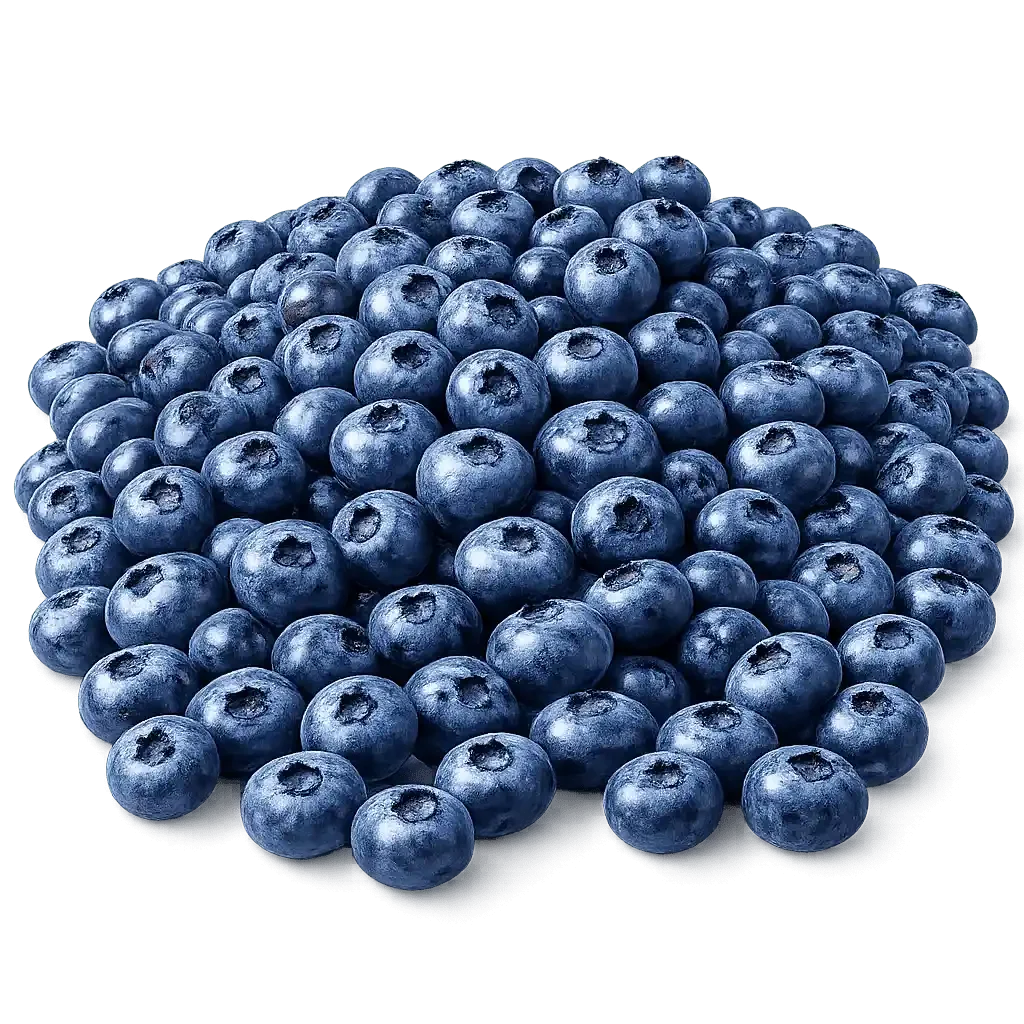
Ripe berries are round, 1/4 to 3/4 inch in diameter depending on variety (with most cultivated highbush types falling in the 1/2 to 3/4 inch range), and a deep, dusty blue covered with a characteristic whitish-gray waxy bloom. The bloom gives the berries their soft, matte appearance and is a sign of freshness and proper handling. Beneath the bloom, the skin is actually dark purple. The flesh is pale greenish-white to slightly purple, juicy, and contains several tiny seeds that are virtually unnoticeable when eating. Berries grow in loose, open clusters that ripen progressively, with the berries at the base of each cluster maturing first.
Ripening time varies enormously by species and cultivar, which is one of blueberry's greatest strengths for homesteaders. Early-season varieties begin ripening in late May to June (southern highbush in warm zones), mid-season varieties ripen in July (most highbush), and late-season varieties extend into August and September (late highbush and rabbiteye). By planting a mix of early, mid, and late cultivars, a homesteader can stretch the fresh blueberry season to 8 to 12 weeks or more.
Visual appeal extends beyond the fruit. Blueberry bushes offer white spring flowers, colorful ripening fruit in summer, and spectacular fall foliage in shades of scarlet, crimson, orange, and burgundy. Several varieties are planted as ornamental landscape shrubs for this reason alone.
How Much Berry Can You Collect?
Blueberry yields are among the most impressive of any homestead fruit crop, and the numbers are well-documented thanks to decades of commercial production data.
Young plants (years 2 to 3): Expect 1 to 3 pounds per bush if you allow fruiting. Many growers sacrifice these early crops for stronger long-term production by removing flowers.
Mature plants (years 6 to 12): Highbush varieties produce 8 to 20 pounds per bush. Rabbiteye varieties produce 10 to 25 pounds per bush. Half-high varieties produce 3 to 7 pounds per bush. Lowbush varieties produce 1 to 3 pounds per plant but spread to form large colonies.
Per-row and acre estimates: Highbush blueberries planted at standard spacing of 4 to 6 feet within rows and 8 to 10 feet between rows translates to roughly 700 to 1,350 plants per acre. At mature yields, commercial highbush plantings average 6,000 to 12,000 pounds per acre, with top-performing operations exceeding 15,000 pounds. For a homestead row planted at 5-foot spacing, expect 80 to 200 pounds per 100 linear feet from established bushes.
Harvest season is one of blueberry's greatest advantages. Individual varieties ripen over a 3 to 5 week window, but by planting early, mid, and late cultivars, you can harvest fresh blueberries from June through September in most zones. That is up to 3 to 4 months of continuous fresh fruit from a single crop type.
Ease of harvest is excellent. Berries grow at a comfortable picking height (2 to 6 feet on most varieties), they are firm enough to handle without crushing, they detach easily when ripe, and they do not stain as badly as darker berries like blackberries or elderberries. An experienced picker can harvest 3 to 5 pounds per hour by hand. Blueberry rakes can increase that rate significantly for large harvests.
Homestead reality: Six to ten mature highbush blueberry bushes will produce 60 to 200 pounds of fruit per year. That is an extraordinary amount of food from a planting that might occupy a 30-by-10-foot strip of your property. Even a modest planting of four bushes will supply a family with fresh eating, frozen stores, and jam with fruit to spare for sharing.
Why Blueberry Berries Are Good for You
Blueberries are one of the most extensively studied fruits on the planet, and the scientific evidence for their health benefits is exceptionally strong. This is not marketing hype. Decades of peer-reviewed research support blueberry's status as a genuine superfood.
Key vitamins and minerals: Blueberries provide approximately 14 to 16 milligrams of vitamin C per cup, along with meaningful amounts of vitamin K (28 micrograms per cup, about 24 percent of the daily value), manganese (25 percent of the daily value per cup), and smaller amounts of vitamin B6, vitamin E, copper, and potassium. A cup of blueberries contains roughly 3.6 grams of dietary fiber and only about 84 calories, making them one of the most nutrient-dense fruits per calorie.
Antioxidants: Blueberries are among the highest antioxidant foods ever tested. Their anthocyanin content is responsible for the deep blue pigmentation and is the primary driver of their health benefits. They also contain significant levels of quercetin, myricetin, chlorogenic acid, and other phenolic compounds. Wild (lowbush) blueberries have even higher antioxidant concentrations than cultivated varieties due to their smaller size and higher skin-to-flesh ratio.
Research-backed health benefits: The body of research on blueberry health benefits is vast and robust. Studies published in journals including the Annals of Neurology, the Journal of Agricultural and Food Chemistry, and the American Journal of Clinical Nutrition have documented that regular blueberry consumption improves memory and cognitive function in older adults, reduces blood pressure and arterial stiffness, lowers LDL cholesterol oxidation, improves insulin sensitivity and blood sugar regulation, reduces muscle damage and inflammation after exercise, and supports urinary tract health. A landmark study from the Harvard School of Public Health found that women who consumed the most anthocyanin-rich berries (primarily blueberries and strawberries) had a 32 percent lower risk of heart attack compared to those who ate the least.
Traditional and folk uses: Indigenous peoples across North America used blueberries extensively as both food and medicine. The berries were dried and stored for winter use, mixed into pemmican, and used in ceremonial foods. Blueberry leaf tea was used by several tribes as a blood tonic and for digestive complaints. The Ojibwe used blueberry flower tea to treat symptoms of what is now understood as anxiety and nervous tension.
What You Can Make with Blueberry Berries
Blueberry may be the single most versatile berry in the homestead kitchen. Its mild sweetness, balanced acidity, and firm texture make it suitable for virtually every culinary application.
Blueberry Jam and Preserves: A homestead staple. Blueberry jam has a rich, sweet flavor and beautiful deep purple color. Low-sugar recipes work particularly well with blueberries, as the natural sweetness of the fruit carries through without needing heavy sugar loads.
Blueberry Pie: One of the great American desserts. Use 5 to 6 cups of berries, 3/4 cup sugar, 3 tablespoons cornstarch or tapioca starch, 1 tablespoon lemon juice, and a pinch of cinnamon for a classic double-crust pie. Frozen berries work nearly as well as fresh.
Blueberry Muffins and Baked Goods: Blueberries hold their shape beautifully in baked goods, distributing pockets of warm, juicy berry throughout muffins, scones, pancakes, coffee cakes, and quick breads. Toss berries in a tablespoon of flour before folding into batter to prevent sinking.
Blueberry Syrup: Simmer berries with sugar and a splash of lemon juice, strain, and reduce to desired thickness. A versatile pantry item for breakfast foods, cocktails, and dessert sauces.
Blueberry Wine: A smooth, medium-bodied fruit wine with a deep garnet-purple color. Blueberry wine ferments reliably and ages well. A standard 5-gallon batch requires approximately 12 to 15 pounds of fruit.
Blueberry Vinegar: Infuse white wine vinegar or apple cider vinegar with crushed blueberries for 2 to 4 weeks, then strain. The resulting vinegar is a beautiful amethyst color and adds depth to salad dressings and marinades.
Blueberry Sauce: A quick stovetop sauce of blueberries, sugar, lemon juice, and a pinch of salt pairs with cheesecake, ice cream, yogurt, pork chops, and grilled chicken. Versatile and fast.
Blueberry Leather: Puree cooked blueberries with a touch of honey, spread on lined dehydrator trays, and dry at 135 degrees Fahrenheit for 6 to 10 hours. A portable, nutrient-dense snack that kids love.
Homestead tip: Blueberries are one of the few fruits that freeze so well they can replace fresh berries in almost any recipe with no noticeable quality loss. Freeze your surplus at peak season and use them all winter in muffins, pancakes, smoothies, and pies. There is no need to thaw before adding to most recipes.
Best Ways to Store, Can, or Make Jam
Blueberry's firm texture and natural waxy coating make it one of the easiest berries to preserve by multiple methods.
Freezing: The gold standard for blueberry preservation. Spread dry, unwashed berries on parchment-lined sheet pans in a single layer. Freeze for 2 to 3 hours until solid. Transfer to freezer bags, remove air, and seal. Store at 0 degrees Fahrenheit for 12 to 18 months. Do not wash before freezing. The waxy bloom prevents clumping and protects quality.
Canning Blueberry Jam (Recipe):
Ingredients: 4 1/2 cups crushed blueberries (approximately 2.5 to 3 quarts fresh) 1 package (1.75 ounces) powdered pectin 7 cups granulated sugar 2 tablespoons lemon juice
Method:
Wash and crush blueberries in a large pot. A potato masher works well. Leave some berries partially whole for texture if desired.
Stir in pectin and lemon juice. Bring to a full rolling boil over high heat, stirring constantly.
Add sugar all at once. Return to a full rolling boil and boil hard for exactly 1 minute, stirring constantly.
Remove from heat and skim foam. Ladle into hot, sterilized half-pint jars, leaving 1/4 inch headspace.
Wipe rims clean, apply lids and bands fingertip-tight, and process in a boiling water bath for 10 minutes (adjust for altitude: add 5 minutes above 6,000 feet).
Yield: approximately 8 to 9 half-pint jars.
Blueberry Butter: Cook 8 cups of blueberries with 2 cups sugar, 1/4 cup lemon juice, and 1 teaspoon cinnamon over low heat for 1 to 2 hours, stirring frequently, until thick and spreadable. Process in a boiling water bath for 10 minutes. This is a lower-sugar alternative to traditional jam and has a deep, concentrated flavor.
Drying: Spread clean berries on dehydrator trays. Dry at 135 degrees Fahrenheit for 12 to 20 hours. Blueberries take longer to dry than their size suggests due to the waxy skin. Poking each berry with a toothpick or briefly blanching in boiling water for 30 seconds before drying breaks the skin and speeds dehydration considerably. Store in airtight containers for 12 to 18 months.
Canning whole blueberries: Pack clean, raw blueberries into hot pint jars. Cover with boiling light syrup (1 cup sugar to 3 cups water), leaving 1/2 inch headspace. Process in a boiling water bath for 15 minutes (pints). Canned whole blueberries are ready to use directly in pies, cobblers, and sauces throughout the year.
Pros of Growing Blueberry
Unmatched versatility. Blueberries can be eaten fresh, frozen, dried, canned, baked, juiced, fermented, and preserved in more ways than almost any other fruit. They are the ultimate multi-purpose homestead berry.
Proven health benefits. Backed by decades of rigorous scientific research, blueberries are one of the most nutrient-dense and health-promoting foods you can grow. The cardiovascular, cognitive, and anti-inflammatory benefits are well-documented.
Long harvest season with variety selection. By planting early, mid, and late cultivars, homesteaders can harvest fresh blueberries for 3 to 4 months. No other single fruit type offers this extended harvest window.
Excellent fresh shelf life. At 10 to 14 days refrigerated, blueberries last longer fresh than almost any other berry. This flexibility reduces pressure to process immediately after picking.
Long-lived and productive. Blueberry bushes produce for 30 to 50 years with proper care. A well-planted blueberry patch is a multi-generational food asset.
Beautiful ornamental value. Spring flowers, summer fruit, and spectacular fall foliage make blueberry a landscape plant in its own right. Several compact varieties work well in foundation plantings and mixed borders.
Wide climate adaptability. Between highbush, southern highbush, rabbiteye, half-high, and lowbush types, there is a blueberry suited to nearly every zone from 2 through 10. Very few fruit crops offer this range.
Self-fertile with improved cross-pollination. Most blueberry varieties will set some fruit alone, but planting two or more varieties dramatically improves berry size, quantity, and earliness of ripening. This flexibility in planting design is a significant advantage.
Cons of Growing Blueberry
Strict soil requirements. Blueberries demand acidic soil with a pH of 4.5 to 5.5. Most garden soils are too alkaline and require significant amendment with sulfur, peat moss, or acidic mulches. This is the single biggest barrier to successful blueberry growing, and failure to maintain proper pH is the number one cause of poor performance and plant death.
Slow to reach full production. With 6 to 8 years needed to reach peak yields, blueberry requires more patience than most homestead fruit crops. The recommendation to remove flowers in years one and two extends this wait further.
Bird pressure. Birds love blueberries, and unprotected plantings can lose 30 to 50 percent or more of the crop to robins, starlings, cedar waxwings, and other fruit-eating species. Netting is essentially mandatory for serious production. Plan for the cost and labor of installing and maintaining bird netting.
Water requirements. Blueberries have shallow, fibrous root systems and require consistent moisture. They need 1 to 2 inches of water per week during the growing season and do not tolerate drought well. In dry climates, irrigation is non-negotiable. Drip irrigation with acidic mulch is the gold standard.
Ongoing soil management. Maintaining the proper soil pH is not a one-time task. Soil pH tends to drift upward over time, especially if irrigated with alkaline water. Regular soil testing (every 1 to 2 years) and periodic sulfur applications are necessary to keep pH in the 4.5 to 5.5 range.
Sensitivity to poor drainage. While blueberries need consistent moisture, they absolutely cannot tolerate waterlogged roots. Planting in raised beds or mounded rows is often necessary in heavy clay soils.
Pruning knowledge required. Productive blueberry bushes need annual pruning to remove old, unproductive wood and maintain vigorous fruiting canes. Improper pruning leads to declining yields and small berries. Learning proper blueberry pruning technique takes some study, though it becomes intuitive with practice.
Growing Tips for Homesteaders
Site selection: Full sun is essential for maximum production, with a minimum of 6 to 8 hours of direct sunlight. Blueberries will grow in partial shade but yields and fruit quality decline markedly. Choose a site with well-drained, acidic soil. If your native soil is alkaline or heavy clay, consider dedicated raised beds filled with a mix of 50 percent peat moss and 50 percent acidified native soil or pine bark fines. Test soil pH before planting and amend as needed. Blueberries require a pH of 4.5 to 5.5, with 4.8 to 5.2 being the ideal sweet spot. Apply elemental sulfur 6 to 12 months before planting if pH adjustment is needed, as sulfur acts slowly.
Planting: Plant container-grown blueberries in early spring (or fall in mild climates). Space highbush varieties 4 to 6 feet apart within rows and 8 to 10 feet between rows. Half-high types can be spaced 3 to 4 feet apart. Rabbiteye varieties need 6 to 8 feet within the row. Dig a hole twice the width of the root ball and the same depth. Backfill with a mix of native acidic soil and peat moss or composted pine bark. Mulch heavily (4 to 6 inches) with pine needles, wood chips, or shredded pine bark to conserve moisture, suppress weeds, and help maintain soil acidity. Water deeply after planting.
Maintenance: Water consistently, providing 1 to 2 inches per week throughout the growing season. Drip irrigation is strongly recommended. Mulch annually to maintain a 4 to 6 inch layer of acidic organic material. Fertilize in early spring with an acid-forming fertilizer such as ammonium sulfate (1 to 2 ounces per plant for young bushes, 4 to 8 ounces for mature plants) or a commercial blueberry/azalea fertilizer. Test soil pH every 1 to 2 years and apply elemental sulfur if pH has drifted above 5.5. Begin pruning in year 4 or 5 by removing the oldest and weakest canes at ground level each winter, leaving 6 to 8 of the most vigorous, upright canes per bush. Install bird netting when berries begin to color.
Variety selection: This is critical and depends entirely on your climate zone. For Zones 3 to 4, plant half-high varieties like 'Northblue,' 'Northsky,' 'Polaris,' 'Chippewa,' or 'Superior.' For Zones 4 to 7, northern highbush varieties are ideal, and the range is enormous: 'Bluecrop' (the industry standard, reliable everywhere), 'Duke' (early), 'Bluegold' (mid-season), 'Elliott' and 'Aurora' (late), and 'Jersey' (heritage variety, outstanding flavor). For Zones 7 to 9, southern highbush varieties like 'O'Neal,' 'Jubilee,' 'Star,' and 'Emerald' are bred for low chill requirements. For Zones 7 to 9, rabbiteye varieties including 'Tifblue,' 'Climax,' 'Premier,' and 'Powderblue' produce huge crops with less acidic soil fussiness than highbush types. Always plant at least two different varieties for cross-pollination.
Companion planting and integration: Blueberries pair naturally with other acid-loving plants. Interplant with lingonberries or lowbush blueberries as groundcovers beneath taller highbush varieties. Azaleas, rhododendrons, and mountain laurel share the same soil requirements and make attractive companions in an edible landscape design. In food forest systems, blueberries fit well in the shrub layer beneath acid-tolerant trees like oaks and pines. Avoid planting near walnut trees, which produce juglone that can harm blueberries. Clover and other nitrogen-fixing cover crops planted between rows help build organic matter, but monitor pH carefully as decomposing organic matter can shift soil chemistry.
Conclusion
Blueberry is the one berry that every homesteader should grow, regardless of where they live. Between the five major species and hundreds of cultivars available, there is a blueberry suited to almost every climate from the Canadian prairies to the Gulf Coast. The fruit is universally loved, endlessly versatile in the kitchen, backed by an overwhelming body of health research, and produced by attractive, long-lived plants that become more productive with every passing year.
The challenge is soil. Blueberries are uncompromising about pH, and getting the soil right is the difference between thriving bushes loaded with fruit and struggling plants that yellow and decline. But this is a solvable problem. A few raised beds filled with the right mix, a bag of sulfur, a thick layer of pine bark mulch, and a soil test kit are all it takes to create the conditions blueberries demand. Once you get the soil dialed in, the plants take care of the rest.
Start with four to six bushes of two or three different varieties matched to your zone. Remove the flowers for the first year or two. Mulch heavily, water consistently, and protect from birds. By year five you will be picking 30 to 50 pounds of blueberries per season from a planting that fits in most backyards. By year ten, you will have more than you can eat, freeze, jam, and give away. That is not a promise. That is what blueberries do.
Explore more guides on different types of berries