
Honeysuckle Berry
Complete Homestead Growing Guide
Botanical Name: Lonicera caerulea (various subspecies and cultivars, including L. caerulea var. kamtschatica, var. edulis, and var. emphyllocalyx) Honeysuckle Berry (Honeyberry/Haskap)
Origin: Honeyberries are native to the boreal forests and mountainous regions of northern Asia, particularly Siberia, northern Japan (Hokkaido), and the Russian Far East. They also occur naturally across parts of northern Europe and into northwestern North America. Japanese and Russian breeders have done the most extensive work developing improved cultivars over the past century, and Canadian breeding programs at the University of Saskatchewan have produced many of the best varieties available to North American growers today.
Description: The honeyberry, also called haskap (from the Ainu language of Japan's indigenous people), is a deciduous shrub that produces elongated, blue berries with a flavor often described as a complex blend of blueberry, raspberry, and black currant. The plant is a member of the honeysuckle family (Caprifoliaceae), though it should not be confused with ornamental honeysuckle vines, which produce inedible or toxic berries. Honeyberries are among the earliest fruiting plants in the temperate garden, often ripening weeks before strawberries. The bushes are dense, upright to spreading, and remarkably cold hardy, surviving winter temperatures that would kill virtually any other fruit bearing shrub.
Size: Mature honeyberry bushes typically reach 3 to 6 feet tall with a spread of 3 to 5 feet, depending on cultivar. Dwarf selections stay compact at 3 to 4 feet, while vigorous Russian and Canadian cultivars can push 6 to 7 feet under ideal conditions. The moderate size makes them excellent candidates for hedgerows, edible borders, and small space homesteads.
Why It Matters for Homesteaders: Honeyberries solve several problems at once for the homestead. They produce fruit earlier in the season than any other temperate berry, often by late May or early June, filling the hungry gap between stored winter food and summer harvests. They are extraordinarily cold hardy (USDA Zones 2 through 7, with some cultivars surviving minus 55 degrees Fahrenheit), making them one of the few reliable fruit crops for homesteaders in extreme northern climates. They establish quickly, produce fruit by year 2 or 3, require minimal pest management, and tolerate a wider range of soil conditions than blueberries. For homesteaders looking to build a diverse, resilient perennial food system, honeyberries are one of the most underutilized and rewarding options available.
How Long Does It Take to Grow?
Honeyberries are fast by perennial fruit standards. Compared to tree fruits or huckleberries, the timeline from planting to meaningful production is refreshingly short.
Year 1: Focus on establishment. Plants put down roots and produce modest top growth. You may see a few flowers, especially on larger nursery stock, but production will be negligible. Most plants will reach 12 to 18 inches tall by the end of the first growing season. Water consistently and keep weeds suppressed.
Year 2: Light fruiting begins. Expect a small but encouraging harvest of 1/4 to 1/2 pound per plant. The berries will be slightly smaller than what mature plants produce, but the flavor will already be impressive. The bush will be filling out visibly, reaching 18 to 30 inches tall.
Year 3: Production ramps up noticeably. Well cared for plants will yield 1 to 3 pounds per bush. The root system is now well established, and the plant is putting significant energy into both growth and fruiting.
Years 4 to 5: Plants approach mature production levels. Expect 3 to 7 pounds per bush annually, depending on cultivar, pollination, and growing conditions. Bushes are reaching their full height and spread.
Years 6 and Beyond: Full production. Mature honeyberry bushes can yield 7 to 12 pounds per plant per year under good management. Some exceptional cultivars in optimal conditions have been documented producing even more. Plants will continue bearing productively for 25 to 30 years, with some reports of bushes producing for 50 years or longer in their native range.
From Cuttings: If propagating from softwood or hardwood cuttings, add 1 year to the timeline above. Cuttings root readily (70% to 90% success rate with proper technique), making honeyberries one of the easier fruit shrubs to propagate on the homestead.
Berry Shelf Life
Fresh: Honeyberries are softer than blueberries and more perishable. Expect 2 to 3 days at room temperature and 5 to 7 days refrigerated at 34 to 38 degrees Fahrenheit. Handle gently, as the thin skin bruises easily. Do not stack berries more than 2 to 3 inches deep in containers to prevent crushing.
Frozen: Honeyberries freeze beautifully and this is the preferred storage method for most homesteaders. Spread berries in a single layer on a parchment lined baking sheet, freeze for 2 hours until solid, then transfer to vacuum sealed bags or heavy duty freezer bags. Properly stored at 0 degrees Fahrenheit, frozen honeyberries keep 12 to 18 months with excellent flavor and texture retention.
Dried: Dehydrate at 135 degrees Fahrenheit for 12 to 18 hours until leathery. The elongated shape of honeyberries means they take slightly longer to dry than round berries. Dried honeyberries store 6 to 12 months in airtight containers in a cool, dark location. They make excellent additions to granola, trail mix, and oatmeal.
Jams and Preserves: Properly water bath canned honeyberry jam has a shelf life of 12 to 18 months in a cool pantry. The high pectin content of slightly underripe honeyberries means they set well with minimal added pectin.
Homestead Storage Tip: Because honeyberries ripen so early in the season (often before you are in full preservation mode), have your freezer bags and sheet pans ready before harvest begins. The window between perfectly ripe and overripe is narrow, sometimes just 3 to 5 days on the bush. Freeze the bulk of your harvest immediately and save jam making and other processing for a less hectic time.
Berry Color and Appearance
Flowers: Honeyberry flowers appear very early in spring, often in March or April, well before most other plants are blooming. They are small (1/2 to 3/4 inch), tubular, pale yellow to creamy white, and grow in pairs at leaf axils. The flowers are frost tolerant down to about 20 degrees Fahrenheit, which is critical given how early they bloom. They are attractive to early season pollinators, especially bumblebees and mason bees.
Unripe Berries: Young honeyberries are small, firm, and green, gradually transitioning to a light blue gray as they approach ripeness. The exterior develops a dusty blue bloom similar to blueberries.
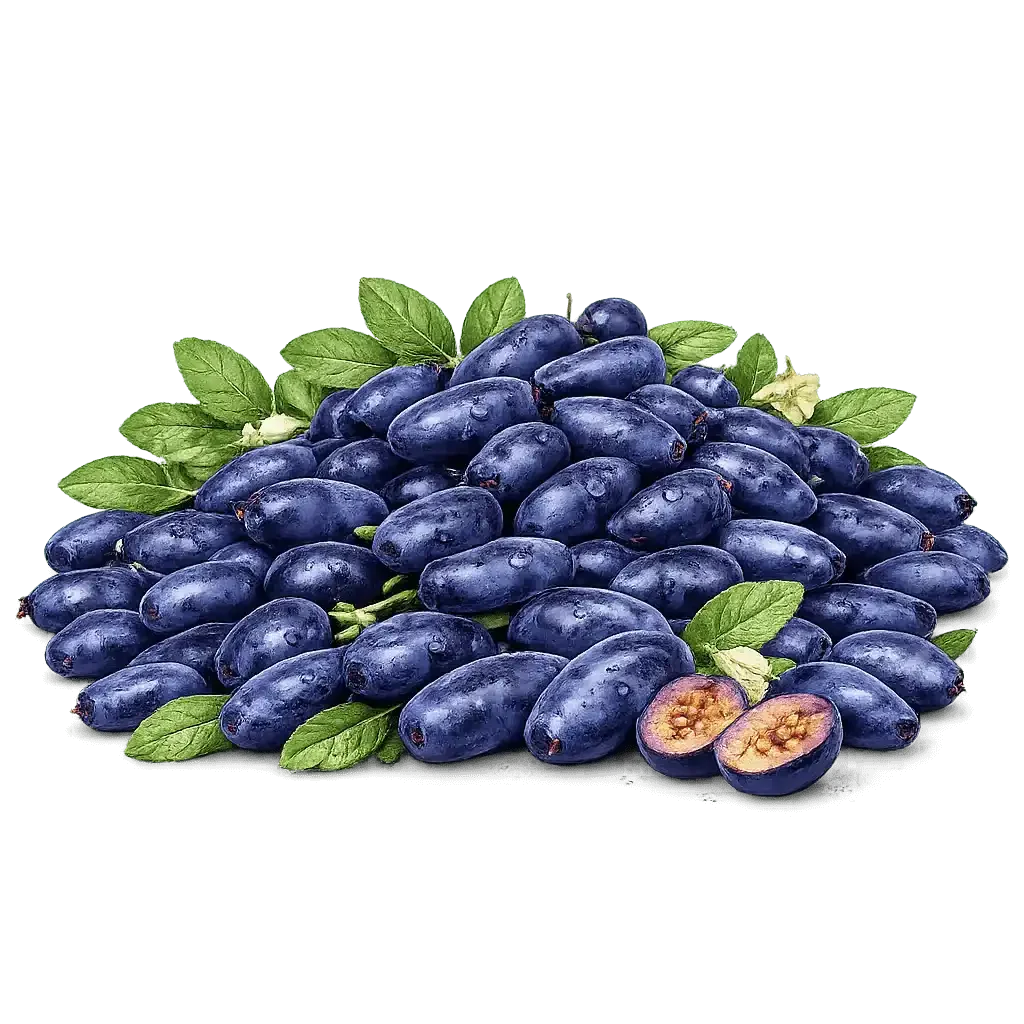
Ripe Berries: Fully ripe honeyberries are a deep dusty blue to blue purple with a prominent waxy bloom. The key visual indicator of ripeness is that the flesh inside turns from green to a deep purple or burgundy. Many growers make the mistake of picking when the outside looks blue but the inside is still green, resulting in sour, underdeveloped flavor. Cut a berry open to check before harvesting your main crop.
Size and Shape: This is where honeyberries are distinctive. Rather than round, the berries are elongated, resembling small cylinders, ovals, or even irregular oblongs. They typically measure 1/2 to 1 inch long and 1/4 to 1/2 inch wide, depending on cultivar. Some newer Canadian cultivars produce berries over 1 inch long.
Cluster Pattern: Berries grow in pairs or small clusters at the leaf nodes along the branches. They are generally easy to spot and access, hanging at or below the foliage line.
Seeds: Honeyberries contain numerous tiny, soft seeds that are virtually undetectable when eating. They do not affect texture in jams, baked goods, or fresh eating.
Ripening Time: Honeyberries are among the earliest ripening fruits in the temperate garden. Depending on location and cultivar, expect harvest from late May through early July. In USDA Zones 4 and 5, peak harvest typically falls in mid to late June. Berries within a single bush ripen over a 1 to 2 week window.
Visual Appeal: Honeyberry bushes have clean, attractive foliage that holds well through summer. The blue green leaves are oval to oblong, and the overall form is tidy and dense. While fall color is not as dramatic as some berry shrubs, the early spring flowers and unique blue fruit give the plants year round visual interest.
How Much Berry Can You Collect?
Young Plants (Years 1 to 3): Negligible to light harvest. By year 3, expect 1 to 3 pounds per plant from vigorous cultivars.
Mature Plants (Years 5 and Up): Well managed honeyberry bushes consistently produce 7 to 12 pounds per plant annually. Top performing cultivars like Tundra, Borealis, and Indigo Gem can reach the upper end of this range with good pollination and soil conditions.
Per Row Estimate: A 100 foot hedgerow planted at 4 foot spacing (25 plants) should produce 175 to 300 pounds of berries per year once mature. This is significantly more per linear foot than most other berry shrubs.
Per Acre Estimate: At a commercial density of approximately 1,800 plants per acre (4 by 6 foot spacing), a mature planting can yield 12,000 to 20,000 pounds per acre. Even at hobby scale, these numbers illustrate the productive potential of honeyberries.
Harvest Season: Short and early. Most cultivars produce their entire crop within a 1 to 3 week window, typically late May through early July depending on zone and cultivar. Staggering early, mid, and late season varieties can extend your total harvest to 4 to 5 weeks.
Ease of Harvest: Honeyberries are much easier to harvest than many wild berries. The berries grow at accessible heights (waist to shoulder level), and the open branch structure makes picking straightforward. Experienced pickers can collect 4 to 8 pounds per hour by hand. For larger plantings, berries can also be harvested by shaking branches over a tarp or using a handheld berry rake, as ripe berries detach cleanly.
Homestead Reality: Honeyberries are one of the most productive and practical berry crops for a homestead of any size. A planting of 10 to 15 mature bushes will supply a family of four with enough berries for fresh eating, freezing, and a full year of jam. The concentrated harvest window means you will be busy for 2 to 3 weeks, but then the work is done until next year.
Why Honeyberries Are Good for You
Key Vitamins and Minerals: Honeyberries are an excellent source of vitamin C (providing 40 to 80 mg per 100 grams, which is roughly 50% to 90% of the daily value per cup). They also provide meaningful amounts of vitamin A, potassium, calcium, phosphorus, and manganese. Dietary fiber content runs approximately 3 to 5 grams per cup.
Antioxidants: Honeyberries are exceptionally rich in anthocyanins, with some studies measuring levels 2 to 3 times higher than cultivated blueberries by weight. They also contain significant amounts of other polyphenols including quercetin, rutin, and chlorogenic acid. The total antioxidant capacity (measured by ORAC value) of honeyberries consistently ranks among the highest of any temperate fruit.
Anti Inflammatory Properties: Research published in the Journal of Functional Foods and other peer reviewed journals has demonstrated that honeyberry extracts exhibit strong anti inflammatory activity, reducing markers of chronic inflammation in cell and animal studies.
Heart Health: The high anthocyanin and polyphenol content has been linked to improved cardiovascular markers, including reduced LDL oxidation and improved endothelial function. Japanese studies on haskap consumption have shown positive effects on blood pressure and circulation.
Eye Health: Like other deeply pigmented berries, honeyberries support eye health through their anthocyanin content, which may help protect against oxidative damage to retinal cells.
Traditional Medicinal Uses: In Japan, haskap berries have been called "the fruit of longevity" and "the fruit of vision" for centuries. The Ainu people of Hokkaido traditionally consumed the berries for vitality and overall health. In Siberia and Russia, honeyberries have long been used in folk medicine for cardiovascular support, digestive health, and as a general tonic. Chinese traditional medicine has utilized Lonicera species for their cooling and detoxifying properties, and the berries were consumed to support liver health and reduce fevers.
What You Can Make with Honeyberries
Jam and Preserves: Honeyberry jam is outstanding. The complex flavor, somewhere between blueberry and black currant, produces a preserve with real depth. The natural pectin in slightly underripe berries helps achieve a good set. Use on toast, biscuits, or as a filling for thumbprint cookies.
Pies and Tarts: Honeyberry pie has a distinctive tartness balanced by natural sweetness that sets it apart from blueberry pie. Use a standard blueberry pie recipe as a starting point, but reduce the sugar by about 2 tablespoons if your berries are fully ripe. The berries hold their shape well during baking.
Syrup: Simmer 4 cups berries with 2 cups sugar and 1 cup water for 15 to 20 minutes. Strain through fine mesh, pressing gently to extract juice without pushing pulp through. Bottle and refrigerate for up to 4 weeks, or water bath can for shelf stable storage. Honeyberry syrup over pancakes or waffles is a homestead breakfast luxury.
Wine and Mead: Honeyberries produce a beautiful, deeply colored wine with excellent acidity and complexity. Use 4 to 6 pounds of fruit per gallon. The early harvest means your honeyberry wine can be fermenting while your summer fruits are still ripening, making efficient use of your equipment and time.
Baked Goods: Muffins, scones, coffee cakes, and quick breads all work well with honeyberries. The elongated berry shape distributes nicely through batters. Fold berries in frozen for best results, as thawed berries can release too much juice and stain the batter.
Sauces and Compotes: A quick honeyberry compote (berries simmered with sugar, a squeeze of lemon, and a pinch of cinnamon) makes an elegant topping for yogurt, ice cream, or cheesecake. A savory honeyberry sauce with balsamic vinegar and rosemary pairs beautifully with grilled lamb, pork chops, or roast chicken.
Smoothies and Frozen Treats: Frozen honeyberries blend into smoothies with a creamy, vibrant purple result. They also make exceptional sorbets and popsicles, especially combined with a touch of honey and lemon.
Homestead Tip: Because honeyberries ripen before most other fruits, process and freeze the bulk of your harvest immediately. Then blend honeyberries with later season fruits (peaches, raspberries, plums) for mixed fruit jams and baked goods later in the summer when you have more variety to work with.
Best Ways to Store, Can, or Make Jam
Freezing (Recommended Primary Method): Gently rinse berries, removing any stems or debris. Pat dry on towels. Spread in a single layer on parchment lined baking sheets and freeze for 2 hours. Transfer to vacuum sealed bags or heavy duty freezer bags, pressing out all air. Label with date and weight. Frozen honeyberries keep 12 to 18 months at 0 degrees Fahrenheit and work beautifully in all recipes as a direct substitute for fresh.
Canning Honeyberry Jam
Ingredients: 5 cups crushed honeyberries (about 3 pounds whole berries), 3 cups granulated sugar, 1 package (1.75 ounces) powdered pectin, 3 tablespoons lemon juice
Method:
Wash and crush berries in a large, heavy bottomed pot. Honeyberries crush easily with a potato masher.
Stir in powdered pectin and lemon juice. Bring to a full rolling boil over high heat, stirring constantly.
Add sugar all at once. Return to a full rolling boil and boil for exactly 1 minute, stirring constantly.
Remove from heat and skim any foam from the surface.
Ladle hot jam into sterilized half pint jars, leaving 1/4 inch headspace.
Wipe rims clean, apply lids and bands finger tight.
Process in a boiling water bath for 10 minutes (adjust for altitude: add 5 minutes above 6,000 feet).
Remove jars, set on a towel, and cool undisturbed for 12 to 24 hours. Check seals before storing.
Yield: Approximately 6 to 7 half pint jars.
Honeyberry Syrup: Combine 4 cups honeyberries, 2 cups sugar, and 1 cup water in a saucepan. Bring to a boil, reduce heat, and simmer for 15 to 20 minutes, mashing berries gently. Strain through fine mesh cheesecloth, squeezing to extract maximum juice. Pour into sterilized jars and process in a boiling water bath for 10 minutes for shelf stable storage. Refrigerated syrup keeps 3 to 4 weeks.
Drying: Spread clean berries on dehydrator trays in a single layer. Dry at 135 degrees Fahrenheit for 12 to 18 hours. The elongated shape means honeyberries may take longer than round berries to dry completely. Check by cutting a berry in half; there should be no visible moisture. Condition in a sealed jar for 5 to 7 days, shaking daily. Store in airtight containers for up to 12 months.
Other Preservation Methods: Honeyberry fruit leather is excellent. Blend berries smooth, spread 1/8 inch thick on dehydrator sheets, and dry at 135 degrees Fahrenheit for 8 to 12 hours. Honeyberry shrub (berries macerated in sugar for 24 hours, then combined with equal parts apple cider vinegar and refrigerated for 2 weeks) makes a refreshing drinking vinegar mixed with sparkling water. Honeyberries can also be preserved whole in a light syrup (2 cups sugar to 4 cups water) and water bath canned in pint jars for 15 minutes.
Pros of Growing Honeyberries
Unmatched Cold Hardiness: Honeyberries are hardy to USDA Zone 2, with some cultivars tolerating minus 55 degrees Fahrenheit. The flowers withstand spring frosts down to 20 degrees Fahrenheit. For homesteaders in extreme northern climates, there is simply no other fruit crop this reliable.
Earliest Fruit of the Season: Honeyberries ripen weeks before strawberries and months before other berry crops. This fills the critical early season gap when fresh fruit is most needed and most appreciated on the homestead.
Fast Production: Unlike many perennial fruits, honeyberries begin producing meaningful harvests by year 2 or 3, with full production by year 5. The payoff timeline is short enough to maintain homesteader enthusiasm.
High Yields for Size: At 7 to 12 pounds per mature bush, honeyberries are among the most productive small fruit shrubs available. A modest planting of 10 to 15 bushes can supply a family year round.
Exceptional Nutritional Value: With anthocyanin levels 2 to 3 times higher than blueberries and outstanding vitamin C content, honeyberries are a nutritional powerhouse that earns their space in the homestead landscape.
Low Pest and Disease Pressure: Honeyberries have very few pest or disease problems in North America. They are not significantly affected by spotted wing drosophila (a major pest of other berries) because they ripen before the fly becomes active. Fungal issues are rare with decent air circulation.
Adaptable Soil Requirements: Unlike blueberries, which demand highly acidic soil, honeyberries tolerate a wider pH range of 5.0 to 7.5. They perform best in slightly acidic to neutral soil but will grow in conditions that would starve a blueberry bush.
Longevity: A well maintained honeyberry planting will produce for 25 to 50 years, making it a true generational investment for the homestead.
Cons of Growing Honeyberries
Requires Cross Pollination: Honeyberries are not self fertile. You must plant at least two different cultivars that bloom at the same time for fruit set. A single bush planted alone will produce little to no fruit, which catches many first time growers by surprise.
Short Harvest Window: The entire crop ripens within a 1 to 3 week window. If you are not ready to pick and process quickly, berries will overripen and drop. This concentrated harvest demands planning and available labor.
Berry Drop: Fully ripe honeyberries can drop from the bush quickly, sometimes within days of peak ripeness. Timely harvest is essential. Some growers place tarps or landscape fabric beneath bushes during harvest season to catch fallen berries.
Heat Sensitivity: Honeyberries struggle in prolonged heat above 90 degrees Fahrenheit and generally do not perform well south of USDA Zone 7. In hot summer climates, plants may go dormant, produce poorly, or decline over time. This is a cold climate crop at heart.
Limited Name Recognition: Unlike blueberries or strawberries, honeyberries are unfamiliar to most consumers. Selling at farmers markets requires education and samples. The upside is that once people taste them, they come back, but the initial marketing effort is real.
Bird Pressure: Birds are extremely attracted to honeyberries and will strip a bush bare if given the opportunity. Netting is virtually mandatory for a reliable harvest. Install netting as soon as berries begin to color, not after you have already lost your crop.
Cultivar Confusion: The honeyberry market includes varieties from Russian, Japanese, and Canadian breeding programs with varying quality, flavor, and compatibility. Choosing the wrong cultivars (poor flavor, mismatched bloom times, or heat intolerant varieties) can lead to disappointing results. Research carefully before purchasing.
Growing Tips for Homesteaders
Site Selection: Choose a location with full sun to partial shade. In northern climates (Zones 2 through 5), full sun is ideal. In warmer zones (6 and 7), afternoon shade helps prevent heat stress. Avoid low lying frost pockets, not because the plants cannot handle cold, but because waterlogged soil in spring can damage roots. Good air circulation reduces the minimal disease risk even further.
Soil Preparation: Honeyberries prefer well drained, loamy soil with a pH of 5.5 to 7.0. They are more flexible than blueberries but still perform best with generous organic matter. Incorporate 3 to 4 inches of compost into the planting area. If your soil is heavy clay, raise beds 6 to 8 inches or amend heavily with compost and coarse organic matter to improve drainage.
Planting: Space bushes 4 to 6 feet apart within rows and 8 to 10 feet between rows. Plant at the same depth as the nursery container or slightly deeper (1 inch). Water deeply at planting and apply 3 to 4 inches of mulch (wood chips, straw, or shredded bark) in a ring around each plant, keeping mulch 3 inches from the stem. Fall planting (September through October) is ideal in most regions, though spring planting works well in Zones 2 through 4 where fall weather turns harsh early.
Pollination Planning: This is critical. Plant a minimum of two different cultivars that bloom at the same time. Good pairings include Tundra with Borealis, Indigo Gem with Aurora, and Honeybee with Berry Blue. Many nurseries sell compatible pairs. Plant pollinators within 15 feet of each other for best results. A ratio of 1:1 different cultivars is standard.
Watering: Provide 1 to 1.5 inches of water per week during the growing season, especially during fruit development and in the first 2 to 3 years of establishment. Drip irrigation is ideal. Honeyberries are not drought tolerant and will drop fruit and reduce next year's bud set if water stressed during critical periods.
Fertilizing: Feed in early spring with a balanced fertilizer (10-10-10) at a rate of about 2 ounces per plant for young bushes and 4 to 6 ounces for mature plants. Alternatively, top dress annually with 1 to 2 inches of compost. Avoid heavy nitrogen applications after June, as late season growth is vulnerable to winter damage.
Pruning: Honeyberries need minimal pruning for the first 3 to 4 years. After that, prune in late winter or very early spring (before bud break) to remove dead wood, crossing branches, and the oldest, least productive canes. The goal is to maintain an open, vase shaped bush with good air circulation and light penetration. Remove no more than one quarter of the total growth in a single year.
Companion Planting and Variety Selection: Honeyberries pair well with currants, gooseberries, elderberries, and other cool climate fruit shrubs. They grow naturally alongside birch, alder, and willow in their native range. Underplant with clover or comfrey as a living mulch to build soil fertility and attract pollinators. For cultivar selection, prioritize varieties from the University of Saskatchewan breeding program (Tundra, Borealis, Indigo Gem, Aurora, Honeybee) for the best combination of flavor, size, and yield in North American conditions. Avoid older Russian and Japanese varieties unless you are in a very specific climate that matches their origin, as many have inferior flavor or poor adaptation to North American growing conditions.
Conclusion
Honeyberries deserve a place on every cold climate homestead, and arguably on any homestead in USDA Zones 2 through 7. They deliver what few other fruit crops can: an early season harvest of deeply nutritious, intensely flavored berries from a plant that thrives in conditions too harsh for most other fruits. The bushes are productive, long lived, low maintenance, and largely unbothered by the pests and diseases that plague other small fruits. For the homesteader in a northern climate who has struggled to grow reliable fruit, honeyberries may be the single most impactful perennial planting you can make.
The keys to success are straightforward. Plant at least two compatible cultivars for pollination. Give them decent soil, consistent moisture, and a mulch layer. Protect the harvest from birds with netting. Be ready to pick and process quickly when the berries ripen in late spring or early June. That concentrated harvest window is the one real demand the plant makes, and in exchange, it gives you decades of production with almost no fuss.
Start with 6 to 10 bushes of 2 or 3 different cultivars, and within 3 years you will have more early season fruit than you know what to do with. Freeze the surplus, make jam when the pace of summer slows, and enjoy the satisfaction of harvesting fresh berries from your homestead when the rest of the fruit world is still weeks away from its first ripe strawberry.
Explore more guides on different types of berries