
American Hazelnut
Written By Arthur Simitian
American hazelnut is the native food shrub that North American homesteads have overlooked for too long. It feeds livestock generously, produces nutritious nuts for the household pantry, builds soil through its extensive root network and annual leaf fall, provides exceptional habitat for native wildlife, and does all of this with a cold hardiness that extends to zone 3 and a tolerance of the difficult, shaded, edge conditions where most productive plants refuse to grow. For homesteads that are serious about integrating food, fodder, and soil health into their landscape design, American hazelnut belongs close to the top of the planting list.
This guide covers American hazelnut in full: what it is, its fodder and food value, how to plant and manage it, pollination requirements, the critical distinction between wild seedling plants and improved named varieties, its role in agroforestry and food forest systems, and an honest accounting of the challenges including squirrel competition and the variable nut quality of unselected seedlings.
What Is American Hazelnut
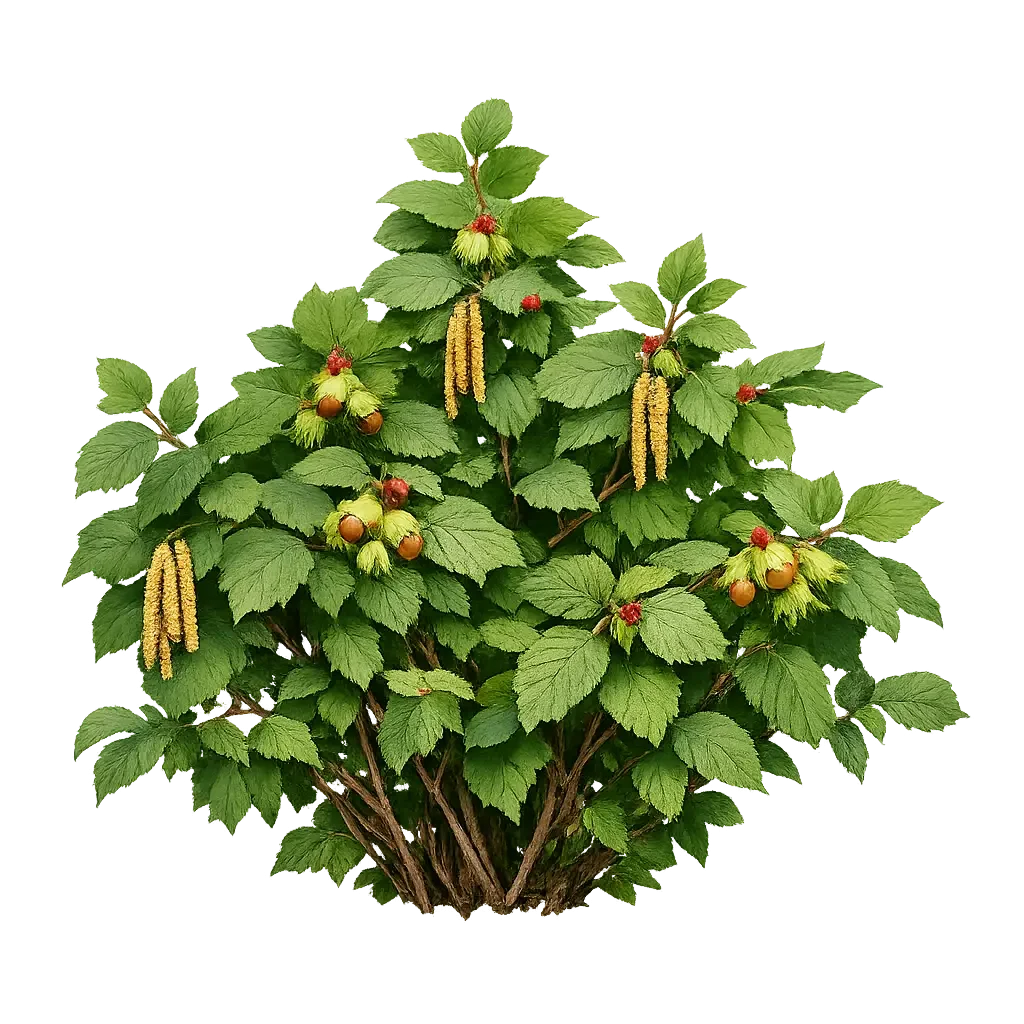
American hazelnut, Corylus americana, is a deciduous multi-stemmed shrub native to a broad range of central and eastern North America, from Saskatchewan and Manitoba south to Kansas and Georgia, and east to the Atlantic coast. It grows naturally in forest edges, thickets, hedgerows, stream banks, and the understory of open woodlands, occupying the shrub layer of the eastern forest ecosystem with a persistence and resilience that reflects millions of years of co-evolution with the continent's soils, climate, and wildlife.
The plant grows as a large, spreading, multi-stemmed shrub reaching six to twelve feet in height and often comparable or greater spread at maturity. It spreads by root suckers and layering to form dense colonies over time, a habit that makes it an effective hedgerow component and a functional windbreak but also requires management to contain it within intended boundaries. The bark is smooth and gray-brown on young stems, becoming rougher with age.
The leaves are broad, oval to heart-shaped with a pointed tip, and distinctly toothed along the margins, turning attractive shades of yellow, orange, and red in fall before dropping. The leaf texture is soft and slightly hairy, and the leaves are large enough to provide meaningful shade and significant organic matter input to the soil surface when they fall.
American hazelnut is monoecious, meaning individual plants carry both male and female flowers but on separate flower structures. The male flowers are the familiar catkins, long pendant structures that develop in fall and expand in early spring before the leaves emerge, releasing pollen in late winter to early spring depending on the region. This early pollen production makes hazelnut one of the most important early-season pollen sources for native bees emerging from winter dormancy. The female flowers are tiny, with only the bright red stigmas visible at the bud tips when receptive.
The nuts are small, round, enclosed in a leafy husk of two to three deeply fringed bracts, and ripen from August through September. They are true hazelnuts, botanically and culinarily, with the same rich, buttery flavor and high fat and protein content as the European hazelnut used commercially, though typically smaller. The husks are distinctly fringed and more bristly than those of European hazelnut, which is a reliable distinguishing characteristic of the American species.
Livestock Fodder Value
American hazelnut is one of the most consistently productive and nutritionally valuable browse plants available for small-scale livestock systems in North America, and its fodder contributions operate at multiple levels across the full season.
The foliage is the primary continuous fodder source, providing a highly palatable, protein-rich browse for goats, sheep, deer, and to a lesser extent cattle throughout the growing season. Hazelnut foliage contains protein levels comparable to many cultivated legume forages and is consumed eagerly by goats in particular, which will strip accessible branches aggressively if allowed unrestricted access. Managing browse pressure through rotational grazing or physical separation during establishment is essential for young plants: unrestricted goat access to newly planted hazelnut will kill the plants before they can establish.
The nuts are the highest-value fodder product, concentrated in energy, fat, and protein in a form that most livestock and poultry consume readily. Pigs, chickens, ducks, turkeys, and deer all eat hazelnuts eagerly, and allowing livestock access to the planting during nut drop in late August and September provides a significant supplemental nutrition source during the pre-winter conditioning period. The nut harvest for human use and the livestock fodder allocation can be managed together by harvesting the bulk of the accessible crop and allowing livestock to glean the remainder, including fallen nuts that would otherwise be taken entirely by squirrels.
The husks and shells, remaining after human nut processing, are consumed by pigs and poultry without issue. The spent leaves raked from beneath the plants in fall provide a carbon-rich bedding material for livestock housing that composts effectively into a high-quality soil amendment when composted with manure.
Rabbits consume hazelnut foliage and young stems readily, and hazelnut planted as a fodder hedge adjacent to rabbit housing can provide a meaningful supplemental browse source during the growing season. Chickens ranging beneath established hazelnut plantings glean insects, fallen nuts, and other food from the ground beneath the canopy, integrating effectively into a food forest management system.
Edible Nut Production for Humans
American hazelnut produces genuine, fully edible, nutritionally rich nuts that are among the most underutilized wild and cultivated foods in North American homestead cooking. The flavor of a freshly harvested American hazelnut is outstanding: rich, buttery, and complex in ways that commercially produced European hazelnuts rarely match, simply because commercial nuts are almost always old by the time they reach the consumer.
The nut is smaller than the European hazelnut used commercially, but the flavor and nutrition are comparable and in many cases superior on a per-nut basis. The shell is thick and harder than commercial varieties, which is one of the practical limitations of the wild species compared to improved selections, but a standard nutcracker or the flat of a hammer handles it without difficulty.
Nutritionally, hazelnuts are among the most energy-dense foods available from any shrub, with a high proportion of monounsaturated fats comparable to olive oil, significant protein content, and meaningful levels of vitamin E, B vitamins, magnesium, and manganese. A handful of hazelnuts represents a genuinely nutritious and calorie-dense food that stores well in the shell for months under cool, dry conditions.
Roasted and eaten out of hand, where the flavor of freshly roasted American hazelnuts is exceptional
Ground into hazelnut butter, a rich and flavorful alternative to commercial nut butters
Chopped and added to baked goods, granola, and trail mix
Incorporated into savory dishes alongside roasted meats and root vegetables
Pressed for hazelnut oil, a premium culinary oil with excellent flavor and stability
Ground into a flour substitute for gluten-free baking
Fermented into hazelnut milk as a dairy alternative
Made into praline and confectionery preparations
The primary competition for the human nut harvest is squirrels, which monitor maturing hazelnuts closely and begin harvesting them before the nuts are fully ripe. Managing this competition through timing of harvest, netting of individual plants, or accepting that squirrels will take a share and planting enough to accommodate both, is a central practical consideration for any grower hoping to harvest meaningful quantities for the household.
Soil Health Contributions
American hazelnut is not a nitrogen-fixing plant, which distinguishes it from several others in this series, but its contributions to soil health are substantial and operate through different mechanisms that are equally valuable over the long term.
The large, broad leaves produced in abundance each season create a significant annual organic matter input to the soil surface when they fall in autumn. Hazelnut leaf litter decomposes relatively quickly compared to the tough, waxy leaves of many other trees and shrubs, releasing nutrients into the surface soil layer over the winter and early spring months and feeding the soil biology that drives long-term fertility.
The extensive root system of established hazelnut colonizes forms mycorrhizal associations with soil fungi, particularly ectomycorrhizal fungi, that are among the most important components of forest soil health. These fungal networks extend the effective root reach of the plant dramatically, improve the plant's access to phosphorus and other nutrients, and connect to the broader below-ground fungal network of the surrounding plant community. In a food forest system, hazelnut planted in the shrub layer contributes to the mycorrhizal network that supports the entire planting.
The root suckering and colony-forming habit of American hazelnut also contributes to soil stabilization on slopes and stream banks, where the fibrous, spreading root system anchors soil effectively against erosion. On degraded sites with erosion risk, hazelnut established in the shrub layer provides long-term stabilization while simultaneously building organic matter and mycorrhizal activity.
Climate and Growing Zones
American hazelnut is one of the most cold-hardy native food shrubs available in North America, reliably hardy from USDA zone 3 through zone 9. Its native range spans the full breadth of eastern North American climate zones, from the cold prairie winters of southern Manitoba and Saskatchewan through the hot, humid summers of the southeastern United States, and this range reflects genuine adaptability to climatic extremes at both ends of the scale.
It is particularly well suited to the climates of the central and eastern United States and Canada, where its native ecological relationships with soil organisms, insects, and plant communities are most fully intact. It performs with equal reliability in the cool, moist climates of the upper Midwest and the warmer, more humid conditions of the mid-Atlantic and upper South.
For cold-climate homesteads in zones 3 and 4, American hazelnut is one of very few productive nut-bearing shrubs that can be grown reliably, and its combination of cold hardiness, food production, and livestock fodder value makes it one of the most important plantings available for these regions.
Sunlight Requirements
American hazelnut is one of the more shade-tolerant productive food shrubs available, growing and producing in partial shade conditions that would significantly reduce or eliminate the productivity of most other nut-bearing plants. It grows naturally in forest understories and edges where it receives dappled to partial light, and this native shade tolerance gives it a flexibility in landscape placement that is practically valuable for homesteads with limited full-sun growing space.
In full sun, American hazelnut produces its best nut yields, densest growth, and most vigorous suckering. In partial shade of three to five hours of direct sun it grows more openly, produces somewhat fewer nuts, but remains productive and functional. In deep shade with less than three hours of direct sun, nut production falls significantly though the plant survives and provides foliage browse and soil health contributions.
For homesteads integrating hazelnut into a food forest system, it occupies the shrub layer beneath canopy fruit trees, receiving the dappled light of partial shade and remaining productive in this understory position better than most other fruiting or nutting shrubs of comparable size.
Soil Requirements
American hazelnut grows well across a wide range of soil types, reflecting its native occurrence across the diverse soils of eastern North America. It performs on sandy loams, clay loams, rocky hillside soils, and the deep, rich soils of floodplain edges, tolerating a pH range of approximately 5.5 to 7.5 and handling both moderately acidic and moderately alkaline conditions without significant decline.
Good drainage is beneficial but not strictly required. American hazelnut tolerates seasonal wet conditions and grows naturally along stream banks and floodplain margins where periodic flooding occurs. On persistently waterlogged sites it performs poorly, but seasonal moisture fluctuation is well within its tolerance.
On lean, infertile soils it grows more slowly than in average or fertile conditions but establishes reliably and produces meaningful foliage browse even where nut yields are modest. On average to fertile soils with good moisture it grows vigorously and produces generous nut crops once it reaches productive maturity.
Pollination: The Most Important Practical Detail
American hazelnut requires cross-pollination between two or more genetically distinct plants to produce nuts reliably. This is the single most important practical point for growers planning a hazelnut planting for nut production, and it is one of the most common reasons that hazelnut plantings fail to produce adequate nut yields despite apparently healthy plants.
The male catkins and female flowers on a given plant do not typically overlap in their timing: the catkins release pollen either before or after the female flowers on the same plant are receptive. This temporal mismatch, called dichogamy, means that self-pollination is largely prevented even though both male and female structures are present. Cross-pollination from a second, genetically distinct plant whose catkin and female flower timing overlaps with the first plant's receptive period is necessary for fruit set.
The practical implication is that planting at least two plants of different genetic origin is the minimum requirement for nut production, and three or more plants provide more reliable cross-pollination across the range of seasonal timing variation. Plants grown from seed of different parent trees are genetically distinct and will cross-pollinate effectively. Named varieties may or may not overlap in their pollen timing, and checking variety-specific information before purchasing is worthwhile.
Hazelnut pollen is wind-dispersed, and the catkins release pollen in late winter when the wind is unimpeded by foliage, which makes the wind-pollination mechanism effective even at considerable distances. Plants within one hundred to two hundred feet of each other typically pollinate successfully in open conditions.
Seedling vs. named variety: Wild American hazelnut seedlings produce smaller nuts with thicker shells and more variable quality than selected named varieties. For growers primarily interested in livestock fodder and wildlife habitat, seedlings are economical and entirely adequate. For growers prioritizing the human food harvest, named improved varieties or hybrid selections offer significantly better nut size, shell thickness, and flavor predictability and are worth the additional cost.
Wild Seedlings vs. Improved Varieties
The choice between wild-type seedlings and improved named varieties is one of the most consequential decisions in planning an American hazelnut planting, and it depends directly on the intended primary use.
Wild American hazelnut seedlings are inexpensive, broadly available from native plant nurseries and conservation suppliers, and entirely appropriate for plantings where the primary goals are livestock fodder, wildlife habitat, soil health, hedgerow establishment, and windbreak function. The foliage browse value, wildlife habitat contribution, and soil health function of wild seedlings are comparable to named varieties, and for these purposes the nut size and shell thickness differences are irrelevant.
For growers who want to harvest meaningful quantities of nuts for human consumption, the improved selections and American-European hybrid varieties offer substantially better returns. The Hazelnut Breeding Program at the University of Nebraska and various private breeders have developed selections with larger nuts, thinner shells, improved flavor, and in some hybrid selections, greater resistance to eastern filbert blight, the primary disease threat to hazelnut in North America.
Hybrid hazelnuts crossing Corylus americana with the European hazelnut, Corylus avellana, are increasingly available from specialist nurseries and represent a practical middle ground: they carry the cold hardiness and disease resistance of the American parent with the nut size and shell quality approaching the European commercial standard. Varieties from the Badgersett Research Corporation and from the work of Philip Rutter have been among the most influential in developing these hybrid selections for North American conditions.
How Far Apart to Plant
5 to 6 feet apart for a dense fodder hedge or windbreak where rapid canopy closure is the goal
6 to 8 feet apart for a productive hedgerow combining nut harvest, fodder, and wildlife habitat
8 to 12 feet apart for individual specimen plants managed for maximum nut production
10 to 15 feet apart for food forest shrub layer plantings where canopy trees will eventually influence light and spacing
At least 5 feet from fences and structures to allow for suckering spread and harvest access
When to Plant American Hazelnut
American hazelnut is best planted in early spring while dormant or in fall after the first frosts have ended active growth. Bare-root plants from native plant nurseries and conservation suppliers are available in early spring and are the most economical option for establishing multiple plants or large-scale hedgerow plantings. Container-grown plants from specialist nurseries are available throughout the growing season and are the standard form for named varieties.
Spring planting is preferred in zones 3 and 4, where the full growing season before winter supports strong establishment. In zones 5 and warmer, fall planting of dormant bare-root or container plants works well and often produces strong first-season growth the following spring.
Where possible, sourcing plants from local or regional seed sources provides better adaptation to local climate and seasonal patterns. For wild seedling plantings, native plant nurseries that grow from locally collected seed are the best source. For named varieties, specialist fruit and nut nurseries with experience in hazelnut culture are the appropriate suppliers.
Planting Process
Plan for at least two genetically distinct plants from the start. Single-plant hazelnut plantings will produce little or no nuts regardless of plant health or management. Three or more plants provide the most reliable cross-pollination.
Choose a site in full sun to partial shade with good to moderate drainage. Avoid low-lying frost pockets where late frosts can damage the early-opening catkins and female flowers and reduce the season's nut set.
Dig planting holes two to three times the width of the root ball and no deeper. For bare-root plants, dig a hole wide enough to spread the roots fully without cramping or circling.
Set the plant at the same depth it was growing, with the crown at soil level. Planting too deeply is a common establishment mistake that stresses hazelnut plants and reduces early growth.
Backfill with native soil. Modest compost incorporation is beneficial on very poor soils but heavy amendment is not necessary on average ground.
Water thoroughly after planting and apply two to three inches of mulch around the base, keeping it pulled back from the main stems. Mulch is particularly important in the establishment year for suppressing competing vegetation around young plants.
Watering Needs
American hazelnut develops good drought tolerance once established and requires minimal supplemental irrigation on average soils from the second year onward. During the establishment year, consistent moisture supports strong root development and healthy first-season growth, and deep watering once or twice per week during dry spells is appropriate.
During the nut development period in mid to late summer, adequate moisture improves nut size and fill. Extended drought during this period can cause nuts to abort or develop incompletely, reducing both the human food harvest and the livestock fodder value. Supplemental irrigation during prolonged summer drought in the nut development window is the most productive use of irrigation resources for established hazelnut plantings focused on nut production.
Fertilization Strategy
American hazelnut responds well to modest annual nutrition and performs better with some fertility input than the nitrogen-fixing plants in this series, which manufacture their own. An application of compost worked lightly into the soil around the drip line in early spring provides the steady, balanced nutrition that supports good nut production without stimulating the excessive vegetative growth that reduces fruit set and increases disease pressure.
On poor, sandy, or severely depleted soils, a balanced organic fertilizer applied in early spring of the second and third years after planting supports the establishment of a productive root system and canopy. On average to fertile soils, compost alone is typically sufficient. Avoid high-nitrogen synthetic fertilizers, which produce lush, soft growth at the expense of nut production and increase susceptibility to disease.
Pruning American Hazelnut
American hazelnut requires minimal pruning to remain healthy and productive but benefits from occasional selective management to improve light penetration, maintain manageable size, and remove old, exhausted wood that has passed its productive peak.
The most important routine pruning task is the removal of root suckers that emerge beyond the intended planting boundary. American hazelnut suckers freely and will expand its footprint steadily if suckers are not removed. Suckers removed in late spring when they are still small and the root attachment is not yet fully developed are the easiest to remove cleanly. Suckers allowed to establish their own root systems become progressively more difficult to remove without leaving root fragments that resprout.
Within the planting, remove the oldest, most congested canes at the base every three to five years to encourage vigorous new growth from the crown and maintain the renewal cycle that keeps production high. American hazelnut produces most of its nuts on one to three year old wood, and plantings dominated by old, thick canes produce fewer nuts than those maintained with a proportion of young, vigorous growth.
Prune in late winter before the catkins expand, both to take advantage of the dormant period when the plant's energy is concentrated in the roots and to avoid removing the catkin-bearing wood that will provide the current season's pollen. American hazelnut tolerates hard renovation pruning and will regrow vigorously from the base if cut back severely.
Harvesting the Nuts
The timing and method of nut harvest is one of the most practically important aspects of American hazelnut management, largely because the competition from squirrels is intense and begins before the nuts have fully ripened.
Nuts are mature when the husks begin to turn from green to tan or brown and the nuts can be pulled or twisted free from the husks with moderate effort. At this stage the shell is fully hardened but the nut inside has reached full size and flavor. Waiting for nuts to fall naturally results in squirrels taking the majority of the crop before it reaches the ground.
The most effective harvest approach is to collect nuts by hand as they approach maturity, pulling them from the husks directly or cutting the husk clusters and husking them afterward. For larger plantings, laying tarps beneath the plants and shaking the branches dislodges ripe nuts efficiently. Nuts harvested slightly before peak ripeness will finish curing off the plant without loss of quality.
After harvest, cure the nuts in a single layer in a warm, well-ventilated space for one to two weeks before storage. Cured nuts store well in their shells in a cool, dry location for three to six months, or in the refrigerator or freezer for longer periods without loss of quality.
Eastern Filbert Blight
Eastern filbert blight, caused by the fungal pathogen Anisogramma anomala, is the most significant disease affecting hazelnut in North America and is the primary reason that European hazelnut cultivation has been difficult across much of the eastern United States. The disease causes cankers on stems that girdle and kill branches progressively, and on highly susceptible plants it can eventually kill the entire shrub.
American hazelnut has significantly better tolerance of eastern filbert blight than European hazelnut, reflecting its co-evolution with the pathogen in its native range. Wild American hazelnut plants in affected regions typically develop blight cankers but survive and resprout from the base, maintaining their vigor through the suckering regeneration that is characteristic of the species. The disease is managed in this way rather than eliminated.
For growers in the eastern United States who want improved nut quality alongside blight management, the American-European hybrid selections with demonstrated blight resistance represent the most practical approach. The Rutgers University hazelnut breeding program has been among the leaders in developing blight-resistant hybrid selections, and varieties from this program are increasingly available through specialist nurseries.
In the Pacific Northwest, where Anisogramma anomala was historically less prevalent, commercial European hazelnut production has been most successful. Growers in this region have a wider range of variety options with less disease pressure to manage.
Wildlife Value
American hazelnut is one of the most ecologically generous native shrubs available for the homestead landscape. Its contributions to native wildlife span every season and nearly every major wildlife category, making it one of the most valuable single-species plantings for any grower who wants to support native biodiversity alongside food and fodder production.
The early spring catkins are among the most important pollen sources available for native bees emerging from winter dormancy, providing a critical early-season food source before most other plants have begun flowering. Several native bee species are specialist visitors to hazelnut and depend on its early pollen for colony establishment in spring.
The dense, multi-stemmed thicket growth habit of established hazelnut colonies provides nesting and roosting cover for a wide range of songbirds, game birds, and small mammals. Ruffed grouse, in particular, are closely associated with hazelnut across their range, using the catkins as a winter food source and the dense shrub layer for escape cover and nesting.
The nuts are a primary food source for squirrels, chipmunks, blue jays, woodpeckers, turkeys, and deer. While this competition for the human and livestock harvest is a management challenge, it also means that a hazelnut planting actively supports the wildlife community of the broader landscape. For homesteads where wildlife support is a value alongside food and fodder production, American hazelnut delivers both simultaneously.
Agroforestry and Food Forest Applications
American hazelnut occupies the shrub layer of the food forest system with a combination of qualities that are difficult to match from any other single species. It tolerates the partial shade of canopy fruit and nut trees, provides foliage browse accessible to livestock, contributes organic matter and mycorrhizal network support to the soil, produces a nut crop for both human and livestock use, and supports native pollinators and wildlife that benefit the entire food system.
In alley cropping systems, hazelnut planted in the alley between crop rows provides both a productive boundary marker and a soil-building strip that improves fertility and water infiltration in the adjacent cropped area over time. Its deep root system draws nutrients from below the plow layer and returns them to the surface through leaf fall, a process called nutrient cycling that is one of the foundational mechanisms of productive agroforestry systems.
As a hedgerow component, American hazelnut combines effectively with nitrogen-fixing shrubs, fruit-bearing thorned plants, and native trees to create a multi-functional boundary that feeds livestock, produces food, supports wildlife, and improves the soil over a timeframe measured in decades.
Pros and Cons of Planting American Hazelnut
Advantages
Native to eastern North America with strong ecological relationships
Hardy from zone 3 to zone 9, one of the most cold-hardy food shrubs available
Foliage is highly palatable livestock browse with good protein content
Nuts are nutritious and flavorful for both human consumption and livestock fodder
More shade tolerant than most nut-bearing plants, suitable for food forest understory
Exceptional wildlife habitat and critical early-season pollen source for native bees
Supports ectomycorrhizal soil fungi that benefit the surrounding plant community
Tolerates a wide range of soil types and conditions
Low maintenance once established, tolerates hard renovation pruning
No invasiveness concern as a native species across most of its range
Limitations
Requires cross-pollination between two or more genetically distinct plants for nut production
Wild seedlings produce smaller nuts with thicker shells than improved varieties
Squirrel competition for the nut harvest can be intense and difficult to manage
Spreads by root suckers requiring ongoing boundary management
Eastern filbert blight is a significant disease concern in the eastern United States
Not a nitrogen-fixing plant, so soil fertility contributions work through different and slower mechanisms
Harvest timing is critical and must be anticipated to beat squirrels to the crop
Improved named varieties can be harder to source than wild seedling plants
Long-Term Planning Considerations
American hazelnut planted thoughtfully becomes one of the most productive and ecologically complete elements of a homestead landscape over a timeframe of decades. It improves with age, developing a larger root system, more productive canopy, stronger mycorrhizal network connections, and a denser, more complex habitat structure that supports increasing biodiversity over time.
The most important planning decisions are ensuring adequate cross-pollination from the start, managing expectations about the timeline to first significant nut yields, choosing between wild seedlings and improved varieties based on the intended primary use, and committing to the ongoing sucker management that keeps the colony within its intended boundary. These are not complicated decisions, but they are consequential ones that shape the productivity and manageability of the planting for years to come.
For North American homesteads in zones 3 through 8 that are building toward a more ecologically integrated, perennial-based food and fodder system, American hazelnut is not an optional addition. It is one of the foundational native food shrubs around which a great deal of the rest of the system can be organized, and its contributions to soil health, wildlife, livestock nutrition, and the household food supply compound together into something greater than any of them individually.
Final Thoughts
American hazelnut has been feeding people and animals on this continent for thousands of years before anyone thought to manage it deliberately, and the qualities that made it such a reliable part of the eastern North American food web are the same qualities that make it so well suited to the intentional homestead landscape today. It is cold-hardy, productive, ecologically connected, tolerant of difficult conditions, and generous with its yields across multiple categories simultaneously.
The homesteader who plants American hazelnut is planting something that belongs in the landscape, in the most literal ecological sense of that phrase. And a plant that belongs in the landscape, properly placed and lightly managed, tends to take care of itself while taking care of everything around it. That is the kind of plant every homestead should have more of.