
Autumn Olive
Written By Arthur Simitian
Autumn olive is one of the most productive and controversial plants a homesteader can choose to grow. Its ability to fix atmospheric nitrogen, restore degraded soils, produce abundant livestock fodder, and yield large quantities of nutritious, edible berries makes it one of the most functionally complete shrubs available to the land manager. Its ability to spread aggressively beyond managed areas and outcompete native vegetation across much of the eastern United States makes it a plant that demands serious, honest consideration before a single seed goes in the ground. This guide takes both sides of that equation seriously.
This guide covers autumn olive in full: what it is, what it does for soil and livestock, its edible and nutritional value, how to plant and manage it responsibly, its nitrogen-fixing mechanism, and an unflinching look at the invasiveness situation that shapes every decision about whether and how to grow it.
What Is Autumn Olive
Autumn olive, Elaeagnus umbellata, is a large, fast-growing deciduous shrub native to China, Korea, Japan, and the Himalayan foothills, where it grows naturally in forest margins, rocky slopes, river banks, and disturbed ground across a wide range of elevations and soil types. It belongs to the family Elaeagnaceae alongside its close relative Russian olive, Elaeagnus angustifolia, and the silverberry, Elaeagnus commutata, all of which share the genus's characteristic silver-scaled foliage and nitrogen-fixing root associations.
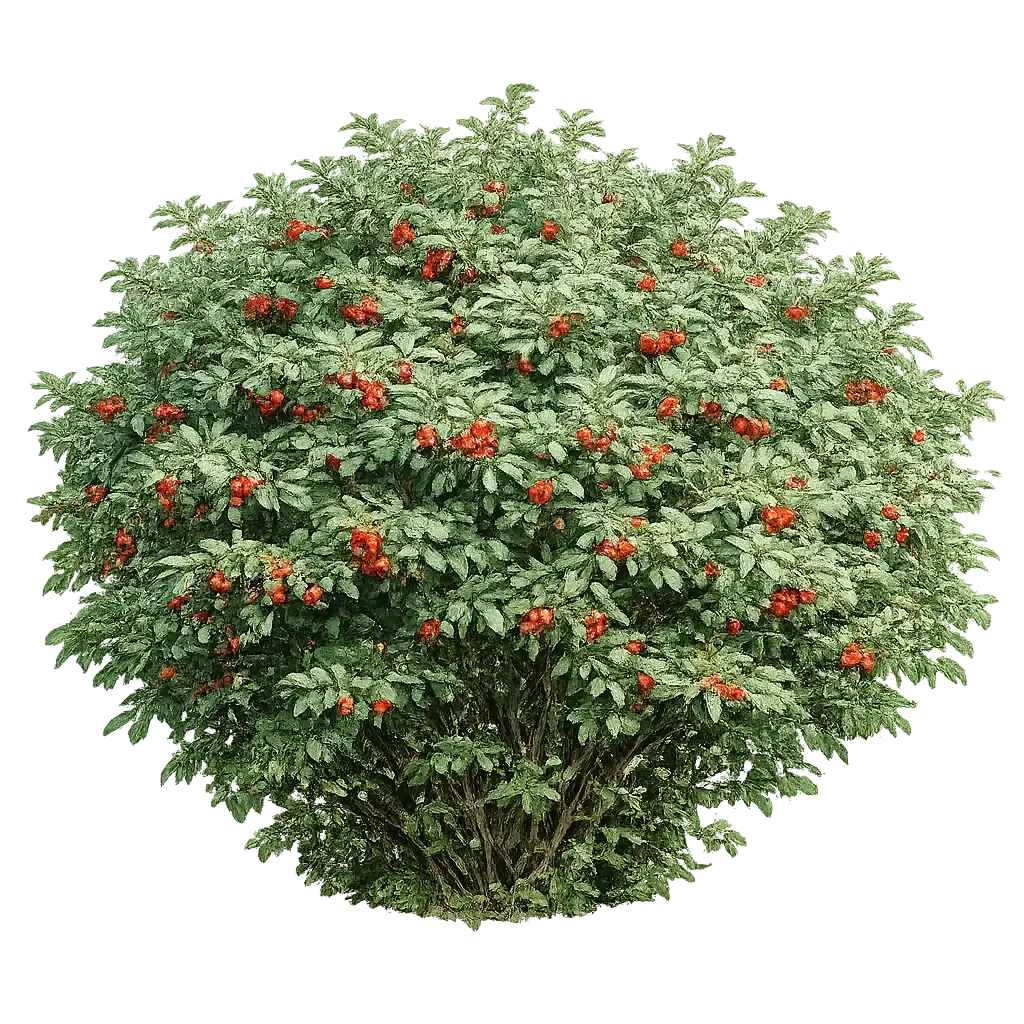
The plant grows vigorously into a large, spreading, multi-stemmed shrub reaching six to sixteen feet in height and comparable spread at maturity. The foliage is one of its most distinctive features: leaves are alternate, oval to lance-shaped, and covered on the underside with minute silver scales that give the entire plant a shimmering, silver-green appearance in the wind. This silvery quality is attractive enough that autumn olive was widely planted as an ornamental and wildlife plant across the eastern United States through much of the twentieth century, which is a significant part of how it became so broadly established.
In spring it produces small, creamy yellow tubular flowers in dense clusters along the stems, intensely fragrant in a way that carries far on warm air and is one of the more distinctive scents of the late spring landscape in regions where the plant is established. The fruit follows in late summer through fall: small, round to oval berries covered in silver speckles that ripen from pink to deep red, produced in extraordinary abundance on mature plants. The berries are astringent when first ripe and develop better flavor after frost.
The roots of autumn olive host symbiotic actinobacteria of the genus Frankia, which fix atmospheric nitrogen in root nodules in a process analogous to the nitrogen fixation of legumes. This biological nitrogen fixation is the foundation of autumn olive's value as a soil-building plant and is the quality that originally made it attractive for reclamation and land restoration work.
Nitrogen Fixation and Soil Health
The nitrogen-fixing capacity of autumn olive is its most significant contribution to soil health and the quality that distinguishes it from most other fast-growing shrubs. Understanding how this process works and what it means in practice for a homestead soil-building program helps clarify both the plant's value and how to deploy it most effectively.
Nitrogen is the primary limiting nutrient in most agricultural and degraded soils, and it is the most expensive component of synthetic fertilizer programs. Plants that fix their own nitrogen from the atmosphere, including legumes and actinorrhizal plants like autumn olive, effectively manufacture fertility in place, building soil nitrogen levels that benefit neighboring plants and the broader soil ecosystem over time.
Autumn olive is estimated to fix between forty and ninety pounds of nitrogen per acre per year in favorable conditions, which is a meaningful contribution to soil fertility for a homestead that is managing degraded or depleted land. When the plant's leaves and prunings are incorporated into the soil or used as mulch, this fixed nitrogen becomes available to neighboring crops and plantings.
Beyond nitrogen, autumn olive's deep, wide-spreading root system breaks up compacted soils, improves drainage, and brings subsoil minerals to the surface through the cycling of leaf litter. On severely degraded sites including old mine spoils, eroded hillsides, and compacted former cropland, it has demonstrated the ability to establish where few other plants will and to initiate a soil-building process that eventually supports more diverse vegetation.
Livestock Fodder Value
Autumn olive has genuine value as a multi-purpose fodder plant, though its applications vary considerably by livestock species and the part of the plant being offered.
The berries are the highest-value fodder product. They are produced in extraordinary abundance on mature plants, with a single large shrub capable of yielding twenty to eighty pounds of fruit in a good year, and they are readily consumed by poultry, pigs, and cattle. For pastured poultry operations where birds have access to the hedge during fruiting season, autumn olive berries provide a significant supplemental energy and nutrition source that reduces grain inputs during the harvest period.
The foliage and young shoots are browsed by goats and deer and contain reasonable protein levels. Goats in particular will graze autumn olive readily and can be used as a management tool to suppress unwanted spread and keep established shrubs from exceeding their intended boundaries. Browsing pressure from goats does not eradicate established autumn olive but does keep it in check and converts the growth into livestock productivity.
The nutritional profile of the berries is notable beyond their fodder value. They contain high levels of lycopene, one of the most potent antioxidant carotenoids, in concentrations significantly higher than tomatoes. They also provide vitamin C, vitamin A, essential fatty acids, and flavonoids. This nutritional density makes them valuable both as livestock feed and as human food.
Edible and Culinary Value for Humans
Autumn olive berries are edible and nutritious for humans, and while they are not yet widely recognized in mainstream food culture in North America, they have a genuine place in the homestead kitchen. The flavor is tart and slightly astringent when fresh, improving considerably after a frost or after a few days in the refrigerator, and developing a pleasantly complex sweet-tart character that works well in processed preparations.
Jam and jelly, where the natural astringency mellows with cooking and sugar and the flavor is excellent
Fruit leather and dried berries for snacking and baking
Juice and fruit wine, where the lycopene-rich flesh produces a deeply colored, nutritious product
Sauces and chutneys alongside game meats and pork
Smoothies and fruit purees blended with sweeter fruits
Infused vinegars and shrubs for culinary use
The berries are most palatable after the first frost or after being frozen, which breaks down some of the astringency and converts starches to sugars. The small seeds are edible but are typically strained out when making juice and jam. For fresh eating, the flavor varies considerably between individual plants, and selecting for sweeter, less astringent individuals from a larger planting is worthwhile if fresh eating is a priority.
Climate and Growing Zones
Autumn olive is broadly hardy across USDA zones 3 through 8 and performs well across a wide range of temperate climates. It tolerates cold winters, hot summers, drought, and coastal exposure with a resilience that reflects its origins across a diverse native range.
It is particularly well adapted to the temperate continental climate of the eastern and central United States, which is also the region where its invasiveness concern is most acute. In drier western climates it grows more slowly and spreads less aggressively, but it remains productive and functional as a soil-building and fodder plant.
At the warmer end of its range it performs adequately in zone 8 but grows less vigorously than in cooler zones. In zones 9 and warmer it is not well suited and will typically decline.
Before planting, check your state: Autumn olive is listed as invasive or noxious in numerous US states including Pennsylvania, New Jersey, Maryland, Virginia, West Virginia, Ohio, Illinois, Indiana, and others. In several of these states planting it is actively discouraged or regulated. Checking current state regulations and the invasive species list for your region is the first step before any planting decision.
Sunlight Requirements
Autumn olive performs best in full sun and produces its most prolific fruit crops with six or more hours of direct sunlight daily. In full sun it also grows most densely and fixes nitrogen most actively, as the process is energetically driven by photosynthesis.
It tolerates partial shade and will establish and grow in sites receiving three to four hours of direct sun, but growth is slower, fruit production is reduced, and the plant's contributions to soil fertility are diminished. For both fodder value and soil-building function, full sun is the appropriate siting target.
Soil Requirements
Autumn olive's tolerance of poor, degraded, and difficult soils is one of its defining practical characteristics and a major reason it was originally promoted for land reclamation work. It establishes on infertile sandy soils, rocky slopes, mine spoils, compacted former agricultural land, and other sites where most shrubs will not grow without significant soil preparation.
It tolerates a wide pH range, from moderately acidic to mildly alkaline, and handles both drought and periodic waterlogging better than most comparable shrubs. On highly fertile, well-amended garden soils it grows extremely vigorously, which can make it more difficult to manage and increases the rate at which it spreads beyond its intended area. Planting on lean, infertile soil produces more manageable growth while still delivering the soil-building and fodder functions it is being grown for.
Good drainage is beneficial but not essential. Autumn olive tolerates periodic wet conditions and will establish in moderately poorly drained sites where its soil-improving root action can be particularly valuable over time.
How Far Apart to Plant Autumn Olive
Spacing depends on the intended function. For maximum soil-building and nitrogen fixation across a degraded area, wider spacing of eight to twelve feet allows each plant to develop its full root system and canopy without excessive competition. For a productive fodder hedge or a windbreak planting, closer spacing of four to six feet produces a continuous barrier faster.
4 to 6 feet apart for a fodder hedge or productive windbreak
6 to 8 feet apart for a mixed hedgerow where autumn olive is combined with other species
8 to 12 feet apart for soil reclamation plantings where individual plant development is the priority
At least 6 to 8 feet from fences, structures, and property boundaries to allow for mature spread
When to Plant Autumn Olive
Autumn olive is best planted in early spring while dormant, from bare-root stock which is available economically from conservation nurseries and is the standard form used for large-scale land restoration plantings. Bare-root plants establish quickly and grow vigorously in their first season when planted before bud break.
Container-grown plants are available from some nurseries and can be planted throughout the growing season with attentive watering. Fall planting of dormant plants works well in zones 5 and warmer. In zones 3 and 4, spring planting gives the roots a full growing season before their first hard winter in the ground.
Planting Process
Confirm that autumn olive is legal and appropriate to plant in your region before purchasing plants or seed. This step is not optional.
Select the planting site with the long-term management plan in mind. Sites adjacent to natural areas, forest edges, or stream corridors where bird-dispersed seeds could establish in natural vegetation should be avoided.
Dig planting holes two to three times the width of the root ball and equal in depth, or prepare a loosened planting slot for bare-root whips.
Set the plant at the same depth it was growing, with the crown at soil level. No soil amendment is necessary or beneficial in most situations.
Backfill firmly and water thoroughly immediately after planting.
Apply mulch along the planting area to suppress competing vegetation, which is the primary establishment threat for bare-root whips in their first season.
Watering Needs
Autumn olive is drought tolerant once established and requires very little supplemental irrigation beyond its first growing season. Its deep root system accesses moisture from well below the surface, contributing to its resilience on dry, infertile sites where it is most commonly used for reclamation purposes.
During the establishment year, consistent moisture supports rapid root development and reduces the risk of transplant failure. Deep watering once or twice per week during dry spells in the first season is appropriate. From the second year onward, established plants in most temperate climates require no supplemental irrigation.
Fertilization Strategy
Autumn olive should not be fertilized. This is one of the few plants in any planting guide where the recommendation is genuinely none. Its nitrogen-fixing root associations mean it manufactures its own primary fertility requirement, and supplemental feeding, particularly with nitrogen, stimulates excessive growth that makes the plant significantly more difficult to manage and dramatically increases its capacity to produce seed and spread.
On the most severely degraded soils, a modest application of phosphorus at planting can support the establishment of the Frankia root nodule associations that drive nitrogen fixation, as phosphorus is the nutrient most often limiting to this symbiotic process on stripped or compacted soils. Beyond this single targeted application at planting on genuinely depleted ground, autumn olive requires and should receive no additional fertilization.
Pruning and Management
Regular pruning is essential for keeping autumn olive productive, manageable, and contained. Without consistent management it grows into a large, spreading shrub that shades out neighboring plants and produces increasing quantities of seed-bearing fruit.
Annual pruning in late winter removes the oldest, most congested canes at the base to encourage vigorous new growth, thins the canopy to improve air circulation and light penetration, and shapes the plant to its intended dimensions. Cutting back long, arching canes that extend beyond the hedge boundary reduces seed dispersal risk by limiting the quantity of fruit produced in subsequent seasons.
For homesteads using goats as a management tool, rotating goat browsing pressure through established autumn olive plantings in summer and fall is one of the most effective and productive approaches to maintaining the shrubs at manageable size while converting the growth into livestock productivity.
Autumn olive resprouts vigorously from cut stumps and roots, which means cutting alone does not eradicate it once established. This resprouting persistence is worth understanding clearly: a planting of autumn olive is a long-term commitment that requires ongoing management, not a planting that can be simply removed if circumstances change.
Fruit Production and Harvest
Autumn olive begins fruiting within two to three years of planting and reaches peak berry production by year four or five. Mature shrubs produce fruit in quantities that are genuinely impressive, with individual plants commonly yielding twenty to forty pounds of berries in a good season and exceptional plants exceeding this considerably.
The berries ripen from late August through October depending on the region and the individual plant. They are most palatable for fresh human consumption after the first frost, when astringency diminishes and the flavor sweetens. For poultry and pig fodder, the berries can be allowed to fall naturally and be foraged directly, or they can be harvested by hand or by laying tarps beneath the plants and shaking the branches.
For jam and juice making, running the berries through a food mill or berry press removes the seeds and fibrous material efficiently. The resulting pulp and juice are deeply colored, intensely flavored, and rich in lycopene and other antioxidants.
Managing seed dispersal: The primary mechanism of autumn olive's invasive spread is bird consumption of the fruit. On homesteads where planting is appropriate and legal, harvesting the majority of the fruit before birds can disperse it is the single most effective practice for limiting spread beyond the intended planting area. This transforms a potential problem into a productive harvest simultaneously.
Windbreak and Habitat Value
Autumn olive's dense, fast-growing habit makes it an effective windbreak component, and its silver-green foliage, fragrant spring flowers, and abundant fall berries make it attractive to a wide range of bird and wildlife species. It has been widely planted as a wildlife habitat plant precisely because it establishes quickly on poor sites and produces fruit in quantity.
In a managed homestead context, strategically placed autumn olive plantings on the windward side of gardens, orchards, and livestock areas can provide meaningful wind reduction that improves growing conditions and reduces winter stress on both plants and animals. The nitrogen-fixing root network also improves soil fertility in the protected zone over time, creating a self-reinforcing system where windbreak function and soil improvement compound together.
The Invasiveness Question: A Full Accounting
No guide to autumn olive is complete or honest without a direct, thorough treatment of its invasive status across much of its introduced range. This is not a footnote or a caveat to be minimized. It is central to the decision about whether to plant it at all.
Autumn olive was introduced to North America in the mid-twentieth century and promoted aggressively by the US Soil Conservation Service and various state agencies as a wildlife habitat plant, windbreak component, and mine reclamation tool. The promotion was based on genuine and accurate observations of its soil-building and wildlife-support qualities. What was not adequately anticipated was the scale at which it would naturalize beyond managed plantings.
Birds consume the berries enthusiastically and disperse the seeds widely across the landscape. Autumn olive establishes readily in forest understories, old fields, roadsides, stream corridors, and disturbed areas, and once established it grows vigorously enough to outcompete native shrubs and understory trees. In the eastern United States, it has naturalized across millions of acres and is now one of the more significant invasive woody plants in the region.
The productive qualities that make it attractive to homesteaders, fast growth, abundant fruiting, nitrogen fixation, tolerance of poor soils, are exactly the qualities that make it ecologically problematic in its introduced range. A plant that thrives on degraded sites and produces forty pounds of bird-dispersed fruit per year is a plant with a significant colonization advantage over native species adapted to local conditions.
Responsible planting of autumn olive in the eastern United States, if it is to be planted at all, requires honest answers to several questions. Is it currently legal to plant in your state? Is the planting site sufficiently distant from natural areas, forest edges, and stream corridors that dispersed seeds are unlikely to establish in native vegetation? Is there a genuine management commitment in place for controlling spread, harvesting fruit before dispersal, and managing the plants long-term? And most fundamentally, are the benefits of planting autumn olive on this specific site compelling enough to justify the ecological risk that planting it in eastern North America represents?
For some homesteads, particularly those in drier western regions where invasive pressure is lower, on severely degraded sites far from natural areas, and with a genuine long-term management commitment in place, the answer to these questions may be yes. For many others, native alternatives that provide comparable soil-building and fodder value without the invasiveness risk are the more responsible choice.
Native and Lower-Risk Alternatives
For homesteaders in regions where autumn olive's invasive status makes it an inappropriate choice, several native and lower-risk alternatives provide comparable soil-building, fodder, and wildlife habitat value.
Siberian pea shrub, Caragana arborescens, a nitrogen-fixing leguminous shrub hardy to zone 2 with good windbreak and fodder value and minimal invasive tendency in North America
Black locust, Robinia pseudoacacia, a native nitrogen-fixing tree with high-value timber and excellent bee forage, though itself invasive outside its native range in some contexts
Goumi, Elaeagnus multiflora, a close relative of autumn olive with similar soil-building properties and edible berries but lower invasive potential in most North American regions
Wild plum, Prunus americana, a native shrub that provides wildlife habitat, edible fruit, and good fodder value in a plant with strong ecological relationships to local fauna
Buffaloberry, Shepherdia argentea, a native nitrogen-fixing shrub of the central plains, highly cold-hardy and producing tart edible berries with good wildlife value
Pests and Diseases
Autumn olive is notably resistant to most pests and diseases in its introduced North American range, which is itself a contributing factor to its competitive success over native species that are subject to the full range of local pathogens and herbivores.
No serious fungal diseases affect established autumn olive under normal conditions. Occasional aphid colonies may appear on new growth in spring but are rarely significant on vigorous plants. The plant is not a significant host for the diseases that affect orchard trees or other fruiting shrubs, and it requires essentially no pest or disease management once established.
The most significant management challenge, as discussed throughout this guide, is the plant itself: its own vigor, seed production, and resprouting persistence are the primary management concerns rather than any external pest or pathogen.
Pros and Cons of Planting Autumn Olive
Advantages
Fixes forty to ninety pounds of nitrogen per acre annually
Establishes on severely degraded, poor, and compacted soils
Produces abundant berries with exceptional lycopene content
Excellent fodder for poultry, pigs, and browsing livestock
Fast-growing windbreak component on difficult sites
Intensely fragrant spring flowers support bees and pollinators
Berries are edible and nutritious for humans
Drought tolerant once established, requires no fertilization
Valuable wildlife habitat and winter bird food source
Tolerates a very wide range of soil types and conditions
Limitations
Listed as invasive or noxious in numerous eastern US states
Bird-dispersed seeds spread the plant widely beyond managed areas
Resprouts vigorously from cut stumps, making removal very difficult
Requires ongoing management to prevent uncontrolled spread
Berries are astringent until after frost, limiting fresh eating quality
Planting is regulated or banned in several states
Deciduous, providing no winter screening or wind reduction
Long-term commitment once established, cannot be easily reversed
Long-Term Planning Considerations
Planting autumn olive is a decision that should be made with a long view and clear eyes. On appropriate sites, in regions where planting is legal and the invasiveness risk is manageable, it offers genuine and significant value: nitrogen fixation, livestock fodder, human food, soil restoration, and wildlife support from a single planting that thrives on the most difficult ground. These are real benefits that are difficult to replicate with less controversial alternatives.
The long-term commitment required is genuine. Autumn olive, once planted and established, is not easily removed. It resprouts persistently from cut stumps and roots and continues to produce seed-bearing fruit for decades. The decision to plant it is therefore not a decision that can be easily reversed if circumstances or preferences change, and it carries responsibilities to neighboring landowners and natural areas that extend beyond the homestead boundary.
For homesteaders who have done the research, confirmed legality in their region, assessed the site context honestly, and committed to ongoing management including aggressive fruit harvest to limit bird dispersal, autumn olive can be a genuinely productive element of a soil-restoration and livestock-fodder system. For everyone else, the native and lower-risk alternatives listed in this guide deserve serious consideration before a planting decision is made.
Final Thoughts
Autumn olive is a plant that encapsulates one of the central tensions in regenerative land management: the most productive and functionally complete plants are sometimes the ones that require the most careful handling. Its nitrogen-fixing capacity, fodder productivity, berry nutrition, and soil-building function are genuine and meaningful. So is its demonstrated capacity to spread beyond managed areas and displace native vegetation across a substantial portion of its introduced range.
The most honest conclusion is that autumn olive belongs on some homesteads and not on others, and that the difference depends on location, site context, management capacity, and a serious engagement with the ecological responsibilities that come with planting a species with this kind of competitive vigor in a landscape where it has no natural checks. For those homesteads where it is the right choice, it is a remarkable plant. For those where it is not, better options exist and are worth the search.