
False Indigo (Amorpha fruticosa)
Written By Arthur Simitian
False indigo is one of those plants that rewards the grower willing to look past an unfamiliar name. Native across a sweeping range of North America from southern Canada to northern Mexico, it is a nitrogen-fixing shrub of genuine ecological value, a reliable soil builder on difficult sites, a visually striking ornamental with some of the most unusual flowers of any hardy native shrub, and a plant with a long history of practical use by Indigenous peoples of the continent. For homesteads focused on building soil fertility while supporting native biodiversity, it belongs in the planning conversation.
This guide covers false indigo in full: what it is, what it does for soil and livestock systems, how to plant and manage it, its ecological relationships, its historical uses, its limitations as a livestock fodder plant, invasiveness considerations outside its native range, and a thorough assessment of where it fits and where it does not.
What Is False Indigo
False indigo, Amorpha fruticosa, is a deciduous shrub in the legume family, Fabaceae, native to a broad range of central and eastern North America, extending from southern Ontario and Quebec south through the central and eastern United States to northern Mexico. It grows naturally along river banks, stream margins, floodplains, forest edges, roadsides, and disturbed ground across a wide range of soil types and moisture conditions.
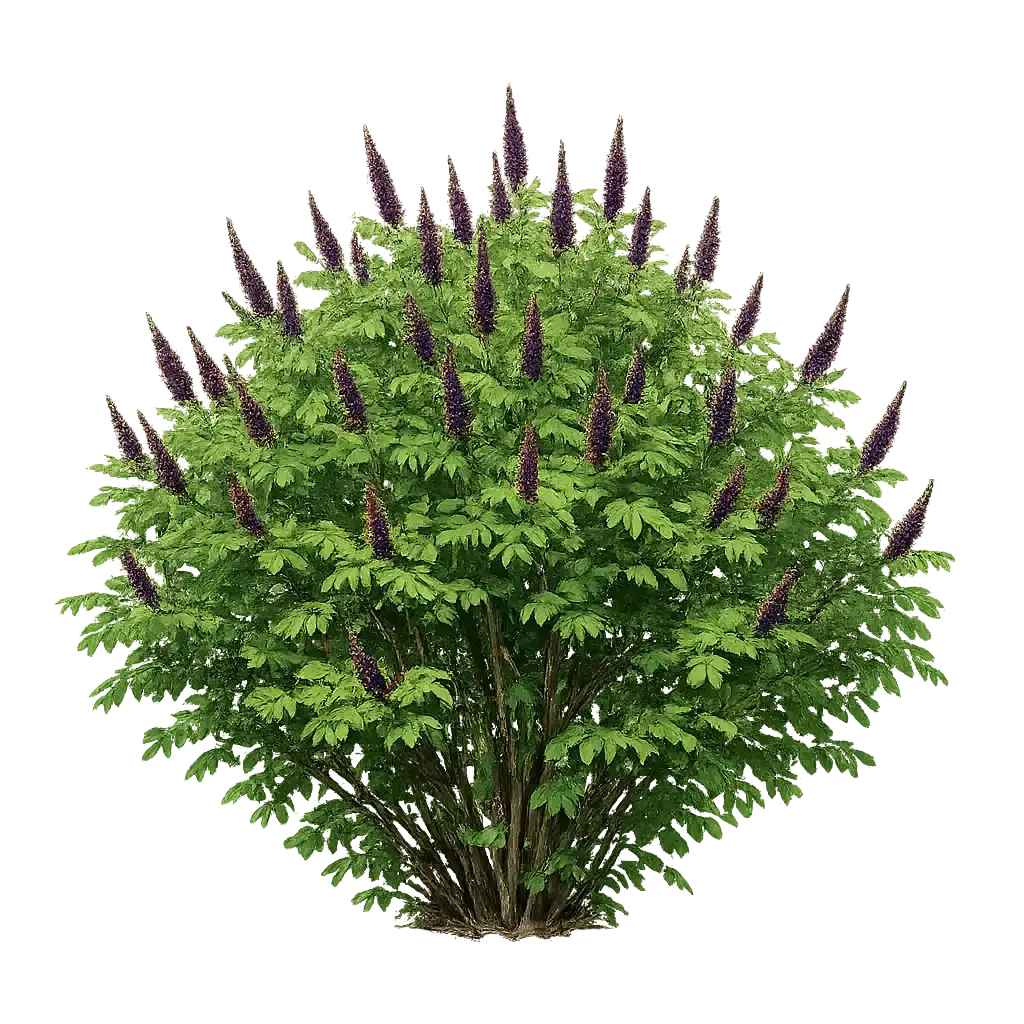
The genus name Amorpha derives from the Greek for shapeless or deformed, a reference to the unusual flower structure: unlike most legume flowers with their characteristic butterfly shape, Amorpha flowers consist of a single petal, the banner, with no wings or keel petals. This reduction produces dense, upright spikes of deep purple to violet-blue flowers with conspicuous bright orange anthers that make a striking visual contrast. The flowers appear in late spring to early summer and are attractive to a range of native bees and other pollinators.
The foliage is pinnately compound, with numerous small, oval leaflets arranged in pairs along each leaf stem, giving the plant a fine-textured, feathery appearance that is graceful and distinctive. The leaves are aromatic when crushed, producing a scent that has been described variously as resinous, herbal, and pleasant.
The plant grows as a large, arching, multi-stemmed shrub typically reaching six to twelve feet in height and comparable spread at maturity, though it is variable and can range from four to fifteen feet depending on site conditions and moisture availability. It spreads by root suckers and can form colonies over time on favorable sites. The stems are unarmed, with no thorns or spines, which is relevant for homesteads where ease of management and accessibility are priorities.
Nitrogen Fixation and Soil Health
As a member of the legume family, false indigo forms symbiotic associations with nitrogen-fixing Rhizobium bacteria in root nodules, using atmospheric nitrogen to build soil fertility in the same fundamental process as clover, alfalfa, and other leguminous plants. This nitrogen-fixing capacity is the primary soil health contribution of false indigo and the reason it is included in soil restoration and agroforestry plantings.
The nitrogen fixed by false indigo becomes available to neighboring plants through the decomposition of root nodules, root turnover, and the incorporation of leaf litter into the soil over time. In a hedgerow or food forest system, false indigo planted as a support species can meaningfully improve the nitrogen status of the soil in its vicinity, reducing or eliminating the need for external nitrogen inputs to neighboring fruit trees, berry shrubs, or fodder plants.
On degraded sites, particularly those with compacted, eroded, or nutrient-depleted soils, false indigo establishes readily and initiates the soil-building process that supports more diverse and productive plant communities over time. Its tolerance of wet, compacted, and flooded conditions makes it particularly valuable on riparian and poorly drained sites where most other shrubs will not establish reliably.
The extensive root system of established plants also contributes to soil structure through physical root penetration of compacted layers, and the annual leaf fall provides meaningful organic matter input to the surface soil. On sites where building organic matter and soil biology is a primary goal, false indigo earns its place as a support species that improves conditions for the entire planting.
Livestock Considerations
False indigo's relationship with livestock is more complicated than that of some other plants in this series and requires careful, honest treatment. The plant contains several bioactive compounds including amorphin, amorpha, and related rotenoid compounds that have demonstrated insecticidal properties and have historically been used as natural pesticides. The toxicity of these compounds to mammals varies, and the situation differs meaningfully between livestock species.
Cattle and horses have consumed false indigo foliage without consistent reports of serious toxicity in the research literature, and the plant is grazed in its native range without widespread documented problems. However, it is not a plant that has been formally evaluated as a reliable livestock fodder in the way that alfalfa, clover, or other leguminous forages have, and the presence of bioactive rotenoid compounds means that caution is appropriate.
The seeds and seed pods contain higher concentrations of these compounds than the foliage, and access to seed-bearing material should be restricted for all livestock species until more definitive information is available. Young animals and those with compromised health are more vulnerable to any toxic compounds, and new access to the plant should be introduced gradually rather than allowing unrestricted grazing of large quantities.
The more practical and defensible role for false indigo in a livestock system is as a soil-building support species adjacent to pastures and fodder plantings rather than as a direct browse plant. Its nitrogen-fixing contributions improve the fertility and productivity of surrounding pasture and fodder crops, which then support livestock nutrition indirectly and more safely than direct browsing of the shrub itself.
Livestock caution: False indigo has not been formally cleared as a safe livestock fodder. Until definitive research is available, treating it as a soil-building support species adjacent to livestock areas rather than a direct browse plant is the more responsible approach. Restrict access to seed-bearing material for all livestock and introduce any access to the foliage gradually and with observation.
Climate and Growing Zones
False indigo is broadly hardy across USDA zones 4 through 9, with some cultivated selections performing reliably in zone 3. Its wide native range across North America reflects genuine adaptability to diverse climatic conditions, from the cold winters of southern Canada to the hot, dry summers of the southern plains and the humid conditions of the southeastern United States.
It is particularly well adapted to the climates of the central and eastern United States, where its native ecological relationships with local soils, insects, and plant communities are most intact. In western North America and in Europe and Asia, where it has been introduced beyond its native range, it has demonstrated invasive tendency in some contexts, as discussed later in this guide.
False indigo tolerates temperature extremes at both ends of the range better than most comparable nitrogen-fixing shrubs. Its tolerance of late spring flooding, summer drought, and cold winters gives it a breadth of climatic adaptability that is genuinely useful for homesteads in variable or challenging climates.
Sunlight Requirements
False indigo grows well in full sun to partial shade, which gives it a practical flexibility that many other shrubs in this category lack. In full sun it produces the most prolific flowering, the densest growth habit, and the most active nitrogen fixation. In partial shade it grows somewhat more openly and flowers less abundantly but remains a functional soil-building plant.
This shade tolerance makes it useful in the understory of food forest systems, along the northern edges of hedgerows, and in other partially shaded sites where full sun nitrogen-fixers like Siberian pea shrub would underperform. In forest edge situations, it occupies the transitional zone between woodland and open ground naturally and performs well in the dappled light conditions typical of these sites.
Soil Requirements
False indigo's native habitat along river banks, floodplains, and disturbed ground gives it a tolerance of difficult soil conditions that is well above average for a woody nitrogen-fixing shrub. It grows in sandy, loamy, and clay soils, tolerates periodic flooding and seasonal waterlogging, handles drought once established, and performs on both acidic and moderately alkaline soils across a pH range of roughly 5.5 to 8.0.
It is one of the few nitrogen-fixing shrubs that tolerates wet and periodically flooded conditions, which makes it particularly valuable for riparian buffer plantings, stream bank stabilization, and poorly drained sites where most leguminous shrubs would decline or fail. This wet-tolerance distinguishes it from Siberian pea shrub, black locust, and most other commonly recommended nitrogen-fixing shrubs that require good drainage.
On moderately fertile average garden soils it grows vigorously and may require more active management to prevent it from spreading beyond its intended area through root suckering. On poor or compacted soils its growth is more measured and manageable while still delivering meaningful soil-building contributions.
How Far Apart to Plant False Indigo
Spacing depends on the intended function and the management approach. Because false indigo spreads by root suckers, initial spacing primarily affects how quickly a continuous planting develops rather than the ultimate spread, which will be determined by ongoing management.
4 to 6 feet apart for a dense nitrogen-fixing hedgerow or windbreak planting
6 to 8 feet apart in a mixed food forest or agroforestry system where it serves as a support species alongside fruit trees and shrubs
8 to 12 feet apart for specimen plantings on reclamation sites where individual plant development is the priority
At least 4 to 6 feet from fences, structures, and paths to allow for lateral suckering and management access
Installing a root barrier along the edges of the planting area is worth considering in situations where lateral spread into adjacent beds, lawn, or natural areas is undesirable. The root suckers are the primary management challenge with established false indigo and are more easily prevented than removed after the fact.
When to Plant False Indigo
False indigo is best planted in early spring while dormant, or in fall in zones 5 and warmer. Bare-root plants from native plant nurseries and conservation suppliers are available in early spring and are the most economical option for establishing multiple plants or larger-scale hedgerow and reclamation plantings. Container-grown plants are available throughout the growing season and establish readily with attentive watering.
Because false indigo is native to much of North America, sourcing plants from regional or locally grown seed sources is worth prioritizing over generic nursery stock. Locally sourced plants are better adapted to regional climate and seasonal patterns and have stronger ecological relationships with local soil microbes, including the Rhizobium strains needed for effective nitrogen fixation.
Planting Process
Confirm that false indigo is native or non-invasive in your region before purchasing. In parts of Europe and western North America outside its native range, it has demonstrated invasive behavior and may be regulated.
Choose a site that matches the plant's natural preferences: full sun to partial shade, with good access to moisture in at least part of the growing season. Riparian and moist sites are particularly appropriate.
Dig planting holes two to three times the width of the root ball and no deeper than the root ball itself. For bare-root plants, prepare a hole wide enough to spread the roots fully without cramping.
If planting on a site with no history of leguminous plants, inoculating the roots with an appropriate Rhizobium inoculant before planting supports the establishment of effective nitrogen-fixing nodules. This step is particularly valuable on severely depleted or sterilized soils.
Backfill with native soil without heavy amendment. False indigo performs well in lean soil and does not require enriched planting holes.
Water thoroughly after planting and keep consistently moist through the first growing season, particularly on drier sites.
Watering Needs
False indigo's native riparian habitat means it is adapted to reliable moisture and performs best with consistent water availability, particularly in the establishment period. On moist to average soils it establishes readily with normal rainfall. On drier sites, supplemental watering through the first growing season supports strong root development.
Once established, false indigo develops the drought tolerance typical of well-rooted woody plants and can handle extended dry periods on average soils. On sandy, dry sites it performs less vigorously than in moister conditions, and supplemental irrigation during prolonged summer drought maintains productive growth. On naturally moist and riparian sites it requires no supplemental watering once established.
Fertilization Strategy
As a nitrogen-fixing legume, false indigo should not be fertilized with nitrogen. External nitrogen inputs suppress the nodule formation and nitrogen-fixing activity that represent the plant's primary soil health contribution, as the plant has no metabolic incentive to maintain the energy-expensive symbiosis with nitrogen-fixing bacteria when nitrogen is readily available from the soil.
On severely phosphorus-depleted soils, a modest application of rock phosphate or bone meal at planting supports the establishment of effective nitrogen-fixing nodules, as phosphorus is the nutrient most critical to the legume-Rhizobium symbiosis. Beyond this targeted support on depleted ground, false indigo requires no fertilization and performs better without it.
Pruning and Management
False indigo benefits from annual pruning to maintain a manageable form, encourage vigorous new growth, and prevent the colony from expanding beyond its intended boundary through unchecked root suckering. The stems are unarmed, making pruning significantly less hazardous than managing thorned security hedge plants, though the aromatic, resinous foliage can cause mild skin irritation in sensitive individuals and gloves are a sensible precaution.
Prune in late winter or early spring before new growth begins. Remove the oldest, most congested canes at the base to encourage vigorous new shoots from the crown, thin any crossing or inward-facing stems that reduce airflow through the canopy, and cut back any root suckers that have emerged beyond the intended planting boundary. On productive nitrogen-fixing plants that are performing their support role well, light annual pruning rather than hard cutting maintains the root system and nodule network most effectively.
False indigo tolerates hard renovation pruning and will regrow vigorously from the base if cut back severely. Coppicing, the practice of cutting woody plants to near ground level on a rotation to harvest the regrowth, is an appropriate management technique for false indigo in a fodder or biomass system, producing a flush of young growth that can be used as mulch, incorporated into compost, or left as a surface covering to decompose and release nitrogen.
Root suckers that emerge beyond the planting boundary should be removed promptly before they establish their own independent root systems. Once a sucker has developed a substantial root system it is more difficult to remove completely, and repeated cutting without root removal will produce persistent resprouting.
The Flowers and Their Ecological Value
The flowers of false indigo deserve more than a passing mention. The dense, upright spikes of deep purple blooms with their bright orange anthers are among the most visually distinctive flowers of any native North American shrub, and the flowering period in late spring to early summer is a significant ecological event in the landscape.
The flowers are highly attractive to native bees, including specialist bees of the genus Andrena that are closely associated with Amorpha species and depend on their pollen. Supporting these specialist pollinators is a meaningful ecological contribution, as specialist bee species tend to be among the most vulnerable to habitat loss and are most dependent on the presence of their specific host plants in the landscape.
The flowers also attract a range of generalist bees including bumblebees and sweat bees, as well as various butterflies and beneficial wasps. The flowering of false indigo coincides with a period in late spring when many early-season pollinators are most active and most in need of abundant pollen and nectar sources.
Historical and Ethnobotanical Uses
False indigo has a documented history of practical use by Indigenous peoples of North America that extends across multiple cultural groups and applications. The plant's common name references its historical use as a source of blue dye, though the color produced is not true indigo and is substantially less colorfast than genuine indigo from Indigofera tinctoria. It was used as a dye plant by various groups across its native range as a substitute for the more valuable true indigo that was not available in temperate North America.
The stems were used by several Indigenous groups to make arrows, taking advantage of the straight, relatively slender canes that false indigo produces. The plant was also used medicinally for a range of purposes across different cultural traditions, though documentation of specific applications varies.
The rotenoid compounds in the seeds and foliage that make the plant a concern for direct livestock fodder use also account for its historical use as a fish poison and natural insecticide in some Indigenous practices. Rotenone, the best-known of these compounds, has been used as a broad-spectrum insecticide in organic agriculture and as a piscicide for fish population management in aquatic restoration work.
Wildlife Value
False indigo supports a notably diverse range of wildlife across its native range, with ecological relationships that extend well beyond the pollinator value of its flowers. It is the host plant for the silver-spotted skipper butterfly and several other Lepidoptera species whose larvae feed specifically on Amorpha foliage, and supporting these specialist insects is one of the more significant wildlife contributions of the plant.
The dense, arching growth habit provides nesting cover and shelter for a range of bird species, and the seed-bearing pods persist into winter and provide food for seed-eating birds including quail and sparrows. On riparian sites where false indigo grows naturally along stream banks, its root system also provides cover for aquatic wildlife and helps stabilize banks against erosion, reducing sedimentation in adjacent waterways.
Invasiveness Outside the Native Range
False indigo is native across much of North America and does not present invasiveness concerns within its native range, where it has co-evolved with the insects, soil organisms, and plant communities it grows among. Outside this native range, however, the situation is different and deserves direct treatment.
In Europe, where false indigo has been introduced as an ornamental and erosion-control plant, it has naturalized extensively and is considered invasive in several countries including Hungary, Austria, the Czech Republic, and others across central and eastern Europe. It spreads by seed along watercourses and by root suckering on disturbed ground, and in these regions it competes with native riparian vegetation in a manner that closely parallels the behavior of autumn olive in eastern North America.
For European homesteaders, false indigo is therefore not an appropriate choice, and the same caution applies in other regions outside North America where it has been or could be introduced. Native alternatives with comparable nitrogen-fixing and soil-building value, including native leguminous shrubs adapted to the specific region, are the responsible choice in these contexts.
Within its North American native range, false indigo is not classified as invasive and its planting is generally encouraged as part of native plant restoration and agroforestry systems. However, growers should still manage root suckering and seed dispersal to prevent the plant from spreading into adjacent natural areas in ways that alter local plant community composition.
Pests and Diseases
False indigo is generally free of serious pest and disease problems within its native range, where the balance of herbivores, pathogens, and plant defenses has reached a long-term equilibrium. The same rotenoid compounds that raise questions about direct livestock use also confer resistance to many insect pests, and established plants in good growing conditions require essentially no pest management.
Leaf spot diseases can occasionally appear in humid conditions with poor air circulation, and powdery mildew may affect plants in shaded, poorly ventilated sites. Both are managed effectively by ensuring adequate plant spacing, pruning for good airflow through the canopy, and avoiding overhead irrigation. Neither is typically serious enough to threaten plant health.
Outside the native range, false indigo may encounter fewer herbivore pressures than in its native habitat, which contributes to its vigorous establishment and spread in introduced regions. This release from natural herbivore pressure is a common mechanism underlying the invasive success of introduced plants generally.
Pros and Cons of Planting False Indigo
Advantages
Native nitrogen-fixing shrub across much of North America
Tolerates wet, flooded, and poorly drained sites unlike most nitrogen-fixers
Broad climate adaptability from zones 3 to 9
Spectacular purple flower spikes support specialist native bees
Establishes on poor, compacted, and disturbed soils
Shade tolerant, useful in food forest understory applications
Unarmed stems make management safer than thorned alternatives
Strong ecological relationships with native insects and wildlife
Tolerates hard coppicing for biomass and mulch production
Requires no fertilization and minimal pest management
Limitations
Not confirmed safe as direct livestock fodder due to rotenoid content
Invasive in Europe and inappropriate outside its North American native range
Spreads by root suckers requiring ongoing boundary management
Deciduous, providing no winter structure or screening
No edible fruit or significant food yield for humans
Foliage may cause mild skin irritation in sensitive individuals
Seed dispersal along watercourses can spread the plant onto neighboring land
Less well known than other nitrogen-fixing shrubs, harder to source in some regions
Long-Term Planning Considerations
False indigo fits most naturally into homestead planning as a support species within a larger system rather than as a standalone productive element. In a food forest, it occupies the shrub layer alongside berry-producing plants and beneath fruit trees, fixing nitrogen that benefits the whole system while providing pollinator habitat and wildlife cover. In a hedgerow, it contributes soil fertility to neighboring productive plants while adding ornamental interest through its striking spring flowers. In a riparian buffer or stream bank stabilization planting, it is one of the most appropriate native shrubs available across much of its range.
The root suckering habit is the primary management consideration for long-term planning. False indigo, once established, will expand its footprint over time unless actively managed. Planning the planting boundaries with this in mind, and committing to annual sucker management to hold the colony within its intended area, avoids the situation where a valuable support plant becomes an unintended management burden.
For North American homesteads working toward more ecologically integrated land management, false indigo offers a combination of soil health function, native ecological value, and ornamental beauty that is difficult to match with non-native alternatives. It is a plant that improves the system it is part of, which is exactly what the best support species do.
Final Thoughts
False indigo asks the homesteader to think in systems. Its primary value is not what it produces directly but what it enables: richer soil, more active soil biology, better nitrogen availability for neighboring plants, and a more ecologically complete landscape that supports the specialist insects and wildlife that broader biodiversity depends on. These contributions are real and meaningful, even if they are less immediately tangible than a harvest of berries or a cord of firewood.
For North American homesteaders who understand this role and have space for it in their planning, false indigo is one of the most ecologically sound nitrogen-fixing shrubs available. It is native, it is effective, it is beautiful in flower, and it earns its place in the system quietly and consistently over the years.