
Butterfly Bush
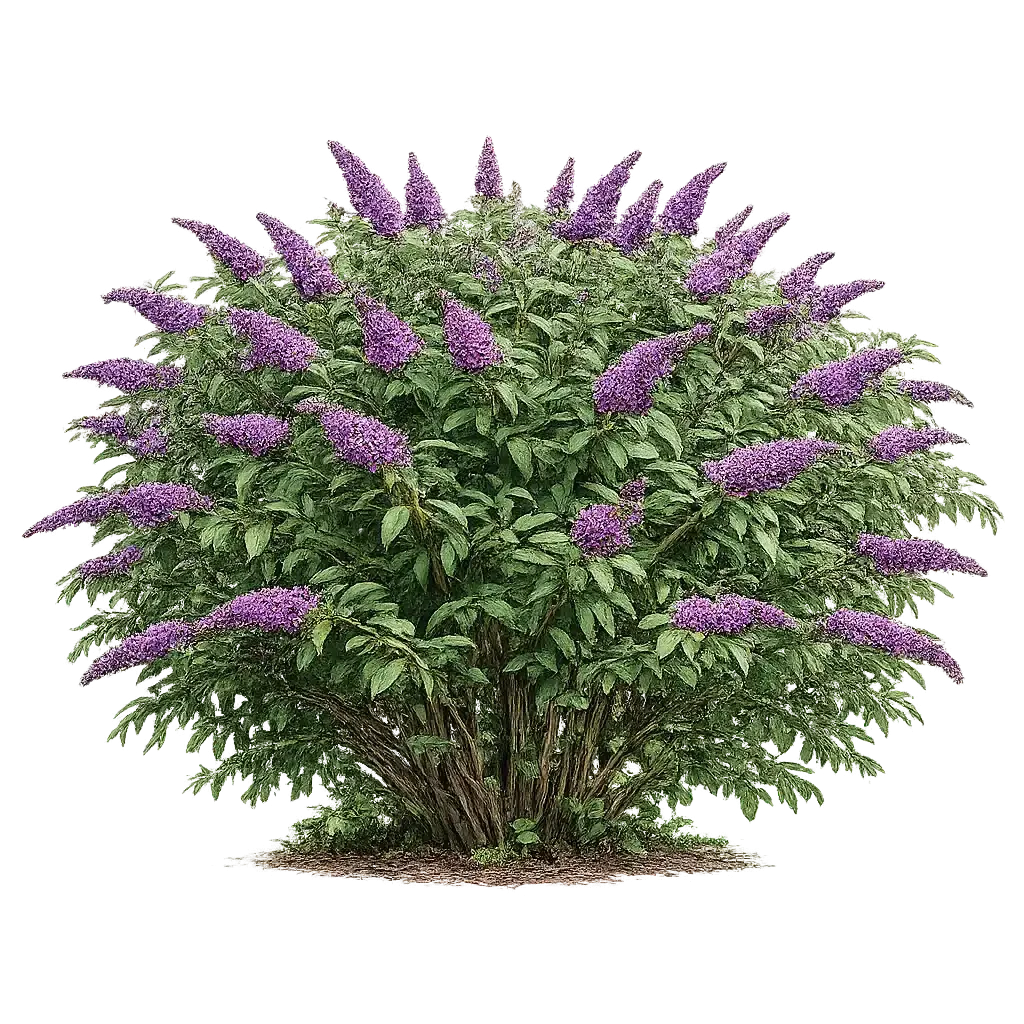
Few garden shrubs generate as much debate as butterfly bush. On one hand it is among the most effective nectar plants available for adult butterflies, moths, hummingbirds, and bees, producing a long, prolific bloom season that draws a diversity and abundance of pollinating insects that few other plants can match. On the other hand it is listed as invasive across significant portions of the Pacific Northwest and in scattered locations elsewhere, and it provides no larval host function for the butterflies it attracts as adults. The responsible gardener navigates both sides of this honestly: the genuine wildlife value is real, the invasiveness concern is real, and the modern sterile cultivars offer a practical path through the tension between the two.
This guide covers butterfly bush in full: what it is, what it genuinely offers wildlife and what it does not, the invasiveness situation by region, how sterile cultivars change the calculus, growing and management, variety selection, and how to integrate it responsibly into a homestead wildlife garden that takes ecological impact seriously.
What Is Butterfly Bush
Butterfly bush, Buddleja davidii, is a fast-growing deciduous to semi-evergreen shrub in the family Scrophulariaceae, native to central China and Japan, where it grows naturally on rocky slopes, stream banks, cliff faces, and disturbed ground across a wide elevation range. It was introduced to Western horticulture in the late nineteenth century, named after the French missionary and naturalist Armand David who collected specimens in China, and rapidly became one of the most widely planted ornamental shrubs in Europe and North America.
The plant grows vigorously into a large, arching, multi-stemmed shrub reaching six to twelve feet in height and comparable spread at maturity, with long, lance-shaped leaves that are gray-green above and white-woolly beneath. The flowers are the defining feature: long, dense, cone-shaped panicles carried at the tips of the current season's arching branches, typically four to twelve inches in length, in colors ranging from deep purple and violet through pink, red, white, and yellow depending on the cultivar. The individual flowers within the panicle are tiny, tubular, and intensely fragrant, with a honey-like scent that carries strongly on warm summer air and is attractive to butterflies and other nectaring insects from a considerable distance.
The bloom season is exceptionally long, beginning in midsummer and continuing through the first frosts of autumn in most climates, and is extended further by deadheading spent flower heads before they set seed. This extended bloom season is one of butterfly bush's most significant practical advantages for the wildlife garden, filling the late summer and autumn period when many other flowering shrubs have finished and nectaring insects are actively seeking food before the season ends.
What Butterfly Bush Actually Does for Wildlife
The wildlife support value of butterfly bush is genuine but specific, and understanding precisely what it offers and what it does not offer clarifies how it fits into a thoughtfully designed homestead wildlife garden.
Butterfly bush is an outstanding nectar source for adult butterflies, moths, hummingbirds, and a wide range of bees and other nectaring insects. The abundance and accessibility of the nectar, the long bloom season, and the strong fragrance that attracts pollinators from a distance combine to make it one of the most effective single plants available for supporting adult nectaring insects through the midsummer to frost period. On a warm late-summer afternoon, a well-established butterfly bush in full bloom can carry a remarkable diversity of butterfly species simultaneously, and the visual display is one of the most compelling wildlife spectacles a homestead garden can offer.
What butterfly bush does not do is provide larval host function for any of the butterfly species it attracts as adults. Butterflies feed on nectar as adults but their caterpillars require specific host plants to complete their life cycle. The monarch needs milkweed. Swallowtails need members of the carrot family or native trees. Fritillaries need native violets. No North American butterfly species uses butterfly bush as a larval host plant, which means that however effective it is at feeding adult butterflies, it does not support the reproduction of any of the species visiting it.
This distinction between a nectar source and a host plant is the central ecological limitation of butterfly bush, and it is the core of the critique that native plant advocates make against it. A garden planted exclusively with butterfly bush would feed adult butterflies without supporting their reproduction, which is the equivalent of maintaining a restaurant with no kitchen: the immediate demand is met but the population cannot sustain itself. For butterfly bush to contribute meaningfully to butterfly conservation rather than just butterfly viewing, it needs to be planted alongside the native host plants that support larval development.
The complete butterfly garden approach: Butterfly bush is most ecologically valuable when planted alongside the native larval host plants that butterflies need to complete their life cycle. Milkweed for monarchs, native violets for fritillaries, native trees for swallowtails, native grasses for skippers. The butterfly bush draws adults to the garden and makes the wildlife display spectacular. The native host plants ensure those adults can reproduce and that the populations they represent are sustained.
The Invasiveness Question
Butterfly bush is listed as invasive in Oregon and Washington State, where it naturalizes readily in disturbed areas, roadsides, stream banks, and open ground and has established feral populations across significant portions of both states. In these regions, planting of seed-producing butterfly bush varieties is actively discouraged, and in some jurisdictions it is regulated. The humid, mild maritime climate of the Pacific Northwest closely resembles butterfly bush's native Chinese habitat in several respects, and this climate match is a significant factor in its success as an invasive plant in this specific region.
Outside the Pacific Northwest, butterfly bush has shown more limited naturalization tendency. It has established some feral populations in parts of the eastern United States, particularly in disturbed areas in the mid-Atlantic and Southeast, but it has not achieved the widespread invasive status in these regions that it holds in Oregon and Washington. In the drier interior West and in cold-winter climates of the northern United States and Canada, it naturalizes very little.
The development of sterile triploid cultivars, which produce no viable seed, changes the invasiveness calculus significantly. These sterile varieties, including the Proven Winners Lo and Behold series and several other selections discussed in the variety section, provide the full nectar value of butterfly bush without the seed dispersal that drives naturalization. For growers in the Pacific Northwest where seed-producing varieties are problematic, sterile cultivars represent the responsible path to growing this plant. For growers in regions where invasiveness is less acute, the sterile varieties are still the more ecologically considered choice.
Checking the current regulatory status in your specific region before planting any butterfly bush is the appropriate first step. The invasive plant lists of individual states and provinces change over time as new data becomes available, and the most current local guidance takes precedence over any general regional characterization.
Climate and Growing Zones
Butterfly bush is reliably hardy across USDA zones 5 through 9, with some cultivars performing in zone 4 with winter dieback to the ground followed by vigorous regrowth in spring. In zones 5 and 6, it commonly dies back to the crown in winter and regrows from the base each spring, behaving more like a woody perennial than a persistent shrub. In zones 7 through 9, it maintains its woody structure through winter and builds size year on year.
In zones 9 and 10, butterfly bush can become semi-evergreen or evergreen and grows very large, reaching the upper end of its size range. In these warmer climates the bloom season is also the most extended, sometimes beginning in late spring and continuing nearly to the year's end. In zones 5 and 6, the shorter growing season between spring regrowth and autumn frost still allows a full summer and early autumn bloom period that is valuable for late-season pollinators.
Sunlight Requirements
Butterfly bush requires full sun and performs best with six or more hours of direct sunlight daily. In full sun it produces its most prolific bloom, most compact growth habit, and most attractive form. Flowering falls off noticeably in partial shade, and in sites receiving less than four hours of direct sun the plant becomes leggy, produces few flowers, and loses the dense, arching form that makes it ornamentally appealing.
For both ornamental quality and maximum wildlife value, full sun is the only appropriate siting for butterfly bush. The nectaring insects it attracts are themselves most active in full sun and warmth, and a butterfly bush in a shaded location fails to deliver the wildlife display that is its primary value.
Soil Requirements
Butterfly bush is tolerant of poor, dry, and rocky soils that reflect its native habitat on cliff faces and rocky slopes in central China. It performs well on lean, well-drained soils and is genuinely drought tolerant once established, making it one of the more practical flowering shrubs for dry sites where more demanding plants struggle.
Good drainage is the most important soil requirement. Butterfly bush does not tolerate persistently wet or waterlogged soils and will decline quickly in heavy, poorly drained conditions. On the well-drained, moderately fertile soils of average gardens it grows vigorously and flowers prolifically. On rich, heavily amended soils it tends to produce lush, somewhat floppy growth with marginally fewer flowers than on leaner ground.
It tolerates a wide soil pH range from mildly acidic to moderately alkaline and is not particular about soil type, growing adequately in sandy, loamy, and rocky conditions provided drainage is good.
Spacing
4 to 6 feet apart for standard full-size varieties in a mixed border or wildlife garden planting
2 to 3 feet apart for the compact dwarf series varieties such as Lo and Behold in a smaller space or container planting
6 to 8 feet apart for large varieties managed as specimen shrubs in open lawn or meadow settings
At least 4 feet from paths and seating areas to allow for the full arching spread of mature plants and comfortable access for harvesting spent flower heads
When to Plant
Butterfly bush is best planted in spring after the last frost date, which gives the root system a full growing season to establish before its first winter in the ground. Container-grown plants are available throughout the growing season and can be planted at any time, though spring and early summer planting produces the best establishment before the demands of flowering begin.
In zones 5 and 6 where the plant dies back to the crown in winter, spring planting is strongly preferred. In zones 7 and warmer, fall planting also works well, allowing root establishment through the mild winter before the plant begins flowering the following summer.
Planting Process
Confirm the invasive status of butterfly bush in your region and verify that you are purchasing a sterile or low-seed variety if planting in the Pacific Northwest or any other region where invasiveness is documented. This step is not optional.
Choose a site in full sun with good drainage. Avoid low-lying areas where water collects. Butterfly bush planted in poor drainage is significantly more likely to fail from root rot than from cold damage, even in marginal cold-hardiness zones.
Dig a planting hole two to three times the width of the container root ball and equal in depth. No soil amendment is needed or beneficial in most situations. Butterfly bush establishes and flowers best in lean to average soil without enrichment.
Set the plant at the same depth it was growing in the container, with the crown at soil level. Planting too deeply encourages crown rot in wet conditions.
Backfill with native soil, water thoroughly, and apply a light mulch around the base keeping the crown clear. The plant will not need additional water after establishment except during extended drought.
Watering Needs
Butterfly bush is drought tolerant once established and requires minimal supplemental irrigation from the second year onward in most temperate climates. Its native habitat on rocky slopes and cliff faces reflects a genuine adaptation to dry conditions, and established plants in average soils typically survive and flower through extended summer dry spells without supplemental water.
During the establishment year, consistent moisture supports strong root development, and deep watering once or twice per week during dry conditions is appropriate. From year two onward, supplemental watering is needed only during severe, prolonged drought. Overwatering in heavy or poorly drained soils is a more common cause of plant decline than drought in most growing conditions.
Fertilization Strategy
Butterfly bush performs best with minimal fertilization and is one of the shrubs that flowers most prolifically on lean, unfed soil. Rich, high-nitrogen feeding produces lush, vegetative growth at the expense of flower production and creates the floppy, overgrown habit that is one of the plant's least attractive characteristics when grown in over-fertile conditions.
A light application of balanced organic fertilizer or compost in early spring as growth resumes is the maximum feeding most butterfly bush plantings require. On average to poor soils, even this modest feeding may not be necessary for vigorous, productive plants. Resist the impulse to feed a plant that appears to be performing well: butterfly bush is one of those plants that rewards restraint in fertility management.
Pruning: The Key to Maximum Bloom
Butterfly bush flowers on the current season's new growth, which means that pruning approach directly and significantly affects flowering. The harder the plant is pruned in late winter or early spring, the more vigorous the new growth produced, and the more abundant the resulting flower display.
In zones 7 and warmer, where the plant retains its woody structure through winter, cut the entire shrub back hard in late winter or early spring before new growth begins. Reduce all stems to twelve to eighteen inches above the ground, leaving a framework of short, stout stubs from which vigorous new shoots will emerge. This hard annual pruning is the most important management practice for maximizing flower production and keeping the plant to a manageable size. Left unpruned, butterfly bush becomes very large, woody, and increasingly sparse in flower over several seasons.
In zones 5 and 6, where the plant typically dies back to the crown in winter, the annual regrowth from the base effectively accomplishes the same reset as deliberate hard pruning, and the management task is simply to cut away the dead stems in spring once new growth has begun from the crown.
Deadheading spent flower spikes through the bloom season extends flowering significantly by preventing the plant from directing energy into seed production and encouraging the development of new lateral flower spikes. For growers with seed-producing varieties, deadheading before seeds mature is also the primary practical measure for limiting seed dispersal. For sterile cultivars, deadheading is a purely optional flowering management practice without the ecological urgency it carries for seeding varieties.
Extending the Wildlife Season
Butterfly bush fills the mid to late summer and autumn nectar gap that is one of the most significant limiting periods for pollinating insects in temperate gardens, and its value is maximized when it is planted as part of a planned sequence of bloom that provides continuous nectar from early spring through frost.
Early spring: willows, native cherries, and early bulbs provide the first nectar for emerging pollinators before butterfly bush has leafed out.
Late spring and early summer: native viburnums, elderberry, rugosa rose, and perennial flowers bridge the gap between early spring and the start of butterfly bush bloom.
Midsummer through frost: butterfly bush carries the primary nectar load through the most active butterfly season and into the autumn period when migrating and overwintering-preparation feeding is most critical.
Alongside this nectar sequence, native larval host plants including milkweed, native violets, native grasses, and native trees complete the picture for butterfly populations that need to reproduce as well as feed. The butterfly bush serves the adult feeding phase. The native host plants serve the reproduction phase. Together they constitute a genuinely functional butterfly habitat.
Variety Selection
The variety landscape for butterfly bush has changed significantly in the past two decades with the development and introduction of sterile triploid cultivars that produce little or no viable seed. For growers who want butterfly bush's wildlife value without the invasiveness risk of seed-producing varieties, these selections are the responsible choice regardless of region.
The Lo and Behold series from Proven Winners represents the most widely available and comprehensively tested sterile dwarf butterfly bushes. Blue Chip and Blue Chip Jr. produce clear lavender-blue flower spikes on compact, mounding plants of two to three feet, which is substantially smaller than standard butterfly bush and suitable for smaller gardens, containers, and mixed borders where the standard size would be overwhelming. Lilac Chip, Ice Chip, and Purple Haze extend the color range of the series. All are sterile and hardy in zones 5 through 9.
Flutterby series selections offer sterile plants at a slightly larger size than Lo and Behold, reaching three to four feet in height, with a wider range of flower colors including Peach, Tutti Frutti, and Gran Bleu. These are appropriate for larger spaces where the dwarf selections would be too small to make an impact.
For growers in zones 7 through 9 who want a larger, more architectural specimen plant and are in regions where the invasiveness concern is lower, full-size varieties including Black Knight, with very deep purple-black spikes, Royal Red, with rich magenta-red flowers, and White Profusion, with pure white panicles, are among the most ornamentally distinguished selections available. These are seed-producing varieties and should be managed with consistent deadheading in regions where any naturalization risk exists.
Miss Ruby and Miss Violet are mid-size sterile selections at four to five feet, offering better flower color saturation than many of the compact series varieties while maintaining lower invasiveness risk than full-size seeding types. They represent a useful middle ground for gardens where the dwarf series is too small but the full-size varieties too large or too risky.
Native Alternatives Worth Knowing
For growers in regions where butterfly bush is regulated, or for those who prefer to support native plant communities alongside their wildlife garden goals, several native flowering shrubs provide meaningful nectar for pollinators and, unlike butterfly bush, also serve as larval host plants for native insects.
Native buttonbush, Cephalanthus occidentalis, produces spherical white flower heads that are exceptionally attractive to butterflies and bees and serves as a larval host for several moth and butterfly species. It tolerates wet conditions where butterfly bush would fail, filling a different niche in the landscape.
Native ceanothus species in western North America produce abundant blue, white, and pink flower clusters that attract native bees and butterflies prolifically and serve as larval host plants for several butterfly species including the spring azure and the pale swallowtail.
Elderberry, Sambucus canadensis, provides both nectar for adult insects and larval host function for dozens of moth and beetle species, while also producing edible berries for both wildlife and household use, making it one of the most ecologically complete native alternatives available.
These native alternatives are not replacements for butterfly bush in the strict sense: none of them matches butterfly bush's specific combination of prolonged late-summer bloom, strong fragrance, and sheer nectar abundance for adult butterflies. But they contribute ecological functions that butterfly bush cannot provide, and a garden that includes both butterfly bush and these native alternatives is genuinely more complete as a wildlife habitat than a garden with either alone.
Ornamental Value
Butterfly bush is one of the most ornamentally generous shrubs available for the warm-season garden, and its visual appeal goes well beyond the wildlife display it attracts. The arching, fountain-like form of a mature plant in full bloom, with dozens of long flower spikes bending gracefully under the weight of feeding butterflies and bees, is among the most satisfying sights a summer garden can offer. The color range available across modern cultivars spans deep purple and violet through pink, red, white, and pale yellow, with sufficient diversity to integrate into nearly any garden color scheme.
The fragrance is strong and genuinely pleasant, carrying on warm summer evenings in a way that adds a sensory dimension to outdoor seating areas and garden paths that few other summer-blooming shrubs provide. Planting butterfly bush within fragrance range of a frequently used outdoor space amplifies its value beyond the visual.
Pests and Diseases
Butterfly bush is generally healthy and requires minimal pest or disease management in appropriate growing conditions. Its main vulnerabilities are linked to poor siting rather than any inherent susceptibility to pathogens.
Spider mites can become a problem during hot, dry summers, particularly on plants under moisture stress. Maintaining adequate soil moisture during extended drought and ensuring good air circulation around the plants reduces spider mite pressure. A forceful spray of water on the undersides of affected leaves dislodges mites effectively without chemical intervention.
Root rot from waterlogged soil is the most significant disease concern and is entirely preventable through appropriate siting and good drainage management. Butterfly bush planted in well-drained soil rarely experiences root rot. Butterfly bush planted in heavy clay or persistently wet conditions declines reliably.
Caterpillars of various moth species occasionally feed on the foliage without significant long-term harm to healthy plants. Given butterfly bush's role as a wildlife support plant, accepting some caterpillar feeding on the foliage is entirely consistent with the plant's intended function in the garden.
Pros and Cons of Planting Butterfly Bush
Advantages
Outstanding nectar source for adult butterflies, moths, hummingbirds, and bees
Exceptionally long bloom season from midsummer through first frost
Sterile cultivars available that eliminate seed dispersal and invasiveness risk
Drought tolerant once established, low water demand in most climates
Performs well on poor, lean, and rocky soils
Wide color range across available cultivars
Intensely fragrant flowers, pleasant near seating and paths
Fast-growing and reliable in bloom from the first year after planting
Responds well to hard annual pruning, easy to keep manageable
Available in dwarf sizes suitable for small gardens and containers
Limitations
Provides no larval host function for any North American butterfly species
Listed as invasive in Oregon, Washington, and some other regions
Seed-producing varieties require consistent deadheading to limit spread
Deciduous, providing no winter structure or screening value
Requires full sun, performs poorly in partial shade
Does not tolerate wet or waterlogged soils
Hard annual pruning is necessary to maintain productive flowering
Non-native with no larval ecological relationships to local insects
Long-Term Planning Considerations
Butterfly bush planted with clear eyes about what it offers and what it does not, chosen in a sterile cultivar where invasiveness is a concern, and combined with native larval host plants that complete the ecological picture, is a genuinely valuable component of a homestead wildlife garden. It earns its place through the sheer abundance and accessibility of the nectar it provides across the most important late-season feeding period for adult pollinators, and through the visual spectacle of the wildlife it attracts on warm summer afternoons.
The long-term planning consideration is primarily about balance. A wildlife garden built around butterfly bush alone is ecologically incomplete: spectacular to watch but not functionally sustaining for the butterfly populations it attracts. A wildlife garden that includes butterfly bush alongside native host plants, native nectar sources, and the structural habitat features that wildlife needs for nesting and overwintering is a genuinely productive habitat, and in that context butterfly bush plays a specific, valuable, and well-defined role that does not need to be apologized for.
Final Thoughts
Butterfly bush is a plant that asks its grower to think carefully rather than simply. It is not the unqualified ecological hero that its common name implies, and it is not the unqualified ecological villain that its most critical detractors suggest. It is a plant with specific, genuine value for adult nectaring insects and specific, genuine limitations regarding larval host function and invasiveness. Understanding both sides of that picture completely is what responsible growing looks like.
Choose a sterile cultivar. Plant it with native host plants. Site it where it can perform at its best in full sun. Prune it hard every spring. And then enjoy, without reservation, the afternoon in August when the first swallowtail lands on the purple spikes and stays.