
Common Fig
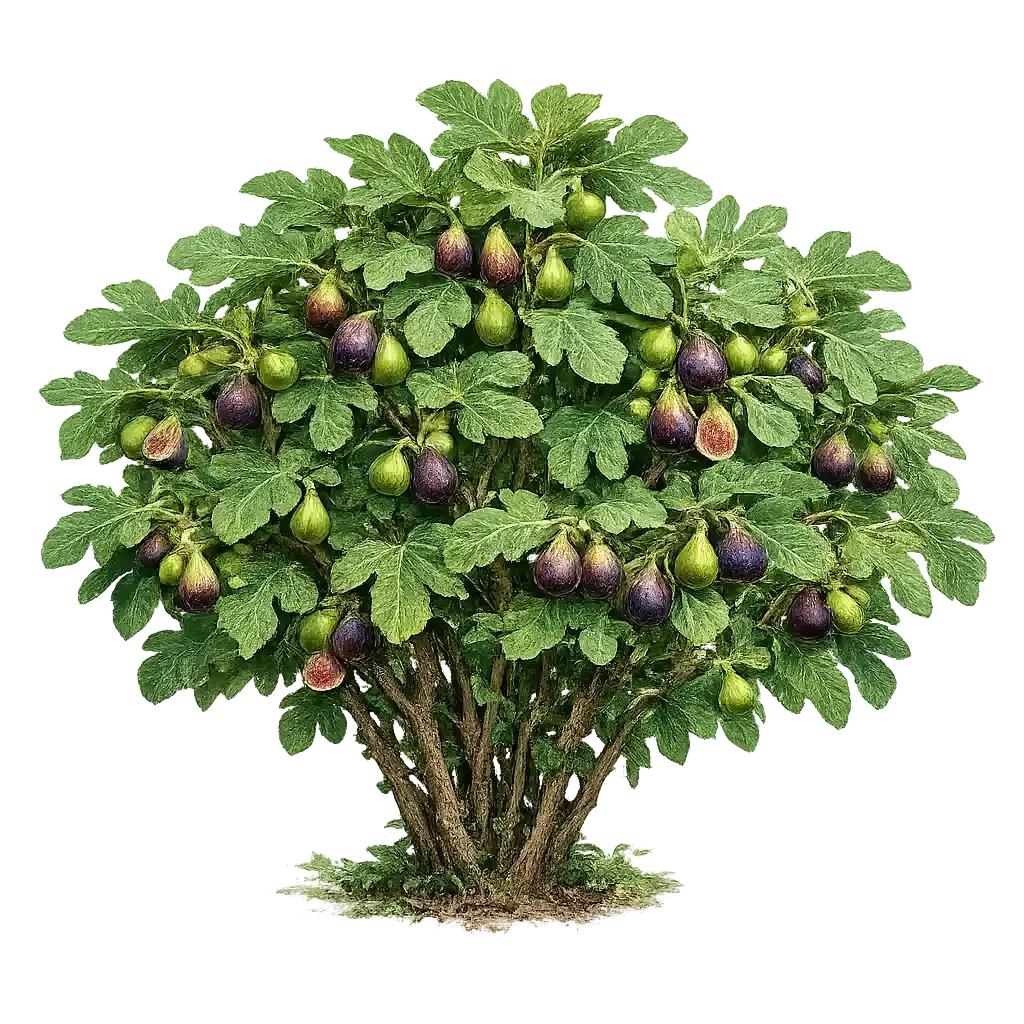
Botanical Name: Ficus carica
Written by Arthur Simitian | simitiannest.com
There are not many fruit trees you can grow that ask this little of you and give this much back. A mature fig tree in the right climate needs almost no spraying, tolerates drought that would kill most other fruit trees, produces two crops per year in warm regions, and delivers fruit with a flavor complexity that fresh figs off the tree have over anything you will find in a grocery store.
The catch is that fig is a Mediterranean plant at heart. It wants heat, it wants dry summers, and it does not love prolonged freezing temperatures. If you live in a warm climate, fig is one of the most productive and low-maintenance fruit trees you can plant. If you live in a colder region, you can still grow it, but you will be doing more work to keep it alive through winter than growers in California, Texas, or the Gulf Coast will ever need to think about.
This is everything you need to know about growing Common Fig on the homestead, from soil and siting to harvesting, preserving, and overwintering in cold climates.
Where It Grows and What It Needs
Common Fig is native to the Middle East and western Asia, with cultivation history going back at least 5,000 years. It is one of the oldest domesticated plants in the world. Today it grows prolifically across the Mediterranean basin, California, the American Southeast, and anywhere that offers long, hot, dry summers and mild winters.
It is hardy in USDA Zones 8 through 11 without any winter protection. In Zones 6 and 7, it can survive with cold protection strategies. In Zone 5, it is marginal and requires significant effort. Below Zone 5, container growing with indoor overwintering is the only reliable approach.
A full-grown fig tree reaches 10 to 30 feet tall and equally wide in an open, multi-branched spreading habit, depending on the variety and how aggressively you prune it. In home gardens and homestead settings, most growers keep them to 8 to 15 feet through annual pruning, which makes harvesting far more manageable. Fig is a deciduous tree, dropping its large, deeply lobed leaves in fall to reveal an attractive gray-barked structure.
Sun: Full sun is essential. Fig needs 8 or more hours of direct sunlight per day for good fruit production. In marginal cold climates, siting the tree against a south-facing wall or fence dramatically improves performance. The wall absorbs heat during the day and radiates it back at night, extending the effective growing season and protecting the tree from temperature swings. This technique, called espalier growing, has been used in northern Europe to grow Mediterranean fruits for centuries.
Soil: Fig is remarkably tolerant of poor soil. It grows in sandy loam, clay, rocky ground, and everything in between. The main requirement is drainage. It does not tolerate waterlogged roots. If your soil is heavy clay and drains poorly, plant the tree on a slight mound or in a raised bed. Soil pH can range from 6.0 to 8.0 with no problems. Do not over-fertilize fig. Excessive nitrogen produces abundant lush foliage and very little fruit. If your tree is growing vigorously and setting poor fruit, stop fertilizing and see what happens. In most average garden soils, established figs need no fertilizer at all.
Water: Young trees need consistent moisture during establishment, roughly the first two growing seasons. Water deeply once or twice per week in dry conditions during the first year. Once established, fig becomes genuinely drought tolerant, more so than almost any other fruit tree you can grow in a temperate climate. Deep, infrequent watering encourages the root system to go deep rather than staying shallow. Overwatering an established fig leads to excessive vegetative growth at the expense of fruit, and in some cases causes fruit splitting or poor flavor from diluted sugars.
Spacing: A fig tree allowed to grow to its natural size needs 15 to 20 feet of clearance in all directions. For a pruned homestead tree kept at 10 to 15 feet, 10 to 15 feet of clearance is adequate. If you are planting multiple trees in a row, 12 to 15 feet between them works well.
The Root System: Extensive and Opportunistic
Fig has an aggressive, wide-ranging root system. The roots follow moisture and can travel significant distances to find it. This means a few practical considerations before you choose a planting site.
Do not plant fig within 20 to 25 feet of underground water lines, sewer lines, or septic systems. The roots are attracted to moisture and organic material and will find their way into any crack or joint in older pipes. This is not a theoretical risk. Fig roots causing pipe damage is a well-documented and genuinely expensive problem.
Do not plant fig immediately next to building foundations, especially older foundations. While fig roots rarely crack solid concrete, they will exploit existing gaps and can cause problems over years.
In open ground away from infrastructure, the spreading root system is an asset. It is part of what makes established figs so drought tolerant and resilient. Roots that reach 20 to 30 feet outward and go several feet deep have access to a huge reservoir of soil moisture that surface-irrigated plants never reach.
For container growing, the root restriction actually encourages fruiting. Container figs in 15 to 25 gallon pots often fruit heavily at a smaller size than in-ground trees. Containers also allow you to move the tree indoors in cold climates, which is the primary reason to container grow in Zones 5 and 6.
Pollination: Most Varieties Need Nothing From You
This is one of the great advantages of Common Fig for home growers. The varieties bred for home cultivation, which make up the vast majority of what you will find at a nursery, are parthenocarpic. The fruit develops without pollination or fertilization of any kind. No bees, no partner tree, no hand pollination needed. A single tree of a common variety like Brown Turkey, Celeste, Black Mission, Chicago Hardy, or Kadota will produce fruit entirely on its own.
There is a category of commercial fig, the Smyrna type, that requires pollination by a specific wasp (Blastophaga psenes) through a process called caprification involving a separate pollinator tree (the caprifig). These are not what you plant on a homestead. If you are buying from a standard nursery and planting a named cultivar bred for fresh consumption, you have a parthenocarpic variety and you do not need to think about pollination at all.
Two Crops Per Year: Breba and Main
In warm climates, the Common Fig produces two distinct crops per growing season. Understanding this matters for how you manage the tree.
The Breba Crop develops on last year's wood, on short spurs and branch tips that overwintered successfully. These fruits swell and ripen in early summer, typically June into July. Breba figs are often larger than main crop figs but fewer in number. In cold climates where the branch tips die back in winter, the breba crop is lost or severely reduced every year because the wood that carries it did not survive. This is one of the hidden costs of winter damage: you lose not just the current year's early fruit but also the capacity that was already set.
The Main Crop develops on the current season's new growth, shoots that pushed out in spring. This is the primary and more abundant harvest, ripening from late summer through fall, typically August through October depending on your variety and climate. In warm zones, the main crop is prolific. A mature tree can produce hundreds of pounds of fruit in a season.
In cold climates where hard freezes kill back branches regularly, you are effectively harvesting main crop figs only, since new wood has to push each spring before fruit can develop. This delays your harvest season and reduces total yield. Selecting cold-hardy varieties like Chicago Hardy, Brown Turkey, or Celeste gives you the best chance of breba crop survival and earlier main crop ripening in shorter seasons.
Timeline: When Do You Get Fruit?
Year 1: A handful of figs, possibly none. Let the tree establish. Any fruit that sets is a bonus.
Year 2: A small crop, 5 to 10 pounds or more depending on climate and variety. Fig establishes faster than many fruit trees and starts producing earlier.
Year 3 to 4: The tree hits its stride. A young but well-established fig in a good climate will produce 20 to 50 pounds of fruit.
Year 5 and beyond: A mature fig in ideal conditions is a prolific producer. Mature trees regularly produce 50 to 100 pounds of fruit per season, and some well-situated old trees in warm climates produce several hundred pounds. The productive lifespan of a fig tree is measured in decades. In the Mediterranean, century-old fig trees are not unusual.
Harvest timing is critical. Figs do not ripen off the tree. Pick them too early and they will sit on your counter hard, tasteless, and slightly gummy from the latex sap. A ripe fig is soft to the touch, hangs slightly downward on the stem rather than pointing upward, may show a small split at the base, and in some varieties will have a small drop of nectar appearing at the eye on the bottom. The stem bends easily and releases with no resistance. Once ripe, figs stay on the tree for only a few days before they begin to ferment or attract insects and birds.
Check the tree every 1 to 2 days during peak harvest. Figs ripen in waves over several weeks, not all at once. A basket and a morning habit of walking the tree will capture most of your crop at peak quality.
What You Can Make: Food and Preservation
Fresh figs are perishable. They soften quickly and bruise easily, which is why they rarely appear in supermarkets in good condition. The flavor of a fresh, fully ripe fig picked from your own tree is in a different category from anything commercially available. The sweetness is dense and honey-like, the texture is soft and jammy, and varieties like Brown Turkey, Celeste, and Black Mission each have distinct flavor profiles worth exploring.
Fresh Eating is the primary reason to grow fig. There is no preparation required. Slice in half, eat with a spoon, or bite directly. Pair with cheese, prosciutto, honey, walnuts, or balsamic reduction for a simple and genuinely impressive appetizer or dessert.
Dried Figs are the most practical long-term storage form. Figs have been dried for preservation for thousands of years. You can sun-dry them in hot, dry climates by splitting and laying them cut-side up on screens for several days, or use a dehydrator at 135 degrees Fahrenheit for 20 to 24 hours. Dried figs store for 6 to 12 months in airtight containers at room temperature, or up to 2 years frozen. The flavor concentrates beautifully during drying.
Fig Jam and Preserves are straightforward to make and shelf-stable when properly canned. Figs are low in acid, so for safe water bath canning, most tested recipes require added lemon juice or citric acid to bring the pH below the 4.6 safety threshold. Do not skip this step with figs. They are among the fruits where the natural acidity alone is not reliable for safe canning without acidification. A batch of jam with 4 pounds of fresh figs, lemon juice, and sugar yields 4 to 5 half-pint jars.
Fig Chutney is an excellent use for figs that are slightly overripe or damaged. Cooked down with onion, vinegar, ginger, and warm spices, fig chutney is a complex condiment that pairs well with grilled meats, cheese boards, and roasted vegetables. Because the high vinegar content lowers the pH, chutney is safely water bath canned without the same acidification concerns as plain fig preserves.
Fig Wine and Fermented Products are traditional in fig-growing regions. Fig wine has a mild, honey-like character with subtle fruit notes. Fig brandy (arak in the Middle East) is a traditional distillate. For home fermentation, fig wine is an approachable project with widely available recipes.
Other products: fig butter, fig balsamic reduction, fresh fig salads, roasted figs with honey, fig-stuffed poultry, fig and olive tapenade, and fig tea made from dried leaves, which has a mild, slightly sweet flavor and has been used in traditional medicine for digestive support.
Medicinal and Nutritional Value
Figs are a meaningful source of dietary fiber, calcium, potassium, magnesium, and vitamins B6 and K. The fiber content is notably high for a fruit, making figs one of the better plant sources for supporting digestive regularity.
Traditionally, fig leaves have been used in folk medicine across Mediterranean and Middle Eastern cultures for blood sugar management, and some modern research has explored compounds in the leaves that may have hypoglycemic effects. Fig latex, the white milky sap that seeps from cut stems and unripe fruit, has antimicrobial properties and has been used topically for wart removal in traditional practice, though it is also a contact irritant for sensitive skin.
The fruit itself contains ficin, a proteolytic enzyme similar to bromelain in pineapple and papain in papaya. This is why figs are a traditional meat tenderizer and why fresh figs cannot be used in gelatin-based desserts without being cooked first, the enzyme destroys the gelatin's setting ability.
Overwintering in Cold Climates
For growers in Zones 6 and 7, winter protection makes the difference between a productive fig and a shrub that dies back to the ground every year and spends all summer trying to recover.
Mulching the roots is the minimum protection. A deep mulch of straw, wood chips, or leaves over the root zone protects the soil from freezing and keeps the roots alive even if the top of the tree dies back.
Wrapping the tree involves bundling the branches together in fall after the leaves drop, then wrapping the bundle with burlap, frost cloth, or straw insulation secured with twine. Some growers build a simple cage of chicken wire around the tree and stuff it with straw. The goal is to protect the branch tips and bud wood from hard freezes so the breba crop wood survives.
Bending and burying is practiced in Zone 5 and colder. After leaf drop, long branches are carefully bent toward the ground and held with stakes, then covered with soil or mulch several inches deep for the winter. The entire tree is effectively buried in insulating earth. In spring, the branches are uncovered and allowed to resume upright growth. This is labor-intensive but allows growers to produce real fig harvests in climates far colder than the tree's normal range.
Container growing is the most reliable cold-climate solution for growers in Zone 5 and below. A 15 to 25 gallon container, moved into an unheated garage or basement in late fall after leaf drop, will keep the tree dormant and protected through winter temperatures that would kill an in-ground planting. Return the container outside in spring after the last frost date. Container figs fruit well and can live in this cycle for many years.
Pros and Cons for the Homestead
Why Plant It
Among the most drought-tolerant fruit trees once established. Genuinely low-maintenance in warm climates with minimal pest or disease pressure. No pollinator required for common varieties. Two crops per year in suitable climates. Fast to bearing, meaningful fruit in year 2 or 3. Exceptionally long productive lifespan measured in decades. Fresh fig flavor is incomparable to anything commercially available. Multiple preservation options including drying, jamming, and fermenting. High nutritional value with significant fiber and mineral content. Ornamental value with attractive lobed leaves and spreading structure. Deer tend to avoid fig due to the milky latex sap, making it lower risk than many other homestead fruits in deer-heavy areas. Thrives in poor soil where other fruit trees struggle.
Why Think Twice
Not suited for climates with cold winters without significant effort and investment in winter protection. Root system can damage pipes and infrastructure if planted carelessly. Fresh figs are extremely perishable, ripening faster than you can process them during peak season. Low acid content means extra care is required for safe water bath canning. The latex sap from stems and unripe fruit is a skin and eye irritant. Without netting or deterrents, birds and squirrels compete aggressively for the harvest. Overwintering in containers requires garage or basement space and annual repotting as the tree grows.
Quick Reference
Zones 8 to 11 without protection, Zones 6 to 7 with winter wrapping, Zones 4 to 5 with container growing
Height 10 to 30 feet unmanaged, 8 to 15 feet with annual pruning
Width 10 to 30 feet, depends on pruning
Root spread is extensive and pipe-seeking, do not plant near water or sewer lines
Full sun, 8 or more hours minimum
Tolerates poor soil, requires good drainage, pH 6.0 to 8.0
Drought tolerant once established, deep infrequent watering preferred
Most home varieties are self-fruitful, no pollinator needed
First real harvest in year 2 to 3
Annual yield is 50 to 100 or more pounds per mature tree in ideal conditions
Two crops per year in warm climates, breba in early summer and main crop in late summer through fall
Top products include fresh eating, dried figs, jam, chutney, and fig wine
Productive lifespan of 50 or more years in suitable climates
Common Fig rewards growers who match it to the right climate with an ease and abundance that few other fruit trees can match. In warm regions it is close to effortless once established. In cold regions it takes annual effort to keep it productive, but the growers who make that effort are rewarded with fruit that cannot be replicated from any store. Site it carefully away from pipes and infrastructure, give it full sun, keep the fertilizer light, and let the summer heat do the work. This is one of the oldest cultivated fruits in human history for very good reason.