Ninebark
Written By Arthur Simitian
Ninebark is one of those native shrubs that has been quietly earning its keep on the North American landscape for millennia while the horticultural world spent decades overlooking it in favor of showier imports. That has changed. Modern breeding has produced a range of foliage color selections spanning deep burgundy through lime green and gold that make ninebark one of the most versatile native shrubs in the contemporary landscape. But the cultivated selections did not create its value. They revealed it. The tough, adaptable, ecologically connected native plant was always there, tolerating wet feet and hard winters and alkaline soils while feeding native bees with its spring flowers and small birds with its persistent seed capsules through autumn and winter. The ornamental selections simply made those qualities impossible to ignore.
This guide covers ninebark completely: its natural history, the species relevant to homestead planting, the wildlife and pollinator contributions it makes, foliage color selection, pruning approach, site adaptability, and everything needed to grow it well and place it wisely.
What Is Ninebark
Ninebark is the common name for shrubs in the genus Physocarpus, a member of the rose family Rosaceae native to North America, with one species native to northeastern Asia. The name refers to the distinctive exfoliating bark of mature stems, which peels away in multiple thin layers to reveal the warm cinnamon-brown inner bark beneath, a characteristic that is particularly attractive in winter when the foliage is absent. Whether the name refers to nine literal layers or simply to the many-layered peeling quality varies by account, but the bark characteristic is consistent across the genus and one of its most distinctive identification features.
The species most relevant to homestead planting in eastern and central North America is common ninebark, Physocarpus opulifolius, native across a broad range from Quebec and the Maritime provinces south through the eastern United States to Georgia and west through the Midwest and Great Plains to Kansas and the Dakotas. It grows naturally along stream banks, woodland edges, rocky slopes, and disturbed ground across this range, reflecting genuine adaptability to a wide range of conditions.
Pacific ninebark, Physocarpus capitatus, is the western North American counterpart, native along stream banks and moist sites from British Columbia south through coastal California to the Sierra Nevada foothills, and is the appropriate species for homestead plantings in the Pacific Northwest and coastal California where local ecological relationships with native insects and wildlife are a priority.
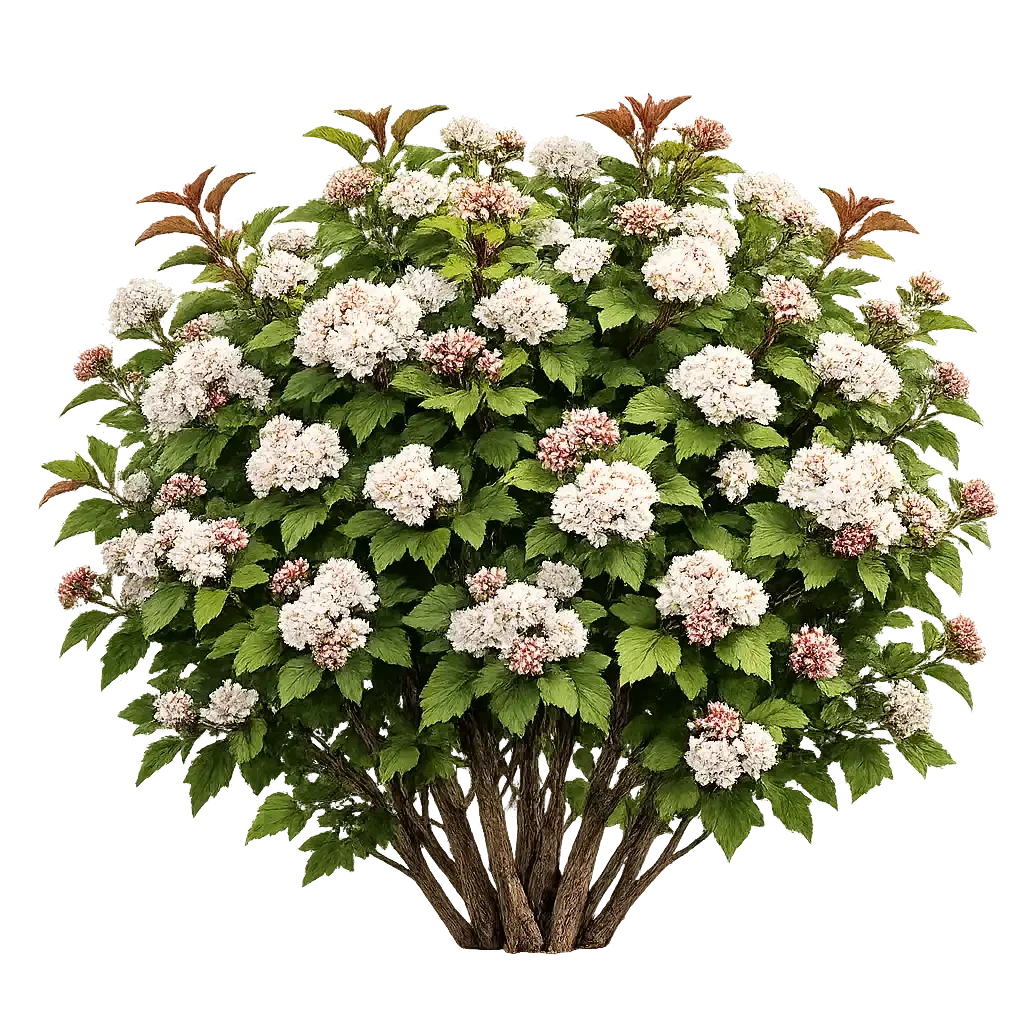
Both species share the fundamental characteristics of the genus: arching, multi-stemmed form, lobed leaves that resemble those of a small maple or viburnum in shape, clusters of small white to pale pink flowers in late spring, and the persistent, inflated red to reddish-brown seed capsules that follow flowering and provide winter interest and bird food through the cold season.
Wildlife and Pollinator Value
Ninebark's ecological value is substantial and spans multiple wildlife functions simultaneously, which is one of the qualities that distinguishes it from ornamental shrubs that are chosen primarily for appearance and contribute little to the living systems of the homestead.
The late spring flowers, typically appearing in late May through June depending on climate and variety, are an important nectar and pollen source for a wide range of native bees. The flower structure, with numerous small individual flowers carrying accessible pollen and nectar in flat-topped to rounded clusters, supports generalist foragers and specialist native bee species equally. Research on native plant-pollinator relationships has identified ninebark as a productive foraging resource for native bumblebees, mining bees, sweat bees, and various other native bee families, as well as for honeybees and a range of butterfly and moth species that visit for nectar.
The persistent seed capsules that follow flowering remain on the plant through autumn and into winter, providing seed food for American goldfinches, pine siskins, and other small seed-eating birds during the period when seed sources in the broader landscape are most limited. This winter seed retention is one of ninebark's most practically important wildlife contributions, and it operates quietly through the coldest months when the plant is otherwise dormant and invisible to the casual observer.
The dense, multi-stemmed arching structure of mature ninebark provides excellent nesting and roosting cover for a range of songbirds. The plant's natural tendency to form dense thickets when multiple stems are allowed to develop creates the kind of interior complexity that small birds prefer for nesting and predator avoidance. Yellow warblers, song sparrows, common yellowthroats, and other shrub-nesting species use ninebark for nesting across significant portions of its native range.
Several species of native caterpillars feed on ninebark foliage, which means the shrub supports the insectivorous bird populations that depend on caterpillars as a high-protein food source, particularly during the breeding season when adult birds are feeding nestlings. A homestead planting of ninebark that shows some caterpillar feeding on the foliage is functioning exactly as a healthy native plant should, and the feeding is rarely significant enough to seriously affect the plant's health or appearance.
The Exfoliating Bark
The peeling, exfoliating bark of mature ninebark stems is one of the plant's most distinctive and underappreciated ornamental features, and it is most visible and most beautiful in winter when the foliage is absent and the light catches the warm cinnamon and russet tones of the inner bark exposed by the peeling outer layers. On mature stems of two to three inches in diameter, the bark peels in long, fibrous strips and ribbons that curl away from the stem surface in patterns that are genuinely attractive in winter light.
This winter bark interest is a meaningful contribution to the homestead landscape during the months when most other shrubs offer little visual engagement. A ninebark planting positioned where winter light reaches the stems, particularly morning or afternoon light that rakes across the stem surface at a low angle, makes the most of this feature through the quiet winter months.
The bark is also the character that gave the plant its vernacular name and that immediately identifies mature ninebark to anyone who knows the plant. On younger stems the bark is smooth and reddish-brown. On older canes of three or more years the exfoliation becomes pronounced, the stem develops visual texture and warmth, and the winter landscape character of the plant is at its most expressive.
Foliage Color and Variety Selection
Modern ninebark breeding has produced a remarkable range of foliage colors from the wild green of the species type, making it one of the most versatile native shrubs for landscape design applications where foliage color contrast is a compositional tool. The full range now spans from the deepest wine-burgundy through purple, bronze-green, and chartreuse to bright lime and gold, with sizes ranging from compact selections of three feet to large shrubs exceeding ten feet.
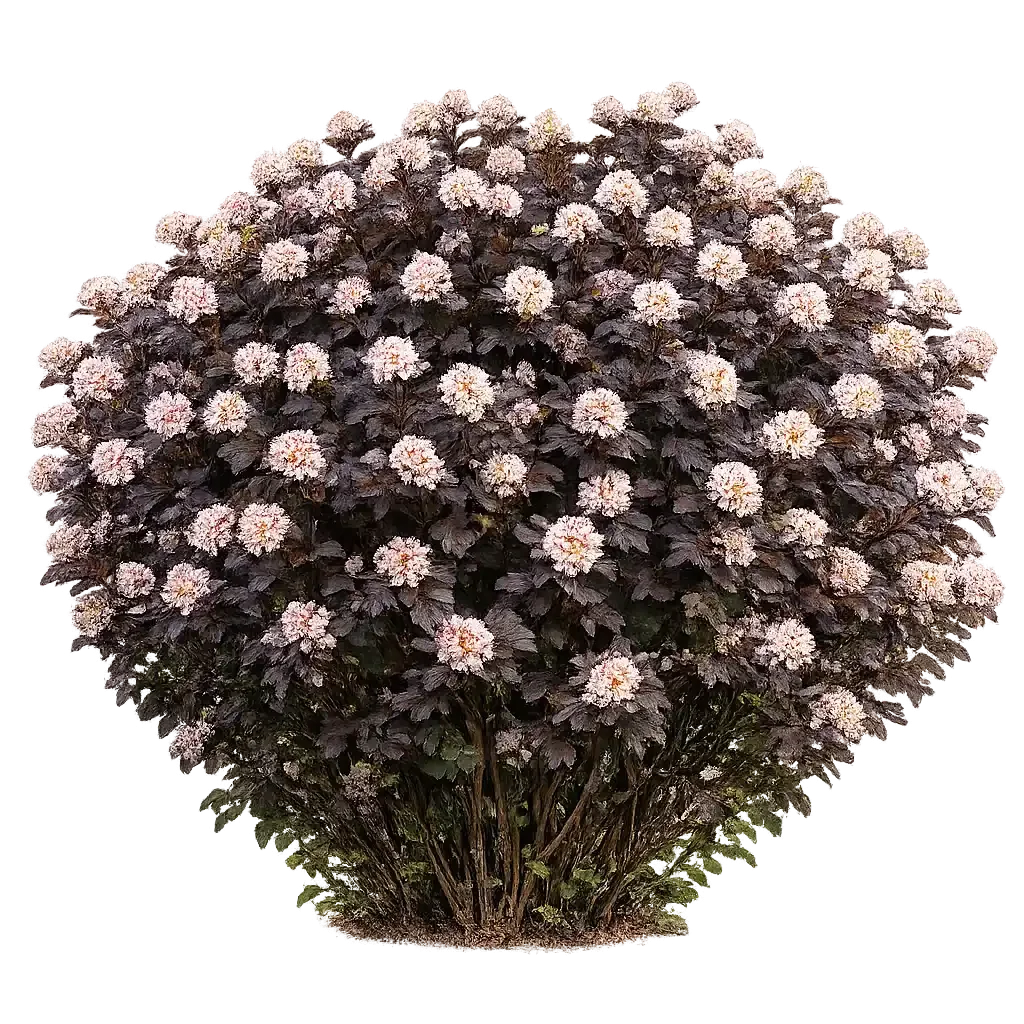
Diabolo is the variety that introduced the dark foliage concept to a wide gardening audience and remains one of the most widely planted large-form dark selections. It reaches eight to ten feet in height and comparable spread with deep wine-purple foliage that is most intensely colored in full sun, fading toward green-purple in partial shade. The size is substantial and requires appropriate space planning.
Coppertina combines bronze-orange to copper foliage in spring with a transition to rich red tones through summer, one of the most dynamic foliage color progressions available in the genus and a selection that rewards close observation across the season. It reaches six to eight feet.
Summer Wine is a more compact dark-foliaged selection reaching four to five feet, with wine-red foliage and a tidier, more rounded habit than Diabolo that makes it appropriate for mixed shrub borders and smaller homestead garden spaces.
Little Devil is among the most compact of the dark-foliaged selections, reaching three to four feet with a dense, mounding habit and deep burgundy foliage. It is one of the best choices for smaller gardens, foundation plantings, and situations where the full-size selections would overwhelm the space.
Center Glow produces a bicolor effect, with deep burgundy-red outer leaves and bright golden-yellow new growth at the center of the plant, creating a torch-like appearance in spring that gradually transitions to a more uniform bronze-green through summer. It reaches six to eight feet.
Dart's Gold is the leading yellow-foliaged selection, producing bright golden-yellow spring foliage that transitions to chartreuse green through summer. It reaches four to five feet and provides strong foliage color contrast against dark-foliaged companions or against green hedgerow backgrounds.
Nugget is a compact golden form reaching three to four feet, appropriate for smaller spaces where Dart's Gold would be too large. Both yellow selections provide the best foliage color in full sun and tend toward green in shade.
For growers prioritizing ecological function over foliage color display, the straight species or unnamed seedling plants grown from local-provenance seed deliver the strongest ecological relationships with native insects and wildlife and are available from native plant nurseries at lower cost than named cultivars. The wildlife value of colored-leaf cultivars is generally comparable to the straight species, as the flowers and seed capsules that provide the primary ecological contributions are not significantly affected by the foliage color trait.
Climate and Growing Zones
Common ninebark is one of the most cold-hardy native shrubs available for the North American homestead, reliably hardy from USDA zone 2 through zone 7 with some selections performing in zone 8. Its native range across the northern tier of North America, including regions with severe continental winters, reflects genuine cold hardiness that makes it one of the most valuable ornamental natives for zones 2 through 5 where the palette of hardy, multi-season-interest shrubs is genuinely limited.
Pacific ninebark is hardy in zones 4 through 8 and is the appropriate species for western homesteads in its native range. Its performance in the mild, wet winters and dry summers of the Pacific Northwest coast is notably better than common ninebark in those specific conditions.
For cold-climate homesteads in zones 2 through 4, ninebark belongs near the top of any native shrub planting list alongside lilac, highbush cranberry, and Siberian peashrub as a plant that combines cold hardiness, ecological value, low maintenance, and multi-season landscape interest more completely than most of the alternatives available.
Sunlight Requirements
Ninebark grows in full sun to partial shade and is one of the more adaptable native shrubs for sites with variable light conditions. In full sun it produces its most compact habit, most intensely colored foliage on colored-leaf varieties, and most prolific flowering. In partial shade of three to four hours of direct sun it grows somewhat more openly and the foliage color on dark and golden varieties is less saturated, trending toward green, but the plant remains healthy and provides good wildlife habitat value.
For maximum foliage color expression on any of the colored-leaf cultivars, full sun is necessary. A Diabolo in partial shade will be adequately purple. The same plant in full sun will be a significantly deeper, more saturated wine-burgundy. The difference is considerable enough that growers choosing ninebark for foliage color contrast should prioritize full sun siting to achieve the variety's characteristic expression.
The straight green-foliaged species is the most shade tolerant and performs acceptably in three to four hours of direct sun, which reflects its natural occurrence as a forest edge and stream bank plant across its native range where filtered or partial light conditions are common.
Soil and Site Requirements
Common ninebark is one of the most site-tolerant native shrubs available for difficult homestead locations, and its adaptability across a wide range of soil types, moisture levels, and pH conditions is one of its most practically useful characteristics. Where other productive shrubs require specific conditions, ninebark simply grows.
It tolerates periodically wet and seasonally flooded soils better than most ornamental shrubs, reflecting its natural occurrence along stream banks and moist riparian edges. This wet-site tolerance makes it a practical choice for low-lying areas, drainage swales, and moist depressions within the homestead landscape that are too wet for standard shrub plantings.
It equally tolerates dry, droughty soils once established, though it grows more slowly and with a somewhat more open habit under drought stress than in moderate moisture conditions. This dry-site tolerance is genuine rather than merely adequate, and established plants in well-drained soils typically survive extended summer dry spells without supplemental irrigation.
Ninebark tolerates a very wide soil pH range from strongly acidic to moderately alkaline, approximately pH 5.0 to 8.0, which is broader than most ornamental shrubs and makes it one of the few reliably performing plants for alkaline soils derived from limestone parent material where pH is a limiting factor for most plants.
It grows on poor, compacted, and disturbed soils that would defeat most ornamental plantings, and its performance on challenging urban and suburban sites where soil quality is compromised by construction and compaction is one of the reasons it has become a standard selection for ecologically minded landscape designers working with difficult sites.
How Far Apart to Plant
3 to 4 feet apart for compact varieties such as Little Devil, Summer Wine, and Nugget in a mixed border or hedgerow planting
5 to 6 feet apart for mid-size varieties such as Coppertina, Center Glow, and Dart's Gold
6 to 8 feet apart for large varieties such as Diabolo developed as specimen shrubs or informal screen plants
4 to 5 feet apart for wildlife hedgerow plantings using the straight species where dense cover for nesting birds is the primary goal
At least 4 feet from structures, fences, and paths to allow for the mature arching spread and maintenance access
When to Plant
Ninebark is best planted in early spring while dormant or in early fall after summer heat has passed. Container-grown plants are available throughout the growing season from nurseries and can be planted at any time with attentive watering, though spring and early fall planting produce the most reliable establishment. Bare-root plants from native plant nurseries are economical for establishing multiple plants in hedgerow and wildlife planting applications and are available in early spring.
Ninebark establishes quickly relative to many other native shrubs and often produces meaningful growth in its first full growing season after spring planting. This relative speed of establishment is a practical advantage on homesteads where new plantings are expected to contribute to the landscape within two to three years of installation.
Planting Process
Choose a site with appropriate sun for the variety selected: full sun for colored-leaf cultivars where foliage color expression is the priority, full sun to partial shade for the straight species in wildlife planting applications. Confirm that the site's moisture conditions match the intended use, keeping in mind that ninebark tolerates both wet and dry extremes with reasonable success.
Dig a planting hole two to three times the width of the container root ball and equal in depth. Ninebark requires no soil amendment on average to poor soils and establishes best without it. On extremely sandy soils where moisture retention is very low, modest compost incorporation at planting supports establishment through the first dry season.
Set the plant at soil level with the crown at or very slightly above grade. Ninebark is not susceptible to crown rot in the way that some shrubs are, but planting at the correct depth is still good practice for long-term establishment.
Backfill with native soil, firm gently around the root ball, and water thoroughly. Create a shallow watering basin around the planting area on droughty sites to direct water to the root zone during establishment.
Apply two to three inches of mulch around the base, keeping it pulled back from the main stems. Mulch is particularly valuable on dry sites where it significantly improves moisture retention through the establishment year.
No fertilization is needed at planting or in subsequent years on average soils. Ninebark establishes and grows well without supplemental feeding in most homestead planting situations.
Watering Needs
Ninebark develops good drought tolerance once established and requires minimal supplemental irrigation from the second year onward on average to moist soils. Its tolerance of both wet and dry extremes means it is less sensitive to the vagaries of rainfall than most ornamental shrubs and requires less attentive management once the root system is established.
During the establishment year, consistent moisture supports strong root development and is the most productive use of supplemental irrigation effort. Deep watering once per week during dry conditions through the first growing season is appropriate on average to dry soils. On naturally moist or riparian sites no supplemental irrigation is needed even in the establishment year.
From year two onward, ninebark on average soils in temperate climates with reasonable summer rainfall typically requires no supplemental irrigation. On very sandy or droughty soils in regions with dry summers, occasional deep watering through August and September maintains better growth and keeps the foliage looking its best through the late season.
Fertilization Strategy
Ninebark requires essentially no fertilization in most homestead planting situations and performs well on soils of average to low fertility without supplemental feeding. On genuinely poor or depleted soils, a light application of compost worked into the soil around the drip line in early spring of the first two to three years after planting supports establishment and improves growth rate, but is not required for the plant to survive and eventually thrive.
Avoid high-nitrogen fertilizers entirely. As with most flowering native shrubs, excessive nitrogen feeding on ninebark produces soft, lush, vegetative growth that is less resistant to pests and disease, and it reduces the energy available for flower and seed production that provides the primary wildlife value. The plant's native habitat on stream banks and rocky slopes, where soil fertility is modest at best, reflects its genuine adaptation to lean conditions.
Pruning Ninebark
Ninebark is one of the more forgiving native shrubs to prune and tolerates a range of approaches from light annual tidying through hard renovation pruning without long-term damage. Understanding what to prune and when is still worthwhile because the approach affects both the plant's appearance and its wildlife contributions.
Ninebark blooms on the previous year's wood, which means spring pruning before the plant flowers will reduce the current season's bloom. The ideal timing for maintenance pruning is immediately after flowering in late June or early July, which allows removal of spent flower clusters and unwanted wood without sacrificing the current season's display or the following season's flower bud development.
Annual renewal pruning for established plants consists of removing dead, damaged, or crossing canes at the base, cutting the oldest and thickest canes at ground level every three to five years to encourage vigorous renewal growth from the crown, and selectively thinning congested areas to improve air circulation through the canopy. This approach maintains plant vigor, keeps flowering and seed production high, and preserves the natural arching form that makes ninebark ornamentally distinctive.
Hard shearing into a formal shape, while technically possible given ninebark's resilience, produces an artificial, balled-up form that eliminates the arching, fountain-like habit that is one of the plant's most attractive natural characteristics and significantly reduces the flower and seed capsule production that provides the primary ecological contributions. Shearing also removes the exfoliating older bark that develops only on canes of several years' age. For most homestead applications, selective renewal pruning is more appropriate than formal shearing.
For overgrown plants that have developed a congested, poorly structured canopy through years without pruning, hard renovation pruning to twelve to eighteen inches above the ground in late winter produces vigorous regrowth from the crown within one growing season, sacrificing one year of flowering for a structurally sound, productive plant thereafter.
Leaving the seed capsules through winter: The persistent reddish seed capsules of ninebark are one of the plant's most wildlife-valuable features through autumn and winter, providing seed food for goldfinches, siskins, and other small birds. Deadheading the spent flower clusters in summer removes this food source before birds can use it. For growers prioritizing wildlife support over a tidy appearance, leaving the seed capsules on the plant through winter and removing them in late winter or early spring when birds have had access to them through the hardest months is the more ecologically considered approach.
Four-Season Landscape Contribution
Ninebark contributes meaningfully to the homestead landscape across three of four seasons, with its most visually quiet period being midsummer when the flowers have finished and the foliage, while attractive, is the only ornamental feature in play.
In spring, the emerging foliage of colored-leaf varieties, particularly the gold and burgundy selections, provides some of the earliest and most saturated foliage color in the landscape before most other woody plants have fully leafed out. The white to pale pink flower clusters appear in late spring and are both ornamentally attractive and ecologically important.
Through summer, the foliage color of selected varieties provides continuous textural and color contrast in the mixed shrub border. The developing seed capsules, green through summer and beginning to color by late July, add visual interest in advance of the full autumn display.
In autumn, the seed capsules ripen to warm reddish-brown tones and the foliage of most varieties colors to orange, yellow, and red before dropping, providing an autumn display that is modest relative to highbush cranberry or serviceberry but still a meaningful contribution to the landscape color sequence.
In winter, the exfoliating bark on mature stems is at its most visible and most attractive, providing the warm cinnamon-brown tones and peeling texture that distinguish ninebark from most other deciduous shrubs in the winter landscape. The persistent seed capsules provide the continuing wildlife food contribution through the coldest months.
Pests and Diseases
Ninebark is one of the healthiest and most pest and disease-resistant native shrubs available for the temperate homestead, requiring essentially no pest or disease management in appropriate growing conditions. This clean bill of health is one of its most practically convenient characteristics for growers who want ecologically productive plants without ongoing intervention.
Powdery mildew occasionally appears on foliage in late summer in humid climates and on plants in still-air sites with poor air circulation. It is cosmetically unpleasant but not a serious health concern for established plants. Ensuring adequate spacing and full sun siting minimizes pressure. The straight species is somewhat more mildew-resistant than some of the cultivated selections, and this should be factored into variety choice for growers in humid climates.
Leaf spot diseases and occasional aphid infestations are sometimes observed without significant plant impact. Natural predator populations manage insect pests adequately on homestead plantings that maintain habitat diversity rather than relying on chemical intervention.
Ninebark has no significant susceptibility to fire blight, verticillium wilt, or the other systemic diseases that affect many other members of the rose family, which is a meaningful practical advantage for growers with these pathogens in the soil from previous plantings of susceptible species.
Pros and Cons of Planting Ninebark
Advantages
Exceptional cold hardiness to zone 2, one of the hardiest native ornamental shrubs available
Tolerates wet soils, dry soils, poor fertility, compaction, and a wide pH range
Significant pollinator value from late spring flowers for native bees and butterflies
Persistent seed capsules provide critical winter food for goldfinches and siskins
Dense structure provides excellent nesting and roosting cover for songbirds
Exfoliating bark provides distinctive ornamental interest through winter
Wide range of foliage color selections from deep burgundy through gold
Establishes quickly and tolerates hard renovation pruning without permanent damage
No serious pest or disease concerns in appropriate growing conditions
Native to North America with strong ecological relationships to local insects and wildlife
Limitations
Deciduous, providing no winter screening or evergreen structure
Foliage color on cultivars is less saturated in partial shade, requiring full sun for best expression
Powdery mildew can affect foliage in humid climates with poor air circulation
Blooms only for two to three weeks in late spring with no repeat flowering
Pruning at the wrong time reduces the following season's flower and seed production
Large varieties such as Diabolo require significant space and can overwhelm smaller gardens
No edible fruit value for human harvest, unlike some other shrubs in this series
Placement and Companion Planting
Ninebark is one of the most versatile native shrubs for placement within a diverse homestead planting because its adaptability to site conditions, its range of sizes and foliage colors, and its multi-season contributions make it a useful compositional anchor alongside a wide range of companion plants.
Dark-foliaged varieties such as Diabolo and Summer Wine provide strong foliage color contrast alongside native wildflowers and grasses in a meadow edge planting. The burgundy foliage is particularly effective as a backdrop for yellow and orange flowering perennials in summer. Against white-flowering companions such as native meadowsweet or elderberry, the dark foliage is at its most dramatic.
In a mixed native hedgerow combining wildlife habitat and informal screening, ninebark planted alongside highbush cranberry, American hazelnut, elderberry, and native viburnums creates a layered, ecologically connected planting that collectively provides spring through winter wildlife support across a sequence of flowering, fruiting, and seed production that no single species accomplishes alone.
On wet sites and riparian edges, ninebark planted alongside native willows and buttonbush creates a productive wet-site community that combines the pollinator contributions of all three genera with the structural habitat diversity that different plant forms and heights provide.
Gold-foliaged varieties such as Dart's Gold and Nugget are effective as foliage contrast elements in mixed borders where the bright yellow-green provides visual lightness against darker-foliaged companions, and they are less somber in enclosed or partially shaded settings than dark selections where foliage color is already muted.
Long-Term Planning Considerations
Ninebark planted on an appropriate site is a long-term fixture of the homestead landscape that improves with age as the root system deepens, the multi-stemmed canopy fills, and the older canes develop the exfoliating bark character that is most expressive on mature wood. It is not a plant that requires replacement on any foreseeable time horizon: well-managed ninebark plantings persist and remain productive for decades.
The most important long-term planning consideration is size. Full-size varieties such as Diabolo reach eight to ten feet in height and spread and require that space to perform well and look their best. Planting them in spaces appropriate for compact varieties results in a congested, overgrown plant that requires constant management and never achieves the arching, fountain-like form that makes the species ornamentally compelling. Matching variety size to available space at planting is a decision worth getting right.
For the cold-climate homestead assembling a long-term native shrub community, ninebark belongs in the plan from the beginning. It fills the zone 2 to 7 native shrub category with more versatility, more site adaptability, and more year-round landscape contribution than most of its alternatives, and it does so without the pest concerns, maintenance demands, or ecological limitations that make some other options less satisfying over a long time horizon.
Final Thoughts
Ninebark is the native shrub for the homestead grower who has been told there is no attractive, ecologically productive, low-maintenance option for their difficult site. It tolerates the wet corner, the compacted slope, the alkaline soil over limestone, the hard continental winter, and the partial shade at the forest edge. It feeds the bees in June and the goldfinches in January. Its bark glows cinnamon-warm on a grey February morning. Its burgundy or gold foliage earns its compositional weight from the first day of the growing season.
It has been doing all of this across North America, largely unnoticed by the gardening world, for a very long time. The modern cultivars made it harder to ignore. The ecological case for planting it was always there.