
Red-Osier Dogwood
Written By Arthur Simitian
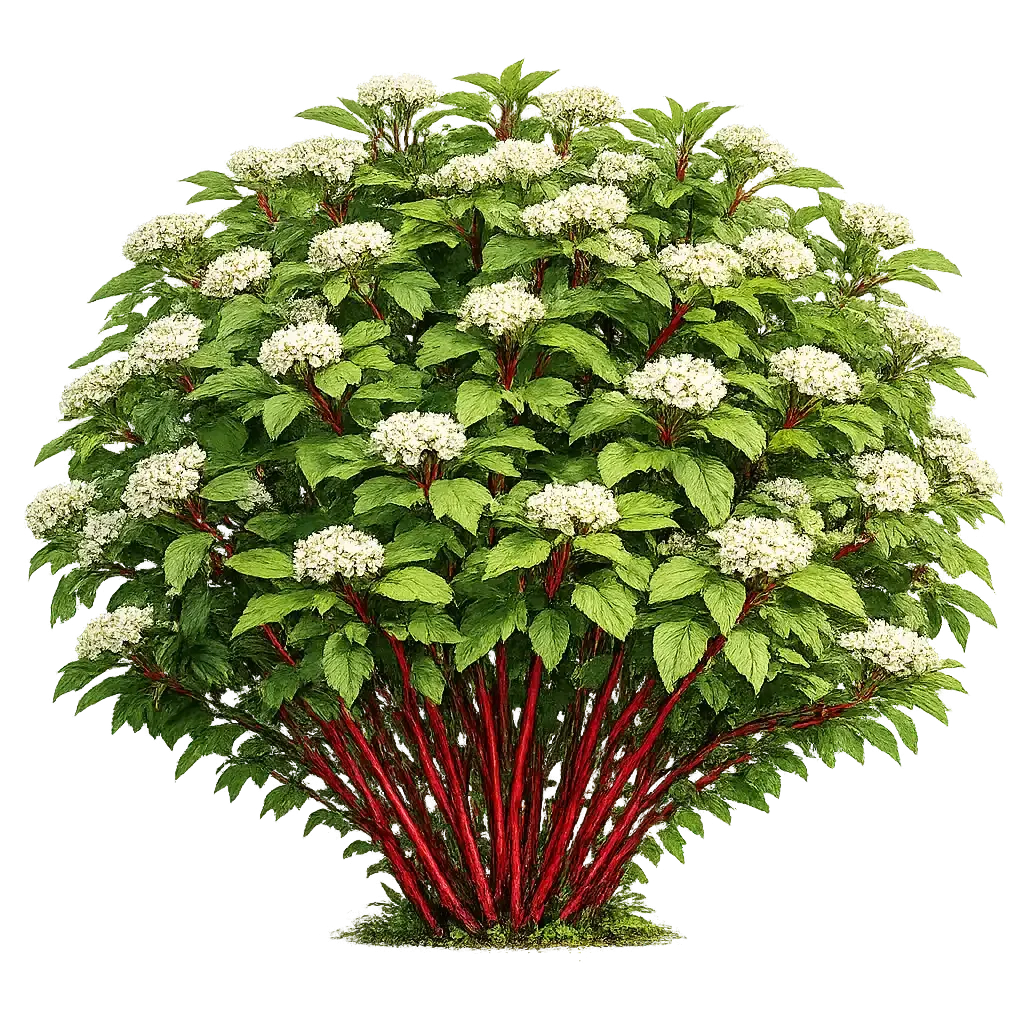
When everything else in the winter landscape has retreated to brown and gray, red-osier dogwood stands out like a brushstroke of pure color. A mass planting of this native shrub in winter, its stems ranging from coral pink on the youngest growth through vivid scarlet to deep wine-red on the older canes, is one of the most striking landscape features available in the cold-climate homestead at the time of year when striking landscape features are most rare and most welcome. That winter stem display is the quality that gets red-osier dogwood planted. The pollinator value of its flowers, the wildlife feeding value of its fruit, the stream bank stabilization it delivers from its fibrous root system, and its exceptional tolerance of wet and difficult sites are the qualities that keep it earning its place for every month of the fifty-one weeks when it is not performing that winter show.
This guide covers red-osier dogwood from the ground up: what it is, the species and varieties worth knowing, the critical pruning practice that maintains stem color intensity, its wildlife and ecological contributions, site requirements and tolerances, and the management approach that brings out its best across all four seasons.
What Is Red-Osier Dogwood
Red-osier dogwood, Cornus sericea, is a deciduous native shrub in the dogwood family Cornaceae, distributed across an enormous range of northern North America from the Atlantic coast to the Pacific, and from the northern United States deep into boreal Canada and Alaska. Few native shrubs occupy a comparably wide natural range, and this distribution across so many different climates, soils, and plant communities reflects the genuine adaptability that makes red-osier dogwood one of the most consistently useful native plants for a wide range of homestead sites and regions.
The plant grows as a large, multi-stemmed, suckering shrub reaching six to ten feet in height and spreading outward through root suckers to form thickets of variable width depending on site conditions and management. In its natural riparian and wet-site habitat it often forms extensive colonies along stream banks, pond margins, and seasonally flooded lowlands, which is a visual expression of both its aggressive suckering habit and its strong preference for moist to wet growing conditions.
The stems are the defining ornamental feature. Young stems produced in the current growing season are the most intensely colored, ranging from coral to brilliant scarlet to deep red depending on the variety and the intensity of light exposure, and the color is most vivid in the dormant winter season after the leaves have dropped. As stems age through their second and third years, the color fades toward dull reddish-brown and eventually gray-brown on the oldest wood. This age-related color fading is the key fact governing the pruning approach discussed later in this guide.
The leaves are oval to lance-shaped with the strongly parallel veining characteristic of the dogwood genus. In summer they are medium green and unremarkable. In autumn they color to shades of orange, red, and burgundy before dropping, providing a modest but pleasant fall display. The flowers appear in late spring and early summer as flat-topped clusters of small, creamy white blossoms. The fruit that follows ripens to white or pale blue-white and is consumed eagerly by a wide range of bird species through late summer and fall.
Yellow-twig dogwood, Cornus sericea 'Flaviramea', is a yellow-stemmed variety of the same species rather than a separate plant, producing stems of clear chartreuse-yellow rather than red on the current season's growth. It is managed identically and provides a striking color contrast when planted alongside red-stemmed forms in a mixed winter display.
The Winter Stem Display and Why It Matters
The winter stem color of red-osier dogwood is not merely decorative. It is the feature that makes this plant a genuinely unique contribution to the homestead landscape, filling the visual and psychological gap that the cold season imposes on gardens where every other deciduous plant has become a collection of gray and brown sticks from November to April.
The stems color most intensely after the leaves drop in autumn and remain vivid through the winter months until the buds break in spring. The color is brightest on the youngest growth, the current season's stems and those of one year old, and is enhanced by cold temperatures and by maximum light exposure. A red-osier dogwood planting that receives full winter sun glows with considerably more intensity than the same plant in a shaded location where the color, while still present, is subdued.
Snow enhances the display dramatically. A planting of red-osier dogwood rising from a snow cover is one of the most classically beautiful winter landscape compositions in the cold-climate plant palette, and growers who experience it for the first time often immediately consider where they can add more plants. The contrast of saturated red stems against white snow in winter light, particularly the low-angle light of a clear winter afternoon, is difficult to replicate with any other plant material.
Siting the planting where it is visible from the most frequently used interior windows of the homestead, and where winter sun reaches the stems, maximizes the return from this feature through the months when it matters most. A planting that is only seen from outside the house, or that is shaded by buildings or evergreen trees through the winter, delivers a fraction of the visual value of one positioned for regular viewing from a warm interior.
Coppicing for stem color: The most intensely colored stems are the youngest. A red-osier dogwood that is never pruned develops an increasing proportion of old, dull-colored wood and progressively loses the vivid winter display that makes it worth planting. Cutting the entire plant or a portion of it to near ground level every two to three years resets the stem age and ensures that the majority of the above-ground growth is young, intensely colored wood. This is the single most important management practice for maintaining the plant at its ornamental best through winter.
Wildlife and Ecological Value
Red-osier dogwood is among the most ecologically productive native shrubs available for the North American homestead, supporting wildlife at multiple trophic levels simultaneously and providing ecological functions that span every season of the year.
The creamy white flower clusters of late spring and early summer are a significant nectar and pollen source for native bees, particularly bumblebees, sweat bees, and mining bees that forage on the flat-topped flower clusters where nectar and pollen are fully accessible to a wide range of insect body sizes. The flowering period overlaps with the active colony-building phase of most native bee species and provides resources at a time when the demand from growing populations is high.
The fruit is one of the most important wildlife foods produced by any native shrub in red-osier dogwood's range. The white to pale blue-white drupes ripen in mid to late summer and are consumed by an exceptionally diverse assemblage of bird species including veeries, robins, thrushes, catbirds, cedar waxwings, woodpeckers, ruffed grouse, wild turkey, and many others. Research on migrating songbirds has identified dogwood fruit as one of the highest-fat native foods available during the fall migration period, when fat accumulation for the journey is a biological priority. A productive red-osier dogwood planting during migration is, in practical terms, a fueling station for birds in transit.
Mammals including black bears, raccoons, foxes, and white-tailed deer consume the fruit and browse the foliage and stems. Beavers use the stems as a food source and building material in riparian plantings where beavers are present. Moose browse the stems in boreal regions.
The dense, arching, multi-stemmed thicket structure of established red-osier dogwood provides nesting cover and protection from predators for a wide range of ground-nesting and shrub-nesting birds. Common yellowthroat, song sparrow, yellow warbler, and alder flycatcher all commonly nest within or adjacent to red-osier dogwood thickets. The proximity of this nesting cover to the reliable fruit and insect food supply the plant provides creates a self-contained habitat feature that concentrates bird activity and makes red-osier dogwood one of the most bird-productive single shrubs available.
More than a hundred species of Lepidoptera, the moths and butterflies, have been recorded using dogwood species as larval host plants in eastern North America. This larval host function supports both the butterfly and moth populations themselves and the insectivorous birds that depend on caterpillars as the primary protein source for raising nestlings during the breeding season.
Erosion Control and Stream Bank Stabilization
Red-osier dogwood's root system is one of its most practically useful characteristics for homestead land management, particularly on wet sites, stream banks, and slopes subject to erosion. The extensive, fibrous root network spreads widely from the base of established plants and binds soil particles with exceptional effectiveness, making it one of the standard plant specifications for riparian restoration and stream bank stabilization projects across its native range.
On stream banks subject to periodic flooding and hydraulic erosion, red-osier dogwood planted at or slightly above the water line stabilizes the bank through both the physical binding of the root network and the hydraulic roughness created by the above-ground stems, which reduce water velocity during flood events and trap transported sediment. Established plantings stop active bank erosion and begin rebuilding the bank profile over several seasons by accumulating the sediment that the slowed water drops as it passes through the stems.
On slopes with sheet erosion and the beginnings of rill development, red-osier dogwood planted on contour across the slope intercepts runoff and forces infiltration. Its tolerance of the seasonally saturated soils that develop upslope of a contour planting makes it more appropriate for this application than many other erosion control shrubs that require better drainage.
The suckering habit that can be a management challenge in garden settings is an asset in erosion control applications, where the progressive expansion of the root system from the original planting continues to bind an increasing area of soil over time without any additional planting input.
Climate and Growing Zones
Red-osier dogwood is reliably hardy from USDA zone 2 through zone 7, with its native range extending into boreal Canada and Alaska at the cold extreme. This exceptional cold hardiness makes it one of the most valuable ornamental native shrubs for zone 2 and 3 homesteads where the palette of plants combining ornamental quality, ecological function, and reliable cold performance is genuinely limited.
At the warm edge of its range in zone 7, red-osier dogwood performs adequately on moist sites with some afternoon shade in hot climates, but it is noticeably less vigorous and less productive than in zones 3 through 6, where its native climate preferences are most fully met. For zone 8 and warmer homesteads, other dogwood species including the native flowering dogwood, Cornus florida, or the cornelian cherry, Cornus mas, are more appropriate choices.
The combination of zone 2 cold hardiness and preference for wet sites fills a specific niche for northern homesteads: productive, ornamentally distinctive, ecologically connected native shrub planting on the wet ground that cold-climate growers often struggle to use effectively. Red-osier dogwood, highbush cranberry, native willows, and ninebark together constitute a native wet-site shrub community for cold climates that covers this challenging niche comprehensively.
Sunlight Requirements
Red-osier dogwood grows in full sun to partial shade, though the intensity of the winter stem color is directly related to light exposure. In full sun the stems are the most vivid, most saturated red. In partial shade the color is still present but noticeably more muted, and in dense shade the color expression is weak enough that the plant's primary ornamental value is largely lost.
For plantings where the winter stem display is the primary ornamental goal, full sun or at minimum six hours of direct sun is the appropriate standard. For wildlife habitat plantings in woodland edges and partially shaded stream banks where the flower and fruit contributions are the primary value, three to four hours of direct sun is adequate for productive flowering and fruiting.
On riparian sites where the plant grows in full sun above the water line and in partial shade from adjacent tree canopy simultaneously, the stems exposed to full sun show notably more intense color than those in the shaded interior of the same planting, and this variation in color intensity across a single mass planting can be visually interesting rather than problematic.
Soil and Site Requirements
Red-osier dogwood is one of the most wet-site-tolerant productive shrubs available, thriving in conditions that range from consistently moist soils through periodically flooded ground to the margins of standing water. It grows naturally along stream banks, pond edges, wet meadows, swamp margins, and seasonally flooded lowlands across its range, and this natural habitat distribution is the most reliable guide to where it performs best in homestead plantings.
On average, well-drained soils with supplemental irrigation it grows adequately, but it reaches its full size, productivity, and ornamental potential most readily on genuinely moist to wet sites. This is a plant for the wet spots, the low corners, the stream margins, and the drainage swales of the homestead, sites that are often the most management-challenging and the least productively used. On these sites red-osier dogwood is in its element and performs with an energy and abundance that clearly reflects the match between plant and place.
It tolerates a wide range of soil types from heavy clay through loam to sandy soils, provided moisture is adequate. Soil pH tolerance is broad, from mildly acidic to moderately alkaline. It grows on poor, lean soils without significant fertility inputs and responds generously to higher fertility when available, which means the nutrient-loaded soils of riparian zones receiving agricultural runoff are particularly productive for it.
Managing the Suckering Habit
Red-osier dogwood spreads by root suckers that arise from the expanding root system and can colonize a considerable area around the original planting over time. In natural riparian and wetland settings this suckering is part of the ecological function, creating the dense thickets that provide habitat structure and bank stabilization. In homestead garden settings it requires management to keep the planting within intended bounds.
The most practical management approach for contained garden plantings is to run a spade or edging tool around the planting perimeter each spring, severing any suckers that have emerged beyond the desired boundary before they have the chance to develop into significant stems. This annual boundary maintenance is a modest effort and is sufficient to prevent the planting from expanding into adjacent areas.
For wildlife habitat and riparian plantings where a naturalistic, expanding colony is the goal rather than a contained planting, the suckering habit is an asset that requires no management. The expanding root system progressively improves stream bank stabilization and the increasing canopy density improves nesting cover and fruit production without any management input.
A mown grass strip or maintained path along the edge of a garden planting creates a simple physical barrier that prevents suckering into adjacent lawn or bed areas and makes the boundary management visible and straightforward.
How Far Apart to Plant
3 to 4 feet apart for a dense wildlife hedgerow or stream bank stabilization planting where rapid canopy closure and maximum root binding are the goals
4 to 5 feet apart for a mixed native shrub border where red-osier dogwood is one of several species
5 to 6 feet apart for specimen or small group plantings where the individual plant's arching form is the ornamental focus
Continuous staggered planting at 18 to 24 inch spacing for maximum stream bank stabilization on actively eroding riparian sites
At least 4 feet from structures, fences, and underground utilities to allow for suckering expansion and root system development
When to Plant
Red-osier dogwood is best planted in early spring while dormant or in early fall after summer heat has passed. Container-grown plants establish at any time during the growing season with attentive watering, but spring and early fall planting produce the most reliable establishment with the least irrigation demand. Bare-root plants from native plant nurseries are available in early spring and are economical for establishing larger plantings on stream banks and wetland margins.
Red-osier dogwood roots readily from hardwood cuttings taken in late winter, which means that growers who have access to established plants or can source cutting material can propagate their own plants at essentially no cost in the same way as willows. The rooting success rate from dormant hardwood cuttings pushed directly into moist soil is high, though somewhat lower than willow. This free propagation pathway makes large-scale stream bank and erosion control plantings economically accessible for homesteads with suitable sites.
Planting Process
Choose the site with moisture conditions in mind first. Red-osier dogwood planted on a genuinely moist to wet site will establish quickly and perform powerfully. The same plant on a dry, well-drained site will survive but will be a perpetual underperformer. If the site is not naturally moist, supplemental irrigation planning is necessary before planting.
Site for winter sun visibility if the stem display is a primary goal. Identify where the plant will be most visible from interior windows during the months of November through March and ensure that winter sunlight reaches those stems for maximum color intensity.
Dig a planting hole two to three times the width of the root ball and equal in depth. No soil amendment is needed on average to fertile soils. On very poor sandy soils, modest compost incorporation supports establishment on a site where moisture may be limiting.
Set the plant at soil level with the crown at grade. Water thoroughly and apply two to three inches of mulch around the base, keeping it pulled back from the main stems. On riparian and naturally moist sites, mulch is less critical but still beneficial through the first growing season.
Mark the intended boundary of the planting with a physical edge or a mown strip at planting time, and begin the annual suckering management routine from the first growing season. Establishing the containment habit early is much easier than trying to reclaim territory that the plant has already colonized.
Coppice Management for Stem Color
The management practice most central to red-osier dogwood's performance as an ornamental plant is coppicing, cutting the stems back to near ground level on a regular rotation to maintain a high proportion of young, intensely colored stems in the planting. Without this renewal pruning, the proportion of old, dull-colored wood increases year by year and the winter display becomes progressively less vivid until the planting looks little different from any other deciduous shrub in winter dormancy.
A full coppice, cutting all stems to six to twelve inches above the ground, is the most straightforward approach for small to medium plantings where the entire plant can be managed at once. Carry this out in late winter or very early spring before the buds break. The regrowth from the cut stools in the following season produces the most intensely colored stems of any in the plant's cycle, and the winter display in the season following a full coppice is typically the most spectacular the planting will produce.
For larger plantings or for growers who want to maintain some height and mass in the planting while still renewing the stem color, a rotation coppice on a third or half of the planting each year maintains continuous color while preserving some structural height. Under this approach the planting always contains a mix of very young, intensely colored stems and somewhat older, moderately colored stems, with no dull old wood allowed to accumulate beyond three years.
Coppicing also manages the size of the planting, preventing it from reaching the full ten-foot height of uncoppiced plants and keeping it at a more manageable four to six feet where the winter stem display is visible from eye level rather than obscured by its own mass.
Watering Needs
On naturally moist to wet sites, red-osier dogwood requires no supplemental irrigation at any stage of its establishment or mature life. The plant's native habitat on stream banks and pond margins reflects a genuine preference for conditions where soil moisture is consistently high, and on such sites it grows and performs without any water management input beyond the natural hydrology of the site.
On average soils in temperate climates with moderate summer rainfall, supplemental watering during the establishment year supports root development and reduces transplant stress. From year two onward on average soils, supplemental irrigation is needed only during extended drought, and the plant will show clear visual stress from wilting and leaf curl before any permanent damage occurs, providing time to respond before serious harm is done.
On dry, droughty soils, red-osier dogwood is a poor choice regardless of irrigation availability. The water investment required to maintain it on genuinely dry sites is better directed toward plants with lower moisture requirements, and the plant will never reach its productive potential or full ornamental value under chronic moisture limitation.
Fertilization Strategy
Red-osier dogwood requires minimal fertilization on average to fertile soils and performs well without supplemental feeding in most homestead planting situations. On the naturally fertile riparian soils of stream banks and wet meadows that represent its optimal habitat, no fertilization is ever needed. On leaner soils away from natural nutrient sources, a light annual application of compost around the drip line in early spring supports good growth through the establishment years.
As with most native fruiting shrubs, avoid high-nitrogen fertilizers that stimulate excessive vegetative growth at the expense of flowering and fruiting. The ecological value of the planting is delivered primarily through the flowers and fruit, and feeding practices that prioritize balanced, moderate nutrition over rapid vegetative growth are most consistent with the plant's intended function.
Variety Selection
The straight species, available from native plant nurseries as regionally sourced seedling plants, is the best choice for wildlife habitat and stream bank stabilization plantings where local ecological relationships with native insects and wildlife are a priority. Local-provenance material carries the strongest genetic adaptation to local climate and soil conditions and develops the most complete relationships with local pollinators and birds.
Cardinal is a selected variety with notably more intense stem color than average seedling plants, producing a brighter, more saturated scarlet on young growth that is valued for high-visibility winter plantings. It is the standard selection for ornamental winter display applications.
Isanti is a compact selection reaching four to five feet rather than the six to ten feet of the standard species, with good stem color and a tidier, more contained habit appropriate for smaller homestead garden spaces and mixed shrub borders where the full-size species would overwhelm the planting.
Flaviramea, the yellow-twig dogwood, is the yellow-stemmed form discussed earlier. Planted alongside Cardinal or the straight species in a mixed winter display, the contrast between scarlet and yellow-green stems is one of the most striking winter landscape compositions available from native material. It is managed identically to the red-stemmed forms and requires the same coppice rotation to maintain stem color intensity.
Baileyi is a selection noted for reliability in the coldest zones, performing strongly in zone 2 conditions where even the straight species can be marginal. For homesteads in the very coldest temperate climates it is worth seeking out over generic seedling material.
Pests and Diseases
Red-osier dogwood is generally healthy and free of serious pest and disease problems in appropriate moist growing conditions, which is one of its most practically convenient characteristics. Its main vulnerabilities appear primarily when it is grown in conditions that are too dry or too warm for its preferences, reflecting the stress-driven nature of most disease susceptibility in plants.
Dogwood sawfly larvae, which feed in groups on the foliage and can cause significant defoliation on individual stems, are the most commonly noted pest. Defoliation is alarming in appearance but rarely a serious threat to the long-term health of established plants, and natural predator populations typically suppress sawfly outbreaks within one to two seasons. On newly planted or very young plants, hand removal of the distinctive larval clusters before they disperse is effective and practical.
Scale insects can colonize stems on plants under stress, particularly drought stress, and are most effectively managed by maintaining the moist site conditions the plant prefers. A dormant oil application in late winter addresses established scale populations without chemical residue concerns.
Fungal leaf spots and cankers occasionally appear, most commonly on stems that have been damaged or stressed. On vigorously growing plants in appropriate conditions these are minor issues. The coppice rotation that removes old wood regularly also removes any stem cankers that have developed on older canes, which is an incidental management benefit of the routine renewal pruning approach.
Pros and Cons of Planting Red-Osier Dogwood
Advantages
Brilliant scarlet winter stem color is among the most striking ornamental features available in the cold-climate landscape
Hardy to zone 2, one of the most cold-tolerant ornamental native shrubs
Fruit is one of the most important wildlife foods in its range, consumed by an exceptionally wide range of bird species
More than a hundred Lepidoptera species use dogwood as a larval host
Exceptional stream bank stabilization and erosion control on wet and riparian sites
Thrives in persistently wet, flooded, and poorly drained conditions where most shrubs fail
Roots readily from hardwood cuttings, enabling free propagation for large plantings
Coppice management is simple and produces rapid, vigorous regrowth
Yellow-twig form provides contrasting winter stem color when planted with red forms
No invasiveness concerns as a native species across most of North America
Limitations
Requires coppicing every two to three years to maintain vivid winter stem color
Suckering habit requires active boundary management in contained garden settings
Performs poorly on dry, droughty sites regardless of supplemental irrigation
Deciduous, providing no winter screening or evergreen structure
Not appropriate for zones 8 and warmer where heat limits performance
Full stem color intensity requires full sun siting in winter
White fruit is not edible for humans in any practical culinary sense
Dogwood sawfly can cause alarming but typically temporary defoliation
Long-Term Planning Considerations
Red-osier dogwood planted on a genuinely appropriate wet or riparian site and managed with a consistent coppice rotation becomes one of the most reliable and self-sustaining elements of the homestead landscape over the long term. The root system deepens and broadens progressively, improving stream bank stabilization and nutrient filtration. The established crown produces increasingly vigorous regrowth after each coppicing. The fruit production grows more abundant as the planting matures. And the winter stem display, renewed by each coppice cycle, remains consistently vivid year after year without any decline in quality.
The most important long-term planning considerations are matching the planting to a genuinely moist or wet site, establishing the coppice rotation as a regular management practice from the first years after planting, managing the suckering boundary actively to prevent unwanted expansion into adjacent areas, and siting the planting where the winter stem display is visible from the places on the homestead where people spend the most time during the winter months.
For homesteads with wet ground, stream banks, drainage swales, or pond margins that are currently unused or problematic, red-osier dogwood offers one of the most complete transformations available: a management challenge converted into a productive, ecologically rich, ornamentally significant, and largely self-sustaining element of the homestead landscape. That transformation, accomplished by a native plant that has been performing it on North American riparian landscapes for thousands of years, is one of the more satisfying outcomes available to the thoughtful long-term land manager.
Final Thoughts
Red-osier dogwood is the answer to the question that every cold-climate homesteader with a wet corner or a stream bank eventually asks: what can I plant here that will actually thrive rather than merely tolerate the conditions, contribute something ecologically meaningful, and give me a reason to look at it in the middle of January? The answer is a plant that has been answering that question along the stream banks and pond margins of North America since before anyone thought to ask it.
Give it wet ground and winter sun. Coppice it every few years. Manage the suckers at the edges. Then stand at the kitchen window on a clear January afternoon when the snow is down and the light is coming in low from the southwest, and watch the stems glow.