
Sagebrush
Written By Arthur Simitian
Sagebrush is the defining plant of the American West. From the Great Basin to the Intermountain Plateau, from the foothills of the Rockies to the high desert valleys of the Columbia Basin, the silver-gray canopy of sagebrush covers more land area than any other shrub type in North America. That dominance is not accidental. Sagebrush succeeds in conditions that defeat most plants: thin, alkaline, droughty soils, temperature swings of more than a hundred degrees between summer and winter, and precipitation that arrives primarily as snow and delivers perhaps eight to fourteen inches of moisture in a good year. For the dry-land homestead in this geography, sagebrush is not merely a landscape option. It is the baseline from which everything else is measured, and understanding it, working with it rather than against it, and restoring it where it has been degraded, is one of the most ecologically productive investments a western homesteader can make.
This guide covers sagebrush for the homestead context: the species worth knowing and distinguishing, the extraordinary wildlife community it supports, its aromatic and medicinal value, what it requires to establish from transplant or seed, how it fits into the dry-land homestead planting plan, and the honest accounting of where it thrives and where it does not.
What Is Sagebrush
Sagebrush is the common name for shrubs in the genus Artemisia, specifically those woody species native to the arid and semi-arid regions of western North America. The genus is large and cosmopolitan, containing several hundred species distributed across temperate and arid regions of the Northern Hemisphere, but the sagebrushes of the American West form a distinct and ecologically coherent group within it. They are not related to culinary sage, which belongs to the genus Salvia, despite the shared common name and the superficially similar aromatic foliage. The fragrance of sagebrush, one of the most evocative scents in the western landscape, comes from a distinct suite of aromatic volatile compounds including camphor, terpinene, and various sesquiterpenes that are chemically quite different from the compounds responsible for culinary sage's fragrance.
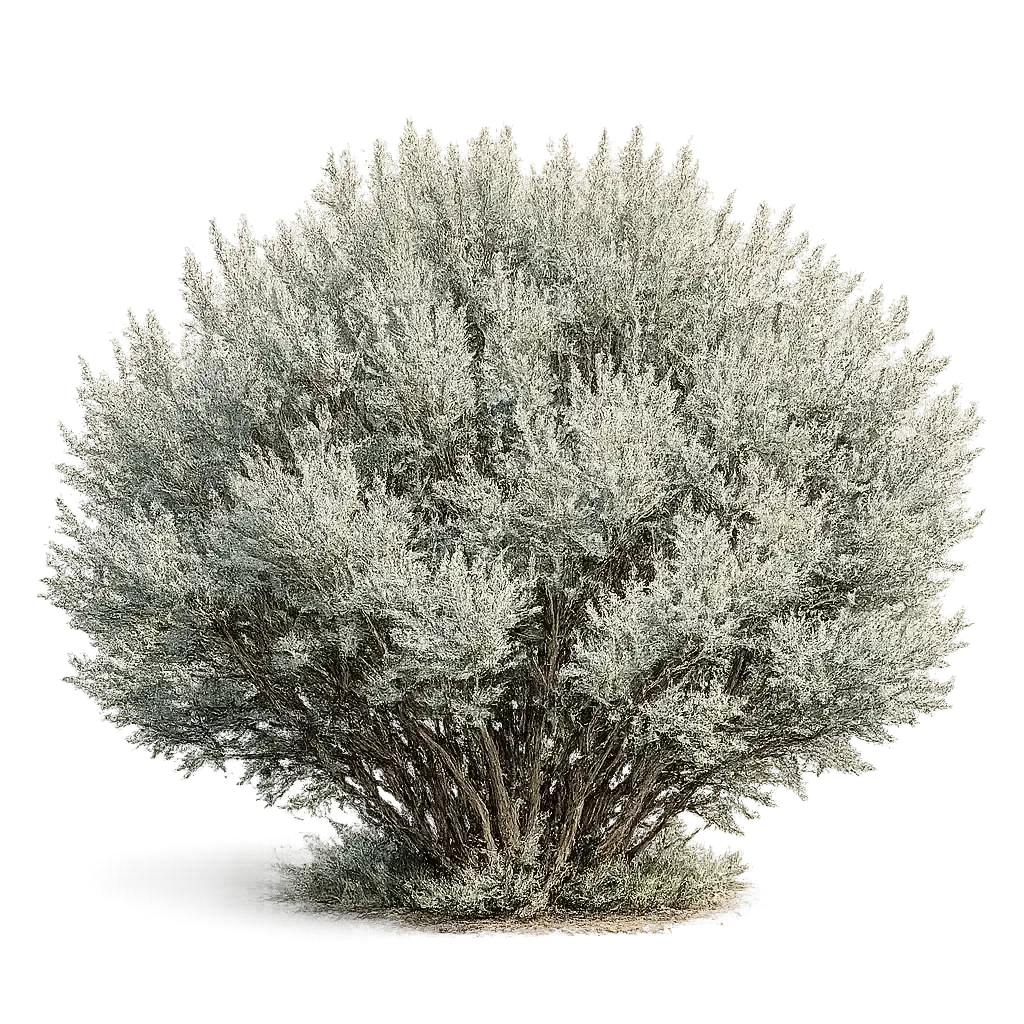
Big sagebrush, Artemisia tridentata, is the dominant species across most of the sagebrush steppe, covering an estimated 165 million acres of the western United States and southern Canada in its various subspecies and forms. It is the sagebrush most people mean when they say sagebrush, the tall, silver-gray, aromatic shrub that shapes the visual character of the high desert and provides the ecological foundation for the sagebrush steppe ecosystem. It reaches two to eight feet in height depending on subspecies and site conditions, with the tallest forms growing in deeper soils with reliable moisture access and the most compact forms occupying shallow, gravelly ridgelines and cold high-elevation sites.
Three subspecies of big sagebrush are relevant to homestead planting and restoration: basin big sagebrush, Artemisia tridentata subsp. tridentata, grows in valley bottoms and deep soils with the best moisture access and reaches the largest sizes; mountain big sagebrush, Artemisia tridentata subsp. vaseyana, occupies higher elevations with greater precipitation and colder winters and is the most cold-tolerant; and Wyoming big sagebrush, Artemisia tridentata subsp. wyomingensis, dominates the drier, more alkaline sites of the low-elevation cold desert and is the most drought and alkalinity tolerant of the three.
Beyond big sagebrush, several other sagebrush species contribute to the dry-land homestead planting palette. Low sagebrush, Artemisia arbuscula, is a compact, mat-forming species of shallow, rocky, often seasonally wet soils that reaches only one to two feet in height and is appropriate for sites too harsh or too shallow for big sagebrush. Black sagebrush, Artemisia nova, occupies the most alkaline and droughty sites within the sagebrush steppe and is the appropriate choice for the most challenging dry-land homestead sites. Silver sagebrush, Artemisia cana, is a taller, more moisture-tolerant species found along stream banks and in meadow edges within the sagebrush zone, offering better performance on moist sites than the other species.
The Sagebrush Ecosystem and Why It Matters
The sagebrush steppe is one of the most ecologically significant and most threatened ecosystems in North America. It supports a suite of wildlife species found nowhere else, including the greater sage-grouse, the pronghorn antelope, the sagebrush sparrow, the sage thrasher, and Brewer's sparrow, all of which depend on sagebrush for food, cover, nesting habitat, or winter survival in ways that cannot be replaced by other plant communities. The sagebrush steppe has been reduced by approximately half of its historical extent through agricultural conversion, urban expansion, invasive grass establishment, and altered fire regimes, and the wildlife species that depend on it have declined correspondingly.
For the western homesteader managing land within or adjacent to the sagebrush steppe, restoring and maintaining sagebrush cover on appropriate sites is one of the highest-value ecological actions available. It is not a romantic gesture toward an idealized landscape. It is a practical contribution to the recovery of an ecosystem and a wildlife community that is genuinely threatened and that provides ecological services, including soil stabilization, watershed protection, and the support of the pollinator communities that serve surrounding agricultural lands, that extend well beyond the boundaries of any individual property.
Wildlife Value
Sagebrush supports one of the most specialized and tightly coupled wildlife communities of any plant genus in North America. The relationships between sagebrush and the animals that depend on it have developed over millions of years and cannot be replicated by substitute plantings of other shrub species, which is what makes sagebrush restoration so important and so irreplaceable on appropriate sites.
Greater sage-grouse are the emblematic example. The adult birds eat sagebrush leaves almost exclusively during winter, when no other food source is available in the snow-covered sagebrush steppe. The aromatic terpenoid compounds that make sagebrush unpalatable to most browsers are detoxified by a specialized gut microbiome that sage-grouse develop. Without sagebrush, sage-grouse do not survive the winter. The relationship is that direct and that specific.
Pronghorn antelope, the fastest land animal in the Western Hemisphere, similarly depends on sagebrush as a primary winter forage. In deep snow years when other vegetation is completely buried, pronghorn survive on sagebrush foliage alone. Their historical population decline tracks the reduction of sagebrush steppe coverage with precision.
Beyond these large, iconic species, the sagebrush community supports a rich assemblage of smaller wildlife. Pygmy rabbit, the smallest rabbit in North America, burrows beneath large sagebrush clumps and eats sagebrush foliage almost exclusively. Sagebrush voles, sage sparrows, Brewer's sparrows, and sage thrashers all nest within sagebrush canopies and depend on sagebrush structure for cover and foraging habitat. Mule deer browse sagebrush foliage through winter when other browse is unavailable. Elk use tall sagebrush stands for thermal cover in cold weather.
The late summer and early fall flowers of sagebrush, though small and inconspicuous, are a significant pollen and nectar source for native bees at a time when most other flowering plants in the arid west have finished their bloom season. The sagebrush bloom period, typically August through October depending on species and elevation, fills a late-season nectar gap that supports native bee populations as they prepare for winter and ensures that the seed set of neighboring late-season wildflowers can proceed with adequate pollination.
Monarch butterflies use sagebrush as a nectar source during their fall migration through the Great Basin, and several specialist bee species in the genus Melissodes and related genera are closely associated with sagebrush pollen as a primary foraging resource.
Aromatic and Medicinal Value
The fragrance of sagebrush after rain is one of the most universally recognized and emotionally evocative scents associated with the American West, and it is produced by the same volatile aromatic compounds that give the foliage its silver-gray appearance. The dense coating of fine hairs that gives sagebrush leaves their characteristic color also traps and concentrates the aromatic oils, releasing them intensely when the leaves are crushed, when the plant is heated by summer sun, or when rain releases the compounds from the dry leaf surface in the petrichor reaction that is the sensory signature of desert rain.
Numerous Indigenous peoples of the Great Basin and Intermountain West have used sagebrush medicinally for centuries, and many of these applications align with the documented chemical properties of the aromatic compounds the plant contains. The leaves have been used as a topical antiseptic for wounds and skin infections, as a steam inhalation for respiratory congestion, as a tea for digestive complaints and fever reduction, and as a smudge for purification and ceremonial purposes across many cultural traditions.
Camphor and alpha-thujone, both present in sagebrush volatile oils, have documented antimicrobial and antifungal properties that support the traditional use as a topical antiseptic and wound treatment. Thujone is also the compound responsible for the toxic effects of high-dose sagebrush preparations: the plant is safe in small, traditional-use quantities but high-dose or concentrated preparations are not appropriate, and pregnant women should avoid medicinal use of sagebrush entirely as thujone is a documented uterine stimulant.
Beyond these more formal medicinal applications, sagebrush has practical homestead utility as a fragrant addition to fire starter bundles, as dried sprigs placed in stored grain and clothing to deter insects, and as an aromatic element in outdoor cooking where the smoke from burning sagebrush adds a distinctive western character to grilled foods. The dried stems burn readily and produce a fragrant, clean-burning fire that has been used as fuel across the sagebrush steppe for thousands of years.
Sagebrush and fire: Sagebrush is highly flammable and burns intensely when dry. This is ecologically significant: the historical fire cycle of the sagebrush steppe, with fires moving through at intervals of decades, maintained the open structure and plant community composition of the ecosystem. The invasion of annual grasses, particularly cheatgrass, Bromus tectorum, has dramatically shortened fire return intervals, carrying fire through the landscape annually and preventing sagebrush recovery. On dry-land homesteads within or adjacent to sagebrush country, fire safety planning is an essential companion to sagebrush planting, and defensible space management around structures is non-negotiable.
Climate and Growing Zones
Big sagebrush and its subspecies are adapted to the cold desert and semi-arid climate of the Intermountain West, characterized by cold winters, dry summers, low annual precipitation of eight to sixteen inches falling primarily as winter snow, and soils that are alkaline, thin, and well-drained to droughty. This climate profile defines where sagebrush can be successfully cultivated rather than merely surviving.
Big sagebrush is reliably hardy in USDA zones 4 through 9 depending on subspecies. Mountain big sagebrush is the most cold-tolerant, performing reliably in zones 3 and 4. Wyoming big sagebrush is the most drought and alkalinity tolerant, appropriate for the harshest dry-land sites in zones 4 through 8. Basin big sagebrush is suited to zones 5 through 9 on the deeper, better-watered valley soils it prefers.
Sagebrush performs poorly in humid climates with high summer rainfall. The aromatic oils that protect the foliage from desiccation and herbivory in dry conditions make the plant susceptible to root and crown diseases in consistently moist soils, and the high humidity of eastern North America and the Pacific Northwest coast is generally not compatible with long-term sagebrush establishment. For homesteads outside the natural sagebrush range, native alternatives are more appropriate choices.
For homesteads within the sagebrush zone, the practical guidance is simple: if sagebrush grew on the site before it was disturbed, it will grow there again given appropriate establishment support and protection from cheatgrass competition. If sagebrush never grew naturally on the site because the soil, moisture, or climate conditions were not appropriate, attempting to establish it is an uphill struggle that rarely produces satisfying long-term results.
Sunlight Requirements
Sagebrush requires full sun and is one of the most demanding shrubs in the landscape for light. It grows naturally on the open, exposed slopes, plateaus, and valley floors of the western interior where direct sunlight is available for the full day, and it reflects this adaptation in an absolute requirement for six or more hours of direct sun, with eight to ten hours producing the best growth and longest-lived plants.
In partial shade, sagebrush grows slowly, produces pale, elongated growth rather than the compact, silver-gray foliage that characterizes healthy specimens, and is significantly more susceptible to root and crown diseases in the reduced air circulation of shaded positions. For any sagebrush planting with long-term health and productivity as the goal, full sun is the only appropriate siting standard.
Soil Requirements
Sagebrush demands well-drained to droughty soils and is one of the most intolerant of wet or waterlogged conditions of any shrub discussed in this series. Its native soils are typically shallow, gravelly, sandy loam to loam, and moderately to strongly alkaline, with pH values commonly in the range of 7.0 to 9.0. Good drainage is not merely preferred but essential: sagebrush planted in heavy clay or persistently moist soils declines quickly from root and crown rot regardless of other conditions.
It performs well on the poor, compacted, alkaline soils of disturbed western landscapes where most other productive shrubs fail, which makes it practically valuable for revegetating degraded sites within its native range. On richer, amended, more fertile soils it can grow more quickly but is often less long-lived than on the lean soils it evolved on, where moderate growth produces the dense, resinous, compact wood that gives established plants their resilience.
Deep, rocky, or gravelly soils are ideal. The extensive root system of established big sagebrush reaches depths of six to ten feet or more on suitable soils, accessing moisture reserves far below the reach of shallower-rooted annual and perennial grasses and sustaining growth through extended summer drought on the stored winter precipitation that characterizes the sagebrush climate.
Establishing Sagebrush from Transplants
Sagebrush is famously difficult to transplant and has a reputation among restoration ecologists for the high failure rates that characterize poorly timed or improperly managed establishment attempts. Understanding the specific requirements that separate successful from unsuccessful establishment converts a plant with a difficult reputation into one that establishes reliably when its needs are met.
The critical factors are: using container-grown plants rather than bare-root material, planting in late fall or very early spring to take advantage of winter and early spring precipitation before the dry summer season, using local-provenance material grown from seed collected within the same ecological region as the planting site, and providing absolutely critical protection from competition by cheatgrass and other invasive annual grasses through the first two to three growing seasons.
Cheatgrass competition is the single most common cause of sagebrush establishment failure in the Great Basin and Intermountain West. Young sagebrush transplants cannot compete with the dense, rapidly germinating cheatgrass carpet that covers most disturbed sites in sagebrush country, and without weed control through the establishment period the transplants are typically outcompeted and die within the first growing season. Effective cheatgrass management around newly planted sagebrush is not optional: it is the prerequisite for any realistic expectation of successful establishment.
Planting Process
Source container-grown plants of local provenance from a native plant nursery that can confirm the seed source location. Local provenance is more important for sagebrush than for most other plants because the subspecies and ecotypes within big sagebrush are closely adapted to specific climate and soil conditions, and material from outside the local ecological region often fails to establish or perform reliably.
Plant in late October through early December, or in February through March before the growth season begins, to take advantage of winter and spring moisture. Summer planting of sagebrush almost always fails without irrigation support that is difficult to sustain through the hot, dry summer months.
Clear competing annual grasses and forbs from a circle of at least eighteen to twenty-four inches radius around each planting location before planting. This competition-free zone around each transplant is the most important preparation step for establishment success.
Dig a planting hole equal in depth to the root ball of the container plant and two to three times its width. Do not amend the soil. Sagebrush establishes best in native soil without organic matter additions, which can hold moisture at the root crown and promote the crown rot that is the primary disease failure mode.
Set the plant so the crown is at or very slightly above the surrounding soil level, which is critical for preventing crown rot. Backfill with native soil, firm gently, and water thoroughly once at planting.
Apply a gravel or coarse rock mulch around the base of the plant rather than organic mulch. A two to three inch layer of small gravel or crushed rock mimics the natural soil surface of sagebrush habitat, reflects heat away from the crown, allows moisture to reach the roots while keeping the soil surface dry, and reduces the establishment of competing annual grasses more effectively than organic mulch.
Continue weed control around each plant through the first two growing seasons, removing any cheatgrass or other competition within the cleared zone by hand pulling or careful hoeing. This ongoing management is tedious but decisive for establishment success.
Establishing Sagebrush from Seed
Direct seeding is an alternative to transplanting for large-scale sagebrush restoration on homestead-scale degraded sites and is considerably less labor-intensive per area treated than individual transplanting. The success rate of direct seeding is generally lower than well-managed transplanting, but the lower cost per area treated makes it practical for large-scale restoration where transplanting every square yard is economically prohibitive.
Sagebrush seed is tiny and requires stratification by winter cold to break dormancy, which means that fall seeding into a prepared, weed-controlled seedbed is the standard approach for direct seeding restoration. The seed germinates in late winter or early spring when moisture and temperatures are appropriate, and the seedlings emerge into the brief moist season before summer drought sets in.
Seed viability declines rapidly with storage. Fresh seed harvested from local plants in late summer and early fall and sown immediately achieves the best germination rates. Stored seed loses viability significantly within one to two years even under ideal storage conditions, and commercial sagebrush seed should be sourced from reputable native seed suppliers with documented harvest dates and germination testing.
Watering Needs
Established sagebrush requires no supplemental irrigation in climates with annual precipitation above eight to ten inches that falls primarily as winter snow and spring rain. This is the water regime it evolved on, and it is fully sufficient for mature plants with deep root systems accessing subsoil moisture reserves.
During the establishment period, supplemental irrigation through the first one to two dry seasons significantly improves survival rates on sites where summer drought is extreme. Deep watering of one to two inches every two to three weeks through the first summer after planting, gradually reducing frequency into the second year, bridges the critical establishment period when the root system is not yet deep enough to access subsoil moisture independently.
Once established, any regular irrigation should be discontinued. Sagebrush receiving regular supplemental water in a summer-dry climate grows faster than is healthy, produces soft, disease-susceptible growth, and develops root systems that remain shallow rather than driving deep to find moisture. The long-term health of an established sagebrush planting is best served by the natural precipitation regime of the site, supplemented only during the establishment period and then withdrawn entirely.
Fertilization Strategy
Sagebrush requires no fertilization at any stage of its establishment or mature life and is one of the plants that is most consistently harmed by fertilization. The nutrient-poor, alkaline soils of the sagebrush steppe are the environment this plant evolved in, and the addition of nitrogen-rich fertilizers produces rapid, soft, elongated growth that is less drought-resistant, less cold-hardy, less aromatic, and more susceptible to disease than the slow, compact growth of unfed plants on lean native soils.
On disturbed sites where soil biology has been compromised by tillage or compaction, inoculating transplants with native soil from a healthy sagebrush site, which carries the mycorrhizal fungi and soil bacteria that support sagebrush root function, is more productive than any fertilization approach and is the most ecologically aligned establishment support available.
Companion Plants for the Sagebrush Homestead
Sagebrush does not grow in isolation in its natural habitat. It is the dominant woody shrub in a complex plant community that includes native bunchgrasses, forbs, and subshrubs that together create the structural and biological diversity of the sagebrush steppe. Planting sagebrush with appropriate companions creates a more ecologically functional, more drought-resilient, and more visually interesting dry-land planting than sagebrush alone.
Native bunchgrasses including bluebunch wheatgrass, Pseudoroegneria spicata, Idaho fescue, Festuca idahoensis, and basin wildrye, Leymus cinereus, are the natural grass-layer companions of big sagebrush across its range and together with sagebrush create the structural diversity that makes the sagebrush steppe suitable for its full wildlife community. These bunchgrasses are perennial, deep-rooted, and drought-tolerant, and they are far less competitive with young sagebrush transplants than the annual cheatgrass that has replaced them on degraded sites.
Native forbs including prairie phlox, Phlox austromontana, sulphur buckwheat, Eriogonum umbellatum, scarlet gilia, Ipomopsis aggregata, and a range of native penstemons provide the spring and early summer flowering that supports the native bee communities of the sagebrush steppe before sagebrush itself comes into bloom in late summer.
Rabbitbrush species, particularly rubber rabbitbrush, Ericameria nauseosa, and yellow rabbitbrush, Chrysothamnus viscidiflorus, are the natural shrub companions of sagebrush on many sites and provide a complementary late summer and fall bloom period alongside sagebrush's own flowering. Both are highly attractive to native bees and butterflies during migration and together with sagebrush extend the late-season nectar season through the critical pre-winter period.
Pruning and Maintenance
Established sagebrush in appropriate growing conditions requires essentially no pruning or ongoing maintenance. The natural growth form, a multi-branched, irregularly shaped shrub with aromatic silver-gray foliage, develops over years to decades into one of the most structurally interesting and ecologically productive forms in the dry-land landscape without any management intervention.
Hard pruning of established sagebrush is not recommended and can severely damage or kill plants. Unlike the willows, dogwoods, and ninebarks discussed elsewhere in this series that regenerate vigorously from coppice cuts, sagebrush does not resprout reliably from old wood and may not recover from severe cutting. If size management is desired, selective removal of individual oldest and most sprawling branches in late winter is appropriate, but cutting the entire plant back to a framework should be avoided.
The most important ongoing maintenance is fire management: keeping flammable fine fuels, particularly cheatgrass, mowed or otherwise managed around and within sagebrush plantings reduces fire risk and also reduces the cheatgrass competition that is the most persistent long-term threat to sagebrush establishment and persistence on degraded sites.
Pests and Diseases
Sagebrush on well-drained soils in appropriate climates is remarkably free of serious pest and disease problems, a reflection of the chemical defenses built into the aromatic compounds of its foliage that deter most generalist insect herbivores and pathogens. The same terpenoid compounds that give sagebrush its distinctive fragrance function as broad-spectrum deterrents to the insects and fungi that affect less chemically defended plants.
Root and crown rot from poorly drained soils or from overwatering is the most common cause of sagebrush decline in cultivation and is entirely prevented by appropriate siting and the gravel mulch crown protection described in the planting section. On the droughty, rocky soils of its natural range, sagebrush essentially never experiences root rot.
Sagebrush defoliator moths and various stem-boring insects affect sagebrush in portions of its native range, causing periodic defoliation and stem dieback that can be alarming but from which vigorous plants typically recover. On homestead-scale plantings, natural predator and parasitoid populations generally manage these pests adequately without intervention.
The most significant long-term threat to sagebrush in homestead plantings is not a pest or pathogen but a plant competitor: cheatgrass. Its continued management through the life of the planting is the most consequential ongoing practice for maintaining a productive sagebrush stand.
Pros and Cons of Planting Sagebrush
Advantages
Iconic western native that supports a wildlife community found nowhere else on earth
Critical year-round habitat and food for sage-grouse, pronghorn, pygmy rabbit, and dozens of sagebrush-obligate species
Significant late-season nectar and pollen source for native bees and migrating monarchs
Extreme drought tolerance once established, requiring no irrigation in appropriate climates
Performs on poor, alkaline, droughty soils that defeat most other productive shrubs
Strongly aromatic foliage with documented antimicrobial properties and traditional medicinal uses
Silver-gray foliage provides distinctive year-round color and texture in the dry-land landscape
No fertilization needed at any stage
Restoring sagebrush on degraded sites contributes directly to landscape-scale ecosystem recovery
Limitations
Establishment is difficult without rigorous cheatgrass control through the first two growing seasons
Does not tolerate humid climates, wet soils, or heavy summer rainfall
Highly flammable when dry, requiring fire management planning near structures
Does not resprout reliably from hard pruning, limiting size management options
Transplanting success requires specific timing, provenance sourcing, and crown drainage management
Ecologically appropriate only within the natural sagebrush range of the western interior
High-dose or concentrated preparations are toxic and contraindicated in pregnancy
Direct seeding success rates are variable and require careful seedbed preparation
Long-Term Planning Considerations
A well-established sagebrush planting on an appropriate dry-land homestead site is one of the most enduring and self-sustaining landscape elements available. Big sagebrush plants in their natural habitat routinely live for fifty to one hundred years or more, and on sites where soil, climate, and moisture conditions are appropriate, a well-established stand requires no ongoing management input beyond the cheatgrass control that protects against the most significant competitive threat.
The ecological contribution of a mature sagebrush stand grows over time. As the canopy height and structural complexity of the planting increase, the wildlife community it supports becomes richer. Sage-grouse and pronghorn use the taller, more complex stands for feeding and thermal cover in ways they do not use young, recently established plantings. The native bunchgrass community that establishes beneath and around mature sagebrush develops in species richness and ecological function over decades. The late summer bloom becomes more abundant with each year of growth.
For western homesteaders managing land within the sagebrush steppe, thinking about sagebrush restoration as a multi-decade investment rather than a landscape improvement project with a three-year payoff horizon is the appropriate planning framework. The plants established today will be providing their most complete ecological function in twenty or thirty years. That is not a reason to delay planting. It is a reason to begin.
Final Thoughts
Sagebrush asks the western homesteader to work with the land rather than against it, to choose the plant that evolved for the conditions that exist rather than the plant that requires conditions to be changed to suit it. That is a simple request that carries a considerable reward. A homestead that restores sagebrush on its appropriate dry-land acres contributes to the recovery of one of the continent's most threatened ecosystems, supports a wildlife community of remarkable specialization and beauty, and creates a landscape that is genuinely of its place rather than imported from somewhere with better rainfall.
The fragrance after the first rain of autumn, the silver-gray canopy against red rock and blue sky, the sage-grouse lek in the meadow below the ridge where you planted fifty transplants three years ago and half of them made it and some of those are now waist high. That is the long-term return on a sagebrush investment. It is worth making.