
Staghorn Sumac
Written By Arthur Simitian
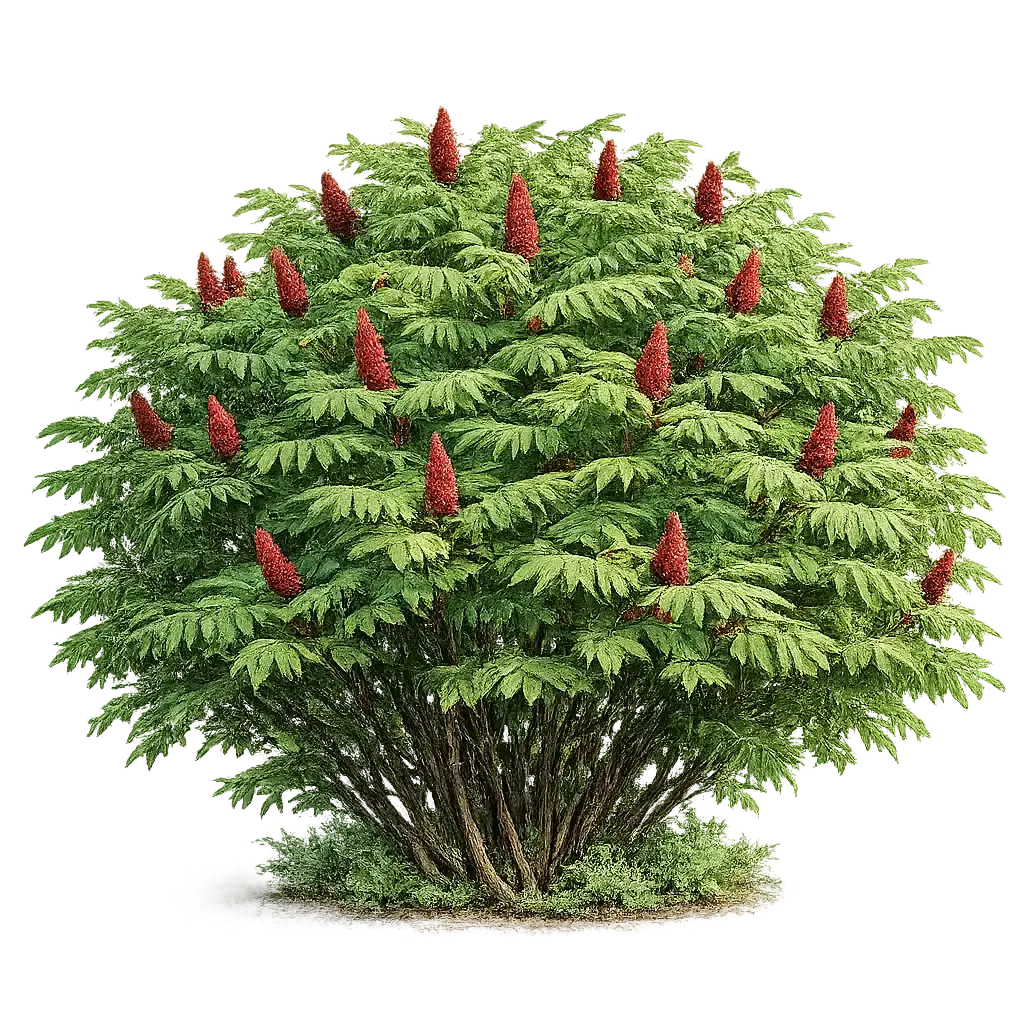
Staghorn sumac makes no attempt to be subtle. The compound leaves can reach two feet in length. The autumn color is among the most saturated scarlet available from any woody plant in temperate North America. The upright velvet-covered berry clusters stand above the canopy like torches through winter. The stems are thick, soft, and covered in the dense reddish hairs that give the plant its name, resembling the velvet-covered antlers of a young deer. Staghorn sumac is a bold, colonizing, drought-tolerant native shrub of the eastern and central United States that fills difficult sites with extraordinary productivity and supports wildlife, pollinators, and the household kitchen simultaneously. It asks for almost nothing and delivers consistently and at scale. The homesteader who has been looking for something to grow on the dry, rocky, compacted bank at the edge of the property has almost certainly found it.
This guide covers staghorn sumac completely: what it is and how it differs from the plants it is sometimes confused with, its four-season landscape contributions, wildlife and pollinator value, the edible and medicinal uses of its distinctive fruit, management of the suckering habit, site requirements, and variety selection.
What Is Staghorn Sumac
Staghorn sumac, Rhus typhina, is a large, deciduous, suckering shrub or small tree in the family Anacardiaceae, native to eastern North America from Quebec and Ontario south through the Appalachians to Georgia and west through the Midwest to the edge of the Great Plains. It grows naturally on rocky slopes, woodland edges, roadsides, disturbed ground, and dry upland sites across this range, where it functions as an early successional colonizer and soil stabilizer on sites that other woody plants have not yet reached.
The plant is immediately recognizable at any season. The stems are stout and covered in dense, velvety, reddish-brown hairs on the current and one-year-old growth, precisely replicating the appearance and texture of velvet-covered deer antlers and giving the plant both its common and botanical names. The leaves are large and pinnately compound, consisting of eleven to thirty-one lance-shaped leaflets arranged along a central stem that can reach twenty-four inches in total length. The overall effect is tropical in scale and boldness, unlike most temperate native shrubs.
The plant is dioecious, meaning male and female flowers are carried on separate plants. Female plants produce the dense, upright, cone-shaped clusters of small drupes that are the plant's most distinctive and practically useful feature, covered in the reddish, sticky, tartly acidic hairs that give the fruit its flavor and its long persistence on the plant through winter. Male plants produce pollen-bearing flower clusters but no fruit. Both sexes are needed in proximity for fruit production, and most naturally occurring and nursery-grown plants produce both sexes in roughly equal proportions without selection.
Staghorn sumac spreads aggressively by root suckers and forms expanding colonies over time, a growth habit that is either an asset or a management challenge depending on where and how it is sited. It is one of the fastest colonizers of disturbed sites in eastern North America, and on appropriate dry, open sites a single plant can expand into a substantial colony within five to ten years.
Staghorn Sumac vs. Poison Sumac: Clearing Up the Confusion
The fear of confusing edible sumac with poison sumac is one of the most common hesitations among new growers, and it deserves a direct and clear answer: poison sumac, Toxicodendron vernix, is a wetland plant that grows in swamps, bogs, and persistently wet soils, bears white or pale yellowish-green berries in loose, drooping clusters, and has smooth, untoothed leaflets. Staghorn sumac grows on dry, well-drained upland sites, bears dark red, densely hairy berries in upright, tight clusters, and has serrated leaflets. The two plants do not share habitat, do not share berry color or form, and are not realistically confused by anyone who has seen both in person.
The practical field rule is straightforward: red berries in an upright cluster on a dry-site sumac are safe and edible. White or pale berries in drooping clusters on a wet-site plant are poison sumac and should not be handled or consumed. This distinction is consistent across all the sumac species native to North America and eliminates the confusion reliably.
Staghorn sumac is also related to poison ivy and poison oak, which belong to the same family Anacardiaceae. However, the urushiol compounds responsible for poison ivy's rash are not present in staghorn sumac, and handling and consuming staghorn sumac carries no such risk for the vast majority of people. Individuals with known severe allergies to mango, cashew, or poison ivy reactions of unusual intensity should exercise some caution, as cross-reactivity within the Anacardiaceae family is possible in highly sensitized individuals, but this is an uncommon concern rather than a general one.
The Edible Berry Harvest
The fruit clusters of staghorn sumac are one of the most distinctive and useful edible wild harvests available from a native North American shrub, and the household that learns to use them has access to a tart, lemony, vitamin-C-rich flavoring agent that persists on the plant from late summer through winter and is available for harvest over a remarkably long season.
The flavor of sumac berries comes from the malic acid content of the dense hairs covering each drupe, not from the drupes themselves. Soaking or briefly rubbing the berry clusters in cold water extracts this acid into the water, producing a tart, deep reddish-pink liquid with a flavor profile that is reminiscent of lemonade or cranberry juice, often described as pleasantly sour with a fruity, slightly astringent character. This infusion, commonly called sumac-ade or Indian lemonade in traditional usage references, is refreshing, attractive in color, and surprisingly complex in flavor for a preparation that requires nothing more than berries, cold water, and a brief steeping period.
Sumac is also a culinary spice in Middle Eastern and North African cooking, where the dried and ground berries of the closely related Syrian sumac, Rhus coriaria, are a foundational flavoring in dishes from fattoush salad to kebab seasoning. The dried and ground berries of staghorn sumac are a functional equivalent and can be used identically in these culinary applications, providing the same sour, fruity acidity that makes Middle Eastern sumac so valuable as a lemon-free souring agent in cooking.
Sumac-ade: berry clusters steeped in cold water for twenty to thirty minutes, strained through cheesecloth, sweetened if desired, and served over ice
Sumac syrup: the strained infusion reduced with sugar to a syrup for flavoring drinks, cocktails, and desserts
Dried and ground spice: berry clusters dried completely, then rubbed and sieved to separate the flavored hairs from the seeds, producing a tart reddish spice powder
Sumac vinegar: the infusion fermented to vinegar for use in dressings and preservation
Sumac jelly: the strained infusion set with pectin into a tart, jewel-colored jelly
Spice rub for grilled meats, fish, and roasted vegetables
Seasoning for hummus, labneh, and other Middle Eastern preparations
Harvest the berry clusters when they are at peak redness and before significant rain has washed the malic acid from the surface hairs. A gentle taste test, rubbing a finger across the berry surface and touching it to the tongue, immediately confirms whether the tartness is still present. Clusters harvested before rain are significantly more flavorful than those that have been repeatedly wetted. The season for peak harvest is typically August through October, and clusters that are not harvested remain on the plant through winter where they continue to provide bird food.
Cold water only for extraction: Sumac berry infusions should always be made with cold water rather than hot. Hot water extracts tannins from the plant material along with the desired malic acid, producing a bitter, astringent beverage. Cold water extracts primarily the tartly acidic surface compounds and produces a clean, pleasantly tart drink. This single detail separates a delicious preparation from an unpleasant one and is the most important practical knowledge for first-time sumac harvesters.
Wildlife Value
Staghorn sumac is one of the most wildlife-productive native shrubs available for the dry-site homestead in eastern and central North America, contributing across multiple seasons and supporting a diverse community of birds, insects, and mammals.
The summer flowers, produced on both male and female plants in dense terminal clusters, are a reliable nectar and pollen source for native bees, particularly bumblebees and various sweat bee species. The flowering period in June and July bridges the gap between the spring flush of native flowering plants and the late summer and fall bloom of goldenrod, aster, and other autumn-flowering species, providing a mid-season resource at a time when competition for nectar can be high.
The persistent berry clusters are one of the most important winter bird foods in the eastern sumac's range. The fruit is consumed by more than three hundred bird species in North America, an extraordinary diversity that reflects both the wide distribution of the plant and the critical role it plays as a high-energy winter food source when other fruits have been depleted. Cedar waxwings, American robins, eastern bluebirds, ruffed grouse, wild turkey, ring-necked pheasant, and a long list of other species consume sumac fruit through late autumn and winter.
The critical wildlife value of staghorn sumac fruit is its persistence through winter. Unlike the soft fruits of elderberry, highbush cranberry, or serviceberry that are consumed quickly in autumn, sumac berry clusters often remain largely intact through January, February, and March, providing an emergency food source during the harshest winter period when other food supplies have been exhausted. This late-winter fruit availability is ecologically significant and is one of the qualities that makes sumac disproportionately valuable in a diverse native planting relative to its modest management requirements.
The dense colony structure of established staghorn sumac provides excellent nesting cover and predator escape habitat for small mammals and ground-nesting birds. White-tailed deer browse the foliage and young stems through summer and fall. Various moth and butterfly caterpillars feed on the foliage, supporting the insectivorous bird populations that depend on caterpillars during the breeding season.
Fall Color
Staghorn sumac produces some of the most intense autumn foliage color available from any temperate woody plant, and in a good fall color year the display is genuinely spectacular. The large compound leaves turn from deep green through yellow, orange, and finally to the saturated scarlet-red for which the plant is best known, with the color developing from the leaflet tips downward over two to three weeks in a gradient of color across each individual leaf that is particularly striking.
The timing is typically early, often coloring before most other native shrubs and trees, which means that a staghorn sumac planting signals the beginning of autumn's color sequence and anchors the early display before the oaks and maples reach their peak. Against the still-green background of late September and early October, a colony of staghorn sumac in full scarlet is one of the most visually commanding sights the autumn landscape produces.
The erect red berry clusters that persist through and after the autumn color display add a vertical element to the landscape that most autumn-coloring shrubs do not provide. The combination of scarlet foliage and dark red fruiting clusters on the same plant, simultaneously, in October, is one of the finest autumn landscape compositions available from a single native species.
Erosion Control and Difficult Site Value
Staghorn sumac's root system is extensive, fibrous, and exceptionally good at binding soil on the difficult dry, rocky, and compacted sites where the plant naturalizes. The combination of aggressive suckering that expands the root-bound colony over time, tolerance of shallow and nutrient-poor soils, and resistance to drought makes it one of the most practical erosion control plants available for dry, disturbed, and degraded upland sites.
On road cuts, dry slopes, rocky banks, and old fields that are too dry and infertile for most productive planting, staghorn sumac establishes readily and quickly stabilizes the surface soil through root binding and through the organic matter contribution of its large falling leaves and annual stem growth. A colony established on an eroding dry bank provides progressively better stabilization with each year as the root system expands and deepens.
The suckering habit that requires management in garden settings is an asset in erosion control applications, where the expanding colony's progressive soil binding matches the ongoing stabilization need without any additional planting or management input.
Medicinal and Tannin Uses
Several Indigenous peoples of eastern North America used staghorn sumac extensively in traditional medicine and material culture, and these uses are grounded in the plant's documented chemical constituents rather than merely in folklore.
The bark, leaves, and fruit of staghorn sumac contain high concentrations of tannins that give them strong astringent properties used traditionally for treating diarrhea, mouth sores, sore throats, and skin conditions including burns and rashes. A strong decoction of the bark or leaves applied topically or used as a gargle has genuine antimicrobial and tissue-tightening effects consistent with the tannin content.
The fruit's high vitamin C content was recognized and used as an antiscorbutic food source by Indigenous peoples and early European settlers, particularly in winter and early spring when fresh food was scarce. The tartness that makes sumac-ade so refreshing reflects the same organic acid content that provides nutritional value.
Historically, sumac leaves and bark were also used in tanning leather, where the high tannin content was valued as a leather-curing agent, and as a dyeing material producing yellows and tans on natural fibers. These material culture uses are less relevant to the contemporary homestead but reflect the breadth of the plant's utility to communities that used it comprehensively.
Climate and Growing Zones
Staghorn sumac is reliably hardy from USDA zone 3 through zone 8, with its native range covering the cold-winter climates of the northeastern United States and southern Canada through the milder conditions of the mid-Atlantic and upper South. It is one of the more cold-hardy large-fruiting native shrubs available for zones 3 and 4 where the productive native plant palette is genuinely limited.
It performs best in the continental climates of zones 4 through 7, where cold winters, warm summers, and moderate precipitation on well-drained soils match its native habitat preferences. In zone 8 and warmer, it grows adequately in drier, well-drained sites but is less vigorous than in cooler zones and may be short-lived in hot, humid conditions.
The plant is not appropriate for wet, humid climates with heavy summer rainfall and poor drainage, where root and crown diseases limit its performance regardless of cold hardiness. Within the dry to moderately moist, well-drained sites of its native range, it is one of the most reliably long-lived and low-maintenance native shrubs available.
Sunlight Requirements
Staghorn sumac performs best in full sun and is primarily a sun-loving plant of open, exposed sites. In full sun it produces its most compact habit, most prolific fruit set, most intense autumn color, and most vigorous suckering colonization. In partial shade of three to four hours of direct sun it grows more openly and fruits less abundantly, but remains healthy and provides good wildlife habitat.
Its natural occurrence on south-facing slopes, woodland edges, and open disturbed ground reflects a genuine preference for maximum light, and the best staghorn sumac colonies in the landscape are invariably on fully exposed, sunny sites where nothing obstructs the sun from any direction through the growing season.
Soil Requirements
Staghorn sumac is one of the most site-tolerant native shrubs in its range for dry and difficult conditions. It grows on thin, rocky, gravelly, sandy, and clay soils across a wide pH range from moderately acidic to moderately alkaline, and it tolerates the compacted, nutrient-depleted soils of road margins, construction disturbance areas, and old fields that defeat most other productive shrubs.
Good drainage is the most important soil requirement. Like sagebrush in the West, staghorn sumac does not tolerate persistently wet or waterlogged conditions and declines reliably in heavy, poorly drained soils. It is a plant of dry upland sites, not wet lowlands, and the drainage requirement is non-negotiable for long-term health.
Rich, heavily amended soils produce overly lush, rank growth with somewhat reduced fruit production relative to plants on leaner soils, and the same restraint in soil enrichment that benefits other native shrubs in this series applies equally to staghorn sumac. Average to poor, well-drained soil is the correct baseline.
Managing the Suckering Habit
Staghorn sumac spreads aggressively by root suckers and can colonize a substantial area around the original planting over five to ten years if left unmanaged. In erosion control and naturalized wildlife habitat applications this is an asset. In mixed garden borders and ornamental plantings it is a management commitment that needs to be understood and planned for before planting.
The most effective containment approach for garden plantings is a physical root barrier of heavy-gauge plastic or metal edging driven twelve to eighteen inches into the soil around the planting perimeter, combined with annual severing of any suckers that emerge beyond the barrier. Without a root barrier, the expansion requires more frequent intervention to manage and can be difficult to contain once an extensive root system has developed.
For homesteads where a naturalistic, expanding colony is the goal, siting the planting on a slope or bank with natural physical boundaries, such as a mown field edge, a driveway, or a structure, on all sides of the desired colony area defines the colonization space without requiring root barriers or ongoing management. The planting colonizes its defined space and the regular mowing or physical boundary prevents further expansion naturally.
Unwanted suckers can be controlled by regular mowing around the planting perimeter before they have developed significant root systems, or by cutting individual suckers at ground level and immediately treating the cut surface with a targeted application of a systemic herbicide if regrowth from the cut stump is unacceptable. Hand-pulling suckers in the first season after emergence, before the lateral roots anchor them firmly, is effective and requires no tools beyond a firm grip and some physical effort.
How Far Apart to Plant
6 to 8 feet apart for a naturalistic colony planting on a dry slope or bank, allowing individual plants to develop and eventually merge into a continuous colony
8 to 10 feet apart for specimen plantings in a mixed native shrub border where individual plant form is the ornamental focus
10 to 12 feet apart for open landscape plantings where maximum canopy spread and fruit production per plant is the goal
At least 6 feet from structures, underground utilities, and paved surfaces to allow for suckering expansion and root system development
At least 10 feet from garden beds where suckering into adjacent planting areas would be a management problem
When to Plant
Staghorn sumac is best planted in early spring while dormant, which allows the root system a full growing season to establish before the plant's first summer on the site. Container-grown plants are available throughout the growing season and can be planted at any time with attentive watering, but spring planting is strongly preferred for the most reliable establishment.
Fall planting in zones 5 through 7 also works well, provided the plant has several weeks of mild weather to establish before the ground freezes. In zones 3 and 4, spring planting is the safer approach to ensure adequate root establishment before severe winter conditions arrive.
Staghorn sumac also propagates readily from root cuttings taken in late winter, which is the most economical propagation method for establishing a large colony planting from a single parent plant. Three to four inch sections of root dug from the outer edge of an established colony and planted horizontally just below the soil surface in late winter produce new shoots within one growing season.
Planting Process
Choose a site in full sun with good drainage on the drier end of the moisture spectrum. Avoid low-lying areas, heavy clay, and any site where water stands after rain. The drier and rockier the site within reason, the more naturally suited it is to staghorn sumac.
Install a root barrier if the planting is in a garden or mixed border context where suckering beyond the intended area would be unacceptable. Set the barrier before planting rather than after, as the root system expands quickly and retroactive barrier installation is difficult once growth is established.
Dig a planting hole two to three times the width of the container root ball and equal in depth. No soil amendment is needed. Staghorn sumac establishes best in native soil on lean sites and does not benefit from organic enrichment at planting.
Set the plant at soil level with the crown at grade. Backfill with native soil, water thoroughly, and apply a light mulch of gravel or coarse bark around the base, keeping it pulled back from the main stem. Avoid deep organic mulch that holds moisture at the crown.
Water through the first growing season during extended dry periods to support root establishment. From year two onward, irrigation is rarely needed on sites with the dry, well-drained conditions that suit staghorn sumac.
Watering Needs
Staghorn sumac is drought tolerant once established and one of the most self-sufficient native shrubs available for dry sites in its range. Its native habitat on rocky, south-facing slopes and dry woodland edges represents genuine adaptation to summer drought, and established plants in appropriate soils typically require no supplemental irrigation after the first growing season.
During establishment, consistent moisture through the first summer supports root development. Deep watering every one to two weeks during dry conditions in the establishment year is appropriate, gradually withdrawing irrigation into the second year as the root system develops. Overwatering is more damaging than drought for this plant, and on naturally dry sites no supplemental watering beyond establishment support is either needed or beneficial.
Fertilization Strategy
Staghorn sumac requires no fertilization on average to poor soils and performs best without supplemental feeding. It establishes and grows productively on the nutrient-poor, disturbed soils of its natural habitat without any fertility inputs, and adding nitrogen-rich fertilizer produces the same soft, rank, disease-susceptible growth that excessive feeding causes in most of the native shrubs discussed in this series.
If the soil is genuinely depleted from severe disturbance, a light application of compost worked into the planting hole at establishment provides a modest improvement without the excess nitrogen that is counterproductive. Beyond this single establishment input, no ongoing feeding program is needed or appropriate.
Pruning and Maintenance
Staghorn sumac in a naturalistic colony planting requires minimal pruning beyond the suckering management discussed above. The natural form, an irregular, spreading, multi-stemmed colony with the distinctive antler-like branch structure visible in winter, is both ornamentally attractive and ecologically functional without any pruning intervention.
The cut-leaf cultivar Laciniata and the compact cultivar Tiger Eyes, discussed in the variety section, have a more refined ornamental character that benefits from light selective pruning to maintain their form and remove any reversion to the coarser straight-species growth that occasionally appears on grafted plants.
Removing dead wood in late winter keeps the colony tidy and reduces disease entry points. Occasional thinning of the oldest and most congested stems at the center of an established colony improves air circulation and maintains the vigorous new growth at the colony perimeter that produces the most intensely colored autumn foliage.
Hard renovation pruning to near ground level is tolerated and stimulates vigorous regrowth from the root system, which can be a useful management tool for overgrown colonies. Unlike sagebrush, staghorn sumac regenerates vigorously from old wood and from the root system and is not at risk from hard cutting.
Variety Selection
The straight species, available from native plant nurseries as seedling plants, is the best choice for wildlife habitat, erosion control, and naturalistic colony plantings where local ecological relationships and maximum productivity are the priorities. Locally sourced seedling plants deliver the strongest ecological connections to local pollinators and wildlife and are the most cost-effective option for large-scale plantings.
Tiger Eyes is a compact, mounding selection reaching four to six feet with deeply dissected, finely cut chartreuse-yellow foliage that turns gold and orange in autumn, considerably more refined in appearance than the straight species. It suckers less aggressively than the species and is the most appropriate selection for mixed ornamental borders and smaller garden spaces. It is grafted and occasionally produces vigorous suckers from the straight-species rootstock that should be removed promptly before they dominate the plant.
Laciniata is the cut-leaf staghorn sumac, with the same bold pinnate structure as the species but with each leaflet deeply lobed and dissected to a feathery texture that creates an elegant, almost tropical effect in summer while retaining the spectacular autumn color of the straight species. It reaches the full size of the species at eight to fifteen feet and is appropriate for larger garden spaces where its size is not a constraint.
Bailtiger, sold as Tiger Eyes in the trade, and other newer compact selections offer improved garden manageability without sacrificing the ornamental qualities that make staghorn sumac worth growing. For growers who want the wildlife value of the straight species with less aggressive suckering, these selections represent the best available compromise.
Pests and Diseases
Staghorn sumac is generally healthy and requires little pest or disease management on well-drained sites in appropriate climates. Its main vulnerabilities appear primarily under conditions of poor drainage, high humidity, or sites outside its preferred dry-site range.
Verticillium wilt, a soil-borne fungal disease that affects many members of the Anacardiaceae family, occasionally causes stem dieback and decline on plants in sites with contaminated soil from previous susceptible plantings. There is no effective treatment; affected plants should be removed and the site rested before replanting with a non-susceptible species.
Powdery mildew appears on foliage in humid conditions and on plants with poor air circulation, producing the characteristic white coating on the leaf surface in late summer. On healthy, well-sited plants in appropriate conditions it is cosmetic rather than threatening. Adequate spacing and full sun siting minimizes pressure.
Sumac gall aphids produce the distinctive red-tinted galls on the upper leaf surface that are frequently encountered on established plants and alarming to growers who have not seen them before. The galls are harmless to the plant's long-term health and are produced by the aphids as a feeding and shelter structure rather than as a sign of serious infestation. No treatment is needed on healthy established plants.
Pros and Cons of Planting Staghorn Sumac
Advantages
Among the most spectacular autumn color available from any native North American shrub
Persistent winter berry clusters feed more than three hundred bird species and provide critical emergency food through late winter
Edible fruit produces excellent tart drinks, spice, jelly, and syrup
Extreme tolerance of dry, rocky, compacted, and nutrient-poor soils
Excellent erosion control on dry slopes and disturbed upland sites
Hardy to zone 3, one of the most cold-tolerant large native fruiting shrubs
Mid-summer flowers support native bees during the between-season nectar gap
Distinctive velvet-antler stems and bold compound foliage provide tropical-scale summer presence
Propagates freely from root cuttings, enabling large-scale plantings at low cost
No invasiveness concerns as a native species across most of eastern North America
Limitations
Aggressive suckering requires active management in contained garden settings
Does not tolerate wet, poorly drained soils
Dioecious, requiring both male and female plants for fruit production
Large size and bold texture can overwhelm smaller garden spaces
Deciduous, providing no winter screening value
Sumac gall aphids produce alarming but harmless leaf galls that concern first-time growers
Related to poison ivy and cashew, though urushiol is absent in this species
Tiger Eyes and ornamental selections are grafted and require removal of rootstock suckers
Long-Term Planning Considerations
Staghorn sumac planted with a clear understanding of its suckering habit and appropriate site requirements is a long-term, self-sustaining element of the homestead landscape that improves ecologically with each year of establishment. The colony deepens and expands, the root-bound soil stabilization improves, the fruit production per colony area grows, and the wildlife community the planting supports becomes richer as structural complexity increases.
The most important long-term planning decisions are siting the colony where the suckering habit has room to express itself productively rather than requiring constant restraint, ensuring that the site is genuinely well-drained and dry enough for the plant to perform at its best, and positioning the planting where the autumn color display is visible from the most frequently used areas of the homestead. These three decisions made correctly at planting produce a planting that requires minimal ongoing intervention and delivers consistent value for decades.
For homesteads with a dry, rocky, compacted, or otherwise difficult site that currently contributes nothing productive to the system, staghorn sumac represents one of the most complete and reliable transformations available. It will stabilize the slope, feed the birds through winter, color the landscape orange and scarlet in October, and produce a harvest of tart, distinctive fruit that connects the household kitchen to the native plant community in a direct and useful way. That transformation asks very little in return.
Final Thoughts
Staghorn sumac is not a plant for tidy gardens or controlled spaces. It is a plant for the difficult, exposed, dry corner of the homestead that nothing else wants. On those sites it is magnificent, and it does not need encouragement or amendment or irrigation or any particular attention beyond initial establishment and the ongoing suckering management that keeps it where it is supposed to be.
The scarlet October. The wine-dark berry clusters in January when the cedar waxwings come through. The first glass of cold sumac-ade in August, tart and pink and surprisingly good. These are the returns on a plant that costs almost nothing to maintain and grows on ground that would otherwise sit empty and eroding. Plant it where it fits and then leave it largely alone. It knows what to do.