
Ancona
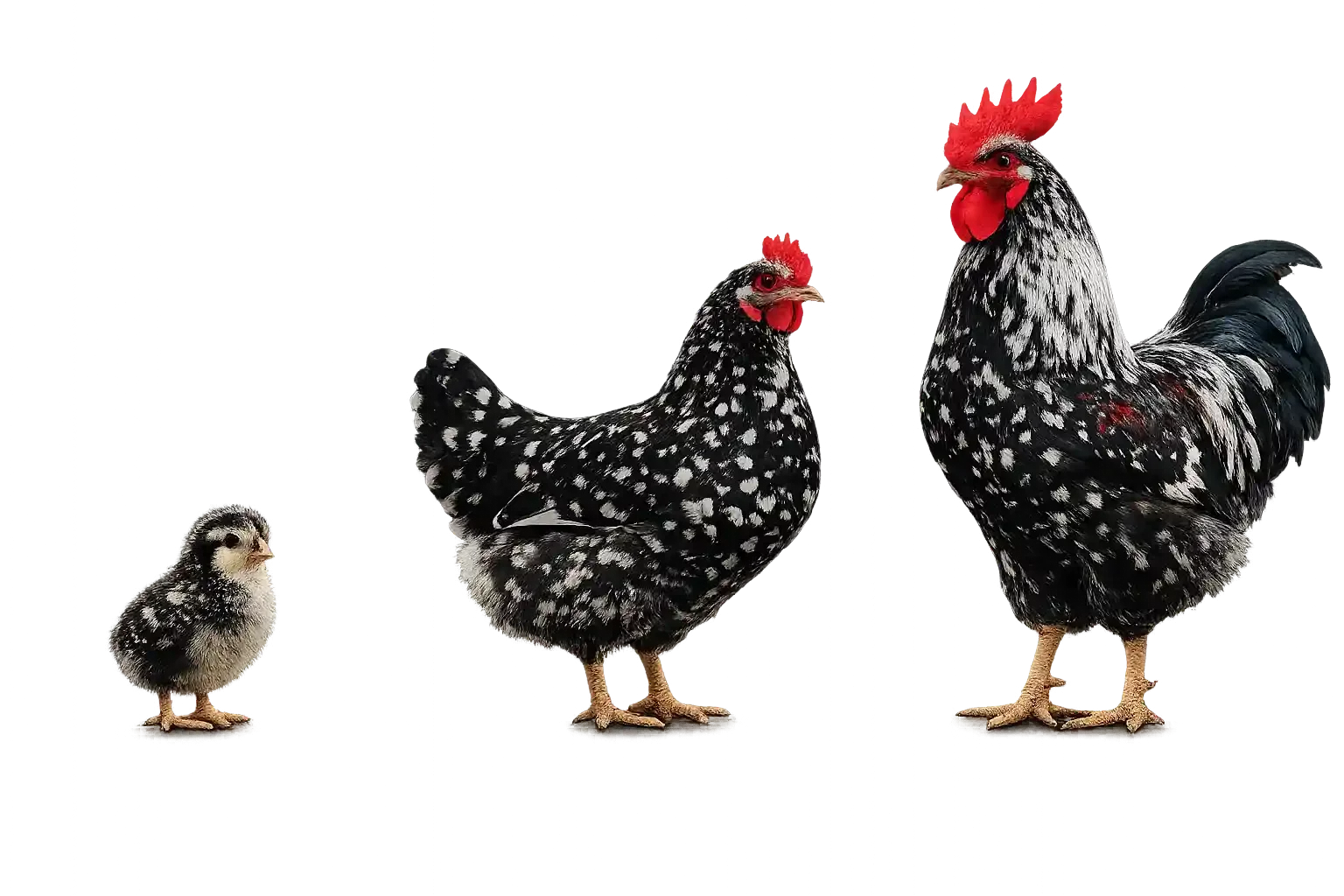
The Ancona is a Mediterranean egg layer from the port city of Ancona on the Adriatic coast of Italy, a breed that has been kept in the Marche region for centuries and that arrived in England around 1850 already carrying a reputation as one of the most prolific winter layers on the European continent. It is not the most commonly kept heritage layer in North America today, but it occupies a specific and well-defined position in the poultry world: a breed that lays white eggs at a volume approaching the Leghorn's, surpasses the Leghorn as a winter layer, forages with an efficiency and alertness that borders on the semi-wild, and carries plumage that is genuinely unlike anything else in the backyard flock. Every feather on a properly marked Ancona is black with a beetle-green iridescent ground color and a distinct V-shaped white tip at the end, producing a bird that reads as dark black from a distance and reveals its complex mottled pattern up close. Older birds moult with progressively larger white tips and more white coverage each year, meaning an Ancona's plumage changes noticeably with age, the older the bird the more white it shows. The temperament is the breed's most defining practical characteristic for prospective keepers to understand: the Ancona is among the most active, alert, and flighty of any heritage breed, a direct product of the independent, free-ranging character that centuries of development in the Italian countryside produced. It is not a breed for keepers who want calm, handleable lap birds or for operations where containment in a fixed run is the primary management model. For keepers who can provide genuine range access, accept the breed's independent nature, want a white egg layer with exceptional winter production and outstanding predator awareness, and are drawn to the rare and visually distinctive, the Ancona is one of the most rewarding heritage breeds available. It is on the Livestock Conservancy's Watch list, and keeping it is a genuine conservation act.
Quick Facts
Class: Mediterranean (APA)
Weight: Roosters approximately 6 lbs; hens approximately 4.5 lbs
Egg Production: Approximately 200 to 220 large white eggs per year; exceptional winter layer surpassing Leghorns in cold-weather production
Egg Color: White
Egg Size: Large; minimum 50 grams per APA standard
Primary Purpose: Egg production; exhibition; conservation
Temperament: Highly active, alert, flighty, and independent; one of the most active Mediterranean breeds; can become somewhat trusting with consistent gentle handling from young but does not seek human contact
Brooding: Very low; considered a non-sitter breed; incubator or surrogate broody hen required for hatching
Flight Capability: Excellent; one of the strongest fliers among standard-sized heritage breeds; high fencing or covered runs required for containment
APA Recognition: 1898 (single comb); 1914 (rose comb); Mediterranean Class
Country of Origin: Ancona, Marche region, Italy
Varieties (APA): Single comb and rose comb; both lay identically; bantam variety also recognized
Comb Type: Single comb (most common) or rose comb; single comb frostbite risk in hard winters; rose comb minimal frostbite risk
Distinctive Trait: Black beetle-green plumage mottled with V-shaped white tips on each feather; white tips increase in size with each moult; yellow legs mottled with black; white earlobes; exceptional winter egg production; strong flier
Conservation Status: Watch (Livestock Conservancy)
Lifespan: Approximately 8 years
Breed Overview
The Ancona's history is longer than its formal documentation suggests. Chickens of the Ancona type had been bred in the Marche region of central eastern Italy for centuries before they came to the attention of English poultry enthusiasts around 1850. The Marche region is separated from Tuscany and the Livorno area, where Leghorn chickens originate, by the Apennine Mountains, and the geographic isolation of the two regions contributed to the development of distinct breeds from related Mediterranean stock. Early comparative poultry literature frequently described the Ancona as a larger, hardier relative of the Mottled Leghorn, and the similarity between the two breeds was close enough that for decades keepers debated whether the Ancona was a distinct breed or simply a color variety of the Leghorn. Poultry experts who examined both breeds in detail concluded that differences in body shape, temperament, and winter hardiness merited a separate classification, and this view eventually prevailed in both the British and American standards.
The first documented importation to England took place around 1850 or 1851, when birds of this type were exported from the port of Ancona, the city that gave the breed its name. Initial interest was limited, partly because the early birds were coarsely and irregularly mottled, with more white than black in some specimens and occasional golden-red hackle or tail feathers in males, which struck English poultry fanciers of the era as unattractive and inconsistent. A second importation in 1883 sparked greater interest, and English breeders began the selective breeding work that refined the Ancona's mottled pattern from the irregular, coarsely marked original to the distinct V-shaped white-tipped pattern on a beetle-green black ground that the current standard requires. By 1880, the breeder M. Cobb had achieved the cleaner, more regular mottling and exhibited his birds successfully, and by 1899 a formal breed standard had been drawn up in England that defined the new type.
American importation began in 1888 when Francis A. Mortimer of Pottsville, Pennsylvania, brought the first birds over from England. Mortimer died shortly afterward and interest briefly waned, but a second importation by H.C. Sheppard of Berea, Ohio, in 1906 reignited American enthusiasm for the breed. By 1910, American poultry journals carried numerous advertisements praising the Ancona's laying ability, and the breed became genuinely popular as a commercial egg layer. The APA had recognized the single comb variety in 1898 and added the rose comb variety in 1914. The breed reached a high point of American popularity in the years surrounding World War I, when both the Ancona's winter laying consistency and its excellent foraging efficiency made it a practical choice for farm egg production. The development of commercial hybrid laying strains that could be managed efficiently in confinement gradually displaced the Ancona from commercial use, as they did for all active, flight-capable Mediterranean breeds that resist confinement, and the Ancona's population declined in North America through the latter 20th century to its current Watch status on the Livestock Conservancy list.
One notable production record: in 1916, an Ancona hen owned by H. Cecil Sheppard laid 306 white eggs in a single year, a remarkable documented performance that illustrated the breed's ceiling when individual genetics and management aligned optimally.
In Italy, the Ancona's situation is paradoxical: the breed is rare in its country of origin, uncommon enough that a formal initiative was launched in 2000 to re-establish Anconas in the Marche region and preserve their genetic biodiversity for the region where the breed developed. The breed is more common in the United States and England than in Italy.
Plumage and Appearance
The Ancona's plumage is the breed's most immediately distinctive visual characteristic and one of the most complex and dynamically changing patterns of any heritage chicken. The ground color is black with a beetle-green iridescent sheen, similar in character to the Black Australorp's or Black Sumatra's iridescence. On top of this black ground, every feather on a correctly marked Ancona carries a distinct V-shaped white tip. The pattern should be even and consistent across all feather tracts, including the hackle, back, breast, wings, tail, and leg feathering, with no tendency toward lacing and no patches of solid black or solid white. The tail, sickles, and all primary feathers should also carry white tips per the APA standard.
What makes the Ancona's plumage uniquely interesting among heritage breeds is that it changes with age. The white tips on each feather increase in size with every moult, meaning a young Ancona shows relatively small, crisp white tips on a predominantly dark ground, while an older bird shows progressively larger white areas and more overall whiteness in the plumage as each annual moult produces new feathers with bigger tips than the previous generation. This dynamic character means an Ancona flock looks different as it ages, the birds becoming notably more white-marked with each passing year. For exhibition purposes, this creates a specific selection challenge: show birds need to show the correct pattern at the age they are exhibited rather than being evaluated against a static standard that applies equally across all ages.
The face is clean and prominent, with orange-red eyes that give the bird an alert, watchful expression consistent with its active character. The earlobes are white, a Mediterranean breed characteristic that has no connection to the white egg color despite the common folk assumption that white earlobes indicate white eggs. The legs are yellow mottled with black, distinguishing the Ancona from breeds with solid yellow or solid dark legs. The beak is yellow with some dark markings on the upper mandible.
The single comb is large and erect in the rooster, falling to one side in the hen in the style typical of Mediterranean breeds. The rose comb variety carries a low, flat comb that ends in a distinct spike or leader pointing rearward, with minimal frostbite risk compared to the large single comb. Both comb varieties are otherwise identical in every characteristic, and the choice between them is partly a matter of personal preference and partly a cold-climate management consideration.
Egg Production
The Ancona's egg production is the central reason for keeping it, and the specific character of that production, particularly its winter consistency, is what distinguishes it from the Leghorn that it otherwise resembles in production profile. The breed lays approximately 200 to 220 large white eggs per year under good management, with documented upper-end performances reaching 250 to 300 in individual hens from optimally selected lines. These figures place the Ancona below the Leghorn's typical production of 250 to 320 eggs per year but above most heritage dual-purpose breeds.
The winter laying advantage over the Leghorn is one of the Ancona's most practically valuable characteristics and historically was the primary reason for its importation to England and America. The Livestock Conservancy specifically notes that while Anconas are not as prolific annual layers as Leghorns, they surpass Leghorns as winter layers. For homestead and direct-sale egg operations where maintaining consistent year-round supply, including through the short-day winter months when other breeds reduce or stop production, is economically important, this winter advantage is a genuine practical differentiator.
The eggs are white throughout, large in size at a minimum of 50 grams per the APA standard, and produced reliably across the laying year with the winter consistency described above. The shell quality is good, and the eggs are visually indistinguishable from Leghorn eggs in color, size, and shape.
Pullets begin laying at approximately 5 months of age, notably early for a heritage breed and consistent with the Mediterranean breed type's early maturity. This early onset means a keeper who acquires Ancona pullets in spring has birds in production by late summer rather than waiting until the following spring as would be required with slower-maturing dual-purpose heritage breeds.
Broodiness is extremely low. The Ancona is considered a non-sitter breed, meaning hens rarely go broody and when they do, they are unreliable in their commitment to incubation. Keepers who want to propagate their Ancona flock naturally will need a broody hen of another breed to serve as a surrogate setter, or will need to use an incubator. This is not a management inconvenience so much as an expected characteristic of a breed selected for decades specifically for maximum egg production rather than maternal behavior.
Meat Quality
The Ancona is primarily an egg-laying breed and is not typically kept for meat production. The body is relatively slight compared to dual-purpose heritage breeds, and the Ancona's active, ranging character means it carries less breast muscle mass than breeds that were developed for table use alongside egg production. Young birds mature quickly and do produce edible carcasses, but other breeds in this directory are meaningfully better suited to the table and the Ancona's primary value is in the egg basket rather than on the dinner plate.
Temperament and Behavior
The Ancona's temperament is the characteristic that most directly determines whether a keeper and this breed are a good match, and it deserves more honest and specific treatment than most breed descriptions provide. The Ancona is among the most active, alert, and flighty of any standard-sized heritage breed. Historic descriptions from early poultry literature describe the breed as resembling a pheasant in its wild habits, a comparison that captures something real about how an Ancona actually behaves in a backyard or homestead setting. The breed is not aggressive toward humans or flockmates, but it is consistently described as nervous, high-strung, and difficult to approach, particularly in birds that have not been handled regularly from a very young age.
What this means in practice is that an Ancona flock managed primarily for egg production on open range with minimal human interaction will function exactly as the breed was designed to function: ranging widely, foraging efficiently, flying freely, and producing eggs with minimal management input. This is a genuinely useful character in a working poultry context. The same character in a small backyard setting where close human contact is frequent, where containment in a standard run is the management model, or where the keeper wants interactive, handleable birds, is a significant mismatch.
Keepers who have worked with Anconas consistently note that regular, gentle handling from chick stage onward produces noticeably more manageable adults, and that individual birds can develop real trust with the specific humans they interact with regularly. The bantam variety is generally reported as somewhat calmer than the large fowl, though the same basic active, alert character is present in both.
The breed's flight capability is exceptional for a standard-sized bird. Anconas fly over standard four-foot and even five-foot fencing without difficulty and will roost in trees if given the opportunity, a behavior that reflects genuine ancestral connection to the semi-wild ranging character of Mediterranean landrace chickens.
Climate Adaptability
The Ancona's Mediterranean origin gives it genuine heat tolerance, and its centuries of development in the central Italian coastal climate, which experiences cold winters alongside warm summers, contributed to cold hardiness that exceeds what the Mediterranean breed classification might suggest. The Livestock Conservancy notes the breed stands frost and snow quite well, and the Oklahoma State University breed profile describes Anconas as "indifferent to the climate," a characteristically understated assessment that points to the breed's genuine adaptability.
The comb variety makes a specific difference in cold climate management. The single comb variety, which is the most common, carries a large upright comb on the rooster and a falling comb on the hen that presents the same frostbite risk as any large single-combed breed in hard freezes. Standard comb monitoring and preventive petroleum jelly application applies to the single-combed Ancona in cold-winter regions. The rose comb variety's low, flat comb structure presents minimal frostbite risk and is the practical choice for keepers in regions with sustained extreme cold who want Ancona egg production without the cold-comb management burden.
Heat tolerance is excellent for both varieties, consistent with the Mediterranean breed type's adaptation to warm climates.
Housing and Management
The Ancona's housing requirements diverge from standard backyard breed guidelines primarily in containment height. A breed that can and will fly over five-foot fencing requires either six-foot or taller fencing, covered runs, or the management acceptance that free-ranging Anconas on open property will range where they choose and roost where they find convenient. In a truly open homestead context where birds can range freely without fencing constraints, the Ancona's flight capability is an advantage rather than a management burden: the breed's ability to fly to safety is its primary predator evasion mechanism, and this aerial escape route provides meaningful protection against ground predators that cannot be offered to the heavier, earth-bound breeds.
Confinement is genuinely stressful for this breed. Anconas kept in small, fixed runs without adequate range access tend toward the anxious, unsettled behavior that characterizes any highly active breed kept below its minimum space requirements. If the management model requires full-time confinement, the Ancona is not the right breed. If the management model supports genuine range access, even partial daily ranging, the Ancona thrives and produces at its best.
Feed management is standard layer guidelines: quality layer feed with adequate protein and free-choice oyster shell for calcium supplementation. The breed's active foraging on range meaningfully supplements the feed ration in season, and its efficient foraging character reduces feed costs on range compared to heavier, less active breeds that forage less thoroughly.
Breeding quality Anconas for exhibition requires specific knowledge of the mottling standard and understanding of how the white tips change with age. Selecting breeding stock that carries the correct V-shaped tip pattern rather than irregular white patches, lacing, or excessive white in young birds requires experience with the breed and access to quality founding stock. The Livestock Conservancy's breeder directory and exhibition networks are the best sourcing resources for birds with verified type.
Sourcing Considerations
The Ancona's Watch status on the Livestock Conservancy list means it is not as widely available from mainstream hatcheries as common heritage breeds, though several hatcheries including Cackle Hatchery carry the single comb variety. For exhibition-quality birds with correct mottling type, sourcing from breeders active in the Ancona community through the Livestock Conservancy network or regional poultry shows produces significantly better starting stock than general hatchery birds selected primarily for production volume rather than exhibition conformation.
The rose comb variety is considerably harder to source than the single comb variety, with far fewer breeders maintaining it in North America. Keepers specifically interested in the rose comb variety for cold-climate management or exhibition purposes should expect longer sourcing lead times and more limited availability than for the single comb.
Purchasing Anconas from verified conservation-focused breeders rather than from hatcheries where possible supports the breed's recovery and ensures that the birds being produced are selected for breed-correct type rather than generic production performance alone.
Pros and Cons
Pros
Exceptional white egg production of 200 to 220 per year with documented peaks approaching 300 in optimally selected lines
Surpasses Leghorns as a winter layer; outstanding cold-weather production consistency
Early laying onset at approximately 5 months of age
Outstanding foraging ability; self-sufficient on range and contributes meaningfully to feed cost reduction
Exceptional flight capability provides genuine predator evasion without human intervention
Visually striking mottled plumage that changes dynamically with each moult
Two comb varieties available; rose comb eliminates frostbite risk for cold-climate keepers
Genuine conservation value; Watch-listed breed whose population benefits from every responsible keeper
Long productive lifespan of approximately 8 years
Hardy and climate-adaptable; tolerates both heat and cold well
Cons
Highly flighty and active; requires high fencing or covered containment and is not compatible with small fixed-run management
Not suitable for keepers who want calm, handleable, or affectionate birds
Non-sitter breed; incubator or surrogate broody hen required for hatching
Single comb variety requires frostbite monitoring in hard winters
Noisy; not ideal for settings with close neighbors or noise-sensitive environments
Limited mainstream hatchery availability; sourcing research required for exhibition-quality birds
Rose comb variety particularly difficult to source in North America
Exhibition breeding of the correct mottled pattern requires experience and good founding stock
Not a useful meat breed; primary value is entirely in egg production
Profitability
The Ancona's profitability case is built on white egg volume, winter production consistency, and the conservation premium that heritage breed buyers in direct-sale markets increasingly recognize and value. In direct-sale egg markets where customers seek variety and provenance, a Watch-listed Italian heritage breed laying large white eggs through winter months provides both a supply-side advantage and a story that resonates with buyers who care about where their eggs come from. White eggs from an Ancona are not visually differentiated from white eggs from a Leghorn in a carton, which limits the color premium available from blue, green, or chocolate eggs, but the heritage breed and conservation angle supports narrative marketing that commodity egg production cannot match.
The breed's outstanding foraging efficiency and willingness to supplement its diet from range access reduces feed costs significantly on operations where ranging is feasible, improving the margin on each egg produced relative to breeds that forage less effectively or that require full confinement feeding.
For exhibition breeders who maintain high-quality mottled Ancona stock with correct type, the demand from the conservation and show community for exhibition-quality birds and hatching eggs from documented lines supports consistent premium pricing. The Ancona's Watch status means the pool of breeders maintaining correct-type birds is small enough that quality stock commands meaningful premiums from serious buyers.
Comparison With Related Breeds
Leghorn: The most direct comparison and the breed most frequently confused with the Ancona. Both are Mediterranean white egg layers with active, alert temperaments, early maturity, and low broodiness. The Leghorn lays more eggs annually at approximately 250 to 320 per year compared to the Ancona's 200 to 220. The Ancona surpasses the Leghorn as a winter layer and is described as hardier in cold conditions. The Ancona is also significantly flightier than the Leghorn, which while flighty itself is described as considerably more manageable than the Ancona. Both are poor confinement breeds and excellent free-rangers. For keepers who want maximum annual white egg volume, the Leghorn wins on production numbers; for keepers who want better winter production and conservation value, the Ancona is the better choice.
Minorca: Another Mediterranean white egg layer with large body size and the largest eggs of any Mediterranean breed. The Minorca is somewhat calmer than the Ancona, lays fewer eggs at approximately 150 to 200 per year, but produces eggs that are notably larger. The Minorca's large single comb is even more vulnerable to frostbite than the Ancona's, making it a poorer cold-climate choice. Both are Watch-listed conservation breeds. Keepers who want large white eggs with a calmer Mediterranean temperament may prefer the Minorca; those who want volume and winter production prefer the Ancona.
Black Australorp: A useful contrast that highlights the Ancona's specific egg-layer character. The Black Australorp lays 250 to 300 large brown eggs per year in a genuinely calm, manageable, dual-purpose bird that handles confinement well and does not fly over fencing. For keepers who want high production from a manageable heritage breed that works in a standard backyard setup, the Australorp is a better fit than the Ancona in most cases. The Ancona's advantages over the Australorp are white egg color, superior winter production, exceptional foraging on open range, and genuine conservation value from a Watch-listed breed.
Whiting True Blue: The blue egg comparison for keepers building a color variety egg basket. The Whiting True Blue lays approximately 280 to 300 blue eggs per year from a Murray McMurray exclusive. The Ancona lays white eggs with better winter production than most blue egg layers and carries conservation value the Whiting does not. Both are active, foraging-oriented breeds unsuited to heavy confinement. For a mixed egg basket that needs white volume alongside the blue, green, and chocolate eggs of other breeds, the Ancona provides the white contribution with heritage breed credentials.
Final Verdict
The Ancona is a breed that asks more of its keeper than most heritage birds in this directory. It asks for genuine range access rather than confined run management, for fencing tall enough to contain a bird that can and will fly over anything shorter, for patience with a temperament that prioritizes independence and alertness over human interaction, and for willingness to use an incubator or surrogate broody hen when propagating the flock. In return it offers one of the most visually unusual plumage patterns in the heritage breed world, white egg production that surpasses the Leghorn when winter counts most, foraging efficiency that makes the flock genuinely self-supplementing on open range, and participation in the preservation of a Watch-listed Italian heritage breed that has been producing white eggs since before any breed standard existed to describe it. The dual purpose and homestead category is better for including it.
Frequently Asked Questions
Why does the Ancona's plumage change over time? The V-shaped white tips on each feather grow larger with every annual moult, meaning young Anconas show relatively small, crisp white tips on a predominantly dark ground, while older birds show progressively larger and more extensive white areas. This dynamic pattern change means an Ancona looks noticeably different at two years old than at five, and exhibition breeders must account for the bird's age when evaluating whether its mottling pattern meets the standard at the time it is being shown.
Does the Ancona really surpass the Leghorn as a winter layer? Yes, this is a consistently documented characteristic of the breed rather than marketing language. The Livestock Conservancy specifically notes this advantage, and it reflects the Ancona's heritage in the central Italian coastal climate, which experiences genuinely cold winters, compared to the Leghorn's origin in the warmer Tuscan region. For homestead operations where winter egg supply matters, this advantage is practically significant.
What is the difference between the single comb and rose comb Ancona? The only difference is the comb itself. The single comb variety carries the large, upright comb typical of Mediterranean breeds and is vulnerable to frostbite in hard winters, particularly on roosters. The rose comb variety carries a low, flat comb that ends in a rearward spike and presents minimal frostbite risk. Both varieties are identical in plumage, production, temperament, and every other characteristic. The rose comb variety is significantly harder to source in North America.
Can Ancona hens hatch their own eggs? Very rarely. The Ancona is considered a non-sitter breed, meaning hens have virtually no tendency to go broody. Keepers who want to propagate their flock need to use an incubator or place eggs under a broody hen of another breed such as a Silkie or Wyandotte.
Is the Ancona suitable for beginners? Not as a primary flock breed. Its flighty temperament, high fencing requirements, flight capability, and non-brooding character create management demands that are better addressed after a keeper has experience with calmer, more manageable breeds. Experienced keepers who understand Mediterranean breeds and can provide genuine range access will find the Ancona highly rewarding. Beginners who want a white egg layer are better served starting with a Leghorn, Black Australorp, or other more manageable heritage breed before adding Anconas to their operation.
Where can I buy Ancona chicks? Cackle Hatchery carries the single comb variety. The Livestock Conservancy's Heritage Breed Finder and breeder directory are the best resources for exhibition-quality birds with correct mottling type. Regional poultry shows where Ancona breeders exhibit their birds are good venues for sourcing and meeting breeders directly. The rose comb variety requires specialty sourcing through the Ancona breeder community and is not available from mainstream hatcheries.
Related Breeds
Leghorn
Black Minorca
Black Australorp
Whiting True Blue
Andalusian
Hamburg