
Andalusian Chicken (Blue Andalusian)
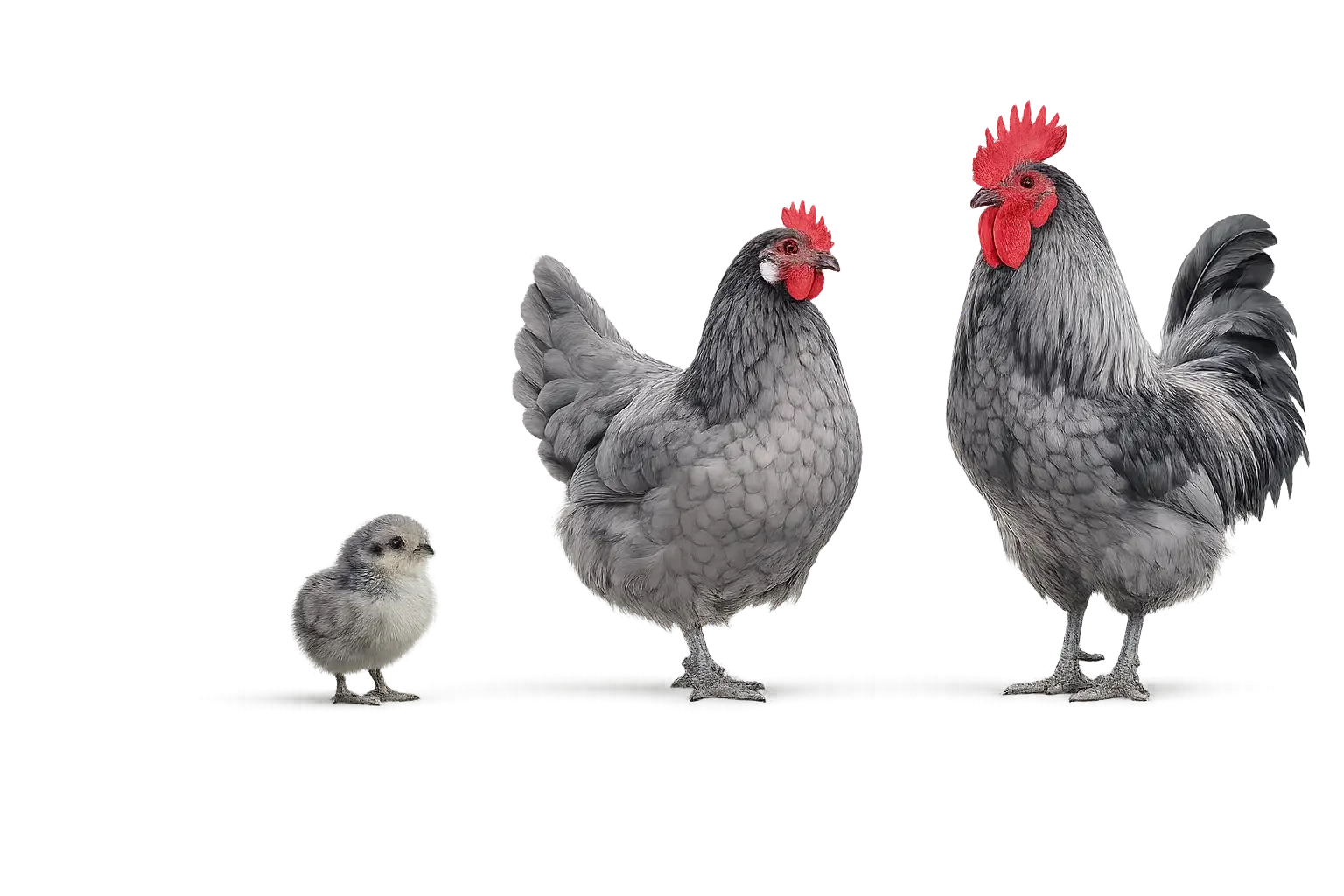
The Blue Andalusian is a Mediterranean heritage breed of genuine elegance and genuine complexity, recognized by the APA since 1874, maintained on the Livestock Conservancy's Watch list, and carrying a set of characteristics that make it one of the most visually striking and most practically specific breeds in this directory. The blue laced plumage that gives the breed its name and its exhibition reputation is not a simple color but a genetic expression produced by a single incomplete dominant dilution gene acting on black plumage: one copy of the dilution gene produces the slate-blue ground color with dark lacing, two copies produce splash or near-white, and no copies produce black. When two Blue Andalusians are crossed, the result follows Mendelian ratios with predictable precision: fifty percent of the offspring are blue, twenty-five percent are black, and twenty-five percent are splash. The breed does not breed true for blue and never will, which is both its most famous genetic characteristic and the primary reason its population has always been smaller than its visual appeal would suggest. Gregor Mendel specifically used the Andalusian's blue genetics in his foundational experiments on incomplete dominance in the 19th century.
The practical profile beyond the genetics is that of a large Mediterranean production breed, similar in type to the Leghorn and Minorca but somewhat larger than the Leghorn and somewhat smaller than the Minorca, laying 160 to 265 chalk-white large eggs per year depending on the strain, with excellent winter production, no inclination toward broodiness, strong foraging instinct, and a deep intolerance of close confinement that makes it genuinely unsuitable for small confined runs. It is active, alert, somewhat flighty, and best managed with generous outdoor access where its foraging ability and predator awareness express productively rather than creating the feather-picking and stress behaviors that confinement produces. For the homestead or small farm keeper with genuine free-range infrastructure who wants the most visually striking white egg layer available in a genuine heritage breed with APA recognition and conservation value, the Blue Andalusian is a breed that delivers on its reputation honestly.
Quick Facts
Class: Mediterranean (APA)
Weight: Roosters approximately 7 lbs; hens approximately 5.5 lbs; larger than White Leghorn, comparable to Minorca
Egg Production: Approximately 160 to 265 large chalk-white eggs per year depending on strain; 3 to 5 eggs per week; excellent winter layer; strong year-round production
Egg Color: Chalk-white; sometimes described as pure white; among the whitest eggs produced by any heritage breed
Egg Size: Large to medium-large; approximately 55 to 65 grams
Primary Purpose: Egg production; exhibition; conservation breeding
Temperament: Active, alert, energetic, and somewhat flighty; not a lap bird; not aggressive toward humans but maintains distance; good forager with strong predator awareness; can be assertive in mixed flocks if confined with less active breeds
Brooding: Essentially never; considered a non-sitter breed; incubator or surrogate broody hen required for hatching
Flight Capability: Good; active and light-bodied; high fencing or covered runs required for reliable containment
APA Recognition: 1874; Mediterranean Class; Blue is the only recognized color variety; bantam also recognized
Country of Origin: Andalusia region of southern Spain; blue lacing developed and standardized in England from 1851 onward; breed standard established by English breeders
Comb Type: Large single comb; hen comb droops to one side at maturity as APA standard specifies; roosters carry upright comb; significant frostbite risk in hard winters
Distinctive Trait: Slate-blue ground color with distinct dark blue to black lacing on every feather; white earlobes; lead blue shanks and toes; single comb with characteristic hen droop; does not breed true for blue; 25 percent of offspring from two blues are black, 50 percent blue, 25 percent splash; male hackle feathers prized by fly tiers; Mendel used the breed's genetics in his foundational inheritance experiments
Conservation Status: Watch (Livestock Conservancy); global population estimated at only 623 birds in six countries as of 2025 per Wikipedia
Lifespan: 5 to 8 years
Breed Overview
The Andalusian's origin is one of the more honestly uncertain stories in heritage breed history. The breed takes its name from the Andalusia region of southern Spain, specifically from the port city of Cadiz through which the first exported birds passed, but the connection to Andalusia itself is weaker than the name implies. When Harrison Weir visited southern Spain in 1879 specifically to investigate the Blue Andalusian in its supposed homeland, he found the bird essentially unknown in the region. The most candid assessment, supported by the Heritage Poultry Conservancy and other breed historians, is that blue-colored chickens were likely found in mixed farm flocks across various parts of Spain where both black and white birds were kept, and that the name Andalusian attached itself to the birds based on the port of export rather than the region of origin or concentration.
The breed as it exists today was largely created in England. John Taylor of Shepherd's Bush imported blue-colored chickens from Spain in 1851, finding among twelve purchased birds only three representative of a consistently type. He crossed these birds with his existing stock, established a breeding program focused on refining the blue lacing, and the English poultry community exhibited the resulting birds at the Baker Street Show in London in January 1853. The development of the distinctive slate-blue ground color with the dark blue to black lacing that defines the modern Blue Andalusian standard was an English achievement, driven by the same interest in creating a striking exhibition bird that shaped other Victorian-era poultry breed refinements.
The breed arrived in the United States between 1850 and 1855 and was included in the APA's inaugural Standard of Perfection in 1874, among the first breeds recognized by the new organization. American breeders continued refining the blue color, and old records from the 1890s document Andalusians laying up to 230 eggs per year with egg weights reaching 30 ounces per dozen, suggesting that early American strains maintained genuine production performance alongside the exhibition character.
The Livestock Conservancy Watch listing reflects a persistent conservation challenge rooted directly in the blue genetics. Because two Blue Andalusians produce only 50 percent blue offspring, with the remaining 50 percent split equally between black and splash, maintaining a large population of correctly colored birds requires dedicated breeding management that most commercial hatcheries do not invest in for rare breeds. A hatchery that sends buyers randomly colored Andalusian chicks rather than specifically selected blue birds is technically sending authentic Andalusians, but the visual appeal that drives interest in the breed is concentrated in the blue birds. The ongoing cycle of interest, impure supply, and keeper disappointment has kept the breed's population below what its visual appeal would otherwise sustain. Wikipedia's 2025 global population estimate of 623 birds in six countries, with the breed listed as at risk or extremely endangered in Germany and the United Kingdom, underscores how genuinely precarious this beautiful breed's conservation status is.
Plumage and Appearance
The Blue Andalusian's plumage is among the most visually precise and technically demanding in the APA standard. Each feather must display a clear, even slate-blue ground color distinctly laced with a narrow edge of dark blue approaching black. The lacing must be even in width, clearly defined rather than blurred or mottled, and present on every feather throughout the body. The ground color should be a genuine medium slate-blue, not too light toward lavender and not too dark toward blue-black, with the dark lacing providing crisp contrast across the full plumage.
The standard color requirements originally called for an even shade of blue without lacing emphasis, but the tendency toward darker lacing on each feather was so persistent in breeding populations that lacing was eventually made a requirement rather than a fault, producing the distinctly laced breed standard that keepers know today. This history illustrates how breed standards sometimes formalize characteristics that genetics produce reliably rather than characteristics that breeders initially intended.
Roosters carry the standard blue lacing throughout their body feathers, with a lustrous blue to dove gray cape and hackle that produces the flowing, iridescent saddle and hackle feathers highly valued by fly tiers. The rooster hackle feathers of well-bred Andalusians are genuinely prized by fly-fishing practitioners for tying artificial flies, representing one of the more unusual secondary commercial values attached to any heritage breed's production.
The comb follows the Mediterranean breed standard with a large, upright, five-pointed single comb in roosters. Hens develop a comb that droops to one side in mature birds, a characteristic specifically required by the APA standard rather than tolerated as a defect. This hen comb droop is a breed-specific feature that distinguishes correctly typed Andalusian hens from other single-combed Mediterranean breeds.
White earlobes are present and consistent with the Mediterranean class white egg connection. The shanks and toes are lead blue, and the skin beneath the feathers is white. The body is long, deep, and carried at an upright angle that gives the bird its characteristic stately carriage.
The Blue Genetics
The Blue Andalusian's genetics are the most educationally famous characteristic of any breed in this directory, specifically because they provided Gregor Mendel with evidence for the concept of incomplete dominance that extended beyond his foundational work with pea plants. The slate-blue color is produced by a single copy of a dilution gene acting on the genetic foundation of black plumage. Because this dilution gene shows incomplete dominance rather than complete dominance, neither the blue nor the black allele completely masks the other, producing the intermediate blue coloration when one copy is present.
Birds with two copies of the dilution gene experience near-total dilution of the black melanin, producing the splash pattern of mostly white with irregular blue or black splashing. Birds with no copies carry full black pigment without dilution, producing the pure black individuals. Birds with exactly one copy produce the partial dilution that generates the slate-blue ground color, creating the blue laced phenotype that is the only APA-recognized color variety.
When two Blue Andalusians are crossed, the predictable Mendelian outcome is fifty percent blue offspring, twenty-five percent black, and twenty-five percent splash. This means that a dedicated Blue Andalusian breeding program is inherently working against the genetics to concentrate blue birds, because half of every generation reverts to the non-blue colors. Maintaining a breeding population with good blue lacing requires selecting the bluest birds from each generation for reproduction, understanding that black and splash offspring will always be produced alongside the blue ones, and either culling or separately managing the non-blue birds.
Hatcheries that order or offer Blue Andalusians may deliver chicks of any of the three colors, since they cannot guarantee blue offspring even from blue parents. This is not mislabeling but an accurate reflection of the breed's genetics. Buyers who specifically want blue birds with excellent lacing are best served by specialty breeders who select intensely for blue quality rather than hatcheries selling general Andalusian stock.
Egg Production
The Blue Andalusian's egg production is its most practically valuable characteristic for homestead operations, and the documented range of 160 to 265 chalk-white eggs per year reflects genuine strain variation rather than inconsistent data. Hoover's Hatchery documents 265 medium white eggs per year from their Andalusian strain, placing the breed among the better heritage white egg layers. The Livestock Conservancy documents 160 to 200 per year. Meyer Hatchery documents 4 to 5 white or slightly tinted eggs per week, which projects to 200 to 260 annually. These differences reflect real variation between hatchery production strains and exhibition-focused conservation strains, with production strains selecting for laying performance and exhibition strains selecting for color precision and conformation.
The eggs are specifically described as chalk-white rather than pure white, a shade distinction that reflects the Andalusian's Mediterranean heritage where a very bright, dense white shell color is characteristic. Some sources describe the eggs as occasionally slightly tinted rather than pure white, consistent with the individual variation within the breed.
Winter production is one of the Andalusian's most consistently praised practical characteristics. Multiple sources specifically note excellent winter laying that continues at strong rates when many heritage breeds reduce or stop production in the shortest daylight months. This winter hardiness in production, combined with the breed's general activity and foraging efficiency, makes the Andalusian a genuine year-round production bird rather than a seasonal layer.
The breed is essentially non-broody, with broodiness bred out through the same selection pressure that drove Leghorn non-broodiness and that characterizes most Mediterranean production breeds. Keepers who want to propagate the breed need incubators or surrogate broody hens of other breeds.
Temperament and Behavior
The Blue Andalusian's temperament is consistent with Mediterranean breed character: active, alert, energetic, somewhat flighty, and maintaining a distance from human contact that makes it a productive working breed rather than a pet breed. The breed is not aggressive toward humans, but it does not seek human interaction, does not welcome handling, and reacts to unexpected approach with alarm and flight rather than curiosity and investigation.
This temperament profile makes the Andalusian well-suited to range environments where its alertness, foraging range, and predator awareness are productive assets and where human contact is functional rather than frequent. It makes the Andalusian poorly suited to small backyard operations where close daily handling is expected, where children will regularly try to catch and hold the birds, or where the nervous energy of an alert Mediterranean breed creates management stress in a small space.
Confinement management specifically brings out the breed's worst behavioral tendencies. The Livestock Conservancy notes that Andalusians do not stand confinement well and are predisposed to feather eating when confined without adequate space. This feather-eating tendency is a stress response to spatial limitation rather than an inherent behavioral defect, and it disappears in range conditions where the breed's foraging drive finds appropriate expression. The practical implication is unambiguous: Andalusians require genuine outdoor access rather than minimum-standard confined runs, and planning for this need before acquiring birds prevents the most common Andalusian management problem.
In mixed flocks, the Andalusian is not aggressive but may be assertive toward calmer, less active breeds when space is limited. The Livestock Conservancy specifically notes that Andalusians can be bullies when confined with other breeds without adequate space, another expression of the confinement stress that free-range management eliminates.
Climate Adaptability
The Blue Andalusian was developed in southern Spain and refined in England, producing a breed that handles heat well from its Mediterranean heritage and handles cold adequately but not exceptionally due to its large single comb. The heat tolerance is genuine and characteristic of Mediterranean breeds: the large comb provides heat dissipation through its vascular surface, and the light-bodied, active character generates less metabolic heat than heavy dual-purpose breeds.
The cold climate limitation is the large single comb, which presents significant frostbite risk in hard winters, particularly for roosters whose combs are larger and more exposed than hens'. The hen's characteristic comb droop actually provides some protection by keeping the comb points lower and less exposed than an upright single comb, but the comb still requires petroleum jelly application during sustained hard freezes and dry, draft-free housing at roost level.
The Livestock Conservancy notes that while the Andalusian can live in colder climates, it is better suited to locations that are warm most of the year. This is an accurate characterization that keepers in cold northern regions should weigh against the breed's other attributes before acquiring birds.
Housing and Management
Adequate outdoor space is the single most important management requirement for Blue Andalusians and the one most frequently underestimated by keepers attracted to the breed's visual appeal without researching its specific needs. The breed requires genuine free-range access or very large runs to prevent the feather-eating and stress behaviors that confinement produces. Planning outdoor access infrastructure before acquiring birds rather than after the first feather-picking incident is the most important pre-acquisition management preparation.
High fencing or covered runs are the second critical infrastructure requirement. The Andalusian's flight capability is good for a standard-sized heritage breed, and standard four to five foot fencing does not reliably contain active Andalusians who are motivated to escape their enclosure. This flight capability is one reason the breed has historically been popular with range operations where birds naturally range freely rather than pushing against fencing boundaries.
The blue genetics require specific management planning for keepers who want to maintain the blue color in their breeding program. Because two blues produce only fifty percent blue offspring, the keeper must maintain black and splash birds alongside the blues to generate additional blues in each generation, or must specifically select the most intensely laced blue birds from each hatch for the breeding flock while managing the non-blue siblings separately. Exhibition breeders who need the most precisely laced blue birds use the technique of crossing a dark blue male with a properly colored hen to intensify the lacing in subsequent generations.
Sourcing Considerations
True Blue Andalusians with excellent blue lacing are significantly more difficult to source than the breed's APA-recognized status might suggest, because the blue genetics make consistent color quality dependent on active selection over multiple generations rather than simple maintenance of a true-breeding standard. Hatcheries that carry Andalusians may sell birds of any color, including black and splash alongside blue, because they cannot guarantee the color of the offspring even from blue parents.
For keepers who specifically want the blue laced exhibition quality that defines the breed's visual appeal, sourcing from breeders active in Andalusian conservation and exhibition who specifically select for lacing quality is the appropriate approach. The Livestock Conservancy's Heritage Breed Finder and the Andalusian breeder community connected to the conservation program provide the most reliable sources for genuinely laced blue stock.
Hatchery Andalusians, while authentic in breed genetics, may not carry the lacing precision that makes the blue birds so visually striking, and buyers who expect exhibition-quality lacing from general hatchery stock will be disappointed in proportion to the difference between hatchery selection emphasis and exhibition-quality breeding selection emphasis.
Pros and Cons
Pros
Among the most visually striking heritage breeds available; the blue laced plumage is genuinely exceptional and unlike any other breed
Strong white egg production of 160 to 265 large chalk-white eggs per year depending on strain
Excellent winter egg layer; maintains production through cold months when many heritage breeds reduce output
APA recognized since 1874; exhibition eligible in the Mediterranean Class
Conservation value; Watch-listed breed that genuine keepers support by maintaining verified stock
Excellent forager; self-sufficient on range with good feed cost savings and strong predator awareness
Non-broody; consistent year-round production without brooding interruptions
Rooster hackle feathers genuinely prized by fly tiers; secondary commercial value specific to this breed
White earlobes consistent with Mediterranean breed heritage
Historically connected to Mendel's foundational genetics experiments; breed story with genuine intellectual interest
Cons
Does not breed true for blue; two blue parents produce only 50 percent blue offspring; maintaining blue color requires active selection management
Conservation status genuinely precarious; global population estimated at only a few hundred birds across six countries
Cannot tolerate close confinement; feather-eating and stress behaviors develop without adequate outdoor access
Flighty and active; not suitable for keepers who want a calm, handleable, people-seeking breed
Large single comb presents significant frostbite risk in hard winters; particularly problematic for roosters
Better suited to warm climates than cold northern regions per Livestock Conservancy guidance
High fencing or covered runs required for reliable containment
Exhibition-quality blue lacing difficult to source from general hatcheries; specialty breeder sourcing required for best color
Non-broody; incubator or surrogate broody hen required for propagation
Assertive toward calmer breeds in confined mixed flocks if space is inadequate
Profitability
The Blue Andalusian's profitability is built on the intersection of genuine rarity, visual spectacle, white egg production, and the conservation narrative that makes buyers willing to pay premium prices for verified stock from a documented breeding program.
White eggs from a Blue Andalusian hen are visually indistinguishable from commercial white eggs, which limits the direct visual premium available in mixed-carton direct-sale markets where colored eggs carry the highest novelty value. However, the heritage provenance story of a Watch-listed Mediterranean breed with APA recognition since 1874, documented genetic connection to Mendel's foundational experiments, and genuinely rare conservation status commands a narrative marketing premium that commodity heritage breeds cannot approach. Buyers who care about breed provenance and conservation contribution pay meaningful premiums for eggs from documented rare heritage flocks.
Exhibition breeding of correctly laced Blue Andalusians from verified conservation program stock produces consistent demand from the show community and from conservation breeders seeking to improve or expand their flocks. The ongoing need to maintain black and splash birds alongside the exhibition blues creates opportunities to sell non-blue Andalusians to other keepers who want to participate in the breed's conservation program without specifically needing exhibition-quality blue lacing.
Rooster hackle feathers from well-bred Andalusians have documented commercial value in the fly-tying market, representing a specific revenue stream that no other heritage breed in this directory offers. The lustrous blue to dove gray hackle quality of a well-bred Andalusian rooster produces feathers that fly tiers specifically seek out, and keepers who supply the fly-tying market can market surplus rooster feathers directly to that community.
Comparison With Related Breeds
White Leghorn: The most directly comparable Mediterranean white egg layer, covered in a dedicated post in this directory. The White Leghorn lays 280 to 320 white eggs per year, significantly more than the Andalusian's 160 to 265, from a bird that is lighter, more flighty, and more production-focused. The Leghorn is available from every mainstream hatchery at commodity pricing and is not conservation-listed. The Andalusian is rarer, more visually distinctive, and carries conservation value that the Leghorn does not. For keepers who want maximum white egg volume from a Mediterranean heritage breed, the Leghorn wins decisively; for keepers who want the Andalusian's specific visual character, conservation value, and breed story alongside strong production, the Andalusian serves a purpose the Leghorn cannot.
Ancona: A conservation-listed Mediterranean heritage breed also recognized in 1874 and also a strong white egg layer at 200 to 220 eggs per year. The Ancona is mottled black and white in plumage rather than blue laced, carries a single comb with the same frostbite considerations as the Andalusian, and has a similar active temperament and free-range preference. The Ancona is covered in a dedicated post in this directory. Both breeds appeal to the same keeper profile of conservation-minded heritage breed enthusiasts who want a visually distinctive Mediterranean white egg layer with APA credentials; the choice between them is primarily aesthetic and driven by which breed's visual character the keeper finds more compelling.
Blue Ameraucana: The comparison for blue-plumaged birds in this directory, covered in a separate post. The Blue Ameraucana is a pea-combed American heritage breed with muffs and beard laying blue eggs rather than white, with better cold-climate management due to its minimal frostbite-risk comb. Both breeds carry blue plumage genetics that do not breed true, with the Blue Ameraucana following the same Black, Blue, Splash genetic ratio as the Andalusian. The Ameraucana's blue eggs versus the Andalusian's white eggs, and the Ameraucana's better cold hardiness versus the Andalusian's stronger production history, are the primary differentiators between two equally beautiful blue-plumaged breeds.
Final Verdict
The Blue Andalusian is the most visually distinctive white egg layer in this directory and one of the most genuinely beautiful breeds in the APA standard. Its conservation status, its elegant laced plumage, its strong winter production, and its documented genetic connection to Mendel's foundational experiments give it a breed story that no other white egg layer can match. The management requirements, genuine free-range space to prevent feather-eating, high fencing for containment, cold comb management in hard winters, and sourcing from conservation breeders rather than general hatcheries for lacing quality, are genuine and specific considerations that a keeper must plan for honestly before acquiring the breed. The blue genetics, which guarantee that any breeding program produces black and splash offspring alongside the blue birds, require understanding and acceptance rather than frustration. For the keeper who brings all of these requirements together with genuine appreciation for what the Blue Andalusian is and what it demands, the breed delivers one of the most rewarding and most visually exceptional heritage flock experiences available in American poultry. The dual purpose and homestead category is better for including it.
Frequently Asked Questions
Why don't all my Blue Andalusian chicks hatch blue? The blue color in Andalusians is produced by a single incomplete dominant dilution gene. Birds with one copy of this gene are blue; birds with two copies are splash or near-white; birds with no copies are black. When two blue birds are crossed, fifty percent of the offspring inherit one copy and are blue, twenty-five percent inherit two copies and are splash, and twenty-five percent inherit no copies and are black. This Mendelian ratio is predictable and consistent across every generation. The only way to produce exclusively blue offspring is to cross black birds with splash birds, which produces all blue offspring. Two blues will always produce non-blue chicks alongside the blue ones.
What is the best way to breed Blue Andalusians to get the best blue lacing? The Livestock Conservancy recommends crossing a dark blue male with a properly colored hen to intensify lacing in subsequent generations. For exhibition breeding, selecting the most intensely and precisely laced birds from each generation for the breeding flock, while managing black and splash siblings separately or in a parallel breeding program, produces gradual improvement in blue quality over multiple generations. Crossing black birds with splash birds produces all-blue offspring, which some breeders use as a method for generating a blue generation with consistent single-copy dilution gene expression.
Are the black and splash Andalusians from a blue breeding program useful birds? Yes. Black Andalusians carry all the same production, temperament, and physical characteristics as blue birds, differing only in plumage color. They are fully eligible for use in the breeding program where their known genetics make them specifically valuable: a black Andalusian crossed with a splash Andalusian produces 100 percent blue offspring. Splash Andalusians are similarly useful in the breeding program and are attractive birds in their own right. Neither is a waste product of blue breeding; both are integral parts of maintaining the blue population.
Why are Andalusian hackle feathers valued by fly tiers? Well-bred Andalusian roosters produce hackle feathers with the lustrous blue to dove gray coloration, fine barb structure, and stiffness properties that fly tiers specifically seek for tying dry flies and other patterns requiring precise feather handling. The hackle feathers from Andalusian roosters have been used in fly tying for generations and are recognized by name in fly-tying communities as a specific quality of feather distinct from other hackle sources.
Can I keep Blue Andalusians in a cold northern climate? With management, but the breed is better suited to warm climates. The large single comb presents significant frostbite risk in hard winters, particularly for roosters. Petroleum jelly application to the comb during sustained freezes, dry and draft-free housing at roost level, and monitoring during the coldest periods manage this risk adequately in most North American climates. The Livestock Conservancy specifically notes the breed is better suited to warm locations, which keepers in genuinely cold northern regions should factor honestly into their breed selection.
Related Breeds
White Leghorn
Ancona
Blue Ameraucana
Minorca
White Faced Black Spanish
Exchequer Leghorn