
Austra White
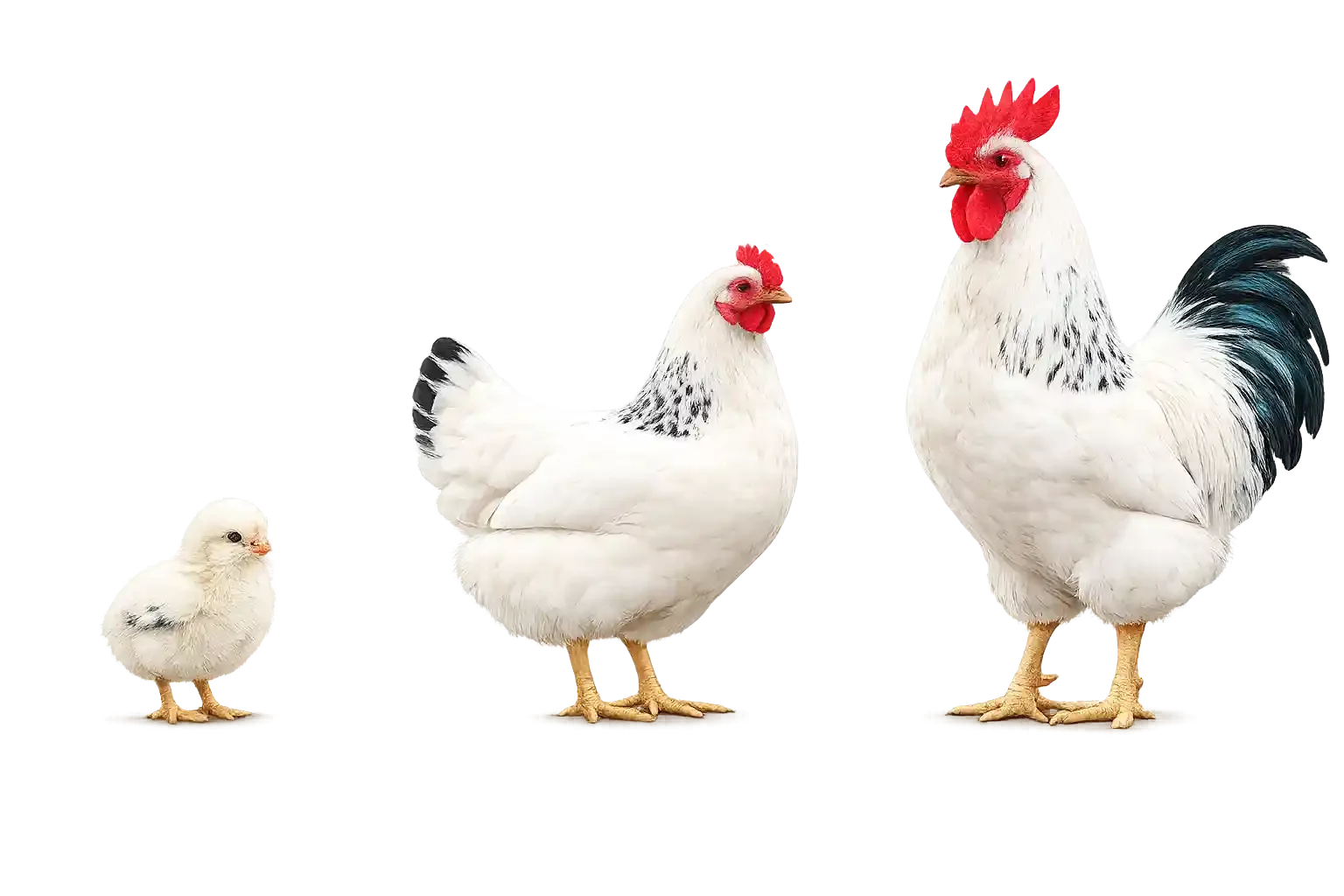
The Austra White is an early 20th-century American hybrid cross between a Black Australorp rooster and a White Leghorn hen, developed with a specific practical goal: to produce a white egg layer that kept the Leghorn's exceptional production output while correcting its two most significant homestead limitations, its nervous and flighty temperament and its relatively slight body. The cross achieves both objectives cleanly. The Austra White lays approximately 220 to 280 large cream to off-white eggs per year at a pace comparable to the Leghorn's, while carrying enough Australorp genetics to be noticeably calmer, heavier, and more manageable in a backyard or small farm setting. Dunlap Hatchery in Oregon claims development of the cross in the early 1900s; Cackle Hatchery has maintained its own Austra White production strain since 1939. The cross is not APA recognized and does not breed true as a first-generation hybrid, meaning keepers who breed Austra White to Austra White will not reliably produce Austra White offspring. The appearance of the bird reflects its dual parentage clearly: hens are predominantly white with random black flecks and speckling from the Australorp side, roosters are pure white with bright red single combs, and the legs can be either yellow from the Leghorn parent or gray from the Australorp parent depending on which genetics dominate in a given bird. For the homestead keeper who wants the productivity of a Leghorn-class white egg layer without the Leghorn's management challenges, who values a calmer and more handleable hen that still forages actively and begins laying at approximately 4 to 5 months of age, and who is comfortable with a hybrid that requires periodic replacement from a hatchery source rather than self-sustaining flock propagation, the Austra White delivers a genuinely well-balanced egg production package.
Quick Facts
Type: Production hybrid; first-generation cross between Black Australorp rooster and White Leghorn hen
Weight: Hens approximately 5 lbs; roosters approximately 6.5 lbs
Egg Production: Approximately 220 to 280 large cream to off-white eggs per year; 4 to 6 eggs per week; some early layers begin as early as 4 months
Egg Color: Cream to very light brown; off-white; lighter than a standard brown egg, warmer than a pure white egg
Egg Size: Large
Primary Purpose: Egg production; dual purpose at homestead scale
Temperament: Active but manageable; calmer and less flighty than a pure White Leghorn; friendlier than most production layers; curious and sociable
Brooding: Low to occasional; some hens go broody despite hybrid genetics; generally less broody than heritage breeds
Flight Capability: Moderate; more active than heavy heritage breeds but less flighty than pure Leghorns; standard fencing generally adequate
APA Recognition: None; hybrid cross not eligible for breed recognition or exhibition
Country of Origin: United States; early 1900s; attributed to Dunlap Hatchery in Oregon; Cackle Hatchery strain developed since 1939
Parent Breeds: Black Australorp rooster x White Leghorn hen
Distinctive Trait: White plumage with random black flecks in hens; pure white roosters; legs variable yellow or gray depending on parent genetics; cream to off-white egg color; calmer and heavier than pure Leghorn with comparable production
Availability: Widely available from mainstream hatcheries; not exclusive to any single supplier
Lifespan: Estimated 5 to 8 years, consistent with production hybrid breeds
Breed Overview
The Austra White's development logic is straightforward enough to state in a single sentence: the White Leghorn lays more eggs than almost any other breed but is too flighty, too light-bodied, and too difficult to handle for many backyard and homestead keepers, and crossing it with the Black Australorp, which is calmer, heavier, and more forager-oriented while also being one of the best heritage layers in the world, should produce offspring that combine the Leghorn's production ceiling with the Australorp's practical management character. The cross delivers on this logic reliably enough that it has been maintained as a production strain by multiple American hatcheries for over a century.
The specific origin of the Austra White as a named cross is attributed by Dunlap Hatchery to their operation in Oregon in the early 1900s, with the stated goal of developing a less flighty, milder-mannered white egg layer than the Leghorn while maintaining high egg production. Cackle Hatchery documents its own Austra White strain development beginning in 1939, focusing on dependable egg production, feed efficiency, and birds suited to backyard and small farm environments. Both hatcheries, and several others including Meyer Hatchery and Chickens for Backyards, carry the cross as a standard offering, making the Austra White one of the more widely available production hybrids in the North American market and the only one whose parent breeds are both extensively documented heritage breeds with their own entries in this directory.
As a first-generation hybrid the Austra White benefits from heterosis, the hybrid vigor that first-generation crosses between two genetically distinct parent lines often produce in health, growth rate, and production efficiency. This is the same genetic advantage that makes sex-link hybrids and other production crosses perform above the production ceiling of either parent breed in isolation. The Austra White does not carry sex-link genetics, meaning chicks are not sexable at hatch by color, and professional vent sexing accuracy at the standard 80 to 85 percent rate applies when ordering sexed pullets.
The practical limitation of the hybrid cross is the same as for all first-generation hybrids: Austra White hens bred with Austra White roosters produce offspring with unpredictable genetics that do not reliably replicate the parent's production characteristics, temperament balance, or egg color consistency. Maintaining an Austra White flock long term requires periodic replacement stock from a hatchery maintaining the verified parent line cross rather than propagating from home flock breeding.
Plumage and Appearance
The Austra White's plumage is the most visually distinctive aspect of the breed and the clearest visible indicator of its dual parentage. Hens are predominantly white with random black flecks, speckles, and occasionally larger dark markings scattered through the plumage, reflecting the Australorp parent's black genetics expressing partially in the cross. The distribution and intensity of the black flecking varies between individual birds, since the cross does not breed to a consistent pattern standard in the way that a recognized breed's plumage is standardized. Some hens carry only light scattered speckling barely visible at a distance; others show more pronounced black markings across the hackle, back, or wings. Both are normal expressions of the hybrid genetics.
Roosters are pure white with no black flecking, carrying the Leghorn's clean white plumage without the Australorp's dark pigmentation expressing in the male. The single comb is bright red and of medium to large size on the rooster. The face, wattles, and earlobes are red. The body is medium-sized, noticeably heavier than a pure Leghorn but lighter than the Black Australorp at approximately 5 pounds for hens and 6.5 pounds for roosters.
The leg color is one of the Austra White's most variable characteristics and a reliable reminder of the hybrid's genetics. Because the Black Australorp carries gray to dark slate legs and the White Leghorn carries yellow legs, the offspring can express either yellow or gray leg coloring depending on which parent's leg color genetics dominate in a given bird. Both yellow-legged and gray-legged Austra Whites are normal first-generation cross outcomes and neither indicates impurity or misidentification. Keepers who specifically want consistent leg color for aesthetic or exhibition purposes will find the Austra White's variability in this characteristic an expected limitation of hybrid genetics.
Egg Production
The Austra White's egg production is its central practical value, and the figures are genuinely strong. Annual production of approximately 220 to 280 large cream to off-white eggs per year, or 4 to 6 eggs per week, places the Austra White at the top of the homestead hybrid layer category alongside the Ameribella and well above most heritage dual-purpose breeds. Hens typically begin laying at approximately 4 to 5 months of age, with some individuals reported starting as early as 12 weeks in Meyer Hatchery's documentation, though this represents an early outlier rather than a typical expectation.
The egg color is one of the Austra White's most practically interesting characteristics. Neither the pure white of a Leghorn egg nor the light to medium brown of an Australorp egg, the Austra White's eggs fall in a cream to very light brown range that many keepers describe as a warm off-white. This egg color sits between the parent breeds' outputs and reflects the partial expression of the brown egg genetics from the Australorp side acting on the white egg base of the Leghorn genetics. The result is consistent within an individual hen, though the specific shade of cream varies somewhat between birds, and it occupies a visually distinct position in a mixed egg carton that combines well with the darker browns, blues, and greens of other breeds.
Year-round laying consistency is one of the Austra White's documented advantages, with the Australorp genetics contributing the winter hardiness and cold-weather production consistency that makes the Black Australorp one of the most reliable heritage winter layers. Keepers report strong production through winter months without the sharp seasonal reduction that pure Leghorn flocks sometimes experience in the shortest days of the year.
Broodiness is low to occasional, consistent with both parent breeds' generally non-broody characters. Cackle Hatchery keeper accounts include reports of Austra White hens going broody, suggesting the Australorp's occasional broodiness can express in the cross, but this is not typical behavior for the hybrid as a whole. Keepers who want reliable natural hatching should use a dedicated broody breed rather than planning hatching programs around Austra White hens.
Temperament and Behavior
The temperament difference between the Austra White and a pure White Leghorn is the most frequently cited practical advantage of the cross by keepers who have experience with both. The White Leghorn is an exceptionally productive bird with a temperament that many backyard keepers find challenging: nervous, reactive, vocal, and inclined toward strong avoidance of human contact even with regular handling. The Austra White's Australorp genetics moderate this character noticeably without eliminating the active, alert quality that makes the Leghorn a productive forager and effective predator avoider.
Austra White hens are described across keeper accounts as friendly, curious, and sociable in a way that distinguishes them clearly from pure Leghorns while remaining more active and alert than the genuinely docile heritage breeds like the Black Australorp, the White Rock, or the Black Jersey Giant. They approach their keeper with interest rather than alarm, tolerate handling better than Leghorns, and integrate into mixed flocks without the nervous tension that pure Leghorns sometimes create in mixed-breed environments. The breed is consistently recommended as beginner-accessible in a way that pure Leghorns rarely are.
The active foraging character from both parent breeds is fully present in the Austra White. The birds range actively on pasture, forage efficiently for insects and plant material, and contribute to feed cost savings in range-managed operations at a level consistent with their Leghorn and Australorp heritage. Predator awareness is strong, reflecting the alert, self-protective character of both parent breeds and making the Austra White a reasonably self-sufficient free-range bird compared to calmer, less alert breeds that rely more heavily on fencing and housing for protection.
Climate Adaptability
The Austra White's climate adaptability is broader than either parent breed alone, combining the Leghorn's heat tolerance with the Australorp's cold hardiness in a cross that handles a wider range of North American climates than either pure parent. The Australorp genetics contribute the dense undercoat and cold-weather production consistency that makes the Black Australorp a reliable northern flock bird; the Leghorn genetics contribute the heat management efficiency of a lighter-bodied Mediterranean-heritage bird.
The single comb, present in both parent breeds and inherited consistently in the Austra White, is the primary cold-climate management consideration. Standard frostbite monitoring and preventive petroleum jelly application during sustained hard freezes applies, particularly for roosters with larger combs. Hen combs are smaller and present less risk under standard good-housing conditions.
The white plumage absorbs less solar heat than dark-feathered breeds, giving the Austra White a modest thermal management advantage in summer compared to the Black Australorp's dark feathering. Standard shade and cool water management handles summer heat adequately in most North American climates.
Housing and Management
Standard production layer housing requirements apply throughout. Four square feet of indoor floor space per bird minimum. Standard four to five foot fencing adequate for a breed of this size and temperament, though the Austra White's moderate flight capability means that particularly active individuals may test lower barriers. Standard layer feed with 16 to 18 percent protein and free-choice oyster shell for calcium supplementation supports the high weekly production volume. The breed's active foraging supplements the feed ration meaningfully on range.
The non-breeding nature of the hybrid is the primary management distinction from heritage breeds. Keepers who want to propagate their flock from their own birds cannot do so reliably with the Austra White, as offspring from Austra White-to-Austra White crosses will not consistently replicate the parent's production characteristics, temperament balance, or egg color. Planning for periodic hatchery replacement is the appropriate long-term management approach.
Unlike the Ameribella, which is exclusive to My Pet Chicken, the Austra White is available from multiple mainstream hatcheries including Cackle Hatchery, Meyer Hatchery, Dunlap Hatchery, and Chickens for Backyards, among others. This multi-supplier availability eliminates the single-source dependency that affects some proprietary hybrid breeds and gives keepers flexibility in sourcing, pricing comparison, and replacement planning.
Sourcing Considerations
The Austra White's wide availability from multiple established hatcheries is one of its practical advantages over proprietary exclusive hybrids. Cackle Hatchery's 1939 strain development history and Meyer Hatchery's well-documented production records make both sources reliable starting points for keepers who want verified production strain Austra Whites. Because the cross is not proprietary, multiple suppliers compete on quality and price, providing keepers with options that single-source exclusive hybrids cannot offer.
Sexing accuracy for Austra White chicks follows standard vent sexing rates of 80 to 85 percent rather than the near-100 percent accuracy of sex-link hybrids, since the Austra White cross does not use sex-linked color genetics to distinguish male from female chicks at hatch. Keepers who specifically want near-certain sexing accuracy should consider a sex-link hybrid; keepers who are comfortable with standard vent sexing accuracy will find the Austra White's multiple-supplier availability and production track record more important considerations than the sexing accuracy differential.
Pros and Cons
Pros
Strong egg production of 220 to 280 large cream to off-white eggs per year; genuine Leghorn-class production volume with significantly improved temperament
Calmer, friendlier, and more handleable than a pure White Leghorn; one of the most beginner-accessible high-production layers available
Early lay onset at approximately 4 to 5 months of age
Good year-round laying consistency including through winter months, enhanced by Australorp genetics
Hybrid vigor from first-generation cross between two high-performing parent breeds
White plumage with black flecking is visually interesting and distinctive in a mixed flock
Cream to off-white egg color sits between brown and white in a mixed carton; visually complementary alongside blue, green, and dark brown heritage eggs
Widely available from multiple mainstream hatcheries; no single-supplier dependency
Good climate adaptability across both cold and warm regions
Active forager with good range efficiency and predator awareness
Cons
Does not breed true; hybrid genetics require periodic hatchery replacement rather than self-sustaining flock propagation
Not APA recognized; not suitable for exhibition
Leg color variable between yellow and gray in the same flock; no consistent standard
Black flecking distribution in hens variable between individuals; no consistent plumage pattern
Vent sexing accuracy of 80 to 85 percent rather than sex-link-level near-certainty
Broodiness low; not reliable for natural hatching programs
Production decline typically more rapid after peak years than heritage breeds
Single comb requires frostbite monitoring in hard winters
Profitability
The Austra White's profitability is built around high-volume cream egg production from a manageable, widely sourced hybrid at accessible pricing from multiple suppliers. The cream to off-white egg color is a practical advantage in mixed egg carton marketing, where its warm off-white sits visually between the dark browns of Marans eggs and the blues and greens of Ameraucana and Easter Egger eggs, contributing to the color variety that direct-sale and farmers market customers seek.
Production volume of 220 to 280 eggs per year from each hen, combined with early lay onset and consistent year-round production, delivers strong return on feed and housing investment for homestead egg operations where volume and consistency are the primary value drivers. The multi-supplier sourcing allows competitive pricing comparison for replacement stock, reducing the long-term cost of periodic flock renewal compared to proprietary exclusive hybrids.
The breed's calmer temperament relative to Leghorns reduces the management labor cost of daily flock interaction and makes the birds genuinely pleasant to work with, which is a practical quality-of-life factor in operations where the keeper's daily experience with their flock matters alongside the economic metrics.
Comparison With Related Breeds
White Leghorn: The most direct comparison and one of the parent breeds. The White Leghorn lays 250 to 320 pure white eggs per year, somewhat more than the Austra White's 220 to 280, but with a nervous, flighty temperament that many backyard keepers find difficult to manage. The Austra White trades a portion of the Leghorn's maximum production ceiling for noticeably improved temperament, slightly heavier body, and cream egg color rather than pure white. For keepers who prioritize maximum white egg volume above all else and can manage a flighty bird, the Leghorn wins on production; for keepers who want strong production in a calmer, more enjoyable bird, the Austra White is the more practical choice.
Black Australorp: The other parent breed, covered extensively in a dedicated post in this directory. The Black Australorp lays 250 to 300 large light brown eggs per year from a true-breeding APA-recognized heritage breed with a century of documented production history, beetle-green iridescent plumage, genuine dual-purpose meat utility, and exceptional temperament. The Austra White produces cream eggs at a comparable volume from a hybrid that is calmer than the Leghorn but not quite as naturally docile as the Australorp. The Australorp breeds true and supports self-sustaining flock propagation; the Austra White does not. For keepers who want heritage breed credentials, conservation value, exhibition eligibility, and a self-sustaining flock, the Australorp is the better choice; for keepers who want the cream egg color and Leghorn-influenced production efficiency in a calmer package, the Austra White serves that specific need.
Ameribella: A useful comparison within the proprietary production hybrid category. The Ameribella is a My Pet Chicken exclusive sex-link hybrid laying cream eggs at approximately 280 to 300 per year, slightly more than the Austra White's upper range, with sex-link sexing accuracy at the hatch. The Austra White is available from multiple suppliers without single-source dependency and has a longer established track record dating to 1939. Both are cream egg production hybrids that occupy similar positions in the homestead market; the Austra White's multi-supplier availability and documented strain history are practical advantages, while the Ameribella's sex-link sexing confidence is a specific advantage for keepers who specifically want near-certain hen-only purchases.
California White: A closely related cross produced by crossing a White Leghorn with a California Gray, producing a similar result to the Austra White in temperament and production but with slightly different genetics. Both are white-feathered production hybrids with black flecking, cream to white eggs, and calmer-than-Leghorn temperament. The distinction between them is primarily genetic; the practical homestead performance is similar enough that keepers choosing between them should focus on supplier quality and availability rather than breed-name differences.
Final Verdict
The Austra White does one specific thing very well: it delivers Leghorn-class egg production in a bird that a backyard keeper can actually enjoy raising. The pure White Leghorn is genuinely one of the most productive egg layers available, and the Austra White's production figures, at 220 to 280 cream eggs per year, sit close enough to the Leghorn's ceiling that the temperament improvement is essentially free in production terms. The hybrid limitation, requiring hatchery replacement rather than home flock propagation, is a genuine consideration for keepers who want a self-sustaining operation, and for them the Black Australorp in this directory delivers comparable production with true-breeding heritage credentials. For everyone else, including the majority of homestead and backyard keepers who replace their laying flock periodically anyway and who want the most pleasant and productive white egg layer available without Leghorn management frustrations, the Austra White makes an honest and well-supported case. The dual purpose and homestead category is better for including it.
Frequently Asked Questions
What is an Austra White chicken? An Austra White is a first-generation hybrid cross between a Black Australorp rooster and a White Leghorn hen, developed in the early 1900s in the United States to produce a high-production white egg layer with a calmer temperament than the pure White Leghorn. It is not a recognized APA breed and does not breed true.
What color eggs does the Austra White lay? Cream to very light brown, described as off-white: warmer than a pure white Leghorn egg and lighter than a standard brown egg. The color reflects the partial expression of the Australorp's brown egg genetics acting on the Leghorn's white egg base in the first-generation cross. Individual hens vary slightly in the specific shade of cream they produce.
Why do Austra White chickens have different leg colors? The Black Australorp carries gray to dark slate legs and the White Leghorn carries yellow legs. In a first-generation cross, the leg color genetics from each parent can express independently in different offspring, producing some yellow-legged and some gray-legged birds in the same hatch. Both are normal outcomes of the hybrid cross. The variability is not a sign of impurity or misidentification.
Can I breed my Austra White chickens and get more Austra Whites? No. The Austra White is a first-generation hybrid that does not breed true. Crossing Austra White to Austra White produces offspring with unpredictable genetics that do not reliably replicate the parent's production characteristics, temperament balance, or cream egg color consistency. Maintaining an Austra White flock requires periodic replacement chicks from a hatchery maintaining the verified parent line cross.
How does the Austra White compare to the White Leghorn? The Austra White lays slightly fewer eggs per year at 220 to 280 compared to the Leghorn's 250 to 320, but is noticeably calmer, heavier, more handleable, and more beginner-friendly. The egg color is cream rather than pure white. For keepers who want maximum white egg volume and can manage a flighty bird, the Leghorn edges the Austra White on production; for keepers who want strong production in a manageable, enjoyable bird, the Austra White is the more practical choice for most homestead settings.
Where can I buy Austra White chicks? From multiple mainstream hatcheries including Cackle Hatchery, Meyer Hatchery, Dunlap Hatchery, and Chickens for Backyards, among others. The Austra White is not exclusive to any single supplier, giving keepers flexibility in sourcing and replacement planning that proprietary exclusive hybrids do not offer.
Related Breeds
Black Australorp
White Leghorn
Ameribella
Black Sex Link
California White
White Rock