
Ayam Cemani
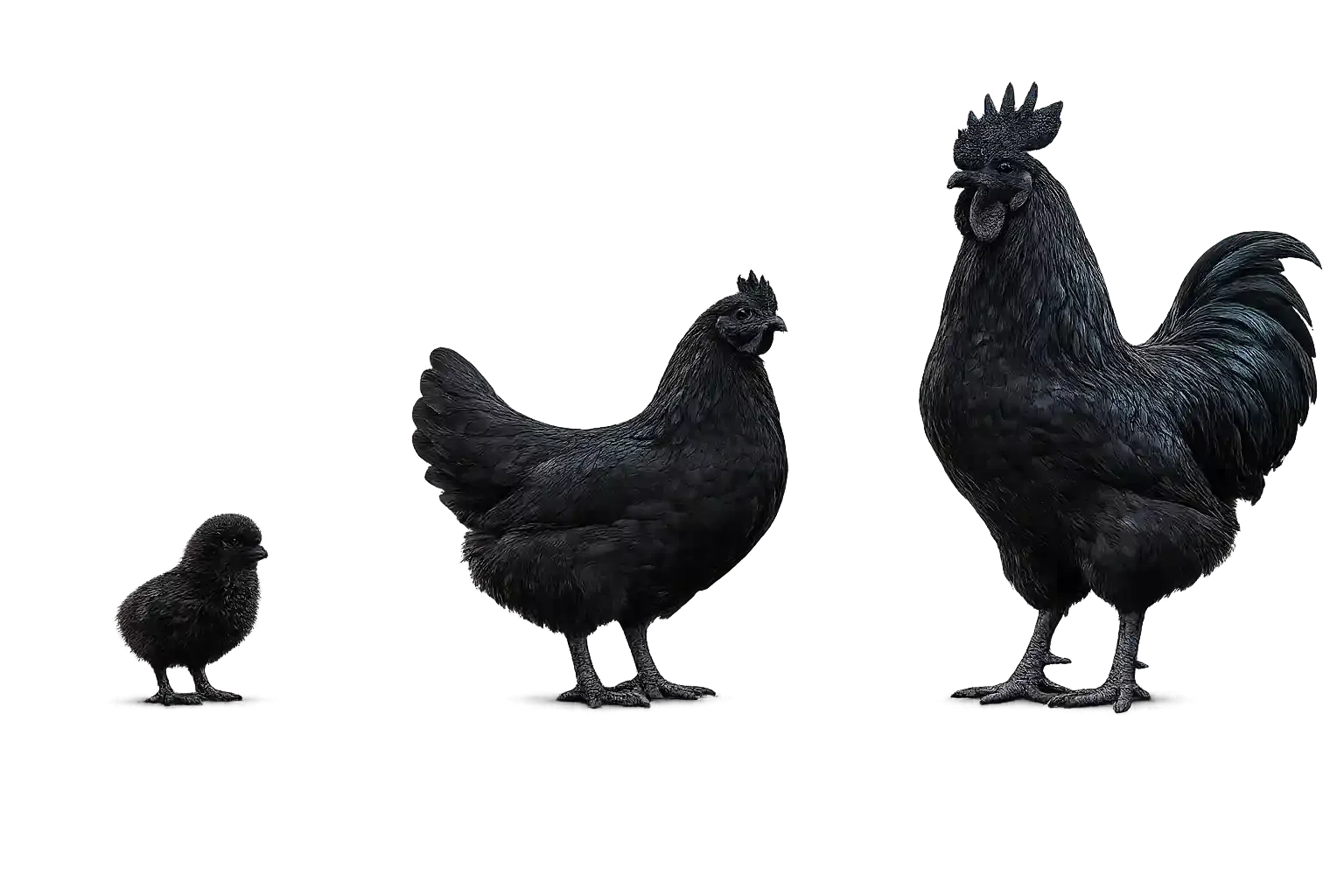
It is known in some circles as the Zombie Chicken, and once you see one in person, the nickname stops feeling dramatic. The Ayam Cemani is completely black. Not black the way a Black Australorp is black, with dark feathers and yellow legs underneath, but black in a way that reaches entirely through the animal: feathers, skin, comb, wattles, beak, tongue, toenails, muscle, fat, internal organs, and bones. The only part of the bird that is not black is its blood, which is a normal dark red, and its eggs, which are cream-colored with a faint pink tint. Everything else is darkness. The cause is a genetic condition called fibromelanosis, a dominant mutation in the EDN3 gene on chromosome 20 that triggers massive overproduction of melanin across every tissue of the body during embryonic development. No other chicken breed expresses this mutation with the same completeness and intensity as the Ayam Cemani. It originated in Central Java, Indonesia, particularly the Kedu region of Temanggung, where it has been kept since at least the 12th century for ceremonial, spiritual, and royal purposes. It arrived in Europe in 1998 when Dutch breeder Jan Steverink imported the first verified specimens, and it reached North American enthusiasts in the years that followed. It is today one of the most recognized, most discussed, most desired, and most frequently misrepresented chickens in the world. For exhibition breeders, ornamental flock keepers, and anyone drawn to a bird that operates at the absolute outer edge of what a chicken can look like, the Ayam Cemani is unlike anything else in the poultry directory.
Quick Facts
Class: All Other Standard Breeds (APA)
Weight: Roosters approximately 5 lbs; hens approximately 4 lbs
Egg Production: Approximately 60 to 100 cream-colored eggs per year; cyclical laying pattern with long off-lay periods
Egg Color: Cream to pale tinted; not black
Egg Size: Small to medium; approximately 45 grams
Primary Purpose: Exhibition; ornamental; conservation
Temperament: Calm, docile, and gentle; hens manageable; roosters protective but not typically human-aggressive; can be flighty when startled
Brooding: Low to moderate; hens go broody occasionally but are poor natural setters and rarely hatch their own brood reliably
Flight Capability: Moderate to high; fencing at five to six feet or covered runs recommended
APA Recognition: Yes; classified under All Other Standard Breeds
Country of Origin: Central Java, Indonesia; Kedu region of Temanggung
Varieties (APA): Black only
Also Known As: Zombie Chicken, Black Chicken of Java, Lamborghini of Poultry
Comb Type: Single comb with five distinct points; frostbite risk in hard winters requires management attention
Distinctive Trait: Complete fibromelanosis; entirely black inside and out, including organs and bones
Conservation Status: Rare; not listed by the Livestock Conservancy; Indonesian national breed with small verified global populations
Lifespan: 6 to 8 years; up to 10 under optimal conditions
Breed Overview
The Ayam Cemani's documented history in Western scientific literature begins in the 1920s, when Dutch colonial settlers in Java first formally recorded the breed and noted its hyperpigmentation alongside its cultural significance among Javanese villagers. But the oral tradition behind the breed runs far deeper. Javanese communities in the Kedu and Temanggung regions maintained the Ayam Cemani as a ceremonial bird for centuries before European contact, using it in ritual offerings, healing ceremonies, and spiritual protection rites. The breed's total blackness was interpreted not as a biological curiosity but as a sign of spiritual potency, and the birds were believed to act as conduits between the physical and spiritual worlds. Access to Ayam Cemani was historically restricted to royal households and priestly communities; the average Javanese farmer did not keep them. This elite status within Indonesian society was part of what motivated their careful maintenance and genetic isolation over generations.
The fibromelanosis trait that defines the breed is the result of a duplication near the endothelin 3 gene on chromosome 20, which researchers have determined originated approximately 6,600 to 9,100 years ago through intense artificial selection from the red junglefowl, the wild ancestor of all domestic chickens. The same gene, in less complete expression, appears in a handful of other breeds including the Silkie, the Swedish Svart Hona, the Indian Kadaknath, and the Vietnamese Black H'Mong. None of these breeds, however, express fibromelanosis with the depth and consistency of the Ayam Cemani in homozygous form, where both copies of the gene carry the mutation and internal pigmentation reaches the organs and bones as completely as it does the feathers.
Jan Steverink's 1998 importation to the Netherlands established the first verified European bloodline. The breed quickly attracted attention from exhibition and ornamental poultry communities across Europe, and early specimens were selling for over two thousand dollars in international markets. By the time significant numbers reached North America in the early 2000s and onward, the breed had acquired a mythology in poultry circles that somewhat outpaced the practical understanding of how to breed and maintain verified pure stock. North American breeders through the Ayam Cemani Breeders Association have been working to develop and stabilize a breed standard, formalize selection criteria, and document lineage in a way that distinguishes genuine Ayam Cemani from crossbreeds or incomplete-fibro birds sold under the same name.
Plumage and Appearance
The Ayam Cemani's appearance is the starting point for every conversation about the breed and deserves careful description, because the popular image of the bird often either overstates or understates what a genuine specimen looks like in person. The feathers are entirely black and carry a structural iridescence in direct light that produces a beetle-green and occasionally purple sheen across the hackle, back, saddle, and tail. This iridescence is similar in character to the Black Sumatra's but appears across a body type that is more upright and game-like in carriage, with a broader chest and stronger muscular development in the thighs, reflecting the breed's gamebird ancestry in Bali, where it was historically used in cockfighting for its speed and muscle mass.
The comb is a single comb with five distinct points, as specified in the breed's standard of perfection, carried erect and deeply black throughout. Wattles and earlobes are small, tight, and black. The face skin is black. The beak is black and curved. The tongue is black. The eyes are dark, nearly black in appearance. The legs are black, medium in length, and clean of feathers. The toenails are black. The soles of the feet are black, which distinguishes the Ayam Cemani from the Black Kedu, a related Javanese breed whose soles are yellowish. Every visible surface of the bird is black.
Internally, a genuine Ayam Cemani in homozygous fibromelanotic expression has black muscle tissue, dark gray to black bones, black organs including the heart, liver, spleen, and lungs, and black connective tissue throughout. The meat, if the bird is processed for the table, is a striking dark gray to black, a characteristic that in Indonesian folk medicine has long been associated with healing and vitality properties, though no rigorous clinical evidence supports these claims. The blood, despite the total internal pigmentation, is dark red rather than black, a fact that surprises many people encountering the breed for the first time.
Not all birds sold as Ayam Cemani express fibromelanosis completely. Hatchery stock and impure lines frequently produce birds with pink in the mouth or gums, lighter-colored toenails, white or mottled skin under the feathers, or reduced internal pigmentation. Exhibition breeders evaluate birds at multiple points: black tongue with no pink, black toenails with no light coloring, black shanks, fully dark facial skin, and, where possible, evidence of internal pigmentation in the lineage. Breeders in the early selection process also check chicks at hatch for a black tongue, black toes and nails, and black or dark gray down as indicators of full fibro expression.
Egg Production
The Ayam Cemani's laying pattern is one of the most distinctive and practically significant aspects of the breed, and one that prospective keepers frequently underestimate. The breed lays in cycles: a period of regular laying producing approximately 20 to 30 cream-colored eggs, followed by a complete stop lasting anywhere from three to six months before the cycle resumes. Annual production under this cyclical pattern runs approximately 60 to 100 eggs in the first year, declining somewhat in subsequent years. This is among the lowest consistent production figures for any APA-recognized or established exhibition breed.
The eggs are cream-colored with a faint pink tint and weigh approximately 45 grams, smaller than the large eggs of production breeds. The cream color surprises many people encountering the breed for the first time, since the assumption that the breed's total blackness would extend to the egg is widespread. It does not. Eggshell color is determined by genetics entirely separate from fibromelanosis, and the Ayam Cemani's cream egg is no different from what one would find from a similarly sized production hen.
Hens show low to moderate broodiness and are generally poor natural setters. Unlike the Black Sumatra, whose hens go broody readily and are competent mothers, the Ayam Cemani hen rarely commits to a complete natural incubation cycle with reliability. Most breeders use incubators to propagate the breed rather than relying on natural setting. Incubation at 99.5 degrees Fahrenheit and approximately 55 percent humidity produces hatch rates around 70 percent from fertile eggs on day 21.
Hens begin laying at approximately five to six months of age, comparable to many medium-sized breeds, though the long off-lay periods that follow the initial productive cycle mean that first-year production is often concentrated in a shorter window than keepers expect.
Temperament and Behavior
The Ayam Cemani's reputation for docility and calm temperament is generally well-earned and represents one of the most practical arguments for keeping the breed in a mixed backyard flock. Hens are calm, quiet, and manageable with regular handling. They are not considered cuddly in the way that breeds like the Cochin or Brahma can be, and they do not seek out human contact, but they tolerate being picked up and held without the alarm response seen in flightier breeds, and experienced keepers report that consistent gentle handling from young produces birds that recognize their owners and approach without significant alarm.
Roosters are protective of their flocks and will defend against perceived threats, but unlike game heritage breeds including the Malay or Asil, Ayam Cemani roosters are not typically human-aggressive under normal management conditions. They are active and alert, and their muscular gamebird body type gives them a physical presence that can be startling to visitors unfamiliar with the breed, but behavioral aggression toward people is not a breed characteristic in the way it is in other game-descended Indonesian breeds.
The breed is sometimes described as flighty, and this characterization is accurate in specific contexts. Loud noises, sudden movement, or alarm calls from a rooster will produce a flock-wide scatter response, with birds flying up and off in multiple directions simultaneously. This flocking alarm behavior reflects the breed's relatively limited domestication compared to heavy production breeds and is not a sign of ongoing stress under normal conditions. It is, however, a practical consideration for run design and containment.
The Ayam Cemani does well in mixed-breed flocks under most conditions and is not typically a bully toward smaller or less assertive breeds. It is described consistently by keepers as a social bird that interacts easily with flock mates and adapts to its environment without the territorial intensity seen in game-focused breeds.
Climate Adaptability
The Ayam Cemani's single comb is the most significant climate management consideration. Where the Black Sumatra's pea comb presents minimal frostbite risk in cold winters, the Ayam Cemani's single comb with five upright points is vulnerable in hard freezes, and breeders in cold-winter regions must provide housing with wind protection, dry conditions, and careful attention to temperature management during extreme cold events. This is not an insurmountable challenge, but it requires more active winter management than pea-combed or rose-combed breeds.
Heat tolerance is strong, consistent with the breed's equatorial Javanese origins. The Ayam Cemani handles high summer temperatures better than heavy dual-purpose breeds, benefits from shade and cool water during peak summer heat, and does not require special summer management beyond standard good practice. Some sources report that the breed's all-black plumage absorbs heat more readily than lighter-colored breeds in direct sun, making shade access particularly important during the hottest periods of the day in warmer climates.
Overall the breed is described as surprisingly hardy across a broad climate range when housing quality is maintained. The key winter requirement is a dry, well-insulated coop with effective wind protection. Under those conditions, Ayam Cemani manage cold winters across most of North America with routine attention rather than special intervention.
Housing and Management
Standard housing requirements apply with two notable adjustments: single-comb winter protection and run containment for a moderately flighty breed. Indoor floor space of four square feet per bird is the standard baseline. Outdoor run space should be generous given the breed's active, alert nature and its game heritage disposition toward ranging. Covered runs or fencing at five to six feet are appropriate for reliable containment, particularly during the alarm-response flock scatters that this breed produces more readily than calm dual-purpose breeds.
Feed management follows standard layer guidelines for the laying cycle. During the extended off-lay periods, some breeders reduce feed slightly and allow more foraging to prevent condition loss from inactivity, but the breed's moderate activity level and efficient foraging behavior mean that this is a relatively low-maintenance management decision rather than a complex nutritional intervention.
The most demanding management aspect of the Ayam Cemani is bloodline verification and breeding selection. Maintaining full fibromelanotic expression across generations requires evaluating birds at multiple checkpoints: chick inspection at hatch for tongue, toenail, and fluff color; juvenile assessment for facial skin and shank pigmentation; and adult evaluation of full pigmentation expression including mouth interior. Birds showing pink in the gums, light toenails, or white skin areas under the feathers are considered to have incomplete fibro expression and should not contribute to a breeding program aimed at exhibition quality or verified pure stock.
Sourcing Considerations
Sourcing genuine Ayam Cemani in North America requires more caution than almost any other exhibition breed, because the combination of the breed's celebrity status, high prices, and the visual challenge of verifying internal pigmentation without processing the bird has produced a significant number of impure or crossbred birds sold under the Ayam Cemani name. Chicks from mainstream hatcheries occasionally carry Ayam Cemani labeling but frequently show incomplete pigmentation expression, non-black toenails, pink gum tissue, or light-colored shanks that indicate incomplete fibromelanosis from diluted or crossbred lineage.
The Ayam Cemani Breeders Association in the United States is the most reliable resource for finding breeders committed to maintaining breed standards and documenting lineage. Greenfire Farms in Florida has been one of the primary importers of verified European bloodlines to North America and maintains documented stock. Belgian lineages imported directly have recently added genetic diversity to North American flocks. A waiting list of six months or longer from reputable breeders is common and should be expected rather than treated as a reason to compromise on stock quality.
Chick prices from verified breeders currently run approximately 50 dollars per bird, a significant reduction from the early importation period when birds sold for over two thousand dollars. Adult breeding pairs from verified pure lines remain substantially more expensive. The current price environment makes quality stock more accessible than it was a decade ago, but it also means that the price premium that once served as a rough quality signal has narrowed, making breeder reputation and lineage documentation more important than price alone as sourcing criteria.
Pros and Cons
Pros
Complete fibromelanosis produces the most visually striking chicken in existence: entirely black from beak to bone, inside and out
Docile, calm temperament; hens are manageable and social; roosters protective but not typically human-aggressive
APA recognition provides a formal breed standard against which exhibition quality can be evaluated
Active forager with gamebird efficiency; manages itself well on range with adequate space
Does well in mixed-breed flocks without excessive dominance behavior
Strong heat tolerance; manages equatorial and temperate summer conditions well
Extraordinary cultural history spanning over a thousand years of Javanese ceremonial and royal use
Chick prices from reputable breeders have become more accessible than in the early importation period
Genuine novelty and visitor interest: no other backyard chicken produces the reaction the Ayam Cemani does
Cons
Single comb requires active frostbite management in hard winter climates, unlike pea-combed exhibition breeds
Cyclical laying pattern with multi-month off-lay periods; annual production of 60 to 100 eggs is among the lowest for any recognized breed
Low broodiness and poor natural setting; incubator propagation is the practical standard
Sourcing verified pure stock is difficult; impure and crossbred birds are widely sold under the Ayam Cemani name
Incomplete fibromelanosis in hatchery or impure stock is common; buyers must verify tongue, toenail, and shank pigmentation at minimum
Flighty alarm response requires covered or tall-fenced runs for reliable containment
High price relative to production utility; the economics only make sense for exhibition or ornamental purposes
Lifespan of 6 to 8 years is shorter than longer-lived exhibition breeds like the Black Sumatra
Profitability
The Ayam Cemani's profitability profile is unusual among exhibition breeds because the breed's celebrity status creates genuine demand at multiple market levels simultaneously. Exhibition-quality adults from verified pure lineage with documented fibro expression command prices that reflect their breeding investment and scarcity. Hatching eggs from verified pairs with documented internal pigmentation lineage have a consistent and active market among breeders working to improve North American stock. Day-old chicks from reputable breeders sell reliably given the ongoing demand from keepers drawn to the breed's visual impact.
The breed's unique position in popular culture, where it has appeared in mainstream media, design publications, and social media content as a visual spectacle, means that it attracts buyer interest from well outside the traditional exhibition poultry community. This broader audience extends the market for verified birds beyond the specialty poultry circuit into ornamental and novelty flock territory, where buyers are often less price-sensitive than exhibition breeders.
The economic challenge is the same one that faces any breed where quality verification is difficult: the market for impure or crossbred birds sold as genuine Ayam Cemani undercuts verified breeders on price and erodes buyer confidence. Breeders who invest in genetic documentation, lineage tracking, and transparent pigmentation assessment at each generation are in the strongest long-term market position. The breed's off-lay periods and low annual production also mean that hatching egg supply from any single breeding pair is limited, which supports price stability for verified stock from established breeders.
Comparison With Related Breeds
Black Sumatra: The closest comparison in North American exhibition circles for an all-black, game-heritage, ornamental breed from Southeast Asia. The Black Sumatra has more reliable broodiness and a longer productive lifespan, and its multiple-spur trait and flowing horizontal carriage give it a different visual character from the Ayam Cemani's upright game-like stance. The Sumatra's pea comb is a practical winter advantage. The Ayam Cemani's complete internal pigmentation and cultural history are without parallel. Both are rare; the Sumatra is Critical by Livestock Conservancy designation while the Ayam Cemani is rare but not formally tracked by the same organization.
Silkie: Shares the fibromelanosis trait and the dark skin and bones that result from it, but expresses the gene heterozygously rather than homozygously, producing less complete internal pigmentation. The Silkie's fluffy non-standard feathering, rose comb, and dramatically different body type and temperament make it a poor visual comparison to the Ayam Cemani despite the shared genetic mechanism. The Silkie is widely available; the Ayam Cemani is not.
Svart Hona (Swedish Black Hen): A Scandinavian breed developed from fibromelanotic Asian stock, also entirely black in external appearance with similar iridescence, but typically expressing fibromelanosis heterozygously with less consistent internal pigmentation than the Ayam Cemani. The Svart Hona was selected for cold-climate hardiness and better egg production rather than ornamental perfection, producing approximately 150 to 200 eggs per year, significantly more than the Ayam Cemani, but with less complete and consistent fibro expression. A practical tradeoff breed for those who want the black-bird experience with better laying utility.
Kadaknath: An Indian breed with the same fibromelanosis trait, kept primarily for its black meat, which commands significant premium prices in Indian markets based on traditional medicine and nutritional beliefs. Less available in the West than the Ayam Cemani and oriented more toward meat production in its home market than toward exhibition.
Modern Game: An exhibition breed with similar upright carriage and game-like body type but entirely different in purpose, plumage character, and breeding history. Useful as a comparison for body type only; the Modern Game's defining feature is its extreme length and fine-boned silhouette rather than pigmentation.
Final Verdict
The Ayam Cemani exists in a category of its own. Every other chicken breed can be evaluated along a spectrum of egg production, meat utility, temperament, and hardiness, and placed in a practical context for the keeper's goals. The Ayam Cemani resists this framework because its defining characteristic, the total blackness that reaches through every tissue of its body, is not a production trait at all. It is a biological spectacle, a piece of Javanese cultural history, a subject of ongoing genetic research, and a living demonstration of how completely a single gene duplication can reshape an organism's appearance. The cyclical laying pattern, the poor natural setting, the single-comb winter management requirements, and the sourcing difficulty are all real practical limitations. None of them are the point.
For keepers who want eggs, the Ayam Cemani is not the right choice and does not pretend to be. For keepers who want to maintain a bird whose existence prompts genuine disbelief from first-time observers, whose genetic story reaches back over six thousand years to the red junglefowl and through the royal households of Java, and whose appearance remains as startling after months of daily familiarity as it was at first sight, the Ayam Cemani stands alone. The chicken directory is better for including it.
Frequently Asked Questions
Do Ayam Cemani chickens lay black eggs? No. This is the most common misconception about the breed. Ayam Cemani hens lay cream-colored eggs with a faint pink tint, identical in color to what many other medium-sized breeds produce. Eggshell color is determined by genetic pathways completely separate from fibromelanosis. The all-black appearance of the bird has no effect on the color of the eggshell.
Is Ayam Cemani blood black? No. Despite the breed's total internal pigmentation, including black organs, black muscle tissue, and dark gray to black bones, the blood is dark red, as in any other chicken. Elevated myoglobin levels in the heavily pigmented muscle tissue can make the blood appear slightly darker than average, but it is not black.
What is fibromelanosis? Fibromelanosis is a genetic condition caused by a duplication near the endothelin 3 gene on chromosome 20 that triggers massive overproduction of melanin across all tissues during embryonic development. In the Ayam Cemani, which expresses the gene in homozygous form with both copies of the gene carrying the mutation, this results in complete pigmentation of feathers, skin, organs, bones, and connective tissue. The condition is also found in partial form in other breeds including the Silkie, Svart Hona, and Kadaknath, none of which express it as completely as the Ayam Cemani.
How many eggs do Ayam Cemani hens lay? Approximately 60 to 100 cream-colored eggs per year, but with an important caveat: the breed lays in cycles of approximately 20 to 30 eggs followed by an off-lay period of three to six months before the cycle restarts. This cyclical pattern is characteristic of the breed and not a sign of health problems. Keepers expecting consistent weekly production will be disappointed; keepers who understand the cycle manage expectations accordingly.
How do I verify that an Ayam Cemani is genuine? At the chick stage, check for a black tongue with no pink, black toenails with no light coloring, and black or dark gray down. In juveniles and adults, check for fully black facial skin, black shanks with black toes on all surfaces including the soles, fully black mouth interior including the gums and palate, and black or dark gray skin throughout. Birds showing any pink in the mouth, light-colored toenails, or white skin under the feathers have incomplete fibromelanosis expression and are not exhibition-quality pure Ayam Cemani, regardless of what they were sold as.
Are Ayam Cemani chickens good for beginners? They are more approachable for beginners than game breeds like the Malay or Black Sumatra, given the generally docile temperament and manageable hens. The primary challenges for beginners are not temperament but sourcing quality stock, understanding and managing the cyclical laying pattern, and providing appropriate winter housing for the single comb. Beginners willing to research sourcing carefully and invest in proper housing can manage Ayam Cemani successfully.
How much do Ayam Cemani chickens cost? Chicks from verified breeders currently run approximately 50 dollars each. Adult birds with verified pure lineage range from 200 to 2,500 dollars depending on the quality of fibro expression, lineage documentation, and the reputation of the breeder. Breeding pairs from top-quality verified stock remain at the higher end of this range. Hatchery birds labeled as Ayam Cemani may be significantly cheaper but frequently lack verified pure lineage and should be evaluated critically before purchase.
Where can I find genuine Ayam Cemani in North America? The Ayam Cemani Breeders Association maintains a breeder network and is the best starting point for sourcing verified stock. Greenfire Farms in Florida is one of the most established importers of documented European bloodlines in North America. Reputable breeders typically have waiting lists of several months, which should be expected. Poultry shows and specialty exhibitions are good venues for meeting breeders, examining birds in person, and evaluating stock before committing to a purchase.
Related Breeds
Black Sumatra
Svart Hona (Swedish Black Hen)
Silkie Chicken
Kadaknath
Modern Game
Malay Chicken