
Barred Plymouth Rock
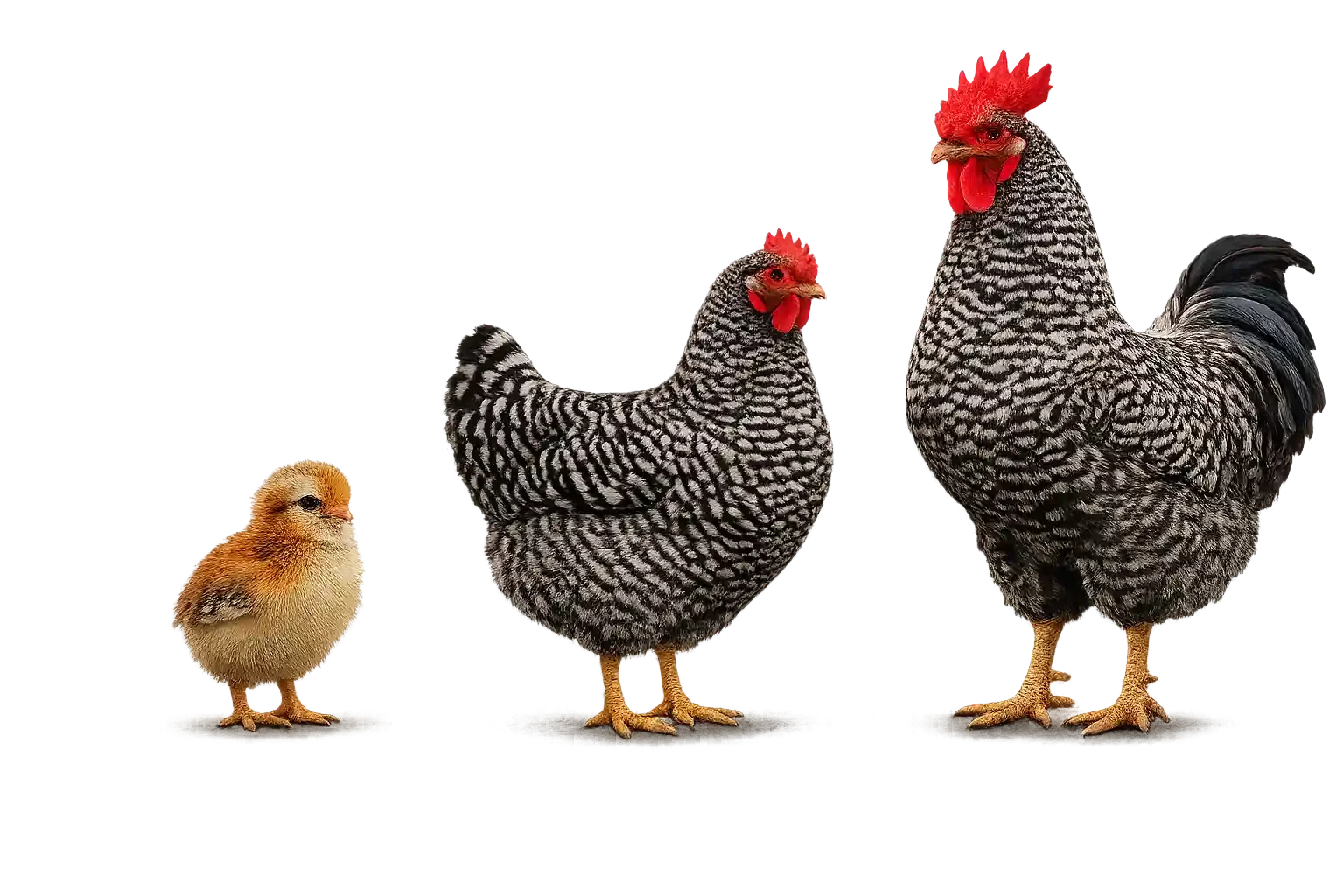
The Barred Plymouth Rock is the foundational American dual-purpose heritage breed, and its claim to that title is not nostalgia but documented historical fact. From the time of its APA recognition in 1874 through the period ending around World War II, no breed was kept and bred as extensively in the United States as the Barred Plymouth Rock. It was called the Hereford of the poultry world, a designation that captured its position as the standard-bearer of American farm poultry the way the Hereford cattle breed represented the standard of the American beef industry: widespread, trusted, productive, and present on farms across every climate zone in the country. Its popularity came from qualities that remain as practically valuable today as they were in the 19th century: genuine dual-purpose utility producing both meaningful egg volume and a worthwhile table bird from the same breeding flock, exceptional cold hardiness, a calm and docile temperament that is consistently safe around children and manageable for beginning keepers, reliable broodiness for natural flock propagation, and the distinctive black-and-white barred plumage that has made the Barred Rock one of the most immediately recognizable heritage breeds in American poultry.
The breed eventually lost its commercial dominance to specialized White Leghorn egg layers and Cornish Cross broiler hybrids, as all balanced dual-purpose heritage breeds did when industrial specialization separated the egg and meat functions into distinct genetic products optimized for each purpose alone. The Barred Plymouth Rock's Livestock Conservancy Recovering status reflects a genuine population recovery driven by the heritage breed revival that has accompanied the growth of backyard flocks, small-scale homesteading, and direct-sale food production over the past two decades. For the homestead keeper who wants the most historically significant, most widely validated, most beginner-appropriate American dual-purpose heritage breed with a track record measured not in years but in generations of farm use across the entire United States, the Barred Plymouth Rock remains the answer it has been for over 150 years.
Quick Facts
Class: American (APA)
Weight: Roosters approximately 9.5 lbs; hens approximately 7.5 lbs
Egg Production: Approximately 200 to 280 large brown eggs per year; 4 to 5 eggs per week; consistent year-round layer including through winter
Egg Color: Light to medium brown
Egg Size: Large; approximately 55 grams average
Primary Purpose: Dual purpose; eggs and meat; also exhibition; historically the most widely kept American farm chicken
Temperament: Calm, docile, confident, and friendly; one of the most beginner-accessible large heritage breeds; good with children; roosters generally manageable when socialized from young
Brooding: Occasional to moderate; some hens go broody and are good mothers; more reliable brooding tendency than many production breeds
Flight Capability: Low; body weight and calm disposition make sustained flight over standard fencing unlikely
APA Recognition: 1874; American Class; among the first breeds admitted to the APA Standard of Perfection
Country of Origin: United States; New England; Massachusetts
Varieties (APA): Barred is the original and most widely kept variety; White, Buff, Silver Penciled, Partridge, Columbian, and Blue are additional recognized varieties
Comb Type: Single comb; frostbite risk in hard winters requires management attention
Distinctive Trait: Bold black-and-white barred plumage on every feather; roosters appear lighter than hens because roosters carry two copies of the barring gene and hens carry one; the original and defining Plymouth Rock variety; most widely kept breed in US history through World War II
Conservation Status: Recovering (Livestock Conservancy)
Lifespan: 6 to 12 years
Breed Overview
The Barred Plymouth Rock's history is one of the most contested and most colorful in American poultry, involving competing claims of invention, a breed that appeared in 1849 and then essentially vanished for two decades before reappearing in 1869, and a standardization debate that eventually produced the APA's first breed recognition list in 1874.
The first documented appearance of a Plymouth Rock chicken at a poultry show in Boston in 1849 predates the modern breed's development by twenty years, and the birds shown at that exhibition bore enough resemblance to Dominiques that contemporaries struggled to distinguish them. The breed disappeared from documentation after 1849, possibly because several different strains were being developed simultaneously by different breeders without any common standard, and possibly because the lines between the early Plymouth Rock and the Dominique were genuinely blurry enough that no consistent breed identity had yet emerged.
The modern Barred Plymouth Rock is generally traced to D.A. Upham of Worcester, Massachusetts, who exhibited his birds at the Worcester poultry show in 1869. Upham had crossed pullets of Black Java ancestry with a cock carrying barred plumage and a single comb, culling the progeny severely and keeping only those with clean yellow legs and consistent barring. His birds were shown in 1869 and the strain they established is considered the foundation of the breed as it exists today, though multiple other breeders including those working with Dominique, Cochin, and other crosses claimed simultaneous or parallel development. The APA admitted the Barred Plymouth Rock to its inaugural Standard of Perfection in 1874.
What followed was the most sustained period of dominance any American chicken breed has achieved. Through the late 19th century and the entire first half of the 20th century, the Barred Plymouth Rock was everywhere on American farms, in every state, in every climate, producing eggs and meat for farm families and commercial operations alike. Its role extended beyond direct farm utility into the development of commercial broiler strains: the New Hampshire rooster crossed with the Barred Plymouth Rock hen was an early broiler cross used through the 1930s and 1940s that helped supply the nation through the Depression and World War II. The White Plymouth Rock variety that eventually became the female parent line of the modern Cornish Cross broiler arose as a white-feathered sport from Barred Plymouth Rock flocks. The California Gray, covered in a separate post in this directory, used the Barred Rock as one of its parent breeds. The Black Sex Link, one of the most popular sex-link hybrids in North America, uses the Barred Plymouth Rock hen as its female parent. The Barred Plymouth Rock's genetic influence on American poultry is pervasive in ways that extend far beyond its own direct population.
The post-World War II commercial transition to specialized layers and dedicated broiler strains displaced the Barred Plymouth Rock from its dominant commercial position, as it did for all balanced dual-purpose breeds. The breed's Recovering status on the Livestock Conservancy list reflects both the population decline that followed commercial displacement and the genuine recovery driven by the growing heritage breed community over the past two decades.
Plumage and Appearance
The Barred Plymouth Rock's plumage is the most immediately recognizable heritage breed pattern in American poultry: alternating black and white bars running parallel across each feather, precisely defined and sharply contrasted, creating the distinctive striped appearance that has made Barred Rocks visually iconic across a century and a half of American farm photography and illustration.
The barring is technically precise by the APA standard. Each feather carries alternating dark and light bars of approximately equal width, running parallel to each other and at right angles to the feather shaft. The bars should be clearly defined rather than blurry or fuzzy, without brownish tinge or metallic sheen. The barring continues down to the skin level on each feather, meaning the pattern is present throughout the feather rather than only on the surface. Exhibition breeders work to maintain the sharpest, cleanest barring possible, selecting against any tendency toward fuzzy transitions between dark and light bars.
One of the Barred Plymouth Rock's most interesting genetic characteristics is the difference in plumage appearance between roosters and hens that arises from the barring gene's sex-linked expression. Roosters carry two copies of the barring gene and appear noticeably lighter than hens, with the extra copy of the barring gene diluting the black pigment more thoroughly and producing broader light bars relative to the dark bars. Hens carry one copy of the barring gene and appear distinctly darker overall, with the black bars more prominent relative to the white. This sex-based color difference means a Barred Plymouth Rock rooster and hen standing side by side show a visible difference in overall darkness despite carrying the same basic barred pattern.
The body is large, broad, and well-muscled, consistent with a breed developed specifically for dual-purpose utility. The back is long and broad, the breast full and rounded, and the overall silhouette conveys the substantial, well-fed appearance of a bird with genuine meat utility alongside its laying function. The legs are yellow and unfeathered. The single comb is moderate in size, upright and red. The face, wattles, and earlobes are red. The eyes are bay-colored.
Egg Production
The Barred Plymouth Rock's egg production places it solidly in the reliable heritage dual-purpose layer category, producing approximately 200 to 280 large brown eggs per year depending on strain, management, and individual bird genetics. This production range is below the Black Australorp's 250 to 300 at the upper end, comparable to the White Rock's 200 to 280, and well above the Black Copper Marans' 150 to 200. For a breed carrying the body weight necessary to produce a worthwhile table bird, the egg production figures represent genuine dual-purpose balance rather than the compromise that often characterizes heavy-bodied breeds.
The eggs are light to medium brown, large, and consistent in size and shell quality across multiple laying seasons. The Barred Rock is known for maintaining strong shell quality and consistent egg size over several productive years, which is a practical advantage in direct-sale markets where customers expect size consistency from their regular egg source.
Year-round laying consistency is a genuine and documented characteristic of the breed. The Barred Plymouth Rock's cold hardiness supports more consistent winter production than many heritage breeds of comparable size, and keeper accounts consistently note eggs from Barred Rocks in weather conditions that have reduced or stopped production in other flock members. Early lay onset at approximately 16 to 20 weeks of age is earlier than many large heritage breeds and is consistent with the breed's history of early maturity into both laying and broiler weight.
Broodiness in the Barred Plymouth Rock is moderate and variable, more reliable than in many production-oriented breeds and less consistently strong than in dedicated broody breeds like the Silkie or Wyandotte. Keeper accounts describe a meaningful proportion of Barred Rock hens going broody and proving attentive, protective mothers, which contributed historically to the breed's self-sustaining farm flock character before incubators became standard equipment. For homestead keepers who want some natural hatching capability without the persistent, production-disrupting broodiness of the most strongly broody breeds, the Barred Rock's moderate broodiness represents a practical balance.
Meat Quality
The Barred Plymouth Rock's meat quality is one of its defining heritage characteristics and historically was as important as its egg production in driving the breed's widespread adoption. The breed was specifically developed for table quality alongside laying performance, and the heritage dual-purpose Barred Rock produces a well-fleshed, yellow-skinned carcass that reflects this development intention.
Roosters and cockerels at 8 to 12 weeks produce fryer-weight broilers in heritage terms, not the 6-week commercial Cornish Cross weight, but a genuine heritage fryer that was the basis of American farm table poultry through the first half of the 20th century. Roosters carried to full maturity at 9.5 pounds produce roasting birds of substantial size, and the yellow skin and broad breast of the Barred Rock carcass present well at the table in the heritage breed aesthetic that direct-sale customers seek.
The breed's dark meat is specifically noted by some sources as particularly flavorful, consistent with the game-heritage character that enters many heritage breeds through their foundation stock crosses. The meat is not as extremely white-breast-dominant as commercial broiler production, reflecting the balanced dual-purpose development rather than single-purpose meat optimization.
Temperament and Behavior
The Barred Plymouth Rock's temperament is one of the most consistently praised characteristics of the breed across its entire history and remains one of its primary practical advantages for homestead keepers, particularly beginners. The breed is calm, confident, and friendly in a way that is neither pushy and demanding like the most people-oriented breeds nor skittish and avoidant like the Mediterranean layers. Barred Rocks approach their keeper with interest and curiosity, tolerate handling well with regular contact, and maintain a settled, unalarmed presence in the flock that reduces management stress and makes daily interaction genuinely pleasant.
The breed sits comfortably in the middle of the pecking order in most mixed flocks, neither dominant bullies nor vulnerable targets, and integrates without significant tension alongside most heritage breeds of similar size and temperament. Keeper accounts consistently note Barred Rocks as compatible companions for Wyandottes, Orpingtons, Brahmas, and other calm large breeds.
Roosters are described as protective and alert flock guardians, watching for threats and calling hens to safety when needed, while generally maintaining manageable temperament toward humans when socialized from young. The breed does not carry the game-bird assertiveness that makes some heritage breed roosters genuinely problematic in homestead settings, and well-socialized Barred Rock roosters are consistently described as manageable even by beginning keepers.
The breed forages actively and efficiently on range, covering ground purposefully and supplementing the flock diet meaningfully from insects, plant material, and seeds in season. This foraging efficiency contributes to feed cost savings in managed range operations and to the pest control value that free-ranging heritage flocks provide on homestead properties.
Climate Adaptability
The Barred Plymouth Rock's cold hardiness is one of its most consistently documented practical advantages and was historically a primary reason for its adoption across northern states where Mediterranean egg layers struggled in cold winters. The breed's substantial body mass retains heat effectively, the dense feathering provides genuine insulation, and the breed maintains production through winter conditions that reduce or stop laying in lighter, less cold-adapted breeds.
The single comb is the primary cold-climate management consideration. Standard petroleum jelly application to comb points during sustained freezes and dry, draft-free housing at roost level manage the frostbite risk adequately in most North American cold-winter regions. Hen combs are smaller than roosters' and present less risk under standard housing conditions.
Heat tolerance is good for a large-bodied breed, with the Barred Rock handling warm climates more comfortably than the largest dual-purpose breeds while remaining somewhat more heat-sensitive than the lighter Mediterranean breeds. Standard shade and cool water management is adequate for most North American summer conditions without special intervention.
Housing and Management
Standard large heritage breed housing requirements apply. Four square feet of indoor floor space per bird is the standard minimum; the Barred Rock's active character benefits from generous outdoor access or range. Standard four to five foot fencing contains the breed adequately given its low flight tendency and calm, ground-oriented disposition.
The breed's dual-purpose utility creates specific management opportunities for homestead operations that single-purpose breeds cannot match. Surplus cockerels can be processed as heritage fryers at 8 to 12 weeks or carried to roasting weight without the management complexity of maintaining a separate meat breed. Older hens whose laying production has declined can be processed as stewing hens that produce flavorful, richly flavored broth-based dishes that the heritage food community values specifically. The self-sustaining flock model, where a breeding pair or small breeding group produces replacement chicks annually through natural hatching or incubation, is practical with the Barred Rock in a way that production hybrids cannot replicate.
Nest box access for the breed's larger hens requires appropriately sized boxes. Standard nest boxes designed for smaller production breeds are cramped for a 7.5-pound hen and may discourage nest box use in favor of floor laying. Boxes with at least 12 by 12 inches of floor space and adequate headroom accommodate Barred Rock hens comfortably.
Sourcing Considerations
The Barred Plymouth Rock is among the most widely available heritage breeds in North America, offered by virtually every mainstream hatchery including Murray McMurray, Cackle Hatchery, Meyer Hatchery, and most regional and farm supply store hatchery programs. This broad availability makes sourcing straightforward without specialty research or waiting lists for keepers who want production-oriented heritage Barred Rock stock.
The same heritage versus production strain distinction that applies to the White Rock applies to the Barred Plymouth Rock. Three general strain types exist: exhibition birds selected for the most precise, sharply defined barring and correct exhibition conformation; production strains selected primarily for egg volume and growth rate without specific exhibition type criteria; and heritage dual-purpose farm birds maintained for balanced performance across both egg production and meat utility with good foraging ability and manageable temperament. Most mainstream hatcheries offer production-oriented Barred Rocks that perform well as homestead layers and table birds. Exhibition-quality birds and verified heritage dual-purpose strains require sourcing from breeders active in the Plymouth Rock Fanciers Club community.
Pros and Cons
Pros
The most historically significant American dual-purpose heritage breed; 150 years of documented farm use across every climate zone in the United States
Genuinely dual-purpose; meaningful egg production of 200 to 280 large brown eggs per year alongside worthwhile table bird utility from the same flock
Exceptionally beginner-friendly temperament; one of the calmest, most manageable, most people-tolerant large heritage breeds available
Outstanding cold hardiness; maintains production through northern winters consistently
Reliable moderate broodiness enabling natural flock propagation without total dependence on incubators or hatchery replacement
Widely available from mainstream hatcheries without specialty sourcing requirements
True-breeding APA recognized breed that supports self-sustaining flock propagation
Excellent forager; efficient on range with meaningful feed cost savings
Distinctive and visually iconic barred plumage instantly recognizable in any flock
Strong roosters that are protective of the flock without being reliably human-aggressive
Long productive lifespan of 6 to 12 years from heritage strains
Cons
Single comb requires frostbite monitoring in hard winters; more cold-comb management than pea-combed or rose-combed breeds
Egg production of 200 to 280 per year is solid heritage performance but below the Black Australorp's 250 to 300 and well below commercial hybrids
Roosters at 9.5 pounds require appropriate roost bar height management to prevent bumblefoot from high-impact landings
Broodiness moderate and variable; not as reliably broody as dedicated broody breeds for planned hatching programs
Heritage dual-purpose strain quality varies between hatcheries; production-optimized strains may show different performance than heritage farm strains
Profitability
The Barred Plymouth Rock's profitability is built on the complete dual-purpose homestead model more completely than almost any other breed in this directory. Brown egg production at 200 to 280 per year from a verified heritage breed with a 150-year American farm history supports premium pricing in direct-sale markets where buyers value provenance and heritage credentials. Heritage table birds from surplus cockerels and older hens command consistent premium pricing from the direct-sale buyers who seek heritage poultry flavor and production ethics. The self-sustaining breeding flock model, supported by the breed's true-breeding genetics and moderate broodiness, reduces ongoing replacement chick costs relative to hybrids that require annual hatchery purchases.
Exhibition breeding of correct-type Barred Plymouth Rocks with precise, sharply defined barring produces consistent demand from the show community and from breeders working to maintain the breed's type. Birds from documented heritage dual-purpose strains with verified barring quality and production history command premium prices from the heritage breed buyer community.
The breed's historical role as parent stock in multiple commercial and hybrid cross programs, including the Black Sex Link and the California Gray, gives Barred Rock roosters a secondary cross-production utility that pure egg-laying breeds do not carry.
Comparison With Related Breeds
White Plymouth Rock: The most direct comparison within the Plymouth Rock family. The White Rock and the Barred Rock share identical breed characteristics in every practical dimension: same body size, same production profile, same temperament, same dual-purpose utility, same cold hardiness, same management requirements. The only difference is plumage: the Barred Rock's iconic black-and-white barred pattern versus the White Rock's pure white. The White Rock's white feathering produces a cleaner-dressing carcass with no dark pin feathers, which is a specific table bird processing advantage. The Barred Rock's more visually distinctive plumage is preferred by many keepers for aesthetic and exhibition reasons. Both are among the most complete heritage dual-purpose options in the American class.
Black Australorp: The most commonly compared alternative for production volume alongside docile temperament. The Black Australorp lays 250 to 300 large brown eggs per year, somewhat more than the Barred Rock's 200 to 280, in a similarly calm and beginner-friendly bird. The Australorp's beetle-green iridescent black plumage is visually striking in a different way from the Barred Rock's barring. The Barred Rock carries somewhat stronger broodiness for natural flock propagation and somewhat better dual-purpose meat character at comparable body weights. Both are excellent heritage homestead choices; the Australorp edges the Barred Rock on egg volume, the Barred Rock edges the Australorp on broodiness reliability and historical American farm heritage.
Rhode Island Red: The most productive American heritage egg layer comparison. The Rhode Island Red lays approximately 200 to 300 large brown eggs per year in a range overlapping substantially with the Barred Rock, with a deep reddish-brown plumage that is visually distinctive. Rhode Island Red roosters are more variable in temperament than the generally calm Barred Rock roosters, with some strains developing assertive or aggressive behavior. The Barred Rock's more consistent rooster temperament is a practical advantage for homestead keepers who maintain roosters for breeding. Both are foundational American heritage breeds; the Rhode Island Red edges the Barred Rock on peak egg volume in the most productive strains, the Barred Rock edges the Rhode Island Red on temperament consistency.
California Gray: A direct cross-breed comparison, since the California Gray uses the Barred Plymouth Rock as one of its parent breeds alongside the White Leghorn. The California Gray is lighter, produces more white eggs at higher volume, and is an autosexing breed that supports self-sustaining flock propagation with hatch-day sex identification. The Barred Rock is heavier, produces brown eggs, carries APA recognition and exhibition eligibility, and has a more extensively documented heritage farm history. The comparison illustrates the tradeoff between the Barred Rock's heritage breed completeness and the California Gray's autosexing production convenience.
Black Sex Link: The sex-link hybrid produced using the Barred Plymouth Rock hen as the female parent crossed with a Rhode Island Red rooster, covered in a separate post in this directory. The Black Sex Link is a first-generation hybrid that produces sex-linkable chicks and lays brown eggs at 200 to 280 per year but does not breed true and requires hatchery replacement each generation. The Barred Plymouth Rock is the heritage parent breed that breeds true, supports self-sustaining propagation, and carries all the Plymouth Rock's historical and exhibition credentials that the hybrid cannot claim.
Final Verdict
The Barred Plymouth Rock is the American heritage dual-purpose breed against which all others are measured, and it earns that position through 150 years of performance rather than sentiment. The egg production is solid without being spectacular, the temperament is genuinely beginner-accessible in a large heritage breed without being falsely advertised as effortless, the cold hardiness is real and documented, the dual-purpose meat utility is genuine rather than theoretical, and the self-sustaining breeding flock capability supported by the breed's true-breeding genetics and moderate broodiness delivers something no first-generation hybrid can provide. The single comb needs winter attention and the production figures will not satisfy keepers who need maximum volume from a single breed. For everyone else, the Barred Plymouth Rock is what it has always been: the most complete, most versatile, most historically proven American farm breed available to the homestead keeper who wants one bird that does everything reasonably well and has been doing it for longer than any living person can remember. The dual purpose and homestead category is better for including it.
Frequently Asked Questions
Why do Barred Plymouth Rock roosters look lighter than hens? The barring gene that produces the black-and-white striped pattern is carried on the sex chromosome in chickens. Roosters carry two copies of the barring gene and hens carry one. The extra copy of the barring gene in the rooster dilutes the black pigment more thoroughly, producing broader light bars and narrower dark bars that make the rooster appear noticeably lighter overall than the hen. A Barred Rock rooster and hen standing side by side show a distinct difference in overall darkness from this single genetic difference.
Is the Barred Rock the same as the Plymouth Rock? The Barred Rock is the original and most widely kept color variety of the Plymouth Rock breed. Plymouth Rock refers to the full breed, which includes seven APA-recognized color varieties: Barred, White, Buff, Silver Penciled, Partridge, Columbian, and Blue. Because the Barred variety was so dominant historically and remains the most widely kept today, the names Plymouth Rock and Barred Rock are frequently used interchangeably in casual usage, though technically Plymouth Rock refers to the breed and Barred is the variety within it.
How does the Barred Rock's egg production compare to commercial hybrids? Meaningfully lower. Commercial hybrid layers produce 300 or more eggs per year in their first laying year. The Barred Plymouth Rock produces 200 to 280. The difference reflects the fundamental tradeoff between hybrid production specialization and heritage dual-purpose balance: the commercial hybrid devotes essentially all genetic resources toward maximum egg output while the heritage Barred Rock maintains the body mass, temperament, broodiness, and meat character of a complete farm bird. Keepers who need maximum egg volume from a single breed should look at high-producing heritage breeds like the Black Australorp or production hybrids; keepers who want balanced dual-purpose utility with genuine heritage credentials will find the Barred Rock's production figures fully adequate.
Are Barred Plymouth Rock roosters aggressive? Generally not when socialized from young with regular calm human contact. The breed is not known for the game-bird assertiveness or human-aggression that makes some heritage breed roosters genuinely problematic in homestead settings. Well-socialized Barred Rock roosters are consistently described as protective of their hens without being aggressive toward humans, and as manageable even by beginning keepers. Individual variation always applies and socialization from young is the most reliable factor in rooster temperament.
Can Barred Plymouth Rock hens hatch their own eggs? Some can. The breed's broodiness is moderate rather than strong or absent: a meaningful proportion of Barred Rock hens will go broody in any given season and prove attentive, protective mothers when they do, but broodiness is not as reliable or as persistent as in dedicated broody breeds like the Silkie or Wyandotte. Homestead keepers who want consistent natural hatching should use a dedicated broody breed for that function; those who want occasional natural hatching from their primary laying flock will find the Barred Rock's moderate broodiness occasionally useful.
Where can I buy Barred Plymouth Rock chicks? From virtually every mainstream hatchery in North America including Murray McMurray, Cackle Hatchery, Meyer Hatchery, and most farm supply stores that carry heritage breed chicks seasonally. For exhibition-quality birds with precise, sharply defined barring and correct breed type, breeders active in the Plymouth Rock Fanciers Club community produce better starting stock than general hatchery birds. For verified heritage dual-purpose strain birds maintained for balanced farm performance rather than exhibition conformation or production volume alone, the Livestock Conservancy's Heritage Breed Finder and regional heritage poultry networks are the appropriate sourcing resources.
Related Breeds
White Rock
Black Australorp
Rhode Island Red
California Gray
Black Sex Link
New Hampshire Red