
Bielefelder
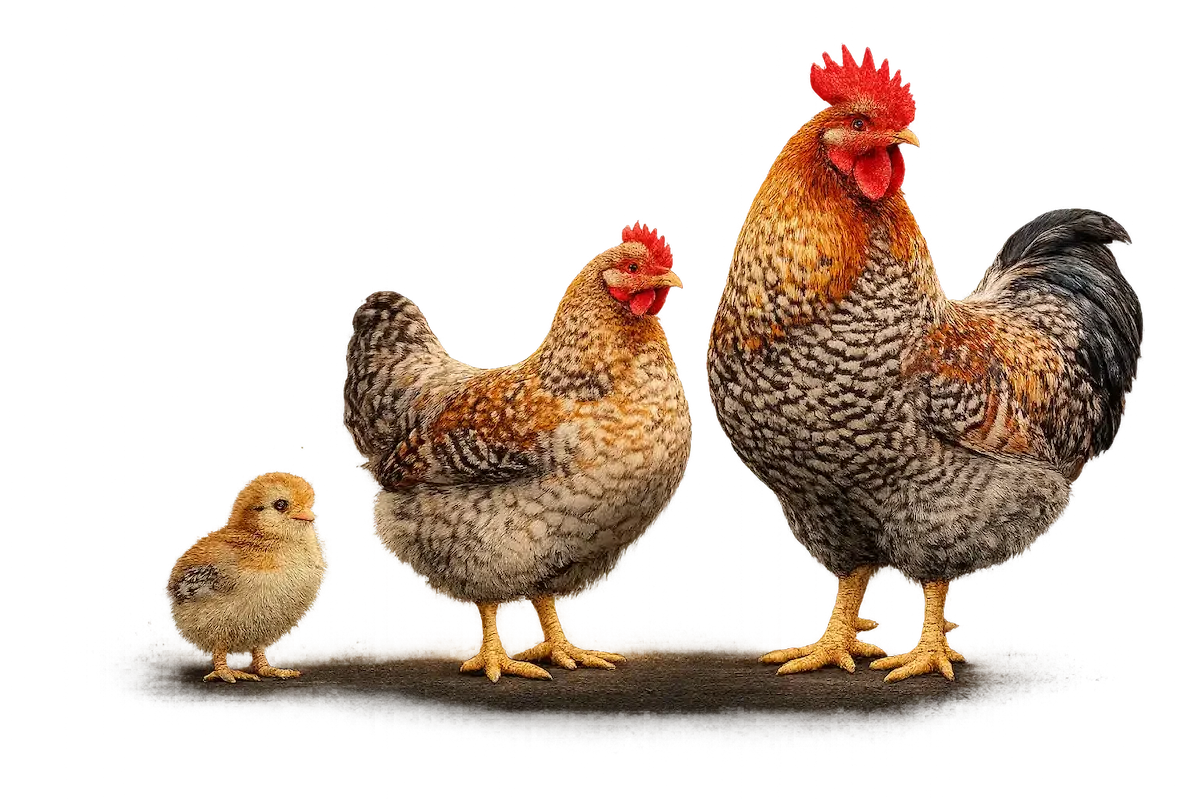
The Bielefelder is a German dual-purpose breed that combines autosexing genetics, large body mass, substantial egg production, and one of the most consistently praised temperaments in the contemporary homestead poultry world into a package that its most enthusiastic advocates describe simply as the Uber Chicken. The name is a shortened version of Bielefelder Kennhuhn, with Kennhuhn meaning indicator chicken in German, a reference to the autosexing characteristic that allows keepers to identify male and female chicks at hatch by their down color without vent sexing or sex-link cross mechanics. The breed was developed in the early 1970s by Gerd Roth near the city of Bielefeld in the Ostwestfalen-Lippe region of northwestern Germany, using a multi-breed crossing program that drew on Malines for body size and meat quality, Welsummer for egg production and autosexing traits, American Barred Rocks for the barring gene essential to the autosexing mechanism, and New Hampshire, Rhode Island Red, Wyandotte, and Amrock genetics for hardiness, temperament, and production balance. The breed was first exhibited in 1976 under the provisional name Deutsche Kennhuhn and formally recognized by the Bund Deutscher Rassegeflügelzüchter in 1980. It remained virtually unknown outside Germany until Greenfire Farms in the United States imported the first American birds in 2011, with subsequent imports of unrelated bloodlines in 2013, 2017, and 2023 that have steadily expanded the genetic diversity available to American keepers.
The Bielefelder is not APA recognized and currently has no established American breed standard, though it meets all other criteria for heritage breed classification: it matures naturally, breeds true from like parent stock, and is not designed for rapid early growth at the expense of longevity and health. For the homestead keeper who wants a large, calm, autosexing, self-sustaining dual-purpose breed with strong brown egg production and the most impressive body weight of any dual-purpose bird in this directory, the Bielefelder is a genuinely exceptional option that has earned its reputation honestly rather than through marketing.
Quick Facts
Type: True-breeding autosexing dual-purpose breed; recognized in Germany; not APA recognized in the United States
Weight: Roosters approximately 10 to 12 lbs; hens approximately 7 to 9 lbs; among the heaviest dual-purpose breeds available
Egg Production: Approximately 200 to 280 large to extra-large brown eggs per year; 4 to 5 eggs per week; consistent year-round including winter
Egg Color: Dark brown; some eggs show a pinkish bloom that wipes away when wet
Egg Size: Large to extra-large; among the largest eggs produced by any heritage breed; average approximately 60 grams
Primary Purpose: Dual purpose; eggs and meat; autosexing flock management; self-sustaining homestead flock
Temperament: Exceptionally calm, docile, and friendly; described by multiple sources as among the most gentle large breeds available; good with children; roosters notably mild-mannered
Brooding: Low; Bielefelder hens show lower broodiness inclination than many heritage breeds; incubator generally required for consistent flock propagation
Flight Capability: Essentially none; body weight prevents sustained flight; standard fencing adequate
APA Recognition: None; German breed standard recognized by Bund Deutscher Rassegeflügelzüchter since 1980
Country of Origin: Bielefeld, Ostwestfalen-Lippe, Germany; developed 1970s
Developer: Gerd Roth; German poultry breeder
Parent Breeds: Malines, Welsummer, Amrock (Barred Rock), Wyandotte, New Hampshire, Rhode Island Red
Autosexing Characteristic: Female chicks hatch with dark chipmunk stripe pattern and distinctive black eye marking; male chicks hatch lighter overall with white spot on top of the head; reliably sexable at hatch within the breed across generations
Varieties: Crele (Kennsperber); Silver (Silber-Kennsperber); Bantam crele version also exists; silver variety is unique to the Bielefelder breed
Comb Type: Single comb; five points; frostbite risk in hard winters
Distinctive Trait: Autosexing within the breed; extraordinary large body weight for a dual-purpose bird; crele plumage combining cuckoo barring with reddish-gold and black; among the calmest large breeds kept; first imported to the United States by Greenfire Farms in 2011
Conservation Status: Not at risk in Germany; rare in the United States
Lifespan: 7 to 10 years
Breed Overview
The Bielefelder's development reflects a specific and ambitious set of goals that Gerd Roth pursued systematically through a multi-breed crossing program spanning several years in the early-to-mid 1970s. Roth's objectives were clear: a chicken that excelled in both egg production and meat quality, was autosexing within the breed so chicks could be identified by sex at hatch without external intervention, had a calm and manageable temperament suitable for both farm and family settings, and was hardy enough to perform consistently across the variable climate conditions of northern Germany.
The autosexing goal required the Barred Rock's barring gene, which is carried on the sex chromosome and expresses differently in male and female offspring in a way that creates visible color differences at hatch. The foundation work for autosexing poultry genetics was established by British geneticist Reginald Punnett in the 1920s and 1930s, who identified the sex-linked plumage differences that allow day-old chicks to be sexed by appearance within a true-breeding breed rather than through sex-link cross mechanics. Roth's crossing program applied this genetic principle to a dual-purpose production bird, incorporating the barring gene through the Barred Rock and Amrock while using the other parent breeds to build the body size, egg production, and temperament he needed around it.
The Malines contributed the large frame and exceptional meat quality that gives the Bielefelder its extraordinary body weight. The Welsummer contributed egg production capability and the strong autosexing tendencies that the Welsummer breed itself carries. The New Hampshire and Rhode Island Red contributed early maturity, hardiness, and production efficiency. The Wyandotte contributed temperament stability and the rounded, broad-backed body type that gives the Bielefelder its substantial visual presence.
The crele color variety that resulted from these crosses is described in German as Kennsperber and produces the distinctive combination of cuckoo barring over a reddish-gold and black ground color that gives the Bielefelder its striking appearance. The silver variety, created later by removing the red and yellow pigmentation from the crele pattern, shows the same cuckoo barring on a silver-gray and white ground. Greenfire Farms notes that the silver variety is unique to the Bielefelder and is not seen in any other recognized breed. The breed was first exhibited in 1976 and formally recognized by the German poultry association in 1980.
The breed remained essentially unknown outside Germany until Greenfire Farms in the United States began importing birds in 2011. Subsequent imports in 2013, 2017, and 2023 of unrelated bloodlines expanded the genetic diversity available to American keepers and reduced the inbreeding risk that small founding populations face. The breed's rapid growth in American homestead and backyard popularity since 2011 is driven by the combination of characteristics that distinguish it from any other breed available in the North American market: the autosexing hatch-day sex identification within a true-breeding self-sustaining breed, the extraordinary body weight that is the largest of any genuinely dual-purpose bird in this directory, and the exceptional calm temperament that makes it safe and manageable even for beginning keepers with children.
Plumage and Appearance
The Bielefelder's plumage in the crele variety is among the most visually complex and immediately striking in the heritage breed world. The pattern combines cuckoo barring, similar to the Barred Plymouth Rock's parallel bar structure, with a reddish-gold and black ground color that produces a layered, warm-toned appearance quite unlike the simple black-and-white contrast of the pure Barred Rock. The specific German term for this color is Kennsperber, and in English it is described as cuckoo red partridge. The adult hen presents as brown with gray barring throughout, with the warm reddish-brown tones of the ground color visible through the barring pattern. The adult rooster carries more dramatic coloration, with orange and gold hackle feathers, a darker body with barring on the chest, and a black tail, producing a striking contrast that many keepers describe as one of the most beautiful rooster appearances in any dual-purpose breed.
The silver variety shows the same cuckoo pattern as the crele but without any red or yellow pigmentation, producing a lighter overall bird with silver-gray and white barring rather than the warm reddish tones. Greenfire Farms specifically notes that this silver color is unique to the Bielefelder and has not been developed in any other recognized breed.
The autosexing characteristic is visible most clearly at hatch and in juvenile plumage. Female chicks hatch with a darker, more strongly marked down pattern that is described as resembling a chipmunk's striping: a dark stripe running down the back with a distinctive dark marking across the eye area. Male chicks hatch with a lighter overall color and a white spot on the top of the head. The distinction is clear enough that experienced keepers can sex chicks reliably at hatch, and the autosexing mechanism reproduces consistently within the breed across generations, unlike sex-link crosses that only produce sexable chicks in the first-generation hybrid.
Adult birds are large and impressively bodied, with a horizontal carriage, broad back, full breast, and the general rounded, substantial silhouette of a breed that was specifically designed for dual-purpose production at a large scale. The single comb is five-pointed and upright, red, and of moderate size. The legs are yellow and unfeathered. The skin is yellow, presenting well in a dressed carcass.
Egg Production
The Bielefelder's egg production is one of its most impressive characteristics at the large-breed scale. Annual production of approximately 200 to 280 large to extra-large brown eggs per year, or 4 to 5 eggs per week, from a hen weighing 7 to 9 pounds places the Bielefelder at the high end of brown egg production for any breed of comparable body weight. The Black Jersey Giant, which is the only other breed in this directory approaching the Bielefelder's body size, produces 150 to 260 eggs per year. The Bielefelder consistently matches or exceeds those figures while carrying comparable or heavier body weight.
The eggs are large to extra-large, averaging approximately 60 grams, which is notably larger than the typical 55 gram heritage breed egg and approaches the jumbo size category. Some Bielefelder eggs display a distinctive pinkish or purple bloom on the shell surface that is specific to the breed and has been noted by Greenfire Farms as a characteristic Bielefelder egg trait. This bloom, like the bloom on Marans eggs, wipes away when the egg is dampened, revealing the dark brown shell beneath.
Year-round production consistency is a documented characteristic, with the Bielefelder maintaining laying through winter months when many other large breeds reduce production. The Grokipedia documentation specifically notes the breed's ability to maintain consistent egg production in cold conditions, attributed to the dense feathering and robust body structure that insulate the bird effectively in cold weather.
The delayed laying onset is the primary egg production consideration that differs from other heritage breeds in this directory. Bielefelders typically begin laying at 5 to 6 months of age in the earlier-maturing individuals, but first laying can extend to 8 to 10 months in some birds. This delayed onset reflects the breed's large body size and is consistent with the general pattern of slower maturity in heavier breeds, but it is notably longer than the 5-month onset of the Black Australorp or the 4-month onset of production hybrids, and prospective keepers should plan their flock timeline accordingly.
Broodiness is low, consistent with the Malines and New Hampshire genetics in the cross. Murray McMurray Hatchery specifically notes that their Bielefelder hens have generally not gone broody, which is useful information for keepers who want consistent production without brood interruptions but requires incubator planning for flock propagation.
Meat Quality
The Bielefelder's meat quality is the most extraordinary aspect of its dual-purpose character and the quality that most distinguishes it from every other breed in this directory. Roosters reaching 10 to 12 pounds at full maturity and hens reaching 7 to 9 pounds produce the largest dressed carcasses of any genuinely dual-purpose heritage breed available to the North American homestead keeper. The Malines genetics that contribute this extraordinary body weight are the same Malines genetics that make the Belgian Malines breed one of the premier heritage table birds in European culinary tradition, and the Bielefelder's carcass reflects this heritage in its broad breast development, yellow skin, and meat quality.
Keepers who have processed Bielefelder birds report good meat quality, though some note it is not as tender as fast-growing meat-specific breeds like Freedom Rangers at comparable processing ages. The recommended processing timeline for table birds is fryers at 14 weeks for smaller, more tender carcasses, or full maturity at 22 weeks for maximum weight and more developed flavor. At 22 weeks a Bielefelder rooster of 12 pounds live weight yields approximately 8 pounds of dressed meat after accounting for bone and cartilage, a remarkable single-bird yield that approaches the table presence of a small turkey.
For homestead operations that want to process surplus cockerels and older hens for genuine heritage table use without maintaining a separate meat breed, the Bielefelder's body weight makes it the most useful dual-purpose table bird in this directory.
Temperament and Behavior
The Bielefelder's temperament is the characteristic that generates the most consistent and enthusiastic keeper feedback of any breed covered in recent posts, and the consistency of that feedback across very different keeper contexts, from small urban backyard flocks to large homestead operations, is striking. The breed is described as exceptionally calm, docile, gentle, curious, and people-seeking in a way that is rare in large-bodied production breeds. Bielefelder hens approach their keepers without hesitation, tolerate handling with patience, and are specifically described as safe and comfortable around small children in a way that is unusual for birds of their size and weight.
The roosters are notably mild-mannered by rooster standards. Multiple keeper accounts describe Bielefelder roosters as non-aggressive toward humans even without intensive socialization, and as relatively non-dominant in mixed flocks, sometimes yielding roosting space to other breeds rather than asserting priority. Greenfire Farms notes that this calm nature, while a significant daily management advantage, also means that Bielefelder roosters are less vigilant and assertive predator watchers than more alert breeds. Keepers who specifically want a protective flock rooster may find the Bielefelder's gentle character inadequate for that function; keepers who want a manageable rooster that poses no human-safety concerns will find the Bielefelder's temperament genuinely exceptional.
The low flight capability that results from the breed's substantial body weight is a practical management advantage over lighter, more active breeds. Bielefelders do not fly over standard fencing and are not inclined to attempt escape from contained runs. Their calm, non-flighty character also means they respond to stressful situations with less alarm and less sustained agitation than nervous breeds, which reduces management complexity in situations like flock introductions, health checks, and weather events.
Climate Adaptability
The Bielefelder's cold hardiness is excellent, supported by the dense, thick feathering from the Malines genetics and the robust body mass that retains heat effectively in cold weather. The breed is documented as an excellent winter layer, maintaining production through cold northern winters when many other breeds of comparable size reduce output. This winter production consistency is a genuine practical advantage for homestead operations that want year-round egg supply without supplemental lighting.
The single comb presents the standard frostbite risk in hard freezes, requiring petroleum jelly application during sustained cold and dry, draft-free housing at roost level. This is the same management consideration as any large single-combed heritage breed and is not exceptional relative to the Barred Rock, White Rock, or Black Australorp.
Heat tolerance is moderate rather than excellent. The Grokipedia documentation specifically notes that the Bielefelder handles warm summers adequately with shade and ventilation but is less suited to prolonged extreme heat above approximately 95 degrees Fahrenheit with high humidity than Mediterranean breeds like the Leghorn. The dense feathering that provides cold hardiness creates heat retention challenges in sustained high-heat conditions, and keepers in regions with extended hot summers should invest in shade infrastructure and adequate coop ventilation for their Bielefelder flocks.
Housing and Management
The Bielefelder's most critical specific housing requirement is low roost bar placement. Multiple keeper accounts document leg and joint injuries from Bielefelder birds jumping off roost bars placed at standard heights, and Greenfire Farms specifically recommends keeping perches low due to the breed's large size and the injury risk when heavy birds land from height. Roost bars at 12 to 18 inches from the floor, with soft or cushioned landing areas beneath, eliminate most of the impact-landing injury risk that the breed's body weight creates. This is the same consideration as the Black Jersey Giant's housing requirements and applies to all breeds whose body weight makes high-impact landings dangerous.
The autosexing management advantage that the Bielefelder offers within a self-sustaining breeding flock is its most distinctive practical characteristic for homestead operations. Unlike sex-link hybrids that require specific parent breed pairings and do not breed true, and unlike non-autosexing heritage breeds that require vent sexing at additional cost and accuracy limitation, the Bielefelder allows keepers who hatch their own chicks to sex them at hatch within the breed's own autosexing mechanism. This means a homestead keeper can maintain a self-sustaining Bielefelder breeding flock, hatch replacement chicks using an incubator given the breed's low broodiness, and identify male from female chicks at hatch without vent sexing, without sex-link cross mechanics, and without hatchery replacement each generation. This combination of capabilities is shared with very few other breeds available to North American homestead keepers.
The breed's low broodiness means incubator investment is generally required for flock propagation rather than relying on natural hatching. This is a meaningful management infrastructure consideration for keepers who want a self-sustaining flock but have not yet invested in incubation equipment.
Sourcing Considerations
The Bielefelder remains significantly more difficult to source in North America than mainstream heritage breeds, reflecting its relatively recent importation history beginning in 2011 and the limited number of breeders maintaining verified bloodlines from the Greenfire Farms import program. Greenfire Farms is the primary and most documented source, with multiple import events providing several unrelated bloodlines that reduce the inbreeding concerns associated with small founding populations. Murray McMurray Hatchery also carries the Bielefelder, making it more accessible through mainstream hatchery channels than purely specialty-sourced breeds.
The availability from Murray McMurray and the growing breeder community that has developed from the Greenfire Farms import program has made the Bielefelder increasingly accessible, though it remains priced above common heritage breeds and requires earlier ordering and more specific sourcing planning than breeds available from every regional hatchery. Premium pricing reflects the breed's genuinely superior characteristics and the investment required to maintain imported bloodlines rather than commodity production economics.
Breeders who specifically identify which Greenfire Farms import generation their stock derives from, and who can document the bloodline diversity in their flock, provide better starting stock for keepers who want to build a genuinely self-sustaining Bielefelder breeding program with adequate genetic diversity.
Pros and Cons
Pros
Autosexing within the breed across generations; chicks sexable at hatch without vent sexing or sex-link cross mechanics; true-breeding autosexing heritage breed
Supports fully self-sustaining flock propagation: breed true, hatch-day sexing, no hatchery replacement required
Largest body weight of any genuinely dual-purpose bird in this directory; roosters 10 to 12 lbs produce exceptional heritage table bird yields
Large to extra-large brown eggs at 200 to 280 per year; high production for a breed of this body weight
Exceptionally calm, docile, and friendly temperament; among the most beginner-accessible large heritage breeds available; exceptional with children
Roosters notably mild-mannered; human-aggression essentially absent in documented keeper accounts
Essentially no flight capability; standard fencing provides reliable containment
Excellent cold hardiness; consistent winter egg production
Visually stunning crele plumage; distinctive and immediately recognizable in any flock
True-breeding heritage breed recognized in Germany since 1980; meets all heritage breed criteria
Cons
Not APA recognized; not suitable for exhibition in APA-sanctioned shows
Less widely available and more expensive than mainstream heritage breeds; requires more specific sourcing planning
Delayed laying onset; some birds do not begin laying until 8 to 10 months of age
Low broodiness requires incubator investment for consistent flock propagation
Low roost bars essential; standard-height roost bars create meaningful leg and joint injury risk for heavy birds
Heat tolerance moderate rather than excellent; requires shade and ventilation management in hot climates
Single comb requires frostbite monitoring in hard winters
Roosters less vigilant as predator guards than more alert breeds; calm nature reduces flock protection utility
Feed consumption higher than smaller heritage breeds due to body weight; larger bird costs more to maintain
Profitability
The Bielefelder's profitability is built on the combination of premium large egg production, extraordinary heritage table bird yield, autosexing flock self-sufficiency, and the novelty premium that a rare, strikingly beautiful German breed commands in direct-sale markets where buyers seek provenance, story, and visual distinction alongside production quality.
The large to extra-large brown eggs with their distinctive pinkish bloom command premium pricing in direct-sale markets, and the Bielefelder's breed story, German origin, autosexing genetics, and growing reputation as the Uber Chicken provides direct-sale narrative value that commodity eggs and even many heritage breed eggs cannot match.
The table bird revenue from Bielefelder roosters is the strongest of any dual-purpose breed in this directory given the body weight at maturity. A 12-pound Bielefelder rooster dressed at full maturity produces a heritage table bird that competes directly with small turkeys in table presence, priced accordingly in direct-sale heritage poultry markets.
The autosexing self-sustaining breeding flock eliminates ongoing hatchery replacement costs once a verified breeding group with adequate bloodline diversity is established, reducing the long-term operational cost of a Bielefelder flock relative to production hybrids that require annual replacement.
Comparison With Related Breeds
Black Jersey Giant: The most useful body weight comparison within this directory. The Black Jersey Giant is the largest dual-purpose chicken breed in America, reaching 13 pounds at full maturity with exceptional table bird yield, but produces only 150 to 260 eggs per year and takes 8 to 9 months to reach full meat potential. The Bielefelder reaches 10 to 12 pounds with stronger egg production at 200 to 280 per year and the autosexing hatch-day sexing within the breed that the Jersey Giant does not carry. Both are calm, large, ground-oriented breeds with similar housing management considerations for heavy birds. The choice between them often comes down to whether maximum single-bird meat yield or the autosexing self-sustaining flock character is the higher priority.
Barred Plymouth Rock: The comparison for autosexing genetics and dual-purpose heritage character in a more widely available and APA-recognized breed. The Barred Plymouth Rock carries barring gene sex-linked genetics but is not autosexing in the true sense the Bielefelder is; the Barred Rock produces visibly different rooster and hen plumage in adults but does not provide the clear hatch-day chick sexing the Bielefelder offers. The Barred Rock is APA recognized, exhibition-eligible, available from every mainstream hatchery, and priced at commodity heritage breed levels. The Bielefelder is larger, calmer, and autosexing at hatch but costs more, is harder to source, and lacks APA recognition. Both are excellent dual-purpose heritage breeds; the choice reflects whether autosexing hatch-day sexing and extraordinary body size are worth the sourcing premium.
California Gray: The autosexing comparison from a white egg production context, covered in a dedicated post in this directory. The California Gray is an autosexing dual-purpose breed developed in the United States producing white eggs at 240 to 300 per year in a 4.5 to 5.5 pound bird. The Bielefelder produces brown eggs at 200 to 280 per year in a 7 to 9 pound bird. Both are autosexing breeds that support self-sustaining flock propagation with hatch-day chick sexing. The California Gray's white egg production at higher volume and lower body weight, and the Bielefelder's brown egg production at lower volume from a dramatically heavier, more impressive dual-purpose body, reflect fundamentally different production priorities that make direct comparison less useful than comparison within each breed's own production category.
Black Australorp: The most productive heritage brown egg layer in this directory, producing 250 to 300 large brown eggs per year from a calmer, beginner-friendly bird at 6.5 pounds. The Black Australorp lays more eggs per year than the Bielefelder and is available from every mainstream hatchery at commodity heritage pricing. The Bielefelder is heavier with dramatically more meat utility, autosexing within the breed, and arguably the most docile large breed temperament in the directory. For keepers who prioritize maximum brown egg production from a heritage breed, the Australorp is the higher production choice; for keepers who want autosexing hatch-day sexing and the largest available dual-purpose carcass alongside strong egg production, the Bielefelder is the answer.
Final Verdict
The Bielefelder earns its Uber Chicken reputation through a combination of characteristics that no other single breed in this directory fully matches simultaneously: autosexing hatch-day chick sexing within a true-breeding self-sustaining breed, the largest body weight and best heritage table bird yield of any dual-purpose breed available to North American homesteaders, consistent large to extra-large brown egg production at rates that outperform every other breed of comparable body weight, and the most consistently praised calm and docile temperament in the contemporary homestead poultry world. The sourcing challenge, the premium pricing, the non-APA recognition, the low broodiness requiring incubator investment, the delayed laying onset, and the critical low-roost-bar requirement are all genuine considerations that a careful keeper should plan for before acquiring the breed. None of them are disqualifying limitations. For the homestead keeper who is ready to invest in a verified bloodline Bielefelder breeding flock, equip their housing with appropriate low perches, acquire an incubator for propagation, and accept a longer wait for first eggs, the return is a self-sustaining, hatch-day-sexable, extraordinarily large and productive dual-purpose flock that no other single breed can match. The dual purpose and homestead category is better for including it.
Frequently Asked Questions
How do you pronounce Bielefelder? Bee-luh-feld-er, with four syllables. The name comes from Bielefeld, the German city in Ostwestfalen-Lippe where the breed was developed. Murray McMurray Hatchery notes that the hardest thing about raising Bielefelders is pronouncing their name correctly, which is a fair assessment given how consistently the breed's other characteristics are praised.
How does autosexing in the Bielefelder work and how is it different from sex-link crosses? The Bielefelder carries the barring gene from the Barred Rock and Amrock in its foundation genetics. This barring gene is carried on the sex chromosome and expresses differently in male and female offspring: female chicks hatch with darker, more strongly marked down featuring a chipmunk-like stripe and a distinctive dark marking across the eyes; male chicks hatch lighter overall with a white spot on the top of the head. Because the Bielefelder is a true-breeding breed rather than a first-generation hybrid, this autosexing characteristic reproduces in every generation of Bielefelder offspring. Sex-link crosses, by contrast, only produce sexable chicks in the first generation from specific parent breed pairings and do not breed true.
Why is the Bielefelder considered rare in the United States? Greenfire Farms first imported Bielefelders to the United States in 2011, followed by unrelated bloodlines in 2013, 2017, and 2023. The breed's availability is therefore recent and limited relative to heritage breeds with decades of established American presence and hatchery programs. The growing number of breeders working from Greenfire Farms founding stock and the availability through Murray McMurray Hatchery have made the breed increasingly accessible, but it remains significantly less available and more expensive than breeds with decades of mainstream American hatchery distribution.
Why are my Bielefelder hens not laying yet at 6 months? The Bielefelder's large body size means some hens take up to 8 to 10 months to begin laying, longer than most heritage breeds and significantly longer than production hybrids. This delayed onset is normal for the breed and not a sign of health problems. Hens that have not begun laying by 10 months in a healthy, well-managed flock may warrant investigation, but within the 5 to 10 month window the variation is normal for the breed.
Can I use a Bielefelder hen as a natural broody? Generally not reliably. Murray McMurray Hatchery notes that their Bielefelder hens have generally not gone broody, and low broodiness is a documented characteristic of the breed. Keepers who want to propagate their Bielefelder flock through natural hatching should plan for incubator use rather than depending on Bielefelder hens as broody setters. The breed's autosexing characteristic makes the incubator investment particularly worthwhile since the resulting chicks can be sexed at hatch without vent sexing.
Where can I buy Bielefelder chicks in the United States? Greenfire Farms in Florida is the original importer and maintains multiple verified unrelated bloodlines including imports from 2011, 2013, 2017, and 2023. Murray McMurray Hatchery carries the breed as a more accessible mainstream hatchery option. A growing number of breeders working from Greenfire Farms founding stock offer birds through the Bielefelder breeder community. Advance ordering is typically required given demand, and availability is seasonal.
Related Breeds
Black Jersey Giant
Barred Plymouth Rock
California Gray
Black Australorp
Malines
Welsummer