
Black Ameraucana
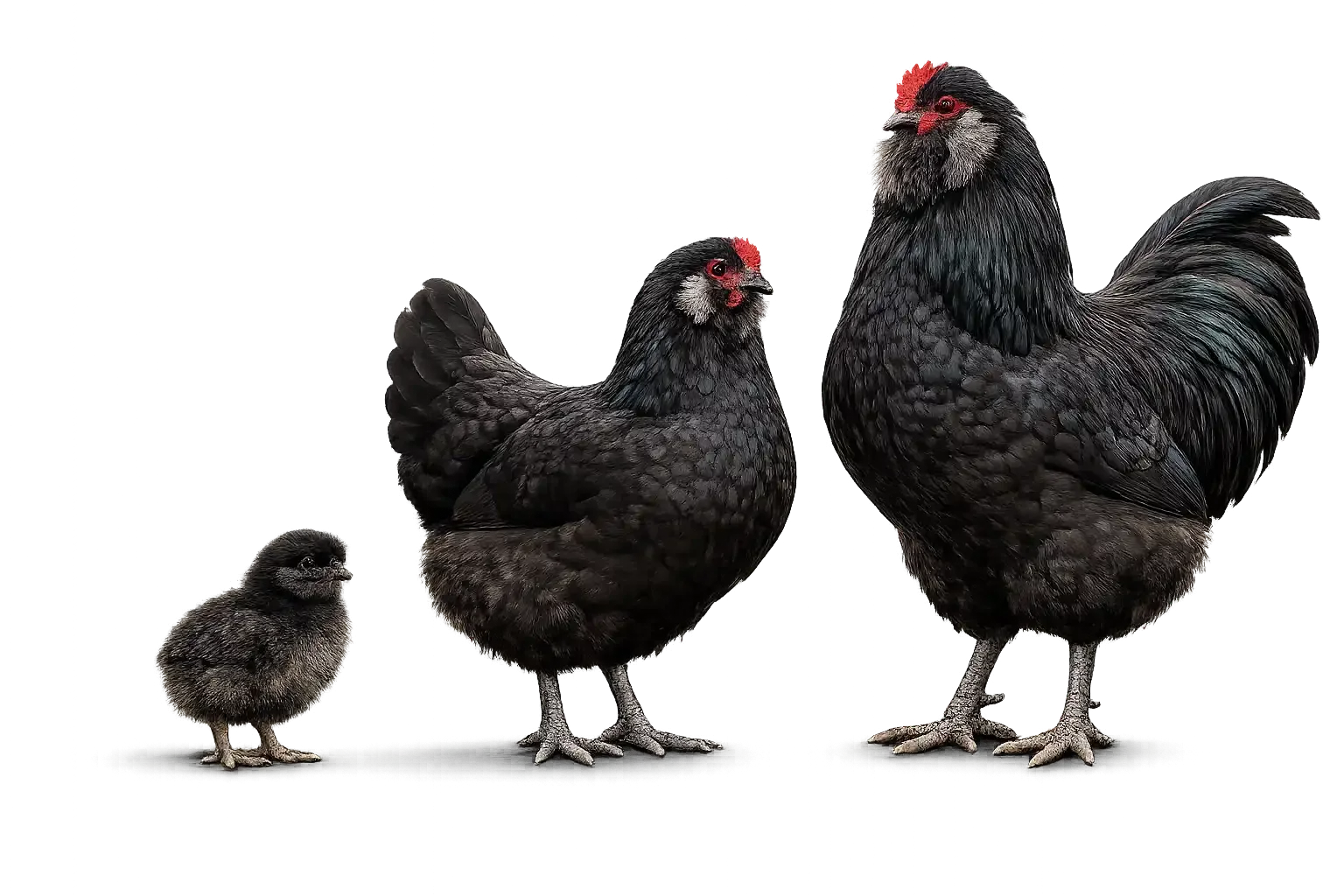
The Black Ameraucana is the most widely kept and most visually striking of the eight APA-recognized Ameraucana varieties, presenting the breed's defining physical features in a uniform jet-black plumage that extends from head to toe and creates a dramatic, hawk-like profile that is immediately distinctive in any flock. The muffs, beard, pea comb, full tail, and blue-gray to slate legs that define the Ameraucana breed standard are all present in the Black variety, and the jet-black body plumage sets against the blue eggs each hen lays to create one of the more visually compelling breed-to-egg contrasts in the backyard poultry world. The breed was developed in the United States in the 1970s from blue-egg-laying South American stock, standardized by American breeders who specifically wanted to preserve the blue egg gene while eliminating the Araucana's semi-lethal genetic traits, and recognized by the APA in 1984. It is not an Araucana, an Easter Egger, or an Americana, and the distinction between these frequently confused names is the single most important piece of information a prospective Black Ameraucana keeper needs before they begin sourcing birds.
The Black Ameraucana lays approximately 180 to 220 medium to large blue eggs per year, makes an adequate dual-purpose meat bird at 5.5 pounds for hens and 6.5 pounds for roosters, and carries a generally calm, curious, and independent temperament that is friendly without being demanding. For the homestead keeper who wants a verified true-breeding purebred blue egg layer in the most dramatic and visually unified of the Ameraucana's recognized color varieties, the Black Ameraucana is the starting point that most experienced Ameraucana keepers return to as their foundational flock bird.
Quick Facts
Class: All Other Standard Breeds (APA)
Weight: Roosters approximately 6.5 lbs; hens approximately 5.5 lbs
Egg Production: Approximately 180 to 220 medium to large blue eggs per year; 3 to 4 eggs per week; lays one consistent shade of blue her entire laying life
Egg Color: Blue; ranges from pale pastel blue to a deeper medium blue depending on the individual hen; each hen lays one consistent shade throughout her laying life
Egg Size: Medium to large
Primary Purpose: Blue egg production; dual purpose; exhibition
Temperament: Calm, curious, and independent; friendly with regular handling; not overly demanding or people-seeking; can be shy initially; suitable for families and mixed flocks; roosters variable
Brooding: Low; Ameraucanas rarely go broody; incubator or surrogate broody hen generally required for flock propagation
Flight Capability: Moderate; alert and active but not typically a fence-flier; standard fencing generally adequate
APA Recognition: 1984; All Other Standard Breeds Class; Black is one of the eight recognized large fowl color varieties
Country of Origin: United States; developed 1970s from South American blue-egg-laying stock; APA standardized 1984
Breed Organizations: Ameraucana Alliance (founded 1978); Ameraucana Breeders Club (bantam 1978; standard and bantam 1986)
Varieties (APA Large Fowl): Black; Blue; Blue Wheaten; Brown Red; Buff; Silver; Wheaten; White; Self-Blue (Lavender) recognized for bantam and large fowl
Comb Type: Pea comb; small and low; minimal frostbite risk; one of the breed's most practically valuable cold-climate characteristics
Distinctive Trait: Jet-black plumage from head to toe including muffs, beard, and shanks; blue to slate leg color; muffs and beard framing the face; full tail; pea comb; blue eggs laid consistently in one shade per individual hen; the most popular Ameraucana variety
Conservation Status: Not listed by Livestock Conservancy; true purebred Ameraucanas are rarer than commonly believed due to widespread Easter Egger mislabeling
Lifespan: 7 to 8 years
Breed Overview
The Ameraucana's development in the United States in the 1970s is best understood as a solution to a specific genetic problem rather than as a creative breed development exercise. The blue egg gene, carried in South American landrace chickens from Chile and broadly referred to before 1976 as Araucana chickens, produced the blue egg color that American poultry enthusiasts wanted to preserve and standardize in a dependable, breed-correct bird. The problem was that the South American birds most associated with the blue egg trait carried two genes that caused significant management difficulties: the rumpless gene, which removes the last two vertebrae and with them the tail, and the tufted gene, which produces the distinctive ear tufts of the Araucana but which in its homozygous form is semi-lethal, killing a significant proportion of chicks before hatch.
American breeders working from the 1970s onward set out to develop a standardized American breed that retained the blue egg gene while eliminating both the rumpless and tufted characteristics, replacing the tufts with the breed's distinctive muffs and beard and restoring the full tail that the rumpless Araucana lacks. The result is a breed that shares the blue egg gene with the Araucana but differs fundamentally in body structure, having a full tail, muffs rather than tufts, and beard, and which does not carry the semi-lethal genetic complications of the tufted gene. The APA's 1984 recognition of the Ameraucana formalized this distinction, creating separate breed standards for the Araucana and the Ameraucana that the breed community has maintained and clarified in the decades since.
The Black variety's specific development within the broader Ameraucana breeding program reflects the same interest in producing the clearest, most vivid blue eggs alongside the most correct breed-standard conformation that drives all serious Ameraucana breeding. The jet-black plumage of the Black Ameraucana was developed to breed true within the variety, producing consistent all-black birds with the full Ameraucana standard physical features of muffs, beard, pea comb, full tail, and blue-gray to slate shanks. The Ameraucana Breeders Club, founded in 1978 for bantam birds and extended to standard large fowl in 1986, is the primary breed governance organization for maintaining the standard and supporting dedicated breeders working to improve color clarity, type, and blue egg quality within all varieties including the Black.
One of the most practically important facts about the Black Ameraucana is the widespread mislabeling that surrounds all Ameraucana varieties in the commercial hatchery market. Birds sold as Araucanas, Americanas, or Ameraucanas by hatcheries and feed stores that cannot document their breeding program are almost certainly Easter Eggers, a mixed-breed bird that may carry the blue egg gene but does not conform to any breed standard and can produce eggs in any color from blue to green to brown to white depending on its genetic mix. The Ameraucana Alliance and Ameraucana Breeders Club both specifically note that the only reliable way to obtain true purebred Ameraucanas is from breeders who maintain documented breeding programs with verified APA-standard conformation and consistent blue egg production.
Plumage and Appearance
The Black Ameraucana's plumage is uniformly jet black throughout, including the body feathers, the muffs and beard framing the face, and the full tail that the Araucana lacks. The jet-black feathering shows the beetle-green iridescent sheen in good light that is characteristic of quality black plumage genetics, similar to the iridescent quality seen in Black Australorp plumage. This iridescent character is a sign of good black genetics rather than a defect, and it intensifies in direct sunlight to reveal the richness of the black coloring that flat-photographed images rarely capture.
The muffs and beard are the most immediately distinctive facial features of the Ameraucana across all varieties and are specifically required by the breed standard. The muffs are full puffs of feathering on each side of the face below the eye, often described as puffy cheeks, and they merge at the chin with the beard, creating a continuous frame of feathering around the lower face that gives the Ameraucana its distinctive hawk-like or bearded-sage expression. This facial feathering is what visually distinguishes a true Ameraucana from an Easter Egger with a clean face, though it is not foolproof since some Easter Eggers do carry muffs and beards.
The pea comb is small, low, and composed of three parallel ridges running from front to back rather than the single upright blade of a single comb. This pea comb structure is one of the Ameraucana's most practically valuable cold-climate management characteristics, presenting minimal frostbite surface area compared to the large single combs of Leghorns, Australorps, and other heritage breeds.
The eyes are a distinctive reddish bay color that contributes to the breed's alert, hawkish expression and that can appear slightly unsettling to keepers unfamiliar with the breed. This eye color is standard and correct for the Ameraucana across all varieties. The legs and feet are blue-gray to slate, specific to the Ameraucana's breed standard and consistent across the Black variety. The skin beneath the feathers is white.
The body is U-shaped when viewed in profile, with both the neck and tail held upright, creating the characteristic silhouette that distinguishes the Ameraucana from heavier, more horizontal dual-purpose breeds. This upright, alert carriage reflects the breed's active, curious character and its moderate size as a dual-purpose bird rather than a dedicated meat or egg production specialist.
Egg Production
The Black Ameraucana's egg production is its primary practical value for most keepers, and the blue egg color is what makes this production meaningful in ways that comparable volume from a standard layer cannot match. Annual production of approximately 180 to 220 medium to large blue eggs per year, or 3 to 4 eggs per week, places the Black Ameraucana solidly in the reliable heritage layer category, above the White Polish at 150 to 200 and below the Black Australorp at 250 to 300, with the blue color providing a direct-sale premium and visual distinction that no standard heritage brown or white egg layer can compete with.
The most important egg characteristic specific to the Ameraucana, confirmed by the Ameraucana Alliance and consistent across breed documentation, is that each individual hen lays one consistent shade of blue throughout her entire laying life. The shade varies between hens, ranging from pale pastel blue to a deeper, more saturated medium blue, but it does not change from egg to egg within an individual hen's production. This individual consistency means that a keeper who identifies which hen lays the deepest blue in their flock can breed selectively toward that shade in future generations.
The blue color is produced by the oocyanin pigment deposited throughout the eggshell rather than only on the surface as brown pigment is. This means the inside of a true Blue Ameraucana egg shell is blue, not white, which is the practical test for distinguishing a genuine blue egg from a green egg with a blue tint. Occasionally individual Black Ameraucana hens produce eggs with a slight greenish tint rather than pure blue, reflecting the interaction of the blue shell base with minor brown pigment deposition, but a correctly bred Black Ameraucana from a documented breeding program should lay blue rather than green.
Hens begin laying at approximately 5 to 7 months of age, somewhat later than many production breeds and consistent with the heritage breed pattern of later maturity alongside longer productive lifespan. The Ameraucana Alliance and multiple keeper accounts note that Ameraucanas tend to lay productively into late fall and resume laying earlier in spring than many heritage breeds, providing a longer annual laying season than their moderate weekly production rate might suggest.
Broodiness is low across the Ameraucana breed. When individual hens do go broody, keeper accounts describe them as attentive and protective mothers, but the breed as a whole is not reliable for natural hatching programs and incubators or surrogate broody hens of other breeds are the appropriate planning assumption for flock propagation.
Temperament and Behavior
The Black Ameraucana's temperament is generally calm, curious, and independent in a combination that keeper accounts consistently describe as engaging without being demanding. The breed approaches its environment and its keeper with active curiosity rather than avoidance, investigating new situations, following its keeper around the yard during ranging, and interacting with flock mates with a social energy that makes the flock entertaining to observe. This curiosity is paired with an independence that means the Ameraucana does not seek out human contact the way the most people-oriented breeds do, and birds that receive minimal handling remain manageable but not particularly personable.
The temperament can be somewhat variable between individuals and between flocks, with some birds developing into quite friendly, handleable companions with regular gentle contact from young and others remaining more reserved regardless of handling frequency. Roosters are specifically noted as variable in temperament, with some being calm and manageable and others proving assertive or flighty. This variability is worth planning for in terms of rooster selection, particularly for keepers who want a manageable breeding rooster in a family flock with children.
In mixed flocks the Black Ameraucana is generally non-aggressive but also non-submissive, finding a comfortable middle position in most flock hierarchies without the vulnerability to bullying that the White Polish and other vision-limited or excessively docile breeds show. Some keeper accounts note that Ameraucanas can occasionally be on the receiving end of pecking from more assertive breeds, and pairing them with similarly calm heritage breeds produces the most harmonious mixed flock experience.
The breed is an active and enthusiastic forager, ranging widely and efficiently on pasture, alert to predators, and self-sufficient enough on range to reduce feed costs meaningfully in managed pasture settings. The muffs and beard that frame the face slightly reduce peripheral vision in a way that is less severe than the Polish crest's impact but worth noting: some keeper accounts describe Ameraucanas as slightly less predator-aware than fully clear-faced breeds as a result.
Climate Adaptability
The Black Ameraucana's climate adaptability is among the broadest of any heritage breed in this directory, and the pea comb is the primary reason. The small, low pea comb presents essentially no frostbite risk in cold winters, making the Ameraucana one of the most cold-climate-friendly heritage breeds available without any special comb management requirement. This is a meaningful practical advantage over the White Leghorn, Black Australorp, Barred Plymouth Rock, and other single-combed heritage breeds that require petroleum jelly application and cold management monitoring in hard winters.
Cold hardiness is well-documented. The breed handles northern winters comfortably and is specifically noted for maintaining laying through late fall and resuming in early spring with a longer productive season than many heritage breeds. The pea comb and moderate body size both contribute to cold-weather comfort without the heat retention challenges of heavy feathering.
Heat tolerance is also good, consistent with the breed's generally moderate body size and absence of feathered feet or excessive feathering that would trap heat in warm weather. Standard shade and cool water access manages summer heat adequately in most North American climates.
Housing and Management
Standard heritage breed housing requirements apply. Four square feet of indoor floor space per bird minimum. Standard fencing height of four to five feet contains most Ameraucana flocks adequately, as the breed is alert but not characteristically a determined fence-flier.
The muffs and beard require monitoring for moisture accumulation and for the parasite presence that dense facial feathering can harbor. Periodic inspection of the muff and beard area for mites or lice is good practice, particularly in wet conditions when facial feathering stays damp and provides favorable conditions for external parasites.
The most important sourcing management consideration for the Black Ameraucana is the Easter Egger mislabeling problem, which begins at the sourcing stage and compounds through the flock's lifetime if not addressed before purchase. A keeper who acquires genuine purebred Black Ameraucanas from a documented breeding program gets a true-breeding heritage breed that produces blue eggs consistently and conforms to the APA breed standard. A keeper who acquires Easter Eggers sold as Ameraucanas gets a mixed-breed bird that may or may not produce blue eggs, cannot be shown at APA-sanctioned events, and does not breed true to Ameraucana conformation. The practical difference matters most for keepers who want to breed their own replacement stock, participate in exhibition, or market their birds and eggs as genuine purebred Ameraucana products.
Sourcing Considerations
True purebred Black Ameraucanas are more difficult to source than their apparent popularity in backyard chicken marketing would suggest, because the name Ameraucana is so widely misapplied to Easter Eggers that genuine purebred birds represent a small fraction of what is marketed under the name. The Ameraucana Breeders Club and Ameraucana Alliance maintain breeder directories that are the most reliable sourcing resources for verified purebred Black Ameraucanas. Breeders who can document their breeding program with APA-standard conformation records and who show their birds at APA-sanctioned events are the most reliable sources for birds that will breed true to standard and lay consistently blue eggs.
John W. Blehm of Michigan is cited by The Chick Hatchery as a foundational Black Ameraucana breeder whose stock forms the basis of their breeding program, which illustrates the importance of documented lineage in sourcing decisions. A hatchery or breeder who can name their foundational stock and describe their selection program for type and egg color is significantly more credible than one selling birds under the Ameraucana name without documentation.
Some mainstream hatcheries do carry verified Ameraucanas, but the quality varies. Buyers who specifically want the Black variety should confirm that the birds are true black rather than blue or splash, that they conform to the muffs, beard, pea comb, and full tail standard, and that the breeding program documents consistent blue egg production from the laying hens in the program.
Pros and Cons
Pros
The most popular and most visually dramatic Ameraucana variety; jet-black plumage with beetle-green iridescent sheen; striking contrast with blue eggs
Genuine true-breeding APA-recognized purebred heritage breed; breeds true to standard with documented breeding program
Blue eggs at 180 to 220 per year; each hen lays one consistent shade throughout her laying life; strong direct-sale premium for genuine blue eggs
Pea comb provides exceptional cold-climate management advantage; essentially no frostbite risk without special management
Good climate adaptability in both heat and cold; no specialized climate infrastructure required
Calm, curious, and engaging temperament; suitable for families and mixed flocks
Active forager; self-sufficient on range with good feed cost savings
Longer annual laying season than many heritage breeds; lays late into fall and resumes early in spring
Generally non-aggressive in mixed flocks; finds comfortable middle position in flock hierarchy
Exhibition eligible under APA standard in the All Other Standard Breeds class
Cons
True purebred Black Ameraucanas are difficult to source; widespread Easter Egger mislabeling requires careful sourcing research
Egg production of 180 to 220 per year is moderate; significantly below high-production heritage and hybrid layers
Muffs and beard require monitoring for parasites and moisture accumulation
Broodiness low; incubator or surrogate broody required for flock propagation
Rooster temperament variable; some roosters prove assertive or flighty regardless of handling
Not a strong meat breed; lighter body weight makes dual-purpose meat utility limited relative to true dual-purpose heritage breeds
Blue egg shade varies between hens and cannot be controlled by the keeper; some hens may produce greenish-tinted rather than pure blue eggs
Slightly reduced facial visibility from muffs may affect predator awareness compared to clean-faced breeds
Profitability
The Black Ameraucana's profitability is built almost entirely on the blue egg premium in direct-sale markets, and the premium available for genuine purebred Ameraucana blue eggs is meaningful and consistent. Blue eggs from a documented purebred Ameraucana breeding program command premium pricing in direct-sale, CSA, and farmers market contexts where buyers seek the color variety and provenance that grocery store eggs cannot provide.
The jet-black plumage of the Black variety photographs exceptionally well against the blue eggs in farm social media and marketing materials, creating a visual identity for a flock or operation that is immediately distinctive and shareable. The contrast of jet-black hens producing pastel blue eggs is genuinely striking and consistently generates the kind of visual engagement that translates into direct-sale customer interest.
Exhibition breeding of correct-type Black Ameraucanas from documented lineages with strong blue egg production and proper APA-standard conformation produces consistent demand from the Ameraucana show community and from breeders seeking to improve their own flocks. The Ameraucana Breeders Club maintains active show programs that provide consistent market access for quality exhibition birds.
The mislabeling landscape that makes sourcing genuine Black Ameraucanas difficult also creates a marketing advantage for keepers who can document and communicate their flock's genuine purebred status: buyers who have purchased Easter Eggers thinking they were getting Ameraucanas and received varied egg colors, inconsistent type, and non-standard birds are specifically seeking documented purebred sources for their next purchase.
Comparison With Related Breeds
Blue Ameraucana: The most direct variety comparison within the breed, covered in a separate post in this directory. The Blue Ameraucana carries the blue dilution gene that produces a slate-blue body plumage, and crosses between Blue and Black Ameraucanas produce Blue, Black, and Splash offspring in predictable ratios following the blue genetics rules. The Black and Blue varieties share identical production figures, temperament, and management requirements; the choice between them is primarily aesthetic. Black breeding produces only Black offspring when Black is crossed to Black, while Blue crossed to Blue produces Blue, Black, and Splash in a 50/25/25 ratio. For keepers who want to maintain a single-color variety that breeds true consistently, the Black is the more predictable choice.
Blue Splash Ameraucana: The third member of the Black, Blue, and Splash genetic trio, also covered in a dedicated post in this directory. The Splash variety carries two copies of the blue dilution gene and produces an irregular white and gray splashed plumage. All three varieties lay identical blue eggs at comparable production rates and share the same breed standard, temperament, and management requirements. A mixed Black and Splash breeding pair produces all Blue offspring, which some breeders use as a consistent method for producing exhibition Blue Ameraucanas.
Lavender Ameraucana: The fourth Ameraucana variety with a dedicated post in this directory. The Lavender carries a different dilution gene from the Blue, producing a pale silvery-lavender plumage that is softer and more uniform than the Blue's slate color. Lavender is the rarest and most sought-after of the recognized varieties for exhibition, while Black is the most common and most widely available. Both lay blue eggs at comparable rates.
Easter Egger: The most important comparison for keeper education. The Easter Egger is a mixed-breed bird that may carry the blue egg gene and may or may not produce blue eggs, may or may not have muffs and beard, and does not conform to any APA breed standard. Easter Eggers sold as Ameraucanas, Araucanas, or Americanas by hatcheries and feed stores are not purebred Ameraucanas of any variety. They can be excellent backyard birds and lay beautiful eggs in various colors, but they are not true Ameraucanas, cannot be shown at APA events, and do not breed true to Ameraucana conformation or egg color. The most reliable test for a genuine Ameraucana is the inside of the eggshell: if the inside is blue, the bird carries the Ameraucana's oocyanin pigment through the shell; if the inside is white with blue coating on the outside only, the bird is an Easter Egger with a green or tinted egg rather than a true blue one.
Whiting True Blue: A production-oriented blue egg layer covered in a dedicated post in this directory. The Whiting True Blue is a hybrid cross developed by Dr. Tom Whiting specifically for maximum blue egg production volume, laying 280 to 300 blue eggs per year compared to the Black Ameraucana's 180 to 220. The Whiting True Blue is not APA recognized, does not breed true, and lacks the purebred heritage breed credentials of the Ameraucana. For keepers who want maximum blue egg volume from a hybrid, the Whiting True Blue is the answer; for keepers who want a genuine purebred heritage breed with exhibition credentials and true-breeding genetics, the Black Ameraucana is the choice.
Final Verdict
The Black Ameraucana is the foundational blue egg layer of the American heritage breed world: the most popular, most widely documented, and most visually dramatic of the recognized Ameraucana varieties, delivering genuine purebred true-breeding heritage breed credentials alongside the blue egg production that makes every keeper who has seen them in a mixed carton want them immediately. The sourcing challenge is the breed's most significant practical obstacle, and it is a real one: the Easter Egger mislabeling that pervades the commercial hatchery market means that a keeper who does not source from a verified documented breeding program is unlikely to get what the Black Ameraucana name promises. For keepers who do the sourcing work and acquire genuine purebred Black Ameraucanas from the Ameraucana Breeders Club network, the return is a beautiful, moderately productive, genuinely cold-hardy, pea-combed, jet-black heritage breed that lays consistent pastel blue eggs its entire life and breeds true to that standard across generations. The dual purpose and homestead category is better for including it.
Frequently Asked Questions
What is the difference between a Black Ameraucana, an Araucana, and an Easter Egger? The Black Ameraucana is an APA-recognized purebred heritage breed developed in the United States in the 1970s with muffs, beard, full tail, pea comb, and consistent blue egg production. The Araucana is a separate APA-recognized breed distinguished by ear tufts rather than muffs, a rumpless body without a tail, and the semi-lethal tufted gene that kills a significant proportion of chicks. The Easter Egger is a mixed-breed bird that carries some version of the blue egg gene but does not conform to any breed standard, may produce eggs in any color, and is not eligible for APA exhibition. The practical test: if the inside of the eggshell is blue, the bird likely carries the true blue egg gene; if the inside is white with color only on the surface, the bird is an Easter Egger laying a tinted rather than a true blue egg.
Why do some Black Ameraucana hens lay greenish eggs instead of blue? The blue egg color is produced by oocyanin pigment deposited throughout the eggshell. When a small amount of brown pigment is also deposited over the blue base, the result is a greenish tint rather than pure blue, exactly as blue paint mixed with yellow-brown produces green. Individual hens that lay greenish rather than pure blue eggs carry a minor brown pigment deposition alongside their blue egg genetics. In a correctly bred Black Ameraucana from a documented program, pure blue should be the norm; occasional greenish tints reflect minor genetic variation that dedicated breeders work to reduce through selection.
Will all my Black Ameraucana hens lay the same shade of blue? No. The shade of blue varies between individual hens, ranging from pale pastel blue to a deeper medium blue, and cannot be predicted from the hen's appearance or parentage alone. What is consistent within each hen is that she lays the same shade her entire laying life; her shade does not change from egg to egg. A flock of Black Ameraucana hens produces a range of blue shades that collectively appear as a beautiful complement of blue tones in a mixed carton.
How do I find genuine purebred Black Ameraucanas? Through the Ameraucana Breeders Club and Ameraucana Alliance breeder directories, which list breeders who maintain documented breeding programs with APA-standard conformation records and show their birds at APA-sanctioned events. Breeders who can describe their selection program for type and egg color and who can name their foundational stock are significantly more credible than sellers offering Ameraucanas without documentation. Mainstream hatcheries vary considerably in the quality and purity of their Ameraucana stock; direct breeder sourcing is the most reliable approach for verified purebred Black Ameraucanas.
Can I cross a Black Ameraucana with a Blue Ameraucana? Yes, and the cross produces predictable offspring. Black crossed with Blue produces approximately 50 percent Black and 50 percent Blue offspring. Black crossed with Splash produces 100 percent Blue offspring, which some breeders use as a consistent method for generating exhibition Blue Ameraucanas. Blue crossed with Blue produces approximately 25 percent Black, 50 percent Blue, and 25 percent Splash. Understanding these ratios is useful for breeders who want to work with all three varieties simultaneously or who want to produce a specific color for exhibition.
Related Breeds
Blue Ameraucana
Blue Splash Ameraucana
Lavender Ameraucana
Ameraucana Bantam
Easter Egger
Whiting True Blue
Araucana