
Black Australorp
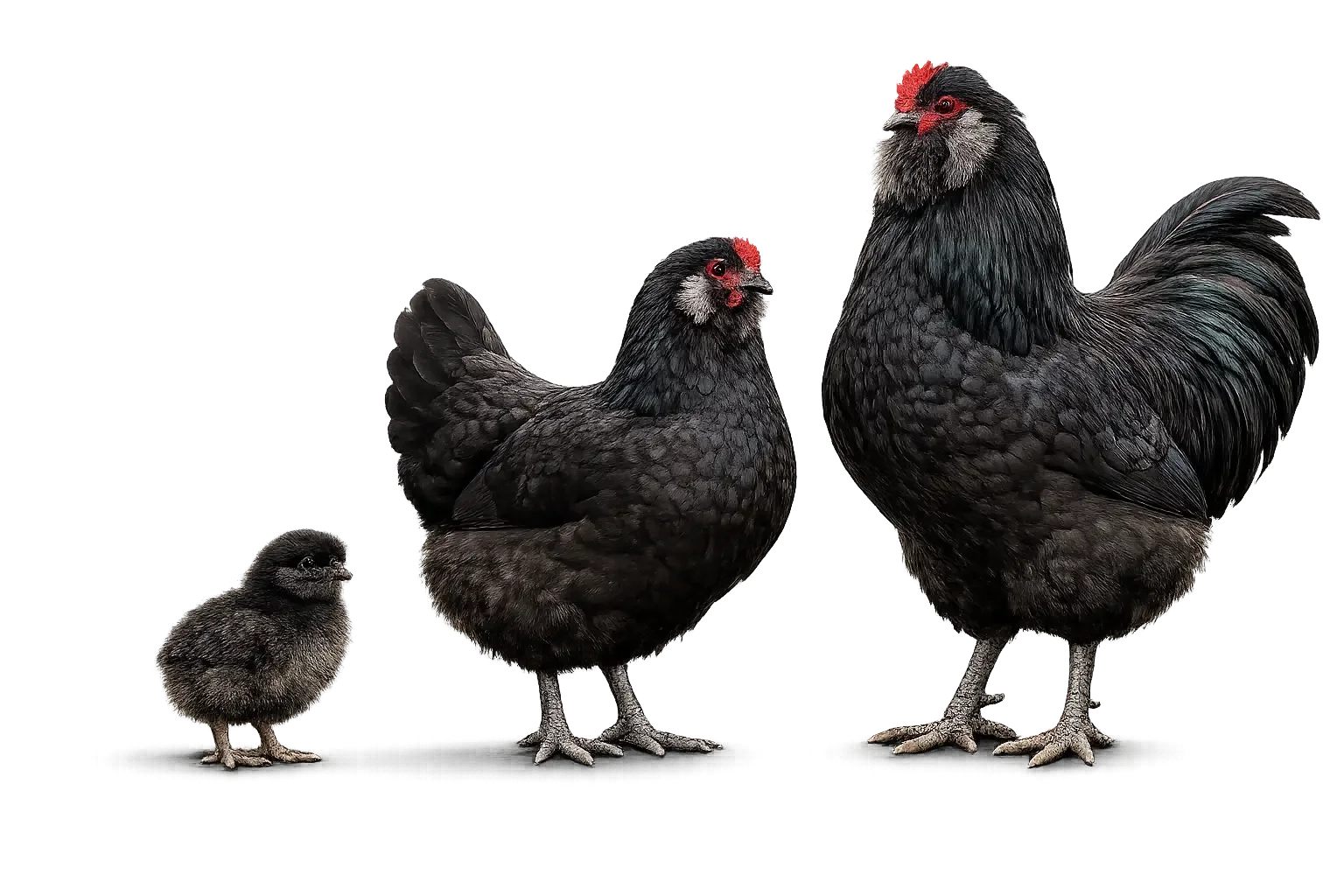
In 1922 and 1923, a pen of six Black Australorp hens at Geelong, Victoria, Australia, set a world record by laying 1,857 eggs across 365 consecutive days, an average of 309.5 eggs per hen without supplemental lighting. The records kept coming. A hen of the Burns bloodline laid 354 eggs in twelve months. Then another hen laid 364 eggs in 365 days, a record that has never been formally surpassed in verified trials of any chicken breed. These were not laboratory productions under artificial conditions but results from Australian egg-laying contests held to evaluate and improve practical poultry breeds for the country's farms and homesteads. The breed that produced them was the Australorp, named for its Australian origin and its Orpington foundation stock, developed between 1890 and the early 1920s by Australian breeders who took Black Orpington chickens imported from England and crossed them selectively with Minorcas, White Leghorns, Langshans, and Rhode Island Reds to extract every possible improvement in laying performance without sacrificing the Orpington's size and practical dual-purpose character. The result was a breed so productive that importation orders flooded in from England, the United States, South Africa, Canada, and Mexico following the record-breaking 1922 to 1923 contest results. The Australorp was admitted to the American Poultry Association Standard of Perfection in 1929, and it has been one of the most consistently recommended heritage dual-purpose breeds in North America ever since. The Livestock Conservancy, which had the Australorp on its priority list, removed it in 2023, indicating the breed's population had recovered to a level no longer requiring conservation concern. It is today the national chicken of Australia. For the homestead keeper who wants a calm, beginner-friendly, cold-hardy, visually striking, and genuinely high-producing heritage layer that also provides worthwhile dual-purpose meat utility, the Black Australorp is the most straightforward and complete answer in the directory.
Quick Facts
Class: English (APA)
Weight: Roosters approximately 8.5 lbs; hens approximately 6.5 lbs
Egg Production: Approximately 250 to 300 large light brown eggs per year; 4 to 5 eggs per week; world record 364 eggs in 365 days
Egg Color: Light brown to tinted; sometimes described as pinkish-brown
Egg Size: Large; approximately 55 grams average
Primary Purpose: Dual purpose; eggs and meat; also exhibition
Temperament: Exceptionally calm, docile, and friendly; one of the most beginner-friendly breeds available; good with children; roosters generally non-aggressive
Brooding: Occasional; some hens go broody; good mothers when they do
Flight Capability: Low; body weight and calm disposition make sustained flight unlikely
APA Recognition: 1929; English Class
Country of Origin: Australia; developed from imported British Black Orpington stock
Varieties (APA): Black only in the United States; Blue and White recognized in Australia
Comb Type: Single comb; frostbite risk in hard winters requires management attention
Distinctive Trait: Glossy black plumage with beetle-green and purple iridescent sheen; world record egg production for a heritage breed; the national chicken of Australia
Conservation Status: Recovered; removed from Livestock Conservancy priority list in 2023
Lifespan: 6 to 10 years
Breed Overview
The Black Australorp's development story is one of deliberate, practical improvement driven by competition rather than sentiment. When Black Orpington chickens were exported from England to Australia between 1890 and the early 1900s, English breeders had been refining the Orpington primarily for meat quality and exhibition type. Australian breeders had entirely different priorities. Australia's agricultural sector needed a practical, dual-purpose bird capable of producing meaningful egg volumes alongside useful meat, and the imported Orpingtons were immediately valued for their potential as layers rather than as exhibition birds.
Five primary bloodlines of what would become the Australorp were developed between 1900 and 1922 by individual breeders: Graham, Burns, Christie, Bertelsmeier, and Drewitt. Each used somewhat different outcrosses on the imported Orpington foundation, adding genetics from Minorca, White Leghorn, Langshan, Rhode Island Red, and Plymouth Rock at various points to improve laying performance. One characteristic that all five early bloodlines shared was a deliberate effort to eliminate broodiness, which interrupts laying cycles and reduces annual egg production. This selection against broodiness contributed substantially to the Australorp's commercial success and distinguished the breed increasingly from the Orpington it had descended from, which retained strong brooding tendencies.
Australia held formal egg-laying contests as a practical tool for evaluating and selecting the best producing lines. Black Orpingtons had taken seven of the thirteen top placements in the first major Hawkesbury Agricultural College contest in 1902. By the 1922 to 1923 contest season, these birds had been refined enough through two decades of competitive selection to produce the record-breaking performance at Geelong that introduced the breed to the world: six hens averaging 309.5 eggs over 365 consecutive days without supplemental lighting. Individual records followed, culminating in the 364-eggs-in-365-days performance by a single hen from the Burns bloodline that remains the most cited benchmark for heritage breed egg production.
The name Australorp was being used commercially by the early 1920s, coined as a contraction of Australian Black Orpington, with the suffix orp denoting the major breed in the fowl's development. Multiple individuals and organizations claim credit for the name, which remains a point of friendly historical debate in Australian poultry circles. What is not debated is the impact: the world record performances drove importation demand across four continents, the breed was standardized in the APA in 1929, and the Australorp established itself as one of the foundational heritage dual-purpose breeds of the 20th-century poultry world.
Plumage and Appearance
The Black Australorp's plumage is entirely black with a beetle-green and purple iridescent sheen that is among the most visually impressive of any black-feathered breed. In direct sunlight the feathers shift through green and purple reflections that change with the viewing angle, producing a display that longtime keepers consistently describe as genuinely beautiful rather than simply black. The iridescence is a characteristic actively selected for in quality breeding programs; birds with flat, matte black plumage without sheen are considered off-type. The green and purple iridescence distinguishes the Australorp's plumage character from the green-dominant sheen of the Black Sumatra or the green-dominant sheen of the Black Jersey Giant, the Australorp's carrying more purple in its reflection.
The body is large, round, and deep-chested, built to the Orpington mold of a broad, well-fleshed dual-purpose bird while carrying the active utility character that Australian breeders selected for over the Orpington's more sedentary exhibition type. The back is broad, the breast full and rounded, and the overall silhouette compact and substantial without the extreme roundness of the modern show Orpington. The legs and toes are black to dark slate-black; the bottoms of the feet are white, a distinctive feature noted in breed descriptions. The eyes are dark brown. The single comb is medium-sized, upright, and red. Wattles and earlobes are red.
Roosters and hens share the same black plumage, with the rooster carrying longer sickle feathers in the tail and the broader, more angular head characteristic of males across all breeds. Sexing at young ages follows the standard indicators of comb development and body proportion rather than any color difference.
The breed's size, at 6.5 pounds for hens and 8.5 pounds for roosters, places it in the medium-large heritage breed category comparable to the Wyandotte and Plymouth Rock, noticeably lighter than the Jersey Giant but substantially heavier than production layer breeds. This size supports the dual-purpose utility that Australian breeders designed the breed to deliver.
Egg Production
The Black Australorp's egg production is the best-documented and most impressive heritage breed laying record in existence, and the practical production figures available to modern homestead keepers reflect genuine high output rather than commercial-hybrid competition. Annual production of approximately 250 to 300 large light brown eggs per year, or 4 to 5 eggs per week, places the Black Australorp at the top of the heritage breed laying category and well above most other dual-purpose breeds of comparable size.
To put the production figures in context: the Black Copper Marans produces 150 to 200 eggs per year; the Wyandotte produces 200 to 240; the Plymouth Rock produces 200 to 280; the Black Australorp consistently produces 250 to 300. This output, achieved from a heritage breed without the commercial genetics and extreme breeding of production hybrids, reflects the genuine outcome of over a century of selection specifically for laying performance.
The eggs are large, approximately 55 grams average, light brown to tinted, and sometimes described as having a pinkish-brown tone that distinguishes them from the darker brown of the Marans or the white of the Leghorn. The shell quality is consistently good, supported by the breed's robust constitution and efficient calcium processing.
The Black Australorp is a reliable winter layer, continuing production through cold months with more consistency than many other heritage breeds of similar size. The breed's Orpington foundation stock, selected in a temperate English climate, combined with the Australian breeders' selection for year-round production, produced a bird that does not shut down as definitively in winter as some breeds that evolved in warmer or more variable conditions.
Broodiness in the Black Australorp is occasional rather than frequent, a direct result of the early breeders' deliberate selection against brooding tendencies. Most hens do not go broody, and those that do are not the persistent, committed sitters of strongly broody breeds like the Silkie or the Wyandotte. For homestead keepers who want maximum egg production without frequent brood interruptions, the Australorp's low broodiness is a practical advantage. For keepers who want natural flock propagation through broody hens, the Australorp is not reliable and other breeds should be selected for that function.
Hens begin laying at approximately 5 to 6 months of age, comparable to other medium-large heritage breeds, somewhat earlier than the Black Jersey Giant but later than high-production hybrids.
Meat Quality
The Black Australorp was designed as a dual-purpose breed and produces a useful table bird alongside its exceptional egg production. The breed's broad, well-muscled build, solid breast development, and heritage-quality meat character make surplus roosters and older hens worthwhile for the table on a homestead scale. The carcass dresses cleanly, yellow-skinned under the black feathering, and produces a flavorful, well-textured meat that heritage breed advocates contrast favorably with commercial broiler production.
The Black Australorp is not a fast-growing meat breed and does not compete commercially with Cornish Cross or other dedicated meat hybrids. Its growth rate is moderate, reaching processing weight over a longer timeline than commercial birds. For homestead operations where heritage quality and the practical value of a single breed serving both egg and meat functions outweigh the commercial economics of specialized single-purpose breeds, the Australorp delivers genuine dual-purpose value.
The breed's exceptional egg production means that homestead flocks kept primarily for eggs can process surplus roosters for meat as a secondary benefit without maintaining a separate meat breed, which is the economic case for keeping a true dual-purpose heritage breed rather than combining a laying breed with a meat breed.
Temperament and Behavior
The Black Australorp's temperament is one of the most consistently praised characteristics of the breed and one of the primary reasons it is recommended specifically for beginners, families with children, and first-time chicken keepers. The breed is exceptionally calm, docile, and friendly to a degree that experienced keepers consistently note as remarkable even in comparison with other breeds commonly described as docile.
Hens are calm and approachable, tolerating handling well and becoming noticeably tame with regular gentle contact. They are curious and active enough to forage effectively and explore their environment with interest, but without the flighty nervousness or unpredictable alarm responses that less calm breeds show. The breed is consistently described as quiet, producing less vocalization than many production breeds and maintaining the soft, contented flock sound that experienced keepers find pleasant rather than disruptive.
Roosters are generally among the most manageable of any large heritage breed. Multiple keeper accounts and breed resources describe Black Australorp roosters as consistently non-aggressive toward humans, laying back in mixed-flock pecking order dynamics, and forming protective but not aggressive flock guardian relationships. Well-socialized roosters raised with regular handling are described as friendly and even personable. This rooster temperament is a genuine practical advantage for homestead keepers who need a manageable male for flock propagation without the human-aggression risk that game-heritage breeds, some Rhode Island Red lines, and other assertive breed roosters can present.
The breed integrates well into mixed flocks without significant dominance behavior and is compatible with a wide range of companion breeds. It is active enough to forage efficiently on range, producing the feed cost savings that make pasture-managed heritage flocks economically practical, and it adapts well to confinement when range is not available, though the Livestock Conservancy notes that purely confined Australorps may tend toward excess weight without the exercise that ranging provides.
Climate Adaptability
The Black Australorp's cold hardiness is good, supported by the breed's medium-large body mass, dense feathering, and Orpington foundation genetics developed in the temperate English climate. The breed handles North American winters in most regions adequately with standard dry, well-ventilated, wind-protected housing.
The single comb is the primary cold-climate management consideration. Unlike pea-combed or rose-combed breeds, the Black Australorp requires comb monitoring during sustained hard freezes, with petroleum jelly as a preventive measure for roosters whose larger combs are most vulnerable to frostbite. Hen combs are generally smaller and present less risk. This is the same management consideration as the Black Copper Marans and other single-combed medium-large breeds; it is not exceptional or difficult but requires awareness.
Heat tolerance is moderate and requires more active management than cold tolerance. The Black Australorp's black plumage absorbs solar heat more efficiently than light-colored breeds, and the breed's substantial body mass generates and retains heat at levels that can cause discomfort and heat stress during extreme summer events. The Livestock Conservancy specifically recommends ample shade for the breed in warm weather, and keeper accounts from hot-climate regions consistently emphasize shade access and cool water as essential rather than optional summer management practices. This is not unique to the Australorp among black-feathered large breeds, but it is worth understanding before acquiring the breed in regions with extended hot summers.
Housing and Management
Standard dual-purpose breed housing applies throughout. Four square feet of indoor floor space per bird is the minimum baseline, with the Australorp's active character benefiting from generous outdoor access. Standard four-to-five-foot fencing contains the breed adequately given its low flight tendency and calm disposition.
The primary housing-specific consideration for the Black Australorp is shade infrastructure in warm climates. The breed's black plumage and substantial body mass make summer heat management more important than for lighter-colored or smaller breeds. Shade structures over outdoor runs, and coop ventilation that prevents heat buildup during hot summer days, are investments worth making before acquiring Black Australorps in regions with extended warm summers.
Feed management follows standard heritage layer guidelines. Quality layer feed with 16 to 18 percent protein and free-choice oyster shell for calcium supplementation supports the breed's exceptional production volume. The Australorp's high laying rate means it processes more calcium than lower-production breeds, and calcium supplementation is correspondingly more important for sustained shell quality and hen health in peak production.
The breed's foraging efficiency is a genuine practical advantage in range management situations. Black Australorps forage actively and cover ground efficiently, supplementing their diet meaningfully from range and contributing to feed cost savings and pest control. The Livestock Conservancy's note about weight management in purely confined birds suggests that some ranging access is preferable to full-time confinement for maintaining the breed in good working condition, though full confinement is manageable with adequate space and appropriate feeding.
Sourcing Considerations
The Black Australorp is one of the most widely available heritage dual-purpose breeds in North America, accessible from virtually every mainstream hatchery, farm supply store chain, and regional poultry source. This broad availability is a genuine practical advantage for homestead keepers who want a quality heritage breed without waiting lists, specialty sourcing research, or premium pricing from conservation breeding programs.
Hatchery stock and exhibition stock differ in the usual ways: hatchery birds are selected for production reliability and general hardiness without specific exhibition conformation criteria, producing birds that perform well as homestead layers but may not represent the deepest iridescent sheen or most precise physical type that serious exhibition breeders maintain. For homestead egg and meat production, hatchery stock is entirely appropriate and widely used. For exhibition, sourcing from breeders active in the Australorp community produces better starting stock.
The breed's removal from the Livestock Conservancy priority list in 2023 reflects genuinely recovered population numbers and removes any conservation urgency from the sourcing calculation. The Black Australorp is not rare and does not require conservation-focused sourcing to support its continued existence, which distinguishes it from the Black Sumatra, the Sultan, and other breeds in this directory whose sourcing decisions carry conservation weight.
Pros and Cons
Pros
Highest egg production of any heritage dual-purpose breed; 250 to 300 large brown eggs per year consistently documented
World record heritage breed production: 364 eggs in 365 days by a single verified hen
Exceptional beginner-friendly temperament; one of the calmest, most docile, and most manageable heritage breeds available
Roosters among the most non-aggressive of any large breed; genuinely manageable for homestead flock propagation
Good cold hardiness for a medium-large single-combed breed
Reliable winter layer; continues production through cold months more consistently than many comparable breeds
Genuine dual-purpose meat utility from a heritage bird; broad, well-muscled build produces a worthwhile table bird
Stunning beetle-green and purple iridescent plumage stands out in a mixed flock
Widely available from mainstream hatcheries; no specialty sourcing required
Long productive lifespan of 6 to 10 years
Recovered from conservation concern; population stable and robust
Cons
Single comb requires frostbite monitoring in hard winters; more management than pea-combed or rose-combed breeds
Black plumage absorbs solar heat; shade infrastructure is essential in hot climates and during summer heat events
Purely confined birds may tend toward excess weight without adequate exercise; some range access preferable
Broodiness occasional and unreliable; not suitable as a natural broody hen breed for hatching programs
Egg color is light brown rather than the chocolate of the Marans or the blue of the Ameraucana; no premium color value in direct-sale rainbow carton marketing
Does not compete with commercial hybrids on sheer egg volume; 250 to 300 is exceptional for heritage but below high-production hybrids at 300 to 320
Profitability
The Black Australorp's profitability is built on the combination of the highest sustained egg production volume available from a heritage dual-purpose breed and the premium pricing that heritage breed, farm-fresh eggs command in direct-sale markets over commodity eggs. A flock producing 250 to 300 large brown eggs per hen per year delivers meaningful revenue from a breed that is widely sourced at standard hatchery pricing without waiting lists or conservation premiums.
The breed's reliability as a winter layer is a particular profitability advantage for direct-sale farm egg operations that maintain supply through the low-production winter months when competing backyard flocks fall off and farm stand egg sales often command the year's highest prices relative to supply.
The genuine dual-purpose character adds secondary meat utility without the feed and infrastructure investment of a dedicated meat breed. Heritage table birds command premium pricing from direct-sale buyers who seek alternatives to commercial broiler production, and the Black Australorp produces a carcass that meets this market from the natural surplus of roosters in any breeding flock.
The breed's beginner-friendly temperament and straightforward management reduce the labor cost and learning curve of flock management, which is a practical profitability factor for homestead operations where keeper time is a genuine input cost alongside feed and infrastructure.
Comparison With Related Breeds
Black Jersey Giant: The closest American heritage comparison for a large, calm, dual-purpose black-feathered breed. The Jersey Giant produces less per year at approximately 150 to 260 eggs and grows to a significantly larger body size that makes it a better dedicated meat producer, but the Australorp outperforms it on sustained egg volume and matures faster. The Jersey Giant's iridescent beetle-green sheen without the purple of the Australorp gives the two breeds visually similar but distinguishable appearances.
Buff Orpington: The Australorp's closest temperamental relative and the breed from which it descended. The Buff Orpington is somewhat more docile and people-seeking, lays approximately 175 to 200 eggs per year, and carries the warm golden buff plumage that is visually distinct from the Australorp's black. The Australorp substantially outperforms the Orpington on egg production while sharing the Orpington's size and dual-purpose character. Both are excellent beginner choices; the Australorp delivers more eggs, the Orpington delivers more warmth of temperament.
Barred Plymouth Rock: The most commonly compared American heritage dual-purpose breed. The Plymouth Rock lays approximately 200 to 280 eggs per year, somewhat less than the Australorp, in a distinctive barred black-and-white pattern rather than solid black. Both are calm, beginner-friendly, cold-hardy, and dual-purpose. The Australorp edges the Plymouth Rock on production volume; the Plymouth Rock's autosexing capability in sex-link crosses and its broader availability in some regions are practical advantages. Both are cornerstone heritage breeds for a homestead flock.
Rhode Island Red: The most productive American heritage laying breed and a useful production comparison. The Rhode Island Red lays approximately 200 to 300 eggs per year in a range overlapping substantially with the Australorp, in a deep reddish-brown rather than black. Rhode Island Red roosters are more variable in temperament and can be significantly more assertive than the generally calm Australorp roosters. For keepers who prioritize rooster manageability alongside production, the Australorp is the safer choice; for keepers who want the widest possible color variety in their egg basket from a single American heritage breed, the Rhode Island Red has slight production parity with a different visual character.
Black Copper Marans: The comparison that most directly highlights the egg color tradeoff in the heritage breed selection. The Black Copper Marans produces approximately 150 to 200 eggs per year in a deep chocolate brown; the Black Australorp produces 250 to 300 eggs in light brown. Keepers who prioritize premium egg color for direct-sale markets choose the Marans; keepers who prioritize maximum heritage production volume choose the Australorp. Both are calm, manageable, black-feathered dual-purpose breeds. Keeping both in the same flock covers both the chocolate and the light brown segments of the premium egg market simultaneously.
Final Verdict
The Black Australorp is the most complete answer to the question of what single breed a homestead keeper should choose if they want the highest heritage production, the most manageable temperament, genuine dual-purpose utility, and a breed that looks genuinely beautiful in the yard without requiring specialized sourcing, conservation-tier pricing, or complex management knowledge. The single comb needs winter attention, the black plumage needs summer shade, and the egg color does not carry the premium color marketing value of a Marans or Ameraucana egg. These are the honest limitations of the breed, and none of them approach the significance of what the breed delivers: the world record heritage layer, the national chicken of Australia, a bird so productive that it drove international importation demand from four continents in the 1920s and has sustained that reputation for over a century without depletion. For the homestead keeper who wants to keep it simple and keep it excellent, the Black Australorp is the answer. The dual purpose and homestead category is better for including it.
Frequently Asked Questions
How many eggs does a Black Australorp lay per year? Approximately 250 to 300 large light brown eggs per year under good management, making it the highest-producing heritage dual-purpose breed consistently documented. Individual hens vary, and well-managed flocks can produce toward the higher end of this range. The world record performance of 364 eggs in 365 days by a single Australorp hen remains the most cited benchmark for heritage breed production but represents an extreme outlier rather than typical expectation.
Is the Black Australorp actually the national chicken of Australia? Yes. The Australorp is officially recognized as the national chicken of Australia, reflecting both its Australian development and its cultural significance as the breed that put Australian poultry on the international map through the world-record egg-laying performances of the 1920s.
How cold hardy is the Black Australorp? Good for a medium-large single-combed breed. The breed's substantial body mass and dense feathering handle cold winters adequately with standard dry, well-ventilated, wind-protected housing. The single comb requires monitoring during sustained hard freezes, with petroleum jelly as a preventive measure particularly for roosters with larger combs. The breed continues laying through winter more reliably than many comparable heritage breeds.
Are Black Australorp roosters aggressive? Generally not. Black Australorp roosters are among the most consistently non-aggressive of any large heritage breed in keeper accounts and breed literature. They are protective of their flock without being human-aggressive, and multiple sources describe them as calm, manageable, and even personable with regular handling. As with any breed, individual variation exists, and socialization from young is the most reliable factor in producing manageable adult roosters.
Does the Black Australorp handle heat well? With management, but not naturally. The black plumage absorbs solar heat efficiently, and the breed's substantial body mass retains heat at levels that can cause discomfort during extreme summer events. Consistent shade access, cool fresh water at all times, and adequate coop ventilation are essential rather than optional management practices in hot climates. The breed manages hot climates adequately with these provisions in place but is not as heat-tolerant as smaller, lighter-colored breeds.
What color eggs does a Black Australorp lay? Large, light brown to tinted eggs, sometimes described as pinkish-brown. The shell color is not the deep chocolate of the Marans, the blue of the Ameraucana, or the white of the Leghorn, but a warm, clean light brown that is appealing in a mixed carton without carrying the strong color novelty premium of those breeds. Shell quality is consistently good from a healthy, well-fed flock.
Where can I buy Black Australorp chicks? From virtually every mainstream hatchery in North America including Murray McMurray, Cackle Hatchery, Meyer Hatchery, and Hoover's Hatchery, as well as most farm supply stores that stock heritage breed chicks seasonally. The Black Australorp's recovered population and broad availability mean no specialty sourcing or waiting lists are required for most keepers. For exhibition-quality birds, breeders active in the Australorp community through the APA breeder network produce better-type stock than general hatchery birds.
Related Breeds
Black Jersey Giant
Buff Orpington
Barred Plymouth Rock
Rhode Island Red
Black Copper Marans
White Wyandotte