
Black Jersey Giant
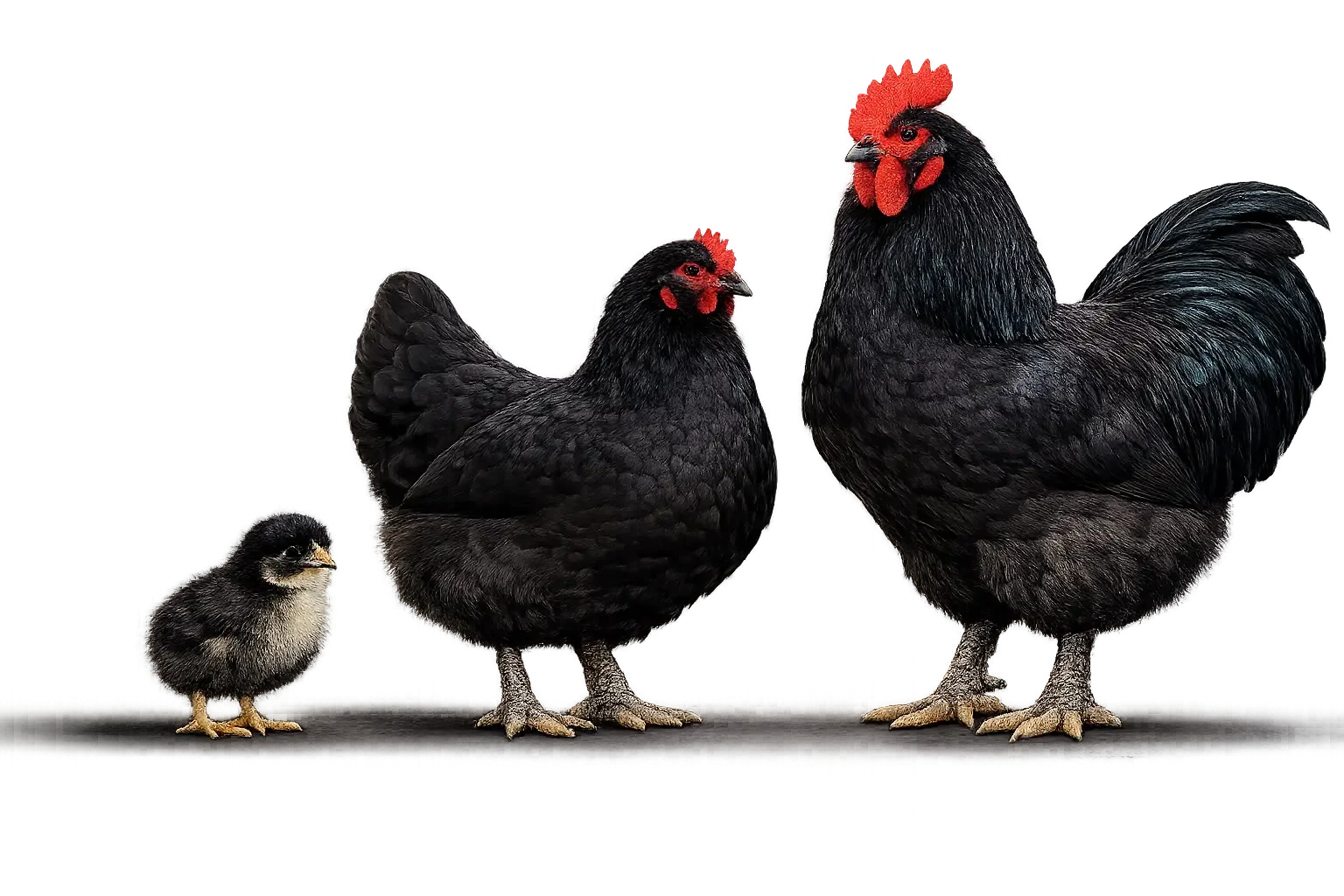
The Black Jersey Giant is the largest chicken breed in America, and it was built that way on purpose. John and Thomas Black, experienced New Jersey poultryman who specialized in caponizing males for premium roasting birds, spent roughly twenty years from 1870 to 1890 crossing Black Javas, Black Langshans, and Dark Brahmas with a single goal: to produce a chicken large enough to compete with the turkey as a premium table bird. The result was a bird so associated with its creators that it was initially called Black's Giants, the Black referring to the brothers rather than the feather color, before Dexter P. Upham of Belmar, New Jersey renamed it the Jersey Giant to reflect its state of origin. The American Poultry Association admitted the Black variety in 1922, the White in 1947, and the Blue in 2002. The breed once held a genuine commercial position as a capon and broiler source before faster-growing industrial strains made the Jersey Giant's slow growth rate economically impractical for mass production, and it subsequently declined in numbers enough to earn a place on the Livestock Conservancy's watch list. It has since recovered, and today the Black Jersey Giant occupies a well-defined and enthusiastic position in the homestead and heritage poultry community. Its combination of extraordinary size, calm and docile temperament, reliable winter laying, large brown eggs, excellent foraging ability, and iridescent beetle-green black plumage makes it one of the most complete dual-purpose heritage breeds available. For homesteaders who have adequate space, understand the slow growth timeline, and want a bird that earns genuine admiration from every visitor who encounters it while also producing meaningful eggs and meat from a single breed, the Black Jersey Giant is one of the most rewarding choices in the directory.
Quick Facts
Class: American (APA)
Weight: Roosters approximately 13 lbs; hens approximately 10 lbs; the Black variety averages approximately one pound heavier than the White
Egg Production: Approximately 150 to 260 large to extra-large brown eggs per year depending on strain and management; 3 to 4 eggs per week
Egg Color: Brown; ranging from light tan to dark brown depending on individual hen and strain
Egg Size: Large to extra-large; among the largest eggs of any heritage breed
Primary Purpose: Dual purpose; meat and eggs; also exhibition
Temperament: Exceptionally calm, docile, and friendly; one of the most gentle large breeds available; roosters rarely aggressive; good with children
Brooding: Variable; some hens go broody and some do not; good mothers when they do; weight can cause egg crushing during natural incubation
Flight Capability: Essentially none; body weight makes sustained flight impossible
APA Recognition: 1922 (Black variety)
Country of Origin: Burlington County, New Jersey, United States
Varieties (APA): Black; White; Blue
Comb Type: Single comb; frostbite risk in hard winters on large-combed roosters requires management attention
Distinctive Trait: Largest dual-purpose chicken breed in America; black plumage with beetle-green iridescent sheen in sunlight; willow-colored to nearly black legs and toes
Conservation Status: Watch (Livestock Conservancy); recovering
Lifespan: 6 to 10 years
Breed Overview
The Black Jersey Giant's development story is one of the most deliberately goal-oriented in American poultry history. John and Thomas Black were not hobbyists or farm experimenters but serious commercial poultryman in Burlington County, New Jersey, who identified a specific market gap: American consumers in the late 19th century valued turkey as their premium roasting bird for large gatherings, and no chicken breed came close to the turkey's size or the prestige it carried at the table. The Black brothers set out to close that gap with a chicken.
Their breeding program began around 1870 and continued for approximately twenty years, a timeline that reflects the genuine difficulty of reliably producing extreme body size in poultry while maintaining practical egg production and manageable temperament. The foundation breeds were chosen for complementary size and meat qualities: Black Javas for their large frame and dark plumage, Black Langshans for their height and bone structure, and Dark Brahmas for their heavy body weight and cold hardiness. Some accounts indicate that Cornish genetics were later introduced to improve growth rate, though this is debated in breed history circles.
By approximately 1895 the brothers' extra-large birds had earned a consistent reputation among regional poultry keepers and were being referred to informally as Black's Giants. The name honored the creators rather than the feather color, a distinction that became important when the White variety was later developed and the name Jersey Giant was formally adopted. Dexter P. Upham, an early breeder who took a serious interest in refining and promoting the breed, is credited with pushing for the name change to Jersey Giant and with organizing the early breed community that eventually led to the formation of the American Association of Jersey Black Giant Breeders Clubs in 1921 and APA recognition in 1922.
The breed's commercial history is an object lesson in the constraints of industrial scale. Jersey Giants were used by the commercial poultry industry for capon and broiler production through the early and middle 20th century, their size and meat quality genuinely competitive with turkey at the premium table. When industrial breeding programs developed fast-growing Cornish Cross and other commercial broiler strains that reached processing weight in eight weeks rather than the Jersey Giant's eight to nine months, the economics of commercial production shifted decisively away from heritage breeds generally and from slow-growing large breeds particularly. The Jersey Giant's commercial role collapsed, and population numbers fell enough to earn the Livestock Conservancy's Watch designation.
The revival of heritage breed interest, the slow food movement, and the growing homestead and small-farm community have all contributed to the breed's recovery. Today it is not endangered but genuinely valued in a community that has the patience for an eight-to-nine-month growth timeline and the space to house a bird that can reach thirteen pounds.
Plumage and Appearance
The Black Jersey Giant's plumage is entirely black with a beetle-green iridescent sheen that appears in direct sunlight, similar in character to the Black Sumatra's iridescence but on a dramatically larger and heavier body type. The iridescence is consistent across the hackle, back, breast, and tail in well-bred specimens and is considered a breed characteristic worth selecting for; birds with dull, flat black plumage without iridescence are considered off-type by exhibition breeders.
One practical note for new Black Jersey Giant keepers: chicks and young birds often show white feathers during their first and second feathering stages, which can cause alarm in keepers who purchased what they expected to be an all-black bird. This is normal in the breed and resolves naturally. By approximately six months of age, the bird typically develops fully black adult plumage with the characteristic green iridescence. Reddish or copper markings occasionally appear in adult plumage and while not considered desirable by many exhibition breeders, they do not affect the bird's practical homestead utility.
The legs and toes are willow-colored to nearly black, one of the distinguishing physical characteristics of the Black Jersey Giant and a trait shared with the White variety. Yellow legs would indicate genetic impurity or crossbreeding. The single comb is medium to large, upright, and bright red, sitting on a broad, strong head. Wattles and earlobes are red. The beak is dark.
The body is the most immediately striking feature of the breed: broad, deep-chested, and massively built, with a strong muscular frame that becomes fully apparent only at maturity. The full adult weight of ten to thirteen pounds is not achieved quickly. Young birds grow relatively fast in their first months but continue adding bone, frame, and muscle well past the six to eight months that most dual-purpose heritage breeds take to reach adult size. A Black Jersey Giant rooster at full maturity at twelve months or beyond is a genuinely impressive animal that routinely surprises visitors who have not encountered the breed before.
Egg Production
The Black Jersey Giant lays large to extra-large brown eggs at a rate that, for the breed's size, is genuinely productive. Annual production of approximately 150 to 260 eggs per year depending on strain and management represents solid dual-purpose laying performance. Cackle Hatchery, which has maintained a production-focused Black Jersey Giant bloodline since 1979, documents 180 to 260 eggs per year from their strain; conservation-focused exhibition lines may produce toward the lower end of this range as they prioritize body type and conformation over laying rate.
The eggs are large to extra-large and among the most substantial eggs produced by any heritage breed. Double-yolk eggs are reported with some regularity by keepers of the largest hens. The eggs range from light tan to dark brown depending on the individual hen and strain, with considerable variation even within the same flock.
One of the Black Jersey Giant's most practically valuable laying characteristics is its consistency through winter. The breed is a reliable winter layer at a time when many other breeds reduce or stop production entirely in response to shortened daylight. This winter production is partly a function of the breed's cold hardiness and partly a characteristic that was selected for during the breed's development as a practical commercial layer alongside its meat role. For homestead operations that want year-round egg supply without supplemental lighting, the Black Jersey Giant's winter production is a genuine practical advantage.
Hens typically begin laying between 5 and 8 months of age, with considerable individual variation. Some strains and individuals begin at 5 months; others do not come into lay until 8 months or later. The delayed maturity compared to production breeds is consistent with the breed's heritage character and should be expected rather than treated as a health concern.
Broodiness varies significantly between individuals and strains. Some Black Jersey Giant hens go broody readily; others rarely or never do. Keepers interested in natural flock propagation should check with their source about broodiness characteristics in the specific strain they are purchasing. When hens do go broody, the breed's weight creates a practical risk of egg crushing during incubation, and many breeders use incubators for Black Jersey Giant eggs rather than relying on natural setting. Incubation of Black Jersey Giant eggs may take 1 to 2 days longer than the standard 21 days, a breed characteristic worth knowing before assuming eggs have failed to develop.
Meat Quality
The Black Jersey Giant was built for the table, and its meat quality reflects that design intention. A fully mature rooster at 12 to 16 months dressed as a capon or roasting bird produces a carcass that one bird can genuinely feed a family of four, with white-fleshed, yellow-skinned meat described consistently as excellent in flavor and texture. The breast is broad and deep, yielding significantly more meat than the narrow-breasted heritage breeds of similar height. The yellow skin, a breed standard characteristic, presents well at the table and is associated with the buttery quality that heritage breed poultry advocates contrast with the pale, flavorless skin of fast-grown commercial birds.
The honest counterpoint to this meat quality is the timeline. A Black Jersey Giant reaching full meat potential at 8 to 9 months or beyond consumes significantly more feed than a Cornish Cross processed at 8 weeks, and the feed-to-weight conversion ratio is poor by commercial standards. This makes the breed economically impractical for any scale of production where feed cost and processing timeline matter as business metrics. For the homestead keeper whose calculation includes food quality, breed heritage, and the practical satisfaction of raising a dual-purpose animal rather than a single-purpose production hybrid, the economics look entirely different. The Black Jersey Giant produces a heritage table bird that cannot be purchased in any grocery store and that experienced homestead cooks consistently describe as worth the wait.
Capons from Black Jersey Giant roosters, produced by caponizing young males to allow extended growth without the tough meat that adult roosters develop, were a commercial specialty of the Black brothers themselves and remain a premium homestead product in the hands of experienced keepers willing to learn the caponizing process.
Temperament and Behavior
The Black Jersey Giant's temperament is one of the most consistent and practically important characteristics of the breed, and one of the most surprising to people who expect a thirteen-pound chicken to be difficult or intimidating. The breed is exceptionally calm, docile, and friendly to a degree that places it among the most manageable large breeds in the directory. Roosters are rarely aggressive toward humans, a notable distinction from game-heritage breeds and from some dual-purpose breeds whose roosters can develop assertive behavior. Hens are generally quiet, content, and easy to handle, becoming noticeably tame with regular gentle contact.
Experienced keepers consistently describe Jersey Giants as having a guardian-like awareness in the flock: alert to environmental threats, more aware of aerial predators than some smaller breeds, and willing to stand their ground against potential aggressors rather than scattering in alarm. This flock awareness is a practical advantage in a free-range environment where predator pressure is real. The breed's size alone provides some deterrent value against small mammal predators that would readily attack lighter breeds.
In mixed flocks the Black Jersey Giant holds its position in the pecking order without bullying smaller breeds. Its size means that smaller birds may defer to it naturally, but the breed does not typically exploit this size advantage to dominate or harass flockmates. This makes it a practical addition to mixed heritage flocks where size differential would otherwise create management challenges.
The breed is also notably vocal in a pleasant way: keepers consistently describe Jersey Giants as producing a soft, musical trilling sound during normal daily activity, particularly when the keeper is present. This is not the loud, persistent alarm-calling of flightier breeds but a conversational, contented vocalization that experienced keepers find agreeable.
Climate Adaptability
The Black Jersey Giant's cold hardiness is strong, a direct inheritance from the Dark Brahma genetics in the breed's foundation. The heavy body mass retains heat effectively in cold weather, the dense feathering provides insulation, and the breed continues laying through winter months when lighter and less cold-adapted breeds reduce or stop production. For homestead operations in cold-climate regions, the Black Jersey Giant's combination of winter hardiness and winter laying consistency makes it one of the more complete year-round heritage breed options.
The single comb is the primary cold-weather management consideration. Large-combed roosters are vulnerable to frostbite on the comb points during sustained hard freezes, and keepers in regions with extreme winters should monitor rooster combs during cold snaps and apply petroleum jelly as a preventive measure. Hen combs are generally smaller and present less frostbite risk under standard good-housing conditions.
Heat tolerance is the breed's relative weakness. The large body mass and black plumage that make the Black Jersey Giant exceptional in cold weather create genuine heat management challenges in summer. Black feathers absorb solar heat more efficiently than white or light-colored plumage, and the breed's large body cannot dissipate heat as efficiently as smaller, lighter breeds. Shade access, cool fresh water at all times, and avoidance of dense confinement during peak summer heat are essential management practices in warm climates. Keepers in regions with very hot summers report that Black Jersey Giants require more active summer management than lighter heritage breeds and that extreme heat events pose a real welfare risk without adequate shade infrastructure.
Housing and Management
The Black Jersey Giant's housing requirements diverge from standard backyard breed guidelines in proportion to its size. The breed needs more of everything: more indoor floor space, more outdoor run space, larger nesting boxes, stronger and lower roost bars, and more feed. The Livestock Conservancy recommends a minimum of six square feet of indoor floor space per bird and twelve square feet of outdoor run space per bird, double the standard guideline for smaller breeds, though more space is always better for a breed this size.
Roost bar placement is particularly important. Standard roost bars at typical heights of two to four feet create a genuine injury risk for a bird weighing ten to thirteen pounds jumping down from height to a hard floor surface. Low roost bars at twelve to eighteen inches from the floor, with soft or cushioned landing areas beneath, reduce the risk of bumblefoot, leg injuries, and joint problems that large-breed birds can develop from repeated high-impact landings. Any sharp or protruding surfaces beneath roost bars are a particular concern; a heavy bird landing on a sharp object can sustain foot injuries that develop into serious bumblefoot infections.
Nesting boxes need to be larger than standard to accommodate a hen that may weigh ten pounds during incubation. Standard nesting boxes designed for five-to-seven-pound production hens are uncomfortable and impractical for Jersey Giant hens and may discourage nesting box use in favor of floor laying.
Feed consumption is substantial. A breed this size eats significantly more than standard-sized heritage breeds, and feed costs should be factored into the economics of keeping Black Jersey Giants. The breed's exceptional foraging ability on range partially offsets this feed cost for flocks with access to good pasture, insect populations, and plant material, but range foraging supplements rather than replaces a quality layer or grower ration.
Sourcing Considerations
The Black Jersey Giant is widely available from mainstream hatcheries across North America and does not require the specialty sourcing of rare conservation breeds. Cackle Hatchery, Meyer Hatchery, Murray McMurray, and most regional hatcheries carry Black Jersey Giants as a standard offering. This wide availability makes the breed accessible for first-time heritage breed keepers without waiting lists or specialty connections.
One important sourcing note: not all Black Jersey Giant bloodlines reliably reach the breed's historically documented weight of ten to thirteen pounds at maturity. Some hatchery lines, maintained primarily for production volume rather than exhibition conformity or maximum size, produce birds that are large by standard chicken measures but fall short of the size that the breed standard describes and that the breed's historical reputation is built on. Keepers specifically interested in birds that will reach full breed weight should research hatchery reviews and breeder accounts to identify sources with documented growth rate performance before purchasing.
For exhibition purposes or for building a breeding program focused on correct breed type and maximum size, sourcing from breeders active in the Jersey Giant community through the American Poultry Association or the Livestock Conservancy network produces better starting stock than general hatchery birds.
Pros and Cons
Pros
The largest dual-purpose chicken breed in America; produces the most meat per bird of any heritage dual-purpose breed
Excellent winter layer; continues producing large to extra-large brown eggs through cold months when many breeds reduce production
Exceptionally calm, docile, and friendly temperament; roosters rarely aggressive; suitable for families with children
Beetle-green iridescent black plumage is visually striking; the breed generates genuine admiration from visitors
Strong cold hardiness; handles northern winters well with standard housing
Outstanding forager; manages itself efficiently on range and contributes to pest control
Flight capability essentially zero; containment is straightforward with standard fencing
Flock guardian character; alert to predators and willing to stand its ground
Widely available from mainstream hatcheries; no specialty sourcing required
Recovering conservation status; keeping Black Jersey Giants supports a heritage American breed
Cons
Slow growth to full meat weight; 8 to 9 months or more to reach processing size compared to 8 weeks for Cornish Cross
Poor feed-to-weight conversion; high feed consumption relative to growth rate makes commercial production impractical
Single comb on roosters vulnerable to frostbite in hard winters; requires monitoring and management
Heat tolerance limited; black plumage absorbs solar heat and large body mass cannot dissipate it efficiently; active summer management required
Requires more housing space, larger nesting boxes, and lower roost bars than standard-sized breeds
Broodiness variable by individual and strain; natural incubation uncertain and weight creates egg-crushing risk
Some hatchery bloodlines do not reliably reach full breed weight; sourcing research required for buyers prioritizing maximum size
Higher feed costs than smaller heritage breeds due to body size
Profitability
The Black Jersey Giant's profitability is built around the premium heritage table bird market and steady direct-sale egg production rather than commercial volume. Heritage breed table birds from homestead operations command premium pricing at farm gate and farmers market sales from buyers seeking quality, provenance, and flavor that commercial production cannot provide, and the Black Jersey Giant produces the most impressive single-bird yield of any dual-purpose heritage breed. One properly grown rooster at full maturity produces a roasting bird that competes directly with turkey in both size and table presence, which is precisely what the Black brothers designed it to do.
The large to extra-large brown eggs produced by strong-laying strains command steady premium pricing in direct-sale markets, and the breed's winter laying consistency is a particular revenue advantage for farm egg operations that maintain supply through the low-production winter months when competing backyard flocks fall off.
Exhibition-quality birds from verified bloodlines with documented size and correct type command premium prices from the heritage breed and show community. The breed's recovering status means that supply from breeders maintaining correct type remains somewhat limited relative to demand from serious buyers, supporting price stability for quality birds.
The economics of the meat side require patience and realistic feed cost accounting. Homestead operations treating the Black Jersey Giant as a premium heritage product with an eight-to-nine-month growth investment, marketed directly to buyers who understand and value heritage breed quality, find the economics viable. Operations expecting commercial broiler economics from a heritage breed will be disappointed.
Comparison With Related Breeds
Barred Plymouth Rock: The most common comparison among American dual-purpose heritage breeds. The Plymouth Rock is more widely available, lays somewhat more consistently at approximately 200 to 280 eggs per year, matures faster to a smaller processing weight, and requires less housing space. The Black Jersey Giant surpasses the Plymouth Rock in single-bird meat yield, cold hardiness, and visual presence, and produces larger individual eggs. For keepers who have the space and patience for the Jersey Giant's size and timeline, it outperforms the Plymouth Rock as a meat bird; for keepers who want faster production and easier housing, the Plymouth Rock is more practical.
Black Australorp: Another large, calm, dual-purpose heritage breed with strong egg production and good cold hardiness. The Australorp lays significantly more eggs per year at approximately 250 to 300 compared to the Jersey Giant's 150 to 260, matures faster, and requires less space. The Jersey Giant produces substantially more meat per bird, has a more dramatic physical presence, and carries a more distinctive American heritage story. Both are excellent beginner-friendly dual-purpose breeds; choice between them often comes down to whether meat yield or egg volume is the primary priority.
Jersey Giant (White and Blue varieties): The White Jersey Giant was developed by selecting for recessive white genetics within the breed and was APA-recognized in 1947. The Blue in 2002. All three varieties share identical temperament, production characteristics, and housing requirements. The Black variety averages approximately one pound heavier than the White and has historically been the most common and most closely associated with the breed's identity. Choice among the three is primarily a matter of plumage preference.
Dark Brahma: One of the foundation breeds used to create the Jersey Giant, and a useful comparison for keepers interested in large, cold-hardy, gentle heritage breeds. The Brahma is similarly massive, similarly docile, and similarly cold-hardy, but lays fewer eggs and grows even more slowly than the Jersey Giant. The Brahma's feathered shanks and distinctive appearance differentiate it clearly from the Jersey Giant's clean yellow legs and black plumage.
Final Verdict
The Black Jersey Giant asks its keeper for two things that most backyard breeds do not require: space and patience. The space requirement is straightforward and physical; this is a thirteen-pound chicken that needs room to move, roost, and nest at a scale that standard backyard coop infrastructure was not designed for. The patience requirement is more unusual. In a poultry world dominated by Cornish Cross broilers that reach processing weight in eight weeks and production hybrid layers that begin laying at 18 weeks, the Black Jersey Giant's eight to nine month meat timeline and five to eight month lay onset can feel genuinely slow to a new keeper conditioned by commercial timelines. That slowness is not a defect but a characteristic of what the breed is: a heritage bird that was designed to grow into something exceptional rather than grow quickly into something adequate.
The keeper who provides the space, accepts the timeline, and manages the summer heat and winter comb considerations gets something that commercial poultry cannot provide: the largest, most impressively built dual-purpose heritage chicken in America, with a temperament calm enough for children, a foraging ability that impresses experienced pasture farmers, winter laying consistency that outperforms most heritage contemporaries, and a table bird quality that delivers on the Black brothers' original ambition of competing with the turkey. The dual purpose and homestead category is better for including it.
Frequently Asked Questions
How big do Black Jersey Giant chickens get? Fully mature roosters typically reach 13 lbs and hens approximately 10 lbs, making the Black Jersey Giant the largest dual-purpose chicken breed in America. The Black variety averages approximately one pound heavier than the White Jersey Giant. Full adult size is not reached until 12 months or beyond; birds at 6 months are noticeably large but have not yet reached their adult weight and frame.
How many eggs does a Black Jersey Giant lay per year? Approximately 150 to 260 large to extra-large brown eggs per year depending on the strain and management. Production-focused strains from hatcheries like Cackle, which has maintained a Black Jersey Giant bloodline since 1979, produce toward the higher end of this range. Exhibition-focused conservation strains may produce toward the lower end. The breed is a notably reliable winter layer, continuing production when many other heritage breeds reduce output.
How long does it take a Black Jersey Giant to reach processing weight? Approximately 8 to 9 months to reach full meat proportions with good body development and proper muscle fill. This is dramatically slower than the 8 weeks of a Cornish Cross, and the feed consumption over that timeline is substantial. For homestead keepers focused on heritage meat quality and provenance rather than commercial economics, the timeline produces a genuinely exceptional table bird. Capons from Black Jersey Giant roosters allowed additional growth time produce even larger and more flavorful roasting birds.
Are Black Jersey Giant chickens good for beginners? Yes, with one caveat: beginners need to be prepared for the breed's size requirements in housing, nesting boxes, roost bars, and feed consumption. The temperament is exceptionally beginner-friendly, the cold hardiness is reliable, and the dual-purpose utility is genuine. Beginners who research the housing requirements and plan infrastructure accordingly before acquiring birds will find the Black Jersey Giant one of the most rewarding and manageable large breeds available.
Do Black Jersey Giants go broody? Variably. Broodiness differs significantly between individuals and strains within the breed; some hens go broody readily and others rarely or never do. Keepers interested in natural flock propagation should ask their source specifically about broodiness characteristics in the strain they are purchasing. When Black Jersey Giant hens do go broody, their weight can cause egg crushing during incubation, and many breeders use incubators for this breed's eggs rather than relying on natural setting.
Why do Black Jersey Giant chicks have white feathers? White feathers during the first and second feathering stages are normal in Black Jersey Giant chicks and should not be a cause for concern. The white juvenile feathering is replaced by fully black adult plumage by approximately 6 months of age, at which point the beetle-green iridescent sheen characteristic of the breed becomes visible in direct sunlight.
Where can I buy Black Jersey Giant chickens? From most mainstream hatcheries including Cackle Hatchery, Meyer Hatchery, and Murray McMurray, as well as many regional hatcheries and farm supply stores that stock heritage breed chicks seasonally. For exhibition-quality birds or birds from bloodlines documented to reach full breed weight, the American Poultry Association breeder referral network and Livestock Conservancy breeders directory provide access to conservation-focused breeders maintaining correct type.
Related Breeds
Jersey Giant
Blue Jersey Giant
Barred Plymouth Rock
Black Australorp
Dark Brahma
Rhode Island Red