
Black Silkie Bantam
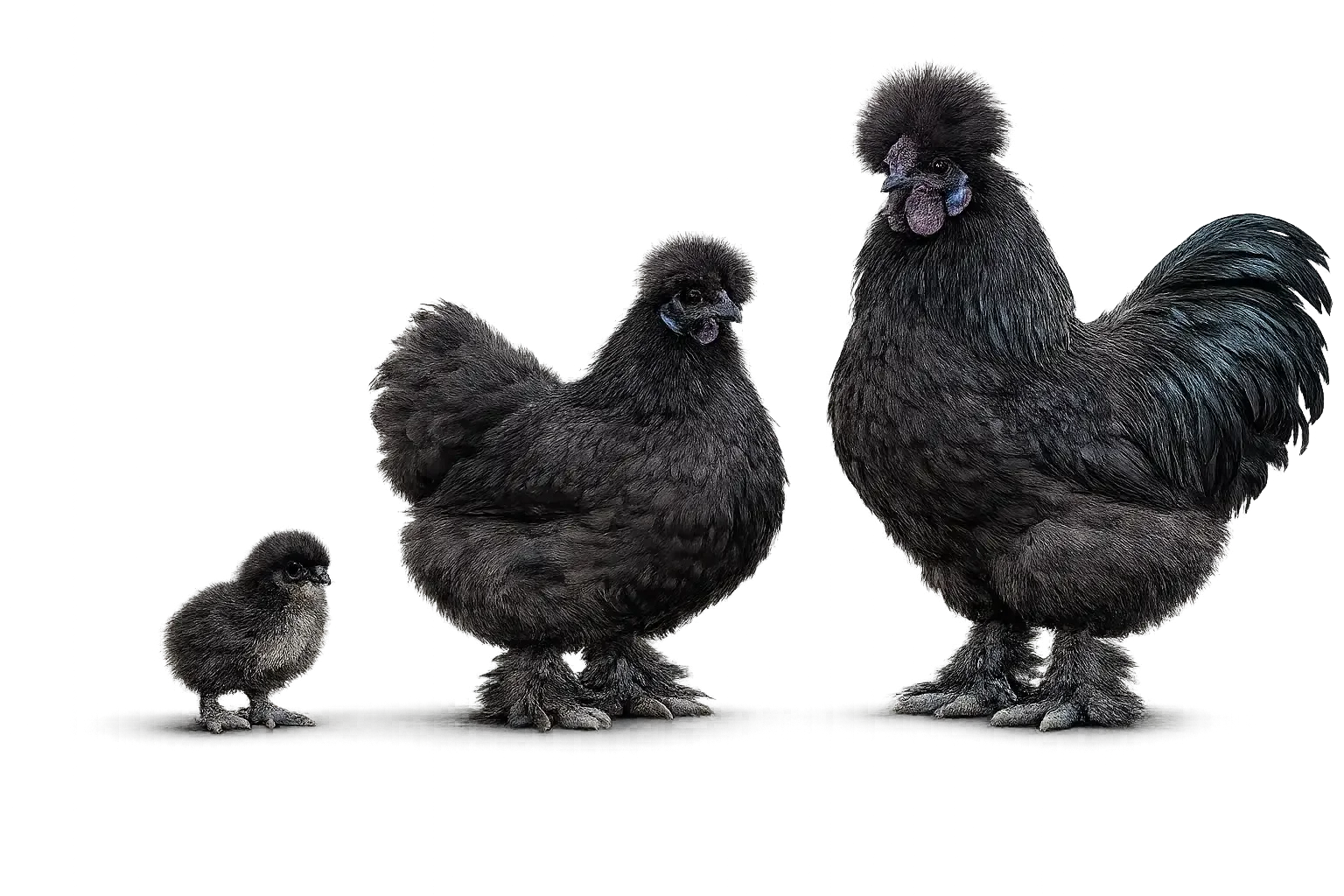
The Black Silkie Bantam is the most visually dramatic expression of a breed already defined by visual drama. Where the White Silkie Bantam presents as a cloud of pure white fluff, the Black Silkie Bantam presents as something closer to a living contradiction: jet black feathers that look and feel like fur, with a beetle-green iridescent sheen visible in direct sunlight, sitting above dark slate-black skin, black bones, a mulberry-colored comb that shades toward near-black, and the same turquoise-blue earlobes, five toes, and fluffy-feathered shanks that define every Silkie regardless of color. The black feather color sits on top of one of the most genetically interesting animals in the domestic chicken world, a bird whose skin, bones, and connective tissue are all darkened by the same fibromelanosis gene that produces the total blackness of the Ayam Cemani, expressed here in a more moderate heterozygous form that darkens everything beneath the feathers without coloring the feathers themselves black through genetics alone. The black plumage is a separate genetic expression from the fibromelanosis; it is a feather color that sits above the dark skin in a visual combination that produces the most striking appearance of any Silkie variety. The breed's history, temperament, brooding ability, egg production, and management requirements are identical to those of all Silkie varieties. What distinguishes the Black Silkie Bantam is the specific exhibition standards for the black color, the visual contrast between its darkly iridescent fluffy plumage and the dark features beneath, and its connection to the broader world of black-skinned Asian chicken breeds that has made the Silkie one of the most scientifically studied breeds in poultry genetics research. For the backyard keeper who wants the most dramatically dark and visually striking Silkie variety with the same exceptional temperament and brooding ability that defines the breed across all colors, the Black Silkie Bantam makes a compelling case that no other Silkie color quite matches.
Quick Facts
Class: All Other Standard Breeds (APA); classified as bantam only in the United States and Canada
Weight: Roosters approximately 36 oz (1 kg); hens approximately 32 oz (900 g) per APA standard
Egg Production: Approximately 100 to 120 small cream to tinted eggs per year; heavily interrupted by frequent broodiness
Egg Color: Cream to tinted white; identical across all Silkie color varieties
Egg Size: Small
Primary Purpose: Ornamental; exhibition; pet; broody hen for hatching eggs of other breeds
Temperament: Exceptionally docile, affectionate, and people-oriented; identical temperament to all Silkie varieties; calm with children
Brooding: Extremely broody; one of the most reliably broody breeds available; excellent natural mother; will hatch eggs from virtually any poultry species
Flight Capability: Essentially none; hookless feather structure prevents flight
APA Recognition: 1874; Black is one of seven recognized APA color varieties
Country of Origin: Ancient China; breed history reaches back to at least the 13th century
Varieties (APA): Black, Blue, Buff, Gray, Partridge, Splash, White; bearded and non-bearded forms exist for most colors
Comb Type: Walnut comb; mulberry to near-black in color rather than the red of most breeds; minimal frostbite risk
Distinctive Trait: Jet black fluffy plumage with beetle-green iridescent sheen; dark mulberry comb approaching black; dark facial skin; fibromelanosis-driven black skin, bones, and connective tissue beneath the feathers; five toes; turquoise-blue earlobes
Conservation Status: Not at risk; widely available
Lifespan: 7 to 9 years
Breed Overview
The Black Silkie Bantam carries the full breed history of all Silkie varieties, which reaches back to ancient China where the breed known in Mandarin as wu gu ji, meaning dark-boned chicken or black-boned chicken, appears in records from the Tang dynasty and was documented by Marco Polo during his 13th-century travels in Asia as a furry chicken unlike anything he had encountered in Europe. The name wu gu ji specifically references the internal blackness of the bird's skin, bones, and connective tissue, the product of fibromelanosis, which was recognized and valued in traditional Chinese medicine for over a thousand years before Western science understood the gene responsible for it. The breed reached the West through the Silk Route and maritime trade by the mid-1800s and was admitted to the APA Standard of Perfection in 1874.
The Black Silkie Bantam's specific history within the Silkie family is the history of the black feather color variety, which is the APA-recognized color most directly connected to the breed's fibromelanosis genetics and its Asian black-boned chicken identity. Understanding why requires understanding what fibromelanosis actually produces in the Silkie and how it differs from what it produces in the Ayam Cemani.
Fibromelanosis in both the Silkie and the Ayam Cemani is caused by the same genetic mechanism: a duplication near the endothelin 3 gene on chromosome 20 that triggers overproduction of melanin across tissues. In the Ayam Cemani, this gene is expressed homozygously, with both copies of the gene carrying the mutation, producing the total, pervasive blackness that extends to the feathers, organs, and every visible surface of the bird. In the Silkie, fibromelanosis is typically expressed heterozygously, with one copy of the gene, producing consistent black skin, dark bones, dark connective tissue, and dark combs and wattles, but not extending to the feather color, which is controlled by entirely separate genetics.
This means that a Black Silkie Bantam is black in two independent ways simultaneously. The black skin and dark features beneath the plumage come from fibromelanosis. The black feathers come from the separate black feather color genetics that any black-feathered breed carries. The two forms of blackness sit on the same bird, reinforcing each other visually, making the Black Silkie the most visually unified and internally consistent of the Silkie color varieties in terms of overall dark appearance. When the feathers part to reveal the black skin beneath, the effect is consistent rather than surprising as it would be if the skin were visible beneath a white or buff Silkie's feathers.
The APA recognized the Black Silkie Bantam as part of its initial 1874 admission of the Silkie breed, making the black variety one of the oldest continuously standardized Silkie colors in North American poultry history.
Plumage and Appearance
The Black Silkie Bantam's plumage is the most visually dramatic of any Silkie color variety. The feathers are jet black throughout, with a beetle-green iridescent sheen that becomes visible in direct sunlight, similar in character to the iridescence of the Black Australorp, Black Jersey Giant, and Black Sumatra but expressed across the Silkie's characteristic hookless, fluffy feather structure rather than the smooth, flat feather surface where iridescence is more commonly observed.
The APA exhibition standard for the Black Silkie Bantam specifies that the black plumage should be uniformly jet black throughout, with the beetle-green sheen considered an indicator of good feather quality rather than a fault. Any brown, red, or rusty toning in the black plumage is considered a defect and indicates leakage of other pigment genetics into the line; exhibition breeders select strongly against any warmth of color in the black feathers, maintaining the deepest, cleanest black possible across all feather tracts including the crest, beard, muffs, shanks, and toe feathering.
The facial features of the Black Silkie Bantam are where the fibromelanosis expression becomes most visually striking. The comb is walnut-shaped and small, but rather than the bright red of most breeds, it ranges from dark mulberry to near-black, reflecting the heavy melanin deposition in the skin and connective tissue. The wattles are similarly dark mulberry. The facial skin is dark, approaching black in the best-bred exhibition specimens. The earlobes, which in all Silkie varieties are turquoise-blue regardless of plumage color, stand out more dramatically against the dark facial skin of the Black Silkie than against the lighter facial skin of the White or Buff varieties. The beak is slate-blue to dark. The eyes are dark, almost black.
The five toes, polydactyly present in all Silkie varieties, are dark in the Black Silkie as the fibromelanosis pigmentation extends to the skin of the feet and the dark leg feathering continues over the dark skin. The overall effect when the Black Silkie Bantam is viewed as a complete bird is of a consistently dark animal from crest to toe, with the fluffy black feathers sitting above dark features in a way that creates a more visually unified dark presentation than any other Silkie color.
Beneath the feathers, the Black Silkie Bantam shares the full fibromelanosis expression of all Silkie varieties: black skin, dark bones, and darkened connective tissue. This internal darkening, visible in the carcass if the bird is ever processed, is what traditional Chinese medicine has valued for centuries and what makes the Silkie one of the most researched chicken breeds in genetic pigmentation studies.
Egg Production
The Black Silkie Bantam lays cream to lightly tinted small eggs at a rate of approximately 100 to 120 per year in an ideal year, with actual production significantly reduced by the breed's exceptional broodiness. The egg color is identical across all Silkie color varieties: the plumage color genetics that make the Black Silkie's feathers black have no effect on egg color, which is determined by entirely separate genetics. A Black Silkie hen lays the same cream-colored egg as a White Silkie hen.
The production characteristics are identical to the White Silkie Bantam in every practical respect: cyclical laying interrupted by frequent brooding, small egg size relative to production breeds, late laying onset at approximately 7 to 9 months of age, and the exceptional brooding and maternal ability that is the breed's most practically valuable characteristic for homestead keepers who want a reliable natural incubator.
Keepers who maintain Black Silkies specifically for egg production rather than brooding will see production toward the higher end of the 100 to 120 range through consistent egg collection that discourages brooding. Keepers who allow natural brooding, which is the Black Silkie's most valuable practical function, will see substantially lower direct egg production as brooding cycles occupy several months of each year.
The practical distinction between the Black Silkie Bantam and the White Silkie Bantam from an egg production perspective is essentially none: both lay the same eggs in the same volumes with the same brooding pattern. The choice between them is entirely a question of visual preference in the backyard flock and exhibition goals at the show level.
Temperament and Behavior
The Black Silkie Bantam's temperament is identical to the White Silkie Bantam's in every practical characteristic. The breed as a whole is exceptionally calm, affectionate, and people-oriented, with the same tendency to seek human contact rather than merely tolerate it, the same patience with children and inexperienced handlers, and the same quiet, contented vocalization that experienced keepers find pleasant.
One behavioral note specific to the Black Silkie that is worth mentioning for keepers who keep multiple Silkie colors in the same flock: there is no behavioral difference between color varieties. The temperament of the Silkie is a breed characteristic, not a color characteristic, and Black Silkies kept alongside White, Buff, or Splash Silkies behave identically. Flock dynamics between Silkies of different colors are no different from those between birds of the same color.
The Black Silkie Bantam's dark coloration does have one practical behavioral implication in mixed-breed flocks: the bird's dark color provides slightly better visual concealment against darker ground or shaded areas than the White Silkie's high-visibility white plumage. This is not a dramatic predator-evasion advantage given the breed's non-flying character and limited awareness regardless of color, but it is occasionally noted by keepers who free-range mixed-color Silkie flocks in environments with aerial predator pressure.
The breed's broodiness is consistent across all color varieties. A Black Silkie hen goes broody as reliably as a White Silkie hen, sits as committedly, and raises chicks with the same attentiveness. For keepers who maintain Black Silkies specifically for their surrogate brooding utility, color has no effect on this function.
Climate Adaptability
The Black Silkie Bantam's climate considerations are identical to the White Silkie Bantam's with one color-specific addition. The hookless feather structure cannot shed water regardless of plumage color, requiring covered housing access in wet conditions for all Silkie varieties. The walnut comb presents minimal frostbite risk in cold winters. Standard shade and cool water management handles summer heat adequately.
The color-specific climate consideration is solar heat absorption. Black feathers absorb solar heat more efficiently than white or light-colored feathers, which means the Black Silkie Bantam is marginally more susceptible to overheating in direct summer sun than the White Silkie Bantam. The practical difference is small given the breed's small body mass and the relatively modest heat absorption difference at bantam scale, but it is worth noting for keepers in very hot climates where every shade management consideration matters. Ensuring shade is accessible during peak summer heat is standard practice for all dark-feathered bantam breeds.
In wet and cold combined conditions, the management requirement is identical across all Silkie colors: dry housing, covered access to shelter, and prompt drying if birds become wet in cold weather to prevent the hypothermia risk that the hookless feathering creates. A wet Black Silkie Bantam is as vulnerable as a wet White Silkie Bantam; the color does not affect this management requirement.
Housing and Management
Standard Silkie housing requirements apply in full, identical to those described for the White Silkie Bantam. Covered runs or reliable dry shelter access is essential given the hookless feather structure's inability to shed water. Low roost bars at 12 to 18 inches allow the breed to roost comfortably without the high-jump impact landing that could damage feathering or cause leg injury. Nipple or cup-style waterers prevent chronic wet beard conditions in bearded specimens.
Exhibition management for the Black Silkie Bantam has specific color-related requirements that differ from the White variety. Maintaining the deepest, cleanest jet black throughout the plumage requires selecting against any rust, brown, or reddish toning in the black feathers across multiple breeding generations. Sun exposure can bleach or warm the black plumage, causing it to show brown tones that would otherwise be absent; exhibition birds shown during summer months benefit from shade management that protects the plumage color from sun-induced fading in the weeks before a show. The mulberry to near-black comb and facial skin coloring is also a selection criterion that exhibition breeders evaluate; the darkest, most uniformly pigmented facial features indicate strong fibromelanosis expression and are preferred in the show ring.
Litter management has a visual dimension for Black Silkie keepers that differs from White Silkie management. While soiling shows dramatically on white feathers and slightly less on black, the dense black feathering can conceal dirt accumulation that would be immediately visible on a white bird. Regular inspection of the feathering, particularly around the vent, feet, and crest, is important for Black Silkie Bantams even when the feathers appear clean from a distance.
Sourcing Considerations
The Black Silkie Bantam is widely available from mainstream hatcheries across North America alongside the other common Silkie color varieties. Most hatcheries that carry White Silkies also carry Black Silkies as part of a standard Silkie color range offering. This broad availability makes the Black Silkie as accessible as any other Silkie variety without specialty sourcing requirements.
For exhibition purposes, the Black variety has specific plumage quality requirements that hatchery stock may not consistently meet. Exhibition-quality Black Silkie Bantams from breeders actively selecting for the deepest jet black without rust or red leakage, the strongest beetle-green sheen, and the darkest mulberry-to-black facial coloring produce better starting stock for the show ring than general hatchery birds. Breeders active in the American Silkie Bantam Club and regional Silkie specialty shows are the appropriate sourcing channel for exhibition-quality Black birds.
Pros and Cons
Pros
The most visually dramatic Silkie color variety; jet black fluffy plumage with beetle-green iridescent sheen on the breed's iconic fluffy bantam frame creates a striking and unusual appearance
Dark plumage visually unified with the dark skin, comb, and facial features produced by fibromelanosis; more internally consistent dark appearance than any other Silkie color
Identical temperament to all Silkie varieties: exceptionally docile, affectionate, people-oriented, and safe for children
Outstanding natural broody hen for hatching any poultry species; reliably commits to incubation and raises chicks attentively
Cannot fly; straightforward containment without high fencing or covered runs required for flight management
Walnut comb presents minimal frostbite risk in cold winters
Widely available from mainstream hatcheries alongside other Silkie color varieties
APA recognized since 1874; active exhibition community with established black variety standards
Slightly better visual concealment than white in mixed free-range flocks with aerial predator pressure
Cons
Hookless feathering cannot shed water; covered housing essential; wet birds require prompt drying to prevent hypothermia
Black plumage absorbs more solar heat than lighter colors; marginally more heat-sensitive in direct summer sun than white variety
Egg production of 100 to 120 small cream eggs per year, with frequent broodiness reducing actual annual totals further
Litter and debris can accumulate in dark feathering without being immediately visible; requires regular inspection
Sun exposure can bleach or warm black plumage color; exhibition birds require shade management before shows
Selecting against rust and red plumage toning requires ongoing breeding attention across generations
Vulnerable to bullying in mixed flocks with assertive or dominant breeds
Crest feathering reduces peripheral vision; regular trimming required for welfare
Profitability
The Black Silkie Bantam's profitability profile is identical in structure to the White Silkie Bantam's, built around pet and companion sales, exhibition breeding, and broody hen utility, with one color-specific marketing distinction. The Black variety's dramatic dark appearance generates stronger visual contrast in photographs and social media content than the White variety, which photographs well against dark backgrounds and in studio-style settings where the green iridescent sheen becomes visible. This photographic impact creates marginally stronger social media engagement and novelty interest from buyers who encounter the breed through online channels, where the Black Silkie's unusual combination of fluffy texture and dark color reads as more unexpected than the White Silkie's more familiar fluffy-white presentation.
The exhibition market for Black Silkies is active within the Silkie specialty show community, with specific color standards that require breeding investment to meet consistently. Breeders producing clean, deep jet black birds with good beetle-green sheen and strong mulberry-to-dark facial coloring command premium pricing from the show community.
The surrogate brooding function generates revenue independent of color from homestead and small farm operations that want reliable natural incubation. A proven Black Silkie broody hen sells readily from operations demonstrating a track record of successful hatching, and her color has no effect on this utility.
Comparison With Related Breeds
White Silkie Bantam: The most direct comparison and the variety covered separately in this directory. All breed characteristics are identical: same body type, same fibromelanosis traits, same temperament, same broodiness, same egg production, same management requirements. The difference is entirely visual: the White Silkie presents as a cloud of pure white fluff against light-colored skin, while the Black Silkie presents as jet black fluff with dark features beneath. Exhibition breeders select for different color-specific standards in each variety but maintain the same underlying breed characteristics. Choice between the two is purely aesthetic.
Ayam Cemani: The most scientifically interesting comparison, connected through the shared fibromelanosis gene. The Ayam Cemani expresses fibromelanosis homozygously, producing total black pigmentation including black feathers, organs, and bones to a degree the Silkie does not approach. The Silkie's heterozygous fibromelanosis expression produces black skin and dark bones without controlling feather color, which is why a Black Silkie's black feathers are a separate genetic expression from its dark skin. The Silkie is significantly smaller, significantly more docile, and significantly more broody than the Ayam Cemani. Both are Asian breeds with fibromelanosis, but their practical characters and management requirements are completely different.
Blue Silkie Bantam: The closest color relative within the Silkie family. The Blue Silkie's plumage is produced by the blue dilution gene acting on black base pigment, producing the same slate blue-gray that the Blue Ameraucana and other blue-gene breeds display in conventional feathering. The Black Silkie and Blue Silkie can be used together in blue-black-splash breeding programs to produce blue offspring. From a management and temperament perspective the two are identical; from an exhibition perspective they are evaluated under different color standards.
Black Australorp: A comparison that highlights the Silkie's ornamental character against a genuinely productive black-feathered heritage breed. The Black Australorp produces 250 to 300 large brown eggs per year from a bird of 6.5 pounds with beetle-green iridescent plumage and a practical dual-purpose character. The Black Silkie Bantam produces 100 to 120 small cream eggs per year from a 2-pound bird with hookless fluffy plumage and an ornamental character. Both are black-feathered with iridescent sheen; everything else about their practical utility is different.
Final Verdict
The Black Silkie Bantam is the most visually unified and internally consistent color expression of a breed already defined by being unlike anything else in the poultry world. The combination of jet black hookless fluffy plumage with beetle-green iridescent sheen, dark mulberry facial features, dark skin beneath the feathers, turquoise-blue earlobes, and five toes produces an animal that strikes every first-time observer as genuinely unusual rather than simply pretty. For keepers who find the White Silkie's pure cloud-white presentation appealing, the Black Silkie offers a darker, more dramatic alternative that shares every practical characteristic the breed is known for: the same extraordinary people-seeking temperament, the same reliable brooding for any eggs you want hatched, the same quiet and manageable daily presence, and the same complete inability to fly over a fence. The slightly higher exhibition management investment in maintaining clean black plumage without rust toning is the only practical additional consideration for Black versus White. For the keeper who wants the most dramatic Silkie and understands the same wet-weather and mixed-flock management requirements that apply across all Silkie varieties, the Black Silkie Bantam is the answer. The backyard chickens category is better for including it.
Frequently Asked Questions
Why does the Black Silkie Bantam have dark skin under its black feathers? The dark skin, bones, and connective tissue are produced by fibromelanosis, a genetic condition caused by a duplication near the endothelin 3 gene on chromosome 20 that triggers overproduction of melanin across body tissues. This is the same gene, in the same basic mechanism, that produces the complete blackness of the Ayam Cemani, though the Silkie's heterozygous expression of the gene produces less complete pigmentation than the Ayam Cemani's homozygous expression. The black plumage is a separate genetic expression from the fibromelanosis; a Black Silkie is black in two independent ways simultaneously.
Are the black feathers of the Black Silkie Bantam caused by fibromelanosis? No. The black feather color is produced by standard black feather pigmentation genetics, the same genetics that make any black-feathered breed black. Fibromelanosis in the Silkie produces the dark skin, bones, comb, wattles, and connective tissue, but does not control feather color. A White Silkie Bantam has the same dark skin and bones as a Black Silkie Bantam because fibromelanosis is present in all Silkie varieties regardless of plumage color. The black feathers of the Black Silkie are a separate and independent visual characteristic from the black skin beneath them.
Does the Black Silkie Bantam lay black eggs? No. All Silkie color varieties lay cream to lightly tinted small eggs regardless of plumage color. Egg color is controlled by genetics entirely separate from plumage color and from fibromelanosis. A Black Silkie hen lays the same cream-colored egg as a White Silkie hen.
How do I maintain the jet black color for exhibition? Breeding is the primary maintenance tool: selecting breeding stock that consistently produces the deepest, cleanest black without rust, brown, or reddish toning across multiple generations gradually improves and stabilizes the color quality. Sun exposure can bleach or warm black plumage, causing exhibition-disqualifying brown tones; protecting exhibition birds from prolonged direct sun exposure in the weeks before a show helps maintain the deepest black possible. Clean, dry litter conditions prevent the staining and dulling of the plumage that wet or soiled conditions cause.
Is the Black Silkie Bantam more aggressive than the White Silkie Bantam? No. Temperament in the Silkie breed is consistent across all color varieties and has no relationship to plumage color. Black Silkie Bantams are identically calm, docile, and affectionate as White, Buff, or any other Silkie color variety. The breed's temperament is a characteristic of the breed, not of any specific color expression within it.
Where can I buy Black Silkie Bantam chicks? From most mainstream hatcheries and many farm supply stores that stock Silkie color varieties seasonally. Most hatcheries that carry White Silkies also carry Black Silkies as part of a standard Silkie color range. For exhibition-quality Black birds with clean jet black plumage meeting APA color standards, breeders active in the American Silkie Bantam Club and regional poultry exhibitions produce better starting stock than general hatchery birds selected primarily for volume rather than exhibition color quality.
Related Breeds
White Silkie Bantam
Blue Silkie Bantam
Buff Silkie Bantam
Splash Silkie
Ayam Cemani
White Sultan