
Black Sumatra
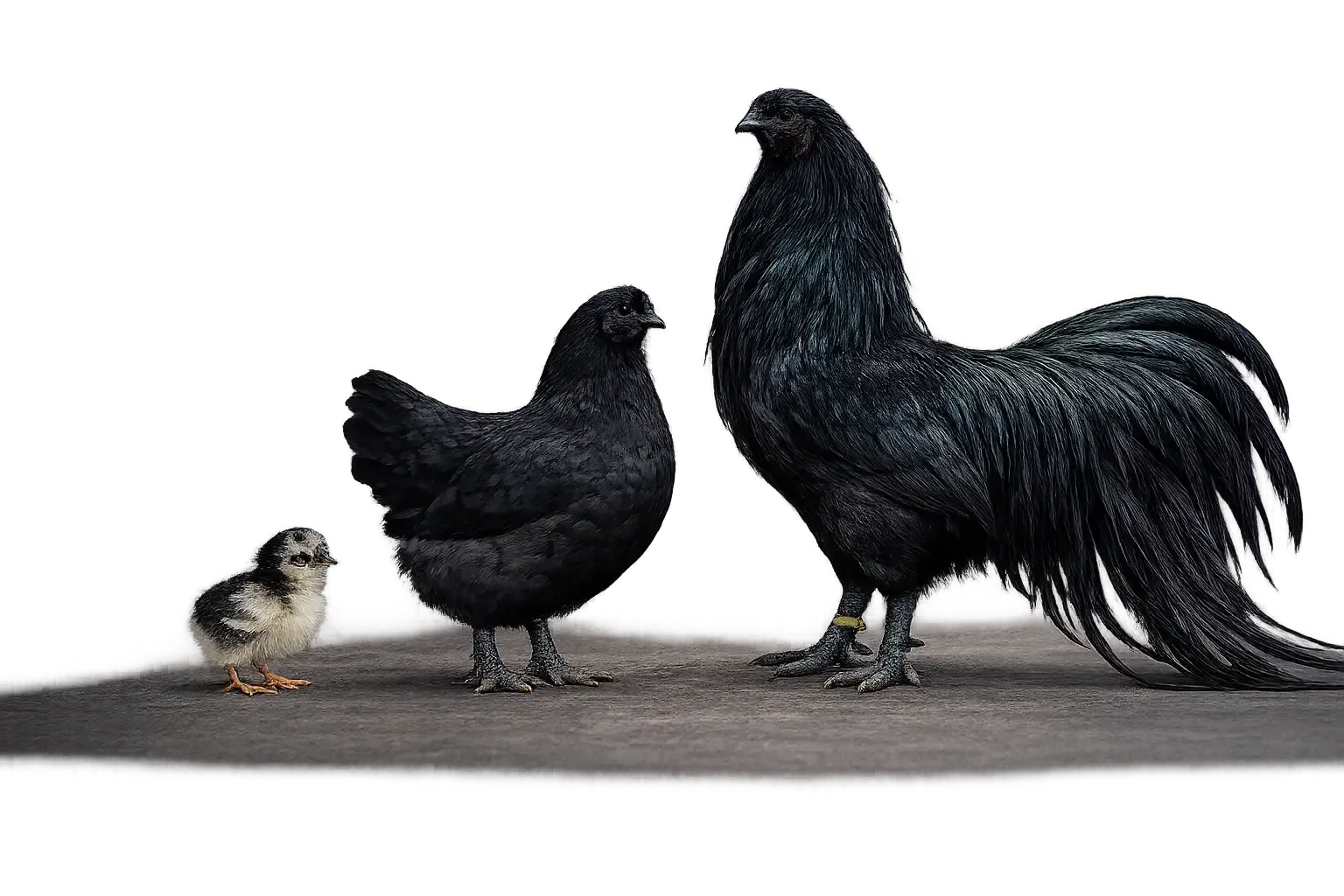
Exhibition Chickens | May 2025 | Written by Arthur Simitian
The Black Sumatra is one of the most visually dramatic chickens in the world, and one of the least understood. Originating from the island of Sumatra in what is now Indonesia, where it was kept for cockfighting, it arrived in the United States and Europe in the 1840s and 1850s primarily as an exhibition curiosity, its long flowing tail and jet-black plumage with a beetle-green iridescence immediately distinguishing it from every European breed of the period. It is today one of the oldest recognized chicken breeds in the American Poultry Association, yet it remains genuinely rare, a conservation breed held by a committed but small community of specialty breeders. For backyard poultry keepers and small-scale homesteaders interested in heritage poultry with extraordinary presence, an unusual multi-spur trait, and a bird that behaves more like a wild jungle fowl than a domesticated production hen, the Black Sumatra is a rewarding, challenging, and unforgettable choice.
Quick Facts
Class: All Other Standard Breeds (APA)
Weight: Roosters 5 lbs; hens 3.5 lbs
Egg Production: Approximately 100 small white eggs per year
Egg Color: White to tinted white
Egg Size: Small
Primary Purpose: Exhibition; ornamental; conservation
Temperament: Active, independent, flighty; roosters can be aggressive toward other roosters
Brooding: Yes; hens go broody readily and are good natural mothers
Flight Capability: High; capable flier requiring tall or covered runs
APA Recognition: 1883 (one of the earliest recognized breeds)
Country of Origin: Sumatra, Indonesia
Varieties (APA): Black; Blue; White
Also Known As: Sumatra Game, Javanese Pheasant Game (historical)
Comb Type: Pea comb; minimal frostbite risk
Distinctive Trait: Multiple spurs on each leg; beetle-green iridescent plumage
Conservation Status: Critical (Livestock Conservancy)
Lifespan: 7 to 10 years
Breed Overview
The Black Sumatra's origins lie not in the domesticated egg-and-meat poultry traditions of Europe but in the Malay Archipelago, where the birds were selected for centuries based on fighting ability, physical endurance, and an appearance that bordered on feral. Early accounts from European traders and naturalists described the birds running semi-wild through the jungles of Sumatra, exhibiting a long flowing tail, a low horizontal carriage, and a deep black plumage with a metallic sheen quite unlike anything found in contemporary European breeds. The breed arrived in the United States around 1847 to 1850, brought by traders familiar with the Southeast Asian poultry trade. It was admitted to the American Poultry Association Standard of Perfection in 1883, placing it among the first formal wave of breed recognitions in North American exhibition poultry.
The breed's early American reception was divided. Exhibition fanciers admired its striking appearance and long flowing tail; practical poultry keepers found its egg production modest, its temperament difficult, and its management requirements unlike those of docile dual-purpose breeds. By the mid-20th century it had declined sharply in numbers as the exhibition poultry world increasingly favored more tractable breeds. Today the Livestock Conservancy lists the Black Sumatra as Critical, the most urgent conservation designation, indicating that fewer than 500 breeding birds exist in the United States and global populations remain small.
Three color varieties are APA-recognized: Black, Blue, and White, though the Black is by far the most common, most studied, and most closely associated with the breed's identity and history. All discussion in this post refers to the Black variety unless otherwise noted.
Plumage and Appearance
The Black Sumatra's defining visual characteristic is its beetle-green iridescence, an optical effect in the feather structure that produces a deep, lustrous sheen across the entirely black plumage when light strikes it at the correct angle. In ideal specimens the iridescence is consistent across the hackle, back, saddle, and tail, creating what exhibition judges describe as a single flowing greenish-black surface rather than a collection of individually colored feathers. Poor specimens show dull, matte black without iridescence, and exhibition breeders select heavily against this trait.
The tail of the Black Sumatra rooster is one of the longest relative to body size of any APA-recognized breed. The main sickle feathers curve dramatically and the tail as a whole flows nearly horizontally from the body when the bird stands in its characteristic low carriage, giving it an unmistakably gamebird-like silhouette. Exhibition standards require this flowing tail to be well-developed; cockerels younger than twelve months often do not yet show the tail development that judges expect from adult males. The hen's tail is relatively short and carried at a slight upward angle, less dramatic than the rooster's but still longer than typical production breeds.
The face and head features distinguish the Black Sumatra clearly from Malay and Asil gamebirds that superficially resemble it. The comb is a pea comb, small, low, and tightly set, with minimal wattles and earlobes that are dark, nearly black in mature birds. The face skin itself is dark, often described as gypsy-faced, a trait that exhibition breeders select for strongly and that distinguishes a quality specimen from a bird with lighter-colored facial skin considered a serious fault. The beak is curved, dark, and strong. Legs are black to dark slate-black, and the skin beneath the feathers is dark-tinged rather than the yellow found in most American production breeds.
A note on multiple spurs: The Black Sumatra is one of the very few chicken breeds in which roosters reliably develop multiple spurs on each leg. Two spurs per leg is common; three per leg occurs in well-bred specimens. This multi-spur trait is unique in the domestic chicken world and reflects the breed's long-limbed gamebird ancestry and centuries of fighting-selection pressure. It is considered a breed hallmark rather than a disqualification.
The Black Sumatra's body type is slim, long, and horizontal in carriage. Where a production breed like the Rhode Island Red carries itself upright and compact, the Sumatra holds its body nearly parallel to the ground, neck extended forward and tail streaming back, a posture that experienced observers describe as wild or pheasant-like and that visitors unfamiliar with the breed sometimes find alarming. This carriage is correct and prized, not a sign of illness or distress.
Egg Production
The Black Sumatra is not a laying breed in any practical sense and should not be evaluated against laying breeds or even moderate dual-purpose breeds. Annual production of approximately 100 small white to tinted eggs per year represents solid performance for the breed, and many well-managed flocks produce somewhat less. Egg size is small by commercial standards but normal for a light, active bird of this body weight and genetic background. The eggs are suitable for table use and for hatching but do not represent a commercial or semi-commercial laying operation in any realistic scenario.
Hens go broody readily, more readily than most production or dual-purpose breeds, and are good natural mothers once the clutch begins incubation. This strong broodiness is partly a reflection of the breed's relatively limited domestication compared to heavy production breeds whose broodiness has been systematically selected against. For keepers interested in naturally propagating a small exhibition flock, the Sumatra hen's willingness to go broody and her competence as a mother are genuine practical advantages. Incubation runs 21 days as with all domestic chicken breeds.
One practical note: Sumatra hens often begin laying later in their first year than production breeds, frequently not coming into lay until seven or eight months of age rather than the five to six months seen in breeds like the Leghorn or Plymouth Rock. This delayed maturity is normal for the breed and consistent with its gamebird character and slow development timeline.
Temperament and Behavior
The Black Sumatra's temperament is one of the most important practical considerations for prospective keepers and one of the most frequently misunderstood. The breed is not aggressive in the way a Malay or Asil cockbird can be toward humans, but it is highly active, independent, alert, and flighty in a way that differs fundamentally from docile dual-purpose or production breeds. Hens are generally manageable with regular calm handling from young; roosters vary considerably by individual, with some developing genuine wariness or low-level assertiveness toward humans and others remaining indifferent. Exhibition breeders handling birds for showing manage this through consistent, respectful handling from early in the bird's life.
Roosters are frequently aggressive toward other roosters. The breed's fighting ancestry means that multi-rooster management in a confined space is generally impractical and often dangerous for the birds. Single-rooster flocks or carefully managed large multi-paddock systems with sight barriers between male birds are the realistic approaches for anyone keeping more than one rooster. Hens coexist more peacefully, though the breed is generally assertive in mixed-breed situations and may dominate more docile breeds.
The Sumatra is an active, ranging breed that does best with significant outdoor access. Confinement in small runs produces stressed, unhappy birds that may pace fence lines, develop feather-picking behaviors, or show generally poor condition. Larger paddocks, open runs, or carefully managed free-range access suit the breed's temperament far better. The breed's active foraging character means it is efficient at finding feed across a range environment but also means it requires significant space to thrive.
Flight capability in the Black Sumatra is genuine and should not be underestimated. Unlike many heavy breeds that are theoretically capable of short flights but rarely attempt them, Sumatras will readily fly to the top of fencing, into trees, or over barriers that would contain most domestic chickens. Covered runs or fencing at six feet or taller are generally required for reliable containment.
Climate Adaptability
The Black Sumatra's pea comb is a significant practical advantage in cold climates. Where breeds with large single combs require management attention to prevent frostbite during hard winters, the Sumatra's pea comb presents minimal frostbite risk and needs no special winter protection beyond what good housing already provides. This cold-hardiness is somewhat counterintuitive given the breed's tropical origins but is a reliable characteristic noted consistently by keepers across cold-winter regions of North America and Europe.
Heat tolerance is good, consistent with the breed's equatorial origins. The slim body type, light weight, and active foraging behavior mean the breed regulates its own thermal comfort better than large, heavy breeds that overheat quickly. Shade and cool water are standard summer requirements, and the Sumatra manages within those parameters without special management intervention in most North American climates.
Housing and Management
The Black Sumatra's housing requirements diverge from standard dual-purpose breed guidelines primarily in run size, fence height, and rooster management. Indoor floor space requirements follow standard guidelines, four square feet per bird, but outdoor run space should be considered a minimum rather than a comfortable allotment. Covered runs or six-foot-plus fencing are required for containment of birds that genuinely fly. Single-rooster management is strongly recommended for standard backyard situations.
The breed's tail development in roosters requires housing that does not damage the sickle feathers during roosting. Standard roost bars at appropriate height work well; confined spaces where the tail drags against walls or floor substrates during normal movement will result in broken, abraded sickle feathers that significantly reduce exhibition quality and require a full molt cycle to recover. Exhibition breeders are particularly attentive to roost placement and run dimensions relative to the rooster's tail length.
Feed management for exhibition birds focuses on maintaining the beetle-green iridescence that judges value most. Quality layer feed supplemented with access to range foraging provides the nutritional base for good feather condition. Some exhibition breeders note that birds raised on range with access to insects, green material, and soil tend to develop better feather sheen than birds kept strictly on pelleted feed, though controlled supplementation can compensate for birds maintained in covered runs.
Sourcing Considerations
The Black Sumatra's Critical conservation status means that sourcing quality birds requires deliberate research and patience. Mainstream hatcheries occasionally offer Black Sumatras, but hatchery stock has frequently been maintained without close attention to exhibition standards and may not produce birds with correct beetle-green iridescence, multiple spurs, gypsy face coloring, or proper body type. For keepers interested in exhibition quality or in actively supporting breed conservation, sourcing from breeders active in the American Sumatra Association or connected to the Livestock Conservancy's heritage breed network is strongly recommended.
The Livestock Conservancy maintains a breeders directory that is the most reliable North American starting point for sourcing verified Black Sumatra stock from breeders attentive to breed standards and conservation.
Exhibition-quality birds from reputable breeders command higher prices than hatchery stock, and this is expected, reflecting the genuine difficulty of maintaining correct type across generations. The Black Sumatra's slow maturity, modest egg production, and complex color genetics make it more expensive to breed correctly than high-production breeds. Keepers unwilling to pay premium prices for quality stock will likely end up with birds that do not represent the breed's full character and may contribute to the genetic dilution that conservation breeders work actively to prevent.
Pros and Cons
Pros
Extraordinary visual presence: beetle-green iridescent plumage, flowing sickle tail, and dramatic horizontal carriage are unmatched in domestic poultry
Pea comb means minimal frostbite risk even in hard winters
Multiple spurs on each leg, a unique trait in domestic chickens, highly prized by exhibition breeders
Strong broodiness and good maternal instincts support natural flock propagation
Efficient forager and active ranger; manages itself well on open range
One of the oldest APA-recognized breeds with a well-documented history
Conservation breeding: keeping Black Sumatras actively supports a Critical breed
Hardy and long-lived with appropriate management
Cons
Critical conservation status means quality stock is genuinely difficult to source
Egg production of approximately 100 small eggs per year is among the lowest of APA-recognized breeds
High flight capability requires covered runs or tall fencing for reliable containment
Roosters frequently aggressive toward other roosters; single-rooster management strongly recommended
Slow maturity; roosters may not show full tail development until second or third year
Not a beginner's bird; independent temperament and management demands require experienced handling
Hatchery stock often fails to represent correct breed type; quality sourcing requires research and cost
Not suitable for small confined runs; requires significant outdoor space to thrive
Profitability
The Black Sumatra's economics bear no resemblance to a production laying breed and should not be evaluated on that basis. Revenue opportunities exist in exhibition, breeding stock sales, and conservation-focused marketing rather than egg or meat production. Exhibition-quality adults command premium prices through specialty poultry networks; hatching eggs from verified breeding pairs with documented lineage have a consistent market among conservation breeders and exhibition enthusiasts. The breed's Critical status and the small supply of quality birds relative to demand means that breeders maintaining correct-type flocks with documented lineage are in a strong position relative to the niche market they serve.
Feed costs for Sumatras are modest relative to heavy breeds given the breed's light body weight and efficient ranging behavior. The genuine economic challenge is the breeding program investment required to produce exhibition-quality birds: the patience to select for multiple generations, the housing infrastructure to manage roosters separately, and the time investment in handling and conditioning birds for show. Keepers who view the Black Sumatra as a conservation breeding project with a secondary exhibition dimension, rather than as a commercial venture, are better positioned for long-term satisfaction with the breed.
Comparison With Related Breeds
Malay: The closest comparison in terms of gamebird heritage, difficult temperament, and exhibition pedigree, but produces a much larger, taller bird with an upright carriage that contrasts sharply with the Sumatra's horizontal silhouette. The Malay is also harder to manage than the Sumatra, with stronger individual assertiveness and higher potential for human-directed aggression from roosters. Egg production runs approximately 80 to 100 tinted eggs per year. Conservation status is Watch.
Phoenix: Shares the long flowing tail and exhibition focus but differs dramatically in temperament, as it is among the gentler exhibition breeds, and produces meaningfully more eggs per year at approximately 150 to 180 white eggs. It lacks the Sumatra's beetle-green iridescence and multiple-spur trait. Conservation status is Watch.
Yokohama: The closest aesthetic parallel to the Sumatra in terms of tail management requirements and exhibition focus, but is even rarer and has a different body type and origin story. Egg production is approximately 80 to 100 small tinted eggs per year. Conservation status is Critical.
Modern Game: An exhibition-only breed with an upright carriage that contrasts with the Sumatra's horizontal posture. Egg production of approximately 50 to 100 white eggs per year is the lowest of any breed in this comparison. Conservation status is Watch.
Old English Game: More widely available than the Sumatra with a longer North American management history, but focused on show rather than production and shares the multi-rooster aggression challenge common to game heritage breeds.
Final Verdict
The Black Sumatra is not a breed for everyone, and it does not try to be. It lays modestly, requires more space and management attention than docile dual-purpose breeds, demands separate rooster housing, and flies over fences that would contain most domestic chickens. None of these characteristics are flaws in the breed; they are expressions of what the Black Sumatra is: an ancient, minimally domesticated gamebird from the jungles of Sumatra that has retained its wild character through centuries of human keeping. That character, the flowing iridescent tail, the gypsy face, the multiple spurs, the horizontal pheasant-like carriage, the independence, is exactly what makes the breed irreplaceable.
For keepers who want a bird that produces eggs efficiently, the Black Sumatra is the wrong choice. For keepers who want to maintain a living piece of poultry history, participate in conservation of a genuinely threatened breed, and keep a bird whose visual impact makes visitors stop and stare, the Black Sumatra is among the most rewarding breeds the American exhibition tradition has preserved. The chicken directory is better for including it.
Frequently Asked Questions
How many eggs do Black Sumatra hens lay? Approximately 100 small white to tinted eggs per year under standard management. This is among the lower production figures for APA-recognized breeds and reflects the Sumatra's exhibition and ornamental purpose rather than any laying utility. Hens often do not begin laying until seven or eight months of age, later than most production breeds.
What makes the Black Sumatra's plumage different from other black chickens? The Black Sumatra's plumage has a structural iridescence in the feather that produces a deep beetle-green sheen when light strikes it at the correct angle. This differs from the flat, matte black of many production breeds and from the purple iridescence seen in breeds like the Black Australorp. Exhibition judges evaluate the quality and consistency of this beetle-green sheen as a primary breed characteristic.
Do Black Sumatras really have multiple spurs? Yes. Multiple spurs on each leg are a documented and prized characteristic of the Black Sumatra rooster. Two spurs per leg is typical in well-bred roosters; three spurs per leg occurs in some specimens. This multi-spur trait is extremely unusual in domestic chickens and is considered a hallmark of the breed rather than a fault or defect.
Are Black Sumatras good for beginners? Generally not. The breed's flight capability, independent temperament, rooster management requirements, sourcing difficulty, and sensitivity to housing conditions make it more appropriate for experienced poultry keepers with adequate space and infrastructure. Beginners interested in exhibition chickens often do better starting with a more tractable breed before moving to Sumatras.
How do I keep Black Sumatra roosters from fighting? Separate housing for roosters is the practical standard. Sight barriers between runs help reduce stress even in separated birds. Multi-rooster free-range situations where birds have very large territories and established hierarchies sometimes work in practice, but confined multi-rooster management is not realistic for most setups. Fighting injuries in gamebird-descended breeds are serious and often fatal if not separated promptly.
Where can I find Black Sumatra chicks or hatching eggs? The American Sumatra Association maintains a breeder referral network and is the most reliable starting point for sourcing quality birds. The Livestock Conservancy breeders directory lists verified conservation breeders. Mainstream hatcheries occasionally offer Sumatras but their stock frequently lacks correct breed type. Poultry exhibition shows are good venues for meeting breeders directly and evaluating bird quality before purchasing.
Do Black Sumatras handle cold winters well? Better than their tropical origin might suggest. The pea comb, small, low, and tightly set, presents minimal frostbite risk compared to breeds with large single combs. With standard cold-weather housing providing wind protection and dry conditions, Black Sumatras winter well across most North American climates. Their slim body type means they do not retain body heat as effectively as heavier breeds, so housing quality matters more for Sumatras than for large dual-purpose breeds in extreme cold.
Related Breeds
Malay Chicken
Phoenix Chicken
Yokohama Chicken
Modern Game
Old English Game
Asil Chicken
Explore more Chicken Breed Guides