
Blue Splash Ameraucana
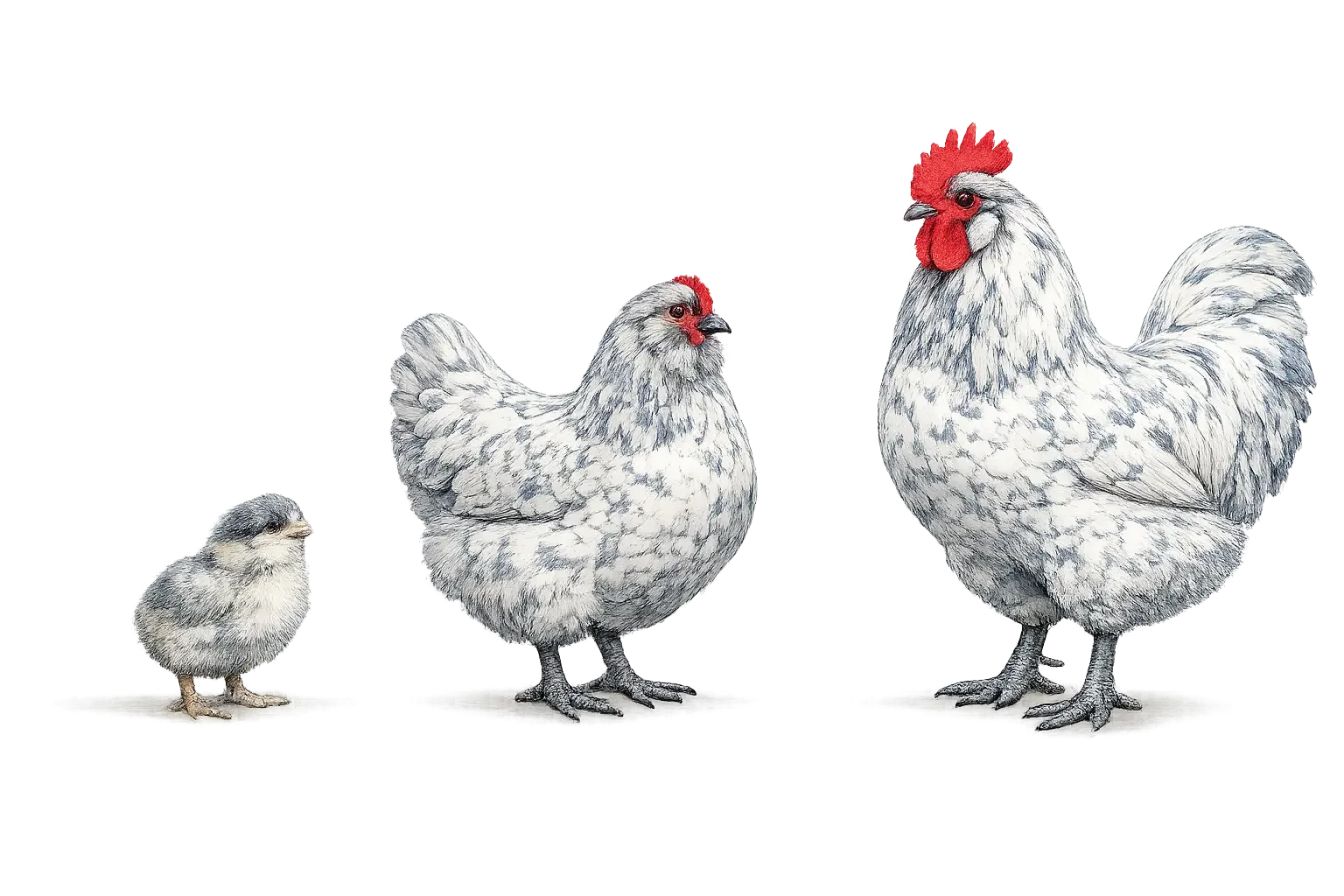
The Blue Splash Ameraucana is the most visually unpredictable and arguably the most striking color expression of a breed already known for its distinctive appearance. Where the Blue Ameraucana presents a coherent slate blue plumage with darker lacing, the Splash Ameraucana looks as though someone took a brush loaded with blue-gray paint and swept it across a white canvas in irregular strokes: a predominantly white bird with blue-black patches, splashes, and stippling distributed across the plumage in patterns that are never quite the same on any two birds. No two Splash Ameraucanas look identical. The pattern is random within a defined range, and that randomness is the point. The Splash plumage is produced by two copies of the blue dilution gene acting on black base pigment, diluting it so completely that what remains is a heavily washed, irregular distribution of blue and near-black marks on a white ground, rather than the even slate blue that one copy of the gene produces. The Splash Ameraucana is recognized as a variety within the Ameraucana breed standard, shares all the defining characteristics of the breed including beard, muffs, pea comb, slate legs, and full tail, and lays the same consistently blue eggs as every other Ameraucana variety. For the homestead keeper who wants a blue egg layer with the most visually distinctive plumage in the Ameraucana family, combined with the cold hardiness, foraging ability, and practical production of the breed as a whole, the Blue Splash Ameraucana delivers something genuinely unlike anything else in a backyard flock.
Quick Facts
Class: All Other Standard Breeds (APA); Miscellaneous Class
Weight: Roosters approximately 6.5 lbs; hens approximately 5.5 lbs
Egg Production: Approximately 150 to 250 blue eggs per year; 3 to 4 eggs per week
Egg Color: Blue; ranging from light sky blue to medium pastel blue; blue throughout the shell inside and out
Egg Size: Medium to large
Primary Purpose: Egg production; dual purpose; exhibition
Temperament: Generally calm, friendly, and curious; individual variation exists; roosters variable; non-aggressive toward humans and flock mates
Brooding: Variable; some hens go broody and are attentive mothers; others rarely do
Flight Capability: Moderate; five-foot fencing adequate for most flocks
APA Recognition: Splash is an APA-recognized Ameraucana variety; the breed was admitted in 1984
Country of Origin: United States; developed in the 1970s from Araucana-derived blue egg laying stock
Varieties (APA): Black, Blue, Blue Wheaten, Brown Red, Buff, Silver, Wheaten, White; Splash recognized as a variety
Comb Type: Pea comb; minimal frostbite risk; excellent cold-climate advantage
Distinctive Trait: Splash plumage: predominantly white with irregular blue-black patches, splashes, and stippling; no two birds look identical; lays blue eggs consistently
Conservation Status: Not at risk; growing in popularity
Lifespan: 7 to 10 years
Breed Overview
The Blue Splash Ameraucana shares its full breed history with the Blue Ameraucana and every other Ameraucana variety. The breed was developed in the United States from the 1930s onward, with significant acceleration of the standardization effort in the 1970s, by breeders working to preserve the blue egg gene of the Chilean Araucana while eliminating the Araucana's two genetic liabilities: the lethal tufted gene associated with ear tufts, and the rumpless trait that interfered with fertility. The result was the Ameraucana, admitted to the APA Standard of Perfection in 1984, defined by its beard and muffs replacing ear tufts, its full tail replacing rumplessness, its pea comb, and its slate legs.
The Splash variety is not a separate breed or a recent innovation within the Ameraucana family. It is the natural outcome of breeding two blue Ameraucanas together, appearing in the offspring as a predictable product of the blue dilution gene's incomplete dominance. Understanding why the Splash exists in the Ameraucana breeding program requires understanding the genetics that produce it, and that genetics story is also the story of why the Blue Splash Ameraucana is always produced alongside Blue and Black birds in any breeding program that uses the blue dilution gene.
The Blue dilution gene, designated Bl, is an incomplete dominant gene. Incomplete dominance means that one copy of the gene produces an intermediate expression rather than a fully dominant or fully recessive outcome. A bird with one copy of Bl on a black base produces the blue color: black pigment diluted to a slate blue-gray. A bird with no copies of Bl remains black. A bird with two copies of Bl has the pigment diluted twice over, producing the splash expression: a white to near-white ground with irregular blue-gray and near-black patches and stippling where the double dilution is uneven across different feather tracts.
Because splash birds carry two copies of the blue gene, they breed true when crossed with each other: splash to splash produces 100 percent splash offspring. This true-breeding characteristic makes the Splash variety self-sustaining once a pair is established, which is a practical management advantage over the Blue variety that requires careful crossing to maintain color consistency. Crossing splash to black produces 100 percent blue offspring, which is the most efficient method of producing blue birds in large numbers and the reason that many breeders maintain both splash and black pens to generate blue offspring as needed.
The Ameraucana Breeders Club has pursued formal APA recognition for the large fowl Splash Ameraucana, establishing standards that call for a predominantly white bird with blue splashing, a beak varying from horn to black, and disqualifications for more than 50 percent blue in the plumage or the appearance of rust coloring. Brassiness, a yellowing of the white areas caused by genetics, sun exposure, or diet, is considered a defect rather than a disqualification.
Plumage and Appearance
The Splash Ameraucana's plumage is its defining characteristic and the feature that most immediately distinguishes it within the Ameraucana family. The base color is white to near-white, and across this white ground the blue dilution gene in double copy creates an irregular distribution of blue-gray and darker near-black splashing. The patches appear across the hackle, back, wing coverts, saddle, and tail in patterns that vary significantly between individual birds: some have dramatic, clearly defined blue patches on a bright white ground; others show softer, more diffuse blue stippling; still others show concentrated blue on the hackle and tail with relatively little marking on the body. No two Splash Ameraucanas look identical, and this unpredictability is part of the variety's visual appeal.
The standard calls for the blue areas not to exceed 50 percent of the total plumage, preserving the white-dominant appearance that defines splash as distinct from a mottled blue or a lightly colored blue bird. Birds with more blue than white are considered to be expressing the color outside the acceptable splash range and would not meet exhibition standards. Exhibition breeders select for clear, well-distributed splash marking on a bright, clean white ground, avoiding brassiness in the white areas and maintaining the irregular but not overwhelming blue coverage that the variety standard describes.
The remaining physical characteristics of the Blue Splash Ameraucana are identical to every other Ameraucana variety. The beard and muffs are full and present together, covering the lower face and cheeks and creating the distinctive puffy-cheeked appearance that defines the breed. The pea comb is small and low, presenting minimal frostbite risk. The legs are slate to nearly black. The eyes are reddish bay. The tail is full and well-developed. The body is medium-sized and carried with the alert, forward-leaning posture that the breed as a whole expresses.
Chicks from splash-to-splash crosses hatch as all splash, making early identification straightforward for breeders maintaining pure splash breeding pens. Chicks from blue-to-blue crosses that produce splash offspring alongside blue and black can be identified at hatch by their predominantly white down, distinguishing them from the darker blue and black chicks in the same hatch.
Egg Production
Every Ameraucana variety lays blue eggs, and the Blue Splash Ameraucana is no exception. The egg color has no relationship to the feather color genetics: the blue egg gene is entirely separate from the blue dilution gene that produces the splash plumage, and changing feather color through breeding has no effect on egg color. A splash hen bred from verified Ameraucana stock lays exactly the same blue eggs as a black, blue, or wheaten Ameraucana hen from the same flock.
Annual production of approximately 150 to 250 blue eggs per year, or 3 to 4 eggs per week, places the Blue Splash Ameraucana in the reliable heritage layer category consistent with the breed as a whole. The egg color is consistent for each individual hen throughout her laying life: a hen that lays a particular shade of sky blue will continue laying that shade, not shifting color with age or season. The shade varies between individual hens, from light pastel to a deeper sky blue, with the most prized exhibition and specialty market eggs showing a rich, saturated medium blue.
The blue color is produced by biliverdin, a bile pigment that permeates the shell material during formation, creating a shell that is blue from the inside surface to the outside. This distinguishes genuine Ameraucana eggs from lightly tinted eggs that are white internally. The same pigment mechanism produces the blue eggs of the Whiting True Blue, the Cream Legbar, and all other true blue egg layers.
Hens typically begin laying at approximately 6 to 7 months of age. The pea comb contributes to winter hardiness that supports more consistent cold-weather production than single-combed breeds of similar size, and the breed generally maintains laying through winter with some seasonal reduction in the shortest days.
Broodiness is variable across all Ameraucana varieties including the Splash. Some hens go broody and are attentive, protective mothers; others rarely or never commit to incubation. Keepers who want reliable natural hatching should not build that expectation around the Ameraucana as a breed, though individual splash hens that do go broody are reported as committed sitters.
Temperament and Behavior
The Blue Splash Ameraucana's temperament reflects the full range of individual variation that characterizes the Ameraucana breed. The splash plumage has no effect on temperament; the behavioral range of calm and curious to somewhat flighty and independent that appears across the breed appears equally across the splash variety. Keepers who have maintained multiple Ameraucana varieties consistently report that temperament variation between individuals within any variety is greater than any systematic difference between varieties.
The Splash variety is described by keepers and breeders as generally calm, curious, sociable, and easy to work with when handled regularly from young. The breed's active, exploratory foraging character is present in the Splash as in all Ameraucana varieties. Birds given range access move actively through their environment, forage efficiently for insects and plant material, and maintain the self-sufficient, alert character that reflects the breed's heritage from semi-wild South American stock.
In mixed flocks the Blue Splash Ameraucana holds a moderate position, generally peaceful toward other breeds but occasionally on the receiving end of bullying from significantly larger or more dominant breeds. The beard and muff feathering can be targeted by aggressive flockmates, making companion breed selection relevant for splash birds kept in mixed environments.
One behavioral note specific to the Splash variety is the strong visual impression the plumage creates in a flock setting. The predominantly white bird with dramatic blue markings is highly visible in both the flock and from a distance, which has predator management implications in open free-range settings where visual concealment in mixed flocks provides some protection. Keepers managing Blue Splash Ameraucanas in high-predator environments should factor the variety's visibility into their predator protection planning.
Climate Adaptability
The Blue Splash Ameraucana's climate performance is identical to every other Ameraucana variety. The pea comb is the primary cold-hardiness advantage, presenting minimal frostbite risk even in hard freezes and supporting more consistent winter egg production than single-combed breeds of similar size. The breed handles North American winters well across most regions with standard dry, well-ventilated, wind-protected housing.
One climate-specific note for the Splash variety: the predominantly white plumage absorbs less solar heat than the darker Blue or Black varieties, which has a modest practical benefit in hot climates where dark feathering can contribute to heat stress. The difference is not dramatic enough to make climate suitability a primary variety selection criterion, but it is a genuine if minor advantage for hot-climate keepers choosing between Ameraucana varieties.
Heat tolerance is good across the breed and the Splash variety reflects this. The pea comb, while limiting heat dissipation compared to a large single comb, is compensated by the breed's moderate body size, and standard shade and cool water management is sufficient for most hot-summer situations without special intervention.
The bearded breeds' wet-weather management note applies here as it does to all Ameraucana varieties: the beard and muff feathering can become wet, chilled, and matted in persistently wet conditions, and waterer design that avoids beard submersion reduces this management burden.
Housing and Management
Standard backyard housing requirements apply throughout. The Blue Splash Ameraucana's housing and management needs are identical to the Blue Ameraucana's: four square feet of indoor floor space per bird as a minimum baseline, five-foot fencing for adequate containment of a moderately active breed, and nipple or cup-style waterers preferred over open-surface waterers to avoid chronic wet beard conditions.
The splash plumage's white ground color is more visible when dirty than the darker blue or black varieties, which has a minor practical implication for litter management: keepers who want to maintain the visual impact of the splash plumage need to manage litter and run conditions to reduce soiling, particularly of the white areas. This is an aesthetic rather than a health consideration, but it is worth knowing for keepers who plan to show their birds or who maintain the flock for visual display purposes.
Breeding management for the Splash variety requires clarity about the goals of the breeding program. Keepers who want to maintain a self-sustaining splash flock breed splash to splash and produce 100 percent splash offspring, the simplest management scenario. Keepers who want to produce blue offspring efficiently can breed splash to black, producing 100 percent blue offspring without the color variance of blue-to-blue crosses. Keepers who want to produce a mix of blue, black, and splash can breed blue to blue or blue to splash in the proportions described in the breed overview section. The egg color remains blue in all cases regardless of the feather color genetics used in the cross.
Breed verification applies to the Blue Splash Ameraucana as it does to all Ameraucana varieties. The misspellings Americana and Americauna reliably indicate Easter Eggers rather than true Ameraucanas. True splash Ameraucanas have slate legs, beard and muffs together, a pea comb, and a full tail. Splash-patterned Easter Eggers exist and may lay blue eggs, but they do not meet the Ameraucana breed standard and should not be purchased at Ameraucana prices.
Sourcing Considerations
True Blue Splash Ameraucanas from verified Ameraucana breeding programs are available through the Ameraucana Breeders Club member directory, through breeders active in the Ameraucana show community, and through a small number of specialty hatcheries that maintain genuine Ameraucana breeding flocks rather than Easter Egger flocks sold under the Ameraucana name.
My Pet Chicken is one of the few mainstream hatchery-adjacent operations that has offered verified Blue Splash Ameraucanas with explicit assurance that they are not Easter Eggers, though availability is described as limited and orders sell quickly. Most mainstream hatcheries do not carry verified Ameraucanas in any color including splash.
The Splash variety's true-breeding characteristic when crossed splash to splash makes it somewhat easier to propagate in a keeper breeding program than the Blue variety, since a splash pair reliably produces splash offspring without the color variance management that blue-to-blue crossing requires. Keepers who establish a verified splash pair from a quality source have a self-sustaining variety without ongoing sourcing dependence.
Pros and Cons
Pros
The most visually distinctive plumage of any Ameraucana variety; no two birds look alike; genuinely striking in any flock setting
Consistent blue egg production of 150 to 250 eggs per year from an APA-recognized heritage breed
Splash variety breeds true when crossed splash to splash; self-sustaining once a verified pair is established
Crossing splash to black produces 100 percent blue offspring; a useful breeding tool for keepers managing multiple Ameraucana color varieties
Pea comb provides excellent cold hardiness with minimal frostbite risk
White-dominant plumage absorbs less solar heat than darker varieties; a modest advantage in hot climates
Active forager with good range efficiency and natural pest control value
Beard and muffs give the breed a distinctive appearance beyond the plumage alone
Generally calm and non-aggressive; suitable for mixed flocks with appropriate companion breeds
Long productive lifespan of 7 to 10 years
Cons
True Blue Splash Ameraucanas require sourcing from verified specialty breeders; availability more limited than the Blue variety
Predominantly white plumage is more visible to predators in open free-range settings than darker varieties
White ground color shows dirt and soiling more visibly than darker varieties; more litter management attention needed for maintained appearance
Brassiness in the white areas is a common exhibition defect requiring dietary and genetic management
Temperament variation between individuals; some birds calmer, some more flighty
Broodiness variable and unreliable for natural hatching programs
Beard and muff feathering requires waterer design consideration to prevent chronic wet beard
Profitability
The Blue Splash Ameraucana's profitability profile builds on the same foundation as the Blue Ameraucana with one additional asset: the splash plumage's visual novelty creates stronger social media and farm marketing appeal than any uniform solid-colored variety. Customers visiting farm stands, farmers markets, or farm social media accounts react distinctively to the splash bird's appearance, and this visual marketing value is genuinely worth something in a direct-sale egg operation where customer engagement and repeat purchase are the revenue drivers.
The blue eggs themselves carry the same premium value as any verified Ameraucana blue egg in direct-sale markets. The splash variety's true-breeding characteristic when managed correctly allows keepers to produce a self-sustaining blue egg flock without ongoing hatchery sourcing costs. The ability to produce 100 percent blue offspring from splash-to-black crosses is a practical tool for keepers who want to expand their blue egg production without the color variance of blue-to-blue crosses.
Exhibition breeding of the Splash variety is active and growing within the Ameraucana community as the APA formal recognition process proceeds. Breeders producing exhibition-quality splash birds with correct color distribution, clean white ground, and well-defined marking patterns command premium prices from the show community.
Comparison With Related Breeds
Blue Ameraucana: The closest comparison within the Ameraucana family. The Blue and Splash varieties share identical breed characteristics, production figures, temperament range, and management requirements. The difference is entirely in plumage: the Blue presents a coherent slate blue with darker lacing, while the Splash presents a predominantly white bird with irregular blue-black markings. The Splash breeds true from splash-to-splash crosses; the Blue requires blue-to-black or blue-to-splash crosses for consistent color management. Both lay blue eggs.
Black Ameraucana: The third member of the blue-black-splash color group, carrying no copies of the blue dilution gene and presenting as solidly black with an iridescent sheen in sunlight. Crossing Black to Splash produces 100 percent Blue offspring, making the Black and Splash varieties useful breeding complements for keepers who want to maintain an efficient Blue egg production program.
Splash Ameraucana Bantam: A bantam-sized version of the same variety that shares the splash plumage genetics and blue egg laying characteristic at a smaller body weight. The bantam produces smaller eggs and proportionally lower annual production, but the visual character and breed temperament are consistent with the standard-sized bird.
Easter Egger: The most commonly misrepresented comparison. Splash-patterned Easter Eggers exist and may lay blue eggs, but they are not verified Ameraucanas, do not meet the breed standard for leg color, comb type, beard and muff conformation, or consistent egg color, and should not be purchased at Blue Splash Ameraucana prices regardless of their visual similarity to the genuine variety.
Blue Laced Red Wyandotte: A visually dramatic comparison breed that also produces striking, non-uniform color patterns through lacing genetics. The Blue Laced Red Wyandotte is a larger, heavier, more productive layer of brown eggs and a better dual-purpose meat bird, while the Blue Splash Ameraucana lays blue eggs and is lighter. Both are visually distinctive breeds that generate strong flock display appeal.
Final Verdict
The Blue Splash Ameraucana is the Ameraucana family's most visually surprising member and one of the most immediately arresting birds that can be added to a homestead flock. The splash plumage is genuinely beautiful, genuinely unpredictable in its specific pattern on any individual bird, and genuinely unlike what most people picture when they think of a chicken. Combined with the breed's blue egg production, pea comb cold hardiness, active foraging character, and calm enough temperament for family and mixed-flock environments, the Blue Splash Ameraucana delivers visual impact and practical utility from the same bird simultaneously.
The sourcing challenge is real; true splash Ameraucanas from verified breeding programs are not found at mainstream hatcheries. The predator visibility of the white plumage in open free-range settings deserves management consideration. Neither of these limitations diminishes the case for the variety in a covered or partially managed range environment where sourcing effort produces birds that are maintained correctly. For the homestead keeper who wants a blue egg layer with the most distinctive appearance in the Ameraucana family and the genetic tools to build a self-sustaining splash flock, the Blue Splash Ameraucana earns its place. The dual purpose and homestead category is better for including it.
Frequently Asked Questions
What makes a Blue Splash Ameraucana different from a Blue Ameraucana? The difference is entirely in plumage color genetics. The Blue Ameraucana carries one copy of the blue dilution gene, which dilutes black pigment to a coherent slate blue with darker lacing. The Blue Splash Ameraucana carries two copies of the blue dilution gene, which dilutes the pigment twice over to produce a predominantly white bird with irregular blue-black patches and stippling. All other breed characteristics including temperament, egg color, production, comb type, and body type are identical between the two varieties.
Do Blue Splash Ameraucanas lay blue eggs? Yes, consistently. The splash plumage genetics have no relationship to the blue egg gene. Every Ameraucana variety lays blue eggs regardless of feather color, and the Splash is no exception. The eggs are blue throughout the shell, inside and out, produced by the same biliverdin pigment mechanism as every other Ameraucana variety.
If I breed two Splash Ameraucanas together, what color chicks will I get? One hundred percent splash. Because splash birds carry two copies of the blue dilution gene, both parents contribute one copy to each offspring, and every chick receives two copies and expresses the splash pattern. This true-breeding characteristic makes the splash variety self-sustaining once a verified pair is established, without the color variance that blue-to-blue crosses produce.
What happens if I cross a Splash Ameraucana with a Black Ameraucana? One hundred percent blue offspring. The splash bird contributes one copy of the blue gene and the black bird contributes no copies; every offspring receives exactly one copy and expresses the blue color. This cross is one of the most efficient methods of producing blue birds in large numbers and is used by breeders who maintain both splash and black pens for this purpose.
Is brassiness in the white feathers a disqualification for exhibition? No, brassiness is classified as a defect rather than a disqualification under the Ameraucana Breeders Club standards for the large fowl Splash variety. It is a yellow tinting of the white areas caused by genetic factors, sun exposure, or diet, and exhibition breeders work to minimize it through careful selection and management. A disqualification applies to birds showing more than 50 percent blue in the plumage or the appearance of rust coloring.
How do I find verified Blue Splash Ameraucana chicks? The Ameraucana Breeders Club member directory is the most reliable North American resource. My Pet Chicken has offered verified Blue Splash Ameraucanas in limited quantities as a specialty offering distinct from their Easter Egger stock. Poultry exhibitions where Ameraucana breeders show their birds are good venues for meeting splash breeders directly. Mainstream hatcheries generally do not carry verified splash Ameraucanas; birds sold as Ameraucanas at most hatcheries are Easter Eggers.
Why is the blue splash plumage pattern different on every bird? The splash pattern is produced by the double dose of the blue dilution gene acting unevenly across different feather tracts during development. The gene's expression varies between feather groups and between individual birds, producing the irregular distribution of blue-gray and near-black marking on a white ground that defines the splash appearance. Because the variation is inherent to the genetic mechanism rather than controlled by a patterning gene that specifies exact marking location, no two birds express the same splash distribution.
Related Breeds
Blue Ameraucana
Black Ameraucana
Lavender Ameraucana
Splash Ameraucana Bantam
Araucana
Easter Egger
Blue Laced Red Wyandotte