
California White
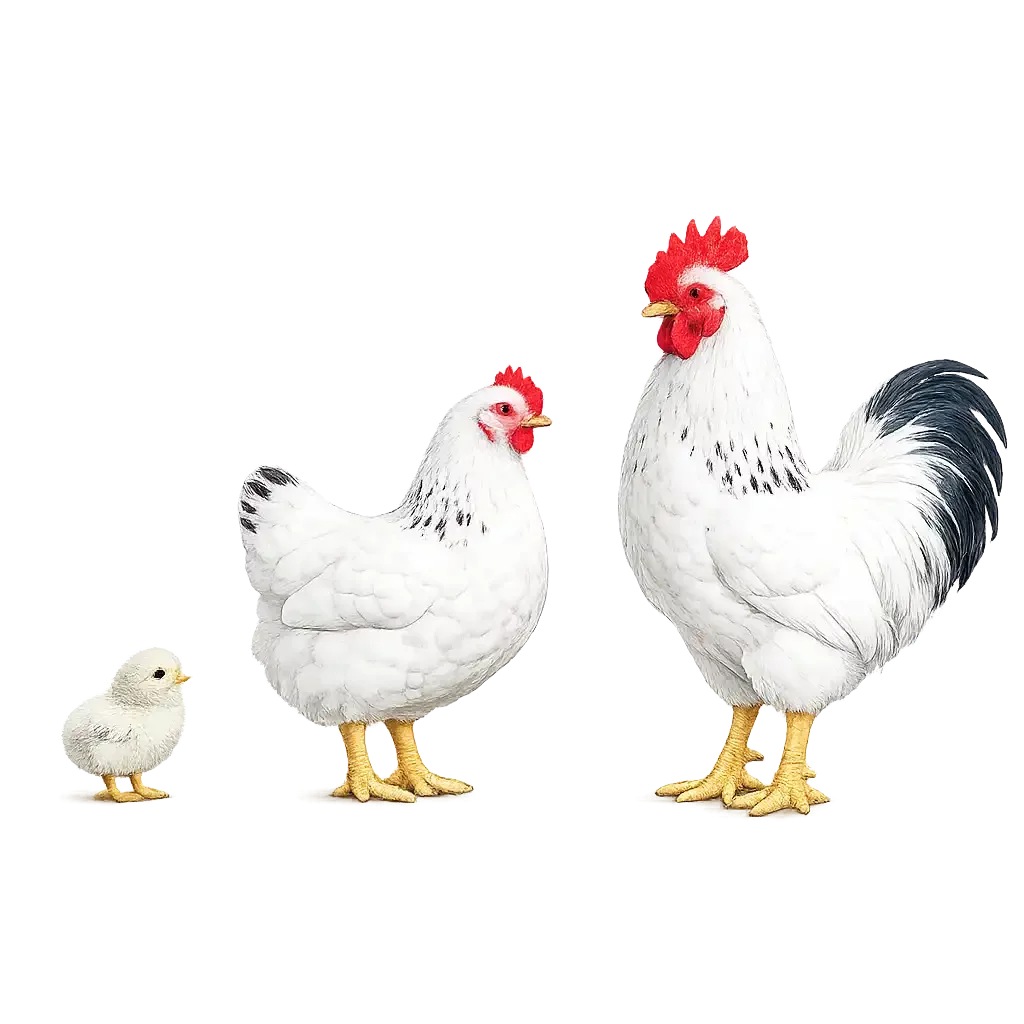
The California White is a sex-link hybrid that solves the same problem the Austra White solves, and does it from a different genetic direction with a slightly different result. The problem is the White Leghorn's temperament. The White Leghorn is the highest-producing white egg layer in the heritage poultry world, laying 280 to 320 large white eggs per year on the best feed-to-egg conversion ratio of any recognized breed, but it is nervous, flighty, loud, and strongly disinclined toward human contact in a way that makes it a poor fit for many backyard and homestead environments. The Austra White addresses this by crossing the Leghorn with the Black Australorp, producing a calmer and heavier bird that lays cream to off-white eggs at comparable volume. The California White addresses the same temperament problem by crossing the White Leghorn hen with a California Gray rooster, producing a calmer, somewhat quieter, sex-linkable hybrid that lays pure white eggs at 280 to 300 per year and introduces the practical advantage of sex-distinguishable chicks at hatch.
The California Gray rooster used in this cross is itself a hybrid, developed in California in the 1930s by Horace Dryden of Modesto by crossing Barred Plymouth Rock roosters with White Leghorn hens to produce an autosexing bird with barred gray adult plumage. This means the California White is not a simple two-breed cross but effectively a three-breed hybrid: three-quarters White Leghorn genetics and one-quarter Barred Plymouth Rock genetics flowing through the California Gray parent. The Barred Plymouth Rock contribution from the California Gray is what produces the sex-link mechanism in the California White cross: male chicks hatch with a white spot on the head from the barring gene, while female chicks hatch predominantly black without the head spot, allowing keepers to sex the flock at hatch with the near-certainty that sex-link sexing provides. It is also what produces the temperament moderation relative to the pure Leghorn: the Plymouth Rock's calm, manageable character expressing partially through the California Gray parent and into the California White offspring.
For the homestead keeper who wants pure white egg production at Leghorn-adjacent volumes, the sex-link confidence of hatch-day chick sexing, a calmer and somewhat quieter bird than the pure Leghorn, and availability from multiple mainstream hatcheries without single-supplier dependency, the California White is one of the most practically complete white egg production hybrids available.
Quick Facts
Type: Sex-link production hybrid; White Leghorn hen crossed with California Gray rooster; effectively three-quarters White Leghorn and one-quarter Barred Plymouth Rock genetics
Weight: Hens approximately 5.5 lbs; roosters approximately 7 lbs
Egg Production: Approximately 280 to 300 large white eggs per year; 5 or more eggs per week; some documentation suggests production can exceed the White Leghorn's annual total in well-managed flocks
Egg Color: Pure white; no cream tinting or coloring
Egg Size: Large to jumbo
Primary Purpose: Egg production; dual purpose at homestead scale; sex-link chick sexing
Temperament: Active and alert but calmer and quieter than the pure White Leghorn; generally manageable and beginner-accessible; less flighty than Leghorns with regular handling; not a lap bird but more approachable than the pure parent
Brooding: Low to variable; generally non-broody like the Leghorn parent but occasional broodiness reported, likely from the Plymouth Rock genetics in the California Gray; incubator generally recommended for flock propagation
Flight Capability: Good; retains the Leghorn's flight capability; high fencing or covered runs recommended for reliable containment
APA Recognition: None; hybrid cross not eligible for breed recognition or exhibition
Country of Origin: United States; California; developed 1930s
Parent Breeds: White Leghorn hen x California Gray rooster (California Gray is itself a Barred Plymouth Rock x White Leghorn cross)
Sex-Link Characteristics: Male chicks hatch with a white spot on the head; female chicks hatch predominantly black without the head spot; sexable at hatch with near-certainty
Distinctive Trait: Pure white adult plumage with black flecks in hens; chicks hatch black with sex-distinguishable white head spot on males; calmer than pure White Leghorn; pure white eggs at high production volume; sex-link hatch-day sexing
Availability: Widely available from mainstream hatcheries; no single-supplier dependency
Lifespan: Estimated 5 to 8 years
Breed Overview
The California White's development story begins with its California Gray rooster parent, which is the more interesting and less commonly discussed half of the cross. Horace Dryden, working in Modesto, California in the 1930s during a period of intense commercial interest in developing efficient egg and meat production birds, set out to create a chicken that combined the White Leghorn's remarkable egg production with the Barred Plymouth Rock's larger body and calmer temperament. The resulting California Gray, produced by crossing Barred Plymouth Rock roosters with White Leghorn hens, was an autosexing breed, meaning chicks could be sexed at hatch within the California Gray breed itself through differences in their down coloring. The California Gray was never APA recognized, as it is itself a cross rather than a true-breeding standardized breed, but it established itself as a practical dual-purpose bird valued specifically as a rooster used to produce sex-link crosses.
The California White is the most widely produced of these California Gray-based sex-link crosses. By crossing a California Gray rooster with a White Leghorn hen, breeders produced a hybrid that carries the sex-link characteristic in a practical form: male California White chicks hatch with a white spot on the head from the barring gene inherited through the California Gray's Barred Plymouth Rock ancestry, while female chicks hatch predominantly black without the head spot. This hatch-day sex distinction allows keepers who want hen-only flocks to identify pullets with the high confidence that sex-link genetics provide, avoiding the 10 to 20 percent error rate of standard vent sexing.
The genetic structure of the California White as three-quarters White Leghorn and one-quarter Barred Plymouth Rock explains both its production figures and its temperament profile. The dominant Leghorn genetics drive the exceptional white egg production and the active, alert, flight-capable character. The Plymouth Rock genetics flowing through the California Gray parent moderate the Leghorn's most extreme temperament characteristics: the California White is calmer, less vocal, and somewhat more manageable than a pure White Leghorn while retaining the productive energy and foraging efficiency of its Leghorn heritage. The Plymouth Rock contribution also increases body size slightly above the pure Leghorn, providing marginally more dual-purpose meat utility than the Leghorn alone, though the California White remains primarily an egg production bird rather than a genuine dual-purpose meat bird.
Like all first-generation hybrids, the California White does not breed true. Crossing California White to California White produces offspring with unpredictable genetics that do not reliably replicate the parent's production characteristics, sex-linkage, or temperament balance. Maintaining a California White flock requires periodic replacement stock from a hatchery maintaining the verified California Gray and White Leghorn parent lines.
Plumage and Appearance
The California White's adult plumage is predominantly white with scattered black flecks and speckling throughout, reflecting the Barred Plymouth Rock genetics expressing partially through the California Gray parent in the hybrid offspring. The black flecking is irregular in distribution, varying between individual birds in the amount and placement of the dark markings, in the same way that the Austra White's black speckling varies. Some birds carry only light scattered flecking barely visible from a distance; others show more pronounced black marks across the hackle, back, and wings. Both are normal expressions of the hybrid genetics.
The chick plumage is the most distinctive and practically important visual characteristic of the California White from a management perspective. Newly hatched California White chicks are predominantly black rather than the yellow or white of most white-plumaged adult breeds. Male chicks carry a white spot on the top of the head from the barring gene inherited through the California Gray's Barred Plymouth Rock lineage; female chicks are predominantly black without this head spot. This hatch-day distinction is what produces the sex-link characteristic and what allows keepers or hatchery sexers to identify pullets from cockerels at the time of hatch.
The adult body is slightly heavier than a pure White Leghorn at approximately 5.5 pounds for hens and 7 pounds for roosters, reflecting the Barred Plymouth Rock genetic contribution through the California Gray parent. The single comb is large and red, comparable to the Leghorn's, and carries the same frostbite risk in hard winters. The legs are yellow and unfeathered. The overall posture and carriage is upright and alert in the Mediterranean breed manner, with the tail carried at an upward angle and the body proportions of an active, light-framed production bird rather than a heavy dual-purpose heritage breed.
Egg Production
The California White's egg production is the central reason for keeping it, and the figures are genuinely strong by any heritage or hybrid comparison. Annual production of approximately 280 to 300 large to jumbo white eggs per year, or 5 or more per week, places the California White at the top of the white egg production category alongside the pure White Leghorn, with some documentation suggesting that well-managed California White flocks can match or slightly exceed the pure Leghorn's annual total through better production consistency across the full year.
The eggs are pure white, large to jumbo in size, and visually identical to commercial production white eggs in color and appearance. Unlike the Austra White's cream to off-white output, the California White's eggs show no tinting or coloring from the Australorp genetics that warm the Austra White egg. Keepers who specifically want pure white eggs rather than cream will prefer the California White's output to the Austra White's.
Hens begin laying at approximately 17 to 20 weeks of age, comparable to the pure White Leghorn's early maturity and significantly earlier than most heritage dual-purpose breeds at 5 to 7 months. This early onset means a keeper who acquires California White pullets in spring is collecting eggs by midsummer at the latest.
Broodiness is low but more variable than in the pure White Leghorn. The non-broody character of the Leghorn parent is dominant in most California White hens, but the Plymouth Rock genetics flowing through the California Gray introduce occasional brooding tendency that does not exist reliably in pure Leghorns. Keeper accounts include reports of California White hens going broody and proving attentive mothers, alongside accounts of hens that have never gone broody across multiple laying years. This variability makes the California White more useful for natural hatching than a pure Leghorn while remaining unreliable enough that incubator planning is prudent for keepers who need consistent propagation results.
Year-round production consistency is strong, with the California White maintaining laying through winter months at a level that many heritage breeds cannot match, partly from the Leghorn's production genetics and partly from the Plymouth Rock's cold-weather resilience expressed through the California Gray parent.
Temperament and Behavior
The California White's temperament is the most practically significant improvement over the pure White Leghorn for backyard and homestead keepers, and it is genuinely meaningful rather than marginal. Where the pure White Leghorn is consistently described as nervous, flighty, and difficult to approach even with regular handling, the California White is consistently described as active and alert but calmer, less vocal, and more manageable, with keeper accounts reporting birds that approach their keepers with curiosity, tolerate handling better than Leghorns, and integrate into mixed flocks without the nervous tension that pure Leghorns sometimes create.
The Plymouth Rock genetics contributing through the California Gray parent are the source of this temperament moderation. Barred Plymouth Rocks are among the calmest, most beginner-friendly heritage dual-purpose breeds in the American class, and their character expresses partially in the California White's calmer baseline relative to the pure Leghorn, even though the Leghorn genetics are dominant at three-quarters of the cross.
The temperament improvement is real but proportional. The California White is calmer than a pure White Leghorn; it is not as calm as a Black Australorp, a White Rock, or a Barred Plymouth Rock. Keepers who specifically want a calm, handleable, people-seeking flock companion should look at the dual-purpose heritage breeds in this directory rather than at the California White. Keepers who want the Leghorn's production output in a bird they can actually work with comfortably on a daily basis will find the California White's temperament genuinely adequate for most backyard and homestead management situations.
Noise level is a consistent point of differentiation from the pure Leghorn. Multiple keeper accounts and breed resources specifically note the California White as quieter than the Leghorn, making it more suitable for urban and suburban settings where neighbor proximity makes the Leghorn's frequent alarm calling and general vocalization a management problem. This noise reduction is one of the California White's most practically valuable improvements over its Leghorn parent for backyard keepers in noise-sensitive environments.
Climate Adaptability
The California White's climate adaptability is broader than the pure White Leghorn's, benefiting from the Plymouth Rock genetics that contribute cold-weather resilience through the California Gray parent alongside the Leghorn's native heat tolerance. The result is a hybrid that handles both warm and cold climates adequately, with the important caveat that the single comb's large size and the wattles present the same frostbite risk in hard freezes that applies to the White Leghorn and all large single-combed Mediterranean-type breeds.
Heat tolerance is excellent, consistent with the Leghorn's Mediterranean heritage and active character. The California White handles hot climates comfortably with standard shade and cool water management and outperforms heavier dual-purpose breeds in high-heat environments.
Cold hardiness is good, enhanced by the Plymouth Rock contribution relative to the pure Leghorn, and documented by keeper accounts of California White flocks maintaining production through cold northern winters. The single comb remains the primary cold-climate management concern, requiring petroleum jelly application during sustained hard freezes and dry, draft-free housing to prevent frostbite on the comb and wattles.
Housing and Management
The California White requires high fencing for reliable containment. Like the White Leghorn from which it inherits the majority of its genetics, the California White is a capable flier that will go over standard four to five foot fencing when given the opportunity. Six-foot fencing or covered runs provide adequate containment for most management situations. This flight management requirement is somewhat less pressing than with pure Leghorns, as the California White's calmer temperament means it is less continuously motivated to escape, but the capability is present and the fencing infrastructure should account for it.
The sex-link chick sexing characteristic is one of the most practically valuable management advantages of the California White over both the pure White Leghorn and the Austra White. Keepers who order sexed California White pullets from a hatchery maintaining the verified California Gray rooster parent lines receive hens with near-certainty at hatch, with professional sexing accuracy approaching the near-100 percent that sex-link genetics provide rather than the 80 to 85 percent of standard vent sexing. This is the California White's primary management advantage over the Austra White, which does not carry sex-link genetics and relies on standard vent sexing for chick identification.
The hybrid non-breeding limitation applies as it does to all first-generation crosses: keepers who want to propagate their flock from their own breeding stock cannot do so reliably, since California White-to-California White crosses produce offspring with unpredictable genetics. Periodic replacement from a hatchery maintaining the parent California Gray rooster and White Leghorn hen lines is the appropriate long-term management approach.
Feed management follows standard production layer guidelines: quality layer feed with 16 to 18 percent protein and free-choice oyster shell for calcium support. The California White's active foraging character on range supplements the feed ration efficiently, contributing to feed cost savings comparable to the White Leghorn's outstanding range foraging performance.
Sourcing Considerations
The California White is widely available from mainstream hatcheries including Cackle Hatchery, Murray McMurray, Privett Hatchery, and others, making it one of the more accessible white egg production hybrids without single-supplier dependency. This multi-supplier availability is a practical advantage over proprietary exclusive hybrids and allows competitive pricing comparison and sourcing flexibility for replacement stock planning.
One important sourcing note: hatchery quality for the California White depends on the parent California Gray rooster lines being maintained correctly. The California Gray itself is not APA recognized and exists primarily in the hands of hatcheries that maintain it specifically for California White cross production. Hatcheries that have maintained documented California Gray lines specifically, such as Privett Hatchery in New Mexico, which is cited in some sources as maintaining original Horace Dryden California Gray genetics, produce more consistent California White cross results than hatcheries that use less documented California Gray stock.
Pros and Cons
Pros
High white egg production of 280 to 300 large to jumbo pure white eggs per year; matches or approaches White Leghorn production volume
Sex-link hatch-day chick sexing; male and female chicks distinguishable at hatch with near-certainty; superior to Austra White's standard vent sexing
Calmer, quieter, and more manageable than the pure White Leghorn; genuine temperament improvement accessible to beginner keepers
Pure white eggs with no cream tinting; visually identical to commercial white eggs; preferred by keepers who specifically want pure white output
Early lay onset at approximately 17 to 20 weeks; among the earliest-maturing production hybrids
Good year-round production consistency including through winter months
Widely available from multiple mainstream hatcheries; no single-supplier dependency
Hybrid vigor from three-breed genetic combination; generally robust health
Slightly heavier body than pure White Leghorn; marginally more dual-purpose meat utility
Active forager; good range efficiency and feed cost reduction on pasture
Cons
Does not breed true; first-generation hybrid requires periodic hatchery replacement
Not APA recognized; not suitable for exhibition
Single comb requires frostbite monitoring in hard winters; same cold-comb limitation as the White Leghorn parent
Retains meaningful flight capability; requires high fencing or covered runs
Not as calm or people-seeking as heritage dual-purpose breeds; not a lap bird
Broodiness low and variable; not reliable for natural hatching programs
Chick plumage is predominantly black rather than yellow or white, which surprises some keepers unfamiliar with sex-link hatch characteristics
Production decline typically more rapid after peak years than heritage breeds
California Gray parent line quality varies by hatchery; sourcing research relevant for consistent cross results
Profitability
The California White's profitability is built on the same white egg production economics as the White Leghorn, with two practical improvements: the sex-link sexing confidence that reduces the cost and management burden of unsexed chick orders, and the calmer temperament that makes daily flock management more efficient and less stressful for the keeper.
Pure white egg production at 280 to 300 per year does not carry the direct-sale premium of blue, green, or chocolate heritage eggs, since pure white eggs are visually identical to commercial production eggs. The heritage provenance story, the sex-link genetics, and the California-bred history of the cross provide narrative marketing angles for direct-sale operations that work with buyers who care about sourcing, but the visual premium available from color-differentiated eggs is not present with white egg production.
The sex-link hatch-day sexing advantage reduces the cost of incorrect-sex chicks in pullet orders, providing a minor but real economic improvement over standard vent-sexed alternatives. For keepers who order large pullet quantities annually, this sexing accuracy improvement compounds meaningfully over multiple replacement cycles.
The multi-supplier availability keeps replacement chick costs competitive through supplier comparison, which is not possible with single-source proprietary hybrids.
Comparison With Related Breeds
White Leghorn: The dominant parent breed and most direct comparison. The White Leghorn lays 280 to 320 pure white eggs per year, slightly more than the California White's 280 to 300 in most documented comparisons, on the best feed-to-egg conversion of any recognized breed. The pure Leghorn is significantly more nervous, flighty, and difficult to handle than the California White. The California White adds sex-link hatch-day sexing that the pure Leghorn does not provide. For keepers who want maximum white egg volume and can manage the Leghorn's temperament, the pure Leghorn is a marginal production winner; for keepers who want Leghorn-adjacent production in a calmer, sex-linkable bird, the California White is the better practical choice.
Austra White: The most important comparison within the white-adjacent egg production hybrid category, covered in a dedicated post in this directory. Both crosses solve the Leghorn temperament problem through different genetic routes. The California White uses California Gray genetics and produces pure white eggs with sex-link hatch-day sexing. The Austra White uses Black Australorp genetics and produces cream to off-white eggs without sex-link sexing. The California White's sex-link sexing advantage is its primary management edge over the Austra White. The Austra White's slightly calmer temperament from the full Australorp genetics, and its cream egg color that differentiates it visually from commercial white eggs, are its primary advantages over the California White. Keepers choosing between the two are fundamentally choosing between pure white eggs with sex-link sexing and cream eggs without sex-link sexing.
California Gray: The rooster parent breed that makes the California White possible. The California Gray is itself a Barred Plymouth Rock and White Leghorn cross, autosexing within its own breed, and is used primarily as a rooster parent to produce sex-link California White crosses. A dedicated California Gray post does not currently exist in this directory, but the breed's role in California White genetics is explained within this post. Keepers interested in the California Gray as a standalone dual-purpose bird rather than as a cross-production tool would find it a heavier and somewhat calmer white egg layer than the California White.
Black Sex Link: A comparison sex-link hybrid that uses the barring gene from a different angle. The Black Sex Link is a Rhode Island Red rooster crossed with a Barred Plymouth Rock hen, producing sex-link chicks where females hatch black and males hatch with a white head spot, the same basic mechanism as the California White. Black Sex Links lay large brown eggs at 200 to 280 per year rather than the California White's pure white at 280 to 300. Both are sex-link hybrids available from multiple mainstream hatcheries; the choice between them is primarily about egg color and production volume rather than management approach.
Final Verdict
The California White is the most complete white egg production hybrid in this directory for keepers who specifically need pure white eggs at high volume from a sex-linkable, multi-supplier-available cross with a meaningful temperament improvement over the pure White Leghorn. The sex-link hatch-day sexing advantage over the Austra White is a genuine practical benefit for keepers who build hen-only flocks and want the near-certainty of sex-link identification over standard vent sexing. The pure white egg output that distinguishes it from the Austra White's cream is a meaningful product differentiation for keepers whose markets or personal preferences specifically require pure white rather than cream. The management demands, high fencing for flight containment, periodic hatchery replacement rather than self-sustaining flock propagation, single comb cold management, and the expectation of a calmer but still active and alert bird rather than a docile lap breed, are all honest and manageable limitations for a keeper who understands them clearly. The dual purpose and homestead category is better for including it.
Frequently Asked Questions
Why do California White chicks hatch black if the adults are white? The sex-link mechanism that allows California White chicks to be sexed at hatch works through the barring gene from the Barred Plymouth Rock genetics in the California Gray parent. In a sex-link cross, the barring gene interacts with the base color genetics to produce different down colors in male and female chicks. California White chicks hatch predominantly black from the base color genetics, with male chicks showing a white head spot from the barring gene and female chicks hatching without it. The white adult plumage develops as juvenile feathering replaces the black down, and the adult bird shows white with scattered black flecking rather than the solid black chick coloring.
Is the California White the same as the Austra White? No. Both are white-feathered production hybrids designed to improve on the pure White Leghorn's temperament while maintaining high egg production, but they use different parent breeds and produce different results. The California White uses a California Gray rooster parent and lays pure white eggs with sex-link hatch-day chick sexing. The Austra White uses a Black Australorp rooster parent and lays cream to off-white eggs without sex-link sexing. Both carry black flecking in adult plumage from their respective dark-pigmented rooster parents.
How does the California White's egg production compare to the White Leghorn? Very closely, with some documentation suggesting the California White can match or slightly exceed the White Leghorn's annual total in well-managed flocks. The pure White Leghorn lays 280 to 320 per year while the California White lays approximately 280 to 300, a difference small enough that management conditions, individual bird genetics, and flock health are more significant variables than the breed distinction.
Can I breed California Whites to produce more California Whites? No. Like all first-generation hybrids, California Whites do not breed true. Crossing California White to California White produces offspring with unpredictable genetics that do not reliably replicate the parent's production characteristics, egg color, sex-link sexing mechanism, or temperament balance. Maintaining a California White flock requires purchasing replacement chicks from a hatchery maintaining the verified California Gray rooster and White Leghorn hen parent lines.
What is the California Gray and why does it matter for the California White? The California Gray is a dual-purpose hybrid developed in Modesto, California in the 1930s by Horace Dryden through crossing Barred Plymouth Rock roosters with White Leghorn hens. It is an autosexing breed, meaning chicks can be sexed within the California Gray breed at hatch. The California Gray is used primarily as a rooster parent to produce sex-link California White crosses when mated with White Leghorn hens. The California Gray's Barred Plymouth Rock genetics are what provide the sex-link mechanism and the temperament moderation that distinguishes the California White from the pure White Leghorn.
Where can I buy California White chicks? From multiple mainstream hatcheries including Cackle Hatchery, Murray McMurray, and Privett Hatchery, among others. The California White's multi-supplier availability makes sourcing straightforward without single-supplier dependency. Privett Hatchery in New Mexico is specifically cited in some sources as maintaining original Horace Dryden California Gray genetics, which may be relevant for keepers who want the most historically consistent California Gray parent line for their cross.
Related Breeds
White Leghorn
Austra White
California Gray
Black Sex Link
Barred Plymouth Rock
Ameribella