
Lavender Ameraucana
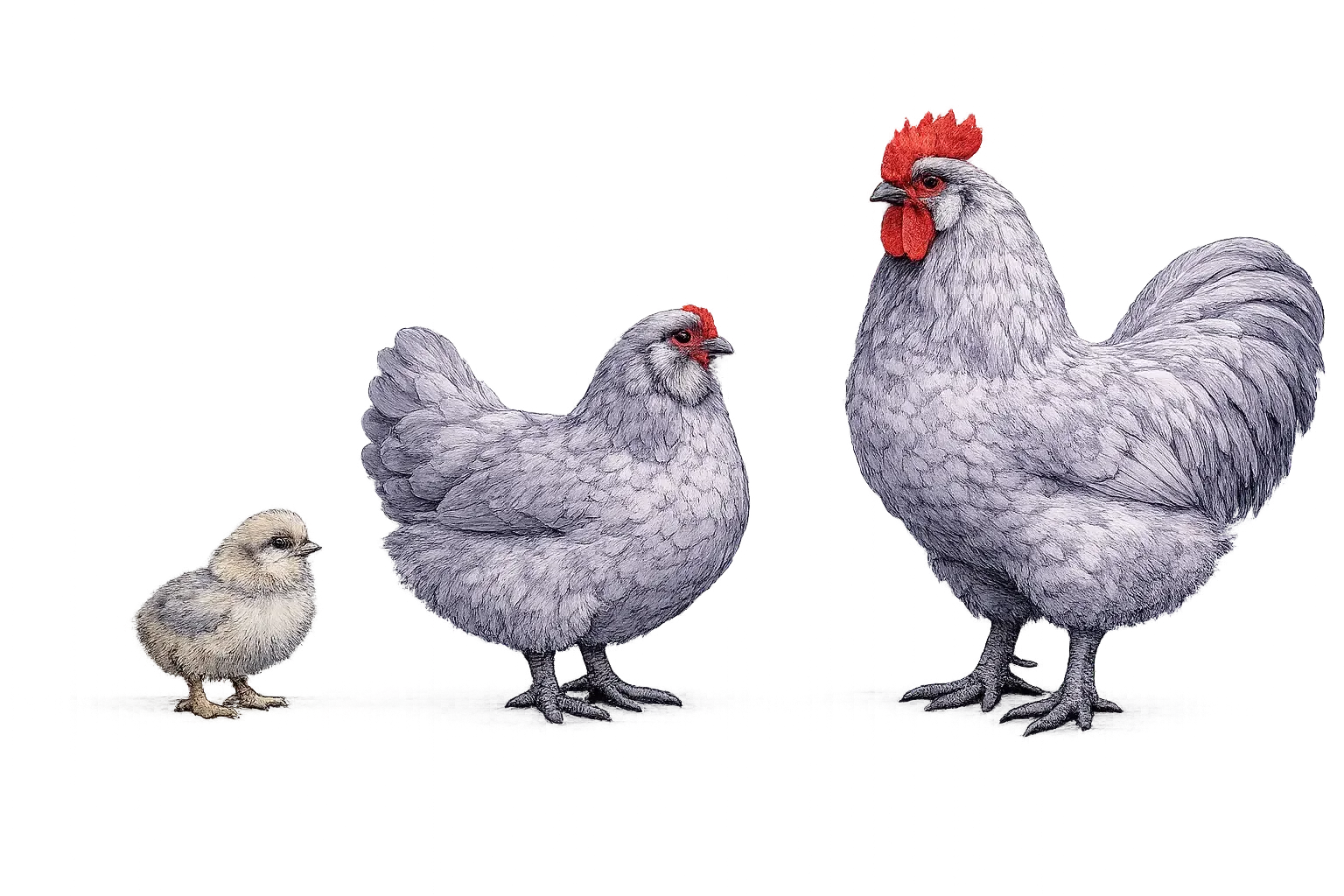
The Lavender Ameraucana is the most recently developed and most visually refined variety of the Ameraucana breed, and the one that generates the most consistent keeper enthusiasm once people see it in person. The plumage color is a soft, even, pale blue-gray that covers the bird uniformly from crest to toe, the color of smoke or morning frost, with none of the lacing or irregular marking that distinguishes the Blue or Splash varieties. It is a cleaner, quieter color than either of its blue-gene relatives, and on the Ameraucana's compact, muffed, bearded, full-tailed frame it creates an effect that many keepers describe as the most elegant-looking chicken they keep. The color is produced not by the blue dilution gene that creates the Blue and Splash varieties but by an entirely separate recessive gene designated lav, identified and named by poultry scientists in 1972 and worked into the Ameraucana breed by Master Breeder John W. Blehm of Birch Run, Michigan, who introduced the large fowl Lavender Ameraucana in 2005. The APA formally recognized the variety in large fowl as Self Blue in 2020, though most breeders, keepers, and the broader poultry community continue using the name Lavender, which is the scientifically accurate term for the genetic color it expresses. The variety shares all the defining characteristics of the Ameraucana breed: beard and muffs, pea comb, slate legs, full tail, and blue egg production. It breeds true from lavender-to-lavender crosses, producing only lavender offspring with certainty, a practical advantage over the Blue variety's variable blue-black-splash outcomes. For the homestead keeper who wants the most visually striking and genetically straightforward of the Ameraucana color varieties, with the same cold hardiness, foraging ability, and reliable blue egg production that defines the breed, the Lavender Ameraucana is the variety most likely to stop visitors in their tracks.
Quick Facts
Class: All Other Standard Breeds (APA); large fowl recognized as Self Blue since January 2020
Weight: Roosters approximately 6.5 lbs; hens approximately 5.5 lbs
Egg Production: Approximately 150 to 200 blue to blue-green eggs per year; 3 to 4 eggs per week
Egg Color: Blue to slightly blue-green; some keepers report a marginally greener tint from lavender hens compared to other Ameraucana varieties; blue throughout the shell
Egg Size: Medium to large
Primary Purpose: Egg production; dual purpose; exhibition
Temperament: Generally calm, friendly, and curious; reported by many keepers as among the most docile and people-oriented Ameraucana variety; individual variation still exists
Brooding: Low to moderate; hens are not typically prone to broodiness; consistent laying without frequent brood interruptions
Flight Capability: Moderate; five-foot fencing adequate for most flocks
APA Recognition: Self Blue variety recognized in large fowl January 2020; developed by John W. Blehm in 2005
Country of Origin: United States; Birch Run, Michigan; developed from existing Ameraucana stock by John W. Blehm
Varieties (APA): Self Blue (Lavender) is the APA-recognized name; the breed recognizes nine large fowl varieties as of 2020
Comb Type: Pea comb; minimal frostbite risk; excellent cold-climate advantage
Distinctive Trait: Uniform soft lavender-gray plumage across the entire bird; breeds true from lavender-to-lavender crosses; lays blue eggs; associated shredder gene causes feather quality issues in some lines, particularly frayed tail feathers in males
Conservation Status: Not at risk; growing rapidly in popularity
Lifespan: 7 to 10 years
Breed Overview
The Lavender Ameraucana's development history is more precisely documented than most breed variety origins because it was the deliberate work of a single identified breeder working within a defined timeframe. John W. Blehm of Birch Run, Michigan, is a Master Breeder of Ameraucana chickens, a lifetime member of the Ameraucana Alliance since 1982, and the recipient of the Ameraucana Breeders Award in 2001. He is credited with originating multiple Ameraucana varieties including large fowl buff, lavender, black, white, blue, khaki, and lavender silver. The large fowl Lavender Ameraucana specifically was introduced by Blehm in 2005, making it the most recently developed variety to reach APA recognition within the breed.
The lavender color gene, designated lav, is entirely different from the blue dilution gene that produces the Blue and Splash Ameraucana varieties. The lav gene was identified and formally named by poultry scientists in 1972. It is a recessive autosomal gene, meaning a bird must inherit two copies, one from each parent, to express the lavender color. A bird with one copy of lav appears black or another base color rather than lavender, and is called a lavender carrier. When two lavender carriers are crossed, approximately 25 percent of offspring express the lavender color, 50 percent carry one copy without expressing it, and 25 percent carry no copies. When two lavender-expressing birds are crossed, all offspring express lavender, giving the variety its true-breeding characteristic that is a practical advantage over the Blue variety's variable color outcomes.
The distinction between the lavender gene and the blue dilution gene is not merely academic. A bird that appears lavender from a distance and a bird that is genuinely lavender are produced by completely different genetic mechanisms, breed true in completely different ways, and produce completely different offspring when crossed with other varieties. A Blue Ameraucana crossed with a Black produces Blue offspring; a Lavender Ameraucana crossed with a Black produces black carriers that do not express lavender but can produce lavender offspring when those carriers are crossed with each other in subsequent generations. Understanding this distinction is essential for breeders who want to maintain a Lavender line correctly rather than inadvertently diluting it through uninformed crosses.
The APA's formal recognition of the Self Blue large fowl variety in January 2020 completed the variety's official journey from development to standardization, though the naming debate between Self Blue and Lavender has continued within the Ameraucana community. The Ameraucana Alliance notes that what the APA calls Self Blue is what poultry scientists and most breeders correctly call Lavender, and that APA officers have declined to use the scientifically accurate term. For practical purposes, the two names refer to the same color and the same genetic variety; buyers and keepers will encounter both names in sourcing and community discussions.
Plumage and Appearance
The Lavender Ameraucana's plumage is the most immediately distinctive feature of the variety and the quality that makes it so visually memorable. The lav gene dilutes both black and red pigments uniformly across every feather on the bird, producing the even, soft, pale blue-gray color that gives the variety its name. Unlike the Blue Ameraucana, which carries darker lacing on the hackle, back, and saddle of the rooster and a more muted blue-gray on the hen, the Lavender Ameraucana presents the same uniform pale color across all feather tracts in both sexes. There is no darker lacing, no contrasting area, no secondary color: just consistent, quiet, pale lavender-gray from the crest to the tail.
This uniformity is the variety's exhibition standard and its visual signature. Exhibition breeders select for the cleanest, most even lavender color throughout the plumage, working against any leakage of gold or red pigment into the hackle or saddle feathers, which the lav gene does not suppress as completely as might be ideal and which is an ongoing selection challenge in Lavender breeding programs. Gold leakage, where warm tones show through the lavender in light-exposed feather areas, is a defect that breeders from other lavender varieties and color backgrounds have developed genetics to address. Breeders like Rachel Heldermon have worked specifically on silver-based lavender genetics to reduce gold bleed-through and maintain cleaner color expression across generations.
The feather quality consideration unique to the Lavender variety is the shredder gene, an associated genetic effect of the lav gene that causes frayed, ragged, or tattered feather edges particularly in males and particularly in the tail feathers. The shredder effect varies in severity between breeding lines; some Lavender Ameraucana lines express it mildly and others more significantly. Exhibition breeders work to minimize the shredder effect through careful selection of birds with the cleanest, most intact feather structure, and through managing the genetic background of the breeding stock. Homestead keepers who are not showing birds often find the shredder effect minimal in practice, particularly in hens whose tail feathers are less affected than the rooster's, but it is a characteristic of the variety worth knowing before acquiring birds.
The remaining physical characteristics of the Lavender Ameraucana are identical to all other Ameraucana varieties. The beard and muffs are full and present together. The pea comb is small and low. The legs are slate to nearly black. The eyes are reddish bay. The tail is full in hens and medium-length in roosters, carried at the upward angles specified in the breed standard. The body is medium-sized with the alert, slightly forward-leaning posture characteristic of the breed.
Egg Production
The Lavender Ameraucana lays blue to blue-green eggs consistently throughout the hen's laying life. One characteristic noted by some keepers and breeders is that lavender hens occasionally produce eggs with a slightly greener tint than the pure sky blue typical of Black, Blue, or Splash Ameraucana hens, though this varies between individual birds and lines. The Pasture Farms, a lavender Ameraucana specialty breeder, notes on their product page that their lavender birds lay a slightly greener tint than their blue, black, and splash lines. This is not a sign of impurity or Easter Egger genetics but a normal expression variation within the breed; the APA Ameraucana Breeders Club acknowledges that green egg shades, while not preferred, do not indicate impurity in a verified Ameraucana.
Annual production of approximately 150 to 200 blue to blue-green eggs per year, or 3 to 4 eggs per week, is the documented range for the variety. Some well-managed production-oriented Lavender lines produce toward the higher end of this range; exhibition lines that prioritize conformation and color expression may produce somewhat less. The egg color is consistent for each individual hen throughout her laying life.
The Lavender Ameraucana is generally described as less broody than some other Ameraucana varieties, with hens tending toward consistent production without the frequent brood interruptions that more strongly broody breeds experience. This lower broodiness is practically useful for homestead keepers who want steady egg supply without managing repeated broody cycles, though it means natural flock propagation through lavender hens is less reliable than it would be with a strongly broody breed.
Hens begin laying at approximately 5 to 7 months of age. The pea comb contributes to winter hardiness that supports more consistent cold-weather production than single-combed breeds.
Temperament and Behavior
The Lavender Ameraucana's temperament is consistently described by keepers as among the friendliest and most docile of all Ameraucana varieties, with multiple keeper accounts reporting the lavender birds as noticeably calmer and more people-oriented than their other Ameraucana varieties kept in the same flock. Whether this reflects genuine genetic temperament selection that accompanied the lavender variety's development by Blehm, or simply keeper selection bias toward a bird they already find visually appealing, is difficult to separate from the available keeper reports. What is consistent is that the Lavender Ameraucana's reputation for approachable, curious, calm behavior is strongly held across a wide range of keeper experiences.
Keeper accounts from Cackle Hatchery customers and specialty breeders describe lavender hens that seek out their keepers voluntarily, tolerate handling from young, respond to human presence with curiosity rather than alarm, and produce the contented soft vocalization that characterizes a settled, comfortable flock. Some keepers specifically contrast the lavender variety's behavior with their flightier Easter Egger or production layer breeds, describing the lavender birds as among the easiest to interact with in a mixed flock.
The individual variation that characterizes all Ameraucana varieties still applies to the Lavender. Not every lavender bird is identically calm; roosters in particular vary in their response to human handling and flock management. But the baseline reported across keeper experience is genuinely calm and manageable, making the Lavender Ameraucana a reliable recommendation for families with children and for first-time Ameraucana keepers who want the most approachable entry point into the breed.
In mixed flocks the Lavender Ameraucana holds a moderate, peaceful position, non-aggressive toward other breeds and generally compatible with a range of companions. The beard and muff feathering can be targeted by assertive breeds, making companion breed selection relevant, and the lavender variety's generally non-assertive character means it should not be paired with breeds that bully lighter flockmates.
Climate Adaptability
The Lavender Ameraucana's climate performance is consistent with the breed as a whole. The pea comb presents minimal frostbite risk in hard winters, supporting cold-hardy management without special comb protection. Standard dry, well-ventilated, wind-protected housing handles North American winters across most regions. The breed maintains winter egg production more consistently than single-combed breeds of similar size.
Heat tolerance is good. The moderate body size and active foraging character allow the Lavender Ameraucana to manage summer heat better than large, heavy breeds, and standard shade and cool water management is sufficient for most hot-summer situations.
One climate and management note specific to the Lavender variety: the shredder gene's effect on feather quality means that tail and flight feathers in affected birds have less structural integrity than normal feathers, which can make those birds slightly more vulnerable to feather damage in wet conditions. Keeping affected birds in clean, dry runs with covered access during wet weather protects the feathering better than open free-ranging in persistent rain.
The beard and muff feathering requires the same waterer design consideration as all bearded Ameraucana varieties: nipple or cup-style waterers that prevent beard submersion reduce chronic wet beard conditions and the matting and management burden they create.
Housing and Management
Standard backyard housing requirements apply without significant modification. Four square feet of indoor floor space per bird minimum, five-foot fencing for adequate containment, and nipple or cup-style waterers for beard management are the same requirements as the Blue and Blue Splash Ameraucana varieties covered earlier in the directory.
The shredder gene feather quality consideration suggests slightly more attention to roost bar placement than for non-lavender varieties. Roosters with the shredder effect in the tail feathers benefit from roost bars that allow the tail to hang freely rather than dragging against a wall or floor surface during roosting. Low traffic, clean, dry housing conditions reduce the visible impact of the shredder effect on daily feather condition.
Breeding management for the Lavender variety is straightforward once a verified lavender pair is established. Lavender-to-lavender crosses produce 100 percent lavender offspring consistently. Breeders who want to introduce new genetics while maintaining the lavender color must work through carrier generations, crossing the new stock to lavender, producing black carriers from that cross, and then crossing those carriers back to lavender to produce lavender offspring in the next generation. This process takes several generations and requires careful tracking of carrier status, which is why sourcing from established lavender lines is significantly simpler than attempting to introduce the lavender gene from scratch.
Breed verification is as important for the Lavender variety as for all Ameraucana varieties. The misspellings Americana and Americauna reliably indicate Easter Eggers. A true Lavender Ameraucana has slate legs, a pea comb, beard and muffs together, a full tail, and the specific uniform pale lavender-gray color produced by the recessive lav gene. Birds sold as lavender Ameraucanas with yellow legs, incorrect comb types, or variable egg colors are not verified Ameraucanas regardless of how they are labeled.
Sourcing Considerations
The Lavender Ameraucana is more widely available than some other true Ameraucana varieties, thanks to the variety's growing popularity driving investment from both specialty breeders and a small number of quality-focused hatcheries. Cackle Hatchery and Meyer Hatchery both offer Lavender Ameraucanas as a verified Ameraucana variety rather than as Easter Eggers, with Cackle specifically noting its membership in the Ameraucana Alliance Club. This makes the Lavender somewhat more accessible through legitimate channels than varieties available only through the specialty breeder network.
Verified exhibition-quality birds from breeders active in the Ameraucana community and specifically working to minimize the shredder effect and gold leakage in their lavender lines produce the best starting stock for keepers interested in showing or building a high-quality breeding program. The Ameraucana Breeders Club directory and the Ameraucana Alliance are the primary resources for finding breeders at this level.
One important sourcing note: the lavender gene has become fashionable across multiple chicken breeds and the availability of lavender-colored birds at mainstream hatcheries and farm supply stores has increased significantly in recent years. Not all lavender-colored chickens sold with Ameraucana-adjacent names are true Lavender Ameraucanas. Verifying slate legs, pea comb, beard and muffs, and consistent blue egg production confirms genuine Ameraucana identity regardless of the bird's feather color.
Pros and Cons
Pros
The most visually striking and distinctive Ameraucana variety; uniform soft lavender-gray plumage on the bearded, muffed Ameraucana frame generates strong keeper and visitor reaction
Breeds true from lavender-to-lavender crosses; simpler color management than the Blue variety's blue-black-splash variability
Generally described as the most docile and people-oriented Ameraucana variety; reported temperament advantage over other varieties in keeper accounts
Consistent blue to blue-green egg production of 150 to 200 eggs per year
Lower broodiness than some other Ameraucana varieties; more consistent production without frequent brood interruptions
Pea comb provides excellent cold hardiness with minimal frostbite risk
APA recognized as Self Blue in large fowl since 2020; formal breed standard established
More widely available through quality hatcheries than most other true Ameraucana varieties
Active forager; good range efficiency and natural pest control value
Long productive lifespan of 7 to 10 years
Cons
Associated shredder gene causes frayed or tattered feather edges, particularly in male tail feathers; severity varies by breeding line
Gold or red pigment leakage into hackle and saddle feathers is an ongoing exhibition breeding challenge; requires deliberate selection to minimize
Egg color may tend slightly greener than other Ameraucana varieties in some hens and lines
True verified Lavender Ameraucanas still require research to source correctly; many lavender-colored birds sold as Ameraucanas are Easter Eggers
Lower annual egg production than some comparable heritage breeds; 150 to 200 eggs is solid heritage-breed performance but below high-production alternatives
Broodiness low; not reliable for natural hatching programs
Beard and muff feathering requires waterer design consideration
Profitability
The Lavender Ameraucana's profitability is built on three converging advantages: the visual novelty of the lavender plumage, the premium value of verified blue Ameraucana eggs in direct-sale markets, and the true-breeding genetics that allow keepers to propagate the variety consistently without ongoing sourcing dependence.
The lavender plumage's fashionable status in the current backyard poultry market creates stronger direct marketing appeal than any other Ameraucana variety. Farm stands, farmers market tables, and farm social media accounts featuring Lavender Ameraucanas generate consistent engagement from buyers who find the color as unusual and appealing as the breed's blue eggs. The combination of a strikingly unusual-looking bird that also lays blue eggs is a particularly strong direct-sale proposition.
The true-breeding characteristic means that once a verified lavender pair is established and productive, the keeper can propagate the variety without returning to breeder or hatchery sources for every generation, reducing ongoing sourcing costs relative to varieties that do not breed true.
Exhibition breeding of the Lavender variety is active and growing, with the APA recognition in 2020 having formalized the competition framework. Breeders producing birds that minimize the shredder effect, maintain clean lavender color without gold leakage, and meet the full Ameraucana breed standard command premium prices from the show community.
Comparison With Related Breeds
Blue Ameraucana: The closest comparison within the breed, sharing all practical characteristics including production, temperament range, management requirements, and cold hardiness. The Blue variety's plumage is a coherent slate blue with darker lacing; the Lavender's is a uniform soft pale gray-blue without lacing. The Blue is produced by the blue dilution gene and does not breed true from blue-to-blue crosses; the Lavender is produced by the recessive lav gene and breeds true from lavender-to-lavender crosses. Both lay blue eggs.
Blue Splash Ameraucana: The third blue-gene variety for comparison. The Splash presents a predominantly white bird with irregular blue-black markings; the Lavender presents a uniformly pale soft gray-blue. The Splash breeds true from splash-to-splash crosses like the Lavender breeds true from lavender-to-lavender, but through entirely different genetic mechanisms. The Splash's white ground tends toward more dramatic visual impact through pattern contrast; the Lavender's impact comes from the quiet, unusual uniformity of its pale color.
Lavender Orpington: The most popular comparison from outside the Ameraucana breed. The Lavender Orpington shares the lavender plumage gene, the soft uniform pale color, and the fashionable current market status, but is a much heavier dual-purpose bird with brown eggs, stronger cold hardiness through body mass, stronger broodiness, and a dramatically different temperament profile that is calmer and more docile. The Lavender Ameraucana lays blue eggs; the Lavender Orpington lays brown. Keepers choosing between them are fundamentally choosing between egg color and body utility.
Whiting True Blue: A production-oriented comparison for the blue egg function. The Whiting True Blue lays approximately 280 to 300 blue eggs per year, significantly more than the Lavender Ameraucana's 150 to 200, and is available through Murray McMurray without the sourcing research that true Ameraucanas require. The Lavender Ameraucana has APA recognition, defined breed standards, active exhibition community support, and a specific and unusual plumage that the Whiting True Blue entirely lacks. The comparison clarifies that choosing the Lavender Ameraucana means choosing the visual and heritage breed experience over maximum blue egg volume.
Easter Egger: The most commonly misrepresented comparison. Lavender-colored Easter Eggers exist and may lay blue or green eggs, but they are not verified Ameraucanas and do not meet the breed standard. Sourcing vigilance regarding leg color, comb type, and egg color consistency applies as it does to all Ameraucana varieties.
Final Verdict
The Lavender Ameraucana is the variety that makes people who already keep other Ameraucana varieties wish they had started with it. The uniform soft lavender-gray plumage on the bearded, muffed, alert Ameraucana frame creates a bird that is genuinely and consistently beautiful, and the true-breeding genetics mean that once a keeper establishes a verified lavender pair, the flock perpetuates itself without the color variance management that the Blue variety requires. The shredder gene is real and worth monitoring in the specific line sourced, particularly for rooster tail feathers in exhibition situations. The gold leakage challenge is real and worth understanding before building a breeding program. The slightly greener egg tint in some lavender hens is real and worth knowing if the deepest sky blue eggs are the priority. None of these characteristics diminish the case for the variety in a homestead setting where beauty, temperament, cold hardiness, and self-sustaining blue egg production are the governing criteria.
For the homestead keeper who wants the most visually refined, temperamentally approachable, and genetically self-sustaining variety of the Ameraucana family, the Lavender Ameraucana makes a compelling case that is difficult to argue with once the bird is actually standing in the yard. The dual purpose and homestead category is better for including it.
Frequently Asked Questions
What is the difference between the Lavender Ameraucana and the Blue Ameraucana? The color and genetics are entirely different despite the similar pale appearance from a distance. The Blue Ameraucana is produced by the blue dilution gene acting on black base pigment, creating a slate blue with darker lacing in the rooster. It does not breed true from blue-to-blue crosses, producing blue, black, and splash offspring. The Lavender Ameraucana is produced by the recessive lav gene, which dilutes both black and red pigments uniformly to a soft pale gray-blue without lacing. It breeds true from lavender-to-lavender crosses, producing all lavender offspring. The practical management implications are significant.
Why is the APA variety called Self Blue instead of Lavender? The APA chose the name Self Blue when formally recognizing the large fowl variety in January 2020, despite the term Lavender being the scientifically accurate name used by poultry geneticists since 1972 when the lav gene was formally identified and named. The Ameraucana Alliance notes that the APA officers declined to use the scientifically correct term. In practice most breeders, keepers, and the broader poultry community use Lavender as the working name; both terms refer to the same color and the same variety.
What is the shredder gene and how does it affect the Lavender Ameraucana? The shredder gene is an associated genetic effect linked to the lavender lav gene that causes frayed, ragged, or tattered feather edges, particularly in male tail feathers. The severity varies significantly between breeding lines; well-selected lavender lines express it mildly while poorly selected lines may show significant tail feather damage in roosters. Exhibition breeders work actively to minimize the shredder effect through selection of birds with the cleanest feather structure. Homestead keepers who are not showing birds typically find the effect manageable in practice, especially in hens who are less affected than roosters.
Do Lavender Ameraucanas lay blue or green eggs? Blue, but with some individual and line variation toward a slightly greener tint. Most lavender hens lay eggs in the blue to blue-green range, and some breeders specifically note that their lavender lines produce a marginally greener tint compared to their black, blue, and splash Ameraucana lines. A green egg from a verified Lavender Ameraucana does not indicate impurity; the APA Ameraucana Breeders Club acknowledges that green egg shades occur within the breed without indicating hybridization.
Who developed the Lavender Ameraucana? John W. Blehm of Birch Run, Michigan, a Master Breeder of Ameraucana chickens and lifetime member of the Ameraucana Alliance since 1982, introduced the large fowl Lavender Ameraucana in 2005. Blehm received the Ameraucana Breeders Award in 2001 and is credited with originating multiple Ameraucana varieties including lavender, buff, black, white, blue, khaki, and lavender silver.
Where can I find true Lavender Ameraucana chicks? Cackle Hatchery and Meyer Hatchery both offer Lavender Ameraucanas as verified breed birds rather than Easter Eggers, making the variety somewhat more accessible through legitimate channels than other true Ameraucana varieties. The Ameraucana Breeders Club directory and the Ameraucana Alliance are the primary resources for exhibition-quality birds from breeders specifically working to minimize the shredder effect and gold leakage. Verify slate legs, pea comb, beard and muffs, and consistent blue egg history before purchasing from any source.
If I breed two Lavender Ameraucanas together, what chicks will I get? One hundred percent lavender. Because both parents carry two copies of the recessive lav gene, every offspring receives one copy from each parent and expresses the lavender color. This true-breeding characteristic is one of the variety's most practical advantages for homestead keepers who want to propagate their flock without color variance management.
Related Breeds
Blue Ameraucana
Blue Splash Ameraucana
Black Ameraucana
Ameraucana Bantam
Lavender Orpington
Easter Egger
Araucana