
Malines
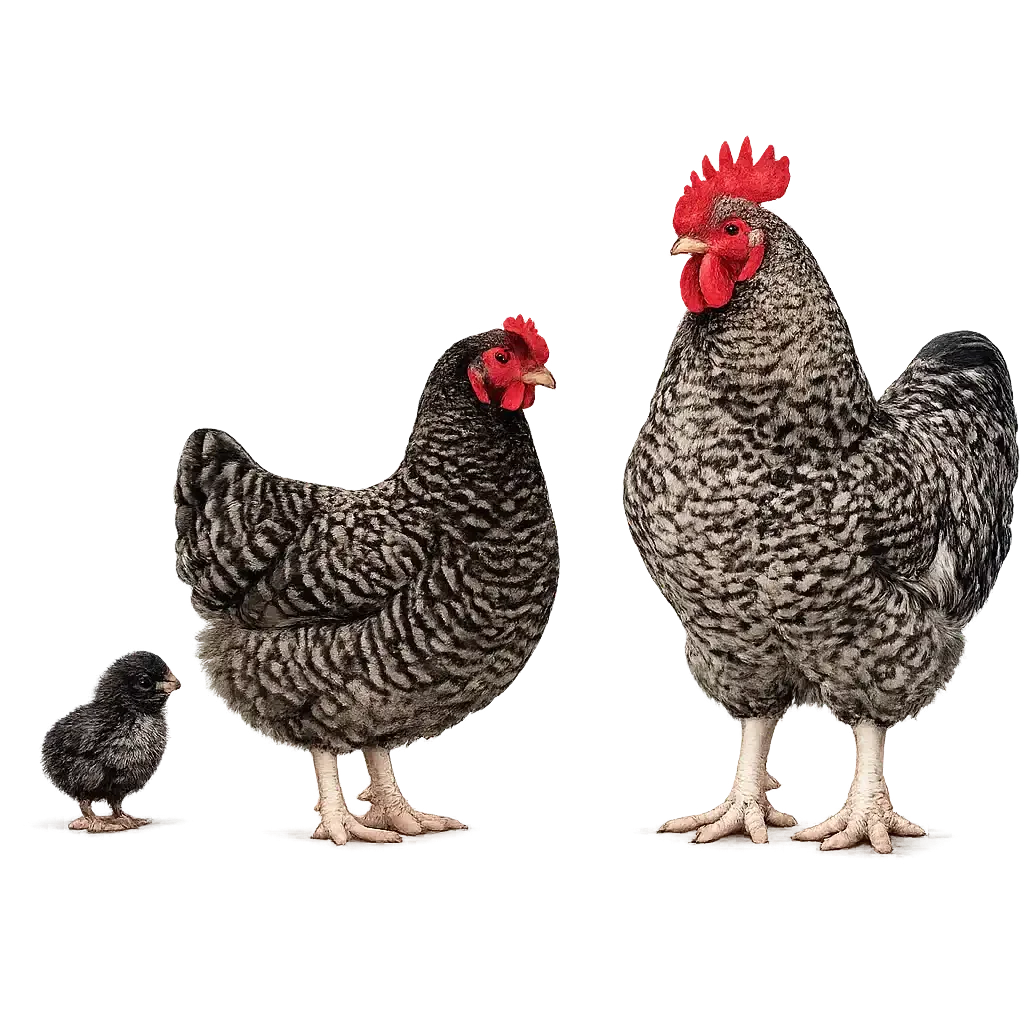
The Malines is a Belgian heritage breed of extraordinary size and culinary distinction, developed in the Mechelen region of the province of Antwerp in Flanders from the mid-19th century onward, and recognized across Europe for producing some of the finest-quality white-fleshed, fine-textured table chicken available from any heritage breed. Its Dutch name, Mechelse Koekoek, meaning Mechelen Cuckoo, reflects both its geographic origin and the cuckoo barring plumage pattern that is its most recognized color variety. Its French name, Coucou de Malines, is how it appears in the Belgian culinary tradition where it is still served as a premium gastronomic dish in restaurants in the Mechelen area and recognized by the Slow Food Foundation's Ark of Taste as a heritage food product worth preserving. The breed ranks alongside the Jersey Giant as one of the heaviest chicken breeds in the world, with roosters reaching 11 to 12 pounds and hens 8 to 9 pounds, making it one of the most impressively bodied birds a homestead keeper can maintain. It is this extraordinary body weight and meat quality that Gerd Roth incorporated into the Bielefelder cross in the 1970s, and understanding the Malines explains much of what makes the Bielefelder as large and meaty as it is.
The Malines is not a bird that most North American homestead keepers know by name despite its exceptional qualities, and it remains genuinely rare in the United States relative to its recognition and prevalence in Belgium and continental Europe. Greenfire Farms imported Malines to the United States alongside their Bielefelder importations, and the breed's growing presence in the North American homestead community reflects the same interest in large, calm, genuinely dual-purpose heritage breeds that has driven the Bielefelder's popularity. For the homestead keeper who wants the most impressive heritage table bird available, with feathered legs, a calm and docile temperament, and a culinary reputation built over 150 years of Belgian gastronomy, the Malines is a genuinely exceptional and underappreciated choice.
Quick Facts
Type: Heritage dual-purpose breed; recognized in Belgium and continental Europe; limited APA presence in North America
Weight: Roosters approximately 11 to 12 lbs; hens approximately 8 to 9 lbs; among the heaviest chicken breeds in the world alongside the Jersey Giant
Egg Production: Approximately 140 to 160 large tinted eggs per year; cream to light brown in color; production not the breed's primary strength
Egg Color: Cream to light brown tinted; described as tinted rather than true brown
Egg Size: Large; approximately 65 grams average; among the larger eggs produced by any heritage breed
Primary Purpose: Meat production; dual purpose; heritage table bird of exceptional gastronomic distinction
Temperament: Calm, docile, and confident; easy to handle when raised with regular contact from young; not skittish; suitable for beginners; good with children
Brooding: Occasional; some hens go broody and are good mothers when they do; not consistently reliable for planned natural hatching
Flight Capability: Essentially none; body weight prevents sustained flight; low fencing adequate for containment
Country of Origin: Mechelen (Malines), Province of Antwerp, Flanders, Belgium; developed from approximately 1852 onward
Recognition: Belgian poultry standard; Slow Food Foundation Ark of Taste listing; limited North American standardization
Parent Breeds: Flemish Cuckoo landrace x imported Oriental breeds including Brahma, Langshan, and Cochin from approximately 1852; later Turkey-headed variant crossed with Bruges Game fowl
Leg Type: Feathered shanks and toes; white leg feathering; requires dry litter management
Varieties: Cuckoo (most common and considered best quality); White; Black; Blue; Golden Cuckoo; others recognized in Belgium and Germany
Comb Type: Single comb; frostbite risk in hard winters
Distinctive Trait: Among the heaviest dual-purpose breeds in the world; pale, fine-textured, marbled meat considered a Belgian culinary delicacy; white feathered shanks and toes; cuckoo pattern where roosters appear lighter than hens; Ark of Taste heritage food recognition; primary parent breed of the Bielefelder
Conservation Status: Not at risk in Belgium; rare in North America
Lifespan: 7 to 10 years
Breed Overview
The Malines breed's development story begins not with a deliberate breeding program by a named individual but with the agricultural tradition of the Mechelen region of Flanders, where local farmers maintained cuckoo-patterned farm chickens that were valued for their size and meat quality long before any formal breed development began. These birds, called Flemish Cuckoo or Vlaanderse Koekoek, formed the foundation stock from which the modern Malines was developed through a series of crosses with Oriental breeds beginning around 1852.
The catalyst for the breed's transformation was the arrival of large Asian chicken breeds in European zoological gardens and estates in the mid-19th century. From approximately 1852, breeders in the Mechelen area began crossing the local cuckoo-patterned Flemish birds with chickens brought from Shanghai, China, to the zoological gardens of Antwerp, and subsequently with Brahma, Langshan, and Cochin genetics that became available through the broader importation of Asian poultry that swept European poultry fancying in the 1850s and 1860s. These Oriental breeds contributed the extraordinary body size that is the Malines' most defining characteristic, along with the feathered legs and toes that distinguish it from clean-legged breeds of comparable weight.
The resulting breed grew rapidly in commercial importance in Belgium. By the late 19th century the Malines was the most popular meat bird in Belgium and was being exported to markets across Europe, where its white-fleshed, fine-textured, marble-threaded meat was recognized as a premium product distinguishable from common chicken by both its appearance and its flavor. The fat marbling within the Malines' muscle tissue is a characteristic specifically noted in Belgian culinary tradition as contributing to the exceptional moistness and flavor that has made Coucou de Malines a dish associated with Belgian gastronomy at its most serious.
A second type of Malines was developed by crossing the standard Malines with the Bruges Game, a very large Belgian game fowl, producing the Turkey-headed Malines, a variant whose head shape resembles that of a turkey and whose body is even more massively built than the standard type. The Turkey-headed variant reflects the game-fowl influence visible in the Malines' overall physical presence and contributes to the breed's history of development for maximum table utility.
The breed's recognition by the Slow Food Foundation's Ark of Taste, an international catalog of heritage food products at risk of disappearing from local and regional food cultures, reflects both the genuine culinary quality of the Malines as a table bird and the conservation status of traditional Malines production in its region of origin. The Ark of Taste listing places the Malines alongside other regionally significant heritage food products whose continued existence depends on the active engagement of farmers, breeders, and consumers who value their specific qualities over generic commodity alternatives.
In North America, the Malines reached meaningful availability through Greenfire Farms' importation program, which brought verified Belgian bloodlines to the United States as part of the same broader effort that introduced the Bielefelder. The breed's growing presence in North American homestead and heritage poultry circles reflects the recognition that the Malines is among the very few genuinely large, genuinely dual-purpose heritage breeds available whose meat quality is not merely adequate but genuinely exceptional by any culinary standard.
Plumage and Appearance
The Malines' most common and most respected color variety is the cuckoo pattern, known in French as Coucou de Malines and in Dutch as Mechelse Koekoek. The cuckoo pattern consists of irregular dark and light barring across the feathers, producing a bluish-gray ground color alternated with darker blue-gray to near-black stripes. This pattern differs from the Barred Plymouth Rock's precise, regularly defined parallel bars in being more irregular and less sharply defined, with a softer overall appearance that reads as gray-and-dark rather than the stark black-and-white contrast of the Barred Rock.
The cuckoo pattern shows the same sex-linked barring gene expression found in other barred breeds: roosters carry two copies of the barring gene and appear lighter overall than hens, who carry one copy. A Malines rooster in cuckoo coloring appears distinctly lighter and more silvery than the hen beside him, whose barring is more pronounced and darker overall. This sex-based color difference is consistent and visible in adult birds, though the Malines is not autosexing within the breed in the precise hatch-day way the Bielefelder is.
The body is the most immediately striking aspect of the Malines' appearance: massive, horizontal, broad-backed, and deep-chested in a way that communicates meat utility before any other quality. The long horizontal back and prominently muscled chest give the Malines the visual character of a bird built specifically for the table rather than for egg production or ornament. The tail is relatively short and carried almost horizontally rather than at the upward angle typical of many heritage breeds. The wings are small relative to the body size and carried close to the body.
The feathered shanks and toes are white, distinguishing the Malines from the Bielefelder's yellow legs and from many other large breeds. The white leg feathering is thick and downy, continuing the dense insulating feathering of the body down to the toes and providing genuine cold protection in wet winter conditions. This feathered foot requires the same dry litter management consideration as all feather-footed breeds: wet or muddy conditions accumulate around the foot feathering and can cause matting and hygiene problems if not managed with clean, dry bedding and covered run access during wet weather.
The single comb is red and relatively large, presenting the standard single-comb frostbite risk in hard winters. The wattles and earlobes are red. The beak is described as relatively small for such a large bird.
Egg Production
The Malines' egg production is the characteristic that most clearly defines it as a dual-purpose breed with a primary emphasis on meat rather than eggs. Annual production of approximately 140 to 160 large tinted eggs per year places the Malines at the lower end of the dual-purpose heritage layer category, well below the Black Australorp's 250 to 300 and even below the Bielefelder's 200 to 280. This production level is adequate for a homestead operation that primarily values the breed for its table bird qualities and treats the egg production as a secondary benefit, and it is not adequate for a keeper whose primary motivation is egg volume.
The eggs are large, averaging approximately 65 grams, which is notably large and reflects the Malines' overall scale. The color is tinted cream to light brown, described as a warm off-white with a slight brown undertone rather than the pure white of the Leghorn or the dark brown of the Marans. The large size and warm tinted color of Malines eggs give them visual appeal in a mixed carton alongside darker and lighter colored heritage eggs.
Some hens go broody and are described as attentive and protective mothers when they do. Broodiness is not consistent enough across the breed to be relied upon for planned natural hatching programs, but the occasional broody Malines hen provides a natural hatching option when it occurs.
Winter production continues at a reduced rate. The Slow Food Foundation and multiple keeper accounts note that Malines maintain some winter laying, though production can drop to one or two eggs per week during the coldest months. This winter production reduction is more significant than in strongly winter-hardy breeds like the Bielefelder or the Black Australorp but is typical of large-bodied breeds that divert energy to heat maintenance in cold conditions.
Meat Quality
The Malines' meat quality is the defining characteristic of the breed and the primary reason for its 150-year gastronomic reputation in Belgium and continental Europe. The meat is pale, fine-textured, and threaded with fat marbling that contributes to exceptional moistness and flavor in ways that most heritage breed meat does not match. Multiple sources specifically note the fat marbling as unique among chicken breeds and as the quality that makes Coucou de Malines a sought-after dish in serious Belgian cuisine rather than merely a large heritage chicken.
The pale color of the Malines' meat is a characteristic that the breed shares with few other chickens and that reflects its specific muscle tissue development rather than the darker, game-influenced meat of many heritage breeds. This pale, fine-textured character is what drew the comparison with high-quality veal and what established the breed's reputation as the premier heritage table chicken of Belgian gastronomy.
A Malines cockerel processed at 4 to 6 months produces ample and tender meat at a size appropriate for a family table bird. The breed grows relatively slowly by commercial standards but faster than some of the largest heritage breeds, reaching useful processing weights at 4 months for smaller, more tender fryers and at 6 months for larger, more substantial roasting birds. Roosters at full maturity of 11 to 12 pounds produce a carcass yield that approaches small turkey scale, with the broad breast and long horizontal back providing the muscle development that the breed's culinary tradition is built on.
One Canadian breeder account notes that Malines growth rate can approach a commercial broiler's impressive weight gain under optimal conditions, reaching approximately 6.5 to 7 kilograms in 16-week cockerels, without the health problems associated with commercial broiler genetics: no heart attacks, no broken legs, and no featherless patches from growth exceeding the bird's structural capacity.
Temperament and Behavior
The Malines' temperament is consistently described as calm, docile, and confident in a way that is appropriate to a large, heavy breed that does not need alertness and flight as predator evasion strategies. Multiple keeper accounts describe Malines as immediately approaching their keepers without hesitation, investigating new people and objects with curiosity rather than alarm, and becoming genuinely tame with regular gentle handling from young. The breed is specifically recommended for beginning keepers and for families with children who want a large heritage breed without the temperament management challenges that some large breeds present.
The Malines' size and calm nature make it remarkably manageable despite its weight. A hen approaching 9 pounds that does not startle, does not attempt flight, and approaches humans readily is a far more manageable animal than smaller, nervous breeds that require constant alertness and quick movement to handle. This practical manageability in a very large bird is one of the Malines' most immediately useful qualities in homestead settings.
The breed forages actively in warmer months, ranging widely to find insects, seeds, vegetation, and fallen fruit, and prefers outdoor access from dawn to dusk when conditions permit. Despite this ranging preference, the breed's low flight capability and calm disposition mean that even minimal fencing contains it effectively. Multiple keeper accounts note that the Malines stays close to home on free range rather than attempting escape, and that low fencing of 4 feet is typically adequate for containment.
Roosters are large and impressive but described as generally manageable when socialized from young. Some caution applies, as with any large rooster, but the Malines rooster does not carry a reputation for human aggression comparable to game-heritage breeds.
Climate Adaptability
The Malines' origin in Mechelen, Belgium, where winters are cold, snowy, and wet, and where the breed has been maintained for over 150 years, has produced a cold-hardy bird whose dense, thick, downy feathering provides genuine insulation against cold temperatures. The feathering that extends down the shanks and toes contributes to foot warmth in cold conditions while also creating the wet-weather management consideration described under housing.
Cold hardiness is good to excellent. The dense body feathering and substantial body mass retain heat effectively, and keeper accounts from cold-climate regions including Canada confirm the breed's ability to maintain flock function through genuine northern winters.
Heat tolerance is the breed's relative weakness. Multiple sources specifically note that the Malines handles warm weather adequately at moderate temperatures but requires extra attention in sustained heat above approximately 75 degrees Fahrenheit, when shade access, ample ventilation, and cool water are essential management provisions. The dense feathering that provides cold insulation creates heat retention challenges in hot weather, and keepers in regions with extended hot summers should plan shade and ventilation infrastructure before acquiring the breed.
The single comb's frostbite vulnerability applies as a standard cold-management consideration. The feathered legs and toes require dry litter and covered run access during wet winter conditions to prevent the matting and foot hygiene problems that wet feathered feet create.
Housing and Management
Standard large heritage breed housing requirements apply with several Malines-specific considerations. Four square feet of indoor floor space per bird is the minimum, with the breed's large body size benefiting from generous space rather than minimum compliance. Low roost bars at 12 to 18 inches from the floor are essential, as they are for the Bielefelder, the Black Jersey Giant, and all breeds where body weight makes high-impact landings from standard-height roost bars a meaningful injury risk. Soft or cushioned landing areas beneath roost bars further reduce impact-landing risk for heavy birds.
The feathered shanks and toes require dry litter management year-round. Clean, absorbent bedding replaced regularly prevents the wet foot conditions that accumulate debris and create hygiene and health problems in feather-footed breeds. Covered run access during persistently wet weather keeps the foot feathering dry when outdoor conditions would otherwise result in chronic wet feet.
Door openings to runs and coop access points should be sized for the Malines' large body, and specifically wide enough that roosters with full tail feathers can pass without catching and damaging their tails on narrow openings. Multiple keeper sources note this tail feather vulnerability in large-bodied breeds with moderate-length tails passing through standard-width openings.
The breed's naturally slow growth to processing weight means that meat management planning differs from the Cornish Cross model that commercial homestead meat programs often use as a reference point. Malines cockerels processed at 4 months for fryer-weight birds or at 6 months for larger roasting birds require feed management appropriate to heritage breed growth rather than commercial broiler timelines. A 15 percent protein grower ration rather than a high-protein starter feed is specifically recommended by experienced Malines keepers, as protein levels above 20 percent create excess waste in slow-growing birds without accelerating growth meaningfully.
Sourcing Considerations
The Malines is among the most difficult breeds in this directory to source in North America, reflecting both its recent importation history and the limited number of North American breeders maintaining verified Belgian bloodlines. Greenfire Farms is the primary documented source of imported Belgian Malines genetics in the United States. The growing breeder community that has developed from Greenfire Farms founding stock provides increasing availability through the heritage poultry network, but the Malines remains significantly less accessible and more expensive than mainstream heritage breeds and requires advance planning and relationship-building with the Malines breeder community.
The genuine scarcity of bloodlines in North America makes genetic diversity a meaningful concern for keepers who want to build a sustainable Malines breeding program. Sourcing from multiple unrelated blood lines wherever possible, and connecting with the broader Malines breeder community to identify and access unrelated stock, is more important for this breed than for breeds with decades of established American hatchery programs.
The exceptional culinary quality that justifies the sourcing investment is genuine and documented. The Coucou de Malines is not a breed whose meat reputation is marketing; it is a breed whose gastronomic distinction has been recognized in professional culinary circles, by the Slow Food Foundation's Ark of Taste, and by 150 years of Belgian market preference. Keepers who source verified Belgian bloodlines and manage their flocks for the breed's heritage production character will find the meat quality genuinely exceptional and unlike anything available from commodity or generic heritage poultry.
Pros and Cons
Pros
Among the heaviest dual-purpose breeds in the world; roosters 11 to 12 lbs produce the most impressive heritage table bird yield available from any breed in this directory
Pale, fine-textured, fat-marbled meat of exceptional gastronomic quality; the basis of a premier Belgian culinary tradition; Slow Food Foundation Ark of Taste heritage recognition
Calm, docile, and manageable temperament; suitable for beginners and families with children despite exceptional body size
Essentially zero flight capability; minimal fencing adequate for containment
Good cold hardiness from Belgian origin and dense feathering; maintains some winter production
Active and confident forager; self-sufficient on range in warm months
Primary parent breed of the Bielefelder; genetic connection to one of the most complete dual-purpose breeds available
Self-sustaining true-breeding breed; no hybrid mechanics or hatchery dependency required
Feathered shanks and toes provide genuine cold insulation in winter conditions
Cons
Egg production of 140 to 160 tinted eggs per year is the lowest of any dual-purpose breed in this directory; not suitable as a primary egg production breed
Very difficult to source in North America; limited bloodline availability requires deliberate planning and breeder network engagement
Premium pricing reflecting rarity and import genetics
Feathered shanks and toes require dry litter management; wet conditions create foot hygiene challenges
Single comb requires frostbite monitoring in hard winters
Heat tolerance limited; requires shade and ventilation management in warm climates
Slow growth to full processing weight; not commercially competitive with broiler timelines
Low roost bar placement essential; standard-height roost bars create injury risk for heavy birds
Door and opening sizing must accommodate large-bodied roosters to prevent tail feather damage
No established APA standard in North America; not suitable for APA exhibition
Profitability
The Malines' profitability in North America is built almost entirely on the premium heritage table bird market rather than on egg volume, and the premium available to a keeper who can produce and market genuine Malines table birds to buyers who know and seek the breed is meaningful. In European markets where the Coucou de Malines is a recognized gastronomic product, pricing reflects the premium quality of the meat. In North American direct-sale markets where heritage breed provenance and quality are increasingly valued, a keeper who can document genuine Belgian Malines bloodlines and the slow-growth, pastured production method appropriate to the breed's character is positioned to market a product that has no commodity equivalent.
The egg revenue from a Malines flock at 140 to 160 eggs per hen per year provides supplementary rather than primary income, with the large tinted eggs carrying aesthetic appeal in a mixed heritage carton but not the volume to anchor a direct-sale egg program on their own.
Breeding stock revenue from verified bloodline Malines breeding pairs, hatching eggs, and chicks commands premium pricing from the growing North American community of keepers who want to establish Malines flocks and cannot access the breed through mainstream channels. This specialty breeder market provides consistent revenue opportunities for keepers who establish genuine Belgian bloodline Malines programs and can document their genetic provenance.
Comparison With Related Breeds
Bielefelder: The most direct and most important comparison in this directory, since the Malines is a primary parent breed of the Bielefelder. The Bielefelder carries the Malines' extraordinary body weight and meat quality alongside autosexing hatch-day chick sexing, stronger egg production at 200 to 280 per year, a more recently developed German breed standard, and broader North American availability through Greenfire Farms' multiple import programs. The Malines is the purebred heritage breed from which the Bielefelder's size was derived, producing comparable body weight with lower egg production, feathered white legs rather than the Bielefelder's yellow legs, and the specific Belgian culinary tradition that the Bielefelder cross cannot claim. Keepers choosing between the two are choosing between the purebred Belgian heritage breed with exceptional meat reputation and the multi-breed German cross with autosexing convenience and stronger production balance.
Black Jersey Giant: The size comparison for North American large-breed keepers. The Black Jersey Giant reaches 13 pounds at full rooster maturity, slightly heavier than the Malines' 11 to 12 pounds, and is an APA-recognized heritage breed available from multiple mainstream hatcheries at commodity heritage pricing. The Malines produces meat of superior gastronomic quality to the Jersey Giant by most accounts, lays comparable egg volumes at 140 to 160 versus the Jersey Giant's 150 to 260, and is notably calmer and more docile. The Jersey Giant is more accessible, more affordable, and APA exhibition eligible; the Malines is rarer, more expensive, and produces a table bird of genuinely exceptional culinary quality that the Jersey Giant does not match.
Barred Plymouth Rock: A useful comparison for the cuckoo plumage pattern connection and dual-purpose heritage character. The Barred Rock is lighter at 7.5 to 9.5 pounds, lays more eggs at 200 to 280 per year, is APA recognized, and is available from every mainstream hatchery. The Malines is larger at 8 to 12 pounds, lays fewer eggs at 140 to 160 per year, is not APA recognized in North America, and produces a premium table bird that the Barred Rock's meat does not approach in culinary distinction. Both carry cuckoo-influenced barring genetics and the associated rooster-lighter-than-hen coloring. For keepers who want a large, calm, barred-plumage dual-purpose breed that is accessible and affordable, the Barred Rock is the practical choice; for keepers who want the most exceptional heritage table bird available with Belgian culinary credentials, the Malines is the answer.
Cuckoo Marans: A comparison that addresses a common naming confusion. The Cuckoo Marans is a Marans variety producing dark chocolate brown eggs, while the Cuckoo Malines is an entirely different Belgian breed of much greater body weight producing cream to tinted eggs. The shared cuckoo pattern nomenclature creates confusion between them that is worth addressing directly: they are not related breeds beyond the shared terminology for the barring pattern.
Final Verdict
The Malines is the most exceptional heritage table bird in this directory and one of the most exceptional in the world, which is a genuine claim backed by 150 years of Belgian gastronomic tradition rather than a marketing assertion. Its egg production is the lowest of any dual-purpose breed covered in these posts, its sourcing is the most difficult, its heat sensitivity requires active management, and its feathered feet require dry litter discipline. Every one of these limitations is real and worth weighing carefully before acquiring the breed. For the homestead keeper who processes their own poultry and values the quality of what appears on their table alongside the quantity of eggs in the basket, who is willing to invest in sourcing verified Belgian bloodlines and managing a specialty heritage breed with appropriate care, and who wants a bird that connects their homestead production to one of Europe's most respected regional food traditions, the Malines delivers something that no other breed in this directory or any other directory fully matches. The dual purpose and homestead category is better for including it.
Frequently Asked Questions
Why is the Malines called the Mechelse Koekoek in Dutch? Mechelse means from Mechelen, the Flemish city in the province of Antwerp where the breed originated. Koekoek means cuckoo, referring to the cuckoo barring color pattern that is the breed's most common and most prized variety. The cuckoo pattern, with its irregular dark and light barring, visually resembles the markings of the cuckoo bird, which is how the color pattern name was applied across multiple poultry breeds. The Coucou de Malines in French and the Mechelse Koekoek in Dutch refer to the same breed and the same primary color variety.
What makes Malines meat different from other heritage chicken? The defining quality of Malines meat is the combination of pale color, fine texture, and fat marbling within the muscle tissue. Most heritage chicken meat is darker and more game-influenced in flavor; the Malines produces pale, white to cream-colored meat that is fine-grained and threaded with fat in a way that more closely resembles the premium table bird tradition of French and Belgian cuisine than the darker heritage flavors of game-influenced breeds. This marbling provides exceptional moistness and flavor that experienced keepers consistently describe as distinguishable from other heritage breeds at the table.
Is the Malines the same as the Cuckoo Marans? No. The confusion between Cuckoo Malines and Cuckoo Marans is common because both names contain Cuckoo and because both breeds carry barred plumage patterns. They are entirely different breeds. The Cuckoo Malines is a large Belgian heritage breed weighing 8 to 12 pounds known for meat quality, producing cream to tinted eggs at 140 to 160 per year. The Cuckoo Marans is a French Marans variety in the black-and-white barred cuckoo pattern, primarily valued for its dark chocolate brown eggs at 150 to 200 per year. They share only the cuckoo plumage terminology and no meaningful genetic relationship.
How is the Malines related to the Bielefelder? The Malines is one of the primary parent breeds used by Gerd Roth in developing the Bielefelder in Germany in the 1970s. Roth crossed Malines with Welsummer, Barred Rock, New Hampshire, Rhode Island Red, and Wyandotte genetics to produce a breed that combined the Malines' extraordinary body weight and meat quality with autosexing genetics and stronger egg production. The Bielefelder's impressive body size, approximately 10 to 12 pounds for roosters, is largely attributable to the Malines genetics in its foundation cross.
Where can I buy Malines chickens in North America? Greenfire Farms in Florida is the primary documented source of imported Belgian Malines genetics in the United States, and the breeder community that has developed from their importation program is the most reliable network for finding verified bloodline Malines stock. Availability is limited and advance connection with the Malines breeder community through heritage poultry networks is the most reliable sourcing approach. The breed is not available from mainstream hatcheries in the way that common heritage breeds are.
Related Breeds
Bielefelder
Black Jersey Giant
Barred Plymouth Rock
Cuckoo Marans
Welsummer
Brahma